Exploring Latent Semantic Information for
Textual Emotion Recognition in Blog Articles
Xin Kang, Member, IEEE, Fuji Ren, Senior Member, IEEE, and Yunong Wu
Abstract—Understanding people’s emotions through natural
language is a challenging task for intelligent systems based on Internet of Things (IoT). The major difficulty is caused by the lack of basic knowledge in emotion expressions with respect to a variety of real world contexts. In this paper, we propose a Bayesian inference method to explore the latent semantic dimen-sions as contextual information in natural language and to learn the knowledge of emotion expressions based on these semantic dimensions. Our method synchronously infers the latent semantic dimensions as topics in words and predicts the emotion labels in both word-level and document-level texts. The Bayesian inference results enable us to visualize the connection between words and emotions with respect to different semantic dimensions. And by further incorporating a corpus-level hierarchy in the document emotion distribution assumption, we could balance the document emotion recognition results and achieve even better word and document emotion predictions. Our experiment of the word-level and the document-word-level emotion predictions, based on a well-developed Chinese emotion corpus Ren-CECps, renders both higher accuracy and better robustness in the word-level and the document-level emotion predictions compared to the state-of-the-art emotion prediction algorithms.
Index Terms—Bayesian inference, emotion-topic model,
emo-tion recogniemo-tion, multi-label classificaemo-tion, natural language un-derstanding.
I. INTRODUCTION
T
HE recognition of human emotions for intelligent sys-tems has been widely studied in many different fields. Recently reported studies include the affect analysis in human– computer interaction [1]−[3], the emotional traits examination in mental disease diagnosis [4]−[7], and the cognitive anal-ysis of emotions in the neuroscience study [8], [9]. Because emotions are the reflection of people’s mind states, perceiving emotions requires a deeper understanding of the semantic meanings in people’s behavior. In this paper, we explore the emotion recognition method based on natural language understanding, to fully understand human emotions expressed in the word-level and document-level texts.Manuscript received May 20, 2016; accepted September 20, 2016. This work was supported in part by the National Natural Science Foundation of China (NSFC) Key Program (61573094), and Fundamental Research Funds for the Central Universities (N140402001). Recommended by Associate Editor Mengchu Zhou. (Corresponding author: Xin Kang.)
Citation: X. Kang, F. J. Ren, and Y. N. Wu, “Exploring latent semantic information for textual emotion recognition in blog articles,” IEEE/CAA J. of
Autom. Sinica, vol. 5, no. 1, pp. 204−216, Jan. 2018.
X. Kang, F. J. Ren, and Y. N. Wu are with the Faculty of Engineering, Tokushima University, 2-1, Minamijyousanjima-cho, Tokushima 770-8506, Japan (e-mail: [email protected]; [email protected]; [email protected]).
Color versions of one or more of the figures in this paper are available online at http://ieeexplore.ieee.org.
Digital Object Identifier 10.1109/JAS.2017.7510421
Emotion recognition in natural language is a difficult study because human emotions are associated not only with the basic words but also with the context semantic meanings, which could even confuse the other human beings in many cases. For example, a positive word “happily” may express negative emotions in some specific contexts: Don’t bother me. I’m living happily ever after. A direct solution for rec-ognizing such emotions might be constructing a dictionary [10]−[13] or a knowledge base [14], [15] for recognizing emotion expressions, or considering the semantic information in contexts such as the previous few words [10], [11] or the syntactically-related words [16], [17]. However, models based on such dictionaries or knowledge bases suffer from a serious under-fitting problem, because the number of emotion-triggering patterns grows exponentially large as the number of context words in consideration increases. Either building an emotion dictionary or training an emotion classifier would require a huge number of labeled examples, which could be too expensive to acquire in practice.
In this paper, we propose a novel method by exploring the latent semantic dimensions as the word context features, for learning the emotion expressions in natural language. Semantic dimensions are represented as the discrete random variables (or topics) in a Bayesian probabilistic model, each of which is associated with a word in the document. The model has to learn a distribution of the topic assignment for each word through a Bayesian inference by reading these documents, in which a distinct topic value can indicate a specific semantic dimension in the word context. In this process, each word can be associated with a series of topic assignments in a probabilistic distribution. The number of distinct topics is adjusted by fitting the Bayesian model for emotion recognition, but the size of increased feature space, which is linear to the distinct topic number, would be much smaller than the size of a dictionary or knowledge based feature space. Therefore, fitting an emotion recognition model based on our context semantic features would be much easier than fitting the model with traditional features.
We introduce two implementations of the Bayesian infer-ence method for textual emotion recognition. The document and word emotion topic (DWET) model is a generative model, which infers the latent topics and the emotion assignments to words and documents by maximizing the probability of word generation throughout a corpus of documents. In the DWET model, we employ the two-level hierarchical conjugate probabilities to demonstrate the distributions of words, topics, and emotions throughout a corpus. The other hierarchical document and word emotion topic (HDWET) model is also
a generative model. It shares the similar structural and prob-abilistic assumptions with the DWET model, except that a third level hierarchy is incorporated for the document-level emotion distribution in HDWET to allow a greater flexibility in the document emotion variation. By tuning the distribution parameters in these generative models, we generate the corpus-level knowledge of emotion expressions with respect to the latent semantic dimensions in the context, and predict the emotion labels for words and documents to maximize the generative probabilities in these models.
The rest of this paper is arranged as follows: Section II re-views the related work in textual emotion recognition; Section III describes the construction and probabilistic assumptions in our Bayesian models for emotion recognition; Section IV illustrates the Bayesian inference method for learning the emo-tion expression knowledge and for predicting emoemo-tion labels in words and documents through a corpus; Section V details our experiment on textual emotion recognition, compares our results with the state-of-the-art emotion classification algo-rithms, and demonstrates the learned knowledge of emotion expressions with respect to different semantic dimensions; Section VI concludes this paper.
II. RELATEDWORK
Developing the knowledge of emotion expression in natural language has been widely studied for textual emotion recog-nition. These studies include the emotion lexicon [18] gener-ated on the co-occurrence of emoticon and emotion in blog articles, the emotion lexicon [11] selected from the Japanese evaluation expression dictionary [19] based on the emotion words proposed by Teramura [20], the emotion lexicon for verbs [12] which was manually annotated to the combination of a Dutch wordnet and a Dutch reference lexicon, and the emotion lexicon [13] based on the word-emotion associa-tion with crowdsourcing. Besides, there have been manually developed emotional rules such as the emotion lexicon and the lexical pattern based rules [11] for finding the emotion-provoking events in the Web corpus, the manually developed rules [21] based on wordnet-affect [22] for constructing the groups of lyric emotions, and the application of common-sense knowledge such as the open mind commonsense (OMCS) knowledge base [23] for the textual affect sensing [24], and the emotinet knowledge base for an emotion detection system [14]. However, many studies on textual emotion recognition [25]−[27] suggested that the development of lexicons or knowledge bases for emotion expression in natural language could be very expensive, and serious accuracy problems could be caused in the developed knowledge base especially for the context sensitive emotion expressions.
There have also been studies on the extraction of context sensitive emotion information. Wu et al. [28], [29] employed a linear chain conditional random fields (CRF) model, based on the negative modifiers and the degree modifiers as context information in a sentence, for recognizing the emotions in words. Das et al. [30] also considered the context information such as the negative modifiers and punctuations in a sentence, and employed a CRF model for the word emotion prediction.
These recognized word emotions have been proved cru-cial for sentence and document emotion classifications. With an emotion lexicon learned through the statistical study of emoticons in online messages, Yang et al. [10] built a support vector machines (SVM) model and a CRF model respectively for the sentence and document emotion classifications in blog articles. Kang et al. [31] proposed a kernel-based method to investigate and compare different word-level emotion features for the sentence emotion prediction in a blog corpus. The major problem in these models is that the context features were either insufficient to demonstrate the sentiment information in natural language or dependent on a very large lexicon which causes the model difficult to fit.
Kang et al. [27] employed a semi-supervised Bayesian framework to predict emotions in words, by incorporating the statistical relationship between words and emotion labels through the online micro-blog streams. By incorporating an emotion transition factor in the Bayesian framework, the model has successfully learned the author-specific emotion ex-pression patterns in micro-blogs, and has effectively improved the emotion prediction accuracy in micro-blog documents. Other probabilistic models [32], [33] explored the word emo-tion and document emoemo-tion separately in blog articles, with emotion labels incorporated as a latent factor in determining the observation of words in the blog documents. Ren et al. [4] examined the emotional traits in suicide blog streams with a probabilistic graphical model, and developed a suicide risk prediction system for the blog authors based on their writing histories with promising results. However, to our knowledge no study has explored the semantic dimensions in the context for simultaneously recognizing the textual emotions in words and documents.
III. BAYESIANMODELS FOREMOTIONRECOGNITION
Bayesian models are the probabilistic description of ob-served values and hidden properties in the real world, in which observed values and hidden properties are represented as visible and latent variables respectively, with the influence among these values and properties represented as the directed connections between these variables. As a complete model of variables and their relationships, a Bayesian model defines the joint probability of all random variables with a directed acyclic diagram. Each random variable is associated with zero or more parent random variables based on some dependent and independent assumptions in the diagram. Probabilistic influence could flow through these directed connections in the diagram to allow probabilistic inference. The Bayesian models are convenient to describe such influence between different variables, because the joint probability of a Bayesian model is easy to factorize into the product of a series of conditional probabilities according to the Bayes’ theorem, and each conditional probability could describe an influence from several parent variables to the child variable in the model. Each factorized probability would incorporate only a few random variables which are more suitable to be mathematically represented than the joint probability. In this paper, we propose two Bayesian models for emotion recognition in words and
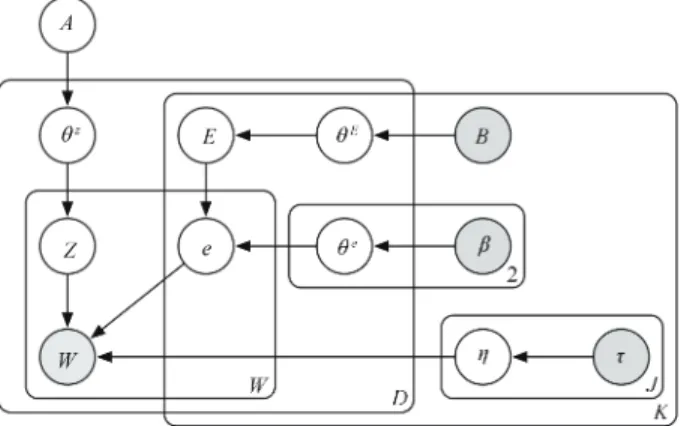
documents, as shown in Figs. 1 and 2. The random variables, parameters, and indexes in these models are listed in Table I for the ease of illustration.
Fig. 1. DWET model for predicting complex text emotions and emotion-topic variation.
Fig. 2. HDWET model with corpus level emotion proportions for predicting complex text emotions and emotion-topic variation.
TABLE I
INDEXES, RANDOMVARIABLES,ANDPARAMETERS
Indexes/variables/ Description parameters
j Index of topic
k Index of emotion category
t Index of word in the vocabulary
i Index of word in a document
d Index of document
J Number of semantic dimensions (topics)
K Number of emotion categories
N Number of words in the vocabulary
D Number of documents in the corpus
Wd Number of words in document d
z Variable of topic
E Variable of document emotion
e Variable of word emotion
w Variable of word
θz Proportion variable in topic distribution
θE Proportion variable in document emotion distribution
θe Proportional variable in word emotion distribution
η Proportional variable in word distribution
φ Concentration variable in document emotion distribution
A Concentration parameter in topic distribution
B Concentration parameter in document emotion distribution
β Concentration parameter in word emotion distribution
τ Concentration parameter in word distribution
α Hyper-parameter in document emotion distribution
A. Model Construction for DWET
The DWET model in Fig. 1 describes a joint probability over the observed word wdi for each document index d ∈
{1, . . . , D} and each word index i ∈ {1, . . . , Wd} throughout a corpus, the semantic dimension value (or topic) zdi for each word, the emotion labels edik of each emotion category k ∈
{1, . . . , K} for each word, the emotion labels Edk of each emotion category for each document, and variables η, θz, θE,
θe, A, B, β, τ as the distribution parameters in the Bayesian model.
Besides, the DWET model describes a series of conditional probabilities over these random variables with directed con-nections as shown in Fig. 1. The observation of a word in wdi given its topic in zdi and corresponding emotions in edi· is assumed to follow a Categorical distribution
wdi|zdi, edi·∼ Categorical(ηzdiedi·) (1)
where ηzdiedi· is the proportional parameter in Categorical
distribution. By arranging the topic variable zdi and the emotion variable edi· as parents to the word variable wdi, we construct a V-structure z → w ← e, in which because the value of the child variable w is observed throughout the corpus, the assignments to z and e falls dependent on each other. This is because that the parent variables, which in the directed V-structure connections could jointly influence the value in the child variable, become inversely influenced by the observations in the child variable and any other par-ent variable through their posterior probabilities. This phe-nomenon is called “explaining away” in the Bayesian model. It allows the observation of a semantic dimension zdi = j in word wdi to affect the distribution of word emotions edi· through the posterior probability p(edi·|wdi, zdi), and therefore makes our emotion recognition depending on the semantic dimensions in the context. Compared to the lexicon-based, rule-based, and knowledge-based emotion inference, in which emotion distributions are represented as p(edi·|wdi, wdj, . . .), our DWET model significantly decreases the complexity in the conditional parts of the emotion probability. In fact, because the model describes a probabilistic connection between the word wdi and topic zdi variables, we can interpret the context semantic information from a vector representation of the topic probabilities [p(zdi = 1), p(zdi= 2), . . .].
The topic variable zdi specifies a semantic dimension in the context of word wdi. We incorporate totally J semantic dimensions in the DWET model, which correspond to a set of discrete values zdi ∈ {1, 2, . . . , J} for the topic assignment. A Categorical distribution is assumed for these discrete topic variables
zdi ∼ Categorical(θdz) (2) where θz
d is the proportional parameter in the Categorical distribution with respect to a specific document d.
The word emotion variable edik ∈ {0, 1} specifies the existence of the kth emotion category in wdi, by taking binary values. We incorporate totally K distinct emotion categories, with k ∈ {1, . . . , K} indexing the specific categories. To analyze the influence of an emotion observation in a document
we connect the document emotion variable Edk to the word emotion variables edik in the DWET model, and assume Bernoulli distribution for the word emotion variable given a document emotion observation
edik|Edk∼ Bernoulli(θedkEdk) (3)
where θe
dkEdk is the proportional parameter in the Bernoulli
distribution with respect to document d, emotion label k, and the observation of document emotion in Edk.
The document emotion variable Edk ∈ {0, 1} is also a binary random variable, which indicates the existence of the
kth emotion category in document d. Emotion categories and
emotion indexes in documents are the same as those in words. We assume Bernoulli distribution for the document emotion variables
Edk∼ Bernoulli(θEdk) (4) with θE
dk as the proportional parameter for document d and emotion label k. Although the word emotion variables ed·k are absent in (4) for the document emotion distribution, the influence from ed·k to Edk still exists in our Bayesian model and is implemented through a Bayesian inference process. In fact, the probabilistic belief in document emotions would be rationally adjusted given the word emotion samples, as will be discussed later.
The DWET model assumption incorporates several propor-tional parameters in η, θz, θe, and θE as shown before. Al-though a direct optimization to these proportional parameters, through Bayesian inference, is feasible for training a model for the document and word emotion predictions, except that the learned values in these parameters might only fit well in the training process but could not adjust properly to new text samples in the real world. One of the advantages in building a Bayesian model is that we can represent the model parameters as random variables and make further assumptions on their distributions. This allows the model to adjust these parameters better, with more flexibility and better robustness in Bayesian inference, for recognizing emotions in the real-world texts. In the DWET model, we assume conjugate priors of the Categorical and Bernoulli likelihoods as the prior probabilities for these proportional parameters, which will simplify the derivation of their posterior probabilities in our Bayesian inference.
Specifically, for the proportional parameter ηjk in (1), we assume Dirichlet distribution
ηjk∼ Dirichlet(τjk) (5) as its prior probability, which is also the conjugate prior of its Categorical likelihood function. τjk is the concentration parameter of this Dirichlet distribution, and j, k are the indexes of topic and emotion in word wdi, respectively. For the proportional parameter θz
din (2), we also assume the Dirichlet distribution as its prior probability, which is the conjugate prior of its Categorical likelihood function
θz
d∼ Dirichlet(A) (6)
A is the concentration parameter of this Dirichlet distribution.
Dirichlet distribution is used to describe the probability of probability mass assignments in the proportional parameters, like θz
d in (6). The proportional parameter θzd can be specified as a set of J probability mass assignments {θz
dj = ˆθzdj|j = 1, . . . , J}, in which each entry ˆθz
djevaluates the probability of observing a topic value in zdi= j, by satisfying the following restrictions J X j=1 ˆ θzdj= 1, ˆθzd·> 0. (7) The Dirichlet distribution in (6) describes a probability density function for the continuous random variables θz
d·. It allows a θz
dj to concentrate on a larger probability mass assignment with a larger concentration parameter Aj, while restricting the probability mass assignments under (7).
For the proportional parameter θe
dkEin (3), we assume Beta distribution
θe
dkEdk ∼ Beta(βkEdk) (8)
as its prior probability, which is also the conjugate prior of its Bernoulli likelihood function. βkEdk is the concentration
parameter in this Beta distribution, while Edkcorresponds to the assignment to the document emotion Edk ∈ {0, 1} with the same document index d and emotion category k. Similarly, for the proportional parameter θE
dk in (4), we also assume the Beta distribution as its prior probability, which is the conjugate prior of its Bernoulli likelihood function
θEdk∼ Beta(Bk) (9)
Bk is the concentration parameter in this Beta distribution. A Beta distribution can be considered as a simple Dirichlet distribution for the binary probability mass assignments. For example, the proportional parameter θE
dk in (4) can be spec-ified with the probability mass assignments of (θE0
dk, θdkE1) = (ˆθE0 dk, ˆθE1dk), in which ˆ θE0 dk + ˆθdkE1= 1, ˆθdkE·> 0. (10) The Beta distribution in (9) describes a probability density function for the continuous random variable θE·
dk. It allows θdkE0 to concentrate on a larger probability mass assignment with a larger concentration parameter Bk, and restrict the probability mass assignments under (10).
All the concentration parameters A, B, β, and τ are constant in our DWET assumption. These parameters are initialized by counting the occurrence and absence of the corresponding categorical variables in the training data. For example, we count the occurrence of document emotion k through the training data for B1
k= P
d1{Edk= 1} and count the absence of document emotion k for B0
k= P
d1{Edk= 0}. We count the occurrence of word emotion k together with document emotion k for β1
kEdk =
P d
P
i1{edik= 1, Edk= 1} and the occurrence of word emotion k with the absence of document emotion k for β0 kEdk = P d P i1{edik = 1, Edk = 0}. Parameter τ is initialized similarly. Because the semantic dimensions are latent even in the training data, we assume their probability masses concentrate equally on the set of discrete values {1, . . . , J}, and employ one value for all the topic concentration parameters Aj= A.
B. Model Construction for HDWET
The HDWET model in Fig. 2 describes a similar proba-bilistic model as DWET, except that we have relaxed the assumption for the document emotion concentration parameter to be constant by incorporating a random variable φk on the corpus-level and by employing αφk in
θdkE ∼ Beta(αφk) (11) as a flexible document emotion concentration parameter. α is a constant hyper-parameter in (11). Because φ is incorporated in the hierarchy of document emotion distribution, we name it the Hierarchical Document and Word Emotion Topic model.
In the previous DWET model, because the corpus-level concentration parameter Bk is constant, all the document emotion proportional parameters θE
dk for different d must have the same probability densities as shown in (9). This corresponds to an implicit assumption that for each emotion category k, the model assumes the same prior probability to observe it in different documents. However, in the real text because the probabilistic concentration of document emotion varies dramatically through different documents, the model needs to adjust itself to all kinds of emotion distributions to properly recognize these document emotions. In the HDWET model, we incorporate the variability in document emotion distribution with a corpus-level concentration parameter αφk, as shown in (11).
We assume Beta distribution for the document emotion concentration parameter φk
φk ∼ Beta(Bk) (12) in which Bk only poses a prior assumption on the emotion dis-tribution and does not directly influence the probabilistic distri-bution for document-level emotions. As a constant parameter,
B is initialized by counting the observation of document
emo-tions through the training data, with B1
k = P
d1{Edk = 1} for the occurrence of emotion k, and B0
k = P
d1{Edk = 0} for the absence of emotion k.
IV. BAYESIANINFERENCE
Bayesian inference estimates the value of a random vari-able based on the Bayes’ theorem, by deriving its posterior probability from the product of its prior and an observation likelihood. For the proposed Bayesian models in this paper, we employ a Gibbs sampling algorithm as the Bayesian inference method, to estimate the values in topic zdi, word emotion
edik, and document emotion Edk, by deriving their posterior probabilities respectively.
Gibbs sampling is an efficient Bayesian inference algorithm, in which samples of the random variables are iteratively drawn from their estimated posterior probabilities in a loop, by freezing the sampled values in other random variables as the observation for their likelihood calculations. The algorithm converges after a few sampling steps, and the posterior prob-ability of each random variable can be estimated by counting the sampling history of this variable.
The Gibbs sampling algorithms for estimating topics and emotions for the DWET model and the HDWET model are
described in Algorithm 1 and Algorithm 2. Both algorithms iteratively draw samples of zdi, edik, and Edk from their posterior probabilities, with the parameter variables including
η, θz, θe, θE in DWET and φ in HDWET collapsed out for sampling efficiency. The sampling steps repeat through
M loops until convergence, which renders a linear time
complexity O(n) for both algorithms. In the following, we illustrate the derivation of posterior probabilities respectively of the topic variable zdi, the word emotion variable edik, and the document emotion variable Edkfor the DWET model and the HDWET model.
Algorithm 1 Gibbs Sampling for DWET Inference 1: for m = 1 → M do 2: for d = 1 → D do 3: for i = 1 → Wddo 4: sample zdiby (13) 5: for k = 1 → K do 6: sample edikby (14) 7: end for 8: end for 9: for k = 1 → K do 10: sample Edkby (15) 11: end for 12: end for 13: end for
Algorithm 2 Gibbs Sampling for HDWET Inference 1: for m = 1 → M do 2: for k = 1 → K do 3: sample φkby (17) 4: end for 5: for d = 1 → D do 6: for i = 1 → Wddo 7: sample zdiby (13) 8: for k = 1 → K do 9: sample edikby (14) 10: end for 11: end for 12: for k = 1 → K do 13: sample Edkby (16) 14: end for 15: end for 16: end for
A. Gibbs Sampling for DWET
We show the derived algebraic expressions of the posterior probabilities in Algorithm 1, with the detailed derivation steps illustrated in Appendix A.
For word i of document d within a corpus1, the posterior
probability of observing a semantic dimension (topic) j, conditioned on the observation of words, emotions, and all
other topics through the corpus are given by p(zdi= j|w, z−di, e, E; A, B, β, τ ) ∝ A + ndj A × J + Wd × Y k∈K1 τ1 kjwdi+ n 1 kjwdi τ1 kj∗+ n1kj∗ × Y k∈K0 τ0 kjwdi+ n 0 kjwdi τ0 kj∗+ n0kj∗ (13) where K1 = {k0|e
dik0 = 1} and K0 = {k0|edik0 = 0}
represent the sets of occurrent and absent of emotion cat-egory in word wdi, ndj =
P
i01{zdi0 = j} counts the
occurrence of topic with the same value as j in docu-ment d, Wd counts the number of words in document d,
n1 kjwdi= P d0 P i01{(ed0i0k, zd0i0, wd0i0) = (1, j, wdi)} counts
the occurrence of word emotion k, topic j, and word with the same value as wdi through the corpus, and n0kjwdi =
P d0
P
i01{(ed0i0k, zd0i0, wd0i0) = (0, j, wdi)} counts the
ab-sence of word emotion k, the occurrence of topic j and word with the same value as wdi through the corpus. “∗” in the subscripts indicates a summation of the variable over the corresponding dimension.
For word i of document d within a corpus, the posterior probability of observing the emotion category k conditioned on the observation of words, topics, and all other emotions through the corpus is given by
p(edik|w, z, e−dik, E; A, B, β, τ )
∝ β1 kEdk+ ndk β1 kEdk+ β 0 kEdk + Wd ×n 1 kzdiwdi+ τ 1 kzdiwdi n1 kzdi∗+ τ 1 kzdi∗ if edik= 1 β0 kEdk+ Wd− ndk β1 kEdk+ β 0 kEdk + Wd ×n 0 kzdiwdi+ τ 0 kzdiwdi n0 kzdi∗+ τ 0 kzdi∗ if edik= 0 (14) where ndk= P
i01{edi0k = 1} counts the occurrence of word
emotion k in document d, while n1
kzdiwdiand n
0
kzdiwdi counts
the same observations as in (13).
For document d in a corpus, the posterior probability of observing emotion category k conditioned on the observation of words, topics, and all other emotions through the corpus is given by p(Edk|w, z, e, E−dk; A, B, β, τ ) ∝ B1 k+ 1 B1 k+ Bk0+ 1 Y i∈Wd p(edik| . . . , Edk= 1, . . . ) if Edk= 1 B0 k+ 1 B1 k+ Bk0+ 1 Y i∈Wd p(edik| . . . , Edk= 0, . . . ) if Edk= 0 (15)
where Wd is the set of word indexes in document d, with the posterior probabilities of word emotion observations in
p(edik| . . . , Edk, . . . ) calculated through (14).
In Algorithm 1, the Gibbs sampler repeatedly draws samples of topic zdi, word emotion edik, and document emotion Edk based on the derived posterior probabilities through (13)−(15), and uses these sampled values to estimate the true posterior
probabilities, until these estimated posterior probabilities get converged. We predict the values in zdi, edik, and Edk by maximizing their estimated posterior probabilities.
B. Gibbs Sampling for HDWET
We illustrate the algebraic expressions for posterior proba-bility calculations in Algorithm 2, with the detailed derivation steps shown in Appendix B.
The HDWET model shares the similar structure and proba-bilistic assumptions with respect to the topic-related distribu-tions and the word emotion-related distribudistribu-tions, as depicted in section III. In fact, the algebraic expressions for posterior probabilities of topics and word emotions are also the same as those in (13) and (14) respectively.
For document d in a corpus, the posterior probability of observing emotion category k conditioned on the observation of words, topics, and all other emotions through the corpus is given by p(Edk|w, z, e, E−dk, φ; A, B, β, τ ) ∝ α ˆφk+ 1 α( ˆφk+¯ˆφk) + 1 Y i∈Wd p(edik| . . . , Edk= 1, . . . ) if Edk= 1 α¯ˆφk+ 1 α( ˆφk+¯ˆφk) + 1 Y i∈Wd p(edik| . . . , Edk= 0, . . . ) if Edk= 0 (16)
where Wd is the set of word indexes in document d, with the posterior probability of word emotion observations in
p(edik| . . . , Edk, . . . ) calculated through (14). ¯ˆφk is the com-plement of ˆφk with ¯ˆφk = 1 − ˆφk, and ˆφk is sampled through its updated posterior probability
φk|w, z,e, E; A, B, β, τ
∼ Beta(B1+ n
k, B0+ D − nk) (17)
nk = P
d01{Ed0k = 1} counts the occurrence of document
emotion k through the corpus.
Similar to the DWET model, the Gibbs sampler in Algo-rithm 2 repeatedly draws samples of topic zdi, word emotion
edik, and document emotion Edk based on the derived pos-terior probabilities through (13), (14), and (16), and estimate their true posterior probabilities based on the sampled values until convergence. Prediction of the values in zdi, edik, and
Edk is made by maximizing their posterior probabilities.
V. EMOTIONRECOGNITIONEXPERIMENT
We examine our Bayesian inference method for textural emotion recognition in blog articles, based on the emotion corpus Ren-CECps [25]. The emotion corpus contains 1, 147 Chinese blog articles collected from Internet, with manually annotated emotion labels for 8 basic emotion categories in the document-level, sentence-level, and word-level, respectively. The basic emotion categories include joy, love, expect, sur-prise, anxiety, sorrow, anger, and hate. And each emotion label has been further distinguished into 10 levels of emotion
intensities according to its emotion strength. The following is an example of emotion-annotated sentence translated from Ren-CECps:
ht0.2|so0.9 I really want to: ex0.6 give up: ht0.3 |so0.6 ! In this example, “want to” indicates a medium (0.6) expect, “give up” implies a low (0.3) hate and a medium (0.6) sorrow, while the complete sentence indicates a low (0.2) hate and a high (0.9) sorrow.
It has to be noted that emotion labels from different cate-gories are not evenly distributed throughout the corpus [33]. In fact, a previous study of the emotion classification for online messages [4] suggests that textual expression of emotions are highly biased, in which love, sorrow, and anxiety are more often observed than surprise and anger. In Ren-CECps, the number of love (over 500) is 1 magnitude larger than the number of surprise (only 90) in the document-level. This makes the textural emotion recognition very difficult for the traditional classifiers, because training a classifier on highly biased data will significantly impact the recall sores for the less common emotion categories.
The emotion corpus is divided into a training set of 917 blog articles and a test set of 230 blog articles. We initialize the concentration parameters A, B, β, τ based on the observation of corresponding categorical variables in the training set, select the model parameter J based on a 5-fold cross validation on the training set, and set the hyper-parameter α to the number of blog articles in each set. We employ precision, recall, and f-score for evaluating the emotion recognition results in emotion category, as defined below
Precision(k) = tpk
tpk+ f pk (18)
Recall(k) = tpk
tpk+ f nk (19)
F-score(k) = 2 × Precision(k) × Recall(k)
Precision(k) + Recall(k) (20)
where k indicates the emotion category, tpk, f pk, and f nk count the number of true positive, false positive, and false negative predictions in the result for emotion category k. We compare the results from the DWET and HDWET models, perform further comparisons with those from the state-of-the-art emotion prediction algorithms, and demonstrate the learned connection between emotion categories and latent semantic dimensions for specific words in the blog articles.
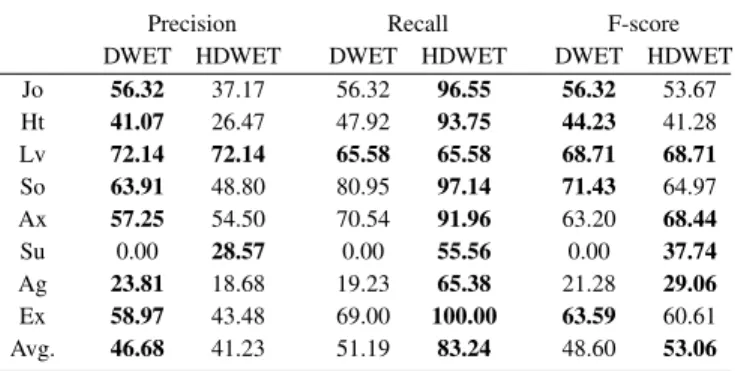
The detailed results of emotion prediction from the DWET and HDWET models are shown in Tables II and III for the document-level and word-level emotion recognition, respec-tively. Jo, Lv, Ex, Su, Ax, So, Ag, and Ht are the abbreviations for the emotions of joy, love, expect, surprise, anxiety, sorrow, anger, and hate, while Ne indicates a none emotion which only occurs in the word emotion prediction.
TABLE II
EVALUATION OF THEDOCUMENTEMOTIONPREDICTION
Precision Recall F-score
DWET HDWET DWET HDWET DWET HDWET
Jo 56.32 37.17 56.32 96.55 56.32 53.67 Ht 41.07 26.47 47.92 93.75 44.23 41.28 Lv 72.14 72.14 65.58 65.58 68.71 68.71 So 63.91 48.80 80.95 97.14 71.43 64.97 Ax 57.25 54.50 70.54 91.96 63.20 68.44 Su 0.00 28.57 0.00 55.56 0.00 37.74 Ag 23.81 18.68 19.23 65.38 21.28 29.06 Ex 58.97 43.48 69.00 100.00 63.59 60.61 Avg. 46.68 41.23 51.19 83.24 48.60 53.06 TABLE III
EVALUATION OF THEWORDEMOTIONPREDICTION
Precision Recall F-score
DWET HDWET DWET HDWET DWET HDWET
Ne 94.73 95.04 99.58 99.51 97.09 97.22 Jo 81.41 78.02 28.07 29.81 41.74 43.13 Ht 82.42 79.25 16.11 22.63 26.96 35.21 Lv 82.72 82.67 55.39 56.31 66.35 66.99 So 82.70 80.89 44.37 47.95 57.75 60.21 Ax 75.23 74.44 29.83 33.43 42.72 46.13 Su 100.00 85.71 1.33 2.67 2.63 5.17 Ag 76.92 88.57 2.78 8.61 5.36 15.70 Ex 79.86 77.94 20.84 23.60 33.05 36.23 Avg. 84.00 82.50 33.14 36.06 41.52 45.11
For document-level emotion recognition, we find that on average the DWET model achieves better precision than the HDWET model, while the HDWET model renders better Recalls than the DWET model. This can be explained by the fact that the variability in probability mass concentration pa-rameter αφ makes the HDWET model easier to generate more positive labels for the less common emotion categories during inference. For example, Surprise is a rare document emotion compared to the other emotions, which is only observed 90 times in 1,147 blog articles in Ren-CECps. During inference, the concentration parameter variable αφSurprise grows larger
than the static concentration parameter BSurprise, which makes
the posterior probability of EdSurprise = 1 in (16) larger than that in (15), and therefore enables the HDWET model to recognize more surprise labels (with a higher recall score) than the DWET model. For the common emotion categories such as love, which is observed over 500 times in 1,147 blog articles, the HDWET model still performs as well as the DWET model for generating the positive labels. This result indicates that the incorporated flexibility in document emotion concentration in the HDWET model has effectively improved the robustness for document emotion recognition. It has to be noticed that although the HDWET model achieves an average lower precision score than the DWET model, in some specific emotion categories such as love and surprise the HDWET model still renders the same or even better precision scores than the DWET model. Considering the f-score as a balanced evaluation, the HDWET model outperforms the DWET model in the document-level emotion recognition.
For word-level emotion recognition, we find that both models achieve promising results for recognizing the Ne label,
which in fact is the most common label for word emotion. On average, the DWET model achieves higher precision scores, while the HDWET model renders higher recall scores. The result suggests that with Bayesian inference, the flexibility in document emotion concentration not only has increased the belief in observing the less common emotion categories in documents but also has flowed through the directed connection
E → e under the probabilistic assumption in (3) to impact the
belief for observing the same word emotions in the HDWET model. For the common emotion category such as love and sorrow, the recall scores from HDWET are still better than those from DWET, indicating that a flexible concentration parameter in the document emotion distribution could effec-tively improve the robustness for word emotion recognition. By considering the f-score as a balanced evaluation, we find the HDWET model also outperforms the DWET model for word-level emotion recognition.
We plot the time complexity of Gibbs sampling algorithms in Fig. 3, in terms of the number of input documents, for two hundred sampling iterations of the DWET and HDWET inference respectively. Our results suggest that inference time of both algorithms grows linearly with respect to the size of evaluation data, and that the DWET and HDWET models render very little difference in the time complexity.
Fig. 3. Time complexity of Gibbs sampling algorithms for Algorithm 1 and Algorithm 2 in terms of document number.
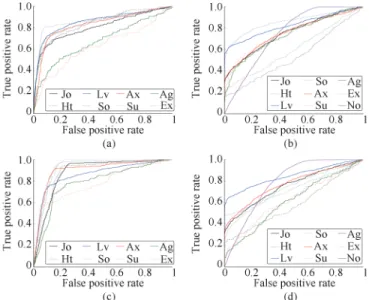
We plot the receiver operating characteristic (ROC) curves in Fig. 4 for the results of document emotion prediction and word emotion prediction, in terms of DWET and HDWET respectively. A comparison of Figs. 4 (a) and (b) suggests that the HDWET model could significantly improve the robustness of document emotion classification, especially for the rare emotion categories, e.g., surprise and anger, in contrast to the DWET model. By comparing Figs. 4 (b) and (d), we find that the DWET model outperforms the HDWET model in the robustness of emotion classification for sorrow and surprise, while the HDWET model could generate robust classification results for more difficult emotion categories like hate and expect with properly selected thresholds.
Next, we compare our Bayesian models with the state-of-the-art emotion prediction algorithms for the document-level
and word-level emotion recognition respectively, as shown in Figs. 5 and 6, based on the Precision scores. The naive Bayesian (NB) and SVM classifiers are employed as the base-line models for the document emotion recognition, and the hidden Markov models (HMM) and conditional random fields (CRF) are employed as the base-line models for the word emotion recognition. For the document-level emotion recognition in Fig. 5, we find that the NB classifier performs slightly better than the SVM classifier, with the average precisions of 30.54 % and 28.41 %, respectively. Our DWET and HDWET models perform much better than the base-line models, with the average precisions of 46.68 % and 41.23 %, respectively. For word-level emotion recognition in Fig. 6, the experiment results suggest that the CRF model performs slightly better than the HMM model, with the averaged precisions of 63.46 % and 62.20 %, respectively. Compared with the base-line models, our DWET and HDWET models render much better results for word emotion recognition, with
Fig. 4. ROC curves for document emotion prediction (a, c) and word emotion prediction (b, d) in terms of the DWET model (a, b) and the HDWET model (c, d).
the average precisions of 84.00 % and 82.50 %, respectively. These comparisons suggest that, our Bayesian models by incorporating the latent semantic dimensions as the context of words have generated a much simpler representation of emotions in the natural language expression, which helps the models to fit more easily than the dictionary feature based models.
Fig. 6. Word emotion precisions from HMM, CRF, DWET, and HDWET.
Fig. 7 demonstrates the knowledge of emotion in natural language expression with respect to the semantic dimensions (topics), in the form of an emotion-topic diagram. The knowl-edge is learned with the HDWET model. We connect words to
their most significant semantic dimensions (T1, . . . , T9), and attach these semantic dimensions to their related emotions, and denote the connection strengths denoted on the edges. The node colors specify the category of a node. For example, all word nodes related to the same topic together with this topic node share the same color. An emotion node shares the same color with its most strongly connected topic node. With this emotion-topic diagram, we can easily tell the connection between words, semantic dimensions, and emotions. For ex-ample, words like “convalesce” and “fall behind” in their most significant semantic dimension T3 are strongly connected to the emotion of sorrow. Words in the emotion-topic diagram are not necessarily the emotional words in traditional definition, because we are generalizing the knowledge of emotion expres-sion from manual annotations to the more general language expressions.
The knowledge of emotion expression with respect to the semantic dimensions has been learned through the V-structure of z → w ← e in both models. The “explaining away” phenomenon allows topic z to directly influence the posterior probabilities of emotion labels e through (14), and enables the reverse influence from word emotion samples e to the posterior probabilities of topics z through (13). The models could therefore recognize the emotion labels e in the same word with different semantic dimensions z, which promises an improved precision, and associate each semantic dimension
z with a specific distribution of emotions e, which generalize
the basic knowledge of emotion with respect to many general natural language expressions to improve the recall.
VI. CONCLUSION
In this paper, we propose two Bayesian models DWET and HDWET for exploring the latent semantic dimensions as the context in natural language, and for learning the knowledge of emotion expressions with respect to these semantic dimen-sions. The basic idea is that probabilistic influence could flow between emotions and topics in Bayesian inference through a V-structure in the models, in which the emotion variable
e and the topic variable z are located as two parents of the
observed word variable w. Because each discrete value in topic
z represents a specific context semantic dimension for the
associate word w, the probabilistic distribution over topics in Bayesian inference corresponds to a vector representation of the probabilities over different context semantic dimensions, which allows the models to distinguish words under different contexts and effectively improves the emotion recognition results. Our experiment of the document-level and word-level emotion predictions, based on the Chinese emotion cor-pus Ren-CECps, demonstrates a promising improvement for emotion recognition compared to the state-of-the-art emotion recognition algorithms. The DWET model outperforms all base-line algorithms for word and document emotion predic-tions. And the HDWET model, with a flexible concentration parameter φ injected in the hierarchy of corpus-level document emotion distribution, allows a self-adjustment of emotion distributions through different documents, and significantly improves emotion recognition for the less common emotion categories with even better Recalls and F-scores compared to the DWET model. We demonstrate the knowledge of emotion expression with respect to latent semantic dimensions through an emotion-topic diagram. By explicitly connecting semantic indexes with emotion categories and the closely related words, the diagram makes it easier to understand the semantic meanings in most general words and their underlying connections to the human emotions.
Our Bayesian models have simplified the language features for textual emotion recognition, by representing the word context with latent semantic dimensions and by associating emotion categories with the word contexts in a low dimen-sional feature space. However, our features could be somehow over-simplified because the context information in natural language expressions is still richer than the discrete semantic dimensions which we can maximally afford in our models. If we set too many semantic dimensions in the model, the probabilistic influence would flow wildly and the Bayesian inference could never converge. Another promising direction for exploring the rich context semantic information is through a deep neural network with multi-layer abstractions. The neurons are very different from our topic variables in that they do not separately (or linearly) represent semantic dimensions, but can be combined together to specify one point in a large semantic space, whose dimension is exponential to the number of neurons. In this sense, we would like to employ the deep neural networks for learning emotion expressions in natural language with a better semantic representation in our future work.
APPENDIXA
DERIVINGPOSTERIORPROBABILITIES FORDWET
The Bayes’ theorem suggests that for a random variable x its posterior probability is proportional to the product of its prior probability and likelihood of other related observations in y. For a complicated Bayesian model, often there are many other variables which are not directly involved in the Bayesian inference, for which we use o to represent. We employ the following equation to represent the Bayes’ theorem with the non-directly involved variables on the condition part
p(x|y, o) ∝ p(x|o) × p(y|x, o). (21) We illustrate the posterior probability derivations based on this equation.
In Section III, we make assumptions of conjugate prior probabilities for the proportional parameters, to simplify our Bayesian inference. This is because that with these conjugate prior probabilities, we can have a closed-form expression of their posterior probabilities after observing values in the related variables. For example, the proportional parameter
θE
dk in (9) is assumed a Beta prior probability, which is the conjugate prior of its Bernoulli likelihood function in (4). After observing E through the documents in the test set, we can have posterior probability of θE dk in a closed-form θE dk|E; B ∼ Beta(Bk+ nk) ∼ Beta(B1 k+ n1k, Bk0+ n0k) (22) in which nk = (n1k, n0k) counts the occurrence and absence of document emotion k in this set.
The topic variable zdi, which specifies a semantic dimension for word wdi, has its posterior probability factorized by following the Bayes’ theorem
p(zdi|w,z−di, e, E; A, B, β, τ )
∝p(zdi|w−di, z−di, e, E; A, B, β, τ )
× p(wdi|w−di, z, e, E; A, B, β, τ ) (23) in which “−” on the subscript indicates the set of all variables except the one specified with the subscript. zdi in (23) corre-sponds to the variable of interest x in (21), wdi corresponds to the related observation y, and the rest variables of w−di,
z−di, e, and E correspond to o. A, B, β, and τ are parameters in these probabilistic distributions.
We follow the categorical distribution assumption for the topic variable zdi in (2), and interpret the value of the first factor in (23)
p(zdi|w−di, z−di, e, E; A, B, β, τ ) = θdiz. (24) The proportional parameter variable θz
di can be inferred through its posterior probability after observing zd in docu-ment d
θz
di|zd; A ∼ Dirichlet(A + ndzdi) (25)
in which ndzdi =
P
i01{zdi0 = zdi} counts the occurrence
of topic with the same value as zdi. This is because the prior probability Dirichlet for θz in (6) is the conjugate prior of its categorical likelihood function in (2), and we can simply update the parameters in Dirichlet to get its posterior probability. By taking the expectation of θz as defined in (25)
to (24), we derive the algebraic expression for the first factor of topic posterior probability in (23)
p(zdi|w−di, z−di, e, E; A, B, β, τ ) = A + ndzdi
A × J + Wd (26) in which Wd= nd∗ is the number of words in document d.
Similarly, by following the assumption of Categorical dis-tribution for the word variable wdi in (23), we can derive the algebraic expression for the second factor in (23)
p(wdi|w−di, z, e, E; A, B, β, τ ) = ηedi·zdiwdi= Y k∈K1 di ηkz1 diwdi Y k∈K0 di ηkz0diwdi (27) in which K1 = {k|e
dik = 1} and K0 = {k|edik = 0} represent the sets of occurrence and absence of emotion category k in word wdi. We assume that different emotion categories can independently influence the observation of a word, and factorize the probability in (27) over emotion category k based on this assumption. η in (27) can be inferred through its posterior probability after observing w, z, and e through a set of documents
η1|0kzdiwdi|w, z, e; τ ∼ Dirichlet(τkz1|0diwdi+ n1|0kzdiwdi) (28) n1 kzdiwdi = P d0 P i01{(ed0i0, zd0i0, wd0i0) = (1, zdi, wdi)}
counts the occurrence of word emotion k, topic and word with the same values as zdi and wdi, while n0kzdiwdi =
P d0
P
i01{(ed0i0, zd0i0, wd0i0) = (0, zdi, wdi)} counts the
ab-sence of word emotion k but the occurrence of topic and word with the same value as zdi and wdi. A replacement of η in (27) with its expectation in (28) gives the algebraic expression for the first factor of topic posterior probability in (23)
p(wdi|w−di, z, e, E; A, B, β, τ ) = Y k∈K1 τ1 kzdiwdi+ n 1 kzdiwdi τ1 kzdi∗+ n 1 kzdi∗ Y k∈K0 τ0 kzdiwdi+ n 0 kzdiwdi τ0 kzdi∗+ n 0 kzdi∗ (29) in which “∗” indicates a summation over the corresponding dimension.
We take (26) and (29) into (23) to derive the algebraic expression of the posterior probability of topic variable zdi in (13).
Next, we factorize the posterior probability of word emotion variable edik by following the Bayes’ theorem
p(edik|w, z, e−dik, E; A, B, β, τ )
∝p(edik|w−di, z, e−dik, E; A, B, β, τ )
× p(wdi|w−di, z, e, E; A, B, β, τ ) (30) in which edik corresponds to the variable of interest x in (21), wdi corresponds to the related observation y, and the rest variables w−di (all words except wdi), z, e−dik, and E corresponds to o. A, B, β, and τ are parameters in these probabilistic distributions.
We follow the Bernoulli distribution assumption for the word emotion variable edikin (3), and interpret the probability value of the first factor in (30)
p(edik|w−di, z, e−dik, E; A, B, β, τ ) = θedkEdk (31)
in which θe
dkEdk can be inferred through its posterior
proba-bility after observing the document emotion and other word emotions in document d
θe
dkEdk|Edk, ed·k; β ∼ Beta(βkEdk+ ndk). (32)
This is because the prior probability Beta for θe in (8) is the conjugate prior of its Bernoulli likelihood function in (3). And because θe is a document-level variable as shown in Fig. 1, we can simply update its parameters with observations in the specific document d to get its posterior probability. In (32), ed·k corresponds to all the word emotion labels in document d and emotion category k, ndk=
P
i01{edi0k = 1}
counts the occurrence of word emotion k in document d. A replacement of θe in (31) with its expectation in (32) gives the algebraic expression for the first factor of word emotion posterior probability in (30)
p(edik|w−di, z, e−dik, E; A, B, β, τ )
= β1 kEdk + ndk β1 kEdk+ β 0 kEdk+ Wd , if edik= 1 β0 kEdk+ Wd− ndk β1 kEdk+ β 0 kEdk+ Wd , if edik= 0 (33)
in which Wd is the number of words in document d, and
Wd− ndkcorresponds to the absent count of word emotion k in document d.
The second factor in (30) is exactly the same as that in (23), whose derivation can be found in (27). We extend its expression by extracting the emotion category k out of the product for the convenience of later derivation, which gives
p(wdi|w−di, z, e, E; A, B, β, τ ) = η1 kzdiwdi× Y k0∈K1/k η1 k0z diwdi Y k0∈K0 η0 k0z dkwdi if edik= 1 η0 kzdiwdi× Y k0∈K1 η1 k0z diwdi Y k0∈K0/k η0 k0z dkwdi if edik= 0 ∝ n1 kzdiwdi+ τ 1 kzdiwdi n1 kzdi∗+ τ 1 kzdi∗ , if edik= 1 n0 kzdiwdi+ τ 0 kzdiwdi n0 kzdi∗+ τ 0 kzdi∗ , if edik= 0 (34)
in which K1/k and K0/k represent the sets of occurred
and absent emotion categories k0 in word w
di except k, respectively. Because the products over K1 and K0 except
k turn to be the same regardless of the assignment in edik in (34), we could take them out to simplify the calculation.
We take (33) and (34) into (30) to derive the algebraic ex-pression of the posterior probability of word emotion variable
Finally, we factorize the posterior probability of document emotion variable Edkby following the Bayes’ theorem
p(Edk|w, z, e, E−dk; A, B, β, τ )
∝p(Edk|w, z, e−d·k, E−dk; A, B, β, τ )
× p(ed·k|w, z, e−d·k, E; A, B, β, τ ). (35) We follow the Bernoulli distribution assumption for the document emotion variable Edk in (4), and interpret the probability value of the first factor in (35)
p(Edk|w, z, e−d·k, E−dk; A, B, β, τ ) = θEdk (36) in which θE
dk can be inferred through its posterior probability after observing the document emotions as described in (22). A replacement of θE
dkin (36) with its expectation in (22) gives the algebraic expression for the first factor of document emotion posterior probability in (35) p(Edk|w, z, e−d·k, E−dk; A, B, β, τ ) = B1 k+ 1 B1 k+ B0k+ 1 , if Edk= 1 B0 k+ 1 B1 k+ B0k+ 1 , if Edk= 0. (37)
As illustrated in the derivation of (27), we assume that different emotion categories are independent, and gives the factorized production of the second factor in (35)
p(ed·k|w, z, e−d·k, E; A, B, β, τ )
= Y
i∈Wd
p(edik|w, z, e−dik, E; A, B, β, τ ). (38) We take (37) and (38) into (35) to derive the algebraic expression of the posterior probability of document emotion variable Edk in (15).
APPENDIXB
DERIVINGPOSTERIORPROBABILITIES FORHDWET
The posterior probabilities for topic variable zdi and word emotion variable edik in the HDWET model are the same as those in the DWET model. For the document emotion variable
Edk, we factorize its posterior probability by following the Bayes’ theorem to get
p(Edk|w, z, e, E−dk, φ; A, B, β, τ )
∝p(Edk|w, z, e−d·k, E−dk, φ; A, B, β, τ )
× p(ed·k|w, z, e−d·k, E, φ; A, B, β, τ ). (39) For the first factor in (39), we derive the same algebraic expression for the prior probability of document emotion Edk as (36), but derive the expectation of θE
dkdifferently as follows. Because the proportional parameter θE
dkfor document emotion distribution in the HDWET model follows the Beta distribution with a flexible concentration parameter αφk in (11), we infer its poster probability from the samples ˆφk of the concentration parameter φk.
In the model construction for HDWET, the flexible concen-tration variable φk is assumed to follow the Beta distribution in (12). Because its related observation in document emotion
variable Edk follows the Bernoulli distribution in (4), the posterior probability of φk can be derived with a closed-form expression with corresponding distribution parameters
Bk updated as in (17). We take the sampled values of ˆφk for variable φk to have the algebraic expression for the first factor in (39) p(Edk|w, z, e−d·k, E−dk, φ; A, B, β, τ ) = α ˆφk+ 1 α( ˆφk+¯ˆφk) + 1 , if Edk= 1 α¯ˆφk+ 1 α( ˆφk+¯ˆφk) + 1 , if Edk= 0. (40)
For the second factor in (39), because word emotion vari-ables ed·k shares the same model structure and probabilistic assumptions in HDWET and DWET, the derivation of its posterior probability turns to be the same as that of the DWET model, which gives
p(ed·k|w, z, e−d·k, E, φ; A, B, β, τ )
= Y
i∈Wd
p(edik|w, z, e−dik, E, φ; A, B, β, τ ). (41) We take (40) and (41) into (39) to derive the algebraic ex-pression of the posterior probability of the document emotion variable Edk for the HDWET model in (16).
REFERENCES
[1] H. Gunes and B. Schuller, “Categorical and dimensional affect analysis in continuous input: Current trends and future directions,” Image Vision
Comput., vol. 31, no. 2, pp. 120−136, Feb. 2013.
[2] J.-C. Lin, C.-H. Wu, and W.-L. Wei, “Error weighted semi-coupled hidden Markov model for audio-visual emotion recognition,” IEEE
Trans. Multimedia, vol. 14, no. 1, pp. 142−156, Feb. 2012.
[3] S. Scherer, M. Glodek, G. Layher, M. Schels, M. Schmidt, T. Brosch, S. Tschechne, F. Schwenker, H. Neumann, and G. Palm, “A generic frame-work for the inference of user states in human computer interaction,” J.
Multimodal User Interfaces, vol. 6, no. 3−4, pp. 117−141, Nov. 2012.
[4] F. J. Ren, X. Kang, and C. Q. Quan, “Examining accumulated emotional traits in suicide blogs with an emotion topic model,” IEEE J. Biomed.
Health Inform., vol. 20, no. 5, pp. 1384−1396, Sep. 2016.
[5] H. Mo, J. Wang, X. Li, and Z. L. Wu, “Linguistic dynamic modeling and analysis of psychological health state using interval type-2 fuzzy sets,” IEEE/CAA J. Automat. Sin., vol. 2, no. 4, pp. 366−373, Oct. 2015. [6] L. Bylsma, B. H. Morris, and J. Rottenberg, “A meta-analysis of emotional reactivity in major depressive disorder,” Clin. Psychol. Rev., vol. 28, no. 4, pp. 676−691, Apr. 2008.
[7] G. Domes, L. Schulze, and S. C. Herpertz, “Emotion recognition in borderline personality disorder-a review of the literature,” J. Pers.
Disord., vol. 23, no. 1, pp. 6−19, Feb. 2009.
[8] K. A. Lindquist, T. D. Wager, H. Kober, E. Bliss-Moreau, and L. F. Barrett, “The brain basis of emotion: a meta-analytic review,” Behav.
Brain Sci., vol. 35, no. 3, pp. 121−143, Jun. 2012.
[9] J. T. Buhle, J. A. Silvers, T. D. Wager, R. Lopez, C. Onyemekwu, H. Kober, J. Weber, and K. N. Ochsner, “Cognitive reappraisal of emotion: a meta-analysis of human neuroimaging studies,” Cereb. Cortex, vol. 24, no. 11, pp. 2981−2990, Nov. 2014.
[10] C. H. Yang, K. H. Y. Lin, and H. H. Chen, “Emotion classification using web blog corpora,” in Proc. IEEE/WIC/ACM Int. Conf. Web Intelligence, Fremont, CA, 2007, pp. 275−278.
[11] R. Tokuhisa, K. Inui, and Y. Matsumoto, “Emotion classification us-ing massive examples extracted from the web,” in Proc. 22nd Int.
Conf. Computational Linguistics, Manchester, United Kingdom, 2008,
pp. 881−888.
[12] I. Maks and P. Vossen, “A verb lexicon model for deep sentiment analysis and opinion mining applications,” Proc. 2nd Workshop on
Com-putational Approaches to Subjectivity and Sentiment Analysis, Portland,
Oregon, USA, 2011, pp. 10−18.
[13] S. M. Mohammad and T. Yang, “Tracking sentiment in mail: How gen-ders differ on emotional axes,” Proc. 2nd Workshop on Computational
Approaches to Subjectivity and Sentiment Analysis, Portland, Oregon,
USA, 2011, pp. 70−79.
[14] A. Balahur, J. M. Hermida, and A. Montoyo, “Detecting implicit expressions of emotion in text: A comparative analysis,” Decis. Support
Syst., vol. 53, no. 4, pp. 742−753, Nov. 2012.
[15] W. Y. Li and H. Xu, “Text-based emotion classification using emotion cause extraction,” Expert Syst. Appl., vol. 41, no. 4, pp. 1742−1749, Mar. 2014.
[16] S. Matsumoto, H. Takamura, and M. Okumura, “Sentiment classification using word sub-sequences and dependency sub-trees,” in Advances in
Knowledge Discovery and Data Mining, T. B. Ho, D. Cheung, and H.
Liu, Eds. Hanoi, Vietnam: Springer, 2005, pp. 301−311.
[17] T. Kudo and Y. Matsumoto, “A boosting algorithm for classification of semi-structured text. in Proc. 2004 Conf. Empirical Methods in Natural
Language Processing, Barcelona, Spain, 2004, pp. 301−308.
[18] C. H. Yang, K. H. Y. Lin, and H. H. Chen, “Building emotion lexicon from weblog corpora,” in Proc. 45th Annu. Meeting of the ACL on
Interactive Poster and Demonstration Sessions, Prague, Czech Republic,
2007, pp. 133−136.
[19] N. Kobayashi, K. Inui, Y. Matsumoto, K. Tateishi, and T. Fukushima, “Collecting evaluative expressions for opinion extraction,” in Proc. 1st
Int. Joint Conf. Natural Language Processing, Hainan Island, China,
2004, pp. 596−605.
[20] H. Teramura, “Japanese syntax and meaning,” Kurosio Publishers, 1982. [21] X. Hu, J. S. Downie, and A. F. Ehmann, “Lyric text mining in music mood classification,” in Proc. 10th Int. Society for Music Information
Retrieval Conf., Kobe, Japan, 2009, pp. 411−416.
[22] C. Strapparava and A. Valitutti, “WordNet-affect: an affective extension of wordNet,” in Proc. 4th Int. Conf. Language Resources and Evaluation, Lisbon, Portugal, 2004, pp. 1083−1086.
[23] P. Singh, “The public acquisition of commonsense knowledge,” in Proc.
AAAI Spring Symposium: Acquiring (and Using) Linguistic (and World) Knowledge for Information Access, Palo Alto, CA, 2002.
[24] H. Liu, H. Lieberman, and T. Selker, “A model of textual affect sensing using real-world knowledge,” in Proc. 8th Int. Conf. Intelligent User
Interfaces, Miami, Florida, USA, 2003, pp. 125−132.
[25] C. Q. Quan and F. J. Ren, “A blog emotion corpus for emotional expression analysis in Chinese,” Comput. Speech Lang., vol. 24, no. 4, pp. 726−749, Oct. 2010.
[26] S. Aman and S. Szpakowicz, “Identifying expressions of emotion in text,” in Text, Speech and Dialogue, V. Matouˇsek and P. Mautner, Eds. Pilsen, Czech Republic: Springer, 2007, pp. 196−205.
[27] X. Kang, F. J. Ren, and Y. N. Wu, “Semisupervised learning of author-specific emotions in micro-blogs,” IEEJ Trans. Electrical & Electronic
Eng., vol. 11, no. 6, pp. 768−775, Nov. 2016.
[28] Y. N. Wu, K. Kita, F. J. Ren, K. Matsumoto, and X. Kang, “Modification relations based emotional keywords annotation using conditional random fields,” in Proc. 4th Int. Conf. Intelligent Networks and Intelligent
Systems, Kunming, China, 2011, pp. 81−84.
[29] Y. N. Wu, K. Kita, F. J. Ren, K. Matsumoto, and X. Kang, “Exploring emotional words for Chinese document chief emotion analysis,” in
Proc. 25th Pacific Asia Conf. Language, Information and Computation,
Singapore, 2011, pp. 597−606.
[30] D. Das and S. Bandyopadhyay, “Word to sentence level emotion tagging for Bengali blogs,” in Proc. ACL-IJCNLP 2009 Conf. Short Papers, Suntec, Singapore, 2009, pp. 149−152.
[31] X. Kang, F. J. Ren, and Y. N. Wu, “Bottom up: Exploring word emotions for Chinese sentence chief sentiment classification,” in Proc. 2010 Int.
Conf. Natural Language Processing and Knowledge Engineering (NLP-KE), Beijing, China, 2010.
[32] X. Kang and F. J. Ren, “Sampling latent emotions and topics in a hierar-chical Bayesian network,” in Proc. 2011 7th Int. Conf. Natural Language
Processing and Knowledge Engineering (NLP-KE), Tokushima, 2011,
pp. 37−42.
[33] F. J. Ren and X. Kang, “Employing hierarchical Bayesian networks in simple and complex emotion topic analysis,” Comput. Speech Lang., vol. 27, no. 4, pp. 943−968, Jun. 2013.
Xin Kang (M’16) received the Ph.D degree from Tokushima University, Tokushima, Japan, in 2013, the M.E. degree from Beijing University of Posts and Telecommunications, Beijing, China, in 2009, and the B.E. degree from Northeastern University, Shenyang, China, in 2006. He is currently an Assis-tant Professor in Tokushima University, Japan. His research interests include statistical machine learn-ing, probabilistic graphical models, neural networks, and text emotion prediction.
Fuji Ren (SM’03) was born in 1959, in China. He received the B.E. and M.E. degrees from Bei-jing University of Posts and Telecommunications, Beijing, China, in 1982 and 1985, respectively. He received his Ph.D. degree in 1991 from Hokkaido University, Japan. From 1991, he worked at CSK, Japan, where he was a Chief Researcher of NLP. From 1994 to 2000, he was an Associate Professor in the Faculty of Information Sciences, Hiroshima City University. He became a Professor in the Faculty of Engineering of the University of Tokushima, Japan, in 2001. His research interests include natural language processing, artificial intelligence, language understanding and communication, and affective com-puting. He is a Member of IEICE, CAAI, IEEJ, IPSJ, JSAI, and AAMT. He is a Fellow of the Japan Federation of Engineering Societies. He is the President of the International Advanced Information Institute.
Yunong Wu received the Ph. D degree and Mas-ter degree from The University of Tokushima, Tokushima, Japan, in 2014 and 2011, respectively. He is currently an Assistant Professor in Tokushima University, Japan. His research interests include sta-tistical machine learning, affective information com-puting, neural network and probabilistic graphical model.