
Myodocopina亜目のカイミジンコBathyleberis yamadaiの生活史について
5
0
0
全文
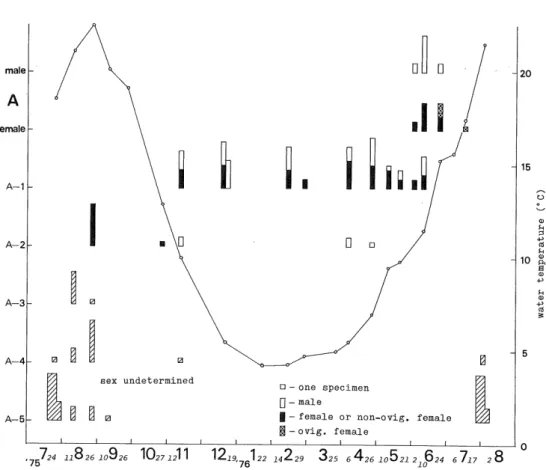
(2) Journal of Hokkaido University of Education (Section II B) Vol. 33, No. 2. March,1983. ^ffi^K^^ (IS2gISB) ^33^. ^2-f. Hgffi 58 ^ 3 J1. Notes on the Life History of Bathyleberis yamadai Hiruta (Ostracoda: Myodocopina). Shinlchi HIRUTA Biological Laboratory, Kushiro College, Hokkaido University of Education, Kushiro 085. Myodocopina ;t£§c7)7t7^ ^^>=3 Bathyleberis yamadai c7)^^^t'l-^v'*~C. Am?n±^mw^.w^M. Our knowledge of the life history of the. ^'0. myodocopid ostracod is still, poor, though some workers have reported the life history of several. Okhotsk Sea. Japan Sea. species (Elofson, 1941; Okada and Kato, 1946, 1949; Nakamura, 1954; Hulings, 1969; Baker, 1977; Hiruta, 1980). The present paper deals with the. Oshoro Bay. life history of Batkyleberis yamadai Hiruta, 1979, together with some biological observations.. Otaru •. Sapporo. Specimens were collected from the bottom sediment of sand or muddy sand (0—5 m depth). v. sampled at Oshoro, a small inlet on the west coast of Hokkaido (Fig. 1), during a period from July, 1975 to August, 1976.. ^. Pacific Ocean. Fig. 1. Location of Oshoro Bay.. Life history One hundred and ninety-three individuals of B. yamadai were collected during the period when collections were made. Fig. 2 shows the seasonal occurrence of the successive develop-. mental stages (with regard to the determination of the stages and sex, see Hiruta, 1979) and the seasonal change of water temperature. The occurrence of adults of both sexes, as shown in. the figure, exhibited a clear seasonality, and it was detected that all the A—l instar larvae. (7).
(3) 74. Shinlchi HIRUTA. 20. mate. A female. 15 A-1. A-2|. 10. A-31. A^ a - one specimen Q - male I - female or non-ovig. female. A-5|-. §-ovig. female. 24 11^2610-^26 1U272211 T2.l9,^^\ 22 14^-29 ^25 6 ^-26 2o5 21 2 .624 6 7^7 28 10. Fig. 2. Seasonal occurrence of the developmental stages of Bathyleberis yamadai on the basis of 193 specimens.. collected on and after 21th May, 1976 showed signs of malting. These facts and the seasonal distribution of each stage suggest that the present species has only one generation per year. That is to say, A—5 instar larvae hatched in the summer develop into at least A—2 instar before winter comes. All the A—2 larvae gradually develop into A—l instar before the arrival of the next summer, and all the A—l larvae develop into adults during the breeding season. Then, after the breeding season, the adults die. Thus one generation lasts only from one summer to the next.. Hulings (1969) reported the life history of Parasterope polex Kornicker, 1967 (Subfamily Cylindroleberidinae) from Hadley Harbor, Massachusetts, and concluded on the basis of the shell size that this species has also only one generation per year, and that adult females were present throughout the year. Hiruta (1979) pointed out that the determination of the developmental stages is difficult to judge only by the shell size in B. yamadai, as is probably the case with some of the other members of the subfamily Cylndroleberininae. As described later in the length-height distribution of each stage of B. yamadai, male A—l instar larvae, whose shell shape is almost the same as in adult female, are somewhat smaller than adult females. If P.. polex shows a similar size distribution as B. yamadai, adult females of P. polex reported by Hulings might contain male A—l instar larvae, and the range of occurrence of adult females. (8).
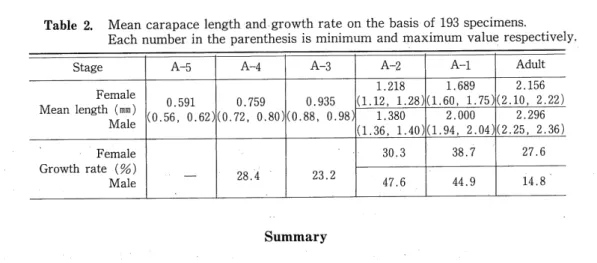
(4) 75. Life history of Bathyleberis yamadai. might be different. Therefore, for precise identification of the stages, it is necessary to examine the appendage morphology, as Rulings has also pointed out.. Biological notes 1) Table 1 shows the total number of males and females in each stage. In some myodocopid ostracods, the male population seems to be initially smaller than that of the female, because the number of adult males collected is too small in comparison with that of adult female. However, in the present species, as is clear from the table, it seems that the sex ratio. is about 1:1. 2 ) The length-height distribution of each stage is shown in Fig. 3. In the present study, as has been reported in the previous paper (Hiruta, op. cit), sexual dimorphism was detected in the shell size of the A—2 instar—adult stage. The mean length of carapace and the growth rate against each previous stage are given in Table 2.. 3 ) It was detected that some ovigerous females had a cluster of eggs in the ovary. This suggests that females are able to deposit eggs at least twice during a breeding season.. Table 1. Number of males and females in each stage.. Adult. A-l. Male. 12. Female. 15. Stage. A-2. A-3. 36. 5. 8. 37. 10. A-4. A-5. 16. 54. sex undetermined. mm. 1.21-. ADULT 1.0 A-1 0.8. • !"I2; A-2 ,,. •0.6. A-4 A-5. 0.4. 0.2. —^. 111111. 0 "0,4 0.6 0,8 1.0 1.2 1.4 1.6 1.8 2.0 2.2. length. Fig. 3. Length-height distribution of growth stages of Bathyleberis yamadai.. (9). 2.4.
(5) 76. Shinlchi HIRUTA Table 2. Mean carapace length and growth rate on the basis of 193 specimens. Each number in the parenthesis is minimum and maximum value respectively. Stage. A-5. A-3. A-4. A-2. 1.218 1.689 Female (1.12, 1. 28)1(1 .60, 1, 0.759 | 0.935 0.591 Mean length (mm) 1.380 2.000 ,(0.56, 0. 62)1(0 .72, 0.80)1(0.88, 0.98)1 Male (1.36, 1.. Female Growth rate (%) Male. 23.2. 28.4. Adult. A-l. 2.156. 75)1(2 .10, 2.22) 2.296. 40)1(1 .94, 2. 04)1(2 .25, 2.36). 30.3. 38.7. 27.6. 47.6. 44.9. 14.8. Summary The life history of a myodoeopid ostracod, Bathyleberis yamadai was reported from Oshoro. The present species has only one generation per year, which lasts from one summer to the next.. Acknowledgements I would like to express my sincere gratitude to Professor Mayumi Yamada of Hokkaido University for his adivice and guidance. C&rdial thanks are also due to Dr. T. Ito of Seto Marine Biological Laboratory, Kyoto University, Dr. K. Kito of Hokkaido University, and Dr. K. -I. Tajika of Nihon University School of IVledicine who provided me field assistance.. References. Baker, J. H. 1977. Life history pattern of the myodocopid ostracod Euphilomedes producta Poulsen, 1962, p. 245—254. In H. Loffler and D. Danielopol (ed.) Aspects of ecology and Zoogeography of recent and fossil Ostracoda. Dr. W. Junk bv Publishers, The Hague. Elofson, 0. 1941. Zur Kenntniss der Marinen Ostracoden Schwedens mit besonderer Berucksichtigung des Skageraks. Zool. Bidrag Uppsala. 19 : 215-534.. Hiruta, S. 1979. A new species of the genus Bathyleberis Kornicker from Hokkaido, with reference to the larval stages (Ostracoda: Myodocopina). J. Fac. Sci. Hokkaido Univ. Ser. 6, Zool. 22: 99-121.. . 1980. Notes on the life history of Sarsiella japonica Hiruta (Ostracoda: Myodocopina). J. Hokkaido Univ. Educ. Section H B, 31: 41-45. Hulings, N. C. 1969. The ecology of the marine Ostracoda of Hadley Harbor, Massachusetts, with special reference to the life history of Parasterope polex Kornicker, 1967, p. 412—422. In J. W. Neal (ed.) The taxonomy, morphology and ecology of recent Ostracoda. Oliver & Boyd, Edinburgh.. Nakamura, N. 1954. Studies on the ecology of Cypridina hilgendorfii G. W. Muller. In Suinangaku-no Gaikan. Japanese Soc. Sci. Fisheries, p. 108—127 (in Japanese). Okada, Y. and K. Kato. 1946. Studies on luminous animals in Japan, III. Preliminary report on the life history. of Cypridina hilgendorfii. Kagaku, 16: 64—66 (in Japanese). -and—. 1949. Studies on luminous animals in Japan, III. Preliminary report on the life history. of Cypridina hilgendorfii. Bull. Biogeogr. Soc. Japan, 14: 21—25.. (10).
(6)
図

関連したドキュメント
An easy-to-use procedure is presented for improving the ε-constraint method for computing the efficient frontier of the portfolio selection problem endowed with additional cardinality
If condition (2) holds then no line intersects all the segments AB, BC, DE, EA (if such line exists then it also intersects the segment CD by condition (2) which is impossible due
Many interesting graphs are obtained from combining pairs (or more) of graphs or operating on a single graph in some way. We now discuss a number of operations which are used
This paper is devoted to the investigation of the global asymptotic stability properties of switched systems subject to internal constant point delays, while the matrices defining
In this paper, we focus on the existence and some properties of disease-free and endemic equilibrium points of a SVEIRS model subject to an eventual constant regular vaccination
The main problem upon which most of the geometric topology is based is that of classifying and comparing the various supplementary structures that can be imposed on a
The last sections present two simple applications showing how the EB property may be used in the contexts where it holds: in Section 7 we give an alternative proof of
Our method of proof can also be used to recover the rational homotopy of L K(2) S 0 as well as the chromatic splitting conjecture at primes p > 3 [16]; we only need to use the
