Multi-ScaleModeling for AnomalousDiffusioninInhomogeneous Media -CreatinganInterdisciplinary Platform
for Taking Aim at Mathematical Innovation-JunichiNakagawa
Advanced Technology Research Laboratories, Nippon Steel
&
Sumitomo Metal Corporation, 20-1 Shintomi, Futtsu-City, Chiba, 293-8511, JAPANE-mail address: [email protected]
Abstract
Nippon Steel
&
Sumitomo Metal Corporationrecognizes thatmathematics isa
powerful language thatcan
capture theessence
ofa
variety ofproblems. Thisis whythe collaborationis in theprocess
ofcreatingan
interdisciplinary platform to encouragemathematicalinnovation. This platformistoserve as a
framework for the coming togetherofmathematicians and engineerstocontemplatesocial problems andtotake voluntary actions.The scientific topic revolves aroundanomalous diffusion in soil. This is
a
typical multi-scale modeling subjectsince the field scaleis macro,i.e., 100 m-10 km while thepore sizeof thesoilis micro,i.e., about 100 $\mu m$. Multi-scalemodeling is ingreat demandinsocial andindustrialproblems, but themathematical theory hasnotyetbeen fully developed.
It isoften the
case
with massdiffusion ina porous mediumsuchas soilthatthe numericalsimulationsusingtraditional advection diffusionequationsfail to predict theobservation results ofa
realphenomenon observedin the fieldor
in laboratory tests. The numerical experimentsusingthe continuoustime random walk (CTRW)approach,predictthat the
mean
squareddisplacement ofparticlesgrows
in proportiontothefractional poweroftime.The first scenariodealswith multi-scalemodeling fromamacro-scale
viewpoint. The CTRW approachis linked with the fractionaldifferential equation
($FDE$) interms oftime. This
means
that anomalous diffusion dependson
thedegree of historytobe retainedfromthe initialtimeto thecurrenttime. The smaller$\alpha$ is,the
more
history will beretained. Wecan combine thephysicalmeaning ofalpha(whichis dueto possible obstacles thatdelay theparticle’sjump)
The secondscenariotakes
a
micro-scale viewpoint. Thus,howdowe
combine themicrostructure with the mechanismfordetermining the value? Whatare
the geometric invariants? How dowe
combinethegeometric invariantswiththe PDE inamathematical framework? Theseare ournextconcem. We considertherelationshipamongthe CTRWapproach, the$FDE$, andthealphavaluethrough the
characterization ofthe geometric features ofthe specimens of
a
$3DCT$-image.The third scenariotakes
a
multi-scale viewpoint. Here, adeductivereasoningis consideredtoderive a$FED$ usming the homogenization method..Introduction
The steel making process requires control of
a
diverse range ofphenomena involving mathematical applications for problem solving andmodeling.“Mathematics for industry” is aimed at extracting universal fundamental principles behind various natural phenomena and engineering problems, and crystallizing them into mathematical structures, and is essential for applying mathematics for industrial technology.
A methodology based
on
the mathematical thinking enablesus
to constmct mathematical models that describe theessence
ofa phenomenon selectively. Such mathematical modelsserve as
important basis for understanding and controllinga
phenomenon. When a mathematical model describes the
essence
ofaphenomenon as simply and comprehensibly as possible (a minimum necessary model), it becomes easier for engineers and researchers from a variety oftechnical fields to study,and it becomes easiertoconceive ideas thatcanleadtoinnovations.Nippon Steel
&
Sumitomo Metal Corporation has globally collaborated with mathematicians for decades and resolved industrial problems by enhancing practical insights with mathematical reasoning. Engineers in Nippon Steel have leamt how to understand the phenomena in the steel-making process only by the mles of pure logic, not by a posteriori ad hoc ways. On the other hand, mathematicians in universities have leamt how to link mathematics with the physicalrealityof thephenomena.As
a
result, the collaborative research is playing a major role in mathematical innovation to broaden the diverse range of applications in mathematics and cultivationin both industry and the fieldofmathematics.Collaboration Style
Figure 1 shows ourstyle ofcollaboration with engineers andmathematicians in the case ofNippon Steel
&
Sumitomo Metal CoIporation and the University ofTokyo. We
formed
intemational taskforce
teams madeup of faculty
members, post-doctoral fellows and doctorcourse
students. Team membersare
selected flexibly to create a task force according to the characteristics of the task. Our collaborationis composed ofsix indispensable phases.The first is “intuition and expertise” from industry. Intuition and expertise
can
be camied out exclusively by insight basedon
observation of phenomena in the manufacturing process. The insight should be enhanced by mathematicalreasoning. The second is “communication.” Communication is bilateral translations: the translation of phenomena to mathematics and the translation of mathematics to phenomena. Engineers in industry needtounderstandreal problemson
site, express them in the language of physics, and offer possible model equations to mathematicians. Mathematicians explore the underlying mathematics to the model equations. This forum forcommunication
through the interpretation ofphenomena is extremely important in order that engineers and mathematicians may reach acommon
understanding of the nature of the problem and the mathematical components. The third is ’‘logical path.” This corresponds to the extraction of mathematical principles from phenomena. Bettercommunication can create amore
logical path. The fourth is “analysis of data.” Thismeans
reasonable and quantitative interpretation of observations carried outon
site. This enablesus
to extract theessence
of phenomena. The fifth is“manufacturing theory.” Thismeans
the integration of logical paths from viewpoints of operation and economic rationality on site. The last is ”activation to mathematics.” Motivation for mathematicianshas launchednew mathematicalresearch fields.
We, engineers in industry, have beeneager tofree ourselves fromrestrictions in
our
conventional thinking by making fulluse
of mathematicalreasoning that is free from specific industrial fields, through wider borderless collaborations. We have examined various conjectures by mathematicians and gained better practical solutions and further utilized analysis results. By repeating such phases of collaboration many times, we are able to pursue economic rationality, and mathematiciansare
ableto findnew
results anddescribe themas
theorem for future wideruses.
It is important that mathematicians work not only for mathematical interests but also for the economic rationality through teamwork with engineers fromalong-termpoint ofview.The cultivating interface between mathematics and industry has
come
into being asa
fomm for communication with the mathematicians mentioned above. Communication between the team members whoare
engineers in industry, and faculty members, post-doctoral fellows and doctorcourse
students in universitymathematicaldepartments,has enhancedtheircommunication skills daybyday. As
a
result, severalnew
themes have beenlaunched.Fig.1 Collaboration with engineers andmathematicians in the
case
ofNippon Steel andtheUniversity of TokyoExample ofinterdisciplinarycollaboration
Figure 2 shows
a
challenge faced by Dr. Yuko Hatano. She isan
associate professor affiliated with the University of Tsukuba whose major is Risk Engineering, and she had already collaborated with Nippon Steelon
another subject.The objective is to predict the progress of soil contamination. It is often the
case
withmass
diffusion in a porous medium suchas
soil that numerical simulations using traditional advection diffusion equations fail to predict observation results ofa
real phenomenon observed in the fieldor
laboratory tests. For instance, thereare
cases
where actually the concentration is beyond the environmental standardas
shown in Fig.3,even
when a simulation indicates that the concentration ofthe pollutant isbelow the relevantenvironmental standard and thedangerofsoilpollutionis unlikely. Diffusionnot followingthepredictionbasedon
sucha
simulation is called anomalous diffusion, in contrast to thetraditional
diffusion equations, and is often observed in differentmanners
with various substances in thesoil or atmosphereinthereal environment.The above is the kind of problem that
we
encounter when numerically simulatinga
soil systeminwhich voidsare
distributedunevenlybetween particles, using a grid for calculation larger than the voids. This type of problem will notoccur
when the grid spacing is smaller than the voids between soil particles, forinstance, about 0.1
mm.
However, since several kilometersor more
is the normal scale for environmental studies, in view of computer load theuse
of sucha
fme grid fora
three-dimensionalcase
is
extremely difficult, andis
practicallyunsuitable
foron-line fieldanalysis. Moreover, whereasa
modeltestcovers
a time
scale ofas
short
as
minutes to days, the prediction ofa
real environmental problem must deal witha
time scaleas
largeas a
fewyearstotens ofyears.$Dr$ YukoHatano,Departmento $RiSk$Engineenng,$UnN\partial/sn\gamma$of rsukuba
Fig.3 Comparisonbetweenmodelpredictionand results of fieldtests
Although
we
have to treat widely varied sizes of data obtained through physical and numerical tests based upon different scales of space and time, the scaling law allowsus
to combine thosedata togetherin accordance withprinciples ofphenomena.Large-scale numerical simulation is the principal method for the dynamic analysis of substances in any environmental medium: air, water or soil. Many detailed chemical andbiochemical reactions
are
incorporated in theprogram codes for environmental simulation, and as a result, simulation programsseem
to be becoming increasingly complicated these days. While a great number ofnumerical simulationsare
conductedon
environmental issues, it is often difficult to tell whether each of such simulation results isvalid, which fact is most serious for the problems.Therefore the present study aims at dynamic prediction of environmental phenomena not totally depending
on
conventional numerical simulations but also employing mathematicalmethods typically suchas
scaling law. Toward this end, it isdesirable tocreatea newfield ofenvironmental study involving mathematicians.Launch of
new
researchfield in mathematicsA stochastic method employing random walk in consideration of the distribution of the waiting time of particles is used for describing
mass
transfer in soil. The stochastic method is calledas
CTRW thatstands forContinuous RandomWalk). The CTRW method has been effective when applied to the small space
dealt with in laboratory tests, but the limitation
on
the number ofparticles isa
bottleneck due to the limit of computer capacity, and thus the method camot respond effectively tomore
pragmatic requirements of calculation ina
larger volume ofspace.On the other hand,
some
fields of physics and engineering employ numerical simulation basedon a
diffusion equationthat includesa
fractional-order derivative in time. While theconcept ofa
fractional-order derivativecan
be tracedback toas
long agoas
Leibniz (see [2]),a
theory of partial differential equation that is applicable to such numerical simulation has not yet been established, and the application of such a method hasso
far been limited to very specialcases
where the space has onlyone
dimension. It is reported inthe literature [3] that, according to the scaling law to the effect that the rootmean
square of the displacement of particles is inproportionto timeraisedto the kthpower $(t^{k})$, the stochastic methodusing the random walk mentioned earlier is closely related to the Fokker-Planck equation, which leadsto afractional-orderderivative:
$(\partial/\partial t)^{k}u(x, t)=\nabla\cdot(\kappa\nabla u(x, t))-\mu\cdot\nabla u(x, t)$,
where $u$(x, t), $\kappa$ and $\mu$
are
the probability density function ofparticles, theirdiffusion coefficient, and mobilityacting onthem, respectively. It is expected that
a
scaling law combines stochastic methods suchas
the random-walk model for anomalous diffusion with the theory of partial differential equation includinga
fractional-order derivative to form anew
field of research for mathematical concept andmethodology. In[1], wediscussarelatedtopicwith sucha
theory.Besides the above, Hatano et al. found that
a
formula$emp\ddot{m}$cally derived fromtwo short-term atmospheric pollution
cases
(emission of inert gas Kr-85 from a nuclear plant in U.S.$A$.
and the data ofaerosol collected byan
intemational teamon
global warming in the Arctic Ocean region)can
describe the behavior of the pollutant ofa
long-termatmospheric pollutioncase
(the accident ofthe Chemobyl Nuclear Power Plant) reasonably well [4], [5]. The formula is also writtenas
a scalinglaw, butit isnot yetbeen fullyclarified why the formula has sucha
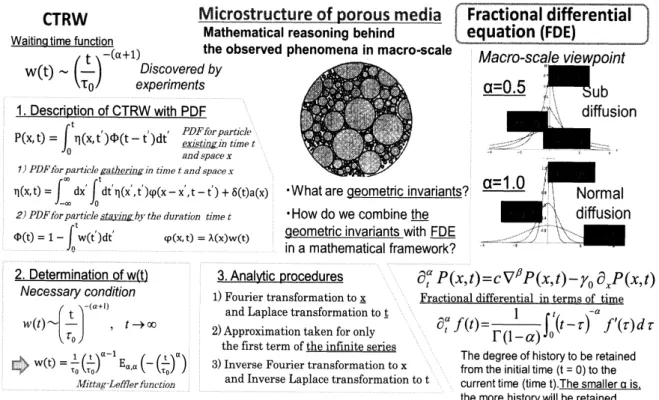
form.Figure 4 shows that CTRW is linked to the fractional order PDE in terms
of
time
[6]. Thismeans
that anomalous diffusion dependson
the degree of history tobe retained from the initialtime
to the current time. For smaller $a$,more
historywill be retained. Wecan
combine theobstacles
thatdelay the particle’s jump) with themathematical
reasoning. This isa
typical example ofa
problem-solving type thatis mathematicallybased. We
presentan
analytical description that mathematically explainsthe facts discovered
bythe
experiments.$\gamma)PDI’ 1\dot{o}rpvr_{J(}1_{\theta}9^{\underline{d}the}arrow Y1I/in$tjme$\ell_{\delta}$ndspecex
.Whatareoeometricinvariants? $\underline{\mathfrak{a}=10}$
$\sqrt{}1\prime\{\sqrt{}|$
$\eta(x,t)=\int_{-\infty}^{\infty}$dx$\int_{0}^{t}dt’\eta(x,t’)\varphi(x-x,t-t’)+\delta(t)a(x)$ Whatare Normal
2$)PDFt\theta Itic1est_{\theta’}i_{1}b_{J}\cdot thedu/sti_{0IJ}$ time$t$ .How dowecombine the $-^{\backslash }$
}
$\backslash _{}$ diffusion
$\underline{\Phi(t)=}1-\int_{0}^{t}\underline{w(t’)dt’\varphi(x,t)=\lambda(x)w(t)}-$
ina$mathemat_{\dot{\ovalbox{\tt\small REJECT}}Ca}|framework$?
oeometric invariantswith$\underline{FDE}$
$\overline{I}^{-}$
$\overline{-}J’\prime^{r_{{\}}^{}}\backslash 4_{\backslash }\searrow.\backslash .-$
$\underline{2.}$Determinationof$w(tl \underline{3.}$Analvtic$orocedures \partial_{t}^{\alpha}P(x,t)=c\nabla^{\beta}P(x,t)-\gamma_{0}\partial_{x}P(x,t)$
$Necessa/y$condition
$w(t) \sim(\frac{t}{\tau_{0}})^{-(a+1)}$ $tarrow\infty$
2$)$
ApproximationtakenforonlyandLaplacetransformationto
$\underline{t}$
$\partial_{t}^{a}f(t)=\overline{\Gamma(1-\alpha)}\int_{0}^{t}(t-\tau)^{-a}f’(\tau)d\tau$
$1\rangle$Fourier transformation
to-x $\frac{Fractionaldifferentia1}{1}$in terms of time
thefirst term of the infinite series
$\ovalbox{\tt\small REJECT}_{J}w(t)=\frac{1}{\tau_{0}}(\frac{t}{\tau_{0}t})^{\alpha-1}E_{\alpha’\alpha}(-(\frac{t}{\tau_{0},io})^{\alpha})tIiLpff?rf\dot{u}ncta$ 3
$)$Inverse Fourier transformationto
$x$
to
Thedegreeofhistorytoberelained
from the$\dot{\ovalbox{\tt\small REJECT}}$nitial
time$(t=0)$tothe
and InverseLaplacetransformationto$t$
current time(time$t\rangle$The smaller$\mathfrak{a}$is
$\frac{themorehistorwillberetained}{}$
Fig. 4 Analytical descriptions used to mathematically explain the facts discovered byexperiments
The approach of the above-mentionedcase is based
on a
macro-scaleviewpoint, and is the first scenarioforobtainingamulti-scale model. Thus,our
nextsteps involve determining: (1) howtocombine themicrostructure with themechanism for determining the alphavalue. (2)the geometricinvariants, and amethod for combining the geometric invariantswiththe PDEinamathematical framework. $A$micro-scale viewpointwill be used.
Figure 5 shows the second scenario usedtoobtain amulti-scale model. Wecan usethegeometric informationof the real sand specimens takenby a$3DCT$-image.
There
are
two kinds of dimensions thatare
used to consider the geometric invariants, namely the geometric dimension, which corresponds to the fractal dimension $d_{f}$, and the analytical dimension, which corresponds to the spectralOur
concem
is determmining how to combinethese geometricinvariants
with the fractional order PDEina
mathematicalframework. Figure 6 showsan
approachto obtaining the relationship amongthe fractal dimension$d_{f}$,the spectral dimension$d_{s}$andthe fractional differential order$a$
.
Equation (7) in Fig showsthe conclusion.Characterization of
the
geometric
features
of
the specimens
of
$3DCT$-image
$\langle$a
micro-scale
viewpoint)arebuiltup.
1$)$Geometricdimension $\Rightarrow$ Fractal dimension
$d_{f}$
2$)$Analytic dimens$\dot{\ovalbox{\tt\small REJECT}}on$ $\Rightarrow$SDectraldimension
$d_{s}$
Fig. 5 The secondscenario forgetting atamulti-scale modeling [7]
Thebehavior ofthemeanvolumeVoccupies byadiffusionparticles initiallyconcentrated
on agivensite$x$isgiven bythemeansquared displacementandthefractal dimension.
$V(x, r)\sim r^{d_{/\sim}}(\sqrt{\langle x(t)^{2}\rangle})^{d_{f}}$ (1)
$V(x,r):=\mu(B(x,r))$ $v(x_{\backslash }\iota)i\backslash 1]1(1ti(^{\backslash },\ln)11i;_{\grave{\prime}111\searrow()}\downarrow t\ln\iota(^{\backslash }of_{t}$
(1)
$B(x,r):=\{\gamma\in V|d(x,y)<r\}$ $\wedge\backslash r_{t}\searrow 0 く:\backslash \iota’\cdot t_{1}i\prime 1|\iota\}(\lambda.\}.)$.
M.BarlowandE.Perkins,Brownian motionontheSierpinskigasket,Probab. Th. Rel.Fields, 79
(1988),showed that thefollowingheat kemel takesplacefor alargevarietyof fractalsets;
$p(x,y,t) \sim t^{\frac{d,}{2}}e\varphi[-(\frac{d(x,y)^{d}}{ct})^{\frac{1}{d_{w}-1}})$
(2) $\Rightarrow$ $p(x,x,t)\sim t^{\frac{d_{s}}{2}}$ (3) $\ln$thecaseof $Y^{-x}$ Wenssumathat $p(x,x,t)\sim V(x,r)^{-1}$ (4) Bycomparing Eq.(5)
WithEq. (1), Eq.(4)and Eq.(3),weobtain that and Eq.(6), wehave
$\langle x(t)^{2}\rangle\sim V(x, r)^{\frac{2}{d_{f}}}\sim p(x,x,t)^{\frac{2}{d_{f}}}\sim(t^{\frac{d}{2}})^{\frac{2}{d_{/}}}\sim t^{\frac{d}{d_{f}}}(5\rangle\} \alpha=\frac{d_{s}}{d_{f}} (7\rangle$
Numericalexperiments usingCTRWsaythat
$\langle x(t)^{2}\rangle\sim t^{a}$
(6)
Fig.6 Relationship between$d_{f},$ $d_{s}$ and the fractional differential order$a$ conjectured
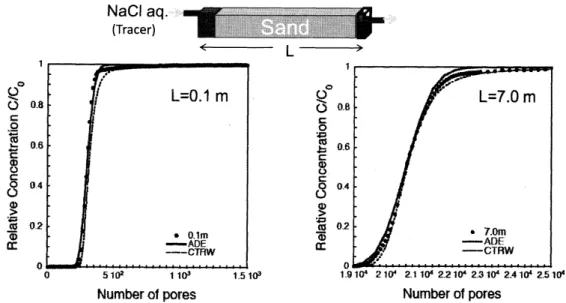
Figure 7
compares
the diffusion behavior between of small-scale experiment and that of large-scaleone.
Theresult of the small-scale experiment showsthatthe diffusion followsan
advection-diffusion equation ($ADE$) that corresponds to thenormal diffusion. The result of the large-scale experiment differs from results obtained using the $ADB$, and it also cannot be completely explained using the
CTRW method. We need
a
scaling law to combine laboratory experiments with field scale.Numberofpores Number ofpores
Fig. 7 Comparison of diffusion behaviorbetweensmall scaleexperimentandlarge scale
one
provided byDr. Yuko Hatanoaffiliated with the department ofrisk engineering,UniversityofTsukubaFigure8 shows the third scenario usedto obtain
a
multi-scalemodel. This is a deductive approach thatuses
the natureofmathematics. Weuse
thehomogenization method proposed by J.L. AuriaultandJ.Lewandowska[9]. InFigure 8, $\Omega$ is composed ofperiodic components
ofamicrocell. The goveming equationin $\Omega$
are
given byEqs. (1) to (3).ThisPDE is anormaldiffusiontype. $D_{m}$ representsthe diffusion coefficient of Media$M$ which
corresponds to solidparticles. On the otherhand, $D_{f}$is the diffusion coefficient of
Media$F$, which correspondstoair space. Eq. (5) shows therelationshipbetween $D_{m}$and$D_{f}$. The $\epsilon$ is
a
homogenizationparameter. When $\epsilon$ becomes zero,therelationship inBq. (5)Plays
an
importantrolein theappearance
ofthememory
termin the homogenization Eq. (6). This
memory
termappears
tocorrespondto thefractional differential interms oftime in$FDE$ inFigure4.What shape ofMleadstoasimilar effect like the fractional differential?
Fig.8 The 3rdscenario for gettingat
a
multi-scale modeling provided by Dr. MasaakiUesaka whois affiliatedwithGraduate School ofMathematical Science, The Universityof TokyoThus, through the collaboration of mathematicians and engineers from both academic and industrial fields,
our
study establishes the fundamental logical stmcture that lies behind the scaling law observed in the behavior of pollutants in different environmental media suchas
soil and atmosphere, and thus clarifies the universal characteristics of the scaling law.Future Plan
In industrial practice,
a
reduced-scale model is constmcted to analyzea
phenomenon that takes place inreal-size equipment, significant physicalvalues for the phenomenon in questionare
described by dimensionless numbers, and the dimensionless numbers obtained from the model analysis are made to match with those of real-size equipment. This matching operationsecures
the similarity of the dynamic physical values between the model and real-size equipment. This similarity refers also to the scaling law. It has been found from the above viewpoint of scaling law that, in addition to the physical values suchas
time and length which have been conventionally used for scaling up, the fractional powers in the differentiation oftime and space are essential. This means that mathematics is expected to present anew
“angle ofview” for the scaling law that deals with inhomogeneous media. Practically, environmental analysis deals with a scale of several kilometersor more
in size. In this relation, establishment of scaling laws including an a priori choice ofan exponentwill make it possible to appropriately use results obtained through reduced-scale tests and clarify a real phenomenon acrossa
large space.By establishing scaling laws and developing mathematical methods based thereon, we
can
significantly reduce costs for producing high-quality productsas
wellas
energy consumption and$CO_{2}$ emissionby improvingproduction efficiencyin various problems ofmanufacturing industries such
as
monitoring of sintering processes, reactions in a blast fumace, and other metallurgical reactions in steel-makingprocesses.Scaling laws andmathematicalmethods
are
applicable also toa
widevarietyof fields such as chemical engineering, mechanical engineering, geotechnical engineering, biotechnology, etc., and therefore, the establishment of such scaling laws is expected to be useful in remarkably accelerating the development of science andtechnology through the solution ofimportant industrialproblems.Furthermore, the concept of scaling law combining micro- and macroscopic aspects is closelyrelated to that of multi-scale modeling, the application ofwhich is rapidly expanding in material science, chemistry, and other widely varied fields. The present study is expected to lead to proposals ofnew mathematical concepts
and methodologies for multi-scale modeling, bringing about
new
problem recognition andmethodology tomathematics.“Mathematics for industry” will be the key for combining mathematics with industrial technology. Mathematical science
can
be understoodas
mathematics for nature; it is aimed at extracting fundamental principles behind different natural phenomena and engineering problems, and crystallizing them into mathematical stmctures.Beyond the simple numerical operation of physical model equations,
a
methodology basedon
the principles and mles of mathematics makes itpossibleto constmct mathematical models that describe theessence
ofa
phenomenon selectively. Such mathematical modelsserve as
important basis for understanding and controllinga
phenomenon. Whena
mathematicalmodel describes theessence
ofaphenomenonas
simply and comprehensiblyas possible (a minimumnecessary
model), itbecomes easier for engineers and researchers from
a
varietyoftechnical fieldsto study,and it becomes easiertoconce.ive
ideas thatcan
leadto innovations. In order to constmct sucha
minimumnecessary
mathematical model that describes theessence
ofa
phenomenon efficiently,a
framework is required for the joint work of mathematicians and engineers from academic and industrial fields where theycan
thoroughly discuss subject phenomena and define suitable targets and milestones for different study stages. In addition, it is indispensable to mutually confilm workprogress.
At present, however, applied mathematics in Japan, compared with other developed countries,seems
to lack such teamwork experience that helps to combinea
phenomenon with mathematical methodology. In order to solvea
problemas
promptlyas
required in industry, it is too late to begin studying methodology after posing of the problem. It isnecessary
to continue to improve the skill to combinea
phenomenon with mathematical methodology for its prompt application, and in this respect, each individual must improve their qualification to be “the right person” whocan
meet the above conditions and the role.It is desirable that both mathematics and industry foster people capable of working jointly with each other from the viewpoint of“mathematics for nature” through academic-industrial collaboration. Towards this end, it is necessary to create a new framework independent of the stmcture of present industry and academic organizations. We must reinterpret and reconstmct the fundamental concept of manufactuning based on field practice, which constitutes the competitive edge in developed countries, from the standpoin$t$ of mathematical
methodology while leaming about interdisciplinary collaboration from abroad. By
so
doing, wewill be able to command the most advanced industrial technology of theworld.References
[1] Cheng, J., Nakagawa, J., Yamamoto, M., Yamazaki, T., Uniqueness in
an
inverse problem for one-dimensional fractional diffusion equation, to appear in “InverseProblems” (2009).[2] Podlubny, I., Fractional Differential Equations, Academic Press, San Diego, 1999
[3] Sokolov, I, M., Klafter J., Blumen A., “Fractional Kinetics,” Physics Today, November 2002,pp. 48-54.
[4]Y. Hatano and N. Hatano: ”Aeolian migration of radioactive dust in
Chemobyl,” Zeitschrift fur Geomorphologie, 116 (1999)pp. 45-58.
$[5]Y$ Hatano, Y, and Hatano, N., Fractal fluctuation of aerosol migration
near
Chemobyl. AtmosphericEnvironment, 31,
2297-2303
(1997)[6]Nakagawa,J., Sakamoto,K., Yamamoto, M.,Overviewto mathematical analysis for fractional diffusion equations-new mathematical aspectsmotivatedby industrial collaboration,Joumal forMath-for-industry, Vol.1 ($2009B$-9),
00.157-163
[7]Matsushima, T., Uesugi,K., Nakano,T., Tuchiyama,A.,J. Appl.Mech.JSCE 11, 507-515 (2008)
[8] Bouchaud, J. P., and A. Georges, Anomalous diffusion in disordered media: Statistical mechanisms, models and physical applications, Physics. Reports 195,
127(1990)
[9] Auriault, J. L., and Lewandowska, J., Non-Gaussian Diffusion Modeling in Composite Poms Media by Homogenization: Tail Effect, Transport in Porous Media, 21:47-70 (1995)

![Fig. 5 The second scenario for getting at a multi-scale modeling [7]](https://thumb-ap.123doks.com/thumbv2/123deta/5963965.1056999/9.892.198.758.230.496/fig-second-scenario-getting-multi-scale-modeling.webp)