Bottom-Left
安定点の効率的な列挙法とその応用
名古屋大学大学院工学研究科 今堀 慎治 (Shinji Imahori) Graduate School of Engineering,
Nagoya University
名古屋大学大学院情報科学研究科 簡 干耀 (Yuyao Chien)
田中 勇真(Yuma Tanaka)
柳浦 睦憲 (Mutsunori Yagiura)
Graduate School ofInformation Science,
Nagoya University 概要: 本稿では,既に配置された長方形の集合と
1
つの未配置の長方形が与えられたとき,未配 置長方形のBottom-Left 安定点を全て列挙する問題を考える.提案アルゴリズムは,配置された 長方形の数を $n$, 未配置の長方形の Bottom-Left安定点の数を $K$とすると,
$O((n+K)\log n)$時 間で全ての Bottom-Left安定点を列挙する.提案アルゴリズムの特徴の一つに,既配置長方形が Bottom-Left安定でない場合や,既配置長方形間に重なりがある場合にも適用可能であることが 挙げられる.計算量の理論的な解析と,数値実験による評価を通して,提案アルゴリズムの有効 性を検証する. 1 IntroductionRectangle packing is animportant problem with applications in steel, wood, glass, paper and
many other industries. There are a number of variants ofthe problem with different objectives and constraints, but the essential task is to place a given set of rectangles in
a
given largerarea
without overlap so that the wasted space in the resulting layout is minimized. (See [14] for atypology of cutting and packing problems.) Almost all variants of the problemare
knownto be NP-hard, and many heuristic algorithms have been proposed in the literature. One of
the typical frameworks of existing heuristic algorithms is the
bottom-left
strategy, which placesrectangles one by one at
bottom-left
stable positions [1, 9, 12]. A fundamental problem to be solved for executing these algorithms is to enumerate all bottom-left stable positions (or to finda bottom-left stable position with some properties) for a set of already placed rectangles and
one new rectangle to be placed next.
Bottom-left stable positions are defined for a given area (in this paper, we assume the shape
of the given areaisrectangular), aset of rectangles placed in the area, and one newrectangle. A
bottom-left stable position is
a
point in thearea
where thenew
rectanglecan
be placed without overlap with already placed rectangles and the new rectangle cannotmove
to the bottomor
totheleft. We note that there are manybottom-left stable positions ingeneral and thelowest one
(ifthere are ties, the leftmost one among the lowest) is called the
bottom-left
position. We alsodefine
bottom-left
stabilityfor a layout; ifthere is no overlap amongrectangles and no rectangleSome constructiveheuristic algorithms for the rectangle packing problem place rectangles at a
bottom-left stableposition [1, 3, 7, 9, 12], andhence anylayoutsconstructed by these algorithms
(including intermediate layouts) satisfy bottom-left stability. For layouts with bottom-left
sta-bility, Chazelle [4] showed that the number of bottom-left stable positions for anewrectangle is at most$n+1$ when the numberof placed rectangles is$n$ and proposed
an
algorithm to enumerateall the bottom-left stable positions in linear time.
Another
common
framework of heuristic algorithms for the rectangle packing problem isim-provement method, which places all the rectangles in the given
area
without overlap and itera-tively improves the layout bysome
operations. This kind of algorithms often placea
rectangle ata bottom-leftstable position, but in this case, theymayneedto solve the problem of finding such
aposition in alayout without
bottom-left
stability. Forthis case, Healy et al. [6] showed that the number ofbottom-leftstable positions fora new
rectangle is $O(n)$ when$n$ rectangles are placedin the area without overlap, and they proposed an $O(n\log n)$ time algorithm to enumerate all
the bottom-leftstable positions.
For
some
packing problems including the two-dimensional irregular packing problem, algo-rithms with compaction and sepamtion opemtionswere
proposed [2, 5, 8, 11, 13]. Thesealgo-rithms generate layouts with overlap during their execution. However, efficient algorithms to
enumerate bottom-left stable positions in layouts with overlap have not been proposed yet.
In this paper,
we
consider the problem of enumerating bottom-left stable positions for anew
rectangle within agiven layout that maynot satisfy bottom-left stabilityand mayhave overlap
between rectangles. We propose
an
enumeration algorithm that runs in $O((n+K)\log n)$ time,where$n$ is the number of placed rectangles and$K$ is the number ofbottom-leftstable positions.
Our algorithm enumerates bottom-left stable positions from bottom to top (from left to right
for positions with same y-coordinates), and hence it outputs the bottom-left position first in
$O(n\log n)$ time.
The bottom-left strategy can naturally be generalized to the three-dimensional
case.
Animportant consequence of the algorithm proposed in this paper is that it
can
be utilized to design an efficient algorithm to execute such a bottom-left algorithm for the three-dimensionalpacking problem. Kawashima et al. [10] showed that the time complexity
was
improved fromthe previous best-known $O(n^{5})$ to $O(n^{3}\log n)$. In their proof, our algorithm is used
as
acore
part of the algorithm, and the applicability of
our
algorithm to thecase
withrectangles havingoverlap is crucial, i.e., existing algorithms such
as
those proposed in [4, 6] cannot be used forthis purpose.
2 Problem description
We are given aset of$n$ rectangles$I=\{1,2, \ldots, n\}$ and one large rectangular area, also called the container. The containerhas its width and height $(W, H)$ anditsbottom left point is placed at (0,0) in the plane. Each rectangle $i\in I$ has its width and height $(w_{i}, h_{i})$, and is placed
orthogonally in the plane. Let $(x_{i}, y_{i})$ be the coordinate of the bottom left point of rectangle $i$
.
We note that the given rectangles may protrudefrom the container and may have overlap each other. We
are
also givenone new rectangle$j\not\in I$ withsize $(w_{j}, h_{j})$ that has not beenplaced yet.(0, 司 口 $(W, H)$ $(0, H)$ 口 $(W, H)$
$(0,0)$ $(w, 0)$ $(0,0)$ $(w, 0)$
$(a)$ $(b)$
Figure 1: Bottom-left stable positions.
See Figure 1 (a) for
an
example of bottom-left stable positions; black points in this figure denotebottom-left stable positions for rectangle$j$. Let $K$ be the number ofbottom-left stable positions
for agiven layout and
one
new rectangle. It is known that $K=O(n^{2})$ and $K$can
be $\Theta(n^{2})$ forsome cases (see Figure 1(b) for an example).
3 Algorithms
In this section, we propose algorithms to enumerate bottom-left stable positions. We first
introduce
no-fit
polygon, which is often used in packing algorithms to check overlap efficiently.In Section 3.2, we give a technique to compute for each point $p$ in the plane the number of
no-fit polygons containing $p$ by using sweep line. In Section 3.3, we propose an algorithm for
enumerating bottom-left stable positions. We estimate the computational complexity of
our
algorithms in Section 3.4.
Instead of considering the constraint that requires a new rectangle to be placed in the
con-tainer, we use a set of four sufficiently large virtual rectangles $C=\{c_{1}, c_{r}, c_{t}, c_{b}\}$ that satisfies
the following condition: Rectangle $j$ does not have overlap with rectangles $i’\in I\cup C$ if and
only ifit is placed in the container without overlap with rectangles$i\in I$. We call these virtual
rectangles container rectangles;
see
Figure 2 for an example of container rectangles. We denote$I’=I\cup C$; then $|I’|=|I|+4$ holds.
3.1 No-fit polygon
No-fit
polygon (NFP) is a geometric technique to check overlap of two polygons intwo-dimensional space. It is defined for an ordered pair of two polygons $i$ and $j$, where the position
of polygon $i$ is fixed and polygon $j$
can
be moved. $NFP(i,j)$ denotes positions of polygon$j$
having intersection with polygon $i$. In this paper, we treat only the situation that both of two
polygons $i$ and $j$ are rectangles, and hence it is easy to compute $NFP(i, j)$. Let rectangle $i$ be
placed at $(x_{i}, y_{i})$ and rectangle$j$ be the new rectangle. Then $NFP(i, j)$ is defined as follows:
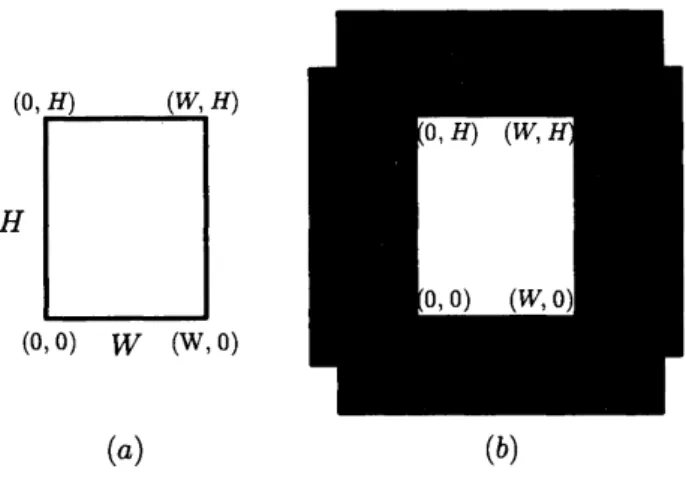
$(0, H)$ $(W, H)$
$(0,0)$ $W$ $(W, 0)$
$(a)$ $(b)$
Figure 2: (a) The given area, (b) Container rectangles to represent the
area.
We also definethe overlap number $B(x, y)$ ofno-fit polygons at point $(x, y)$
as
follows:$B(x, y)=|\{i\in I’|(x, y)\in NFP(i,j)\}|$
.
By using this overlap number, we can characterize bottom-left stable positions
as
follows:$(x, y)$ is a bottom-left stable position $\Leftrightarrow$
$B(x, y)=0$ A$B(x-\epsilon, y)>0\wedge B(x, y-\epsilon)>0$,
where $\epsilon$ is any sufficiently small positive number. In the next section, we will describe how to
compute overlap number ofno-fit polygons.
3.2 Compute overlap numbers
The algorithm first computes all no-fit polygons $NFP(i,j)$ of rectangle $j$ relative to placed
and container rectangles $i\in I’$
.
Inorder to compute overlap numbers (ofno-fit polygons) in thegiven
area
efficiently, the algorithmuses
a sweep line parallel to the x-axis andmoves
it from bottom to top.Let $N_{t}$ (resp., $N_{b}$) be the set of all the top (resp., bottom) edges of no-fit polygons and
$N_{tb}=N_{t}\cup N_{b}$. The overlap numbers
on
the sweep line will be changed only when the sweep line encounters a member of $N_{tb}$, and changes occur only in the interval between the left edgeand right edge of the no-fit polygon encountered by the sweep line.
Let $N_{1}$ (resp., $N_{r}$) be the set of all the left (resp., right) edges of no-fit polygons and $N_{1r}=$
$N_{1}\cup N_{r}$. Because there are $n$ placed rectangles and four container rectangles, $|N_{t}|=|N_{b}|=$
$|N_{1}|=|N_{r}|=n+4$ and $|N_{tb}|=|N_{1r}|=2n+8$ hold. The elements in $N_{1r}$
are
sorted innondecreasingorder of thex-coordinates of the elements, where ties
are
broken by puttingmore
priority to elements in $N_{r}$
.
This tie-breaking rule is important, because if two no-fit polygonshave theirleft and right boundaries at thesame x-coordinate, the newrectangle$j$
can
beplacedwithout overlap at the intersection point of boundaries ofthe two no-fit polygons. Let $x_{1r}^{(k)}$ be
the x-coordinate ofthe kth element in the sorted list of$N_{1r}$, and define intervals
$S_{k}=[x_{1r}^{(k)}, x_{1r}^{(k+1)}]$, $k=1,2,$
on
the sweep line.The algorithm maintains the overlap number for each interval $S_{k}$ during the computation.
Initially, the sweep line is at
a
sufficiently low position, and it overlaps withno
NFP. At thismoment, the overlap number ofevery interval $S_{k}$ is zero.
Wenowconsider themoment when thesweeplineencounters amember in $N_{tb}$. Let $NFP(i, j)$
be the rectanglewhose top orbottom edge is encountered bythesweepline, and
assume
that the left (resp., right) edge of$NFP(i, j)$ is the lth (resp., $(r+1)$st) element inthe sorted list of$N_{1r}$. Inthis situation, we should change the overlap numbers for intervals $S_{l},$$S_{l+1},$ $\ldots,$
$S_{r}$. To be
more
precise, we should increase (resp., decrease) their overlap numbers by one if the encountered
edge is a member of $N_{b}$ (resp., $N_{t}$). To update overlap numbers on the sweep line efficiently,
we use a complete binary tree whose leaves represent intervals $S_{1},$ $S_{2},$
$\ldots,$$S_{2n+7}$. Here, the kth
leaf from the left corresponds to the interval $S_{k}$, and the
name
of this leaf is $k$.
We note that$2n+7$ is not
a
power of two for any $n$, and thereare
remaining leaves on the right side of theleaf corresponding to interval $S_{2n+7}$. Such remaining leaves are called dummy leaves. Weuse a complete binary treewiththe minimum numberofdummy leaves. Then the number ofdummy
leaves is less than $2n+7$ and the height of this tree is $O(\log n)$. Every node of this tree stores valuesPself, Pmin andPmax, whose role will be explained later.
For two nodes $u$ and $v$ of the tree, let PATH$(u, v)$ be the set of nodes in the path from
$u$ to $v$ including $u$ and $v$ themselves. Let $g(k)$ be the overlap number for interval $S_{k}$ of the
sweep line. (To be more precise, $g(k)$ is the overlap number of all points in $S_{k}$ except the
left (resp., right) boundary of $S_{k}$ if it corresponds to the left (resp., right) boundary of an
NFP. Thus we need to treat the boundaries carefully considering that each NFP is an open set. When the value of $y$ is fixed to the height of the current sweep line, the function $B(x, y)$
is a lower semicontinuous piecewise linear function consisting of horizontal line segments with
heights $g(1),$ $g(2),$$\ldots,$$g(2n+7)$ aligned in thisorderfrom left to right.) Forevery dummyleaf$u$,
we set $g(u)=1$.
The algorithmmaintains the values ofPself for all nodes ofthe tree so that
$\sum_{u\in PATH(k,root)}$Pself$(u)=g(k)$
is satisfied for each leaf $k$, where root is the root node of the binary tree. Then it is possible
to compute the overlap number of an interval in $O(\log n)$ time by using the values ofPself in the path from the corresponding leaf to the root node. We also define the values ofPmin(v) and Pmax(v) for each node $v$ of the complete binary tree as follows:
Pmin$($v$)$ $=$ $\min$ $\sum$ Pself$(u)$, (1) $k\in Q(v)$
$u\in PATH(k,v)$
Pmax$(v)=$ $\max$ $\sum$ Pself$(u)$, (2)
$k\in Q(v)$
$u\in PATH(k,v)$
where $Q(v)$ is the set of all leaf nodes in the subtree rooted at the node $v$. By using the value
of $p_{\min}(v)$ (resp., $p_{\max}(v)$) and the values of $p_{self}(u)$ for nodes $u$ in the path from the parent
equal to
zero
(resp., positive) exist in $Q(v)$.
Let $u$ and $u’$ be the children of node $v$ andassume
that the values ofPmin$(u)$ andPmin$(u’)$
are
known. In this situation, the valueofPmin(v)can
be computed in constant time byPmin$(v)=p_{self}(v)+ \min$
{
$p_{\min}(u)$,Pmin$(u’)$}.
(3) The value ofPmax(v) can be computed similarly.We
now
explainthe algorithm tokeepthe values ofPself,$p_{\min}$andPmax appropriately. Considerthe moment when the sweep line encounters a member in $N_{tb}$
.
Let $NFP(i, j)$ be the rectanglewhose top or bottom edge is encountered by the sweep line, and let the left (resp., right) edge of $NFP(i,j)$ be the lth (resp., $(r+1)$st) element in the sorted list of $N_{1r}$. Here
we
assume
forsimplicitythat the encountered edge is
a
bottom edge of the NFP. Thecase
whena
top edge isencountered issimilar; instead ofincreasingthe valuesby one, the algorithm decreases the values
by
one.
The algorithm first finds the leaves $l$ and$r$ that correspond to the lth and rth intervalsand increases the values ofPself,Pmin andPmax oftheseleafnodes by
one.
It then traverses nodesin the paths from theleaf nodes $l$ and $r$ to theirleast commonancestor $v$. Duringthis traversal,
whenever a node in the path from $l$ (resp., r) to $v$ is reached from its left (resp., right) child,
the algorithm increases the values of$p_{self}$,Pmin and Pmax of the right (resp., left) child by
one.
It also updates$p_{\min}$ (by using (3)) andPmax for nodes in the paths from $l$ and$r$ to$v$
so
that theconditions (1) and (2) are satisfied. Finally, the algorithm updates the valuesofPmin andPmax
for all nodes in the path from $v$ to the root node of the tree. The details of this procedure is
summarized
as
Algorithm UPDATEVALUES$(\lambda, l, r)$.Algorithm UPDATEVALUES$(\lambda, l, r)$
Input: An index $\lambda(\lambda=1$ when the sweep line encounters a bottom edge of NFP; $\lambda=-1$
when the sweep line encounters a top edge ofNFP), two leaves $l$ and $r$ corresponding to
the leftmost and rightmost intervals and current values of$p_{self}$, Pmin and$p_{\max}$
.
Task: Update the values of$p_{self}$, Pmin and$p_{\max}$.
Step 1: Increasethe valuesofPself$(l)$,Pmin$(l)$,Pmax$(l),$ $p_{self}(r)$,Pmin$(r),p_{\max}(r)$ by $\lambda$ (thismeans
that if$\lambda=-1$, these values are actually decreased by one).
Step 2: Let $l_{prev}$ $:=l$ and $r_{prev}$ $:=r$, andthen let $l$ be the parent of$l$ and $r$ be the parent of$r$.
If $l\neq r$, proceed to Step 3; otherwise go to Step 4.
Step 3: If the right (resp., left) child$u$of$l$ (resp., r) is different from
$l_{prev}$ (resp., $r_{prev}$), increase
the values ofPself$(u)$,Pmin$(u)$and$p_{\max}(u)$ by$\lambda$
.
LetPmin$(l)$ $:=p_{self}(l)+ \min$
{
$p_{\min}(u)$,Pmin$(u’)$},
where $u$ and $u’$ are the children of node $l$. Update the values of$p_{\max}(l)$,Pmin$(r),p_{\max}(r)$ similarly. Return to Step 2,
Step 4: For each node $v$ in the path from $l(=r)$ to the root and the children $u$ and $u’$ of$v$, let
Figure 3: No-fit polygons whose top edges have the same y-coordinate.
3.3 Enumerate bottom-left stable positions
We explain our algorithm that enumerates bottom-left stable positions. Observe that, while
the sweep line parallel to the x-axis is moved from bottom to top, the overlap numbers of
no-fit polygons for intervals in the sweep line decrease only if the top edge of
a
no-fit polygon is encountered. Thismeans
that bottom-left stable positionscan
be found only in this case,because apoint $(x, y)$ canbe abottom-left stableposition onlyif$B(x, y)=0$ and$B(x, y-\epsilon)>0$
for any sufficiently small positive $\epsilon$. For this reason, when the sweepline encounters thebottom
edge ofano-fit polygon, the algorithmjust updates the overlap numbers according to the rule described in Section 3.2. On the other hand, when the sweep line encounters the top edge of
a no-fit polygon, the algorithm updates the overlap numbers and outputs bottom-left stable positions onthe sweep line if such positions exist. To manage these events, the elements in $N_{tb}$
are sorted in nondecreasing order of they-coordinates of theelements, where ties are broken by putting more priority to elements in$N_{t}$. If the top edges ofsome no-fit polygons have the same
y-coordinate, we put more priority to those elements that correspond to no-fit polygons whose
left edge have smaller x-coordinates.
At any point $(x, y)$ such that the overlap number $B(x, y)$ is equal to zero, we can place
rectangle $j$ without overlap. Moreover, if the overlap number becomes zero when the top edge
of a no-fit polygon is encountered by the sweep line, then $B(x, y-\epsilon)>0$ for any sufficiently
small $\epsilon>0$, i.e., rectangle $j$ cannot
move
downward from the point. Furthermore, ifthe point$(x, y)$ is at the left boundary ofan interval $S_{k}$ and its left adjacent interval $S_{k-1}$ has a positive
overlap number, then $B(x-\epsilon, y)>0$ for any sufficiently small $\epsilon>0$, i.e., rectangle$j$ cannot
move to the left, provided that all the top edges of no-fit polygons whose y-coordinates
are
$y$have already been encountered by the sweep line. Such a point $(x, y)$ is
a
bottom-left stableposition, and our algorithm enumerates all such points. We note that, if there are some no-fit
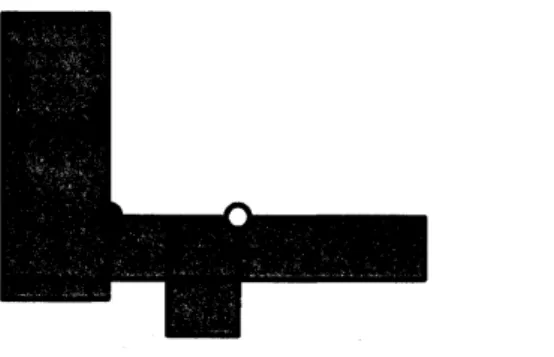
polygons whose top edges have thesame y-coordinate, all such top edges should leave thesweep line together. Otherwise, the algorithm may output positions from which rectangle $j$ can move
to the left as depicted in Figure 3; when rectangle $i$’ leaves the sweep line, black and white
pointsmay be output asbottom-left stable positions. The details ofouralgorithm to enumerate
Algorithm ENUMERATEBL$(j, I)$
Input: Placed rectangles $i\in I$ inthe given
area
andone new
rectangle $j\not\in I$.Output: All bottom-left stable positions for rectangle $j$.
Step 1: Compute all no-fitpolygonsof rectangle$j$relativeto allplacedand container rectangles
$i\in I’$
.
Sortleft and right edges $N_{1r}$ $:=N_{1}\cup N_{r}$ofno-fit polygonswith the rule described inSection 3.2. Createtheminimumcomplete binary tree with at least$2n+7$leaves. Initialize
the values$p_{self}(u)$ $:=0$, Pmin$(u)$ $:=0$ andPmax$(u)$ $:=0$ for all leaf nodes $u$corresponding to
intervals $S_{1}$ to $S_{2n+7}$, and initialize thevalues$p_{self}(u)$ $:=1$,
Pmin$(u)$ $:=1$ and$p_{\max}(u)$ $:=1$
for all dummy leaves$u$
.
For all internal nodes $u$, set $p_{self}(u)$ $:=0$ andcompute the valuesofPmin$(u)$ and$p_{\max}(u)$
.
Sort
top andbottomedges $N_{tb}$ $:=N_{t}\cup N_{b}$ of no-fit polygonswiththe rule described in Section 3.3.
Step 2: Choose the first element $e\in N_{tb}$ and let $N_{tb}$ $:=N_{tb}\backslash \{e\}$
.
If the y-coordinate ofelement $e$ is greater than H–hj, then stop.
Step 3: Let $i\in I’$ be the no-fit polygon having the element $e$
as
its topor
bottom edge, andassume
that its left (resp., right) edge is the lth (resp., $(r+1)$st) element in $N_{1r}$. If$e\in N_{t}$ (resp., $N_{b}$), then set $\lambda$ $:=-1$ (resp., $\lambda$ $:=1$). Call algorithm UPDATEVALUES$(\lambda, l, r)$
.
Step 4: If$e\in N_{b}$, return to Step 2; otherwise $(i.e., e\in N_{t})$, set $\alpha$ $:=l$ and $\beta$ $:=r$.
Step 5: Let $e$‘ be the first element in $N_{tb}$
.
If$e$ and $e$‘ have thesame
y-coordinate and $e’\in N_{t}$,go to Step 6; otherwise go to Step 7.
Step 6: Let $i’\in I’$ bethe no-fit polygon having the element $e’$
as
itstop edge, and assumethatits left (resp., right) edge is the
l’th
(resp., $(r’+1)$st) element in $N_{1r}$.
If $l’>\beta$ holds, goto Step 7; otherwise let $N_{tb}:=N_{tb}\backslash \{e’\}$ and call algorithm UPDATEVALUES$(-1, l^{f}, r’)$. If $r’>\beta$ holds, set $\beta$ $:=r’$
.
Return to Step 5.Step 7: If the overlap number of interval $S_{\alpha}$ is positive, go to Step 8. Ifthe overlap number of
interval $S_{\alpha}$ is equal to $0$ and that ofinterval $S_{\alpha-1}$ is positive, then output a bottom-left
stable position $(x, y)$, where $x=x_{1r}^{(\alpha)}$ and
$y$ is the y-coordinate ofthe current sweep line.
Go to Step 9.
Step 8: Byusingthe values ofPmin, find the leftmost interval$S_{\gamma}$ that satisfies$\gamma>\alpha$ andwhose
overlapnumber is equalto$0$. If$\gamma>\beta$or sucha$\gamma$is notfound, return to Step 2; otherwise,
output abottom-left stable position $(x, y)$, where $x=x_{1r}^{(\gamma)}$ and
$y$is they-coordinateofthe
current sweep line. Let $\alpha$ $:=\gamma$ and go to Step 9.
Step 9: By usingthe valuesofPmax, findtheleftmost interval$S_{\gamma}$ that satisfies $\gamma>\alpha$and whose
overlap number is positive. If$\gamma\geq\beta$ or such a $\gamma$ is not found, return to Step 2; otherwise,
let $\alpha$
$:=\gamma$ and go to Step 8.
The overlap number of every dummy leaf is initialized to one and is not changed during the execution of the algorithm, and hence the dummy leaf nodes have
no
influenceon
the output ofthis algorithm. By executing this algorithm, allthe bottom-left stable positions are enumerated from bottom to top (from left to right for positions with same y-coordinates).
In Step 8, $\gamma$ is found
as
follows. The algorithm first climbs the binary tree from the leaf$\alpha$,and whenever a node $v$ is reached from its left child, it checks whether the subtree rooted at
the right child $u$ of$v$ has a leafwhose overlap number is zero. When the first node $u$ having
such aleafis found, the algorithm goes down the tree from the $u$, choosing the left-most child
including such aleaf. In Step 9, the leaf$\gamma$ is found similarly.
3.4 Computational complexity
We estimate the time complexity of our algorithms described in Sections 3.2 and 3.3.
Al-gorithm UPDATEVALUES$(\lambda, l, r)$ runs in $O(\log n)$ time since the height of the complete binary tree is $O(\log n)$
.
Algorithm ENUMERATEBL$(j, I)$ calls algorithm UPDATEVALUES$(\lambda, l, r)$as a
subroutine at most $2n+8$ times in Steps 3 and 6; then the total timefor this part is $O(n\log n)$.
The time complexity of Step 7 is $O(\log n)$ and it is called at most $n+4$ times. The time com-plexity of Step 8 is $O(\log n)$ because $O(\log n)$ nodes
are
visited during the traversal from $\alpha$ to $\gamma$, and it is possible for each node $u$ to check whether the subtree rooted at the node $u$ has aleaf node whose overlap number is equal to zero in constant time (this is not hard to see from
the property explained in Section 3.2 just after equation (2)$)$. The timecomplexity of Step 9 is
also $O(\log n)$ for asimilar
reason.
Steps 8 and 9are
called at most $n+4+K$ times, where$K$ isthe number of bottom-left stable positions enumerated. Insummary, the total time complexity
of algorithm ENUMERATEBL$(j, I)$ is $O((n+K)\log n)$
.
Furthermore, ifour algorithms are uti-lized for finding the bottom-left position (i.e., the lowest (if there are ties, the leftmost amongties) bottom-left stable position), algorithm ENUMERATEBL$(j, I)$ can be stopped immediately
when it finds the first bottom-left stable position. In this case, the time complexity to find the
bottom-left position is $O(n\log n)$.
4 Computational results
In this section, we evaluate the proposed algorithms via computational experiments. All the algorithms were coded in $C$ and experiments were conducted on a PC (Intel Xeon $3GHz,$ $2MB$
cache, lGB memory). As
a
set of placed rectangles, we used test instances for the rectangle packing problem with 16,32, 64,. .
., 1048576 rectangles (these instances are obtained electron-ically from http://www.na.cse.nagoya-u.ac.jp$/\sim$imahori/packing/instance.html). The size ofa
new rectangle to be placed next is similar to the placed rectangles.
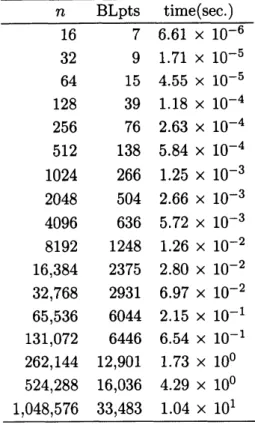
Table 1 shows the computational results. Column $(n$“ shows the number ofrectangles placed
in a rectangular area. The number of bottom-left stable positions enumerated is shown in
column ”BLpts,” and computation time in seconds is reported in column “time(sec.).” We
note that layouts were randomly generated many times (at least 10 times; it depends on the number ofplaced rectangles) and theaveragenumberof bottom-left stable positions andaverage
computation time were reported. From the table, we can observe that the proposed algorithm
enumerates bottom-left stable positions in a short time. It can enumerate all the bottom-left stable positions among hundreds of rectangles within 0.001 seconds, it spends less than 0.1
Table 1: Performance ofour algorithm. $\frac{nBLptst.ime(sec.)}{167661\cross 10^{-6}}$ 32 9 1.71 $\cross 10^{-5}$ 64 15 4.55 $\cross 10^{-5}$ 128 39 1.18 $\cross 10^{-4}$ 256 76 2.63 $\cross 10^{-4}$
512
1385.84
$\cross 10^{-4}$1024
266 1.25
$\cross 10^{-3}$ 2048 504 2.66 $\cross 10^{-3}$ 4096 636 5.72 $\cross 10^{-3}$ 8192 1248 1.26 $\cross 10^{-2}$ 16,384 2375 2.80 $\cross 10^{-2}$ 32,768 2931 6.97 $\cross 10^{-2}$ 65,536 6044 2.15 $\cross 10^{-1}$ 131,072 6446 6.54 $\cross 10^{-1}$ 262,144 12,901 1.73 $\cross 10^{0}$ 524,288 16,036 4.29 $\cross 10^{0}$ 1,048,576 33,483 1.04 $\cross 10^{1}$seconds for instances with up to 32,768 rectangles, and it takes 10.4 seconds to enumerate all the bottom-left stable positions in layouts with about
one
million rectangles.5 Conclusions
In this paper, the problem ofenumerating bottom-left stable positions for a given layout of rectangles
was
studied. We proposed an algorithm that enumerates all the bottom-left stable positions in $O((n+K)\log n)$ time, where $n$ is the number of placed rectangles and $K$ is thenumber of bottom-left stable positions (i.e., size of the output). Ouralgorithm works for layouts without bottom-left stability and with overlaps. We also evaluated the proposed algorithm via
computational experiments. Even for instances with more than one million placed rectangles,
theproposed algorithm works in ashort computation time.
A direction of future work is to propose faster algorithms: Our algorithm
runs
in $O((n+$$K)\log n)$ time, but the existence of algorithms that run in $O(n\log n+K)$ is open.
References
[1] Baker, B. S., Coffman, E. G., Rivest, R. L., Orthogonal packings in two dimensions. SIAM
Journal on Computing. 9 (1980) 846-855.
[2] Bennell, J. A., Dowsland, K.A., Hybridising tabu search with optimisation techniques for irregular stockcutting. Management Science. 47 (2001) 1160-1172.
[3] Burke, E. K., Kendall, G., Whitwell, G., A
new
placement heuristic for the orthogonal stock-cutting problem. Operations Research. 52 (2004) 655-671.[4] Chazelle, B., The bottom-left bin packing heuristic: an efficient implementation. IEEE Tkansactions on Computers. 32 (1983) 697-707.
[5] Gomes, A. M., Oliveira, J. F., Solving irregular strip packing problems by hybridising
simulated annealing and linear programming. European Journal of Operational Research.
171 (2006)
811-829.
[6] Healy, P., Creavin, M., Kuusik, A., An optimal algorithm for rectangle placement. Opera-tions Research Letters. 24 (1999) 73-80.
[7] Imahori, S., Yagiura, M., The best-fit heuristic for the rectangular strip packing
prob-lem: an efficient implementation and the worst-case approximation ratio. Computers and Operations Research. 37 (2010) 325-333.
[8] Imamichi, T., Yagiura, M., Nagamochi, H., An iterated local search algorithm based on
nonlinear programming for the irregular strip packing problem. Discrete optimization. 6 (2009) 345-361.
[9] Jakobs, S., On genetic algorithms for the packing of polygons. European Journal of
Oper-ational Research. 88 (1996) I65-181.
[10] Kawashima, H., Tanaka, Y., Imahori, S., Yagiura, M., An efficientimplementation ofa
con-structive algorithm for the three-dimensional packing problem (in Japanese). Proceedings of the 9th Forum on Information Technology 2010 (FIT2010), Issue 1, pp. 31-38.
[11] Li, Z., Milenkovic, V., Compaction and separation algorithms fornon-convex polygons and
their applications. European Journal ofOperational Research. 84 (1995) 539-561.
[12] Liu, D., Teng, H., An improved BL-algorithm for genetic algorithm of the orthogonal packing of rectangles. European Journal of Operational Research. 112 (1999) 413-420.
[13] Umetani, S., Yagiura, M., Imahori, S., Imamichi, T., Nonobe, K., Ibaraki, T., Solving the
irregular strip packing problem via guided local search for overlap minimization.
Interna-tional Transactions in Operational Research. 16 (2009) 661-683.
[14] W\"ascher, G., Haussner, H., Schumann, H., An improved typology of cutting and packing