Alternative Theorems
for
Set-Valued
Maps
新潟大学大学院自然科学研究科 小野塚真紀 (Onodsuka, Maki)*
Graduate School ofScience and Technology, Niigata University
新潟大学大学院自然科学研究科 西澤正悟 (Nishizawa, Shogo)\dagger
Graduate School of Science and Technology, Niigata University
新潟大学大学院自然科学研究科 田中環 (Tknaka, Tamaki)\ddagger
Graduate School of Science and Technology, Niigata University
Abstract: Based
on
a comparison ofeach image ofa
set-valued mapwith the
zero
vector with respect toa
givenconvex
cone,we
estab-lish five types of alternative theorems for set-valued maps without any
convexity assumption, which are proved by
a
nonlinear scalarizationtechnique. As
an
application, we obtain optimality conditions forvec-tor optimization problems with set-valued maps.
Key words: Alternative theorem, nonlinear scalarization, vector
op-timization, set-valued optimization, set-valued maps, optimality
condi-tions.
1
Introduction
This paper is concerned with alternative theorems for set-valued maps based on
a
nonlinearscalarization. Alternative theorems ofthe Farkas and Gordantypes play
important rolesin many applications, especially in optimization theory concerning
optimality conditions for nonconvex programming problems and duality theory of
these problems. A generalized Gordan alternative theorem
was
given foravector-valued function by Jeyakumar [8] in 1986, and its generalization to set-valued
maps wasproved by Li [10] in 1999 and Yanget al. [17] in 2000. These results rely
2000 Mathematic Subject Classification. Primary: $90\mathrm{C}29$; Secondary: $90\mathrm{C}46,49\mathrm{J}53$
.
$E$-mail: [email protected]
$\uparrow E$
-mail.$\cdot$ [email protected]
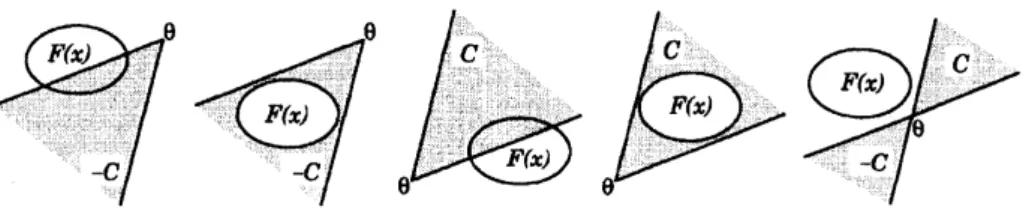
Figure 1: Five types of classification for comparison between the
zero
vector andeach image ofmultifunction with respect to
cones.
on
certain convexity assumptions like cone-subconvexlikeness in order to adopta
separation approach;
see
also $[2, 6]$ for alternative theorems of set-valued maps. Ifwe
look at this approach froma
different point of view,we
will know that thoseproofs
are
basedon a
linear scalarization like an inner product. On theone
hand,anonlinear scalarization for vector-valued functions was introduced and applied to
nonconvex separation theorems by Gerth (Tammer) and Weidner [5] in 1990, and
similar approaches have been taken for severalapplications in [1, 3, 4, 15, 16] but at
the
same
timewe
have researched some fundamental properties ofa
specific formofthose nonlinear scalarizations in $[13, 14]$
.
By using special scalarizing functionsunder this type of nonlinear scalarization,
we
establish alternative theorems forset-valued maps without any convexity assumption.
In this paper, based
on
comparison between a vector anda
set, we show fivetypes of alternative theorems for set-valued maps;
see
also [9] fora
comparisonmethod between two sets. When comparing the
zero
vector and each image ofa
set-valued map (multifunction) with respect to
a
given dominance cone, thereare
five types of relationships
as
illustrated in Figure 1. Under this basic policy, weestablish five types of alternative theorems 3.1-3.5 with respect to the interior of
a
convex cone
in thesense
of weak efficiency. Besides,we
present five types ofalternative theorems 3.6-3.10 with respect to the closure of
a
convexcone
in thesense
ofstrongefficiency.2
Nonlinear Scalarization
In thissection,we introduce anonlinear scalarizationforset-valued maps and show
some
properties that a characteristic function and scalarizing functions have.Let$X$ and $\mathrm{Y}$ be
a
nonempty set anda
topological vector space, $C$a
convex cone
in $\mathrm{Y}$ with its nonempty interior,and $F:Xarrow 2^{\mathrm{Y}}$ a set-valued map, respectively.
We
assume
that $C\neq$Y, which is equivalent toint$C\cap(-\mathrm{c}1C)=\emptyset$ (2.1)
To begin with, we define a characteristic function
$h_{c}(y;k):= \inf\{t : y\in tk-C\}$
where $k\in$ int$C$ and
moreover
$-h_{C}(-y;k)= \sup\{t : y\in tk+C\}$.
This function$hc(y;k)$ has been treated in
some
papers and which is regardedas
a
generalizationof the Tchebyshev scalarization. Essentially, $h_{c}(y;k)$ is equivalent to the smallest
strictly monotonic function defined by Luc in [11]. Note that $h_{c}(\cdot;k)$ is positively
homogeneous and subadditive for every fixed $k\in$ int$C$
.
Now,
we
givesome
useful properties of this function $h_{c}$.
Lemma 2.1 Let y $\in$ Y, then thefollowing statements hold:
(i)
If
$y\in$ -int$C$, then $hc(y;k)<0$for
all $k\in$ int$C$;(ii)
If
there exists $k\in$ int$C$ with $hc(y;k)<0,$ then $y\in$ -int$C$.
Proof. First we prove the statement (i). Suppose that $y\in$ -int$C$, then there
exists an absorbing neighborhood $V_{0}$ of 0 in $\mathrm{Y}$ such that
$y+V_{0}\subset$ -int$C$
.
Since6
is absorbing, for all $k\in$ int$C$, there exists $t_{0}>0$ such that $t_{0}k\in V_{0}$.
Therefore,$y+t_{0}k\in y$$+V\mathrm{Q}\subset$ -int$C$
.
Hence,we
have$\inf\{t : y\in tk-C\}\leq-t_{0}<0,$
which shows that $hc(y;k)<0.$
Next we prove the statement (ii). Let $y\in$ Y. Suppose that there exists
$k\in$ int$C$ such that $h_{C}(y;k)<0.$ Then, there exist $t_{0}>0$ and $c_{0}\in C$ such that
$y=-t_{0}k$ $-c_{0}=-(t_{0}k+c_{0})$
.
Since $t_{0}k\in$ int$C$ and $C$ isa
convex
cone,we
have$y\in-$intC.
1
Remark 2.1 By combining statements (i) and (ii)
a&Ove,
we
have the following:there exists k $\in$ intC such that $h_{C}(y;k)<0$
if
and onlyif
y $\in$ -intC.Lemma 2.2 Let y $\in$
Y’.
then thefollowing statements hold:(i)
If
$y\in-$cl$C$, then $h_{C}(y;k)\leq 0$for
all $k\in$ int$C$;(ii)
If
there exists $k\in$ int$C$ with $hc(y;k)\leq 0,$ then $y\in-$cl$C$.
Proof. First
we
prove the statement (i). Suppose that $y\in-$cl0.
Then, thereexist anet $\{y_{\lambda}\}\subset-C$such that yx converges to $y$
.
For each $!tx$, since $y\lambda\in 0\cdot$$k-C$for all $k\in$ int$C$, $hc(y_{\lambda};k)\leq 0$ for all $k\in$ int$C$
.
By the continuity of $h_{c}(\cdot;k)$,$hc(y;k)\leq 0$ for all $k\in$ int$C$
.
Next we prove the statement (ii). Let $y\in \mathrm{Y}_{\ulcorner}$ Suppose that there exists
it is clear that$y\in-$cl$C$
.
Sowe assume
that $hc(y;k)=0$ and showthat $y\in-$cl$C$.
By the definition of $hc$, for each $77=1,2$, $\ldots$, there exists $t_{n}\in R$ such that
$hc(y;k) \leq t_{n}<hc(y;k)+\frac{1}{n}$ (2.2)
and
$y\in t_{n}k-C$
.
(2.3)Prom (2.2), $\lim_{narrow\infty}t_{n}=0.$ Prom (2.3), thereexists $c_{n}\in C$ such that $y=t_{n}k-c_{n}$,
that is, $c_{n}=t_{n}k-$ !l. Since $c_{n}arrow-y$
as
$narrow\infty$, we have $y\in-$clC.1
Remark 2.2 By combining statements (i) and (ii) above,
we
have the following:there exists k $\in$ intC such that $h_{c}(y;k)\leq 0$
if
and onlyif
y $\in-\mathrm{c}1C$.
Lemma 2.3 Let$y\in \mathrm{Y}$, then thefollowing statements hold:
(i)
If
$y\in$ int$C$, then $hc(y;k)>0$for
all $k\in \mathrm{i}\mathrm{n}t$ $C_{f}$. (ii)If
$y\in \mathrm{c}1C$, then $hc(y;k)\geq 0$for
all $k\in \mathrm{i}\mathrm{n}\mathrm{t}$$C$.Thefollowinglemmashows (strictly) monotoneproperty
on
$hc(\cdot;k)$, which hasbeen investigated in [5] and [1].
Lemma 2.4 Let $y,\overline{y}\in \mathrm{Y}_{f}$ then thefollowing statements hold:
(i)
If
$y\in\overline{y}+$int$C$, then $h_{c}(y;k)>h_{c}(\overline{y};k)$for
all $k\in \mathrm{i}\mathrm{n}\mathrm{t}C$;(ii)
If
$y\in\overline{y}+cl$C. then $hc(y;k)\geq hc(\overline{y};k)$for
all $k\in \mathrm{i}\mathrm{n}\mathrm{t}C$.Lemma 2.5 Let $y,\overline{y}\in \mathrm{Y}$ and $k\in$ int$C$, then thefollowing statements hold: (i)
If
$h_{C}(y;k)>h_{C}(\overline{y};k)$, then $h_{C}(y-\overline{y};k)>0;$(ii)
If
$hc(y;k)\geq h_{c}(\overline{y};k)$, then $h_{C}(y-\overline{y};k)\mathrm{Z}$ $0$.
Remark 2.3 In the above lemma, we note that each converse does not hold.
Now,
we
consider several characterizations for images ofa
set-valued map bythe nonlinear and strictly monotone characteristic function $h_{C}$
.
We observe thefollowing four types of scalarizing functions:
(1) $\mathrm{A}\mathrm{C}\mathrm{r}(x; k):=\sup\{h_{C}(y;k) : y\in F(x)\}$ ,
(2) $\varphi_{C}^{F}(x;k):=\inf\{hc(y;k) : y\in F(x)\}$ ,
(3) $-fc-F(x;k)= \sup\{-h_{C}(-y;k) : y\in F(x)\}$,
(4) $-\psi_{C}^{-F}(x;k)=$inf$\{-hc(-y;k) : y\in F(x)\}$
.
Functions (1) and (4) have symmetric properties and then results for function
(4) $-\psi_{\overline{C}}^{F}$
can
be easily proved by those for function (1) $\psi \mathrm{r}$.
Similarly, the results for function (3) $-\varphi_{C}^{-F}$can
be deduced by those for function (2) $\varphi_{C}^{F}$.
By usingthese four functions
we measure
each image of set-valued map $F$ with respect toits 4-tuple ofscalars, which can be regarded
as
standpoints for the evaluation ofProposition 2.1 Let x $\in X,$ then the following statements hold:
(i)
If
$F(x)\cap$ (-int$C$) $\neq\emptyset$, then$\varphi_{C}^{F}(x;k)<0$for
all $k\in \mathrm{i}\mathrm{n}\mathrm{t}C$;(ii)
If
there exists $k\in \mathrm{i}\mathrm{n}\mathrm{t}C$ with $\varphi_{C}^{F}(x;k)<0,$ then $F(x)\cap$ (-int$C$) $\neq\emptyset$.
Proof. Let $x\in X$ be given. First we prove the statement (i). Suppose that
$F(x)$rl(-int$C$) $\neq \mathit{1}\mathit{3}.$ Then, there exists$y\in F(x)\cap$(-int$C$). By (i) of Lemma 2.1, for all $k\in$ int$C$, $h_{C}(y;k)<0,$ and hence, $\varphi_{C}^{F}(x;k)<0.$
Next we provethe statement (ii). Suppose that there exists $k\in$ int$C$ such that
$\varphi i(x;k)<0.$ Then, there exist $\epsilon_{0}>0$ and $y_{0}\in F(x)$ such that
$h_{C}(y_{0};k) \leq\inf_{y\in F(x)}h_{C}(y;k)+\epsilon_{0}<0.$
By (ii) ofLemma2.1, we have$y_{0}\in$ -int$C$, whichimpliesthat$F(x)\cap$(-int$C$)
$\neq\emptyset \mathrm{I}^{\cdot}$
Remark 2.4 By combining statements (i) and (ii) above, we have the following:
there exists k $\in$ intC such that $\varphi_{C}^{F}(x;k)<0$
if
and onlyif
$F(x)\cap$ (-int C) $\neq\emptyset$.
Proposition 2.2 Let x $\in X,$ then the following statements hold:
(i)
If
$F(x)\subset$ -int$C$ and $F(x)$ is a compact set, then $\psi_{C}^{F}(x;k)<0$for
all$k\in \mathrm{i}\mathrm{n}\mathrm{t}Cj$
(ii)
If
there eists $k\in$ int$C$ with $\psi_{C}^{F}(x;k)<0,$ then $F(x)\subset$ -int$C$.
Proof. Let $x\in X$ be given. First
we
prove the statement (i). Assume that $F(x)$is
a
compact set and suppose that $F(x)\subset$ -int$C$.
Then, for all $k\in$ int$C$,$F(x) \subset\bigcup_{t>0}(-tk-\mathrm{i}\mathrm{n}\mathrm{t}C)$
.
By the compactness of$F(x)$, there exist $t_{1}$,
$\ldots$,$t_{m}>0$ such that
$F(x) \subset\bigcup_{i=1}^{m}$($-t_{i}k$ –int$C$).
Since $-tq$k-int$C\subset-t_{p}$k-int$C$ for$t_{p}<t_{q}$, there exists$t_{0}:= \min\{t_{1}$,
.
.
.
’$t_{m}\}>0$such that $F(x)\subset-t_{0}k$ - int$C$. For each $y\in F(x)$, we have
$h_{c}(y;k)= \inf\{t:y\in tk-C\}\leq$ -tO.
Hence,
$\psi_{C}^{F}(x;k)=\sup_{y\in F(x)}h_{C}(y;k)\leq-t_{0}$ $<0.$
Next, we prove the statement (ii). Suppose that there exists $k\in$ int$C$ such
that $\psi_{C}^{F}(x;k)<0.$ Then, for all $y\in F(x)$, $hc(y;k)<0.$ By (ii) ofLemma 2.1, we
Remark 2.5 By combining statements (i) and (ii) above,
we
have the following: there exists $k\in$ int$C$ such that $\psi_{C}^{F}(x;k)<0$if
and onlyif
$F(x)\subset-$intC. Whenwe replace $F(x)$ in (i)
of
Proposition 2.2 by$\mathrm{c}1F(x)$, the assertion still remains.Moreover,
we can
replace (i) in Proposition 2.2 by another relaxed form.Corollary 2.1 Let $x\in X$ and assume that there exists a compact set $B$ such that
$B\subset$ -intC.
If
$F(x)\subset B-C,$ then $\psi_{C}^{F}(x;k)<0$for
all $k\in \mathrm{i}\mathrm{n}\mathrm{t}C$.
Proof. Let $x\in X,$ and
assume
that there existsa
compact set $B$ such that$B\subset$ -int$C$ and $F(x)\subset B-C.$ By applying (i) ofProposition 2.2 to $B$ instead
of $F(x)$, for all $k\in$ int$C$,
$\sup_{y\in B}h_{C}(yjk)<0.$
Since $F(x)\subset B-C,$ it follows from (i) of Lemma 2.1 and the subadditivity of
$h_{c}(\cdot;k)$ that
$h_{C}(y;k) \leq\sup_{z\in B}h_{C}(z;k)$
for each $y\in F(x)$
.
Therefore, $7\mathrm{c}(X1;k)<0$ for all $k\in$ intC.1
Proposition 2.3 Let $x\in X,$ then thefollowing statements hold:
(i)
If
$F(x)$ rl $(-\mathrm{c}1C)\neq\emptyset$, then $\varphi_{C}^{F}(x;k)\leq 0$for
all $k\in \mathrm{i}\mathrm{n}\mathrm{t}C$;(ii)
If
$F(x)$ is a compact set and there exists $k\in$ int$C$ with $\varphi_{C}^{F}(x;k)\leq 0,$ then$F(x)\cap$ (-cl$C$) $\neq\emptyset$
.
Proof. Let$x\in X$ and
we
prove thestatement (i). Suppose that $F(x)\cap(-\mathrm{c}1C)\neq$$\emptyset$
.
Then, there exists$y\in F(x)\cap(-\mathrm{c}1C)$
.
By (i) of Lemma 2.2, for all $k\in$ int$C$, $h_{c}(y; k)$ $\mathrm{S}0$, and hence $\varphi_{C}^{F}(x;k)\leq 0.$Next, we prove the statement (ii). Suppose that there exists $k\in$ int$C$ such
that $\varphi_{C}^{F}(x;k)\leq 0.$ In the
case
$\varphi_{C}^{F}(x;k)<0,$ from (ii) of Proposition 2.1, it isclear that $F(x)$ rl $(-\mathrm{c}1C)\neq\emptyset \mathit{3}$
.
Sowe
assume
that $\varphi_{C}^{F}(x;k)=0$ and show that$F(x)\cap(-\mathrm{c}1C)\neq\emptyset$
.
By the definition of $\varphi_{C}^{F}$, for each $n=1,2$,$\ldots$, there exist
$t_{n}\in R$ and $y_{n}\in$ $F(x)$ such that $y_{n}\in t_{n}k-C$ and
$\varphi_{C}^{F}(x;k)\leq t_{n}<\varphi_{C}^{F}(x;k)+\frac{1}{n}$. (2.4)
From (2.4), $\lim_{narrow\infty}t_{n}=0.$ Since $F(x)$ is compact,
we
may suppose that $y_{n}arrow y0$for
some
$y_{0}\in F(x)$ without loss of generality (taking subsequence). Therefore, $y_{n}-t_{n}karrow y_{0}$ and then $y0\in-\mathrm{c}1C$, which shows that $F(x)\cap(-\mathrm{c}1C)\neq\emptyset$.
I
Remark 2.6 By combining statements (i) and (ii) above, we have the following:
under the compactness
of
$F(x)$, there eists $k\in$ int$C$ such that $\varphi_{C}^{F}(x;k)\leq 0$if
and onlyif
$F(x)\cap(-\mathrm{c}1C)\neq\emptyset$.
Otherwise, there are counter-examples violatingthe statement (ii) such as an unbounded set approaching -cl$C$ asymptotically or
Proposition 2.4 Let x $\in X,$ then the following statements hold:
(i)
If
$F(x)\subset-$cl$C$, then $\psi_{C}^{F}(x;k)\leq 0$for
all $k\in$ int$C$;(ii)
If
there exists $k\in$ int$C$ with $\psi_{C}^{F}(x;k)\leq 0,$ then $F(x)\subset-\mathrm{c}1C$.Proof. Let $x\in X$ be given. First we prove the statement (i). Suppose that
$F(x)\subset-$cl$C$. Then, for each $y\in F(x)$, it follows from (i) of Lemma2.2 that
$hc(y;k)\leq 0$ for all $k\in$ int$C$, and hence $\psi_{C}^{F}(x;k)\leq 0$for all $k\in$ int$C$
.
Next, we prove the statement (ii). Suppose that there exists $k\in \mathrm{i}\mathrm{n}\mathrm{t}C$ such
that $\psi_{C}^{F}(x;k)\leq 0.$ Then, for all $y\in F(x)$, $h_{C}(y;k)\leq 0.$ By (ii) ofLemma 2.2, we
have $y\in-$cl$C$, and hence $F(x)\subset$ -cl$C$.
I
Remark 2.7 By combining statements (i) and (ii) afawe, we have the following:
there exists $k\in$ int$C$ such that $\psi_{C}^{F}(x;k)\leq 0$
if
and onlyif
$F(x)\subset-\mathrm{c}1C$.
3
Alternative Theorems
Inthissection, wepresentvarioustypes ofalternative theorems for set-valued maps
without any convexity. These alternative theoremsare fundamental tools to derive
optimality conditions for vector optimization problems with set-valued maps. As
stated in Introduction, there
are
five types ofrelationships between the zerovectorand each image ofa set-valued map with respect to a given dominance
cone.
First, we present five types of alternative theorems for set-valued maps when
wecompare each image of set-valued map with the
zero
vector with respect to theinterior ofa convex
cone.
Theorem 3.1 Let $X$ and $\mathrm{Y}$ be a nonempty set and a topological vector space, $C$
a convex cone in$\mathrm{Y}$ with its nonempty interior, and $F:Xarrow 2^{\mathrm{Y}}$ a set-valued map,
respectively. Then, exactly one
of
the following two systems holds:(I) There exists $x\in X$ such that $F(x)\cap$ (-int$C$) $\neq\emptyset$;
(II) There exists $k\in$ int$C$ such that $\varphi_{C}^{F}(x;k)\geq 0$
for
all $x\in X.$Proof. First, we
assume
that system (I) holds. Then, there exists $x\in X$ suchthat $F(x)\cap$(-int$C$) $\neq\emptyset$
.
By (i) of Proposition 2.1, $\varphi \mathrm{j}(x; k)$ $<0$ for all $k\in \mathrm{i}\mathrm{n}\mathrm{t}C$,which shows that system (II) does not hold.
Next, we
assume
that system (II) does not hold. Then, for all $k\in$ int$C$, thereexists $x\in X$ such that $\varphi_{C}^{F}(x;k)<0.$ By (ii) ofProposition 2.1, system (I) holds.
1
Theorem 3.2 Let $X$ and $\mathrm{Y}$ be a nonempty set and a topological vector space, $C$
a convex cone in $\mathrm{Y}$ with its nonempty interior, and $F:Xarrow 2^{\mathrm{Y}}$ a set-valued map,
respectively.
If
$F$ is compact-valuedon
$X$, then exactly oneof
the following two(I) There exists $x\in X$ such that $F(x)\subset$ -int$\mathit{0}_{i}$
(II) There exists $k\in$ int$C$ such that $\psi_{C}^{F}(x;k)\geq 0$
for
all $r\in X$.Proof. First,
we assume
that system (I) holds. Then, there exists $x\in X$ suchthat $F(x)\subset$ -int$C$
.
By (i) of Proposition 2.2, $\psi_{C}^{F}(x;k)<0$ for all $k\in$ int$C$,which shows that system (II) does not hold.
Next, we
assume
that system (II) does not hold. Then, for all $k\in$ int$C$, thereexists $x\in X$ such that $\psi_{C}^{F}(x;k)<0.$ By (ii) of Proposition 2.2, system (I) holds.
I
Corollary 3.1 Let$X$ and $\mathrm{Y}$ be a nonempty set and a topological vector space, $C$
a
convex
cone
in $\mathrm{Y}$ with its nonempty interior, and $F:Xarrow 2^{\mathrm{Y}}$ a set-valued map,respectively. Assume that
if
$F(x)\subset$ -int$C$, then there existsa
compact subset$B\subset$ -int$C$ such that $F(x)\subset B$ –C. Then, exactly
one
of
the following twosystems holds:
(I) There exists $x\in X$ such that$F(x)\subset$ -int$Cj$
(II) There exists $k\in$ int$C$ such that $\psi_{C}^{F}(x;k)\geq 0$
for
all $x\in X.$Proof. First, we
assume
that system (I) holds. Then, there exists $x\in X$ suchthat $F(x)\subset$ -int$C$
.
By Corollary 2.1, $\psi_{C}^{F}(x;k)<0$ for all $k\in$ int$C$, which showsthat system (II) does not hold.
Next,
we
assume
that system (II) does not hold. Then, for all $k\in$ int$C$, thereexists $x\in X$ such that $\psi_{C}^{F}(x;k)<0.$ By (ii) ofProposition 2.2, system (I) holds.
I
Theorem 3.3 Let $X$ and $\mathrm{Y}$ be a nonempty set and a topological vector space, $C$
a convex cone in $\mathrm{Y}$ with its nonempty interior, and$F:Xarrow 2^{\mathrm{Y}}$ a set-valued map,
respectively. Then, exactly
one
of
thefollowing trno systems holds:(I) There exists $x\in X$ such that $F(x)\cap$int$C\overline{\neq}$ $\emptyset$;
(II) There exists $k\in$ int$C$ such $that-\varphi_{\overline{C}^{F}}(x;k)\leq 0$
for
all$x\in X.$Proof. The proof is completed simply by replacing $F$ by $-F$ in the proof of
Theorem 3.1.
1
Theorem 3.4 Let $X$ and $\mathrm{Y}$ be a nonempty set and
a
topological vector space, $C$a convex cone in $\mathrm{Y}$ with its nonempty interior, and$F:Xarrow 2^{\mathrm{Y}}$ a set-valued map,
respectively.
If
$F$ is compact-valued on $X$, then exactlyone
of
the following twosystems holds:
(II) There exists $k\in$ int$C$ such $that-\psi_{C}^{-F}(x;k)\leq 0$
for
all $x\in X.$Proof. The proof is completed simply by replacing $F$ by $-F$ in the proof of
Theorem 3.2.
1
Corollary 3.2 Let $X$ and $\mathrm{Y}$ be a nonempty set and a topological vector space,
$C$ a convex cone in $\mathrm{Y}$ with its nonempty interior, and $F$ : $Xarrow 2^{\mathrm{Y}}$ a set-valued
map, respectively. Assume that
if
$F(x)\subset$ int$C$, then there exists a compact subset$B\subset$ int$C$ such that$F(x)\subset B+C$
.
Then, exactly oneof
thefollowing two systemsholds:
(I) There exists$x\in X$ such that $F(x)\subset$ int$C$;
(II) There exists $k\in$ int$C$ such ihat-$\mathrm{A}_{\overline{C}}^{F}(x;k)\leq 0$
for
all$x\in X.$Proof. The proof is completed simply by replacing $F$ by $-F$ in the proof of
Corollary 3.1.
1
Theorem 3.5 Let $X$ and $\mathrm{Y}$ be
a
nonempty set anda
topological vector space, $C$a
convex cone
in $\mathrm{Y}$ with its nonempty interior, and $F:Xarrow 2^{\mathrm{Y}}$ a set-valued map,respectively. Then, exactly one
of
thefollowing trno systems hOld8:(I) There exists $x$ $\in X$ such that $F(x)\cap$ (-int$C$) $\neq/)$ or $F(x)\cap \mathrm{i}\mathrm{n}\mathrm{t}C\neq\emptyset j$
(II) There exists $k\in$ int$C$ such that $\varphi_{C}^{F}(x;k)\geq 0$ and $-\varphi\overline{c}^{F}(x; k)$ $\leq 0$
for
all$x\in X.$
Proof. The proof is straightforward from the
same
way as the proofs ofTheO-rems 3.1 and 3.3.
1
Next, we present five types of alternative theorems for set-valued maps when
we compare each image of set-valued map with the
zero
vector withrespect to theclosure ofa convex cone.
Theorem 3.6 Let $X$ and$\mathrm{Y}$ be a nonempty set and a topological vector space, $C$
a
convex cone
in $\mathrm{Y}$ with its nonempty interior, and$F:Xarrow|$ $2^{\mathrm{Y}}$ a set-valued map,respectively.
If
$F$ is compact-valuedon
$X$, then exactlyone
of
the following twosystems holds:
(I) There exists$x\in X$ such that $F(x)\cap(-\mathrm{c}1C)\neq\emptyset$;
(II) There exists $k\in$ int$C$ such that $\varphi_{C}^{F}(x;k)>0$
for
all $x\in X.$Proof. First, we
assume
that system (I) holds. Then, there exists $x\in X$ suchthat $F(x)$ rl $(-\mathrm{c}1C)\neq\emptyset$
.
By (i) of Proposition 2.3, $\varphi \mathrm{j}(x; k)$ $\leq 0$ for all $k\in \mathrm{i}\mathrm{n}\mathrm{t}C$,which shows that system (II) does not hold.
Next,
we assume
that system (II) does not hold. Then, for all $k\in$ int$C$, thereexists $x\in X$ such that $\varphi_{C}^{F}(x;k)\leq 0.$ By (ii) ofProposition 2.3, system (I) holds.
Theorem 3.7 Let $X$ and $\mathrm{Y}$ be a nonempty set and a topological vector space, $C$
a convex cone in $\mathrm{Y}$ with its nonempty interior, and$F:Xarrow 2^{\mathrm{Y}}$ a set-valued map,
respectively. Then, exactly
one
of
the following two systems holds: (I) There exists $x\in X$ such that $F(x)\subset-$cl$C,\cdot$(II) There exists $k\in$ int$C$ such that $\psi_{C}^{F}(x;k)>0$
for
all $x\in X.$Proof. First,
we
assume
that system (I) holds. Then, there exists $x\in X$ suchthat $F(x)\subset-$cl$C$
.
By (i) ofProposition 2.4, $\psi_{C}^{F}(x;k)\leq 0$ forall $k\in$ int$C$, whichshows that system (II) does not hold.
Next,
we assume
that system (II) does not hold. Then, for all $k\in$ int$C$, thereexists $x\in X$ such that $\psi_{C}^{F}(x;k)\leq 0.$ By (ii) of Proposition 2.4, system (I) holds.
1
Theorem 3.8 Let $X$ and $\mathrm{Y}$ be a nonempty set and a topological vector space, $C$
a
convex cone in $\mathrm{Y}$ with its nonempty interior, and$F:Xarrow 2^{\mathrm{Y}}$a
set-valued map,respectively.
If
$F$ is compact-valuedon
$X$, then exactlyone
of
the following trnosystems holds:
(I) There exists $x\in X$ such that $F(x)$ rlcl$C\neq\emptyset$;
(II) There exists $k\in$ int$C$ such $that-\mathrm{C}\mathrm{P}\overline{c}^{F}(\mathrm{t}; k)$ $<0$
for
all $x\in X.$Proof. The proof is completed simply by replacing $F$ by $-F$ in the proof of
Theorem 3.6.
1
Theorem 3.9 Let $X$ and $\mathrm{Y}$ be a nonempty set and a topological vector space, $C$
a convex cone in $\mathrm{Y}$ with its nonempty interior, and $F:Xarrow 2^{Y}$
a
set-valued map,respectively. Then, exactly
one
of
thefollowing two systems holds:(I) $\mathrm{I}^{\mathrm{Y}}here$ exists $x\in X$ such that $F(x)\subset \mathrm{c}1c_{i}$
(II) There exists $k\in$ int$C$ such $that-\psi_{\overline{C}}^{F}(x;k)<0$
for
all$x\in X.$Proof. The proof is completed simply by replacing $F$ by $-F$ in the proof of
Theorem 3.7.
1
Theorem 3.10 Let $X$ and $\mathrm{Y}$ be a nonempty set and a topological vector space, $C$
a convex cone in $\mathrm{Y}$ with its nonempty interior, and $F:Xarrow 2^{\mathrm{Y}}$ a set-valued map,
respectively.
If
$F$ is compact-valued on $X$, then exactly oneof
the following twosystemsholds:
(I) There exists $x\in X$ such that $F(x)\cap(-\mathrm{c}1C)\neq\emptyset$
or
$F(x)\cap \mathrm{c}1C\neq\emptyset j$(II) There exists $k\in$ int$C$ such that $\varphi_{C}^{F}(x;k)>0$ and $-\varphi_{C}^{-F}(x;k)<0$
for
all$x\in X.$
Proof. The proof is straightforward from the
same
wayas
the proofs of4
Optimality
Conditions
Throughout this section, let $X$ be a nonempty set, and let $\mathrm{Y}$ and $Z$ be ordered
topological vector spaces with
convex cones
$C$ and $D$, respectively. Weassume
that $C\neq \mathrm{Y}$ and int$C4$ $\emptyset$
.
Let $F$ : $Xarrow 2^{Y}$ and $G:Xarrow 2^{Z}$ be set-valued maps.A constrained set-valued optimization problem is written as
(MP) $\min_{K}$ $F(x)$
subject to $G(x)\cap(-D)!-$ $\emptyset)$,
where $K$ is a
convex
cone in $\mathrm{Y}$ The feasible set of problem (MP) is definedby $V=\{x\in X : G(x)\cap(-D))^{1}\emptyset\}$
.
Problem (MP) is to find all solutions$x_{0}\in V$ such that there exists $y_{0}\in F(x_{0})$ and for each $x\in V,$ there exists
no
$y\in F(x)$ satisfying $y_{0}\in y+K\backslash \{0_{\mathrm{Y}}\}$
.
Such solution $x_{0}$ is called an efficientsolution ofproblem (MP) withrespect to $K$, and in
case
ofint$K$ instead of$K$, itssolution is called a weakly efficient solution (traditionally in vector optimization).
Since the constraint in problem (MP) is reduced to $G(x)\leq 0$ when $G$ is a
real-valued function and $D$ is the
cone
of nonnegative reals, it is a generalization ofthe inequality constraints of a standard nonlinear programming problem. Thus,
we
consider the followingoptimization problems:(MP1) intC $F(x)$ subject to $G(x)\cap(-D)\mathit{1}^{\overline{l}}$ $\emptyset$;
(MP2) $\min_{C}F(x)$ subject to $G(x)\cap(-D)\neq lJ$
.
Definition 4.1 A point $x_{0}\in V$ is said to be a weakly
efficient
solution of (MP1)ifthere exists $y_{0}\in F(x_{0})$ and for each $x\in V,$ there exists
no
$y\in F(x)$ satisfying$y_{0}\in y+\mathrm{i}\mathrm{n}\mathrm{t}C$, that is,
$F(V)\mathrm{I}$ ”
$(y_{0}-\mathrm{i}\mathrm{n}\mathrm{t}C)=\emptyset$; (4.1)
A pair $(x_{0}, y_{0})$ is said to be a weakly
efficient
element for (MP1) if $x_{0}\in V$ and$y_{0}\in F(x_{0})$ satisfies (4.1).
Definition 4.2 A point $x_{0}\in V$ is said to be an
efficient
solution of (MP2) ifthere exists $y_{0}\in F(x_{0})$ and for each $x\in V,$ there exists
no
$y\in F(x)$ satisfying$y_{0}\in y+C\backslash \{0_{\mathrm{Y}}\}$, that is,
$F(V)\cap(y_{0}-C\mathrm{S}\{0_{\mathrm{Y}}\})=\emptyset$; (4.2)
Apair $(x_{0,10})$ is said to be an
efficient
element for (MP2) $\mathrm{i}\mathrm{f}x\circ\in V$ and $y_{0}\in F(x_{0})$satisfies (4.2).
Definition 4.3 Let $k\in$ int$C$
.
Consider the following scalar minimization problem$\min_{x\in V}\varphi \mathrm{j}(x;k)$
.
(4.3)Let $x_{0}\in V$ be given. Then,
a
pair $(x_{0}, y_{0})$ is said to be an optimal elementfor the(i) $\varphi_{C}^{F}(x;k)\geq\varphi_{C}^{F}(x_{0};k)$ for all $x\in V;$
(ii) $/\mathrm{c}(x_{0}; k)=hc(y0;k)$ and $y0\in F(x_{0})$
.
Remark 4.1 Under k $\in \mathrm{i}\mathrm{n}\mathrm{t}$C, we have thefollowing:
a
pair $(x_{0}, y\circ)$ is an optimalelement
for
(4.3)if
and onlyif
$x_{0}\in V$ and $y_{0}\in F(x_{0})$satisfies
$h_{c}(y;k)\geq h_{C}(y_{0};k)$
for
all $y\in F(V)$.
Definition 4.4 Let $k\in$ int$C$
.
Consider problem (4.3). Let $x_{0}\in V$ be given.Then,
a
pair $(x_{0}, y_{0})$ is said tobe a strictoptimal elementif thefollowing conditionshold:
(i) $\varphi_{C}^{F}(x;k)>\varphi_{C}^{F}(x\circ;k)$ for all $x\in V\backslash \{x_{0}\}$;
(ii) $j_{C(x_{0};k)=hc(y0;k)\mathrm{a}\mathrm{n}\mathrm{d}}^{F}$ $y0$ $\in F(x_{0}))$
.
(iii) $hc(y;k)>hc(y0;k)$ for all $y\in F(x_{0})\backslash \{y_{0}\}$
.
Remark 4.2 Under k $\in \mathrm{i}\mathrm{n}\mathrm{t}$C,
we
have the following: a pair $(x_{0}, y_{0})$ is a strictoptimal element
for
(4.3)if
and onlyif
$x_{0}\in V$ and $y_{0}\in F(x_{0})$satisfies
$h_{c}(y;k)>h_{c}(y_{0};k)$,
for
all $y\in F(V)\mathrm{s}$ $\{y_{0}\}$.Theorem 4.1 (Sufficient condition for (MP1).) Let$\overline{x}\in V$ and$\overline{y}\in F(\overline{x})$
.
If
thereexists $k\in$ int$C$ such that $(\overline{x},\overline{y})$ is
an
optimal elementfor
(4.3), then $(\overline{x},\overline{y})$ is $a$weakly
efficient
elementfor
(MP1).Proof. Assume that $(\overline{x},\overline{y})$ is not
a
weakly efficient element for (MP1). Then, there exist $x\in V$ and $y\in F(x)$ such that $\overline{y}\in y+\mathrm{i}\mathrm{n}\mathrm{t}$C. Since $k\in$ int$C$, it followsfrom (i) of Lemma 2.4 that $h_{c}(\overline{y};k)>h_{C}(y;k)$. By Remark 4.1, it contradicts the
assumption that $(\overline{x},\overline{y})$ is an optimal element for (4.3).
1
Theorem 4.2 (Necessary and sufficient condition for (MP1).) Let $\overline{x}\in V$ and
$\overline{y}\in F(\overline{x})$
.
Then $(\overline{x},\overline{y})$ is a weaklyefficient
elementfor
(MP1)if
and onlyif
thereexists $k\in$ int$C$ such that $h_{C}(y-\overline{y};k)\geq 0$
for
all$y\in F(V)$.Proof. Suppose first that $(\overline{x},\overline{y})$ is
a
weakly efficient element for (MP1). Bydefinition,
we
have $(F(V)-\overline{y})\cap$(-int$C$) $=\emptyset$.
By applying Theorem3.1to $F(V)-\overline{y}$instead of$F(x)$, there exists $k\in \mathrm{i}\mathrm{n}\mathrm{t}C$ such that $hc(y-\overline{y};k)\geq 0$ for all$y\in F(V)$
.
Conversely, supposethat thereexists $k\in$ int$C$such that $hc(y-\overline{y};k)\mathit{2}$ $0$ for all $y\in F(V)$
.
Assume that $(\overline{x},\overline{y})$ is nota
weakly efficient element for (MP1). Then, thereexist$x\in V$ and$y\in F(x)$ such that $y-\overline{y}\in$ -int$C$.
Since $k\in$ int$C$, itfollowsTheorem 4.3 (Sufficient condition for (MP2).) Let$\overline{x}\in V$ and $\overline{y}\in F(\overline{x})$
.
If
thereexists $k\in$ int$C$ such that $(\overline{x},\overline{y})$ is a strict optimal element
for
(4.3), then $(\overline{x},\overline{y})$ isan
efficient
elementfor
(MP2).Proof. By applying the
same
argumentas
the proof of Theorem 4.1 to problem(MP2), the proof is straightforward from (ii) of Lemma 2.4 and Remark 4.2.
1
Theorem 4.4 (Necessary and sufficient condition for (MP2).) Let $\overline{x}\in V$ and
$\overline{y}\in F(\overline{x})$ .
If
$F$ is compact-valued on $V$ and$C$ is closed, then $(\overline{x},\overline{y})$ isan
efficient
elementfor
(MP2)if
and onlyif
there exists $k\in$ int$C$ such that $h_{c}(y-\overline{y};k)>0$for
all $y\in F(V)\backslash \{\overline{y}\}$.
Proof. For problem (MP2), by using the
same
argumentas
the proof ofThe-orem 4.2, it follows from Theorem 3.6 that the necessity is shown. By (i) of
Lemma 2.2,
we
can also show the sufficiency.I
5
Conclusions
Basedon anonlinear scalarizationtechniqueforsets,
we
establish fivetypesofalter-native theorems for set-valued maps without any convexity assumption. Moreover,
we
obtain optimality conditions for set-valued optimization problems.References
[1] G. Y. Chen andX. Q. Yang, Characterizations of Variable Domination
Struc-tures viaNonlinear Scalarization, J. Optim. Theory Appl. 112 (2002), 97-110.
[2] O. Ferrero, Theorems ofthe Alternative for Set-Valued Functions in
Infinite-Dimensional Spaces, Optimization 20 (1989), 167-175.
[3] P. G. Georgiev and T. Tanaka, Vector-Valued Set-Valued Variants ofKyFan’s
Inequality, J. Nonlinear Convex Anal. 1 (2000), 245-254.
[4] P. Gr. Georgiev and T. Tanaka, Fan’s Inequality for Set-Valued Maps,
Non-linear Anal. 47 (2001),
607-618.
[5] C. Gerth and P. Weidner, Nonconvex Separation Theorems and Some
Appli-cations in Vector Optimization, J. Optim. Theory Appl. 67 (1990), 297-320.
[6] F. Giannessi, Theorems ofthe Alternative for Multifunctions with
Applica-tions to Optimization: General Results, J. Optim. Theory Appl. 55 (1987),
233-256.
[7] R. B. Holmes, Geometric Fhnctional Analysis and its Applications,
[8] V. Jeyakumar, A Generalization ofa MinimaxTheorem ofFan viaa Theorem
of the Alternative, J. Optim. Theory Appl. 48 (1986), 525-533.
[9] D. Kuroiwa, T.Tanaka, andT.X.D. Ha, On
cone
convexityof set-valuedmaps,Nonlinear Anal. 30 (1997), 1487-1496.
[10] Z. Li, A Theorem of the Alternative and Its Application to the Optimization
of Set-Valued Maps, J. Optim. Theory Appl. 100 (1999), 365-375.
[11] D. T. Luc, Theory
of
Vector Optimization, Lecture Note in Economics andMathematical Systems, 319, Springer, Berlin, 1989.
[12] S. Nishizawa andT. Tanaka, On Inherited PropertiesforSet-ValuedMapsand
Existence Theorems for Generalized Vector Equilibrium Problems, to appear
in J. Nonlinear Convex Anal. (2004).
[13] S. Nishizawa, T. Tanaka and P. Gr. Georgiev, On Inherited Properties of
Set-Valued Maps, in NonlinearAnalysis and Convex Analysis, W. Takahashi and
T. Tanaka (eds.), Yokohama Publishers, Yokohama, 2003, pp.341-350.
[14] S. Nishizawa, T. Tanaka and P. Gr. Georgiev, On Inherited Properties for
Vector-Valued Multifunctions, in Multi-Objective Programming and
Goal-Programming, T. Tanino, T. Tanakaand M. Inuiguchi (eds.), Springer, Berlin,
2003, pp.215-220.
[15] C. Tammer, A Generalization of Ekeland’s VariationalPrinciple, Optimization
25
(1992), 129-141.[16] C. Tammer, Stability Results for Approximately Efficient Solutions, OR
Spec-trum 16 (1994), 47-52.
[17] X. M. Yang, X. Q. Yang and G. Y. Chen, Theorems of the Alternative and
OptimizationwithSet-Valued Maps, J. Optim. TheoryAppl. 107 (2000),