Optimal
Portfolio
Selection
by
CVaR-Based
Sharpe
Ratio
Sequential Linear Programming Approach
Shan LIN
(
林
杉)
and
Masamitsu
OHNISHI
(
大西 匡光)
Graduate School of
Economics,
Osaka
University
(
大阪大学大学院・経済学研究科
)
1
Introduction
We address an optimal portfolio selection problem ofmaximizingso wecall CVaR (Conditional
$\mathrm{V}\mathrm{a}\mathrm{l}\mathrm{u}\mathrm{e}-\mathrm{a}\mathrm{t}-\mathrm{R}\mathrm{i}\mathrm{s}\mathrm{k})$-based Sharpe ratio of portfolio’s return rate, which is defined as the ratio
of the expected
excess
return to CVaR. The Sharpe ratio definedas
the ratio of expectedexcess
return tostandard deviation, the mostcommon
traditional performancemeasure, takesstandard deviation as a risk measure, however its has beenreceived a lot ofcriticisms. In our CVaR-basedSharpe ratio, thestandarddeviation is replaced withCVaR, which is aremarkable coherent risk
measure
whichovercomes
essential defects ofstandard deviation. Althoughour
new performancemeasure
is expected to enlarge the applicablearea
of practical investment problems for which the original Sharperatio is not suitable,however, weshould device effective computational methods to solve optimal portfolio selection problems with very large number ofinvestment opportunities.In order to deal with rather complicated
non-concave
objective function, whichcomes fromthe introduction of CVaR,
we
propose the following SLP (Sequential Linear Programming) approach: By introducing a real parameter, we make thenon-concave
maximization problem to a parametric family ofconcave
maximization problems. Then, for each of these problems, utilizing the results of Rockafellar and Uryasev (2000),we
introduce an auxiliary decisionvariable
to obtain a tractableconcave
maximization proble1n. Furthermore, ifwe
estimate orapproximate required expected values bysamplingmethods orhistoricaldata,
we
can reduce the parametricconcave
maximizationproblems to LP (Linear Programming) problems. Therefore,our problem could be finally reduced to a sequence of LP problems. Numerical experiments from real Japanesefinancial data are conductedto test our SLP approach.
The
paper
is organized as follows. In Section 2, we introduce downside riskmeasures:
$\mathrm{V}\mathrm{a}\mathrm{R}$ and CVaR, in Section 3,
we
make a brief review of parametric approach to fractionalprogramming. Sample approach will be presented in Section 4. Further, in Section 5 an empirical study is given.
2
VaR and
CVaR
Let $\tilde{r}$denote arandom variable denoting a rate of return on an asset or a portfolio of assets.
Value at Risk $(\mathrm{V}\mathrm{a}\mathrm{R})$ of
$\overline{r}$with confidence level $\beta\in[0,1]$, denoted
negative of $(1-\beta)$-quantile of$\overline{r}.\cdot$
$\mathrm{V}\mathrm{a}\mathrm{R}_{\beta}[\neg r$ $:=$ $- \inf\{r\in \mathbb{R} : \mathrm{P}(\overline{r}\leq r)\geq 1-\beta\}$
$=$ $\sup\{u\in \mathbb{R} : \mathrm{P}(-\mathrm{r}\geq u)\geq 1-\beta\}$. (1)
ConditionalValue at Risk (CVaR) of $\overline{r}$with confidence level
$\beta\in[0,1]$, denoted $\mathrm{C}\mathrm{V}\mathrm{a}\mathrm{R}_{\beta}[\urcorner r$,
is then defined as follows:
$\mathrm{C}\mathrm{V}\mathrm{a}\mathrm{R}_{\beta}[\neg r:=\frac{1}{1-\beta}\int_{0}^{1-\beta}.\mathrm{V}\mathrm{a}\mathrm{R}_{\alpha}[\hat{r}]\mathrm{d}\alpha.$ (2) It can be shown that
$\mathrm{C}\mathrm{V}\mathrm{a}\mathrm{R}_{\beta}[\neg r=\frac{1}{1-\beta}\mathrm{E}$[$-\overline{r}\cdot-)r-\geq \mathrm{V}\mathrm{a}\mathrm{R}_{\beta}[r\urcorner]-\mathrm{V}\mathrm{a}\mathrm{R}\mathrm{O}[\mathrm{r}]$
{
$\mathrm{P}$(-r$\geq \mathrm{V}\mathrm{a}\mathrm{R}_{\beta}$[$r\neg)-(1-\beta)$
}
, (3) where $\mathrm{E}[Y;\mathrm{A}]$ denotes the partial expectation of a random variable $Y$ onan
event $A$; that is$\mathrm{E}[Y\cdot a]\};=\mathrm{E}[Y1_{A}]$. Although this expression is somewhat complex, if
$\mathrm{P}$$(-\overline{r}\geq \mathrm{V}\mathrm{a}\mathrm{R}_{\beta}[\neg r )=1-\beta$, (4)
then the second term vanishes and it becomes
$\mathrm{C}\mathrm{V}\mathrm{a}\mathrm{R}_{\beta}[\neg r=\frac{1}{1-\beta}\mathrm{E}[-\overline{r},\cdot-\overline{r}\geq \mathrm{V}\mathrm{a}\mathrm{R}_{\beta}[\neg r ]=\mathrm{E}$[$-\neg r-\overline{r}\geq \mathrm{V}\mathrm{a}\mathrm{R}_{\beta}[r\neg]$ (5)
Average Value at Risk (AVaR), Expected Shortfall (ES), Tail Conditional Expectation (TCE), andothersaresimilar concepts, not few researchers preferoneoftheseterms toCVaR, but these become identical when the above condition holds (whose sufficient condition is the continuity of cumulative distribution function (cdf) of$\gamma r$
.
A veryuseful characterization is obtained by Pflug (2000), Uryasev (2000), and Rockafellar
and Uryasev $(2000, 2001)$. Let
us
introducea
function:$F_{\beta}(a,\cdot\gamma r$ $:=a+ \frac{1}{1-\beta}\mathrm{E}[(-\tilde{r}-a)^{+}]$, $a\in \mathbb{R}$, (6)
then the following theorem holds (for
a
real number $c\in \mathbb{R}$, ($c \rangle^{+}:=\max\{c, 0\}$ is the positivepart of$c$).
Theorem 1.
(1) $\mathrm{C}\mathrm{V}\mathrm{a}\mathrm{R}\beta[\neg r$ coincides with the minimum of function $F_{\beta}(\cdot;\overline{r})$:
$\mathrm{C}\mathrm{V}\mathrm{a}\mathrm{R}_{\beta}[\neg r’=\min\{F_{\beta}(a,\cdot r\gamma :a\in \mathbb{R}\}$. (7)
(2) The minimum offunction $F_{\beta}(\cdot;\tilde{r})$is attained at when the variable is equal to
$\mathrm{V}\mathrm{a}\mathrm{R}_{\beta}[\neg r$:
$\min\{F_{\beta}(a;\overline{r}) : a\in \mathbb{R}\}=F_{\beta}(\mathrm{V}\mathrm{a}\mathrm{R}_{\beta}[\tilde{r}(x)];r\gamma$ . (8)
(3) $F_{\beta}(a;\tilde{r})$ is convex both in $a\in \mathbb{R}$ and $\overline{r}$
.
$\square$
Now let
us
consider a portfolio optimization of investments in financial assets numbered$\bullet$ $r-i$, $\mathrm{i}=1$,$\cdots$ ,$n$: the random rate of return on financial asset ;
$\bullet$ $\overline{r}_{i}:=\mathrm{E}[\overline{r_{i}}]$, $\mathrm{i}=1$,$\cdots$ ,$n$: the mean (or expected) rate of return
on
financial asset $\mathrm{i}$; $\bullet$ $x_{i}(\in \mathbb{R})$, $\mathrm{i}=1$,$\cdots$ ,$n$: aportfolio weight, that is, aproportion ofinvestment in financialasset $\mathrm{i}$;
$\bullet$ $r-.–$ $(\tilde{r}_{1}, \cdots,\overline{r}_{n})^{\mathrm{T}}$: the random vector ofreturn rates on financial assets $\mathrm{i}=1$,$\cdots$ ,$n,\cdot$
$\bullet$ $\overline{r}:=(\overline{r}_{1}, \cdots)$$\overline{r}_{n})^{\mathrm{T}}$: the vector ofmean return rates on financial assets $\mathrm{i}=1$,$\cdots$ ,$n$;
$\bullet$ $x:=$ $(x_{1}, \cdots, x_{n})^{\mathrm{T}}$: the portfolio of investment proportions in financial assets
$\mathrm{i}=$
1,$\cdots$ ,$n$.
Further
we
let$\mathrm{r}(\mathrm{x})$ $:=$ $\tilde{r}^{\mathrm{T}}x=\sum_{l=1}^{n}\overline{r_{i}}x_{i)}$. (9)
$\mathrm{r}(\mathrm{x})$ $:= \mathrm{E}[\overline{r}(x)]=\mathrm{E}[\tilde{r}^{\mathrm{T}}x]=\sum_{i=1}^{n}\mathrm{E}[\tilde{r}_{i}]x_{i}=\overline{r}^{\mathrm{T}}x=\sum_{i=1}^{n}\overline{r}:x_{0}$
.
(1)Theabovetheoremisparticularlyuseful whenwe mustconsider the minimization of$\mathrm{C}_{J}\mathrm{V}\mathrm{a}\mathrm{R}_{\beta}[\overline{r}(x)]$ ofreturn rate $\mathrm{r}(\mathrm{x})$ on portfolio $x$. According to the definition of $\mathrm{C}\mathrm{V}\mathrm{a}\mathrm{R}_{\beta}[\overline{r}(x)]$, for every eval-uation of the objective function at $x\in X$, we must evaluate the values in the order:
(1) $\mathrm{V}\mathrm{a}\mathrm{R}_{\beta}[\overline{r}(x)]$ $\supset$ (2) $\mathrm{C}\mathrm{V}\mathrm{a}\mathrm{R}_{\beta}[\tilde{r}(x)]$, (11) but these are tremendous tasks. The following theorem implies that the evaluation and
mini-mization of $\mathrm{C}\mathrm{V}\mathrm{a}\mathrm{R}_{\beta}[\tilde{r}(x)]$can be done by the simultaneous minimization of function $\Gamma\prec(a;\overline{r}(x))$ with respect to the original decision variable $x\in X$ and
an
auxiliary variable $a\in \mathbb{R}$.Theorem 2. (1)
$\min\{\mathrm{C}\mathrm{V}\mathrm{a}\mathrm{E}_{\beta}[\overline{r}(x)] :x\in X\}$$= \min\{F\beta(a;\overline{r}(x)) : a\in \mathbb{R},\cdot x\in X\}$. (12)
(2) For $x^{*}\in X$,
$\min\{\mathrm{C}\mathrm{V}\mathrm{a}\mathrm{R}_{\beta}[\overline{r}(x)] :x\in X\}$$=\mathrm{C}\mathrm{V}\mathrm{a}\mathrm{R}\beta[\overline{r}(x^{*})]$ (13)
ifand only if
$\min\{F_{\beta}(a;\tilde{r}(x)) :a\in \mathbb{R}_{\mathrm{j}}x\in X\}=F_{\beta}(\mathrm{V}\mathrm{a}\mathrm{R}_{\beta}[\tilde{r}(x^{*})];\overline{r}(x^{*}))$ . (14)
(3) $F_{\beta}(a;\tilde{r}(x))$ is
convex
both in$a\in \mathbb{R}$ and $x\in X$.
$\square$ Accordingly, the original convex program ming problem with $n+1$ decision variables;
$|\mathrm{M}\mathrm{i}\mathrm{n}\mathrm{i}\mathrm{m}\mathrm{i}\mathrm{z}\mathrm{z}\mathrm{e}\mathrm{s}\mathrm{u}\mathrm{b}\mathrm{j}\mathrm{e}\mathrm{c}\mathrm{t}\mathrm{t}\mathrm{o}$ $x\in X\mathrm{C}\mathrm{V}\mathrm{a}\mathrm{R}_{\beta},[\tilde{r}(x)]$ (15)
couldbe reduced to the following
convex
programming problem with $n+1$ decision variables; $|\mathrm{s}\mathrm{u}\mathrm{b}\mathrm{j}\mathrm{e}\mathrm{c}\mathrm{t}\mathrm{t}\mathrm{o}\mathrm{M}\mathrm{i}\mathrm{n}\mathrm{i}\mathrm{m}\mathrm{i}\mathrm{z}\mathrm{z}\mathrm{e}$ $x \in’ Xa\in \mathbb{R}_{j}F_{\beta}(a\cdot\overline{r,}(x)).--a+\frac{1}{1-\beta}\mathrm{E}[(-\tilde{r}(x)-a)^{+}]$ (16)3
Fractional
Programming
Let
us
consider a fractional programming problem formulatedas
follows: [P] $|\mathrm{s}\mathrm{u}\mathrm{b}\mathrm{j}\mathrm{e}\mathrm{c}\mathrm{t}\mathrm{t}\mathrm{o}\mathrm{M}\mathrm{a}\mathrm{x}\mathrm{i}\mathrm{m}\mathrm{i}\mathrm{z}\mathrm{e}x\in Xh(x).--$,
$\frac{f(x)}{g(x)}$
(1)
where
$\bullet x=(x_{1}, \cdots, x_{n})^{\mathrm{T}}$:
$\bullet$ $X\subset \mathbb{R}^{n}$: a
convex
and compact constraint set;$\bullet$ $f$ : $X-arrow \mathbb{R}$: a continuous function on $X$;
$\bullet$ $g$ : $Xarrow \mathbb{R}_{++}:$ a continuous positive-valued function on $X$. $\bullet$ $h$ : $Xarrow \mathbb{R}$: a continuous function
on
$X$.
If
(A1) $f$: a linear (or, more generally, concave) function on $X$;
(A2) $g$: a convex function on $X$
then
$h:=f/g$ : $Xarrow \mathbb{R}$ : a($\mathrm{n}$ essentially) quasi-concavefunction on $X$ (2)
because, for a (nonnegative) level $z\in \mathbb{R}_{+}$, the level set
$L_{h}(z)$ $:=$ $\{x\in X : h(x)\geq z\}$
$=$ $\{x\in X : f(x)-zg(x)\geq 0\}$ : a
convex
set in $\mathbb{R}^{n}$ (3) which isdue tof-zg. $Xarrow \mathbb{R}$ :
a concave
function on X. (4)Now, by introducing areal parameter $z\in \mathbb{R}$, let us consider $[\mathrm{Q}(z)]$ $|\mathrm{s}\mathrm{u}\mathrm{b}\mathrm{j}\mathrm{e}\mathrm{c}\mathrm{t}\mathrm{t}\mathrm{o}\mathrm{M}\mathrm{a}\mathrm{x}\mathrm{i}\mathrm{m}\mathrm{i}\mathrm{z}\mathrm{e}$ $x\in.Xu(x,z)$
, (5)
where, for each $z\in \mathbb{R}$, we define
$u(x;z):=f(x)-zg(x)$ : $Xarrow \mathbb{R}$ (6)
Since, for any $z\in \mathbb{R}$, the function $u(x;z)$ is a continuous function of$x\in X$, and $X\in \mathbb{R}^{n}$ is a
compactset, byWeierstrassTheorem, theproblem $\mathrm{Q}(z)$ has anoptimalsolution, say$x(z)\in X$,
$\mathrm{F}\mathrm{u}\mathrm{r}\mathrm{t}\mathrm{l}\uparrow\circ \mathrm{r}$Let us define theoptimal
value function by
$v(z)$ $:= \max\{u(x;z) : x\in X\}$
$=$ $\max\{f(x)-zg(x) : x\in X\}$ $=$ $\{f(x(z))-zg(x(z))$, $z\in \mathbb{R}$.
Since,for each$x\in X$, $u(x;z)=f(x)-zg(x)$ is amonotonedecreasinglinear function of$z\in \mathbb{R}$,
and $v(z)$ is a function composed of pointwise maximum of such linear $\mathrm{f}\mathrm{u}\acute{\mathrm{n}}$
ctions, we conclude
$v(z)$ is
a
(possibly non-smooth) monotone decreasingconvex
function $z\in \mathbb{R}$. Furtherm ore itis noted that asub-differential (aslope) of the function $v(z)$ at $z\in \mathbb{R}$ is given by $-g(x(z))$,
that is, let $z’\in \mathbb{R}$ be another point, then
$v(z’)-v(z)$ $=$ $\max\{f(x)-z’g(x) : X\in X\}-\max\{f(x)-zg(x)|.x\in X\}$
$=$ $\max\{f(x)-z’g(x) : X\in X\}-\{f(x(z))-zg(x(z))$
$\geq$ $\{f(x(z))-z’g(x(z))\}-\{f(x(z)-zg(x(z))$
$=$ $\{-g(x(z))\}(z’-z)$, $z’\in$ R. (7)
Therefore, a supporting line at $(z, v(z))$ is represented by
$v’=\{-g(x(z))\}(z’-z)+v(z)$, $(z’, v’)\in \mathbb{R}^{2}$. (8)
It is noted that the zero ofthe above linear function is
$z^{\mathit{4}}= \frac{f(x)}{g(x)}$. (9)
In the theory offractional programming, the followingtheorem is known.
Theorem 3. The following two statements
are
equivalent;(SI) For the problem $\mathrm{P}$, $z^{*}\in \mathbb{R}$ is the optimal value and $x^{*}\in X$ is
an
optimal solution, thatis,
$z^{*}= \max\{\frac{f(x)}{g(x)}$ : $x \in X\}=\frac{f(x^{*})}{g(x^{*})}$
.
(10)(S2) For $z^{*}\in \mathbb{R}$, $x^{*}\in X$ is
an
optimal solution of $\mathrm{Q}(z^{*})7$ and itsoptimal value is 0, that is, $v(z^{*})= \max\{f(x)-z^{*}g(x) : X\in X\}=f(x^{*})-z^{*}g(x^{*})=0$. (11)$\square$
This theorem implies the fractional programming problem (P) is reduced to the nonlinear equation with one unknown variable: Find
a
zero
point of (possibly)non-smooth
optimal value function $v$ :$\mathbb{R}arrow \mathbb{R}$ ofthe family ofmaximization problems ofconcave
functions$u(x;z)$subject to $x\in X$ with a real parameter $z\in \mathbb{R}$:
[NLE] $|\mathrm{F}\mathrm{i}\mathrm{n}\mathrm{d}z^{*}\in \mathbb{R}$ suchthat $v(z^{*})=0$. (12)
And it also suggests a numerical procedure for finding the optimal solution of the fractional programming problem (P)
Dinkelbach (1962) reduces the solution of a linear fractional programming problem to the solution , a sequence of linear programming problems. The method is general in
as
muchas
it canbe pplied even when we have aratio of functions that not necessarily linear. The$\beta$ ewton algorithm for solving NLE becomes
as
followsAlgorithm 1 (Newton Method).
Step 0: (Initialization) Set $karrow \mathrm{O}$ and $z^{0}\in \mathbb{R}_{+}$ arbitrarily.
Step 1: For $z^{k}\in \mathbb{R}_{+}$, solve
$[\mathrm{Q}(z^{k})]$ $|\mathrm{s}\mathrm{u}\mathrm{b}\mathrm{j}\mathrm{e}\mathrm{c}\mathrm{t}\mathrm{t}\mathrm{o}\mathrm{M}\mathrm{a}\mathrm{x}\mathrm{i}\mathrm{m}\mathrm{i}\mathrm{z}\mathrm{e}$ $u(x;z^{k})x\in X,:=f(x)-z^{k}g(x)$ (13)
and set the optimal solution as $x^{k}\in X$, and theoptimal value as $v(z^{k})$.
Step 2: For a pre-specified accuracy bound $\epsilon$ $\in \mathbb{R}_{++}$, if
$|v(z^{k})|=|u(x^{k}; z^{k})|=|f(x^{k})-z^{k}g(x^{k})|<\in$ (14)
then stop; else set
$z^{k+1} arrow-(\frac{f(x^{k})}{g(x^{k})})^{+};$ (15)
$k$
$-k+1$
(16)and go to Step 1.
a
3.1
Implementation for Maximization of CVaR-based
Sharpe
Ratio
For ourmaximization problem of CVaR-based Sharperatio, for $x\in X$, let us define
$f(x)$ $:=\overline{r}(x)-r_{f}=\mathrm{E}[\tilde{r}(x)]-r_{f}=\mathrm{E}[\overline{r}^{\mathrm{T}}x]-r_{f}=\overline{r}^{\mathrm{T}}x-r_{f}$
$=$ $\sum_{i=1}^{n}\overline{r}_{i}x_{i}-r_{j}=\sum_{:=1}^{n}(\overline{r}_{i}-r_{f})x_{i}$; (17)
$g(x)$ $:=$ $\mathrm{C}\mathrm{V}\mathrm{a}\mathrm{R}_{\beta}(x):=\mathrm{C}\mathrm{V}\mathrm{a}\mathrm{R}_{\beta}[\tilde{r\cdot}(x)]$
$=$ $\min\{F_{\beta}(a;\overline{r}\acute{(}x)) :a\in \mathbb{R}\}$, (18)
where we assume that
$g(x)=\mathrm{C}\mathrm{V}\mathrm{a}\mathrm{R}_{\beta}(x)=\mathrm{C}\mathrm{V}\mathrm{a}\mathrm{R}_{\beta}[\overline{r}(x)]>0$, Vx $\in X$. (19)
Then, the objective function in $\mathrm{Q}(z)(z\in \mathbb{R}_{+})$ to be maxi mized, becomes $u(x_{\mathrm{i}}z)$ $=$ $f(x)-zg(x)$
$=$ $(\overline{r}(x)-r_{f})-z\mathrm{C}\mathrm{V}\mathrm{a}\mathrm{R}_{\beta}(x)$
$=$ $(\overline{r}(x)-r_{f})$ $-z \min\{F_{\beta}(a;\overline{r}(x)) : a\in \mathbb{R}\}$
$=$ $\max\{(\overline{r}(x)-\mathrm{r}\mathrm{f})-\mathrm{z}\mathrm{F}\mathrm{p}(\mathrm{a};\mathrm{r}\{\mathrm{x}))$ :$a\in \mathbb{R}$
}
. (20)Therefore, theproblem$\mathrm{Q}(z)(z\in \mathbb{R}_{+})$is reducedtothe following
concave
maximizationproblemwith $n+1$ decision variables $x\in X$, $a\in \mathbb{R}$:
$[\mathrm{Q}(z)]$ $|\mathrm{s}\mathrm{u}\mathrm{b}\mathrm{j}\mathrm{e}\mathrm{c}\mathrm{t}\mathrm{t}\mathrm{o}\mathrm{M}\mathrm{a}\mathrm{x}\mathrm{i}\mathrm{m}\mathrm{i}\mathrm{z}\mathrm{e}$ $x\in Xa\in \mathbb{R}(\overline{r}(x),.-r_{f})$
$–$ $zF_{\beta}(a;\overline{r}(x))$
(21) Here,
4Sampling Approach
Let
$d^{1}=(d_{1}^{1}, \cdots, d_{n}^{1})^{\mathrm{T}}$,$\cdot$
. .
,$d^{m}=(ff_{1}^{n}, \cdots, d_{n}^{m})^{\mathrm{T}}\in \mathbb{R}^{n}$ (1)be asample ofdata with size$m\in \mathbb{Z}_{++}$, whichare drawnfrom the population of randomvector
$\overline{r}=$ $(\tilde{r}_{1}, \cdots ,\overline{r}_{n})^{\mathrm{T}}$. Then, a natural unbiased estimator of$\overline{r}=(\overline{r}_{1}, \cdots, \overline{r}_{n})^{\mathrm{T}}(\in \mathbb{R}^{n})$ is given by
$\hat{\overline{r}}:=\frac{1}{m}\sum_{j=1}^{m}d^{j}$, or, $\hat{\overline{r}}_{i}:=\frac{1}{m}\sum_{j=1}^{m}d_{i}^{j}$, $\mathrm{i}=1$, – }$n$
.
(2)Furthermore, the corresponding natural unbiased estimator of
mean
$\overline{r}(x)=\overline{r}^{\mathrm{T}}x$ of randomreturn rate $\overline{r}(x)=\overline{r}^{\mathrm{T}}x$of portfolio $x\in X$ is given by
$\overline{\overline{r}(x}):=\{\frac{1}{m}\sum_{i=1}^{m}d^{j}\}^{\mathrm{T}}x=\frac{1}{m}\sum_{j=1}^{m}d^{j^{\mathrm{T}}}x$ , $x\in X$
.
(3)Onthe other hand, in order to estimate
$\mathrm{C}\mathrm{V}\mathrm{a}\mathrm{R}_{\beta}(x)=\mathrm{C}\mathrm{V}\mathrm{a}\mathrm{R}_{\beta}[\overline{r}(x)]=\mathrm{n}1\mathrm{i}\mathrm{n}\{F_{\beta}(a;\overline{r}(x)) : a\in \mathbb{R}\}$, $x\in X$, (4)
we usethe final representation toobtain
$\mathrm{C}\mathrm{V}\overline{\mathrm{a}\mathrm{R}_{\beta}(}x):=\min\{F\beta\overline{(a,\cdot\tilde{r}(}x))$ : $a\in \mathbb{R}\}$ , $x\in X$, (5)
where
$F_{\beta} \overline{(a\cdot\overline{r}()}x)):=a+\frac{1}{1-\beta}\ovalbox{\tt\small REJECT}\frac{1}{m}\sum_{i=1}^{m}(-d^{j^{\mathrm{T}}}x-a)^{+}\ovalbox{\tt\small REJECT}$ $a\in \mathbb{R};x\in X$. (6)
Accordingly, the objective function of$\mathrm{Q}(z)$ to be maximized, is now estimated as $(\overline{r}(x)-r_{f}\overline{)-z}F_{\beta}(a;\overline{r}(x)) = (\overline{\overline{r}(x})-r_{f})-zF_{\beta}\overline{(a,\cdot\overline{r}(}x))$,
$=$ $( \frac{1}{m}\sum_{j=1}^{m}d^{j^{\mathrm{T}}}x-r_{f})-z(a+\frac{1}{1-\beta}\ovalbox{\tt\small REJECT}\frac{1}{m}\sum_{i=1}^{m}(-d^{j^{\mathrm{T}}}x-a)^{+}\ovalbox{\tt\small REJECT})$
$=$ $( \frac{1}{m}\sum_{j=1}^{m}d^{j^{\mathrm{T}}}x-r_{f})-z(a+\frac{1}{(1-\beta)m}\sum_{\iota=1}^{m}u_{j})$,
$a\in \mathbb{R};x$ $\in X$, (7)
where we introduced auxiliary variables$u=$ $(u_{1}, \cdots,u_{m})^{\mathrm{T}}\in \mathbb{R}^{m}$:
$u_{j}:=(-d^{\mathrm{i}^{\mathrm{T}}}x-a)^{+}$, $j=1$,$\cdots,m$
.
(8)Collectingthe above results, through asampling method, we can approximate the problem
$\mathrm{Q}(z)$ by the following Linear Programming (LP) problem with $n+m+1$ decision variables $a\in \mathbb{R};x=(x_{1}, \cdots, x_{n})^{\mathrm{T}}\in \mathbb{R}^{n};u=(u_{1}, \cdots, u_{m})^{\mathrm{T}}\in \mathbb{R}^{m}$:
$\overline{[\mathrm{Q}(z)]}$
$|\mathrm{S}\mathrm{l}\mathrm{l}\mathrm{b}\mathrm{j}\mathrm{e}\mathrm{c}\mathrm{t}\mathrm{t}\mathrm{o}\mathrm{M}\mathrm{a}\mathrm{x}\mathrm{i}\mathrm{m}\mathrm{i}\mathrm{z}\mathrm{e}$ $u_{j}x \in Xa\in \mathbb{R}(\frac{1}{m}\sum_{j=1}^{m},\cdot.,d^{j^{\mathrm{T}}}x-.r_{f})\geq-d^{j^{\mathrm{T}}}x-a,u_{j}\geq 0,j=1-z(a+\overline{(1,}$
5
Numerical
Experiments:
Historical Cases
In this section,
we
try to apply thenew
performance measure, CVaR-based Sharpe ratio, toa
(virtual) risky investment on the NIKKEI stock indexes constructed from stocks traded at the Tokyo Stock Exchange. In the empirical study,we use
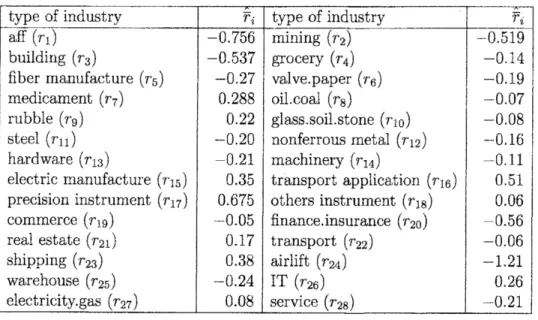
the monthly stock return data of various types of industries from January 1995 to December 2003. Weregard these 28 typesof industry indexesas
28 kinds of risky securities. At first, we compute the 9-year average return rates by using 9-year monthly rate of returns to obtain $\hat{\overline{r}}_{i}$, $\mathrm{i}=1$, $\cdots$ ,28 (see Table 1). For$\mathrm{e}\mathrm{x}\mathrm{a}$mple, the estimated mean rate of return on building industry is
$\hat{\overline{r}}_{3}$, and the
weight on the building industryin the portfolio investment is $x_{3}$. The
$\zeta" \mathrm{a}\mathrm{f}\mathrm{f}$” in Table 1 means the industry of
agriculture, forestry, and fisheries.
We use the SLP (Sequential Linear Programming) approach to derive an optimal portfolio of maximizing the CVaR-based Sharpe ratio. The computation are carried out based on
Al-gorithm 1 by utilizing the LP solver ofMATLAB 6.5 on a 2.60 GHz Pentiu$\mathrm{r}\mathrm{n}4$machine. The
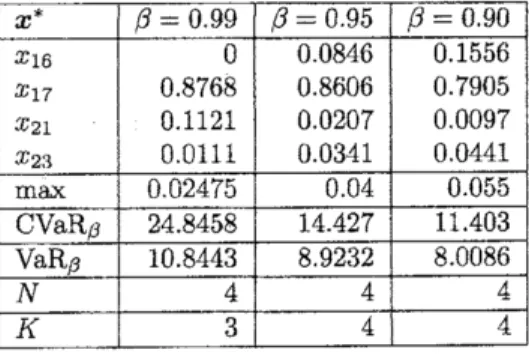
optimal weights$x_{i)}^{*}\mathrm{i}=1$,$\cdots$ ,$n$, and the optimal number$K$ ofriskysecurities included in the
optimal investment
are
found out, and they are shown in Table 2. Then, for three different $\beta$-values 0.99, 0.95, 0.90,we
also compute the $\beta-\mathrm{V}\mathrm{a}\mathrm{R}$ and $/3$-CVaR of the optimal portfolio $x^{*}$ as shown in Table 2. Further, in Table 2, $N$ is the number of iterations required for theconvergence to the optimal solution. We find that the algorithm converges after 4 iterations for all $\beta$ values.
Table 1: Estimated Expected Rateof Return on Each Industry’s from Jan. 1995 to Dec. 2003 (%)
References
[1] Andersson, F. and Uryasev, S. (1999), Credit Risk Optimization with Conditional Value-at-Risk Criterion, Research Report 99-9 ISE Department, University of Florida
Table 2: Maximal Value of CVaR-based Sharpe ratio, $x^{*}$, $\mathrm{V}\mathrm{a}\mathrm{R}_{\beta}$, and $\mathrm{C}\mathrm{V}\mathrm{a}\mathrm{R}_{\beta}$ Calculated by
Sequential Linear Programming Algorithm for $\beta=0.99$ 0.950.90 and $r_{f}=$ 0.0005, where
relevant
nonzero
$x_{i}\mathrm{s}$ are shown.$x^{*}$ $\beta=0.99$ $\beta=0.95$ $\beta=0.90$
$x_{16}$ $x_{17}$ $x_{21}$ $x_{23}$ 0 0.8768 0.1121 0.0111 00846 0.S606 0.0207 0.0341 0.1556 0.7905 0.0097 0.0441 $\max$ 0.02475 0.04 0.055 $\mathrm{C}\mathrm{V}\mathrm{a}\mathrm{R}\beta$ $24.845\mathrm{S}$ 14.427 11.403 $\mathrm{V}\mathrm{a}\mathrm{R}\beta$ 10.8443 8.9232 8.0086 $N$ 4 4 4 $K$ 3 4 4
[2] Andersson, F., Maussef, H., Rosen, D., and Uryasev, S. (1999), Credit Risk Optimization
with
Conditional
Value-at-Risk, MathematicalProgramming, Series B, December2000.
[3] Artzner, P., Delbaen F., Eber, J. M., and Heath, D. (1997), Thinking Coherently, Risk,
10, November 68-71.
[4] Artzner, P., Delbaen F., Eber, J. M., and Heath, D. (1999), Coherent Measures of
Risk}
Mathematical Finance, 9 203-228.
[5] Dinkelbach, Werner (1967), On Nonlinear Fractional Programming, Management Science,
13,
492-498.
[6] Stancu-Minasian, I. M. (1997), $Fract\iota onal$ Programming: Theory, Methods and
Applica-tions, Kluwer Academic Publishers.
[7] Sharpe, William F. (1994), The Sharpe Ratio, Journal
of Portfolio
Management, Fall,49-58.
[8] Markowitz, H. M. (1952), Portfolio Selection, Journal
of
$F\iota nance$, 7 (1)77-91.
[9] Palmquist, J., Uryasev, S., and Krokhmal, P. (1999), Portfolio Optimization with Condi-tionat Value-at-Risk Objective and Constraints, Journal
of
Risk, 4, 11-27.[10] Pflug, G. (2000), Some Remarks on theValue-at-Riskand theConditionalValue-at Risk,
in Probabilistic Constrained Optimization: Methodology and Applications (Ed. Uryasev,
S.), Kluwer Academic Publishers.
[11] Rockafellar, R. T. and Uryasev, S. (2000), Optimization of Conditional Value-at-Risk,
Jo\prime nmal
of
Risk, 2, 21-41.[12] Rockafellar, R. T. and Uryasev, S. (2001),
Conditional
Value-at-Risk for General LossDistributions, Research Report 2001-5, ISE Department, University of Florida, April, 2001.
[13] Uryasev, S. (2000), Conditional Value-at-Risk: Optimization Algorithms and