No 17 keV neutrino: Admixture < 0.073% (95%
C.L.)
著者
Ohshima T., Sakamoto H., Sato T., Shirai
J., Tsukamoto T., Sugaya Y., Takahashi K.,
Suzuki T., Rosenfeld C., Wilson S., Ueno
K., Yonezawa Y., Kawakami H., Kato S.,
Shibata S., Ukai K.
journal or
publication title
Physical Review. D
volume
47
number
11
page range
4840-4856
year
1993
URL
http://hdl.handle.net/10097/53659
doi: 10.1103/PhysRevD.47.4840
PHYSICAL REVIE%'D VOLUME 47, NUMBER 11 1JUNE 1993
ARTICLES
No
17 kev
neutrino:
Admixture
(
0.
073Fo
(95'Fo
C.L.
)
T.
Ohshima, H. Sakamoto,T.
Sato,3.
Shirai, andT.
Tsukamoto KEK, National Laboratory for High Energy Physics, Tsukuba 805, JapanY.
Sugaya andK.
TakahashiTokyo University ofAgriculture and Technology, Tokyo 18$, Japan
T.
SuzukiRIKEN, Institute ofPhysical and Chemical Research, Wako MI 01, -Japan
C.
Rosenfeld andS.
WilsonUniversity ofSouth Carolina, Columbia, South Carolina 29808
K.
UenoUniversity ofRochester, Rochester, Neur York 1$M7
Y.
Yonezawa*Institute ofApplied Physics, University ofTsukuba, Tsukuba 805, Japan H. Kawakami,
S.
Kato, S.
Shibata, andK.
UkaiInstitute for Nuclear Study, The University of Tokyo, Tokyo 188, Japan (Received 12 January 1993)
Tosolve the controversial issue concerning the possible existence ofa 17keV neutrino with aleap
admixture innuclear Pdecay, wesearched directly for any evidence ofaproduction-threshold effect. The Ni Pspectrum was measured with a magnetic spectrometer, with very high statistics along with afine energy scan over a narrow energy region around the expected threshold. The obtained mixing strength was ~ U ~
=
[—
0.011+
0.033(stat)+0.
030(syst)]'Fo, very consistent with zero, anddecisively excluding the existence of a 17keV neutrino admixing at the 1'Folevel with the electron neutrino. The corresponding upper limit was set at ~ U ~
(0.
073Fo (95% C.L.).
A new limit wasalso obtained for awider mass range: ~ U ~
(0.15'
(95FoC.L.) for 10.5to 25.0keV neutrinos.PACS number(s): 23.40.Bw, 14.60.Gh, 27.50.
+e
I.
INTRODUCTION
Extensive experimental eKorts continue in order
to
probe the basic properties
of
the mysterious neutrinos. The current issues are relatedto
their masses and flavor mixing. In additionto
the solar neutrino problem, in particular, an experimental indication of a17
keV neu-trino, reported by Simpson [1]in1985,
has added fuelto
neutrino studies. Various theoretical models [2] have been proposedto
accommodate such particles, while ex-perimental i.nvestigations have become controversial.The current experimental situation regarding the
17
keV neutrino is illustrated inFig.
1.
There is a'Present address: Tsukuba College ofTechnology, Tsukuba 305,Japan.
clear discrepancy between the negative [3—12] and pos-itive
[13
—17]results, which cannot be dueto
statistical fluctuations. One might saythat
since positive evidence has been obtained only in experiments using solid-state detectors, not using magnetic spectrometers, unknown detector-related phenomena are yielding an eEect which resemblesa
heavy-neutrino contribution.If
so, the un-known phenomena have somethingto
do with the specific energy(17
keV) below the end-point energy since the pos-sible mass values so far reported are all around17
keV [18],irrespectiveof
the kindof
nuclei used forexperiment. On the other hand, measurements using amagnetic spec-trometer have been criticized as having some ambiguities regarding the P-ray spectral correction.The search for a heavy neutrino involves looking for some distortion due
to
neutrino mixing inthe P-ray spec-trum or an internal bremsstrahlung p-ray spectrum asso-ciated with some electron-capture process of radioactive nuclear decays. The flavor eigenstate could bea
linear 0556-2821/93/47(11)/4840(17)/$06. 00 47 48401993
The American Physical Society47 NO 17 keV NEUTRINO: ADMIXTURE &
0.
073go (95goC.I.
.
) I I I I IIII„
(99~)
[3].
35S. M[4],
35S, M[5],
35S, M[6],
35s,
s
[7],
35s,
s
6]
63Ni, M[9]
125[ S[10],
63Ni, M[ii],
55Fe, S[12],
35S, M[13],
3H. S[14],
35S, S[i5],
35s,
s
[16],
~'Ce,
S[17],
'4c, s
:(95')
THISEXPERrMENT, SSNi, M
I I I I I I II
0.
1% 1%Mixing
strength
IUI5%
combination
of
the mass eigenstates: I v,)=
cos8
~ vi)+
sin 8 I v2) if only two states are considered, where 8represents the mixing angle. The
P
spectrum would thus beN(E)
=
cos8Ni(E)
+
siil8'(E),
N,(E)
=
F(Z,
E)pE
(Eo—E)
(Eo
—
E)2
—
m2FIG.
1.
Experimental results concerning the mixing strength (I U I ) for 17keV neutrino. The arrows representthe upper limits at the 90% confidence level (unless other-wise indicated), while the closed circles are from experiments reporting positive evidence. Indicated on the right are the reference, the P-ray emitter, and the experimental method. M and
8
represent amagnetic spectrometer and asolid-state detector, respectively. Our result is alsoindicated by the thick arrow.understanding, the spectrum is usually presented in the form
of
a
Kurie plot:gN(E)/[I'(Z,
E)pET]
vsE.
It
forms a straight line if I U I
=0;
for I U I$0,
however,the slope for
E
((
E&h is difFerent fromthat
forE
&Eth.
Although the experimental principle is very simple, get-ting
a
reliable measurement is not, as described below.History is our teacher: forinstance, it had already been found 58years ago in 1934 [19),
a
few years after the birthof
Fermi's P-decay theory,that
Kurie plotsof
the mea-sured P-ray spectra were not as straight as theoretically expected. A noticeable excess was seen in the low-energy part of the spectrum. This discrepancy wasat that
time interpreted as being an indicationof
the necessityto
re-vise Fermi's theory, not as asignof
heavy-neutrino pro-duction. For example, Konopinski and Uhlenbeck [20] even proposed arevised theory in 1935in orderto
explain the experiment. Various investigations [21],which were carried out for over 20 years, finally revealedthat
the low-energy excess was the resultof
energy losses in the source substance and backscatteringat
the source back-ing plate.It
is interestingto
realizethat
we are again facing controversy concerning the P-ray spectral shape. This time, however,it
isfrequently interpreted as arising from a1%
admixture ofa 17
keV neutrino, thus causing some excitement among particle physicists.We performed a measurement in order
to
clearly solve this controversial situation concerning the proposed 17 keV neutrino witha 1%
admixture.It
was aimedat
achieving a sensitivityof 0.1%
on I U I by directlysearching for a kink of the expected emission threshold in the ssNi
P
spectrum with high statistics and under well-controlled systematic conditions. Our experimental strategyto
overcome the problematic aspectsof
previous experiments is described inSec.
II.
Descriptions of the experimental apparatus and the quality examinationof
the observed
data
are given in Secs.III
and IV, respec-tively. Section V presents deductions concerning theP
spectra and the response function. An analysis
of
theP
spectra in termsof
a y2 fit is performed inSec.
VI, but using a somewhat diferent method thanthat
used in a previous publication [22]. Two analyses resulted in very good agreement concerning every fitting variable in detail. A further examinationof
the observedP
spectra is presented inSec. VII.
The search for a diferent mass of the heavy neutrino is also described inSec. VI.
II.
CONSIDERATION
(E
(
Ep—
m,;i
=
1, 2),where p,
E,
andET
are the momentum, kinetic energy, and total energy ofa P
ray. Ep is the end-point energyand
I'(Z, E)
is the Fermi function. For the case inques-tion, the mass mi
of
the dominant neutrino, Ivi)
I v,),
is set
to
zero and mass m2to 17
keV. Thus, the minorI v2) component should manifest itself as an excess over
the major term
at
an energy below its emission thresh-old, Eth=
Eo—
m2. Such an excess correspondingto
sin 81%
was reported as positive evidence for a17
keV neutrino [1,13—17].
(In the following, the admix-ture sin 8is denoted by ~ U ~ .) For the sakeof
intuitiveA. Objectives
Loiii energy tail
of R(E')-and
the shape correction The trueP
spectrum isdeformed dueto
the finite reso-lutionof
the experiment. Thise8ect
isrepresented by the response functionR(E,
E),
which gives the probability for monoenergetic electronsof
energyE'
to
be detected at energyE.
[For simplicity,R(E', E)
is hereafter de-noted asR(E)
throughout most partof
this paper.] Along, low-energy tail appears in
B(E)
dueto
energy losses and backscattering, which exhibits an approximately flat4842
T.
OHSHIMA etal. 47tail effect
6N(E')dE'
where
AE
=
(Eo—
E).
In an experiment with aP
source separated from a detector, the backscattering gen-eratesa
tail witha
sizeof
20—30'%%uo ofR(E).
b' is thuson the order
of
10 s (keV) . For example, 6' (20—30%)/(
150keV) for an s S source(ED=167
keV). Then, the above-mentioned cumulative effect easily results in an excessof
a few %, since the net effect is amplified by a factor ofLE,
which istypically afew tens of keV.Such an excess atlower energies never disappears, even though it can be reduced by experimental efforts. Sys-tematic uncertainties usually limit any knowledge con-cerning 6
to
~
10
(keV),
thus leaving some10
ambiguity in the measured spectrum, which cannot be ignored in
a
search for a heavy-neutrino effectat
the I'%%uolevel. A so-called shape correction term is thus intro-duced
to
absorb this ambiguity. The term should never be omitted, unless experimentally justified.8.
Statistical
balance and toide energy spectrumenergy distribution with an amplitude of6(keV) idown
to
zero energy. We also describe the factthat
a
fraction of theP
raysof
energy(E')
flows into a data point at a lower energyE.
By
approximating the true spectrumN(E)
to
be proportionalto
the squareof
the energy in-terval from the end point,Eo,
the fractional sizeof
the tail contributionto
the observed spectrum can be esti-mated asEp
near Eih in such experiments [13—
17].
A magnetic spec-trometer can considerably improve this situation.B.
Experimental
strategy
Along with these considerations, we adopted a strategy
to
search directly for a kink dueto
the proposed17
keV neutrino emission by meansof
a fine scan over the nar-row energy region in question with equally high statistics both above and below E&h. Any systematic uncertain-ties possibly arising from the energy-dependent charac-ter of corrections would not bea
significant factor ina
kink search. A kink, if
it
exists, would not be confused with the shape correction term. A very high-statistics measurement was made possible dueto
the combination of an intense source (ssNi) and a high-resolution mag-netic spectrometer. The signal-to-background ratio was as high as 1000near E~h, thus reducing the ambiguities in the background estimationto
an insignificant level.Another important feature of the present experiment is that
R(E)
was precisely determined by a measurement, not by a Monte Carlo simulation. A monoenergetic P emitter (ro9Cd) was used forthis purpose, which was pre-pared so asto
yield the same energy-loss and backscat-tering effects as that of the 3Ni source.The spectrum near Eo was also measured at
a
place where the shape correction is negligible and the17
keV neutrino has no effect. The thus-obtained Eo value was compared, as a self-consistencytest,
with those deter-mined bydata
taken around E&h. The measurement was carried out using 30independent cells of a proportional chamber; this also helped in examining any systematic effects.Most ofthe previous experiments measured some spec-trum over awide energy region, and used a
y
fit over all parts in orderto
look for any difFerence in the slopes above and well below E~h, the threshold energy for heavy-neutrino emission. Nobody, except for Hetherington et al. [10], obtained sufficiently high statistics in the higher sideto
determine the slope there. In such data, the lower is the P-ray energy, the higher is statistical accu-racy, though the ambiguity islarger dueto
the tail effect described above. The situation isreversed at higher ener-gies. Consequently, the analysis becomes strongly biased by the low-energy portion of thedata
where the uncer-tainty islarge.The above problem is not easily solved in experiments using
a
solid-state detector. The usable source intensity is severely limited by a signal pileup effect. Further, noP
rays in an energy bandof
interest can be singled out.8.
Signal-to-background ratioAccurate knowledge concerning background is, need-less
to
say, the key for any reliable result. The determi-nationof
the slope above Eqh is particularly affected bythe background. Experiments using solid-state detectors suffer from asignal pileup effect and residual radioactiv-ity. In fact, the signal-to-background ratio was only 6—60
III.
APPARATUS
A. P spectrometer
The P-ray momentum was analyzed by adouble
focus-ing
~~2-type,
iron-free spectrometerat
INS (Institutefor Nuclear Study). This spectrometer had been success-fully used inprevious experiments [23] with athin tritium source in order
to
set the limit on the massof
the elec-tron antineutrino. The mean radius of the P-ray orbit is 75 cm, the main coil current is stabilizedto
within10
and three sets ofHelmholtz coils (east-west, north-south, and up-down) can cancel an external magnetic field and its Huctuation down
to 10
of
the10
G field appliedto
theP
rays. The momentum resolution is controlled by a discriminationbaRe
slit located at 60 from the source position (seeFig.
2).
For this experiment, the slit was adjusted so asto
giveAp/p=0.
2% anda
solid an-gle of 0/4vr=4.7x10 s.
The vacuumof
the spectrometer chamber was kept at10
3—10Pa
during the entirepe-riod.
B.
P
sourceWe employed sNi (wr~q
—
—
100yr) and Cd (wr~q——463calibra-47 NO 17 keV NEUTRINO: ADMIXTURE
(0.
073% (95% C.L.) 4843concerning the line shape and the count
rate.
The result verified good reproducibility in the source preparation.C.
P detector
Gate Valve
ay
CB
Detector
FIG, 2. Top view of a vacuum chamber of the INS
m.v2-type, iron-free spectrometer. The momentum resolution
is controlled by adiscrimination baNe slit.
tion
P
emitters, respectively. Ni provides a 12-times larger rate decaying into energies near E&hthan does 3S.
Well-known conversion lines
of
Cd decay provide us with a meansto
calibrate the system as well asto
de-termineR(E)
The two.
sources were alternated several times during the experiment. The reproducibilityof
the source position was verified using the measured relative shiftof
theK
conversion lines between different calibra-tion runs,to
be better than &+60
p,m, equivalentto
LE
&+2
eV atE=50
keV. The sources were electri-cally grounded in orderto
avoid any charging.Both
sources, eachof
4x20
mm2 size, were prepared ona
1.
5 p,m thick Ni backing foil by an electroplatingmethod under the same conditions. An electrolytic so-lution
(0.
5 ml)of 1%
ammonium lactate was used for the electroplating process with a constant 10 V applied for 15minat
room temperature. The electric current in this process ranged from 40to
80mA. The thus-obtained saNi source was 50 pg/cm2 in thickness and 580 pCi in intensity.The Cd source of 150 pCi was prepared as
a
mix-ture with natural Ni atoms sothat
the energy-loss and backscattering efFects would be the same as those pro-duced with the ssNi source. The uniformityof
the mix-ture was confirmed in two ways.(1)
The electroplated efficiency was measured as a functionof
time by count-ing theP
intensity.The
same efficiency was observed for two solutions (ssNi mixed with natural Cd and Cd mixed with natural Ni). (2) Another source was made by electroplating the correct amountof
i09Cd and then natural Ni. The amountof
the latter wasjust
one-halfthat
contained in the standard ~osCd source. Since nat-ural Ni dominates the material in the standard o Cd source, this choice was made in orderto
mimic the av-erage energy losses encountered in the standard one. Enfact, the same
K
line shape was observed for the stan-dard and this test source. Finally, six Cdsources were prepared, and measurements were made for eachof
themrame(AI) lit plate mmt, Brass) Mesh sheet 1mmt, SUS) olyester film 1.5pmt) Anode (6mm s 0 Mesh sheet .1mmt, SUS) 0/ire plate (G-10) l Gas outlet
~
240mm ase plate (Brass) Mesh Sheet (SUS,O.im ~) 3mm slit (gross PolyesTer film (I,5PrT)L)—
+&8—
1mrn y~&emm x Yyx
Anode wirep/ggggg/gg/ggy (Zap,m&,Au-platelet W
FIG. 3.
Structure and construction of the proportional chamber used as the P-ray detector.The
P
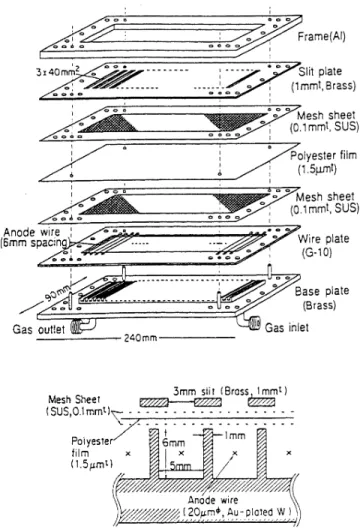
detector was a proportional wire chamber with 30 isolated cells placed on the spectrometer focal plane. Fig3.
shows its structure. Signal wires were of 20pm rrrrAu-plated tungsten, strung at 6 mm intervals. Rectan-gular counting cells
of
Gx6 mm each were formed by inserting 1 mm thick brass walls. Facing the incidentp
rays, an entrance slitof
3x40
mrna opening was cut out for each cell ona
1 mm thick brass plate. The slit size correspondsto
the momentum biteof
Ap/@=0.1'%%uoor an energy bite
of
DE=96
eVat
E=50
keV. Behind the slit plate wasa
1.
5 pm polyester 61m sandwiched by 100pm thick stainless-steel meshes of 95'Fo in trans-parency.It
isolated the chamber gas from the spectrome-ter vacuum and the inner mesh served asa
cathode plane. The counting gaswas isobutane keptat
4x
104Pa
(withinl%%u~). A high voltage
of
1.
54 kV was applied in orderto
T.
OHSHIMA etal. 47 were mounted on the chamber. The position and angleof the source and detector were optimized for the best momentum resolution by observing the ~ Cd
K
line. In this paper, the cells are numbered 1—30from the low-
to
high-momentum side.
D.
Data
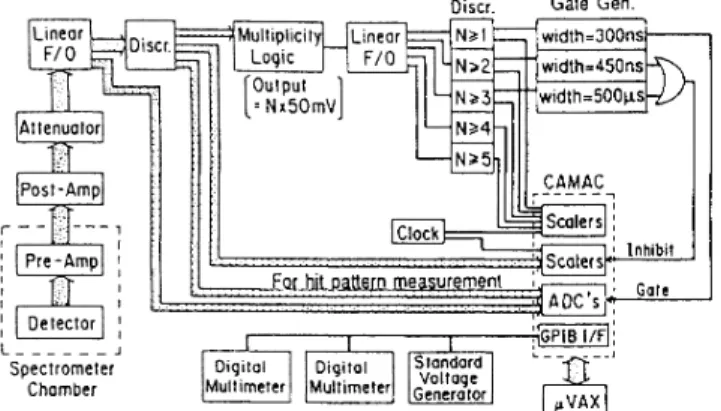
acquisition systemThe electronics system is illustrated in
Fig. 4.
The overall gain in each pre- and post-amplifier chain was 12 mV/pA. Amplified signals were sentto
analogue-to-digital converters (ADC's) (LeCroyFERA)
for pulse-height measurements as well asto
discriminators. The discriminator outputs were useful in three ways:to
record the numbers of hits/cell by scalers,
to
register any event hit pattern by the ADC's, andto
tag the hit multiplicity by the multiplicity logic module (LeCroy380A).
Multiple hits were caused by cosmic rays,elec-tronic noise, and cross talk; their rate was used
to
cor-rect for the dead time. Since electronic noise manifested itself as simultaneous trailing pulses on many cells, a 500 ps wide inhibit signal was generated on the multi-plicityN &3. Its
contributionto
the dead time, however, was negligibly small.The magnetic field strength of the spectrometer was set by a standard voltage generator
(FLUKE
5440A). Using two digital multimeters(FLUKE
8505A's), a yVax com-puter was usedto
monitor the generator voltage as well as the voltage acrossa
standard resistor inserted in se-ries with the main coil, and thus controlled the generator accordingly.illustrated in
Fig.
5, three setsof
scans covered the energy regions of interest. Each set consisted ofmeasurements performedat
20 magnetic fields approximately in 284eV steps for the Eqh region and the 4 magnetic fields ap-proximately in7.
4 keV steps for the Eo region. In the former, the number ofdata
points totaled (3 sets)x
(20 magnetic fields per set)x (30
detector cells)=1800.
Of the 20points in each scan set, as can be seen in the figure, 3 points always overlapped with one or two other sets for normalization purpose.At each magnetic field setting (thereafter expressed by the voltage across the standard resistor, V ~s), a mea-surement lasted 5 min, generating 30
data
points corre-spondingto
the numberof
detector cells. In orderto
minimize any systematic errors, the V ~z value at
ev-ery scan was selected randomly. This was repeated until more than
10
counts had been accumulated at every data point, resulting in 2.4x10
total
events over theEqh region where the signal-to-background ratio was as high as
1000.
Typical counting rates were 40 Hz and0.
03Hz/cell at Ech and aboveEo,
respectively.The Cd spectrum measurement was performed over a wide energy region from
16
to
107 keV in orderto
cover the
KI
I
Auger,K,
I,
M
and N conversion lines. Different scanning steps were chosen, depending on the purpose: an absolute energy calibration, ameasurement of the spectrometer dispersion (dp/d2:, wherez
isposition displacement onthe detector plane), orameasurementof
the response function. Figure 6shows an example ofsuch data recorded on the 16th cell. The counting rate was
IV.
DATA-TAKING
ANDQUALITY
EXAMINATION
20 points 20 points
20 points
A. Data-taking
procedure
The 6 Ni spectrum was measured in two different energy regions: One was around the expected heavy-neutrino emission threshold (called the Ech region) and the other was around the end point (the Eo region). As
Linear ~ F/0 ~oiscr
—
ll
Attenuator ,' Multiplicity Linear Logic F/0 Output =Nx5OmV—
N&4-Discr. Gate Gen.
, N&1& 'width=300ns
=L
N~2 width=450ns —Np3 width=500ps 284eVsteps
40 4550
55
60Energy
(keV)
Post-Amp 1 ( ; lpre-~mpl Detector, , ' L Spectrometer Chamber CAMAC ~scalersj', I Inhibit -- -=-',*',Scolersi-, I Gate I' GPI8I/Fl, ' 'a'
I&lock,'Fgrhitoattern measurement
I Digital Digital Standord ,Muttimeter Multime ter
Generator Voltage
R.VAX
FIG.
4. Electronics diagram.FIG.
5. Illustration ofan energy scan performed around the 17keV neutrino threshold, Ebb=50 kev. Each of the three sets ofscans covered adiamond-shaped area, compris-ing (20V,
s settings)x(30
detector cells)=600 data points. The overlapped zones comprised three data points per detec-tor cell from each neighbor. The energy regions covered by the 16th cell are 45.9—51.3keV in(1),
41.4—46.5 keV in (2), and 50.7—56.3in(3).
The four points in the Ep region, not illustrated, covered 65.4—87.6keV in(1),
68.9—91.
5 keVin (2), and 63.7—85.7keV in(3).
47 NO 17 keV NEUTRINO: ADMIXTURE &
0.
073%(95goC.L.) 4845 1(141)
2(142)
3(142)
4 (142) O0
2000—
10QO— KLL Auger I KLM8cKLN Auger ) K line Lline M line &~N line30—
zo—
10—
0 I3
I 5 (142) 6(142)
7(142)
6 (142)30—
zo—
10—
80 40 60 80 100 oEnergy (keV)
FIG.
6. Cd spectrum measured inthe 16th detector cell, showing discrete lines and their tails used for calibration pur-poses.2.
2kHz/cellat
the peakof
theK
line. The measurement was performed four times duringa
2-month data-taking period, each lasting for 2to
3 days.The background was studied without the source, or by closing gate valves
at
either the source chamber or the detector chamber. Sinceit
was mostly cosmic rays, the rate did not appreciably depend on how theP
rays were shut out. In addition, this rate fairly well agreed with those observed above Eo()67
keV) aswell as above the CdN
line()88
keV) where noP
rays should exist.9 (142) 10 (142) 11
(142)
12 (142) g30—
20—
10—
0 I I —5 0 I I I 5 —5 0 I I 5—5 I 5 —5 0 Devia.tion
FIG. 7. Distributions of the counting rates (n's) rela-tive to the average (n). The horizontal axis corresponds to (n-n)/Vn. The data are from the 16th detector cell, in data set (1)at 12difFerent V s settings. Thecurves are Gaussians ofunit standard deviation, with areas equal tothe number of runs shown in parentheses.
B.
Data
equalityX. '81Vi data
As explained above, each
data
point isa
resultof
many runs performed in random order. The run-to-run stability
of
the counting rates in individualdetec-tor
cells should bea
good measureof
thedata
quality. The histograms inFig.
7 show distributionsof
the rates(n's) recorded under identical conditions. The curves are Gaussian distributions normalized
to
the respective num-berof
runs. One clearly finds only statistical fluctuations without anyextra
disturbance. This is also true for allof
the other data not shown in the figure. The count-ing ratesof
all runsat
600 individualdata
points, (20 V~ g's)x
(30 cells), in the Eth region were further exam-ined in termsof
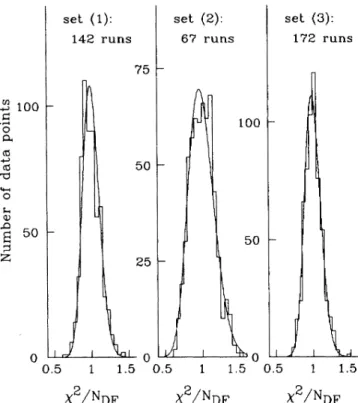
the reduced yz:(reduced
y
)—
:
)
.
(n
—(n)&'
run &
)
[(the number of runs)
—
1j.
Here, (n) corresponds
to
the average of the ratesat
eachdata
point, and isdetermined by minimizing the reducedy
. Figure 8 shows the reducedy
distributions for the three setsof
scans. The curves represent idealy
dis-tributions and showthat
thedata
scatter in a purely statistical manner.As shown in
Fig.
5, three sets(1,
2and 3) of scans were carried out in random order for individual points, with an overlap in two bands. The ratioof
the summed counts in these bands should depend only on the data-collection time and the ssNi lifetime. The experimental values areI
0.42430+0.
00006
for(2)/(1)
and1.32809+0.00018
for(3)/(1),
which are in very good agreement with the ex-pected0.
42445
and1.
3299.
Because there was ascheduled electric power outage after scans (1)—(2), the comparison ofthe absolute rates between (1) and (3)gets a bit poor. But, it does not influence this experiment. The Cd calibration runs were therefore per-formed before and after the both (1)—(2) and (3)scans
4846
T.
OHSHIMA etaI. 47set
(1):
142 runsset
(2):
67
runsset
(3):
172
runs100
0
Q0
50
25—
100—
50
o I0.
5 11.
50.
51.
5 00.
5 11.
5 X /NDF X /NDFx
/NDFFIG.
8. Histograms ofreduced y defined by Eq. (3)for three data sets, each with 600data points. The curves repre-sent ideal distributions for Gaussian distributed variables for the corresponding number ofruns.It
is thus concludedthat
the entire experimental sys-tem has been stable andthat
the final spectrum can be obtained by summing allof
the counts in eachde-tector
cellat
the same V ~+ without making anytime-dependent corrections. A single scan set lasted for about 2 h
at
over 24 different V~~z settings with 5 min each. The long lifeof
Ni does not require any correction for this time period, and the random sequence in the indi-vidual settings further reduced the effect of the source lifetime.It
can also be concludedthat
the source did not evaporate in avacuum, contraryto
other cases [8,12].
V.
DATAREDUCTION
We aimed
at
precisely measuring the shapeof
the 3Ni P-ray spectrum, not the absolute decayrate.
Therefore,Of the four calibration data sets with the resCdsource, both the first two and second two were taken
at
29—30 day intervals. The source lifetime is not negligible here when comparing thedata
sets. The observed ratio of counts at around theK
line is0.
9568 between the first two and0.
9569 between the second two, while0.
9561—0.
9575is expected for both from the decay in the source intensity. This agreement again confirms the stabilityof
the system, as already shown using the Ni
data.
It
also showsthat
no appreciable source evaporation occurred.energy-dependent corrections were important, such as the electronics dead time, transmission through the
de-tector
window, and any loss dueto
pulse-height discrim-ination. The Cd spectrum was used for absolute-energy calibration as well asto
establish the spectrometer dis-persion. The response function[R(E)]
was also obtainedfrom the same
data.
Finally, the Ni P-ray spectra in 30individual cells were arranged for subsequent analyses.
A. Corrections
1.
Dead time correctionThe sealer counts of 30 cells at every V ~ setting were normalized by the live-time interval. Only single-hit events were counted in order
to
reject electronic noise, cosmic rays, and cross talk. The number ofinhibit sig-nals generated on multihit events was also recorded in orderto
evaluate the electronic dead time. The result-ing dead time correction was on the order of10
for 20 points in individualdata
sets, each covering approxi-mately a5.
4keV interval near Eqh.Its
variation between the lowest- and highest-energy point was3x10
4 for set(1), 4x10
4 for(2),
and2xl0
4 for(3).
Consequently,this correction of the 3Ni spectral shape amounted
to
only &
+2x10
over the5.
4keV interval near E&h. The correction near Eo was even smaller, being on the orderof
10-'.
2.
Count Lo88 due to discriminatione(E)
&max
h(E,
c)dc
&max
h(E,
c)dc, (4) whereh(E,
c) represents the count in the cth ADC bin for the P-ray energy(E)
and h isthe averageof
20spec-tra.
e(E)
depended slightly on the range of integration. The choiceof
c
=9
was made in orderto
make it sensi-tiveto
any discrimination efFect. The result isplotted inThe background pulse-height distribution inthe cham-ber was determined from
data
takenat
two V ~gsettings, where no P rays from the source were expected. Figure9(a)
shows a typical background-subtracted pulse-height distribution for the Ni source. One can see a discrimina-tion level correspondingto
ADC channels of 10or below; the loss dueto
discrimination is therefore only a small fraction of thetotal
events. What is relevant in this ex-periment is the P-ray energy dependence of this small fraction.The low pulse-height part is shown in
Fig.9(b),
where 20spectra correspondingto
20 consecutive V ~ settings in one of three data sets are plotted forthe same detector cell, and the histogram is their average. The fraction of counts in this part does not show any noticeable depen-dence on the P-ray energy (or V ~s). To determine the possible energy dependence ofsome discrimination effect, the count integrated over low ADC bins was studied rel-ativeto
the average, by defining47 NO I7keV NEUTRINO: ADMIXTURE &0.073% (95% C.
L.
) 484715000
10000
5000
0 00.
015
0
0.
010
a
0.005
0
0.000
(b)
100
ADCchannel
I 10 20 ADCchannel
200
Semiempirical equations exist
that
relate the electron energy and the extrapolated range [24], andthat
repre-sent the transmission [25]. Equations(6)
and(7)
in Ref. [24] well reproduce many experimental data; however, as the authors pointed out, they are not in perfect agree-ment with each other. This uncertainty correspondsto
approximately
+4%
in our film thickness, while the ac-tual thickness is uncertainto
+3%.
Thus, by quadrati-cally adding these uncertainties,+5%
was assigned as a systematic error in the film thickness.Figure 10 shows the thus-calculated transmission through the
1.
5 pm film, which is98.1% at
E=40
keVto 99.3%
atE=60
keV. The rangeof
uncertainty is alsoshown there, and is smaller than
+1
x10
in the Eih-region. This correction was also appliedto
the Cd spec-trum.B.
Energydetermination
1.
05 Qp —~.p T~ IP ~ ~~ ~~ II II sa. %F0.95
I46
I 4850
Energy
(keV)FIG.
9.
(a) Background-subtracted pulse-height distribu-tion for the 15th detector cell measured at the 10th V setting in data set(1).
(b) A closeup ofthe low pulse-height region of(a).
The dots are for 20different V~~s settings and the histogram shows their average. (c) e(R)defined byEq.(4) at individual V ~ values, thus at differentE.
The solid line is afit to the data.X. Dispersion relation
=
(U~i;„,
)is(V)
[1+
a(j
—
16)
+
5(j
—
16)
+c(j
—
16)
].
(5)The sizes of the coefBcients determined in the first cal-The momentum dispersion
of
the spectrometer was established by determining the Vm~g value) V~ ]I„p&at
which the Cd
K
line peak appeared ina
given detector cell. For this purpose, by changing Vm@g the positionof
the
K
line was moved across allof
the cells. The accuracy in this measurement was+(1
—2) eVin energy. The result was fit bya
fourth-order polynomialof
the cell number(j),
where the 16th cell was taken asa
reference:(I
Kline)j(~)
Fig. 9(c)
asa
functionof
E.
The linear fit shown in the same figure gives the energy-dependent contributionto
the low pulse-height part
to
be smaller than+1%/keV.
The
total
lossof
counts in this pulse-height region was(1.5+0.
4)%,
by linearly extrapolating the countsat
c
The uncertainty resulted from the fact that the choice
of
c
is not unique. The final correction factor is there-fore less than(1.
5+0.
4)x10
4/keV. The same correction was also appliedto
the Cd spectrum, although it is much smaller than the statistical errors.8.
Z'ronsmissionof
detector isindoiii film The only materialto
beconsidered is the1.
5 pm thick polyester used as the detector window, since the meshes havea
fixed transmission, irrespectiveof
the p-ray en-ergyof
interest. The chemical structure of the film is Cz+ip He+s~Og+4~ and the density is1.
393
g/cm For sufBciently large valuesof
n, the effective atomic and mass numbers areZ,
a=6.
45 and A,@=12.39,
respec-tively. The ambiguities in the n value has totally negli-gible effects on the transmission.1.OO0 a.995 0.990 0.985 0.980 O.975 0.10 0.05 0.00 —0.05 —O.
&0—
40 l 45 50Energy
(keV) ! 55 60FIG.
10. (a) Calculated P-ray transmission[T(E)]
for a1.
5 pm thick polyester film. The thin curves show the range ofuncertainty corresponding to+5%
ofthe nominal thick-ness. (b) The range ofrelative uncertainty when normalized atE=50
keV.4848
T.
OHSHIMA etal. 47 ibration run came outto
bea
=
—
1.
95023x10,
6=
6.
34526x10,
andc
=
3.07130x10
.
They agreedvery well with the analytic orbital calculation.
The same measurement was performed in every cali-bration run. A slight variation which depended on the run was detected in the V gvalue forthe
K
peak at the reference cell, and was attributedto
asource replacement error.By
examining the relative shiftof
theK
andI
lines, the errors in position were foundto
be+15
pm be-tween the first two calibrations and+60
pm between the second two. They correspondto
an energy uncertainty of+0.
6eV and+2.
4eVat
K
line energy.8.
Abaolute-energy calibrutionTo relate V~~s
to
the P-ray momentum, theK
andL
lines, aswell asthe
KLI
lines, were measured bythe 16th cell in every calibration. Their energies (and relative in-tensities) are known with accuraciesof
0.
3—0.
4eVfor theK
andL
lines [26] aswell as1.
3—
1.
7eVfortheKLL
lines [27]. In our measurement, theK
line,E~=62.
520 keV, was measured with an accuracyof
+0.7x10
in V ~~, or+0.
8 eV in energy. A fit was madeto
theL
linedata
based on the observedK
line spectrum, rescaled by taking into account the energy differences, the rela-tive intensitiesof
theI
sublines, and the different energy losses. The result was accurateto
+3.1xl0
5 in Vz,or
+4.
9 eV in energy, atEI.
,
=84.
683 keV. TheKLL
Auger spectra were fit bya
functional form used in Ref. [27]; the KLqL3 line,E~g,
L,,
=18.
512keV, was determinedto
be
+6.
8x10
in V z or+2.
5eV in energy. The result isexpressed asserved near 53and 72 keV, which could be backscattered
P
rays of theK
and L lines, respectively. Becauseof
this efFect, the tail shape, expressed asexp[(Eb„~ —
E)
s],
where
Eb„p
represents the position of the bump, was foundto
reproduce thedata.
Several different functions were also usedto
evaluate the uncertainty in the subtrac-tion. Figurell
isa
resultof
such an evaluation, showing the possible variations in the tail spectrum. This un-certainty was treated as oneof
the systematic errors in the final analysesto
be described later. The high-energy sideof
the resulting pureK
line shape was also checked by comparing it withthat
of
theN
line, which is at the highest energy receiving no contribution from other con-version lines.Figure
11
shows the thus-obtainedK
line spectrum.It
is equivalentto
the response functionR(Ea, E)
forP
raysof
energyEa.
The low-energy component re-fiects the backscattering and energy-loss efFects. This response function was appliedto
other P-ray energies byjust
rescaling it in momentum.D.
S~Nispectrum
After applying the conversions and corrections de-scribed above, the counts recorded under the same condi-tions were summed. As described before, there were 1800 data points near E&h, and 360data points
at
aroundEo.
The three sets
of data
were normalized using the counts in the overlapped region, three points from eachset.
Thep(keV/c)
=
187.
6650 xV,
s(V)
+
0.
3070 (6)x
]05
for the 16th cell. This relation was valid for all
of
the calibration runs within+1
eV accuracy and, therefore,at
all of the energies covered by Ni runs.Equations (5) and (6) were used
to
convert the V ~s value ofeachdata
pointto
the energyE.
The measured countsat
allof
the points were then corrected so asto
have the same energy bin size.
C.
Response
functionBecause of the optical characteristics of the spectrom-eter, there is a very small cell dependence in
K
line spectra. The momentum resolution [Ap/p full width at half maximum (FWHM)] varies parabolically from0.
26% at the 16th cellto
0.
29% at both ends(1st
and 30th cells). In more detail, their half width at half maximum (HWHM) remains constantat
the higher-momentum side, but has acell dependenceat
the lower side. There-fore, both Ni and Cd spectra measured in individual cells were separately treated in the following analyses.To
extract
only theK
line spectrum from the data(shown in
Fig.
6, for example), the low-energy tails of the L and higher lines must be subtracted. They were assumedto
have the same functional forms asthat of
theK
line. Inthe spectrum, small but broad bumps wereob-xQQ
I I
40
50
Energy
(keV)FIG.
11.
Response function[R(E~, E)]
extracted from the Cd P spectrum, shown by a curve with data points. The size of the ambiguity resulting from subtraction of the L and higher line components is indicated, by adding to the47 NO 17 keV NEUTRINO: ADMIXTURE &0.073% (95% C.
L.
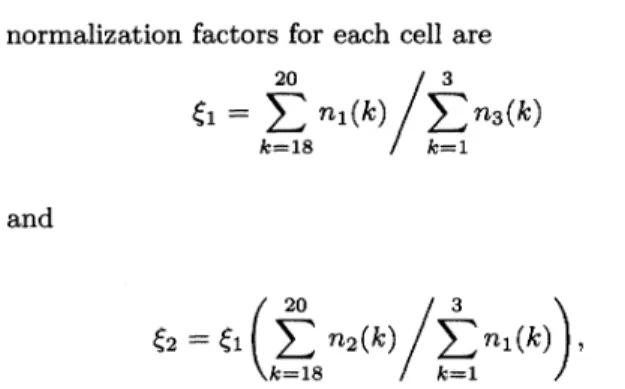
) 4849 normalization factors for each cell are20
g,
=
)
n,
(k)
)
n.
(k) k=18A.
FormulaThe following formula was used
to
fit thedata:
N
'(E) =
Ap[N'"(E')(1+
n(Ep
—
E'))R(E',
E)]dE'
(7)
+B(E),
(8)
2p
(g
—
—
qi)
n2(k)
)
ni
(k)(A'=is k=1
where
n;(k)
are the countsof
the kth data points in the ith data set(i=1,
2,3).
Furthermore, the spectrum ofeach detector cellwas normalizedto
the 16thcell by equalizing the summed counts in the same energy ranges. The final spectrum in the Eqh region is shown inFig. 12.
VI.
y~ANALYSIS
N'"(E')
=
I'(Z,
E')p'ET
.
(
(1-
I UI')(E.
—
E')'
+
I UI'
(E,
—
E')
(E.
—
EI)2
—~2
(9)
where ET is the total energy
of
theP
ray, Ap is thenor-malization constant, and cristhe shape correction factor.
I U I2 expresses the mixing strength
of
a heavy neutrinoofmass rn H.
F(Z,
E)
is the radiatively corrected, rela-tivistic Fermi function [28]. The background spectrum is represented byB(E),
comprisinga
constant anda
small linear term.The narrower the energy range analyzed is, the smaller the ambiguities in energy-dependent corrections are. The spectra in the Eqh region and the Ep region were therefore analyzed separately. The
E0
value extracted from the latter was usedto
assess the result from the former. The following analysis is different fromthat
reported in Ref. [22] in treating the normalization constants,(i
and(z.
However, the result is not significantly different.
x&O6
B.
Eo regionThe three sets
of
scans madeat
around the end point (Ep) were combined into a single spectrum by using the normalization factors(i
andQ
inEq. (7) that
were eval-uated from the data nearEth.
Ambiguities arising from this procedure are negligible comparedto
the statistical accuraciesof
the data in question.In the energy region near
E0,
the shape correction fac-tor (a.) has only a small effect.The
low-energy tail ofR(E)
also plays aminor role in the integrationof Eq. (8),
since the energy rangeto
be considered here is narrow. In addition, the emission threshold (Et,h) of the heavy neutrino is much lower. Consequently, one can deter-minea
reliable value forE0
under clean circumstances.It
would provide us witha
very valuable meansof
making consistency checks on our analysesof
the entire spectra. A g2 fit was madeto
the spectrum between 63 and 74 keV with bothn
and I U I setto
zero. The fittingvariables were Ap, Ep, and two parameters of
B(E).
The result is shown inFig. 13
and the best-fit value isEp
=
(66 945.9+
4.
4) eV,with
y
/NDF(numberof
degreesof
freedom)=116.
6/102.
A similar fit was repeated with and without cr as an ad-ditional parameter and by changing the low end
of
the fitted data points in0.
5keV steps from62.
0to 64.
5keV. The resulting valuesof
Ep andB(E)
were very stable. Therefore, the backgroundB(E)
determined here was used in the following analyses. The valueof
a
was con-sistent with zero with large errors.p I
40
I I I45
5055
Energy
(keV) I60
C.
IndividualBts for
X~h regionFIG.
12. Ni spectrum measured around the 17keV neu-trino threshold (Etq), consisting of1800data points. See the text for details.30 sets
of
spectra, each consistingof
60data
pointsat
around Eth, were individually analyzed under the as-sumptionthat
m~H=17
keV. The normalization factors4850
T.
OHSHIMA etal.((i
and(2)
were not applied here. Instead, the following six parameters were treated as being free: I UI,
o.,threenormalization constants [2~0
(j=l,
2,3)]correspondingto
the three sean sets, and
Eo.
Other cases were also exam-ined with Eobeing fixedto
the measured value [Eq.(10)j
or with I U I set
to
1%.
Figure 14 compares the best fits and the
data:
(a)
for six parameters and (b) for five parameters with
I U I
=1'%%uo. For case
(b),
the fit clearly becomes worsenear 50 keV, the expected neutrino production thresh-old. The qualities
of
the fits are shown inFig. 15(a)
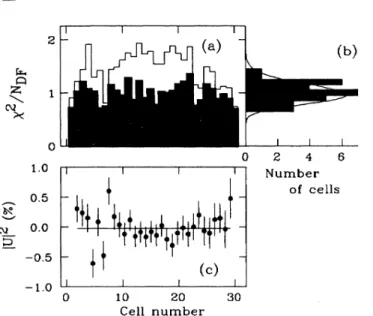
as the reduced y2 values for the 30 spectra. Systematically larger yz values are seen for the case with I U I =1'%%uo.The best-fit I U I values are plotted in
Fig.
15(c).
Theaverage over the 30individual results gives
6 —
x10
(I U I )
=
(—
0.
029+
0.
038)%
with
y
/NDp=1.13 (NDp=29).
It
isconsistent with zero; in fact, the average of the reducedy
values is1.
01forI U I being free, while it jumps up
to
1.
45for I U I =l%%uo.The five-parameter fit with Eo fixed also leads
to
(I U I
)=(
—
0.022+0.033)%
withg
/NDp=1.26.
The other parameters determined inthe fitsare plotted in
Fig. 16.
When I U I is left free, the average of 30 Eo66
68
70 7274
Energy
(keV)FIG.
13. Ni spectrum measured near the end point, Eo. The curve isthe best fit which gives aprecise value ofEo.0.005 — 13
(1.
233) 16 (0.786) 13(1.
939)
16(1.
542) 0.000 f ilI il I I I,lIIII I QIll I III il I ~ il y II I JI IliIi IIIII ..1IIIJ%iI III II~IliIl ilIIIiiIIii Il 'lI il II)IIIIl illl' II il ll I~1III il II .i'll 'l..Ii ii'IIIli il ll II
'IIII"IIiII)II
'
IIIII II I1I 1/111II ii11~ ~ —0.005 0.005 — 14
(0.913)
i7
(i.
03i)
14(1.
730) 17(1.
540) I A 0.000 il II ll 1 I Ii il Il 11 II l11 JJIIII ll II illlil il i I I I illI II ll I il ii i iiI iI II ll III il..)' ~i&ll II II II II il II iII il , g,ii"o11 ~I III III1 II 111 iil' II il 111 I ilil ll li ]y~ ~I 111 il 11 il II iIII —0,005 0.005 — 15(1.
077) 18(1.
008) 15(1.
780) 18(1.
766) 0.000 il ii II Jpll (li il IIIill 'll ' Il I& I I I III't Q iI 1I II II ill il il II II ll illl illIl ll II iI il il ii iII il IIIIIIi I
il"'
iiIII1,„il.. II[ ~~ i1 II ~I Ill 1I IIllI IIII il '1l ll il Illi ii il Illl,i ill ilill.II !' il 'll ll IIIIIIII 11 III ii illi iII II II il —0.005 40 I 50
Energy
(keV) I I 55 40 I 45 50 Ener gy (keV) I 55 40 45 50Energy
(keV)
I I 55 40 45 50 Ener gy(keV)
I 55FIG.
14.Examples of the fitstoindividual Ni spectra measured in the energy region around E&p. Six spectra corresponding tothe detector cells from the 13th to the 18th are plotted relative to the best fits. (a)and (b) show the results of the fit withI U I left free and with I U I =1'%%uo, respectively. Shown at the top ofeach spectrum are the cell number and the reduced y
NO 17 keV NEUTRINO: ADMIXTURE
(0.
073% (95% C.L.
) 4851(a)
(b)
C& C& I CO 200 Ii IIli][ il)
IIIIf
f —100 —(a)
0 i 0.5 V (g0.
0 II Igl /I II II IIII II Ii II I 2 4 6 Number ofcells
—20(b)
IiII il Ii II II wr —0.
5 —1.0 I 0 j I iO 20 Cell number I 30 1.002 1.000 C00.999
~~~ ~~ ~~ II II ~fl ~~~II() I)~ IIII/ $() () () ~~~~~ ~iiI ~~II~ () () II ..
()II c&II.ll.(il
.
)g. .
„.
~I.'
Ii IiIl
FIG.
15. Result ofindividual fits. (a) Reduced )( values where the closed histogram comes from afit with i U i leftfree and the open histogram from the fit with i U i =1%%uo.
The distribution ofthe )( values are plotted in (b), where the curve represents an ideal one for a Gaussian distributed random variable for No@=54. (c)The best-fit i U i values.
1.002 CO
0.
998 C3 ~~ II I 0~~ ~ 1.000 ~()~ g)q) ~ ~ () II II a~~ s~~ ~ ~~ II II ~I')I)~()~~()Iif ~iiII(c)
. .
.
.
.
,.
ji.-~ ~~ 0~ ~~~ ~~i~ ~)I(d)
values is (Ep)=
(66 942.86
5.
5) eV, 10 20 Cellnumber
30D.
Global fits forthe
Eth regionNext, a global fit was performed
to
allof
the 1800data points with 122 fitting parameters: n and A~&(j=1,
2,3)for each detector cell and two common variables, Eoand
i U i . The best fit shown in
Fig. 19(a)
resulted ini U i
=
(—
0.
011
+
0.033)%
(13)
which agrees very well with the measured
Ep=(66945.
9+4.
4) eV, [Eq.(10)j,
as can be seen inFig.
16(a).
On the other hand, if i U i is setto 1%,
the resulting average Eo is lower by
61.
5 eV. The sizeof n
given inFig. 16(b)
is on the order of10
4 (keV)when i U i is left free. Finally, two ratios of the
normal-ization constants, Ap/Ap
sand
Ap/Aps, are comPared with those independently evaluated in the previous section in termsof (1
and(z.
Figures16(c)
and16(d)
show such a comparison. The dotted lines indicate the statistical uncertainties involved in the (' values. The two difFer-ent methodsof
normalization give consistent results only when i U i is not fixed. In conclusion, the cases with i U i=1%
are significantly disfavored in several aspects:y,
Eo,
0,as well as the normalization.Figure
17
displays the variationof
yz with i U izforthe
30 spectra, showing
that
they
minima are well defined andthat
all of the best-fit values cluster around zero. Correlations between the variables are shown inFig.
18 asy
contour plots: n-i Ui,
n-Ep, and Ep-i U iFIG.
16.Various parameters resulting from individual fits, made with i U i left free (closed circles) and with i U i=1%
(open). (a) The end point energy. The line is the one deter-mined from the data taken near Ep itself, Eq.
(10).
(b) The shape correction factorn.
(c)and (d) Ratios ofnormalization constants for three data sets, compared with those((i
and (2) obtained from the counts in the overlapped region. The dotted curves indicate the statistical uncertainties involved in('s.
Ep
=
(66943.
36
4.1)
eV,(14)
with
yz/NDF=1701.
1/1678=1.
01
(also seeFig.
20).
Allof
the other parameters turned outto
besimilarto
those obtained from the individual fits. The curve simply il-lustrates the sizeof
the hypothetical 1'%%uo mixing for the17
keV neutrino. When i U i was fixedto
1'%%uo, the
resulting Eo
—
—
66882.
3+4.
6 eV was oK by63.
6 eV fromEq.
(10),
and the fit was considerably worse, as can be seen inFig. 19(b),
givingy
/NDF=2466.
9/1679=1.
47.
It
should be noted herethat,
as the figure shows, since the statistical weightof
thedata
points was well equalized over the whole energy region, the fit was not locally bi-ased. The resultof
the global fit,Eq.
(13),
agrees very well withEq.
(11)
obtained from the individual fits.Possible sources
of
systematic errors are the remaining ambiguities in the P-ray transmission through thedetec-4852
T.
OHSHIMA etal. 47 Allof
the results described in this section aresummarized in TableII.
E.
Search
fora
difFerent massof
the
heavy neutrinoA global fit was also performed while searching for heavy neutrinos
of
different mass.Fit
and error evalua-tions were carried out in the same manner as described above. Figure 21shows the best-fit ~ U ~ values as wellas the
95%
confidence upper limit on them. Where the fit resulted ina
negative valueof
~ U~,
it
was setto
zeroin evaluating the corresponding limit. No evidence was found for heavy neutrinos, Inconclusion, the upper limit on the heavy-neutrino admixture is
0.
15%(95% C.L.
)in the mass range10.
5—25.0 keV.—
0.
02 —0.
01
l0.
01
l0.
02
VII.
DISCUSSION
A.
NormalizationFIG.
17. y curves vs ] U ~ for individual spectra(NDi;=55 each). The closed circles are the best-fit ~ U
values.
~ U
~'
=
[—
0.
011+
0.033(stat)
+
0.
030(syst)]%
(15)
~ U i
(0.
073%(95% C.
L.
).
(16)
tor window, the low-energy tail of the response function
[R(E)]
and the background shape[B(E)].
To evaluate their effects on the final physics outputs, fits were made by varying the individual factors within the ranges esti-mated inSec.
V.
The results are listed in TableI.
The overall systematic errors were obtained by quadratically adding these uncertainties, giving+0.
03%
for~ U ~ and
+11.
5 eV forEo.
Consequently, our final result for the17
keV neutrino isThe energy region around Eth was measured by three partly overlapped sets
of
scans; therefore, two normal-ization factors were introduced in the fits described in the previous section. Ina
previous publication [22], on the other hand, the normalization had not been treated as free parameters. Instead, it had been uniquely deter-mined by calculating the(i
and (2 as given byEq.
(7).
These different methods were systematically compared in this paper, as already shown inFig. 16.
It
is concluded that the physics results do not depend on the normaliza-tion method.B.
Smoothnessof
the spectrum
The heavy-neutrino component near the emission threshold should exhibit an energy dependence
that
is quite difFerent from the shape correction term. Infact, as already shown inFig. 19(b), a
fitwith ~ U ~=1%
resulted0,
01
0.
01
G?—
0.00
—
0.
00
—0.
01 —0.
01
—0.001
0.
001
n(1/keV)
—0.001
00.001
n(1/keV)
EQ(keV)
FIG.
18. y contour curves for the spectrum measured by the 16th detector cell, showing correlations between the Gtparameters; (a) ~ U ] vs
a,
(b) Eo vsa,
and (c) ] U ~ vs Eo. The contours correspond to b,g=y —
y;„of
1,1Q, 5Q, 1QQ,NO 17 keV NEUTRINO: ADMIXTURE &0.073% (95% C.
i.
.
)0.
008
I (Q0.
004
0.
000
-0.
004
0.
004
0.
000
A —0.004
40
[ 45Energy
(keV) [50
I55
]60
FIG.
19.The data in the Eqh region plotted relative to the best global fit, (a) mith ] U ] free and (b) ] U ]=1%.
For thesake ofillustration, deviations of data points are binned into every 50 eV. The curve in (a) illustrates the size ofa 1%mixing effect of the 17keV neutrino.
Source ofambiguity Window film thickness Tail in
R(E)
Background shape
B(E)
TABLE
I.
Evaluation of systematic ambiguities. Change in parameter Effect on ~U],
Ep+5%
—
0.024%,+5.
2eV—
5%+0.
002%,—
5.9 eVPositive side (Fig. 11)
+0.
018%,—
8.3 eV Negative side (Fig. 11)—
0.037%,+11.
9 eVNegligibly small for NDF
—
—
1678 1701.0 1701.8 1702.9 1701.5TABLE
II.
Results ofvarious fits with m H=17
keV. The number in angular brackets is theaverage of the 30resultant values obtained by the individual fits. Details are described in the text.
x'
I U I' (%)Fit near Eo
116.6 102 fixed to 0.0 45.
9+4.
4 Ep=
[66945.9+4.
4(stat)+3.
2(sys)] eV Individual fitsnear Eth Fixed to
1.
0(-0.022+0.033) Fixed to
1.
0 (—
0.029+0.038)]U ]
=(
—
0.029+0.038+0.
028)%,]Usystematic errors;
+0.
014% (windomFixed to 45.9 Fixed to 45.9 (
—
18.7+4.
6) ( 42.8+5.
5)(
0.077%at 95% C.L. trans.),
+0.
024% (R-tail) Global fitsnear Egh 2744.3 1680 Fixed to
1.
0 Fixed to 45.91701.0 1679
—
0.024+0.033 Fixed to45.9 2466.9 1679 Fixed to1.
0—
17.7+4.
6 1701.1 1678—
0.011+0.
033 43.3+4.
1]U [
=(—
0.011+0.033+0.
030)%,]U ](
0.073%at 95%C.L.systematic errors;
+0.
013%(window trans.),+0.
027% (R-tail) Ep=[66943.3+4.1(stat)+11.
9(sys)] eVStudy ofsmoothness
4854
T.
OHSHIMA etaL 47 I —0.
01
1000
—
—0.
60.
0
I0.
01
FIG.
20. y vs ~ U ~ in the global fit to 1800data points(NoF=1678) at around Eth. The closed circle is the best-fit value; it changes to an open circle when ~ U ~ is fixed to 1%.
heavy-neutrino effect, 30 individual spectra above Et,h
were fit with two variables,
a
and Ap. Ep was fixedto
the value given by
Eq. (10)
and ~ U ~to
zero. Thethus-obtained best fit was then extrapolated
to
the re-gion below Eqh, and was then compared with the data there. The averageof
the resulting 30 g2/NDF values, shown inFig. 22(a),
was1.
52; this can be compared with21.
72, which was obtained ina
similar comparison made with ~ U ~2=1%.Another check was made by fixing all of the param-eters, but ~ U
~2
to
those obtained above Eqh. TheU ~ value was then extracted from
a
fitto
each ofthe 30 spectra below Eth, and is plotted in
Fig.
22(b); a small error resulted from fits made without making any allowance for uncertainties inn
and Ao. When averaged over 30 results, it was (~ U ~ )=(
—
08+0
7)&&10(y
jNDF)=0. 97.
In conclusion, the observed spectra are smooth across the threshold energy, and no structure isseen which can be attributed
to
the existence of a heavy neutrino. The~ U ~ value obtained in the present fits isconsistent with
zero, in very good agreement with the conclusion of the previous section.
C.
End-point
energyin
a
sharp artificial structureat
the threshold energy, even though the shape correction term and others were allowedto
vary freely. Therefore, the absenceof
a 1%
heavy-neutrino admixture can also be checked by deter-mining whether the
data
constitutea
single monotonous spectrum.The data were divided into two: above and below Eth
—
—
50 keV. In this case, the relative normalization be-tween differentdata
sets was carried out based on the calculated(i
and (q values.First,
being free from the40—
(a)
The result ofan absolute energy calibration is, in good part, affected by the reproducibility in the source po-sition as well as the stability
of
the magnetic field.Its
1.
0 V,0.
5 0 I 0.5 +0 0.0 Wg aOe ~ 0II~
0.
0 IyIl II IlJ
I
4 ' T T —0.5 I 10 20 Cellnumber
I 30 I15
25Heavy
neutrino
mass
(keV)30
FIG.
21. Best-fit ~ U ~ values as a function of thehypo-thetical heavy neutrino mass. The closed circles are the result with statistical errors. The upper limit at the 95%
C.
L.is evaluated with systematic errors and is shown by the curve.FIG.
22. Result of testing the smooth continuation of the Ni spectrum across Eqh. (a) Comparison of data forE
&50 keV with an extrapolation of the best fit obtained with data forE
~50
keV. The reduced y values are plot-ted for 30 spectra; the closed histogram results from the case with ~ U ~=0%
and the open histogram with ~ U ~=1%.
(b) ~ U ~ values resulting from asingle-parameter fit to the datafor