A New Approach to Applicative Constructions
著者
Nam Deokhyun
学位授与機関
Tohoku University
2018 Master’s Thesis
A New Approach to
Applicative Constructions
(充当態構文への新しいアプローチ)
Graduate school of International Cultural Studies
International Graduate Program in Language Sciences
A New Approach to Applicative Constructions
(充当態構文への新しいアプローチ)
International Graduate Program in Language Sciences
B6KM2005 Deokhyun Nam
In order to make a classification of applicative constructions, there are two things we remember to do first. The one is to be conscious of contrasts between applicative and other valency-changing operations. The other, which is more important, is to notice that the previous views toward applicative which are labelled here as ‘the increasing view’ and ‘the valency-increasing vs. valency-rearranging view’ have problems. For, from these views, it is difficult either to consider any foundation for classification or to discuss in detail what kinds of change are caused in what way in the process of applicativization. Thus, I proposed ‘the two-direction of derivation view’ as a new approach which distinguishes ‘double-fledged applicative derivation’ and ‘single-fledged applicative derivation’ by differentiating the two valencies: syntactic valency and participant number. As a result, I established a classification of applicative constructions which contain ‘canonical applicative constructions’, ‘non-canonical applicative constructions’ and ‘lexicalized applicative constructions’, which were defined according to the two applicative derivations. Although lexicalizd applicative construction is precisely not an applicative construction, I showed that there are good reasons to include it into the classification. Plus, I characterized them in terms of different kinds of syntactic and semantic changes caused in the process of each derivation. I applied this approach to ‘transitivization’ as well, which is here defined as similar to but different from applicativization, and made a parallel classification of transitivized constructions to capture that of applicative constructions in a wider perspective. The ultimate version of my classification thus gained is different from Lehmann & Verhoeven (2006) and Pacchiarotti (2017) in significant ways and can supplement what they fail to notice. Applying this approach to Japanese benefactive construction, I demonstrated that it is difficult to assume double-fledged applicative derivation and single-fledged applicative derivation in the construction, by discussing the way in which the applicative-like properties are just incidental, the difficulty of finding base constructions and the poverty of promotion effects. This means that Japanese benefactive construction is hardly admitted as an applicative construction.
Contents
List of tables 1 Introduction 1
2 Applicativization and the other valency-changing operations 3 2.1 Valency-decreasing operations 3 2.1.1 Passivization 3 2.1.2 Antipassivization 4 2.2 Valency-increasing operations 5 2.2.1 Causativization 5 2.2.2 Applicativization 6
2.3 Relationships between the four valency-changing operations 7 3. Previous views toward applicative 9
3.1 The valency-increasing view 9
3.2 The valency-increasing vs. valency-rearranging view 9 4 An alternative view: the two-direction of derivation view 13 4.1 The two-direction of derivation view 13
4.2 Previous attitudes toward the two derivation directions 18 5 Changes brought by applicative derivations of each direction 21 5.1 Promotion 21 5.1.1 Promotion markings 22 5.1.1.1 Accusative morpheme 23 5.1.1.2 Bound pronoun 24 5.1.1.3 Constituent order 25 5.1.2 Promotion effects 26 5.1.2.1 Passivization 27
5.1.2.2 Relativization 28 5.1.2.3 Topicalization 28 5.2 Valency-increasing 29
5.3 Semantic changes 30 5.4 Summary 32
6 Classifying applicative constructions according to the two derivations 33 6.1 Canonical and non-canonical applicative constructions 33
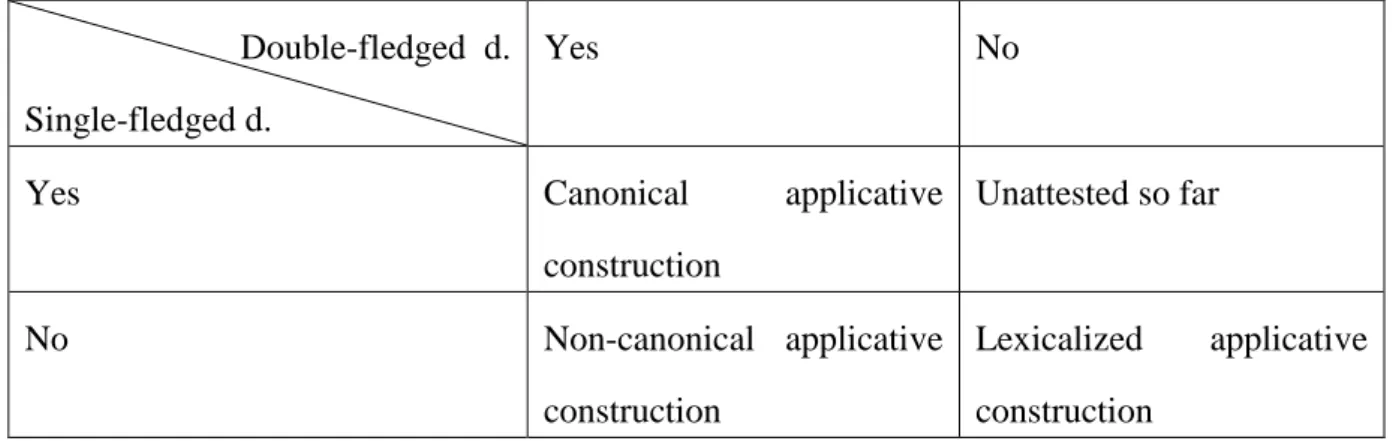
6.2 Lexicalized applicative construction 35 6.3 Summary 38
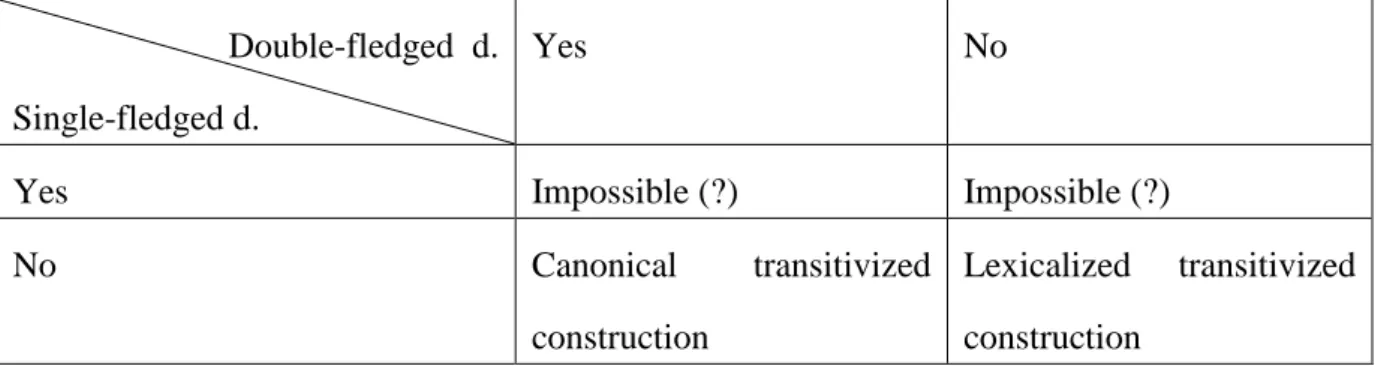
7 Transitivization 40
8 Result of the classification 45
9 Comparison with other classifications 46 9.1 Lehmann & Verhoeven (2006) 46 9.2 Pacchiarotti (2017) 48
10 Concluding remarks 51
11 Japanese benefactive construction 52
11.1 Demonstration of double-fledged applicative derivation 52 11.1.1 Similarities 53
11.1.2 Differences 54 11.1.3 Summary 56
11.2 Demonstration of single-fledged applicative derivation 56 11.2.1 What would be base construction? 56
11.2.2 Are there promotion effects? 59 11.2.2.1 Passivization 59
11.2.2.2 Relativization 60 11.2.2.3 Topicalization 60
11.2.2.5 Interrogativization 61 11.2.2.6 Summary of the results 62 11.3 Conclusion 62
Abbreviations 65 References 66
List of tables
1. The four valency-changing operations in terms of participant role affected and change of valency 7
2. Applicative derivations in terms of syntactic valency and participant number 17 3. Summary of relationship between each derivation and changes 32
4. Primary classification of applicative constructions 34 5. Relationship between constructions and changes 34
6. Relationship between double-fledged and single-fledged applicative derivations 38 7. Functions of derivations of each construction 39
8. Relationship between double-fledged and single-fledged transitivizing derivations 43
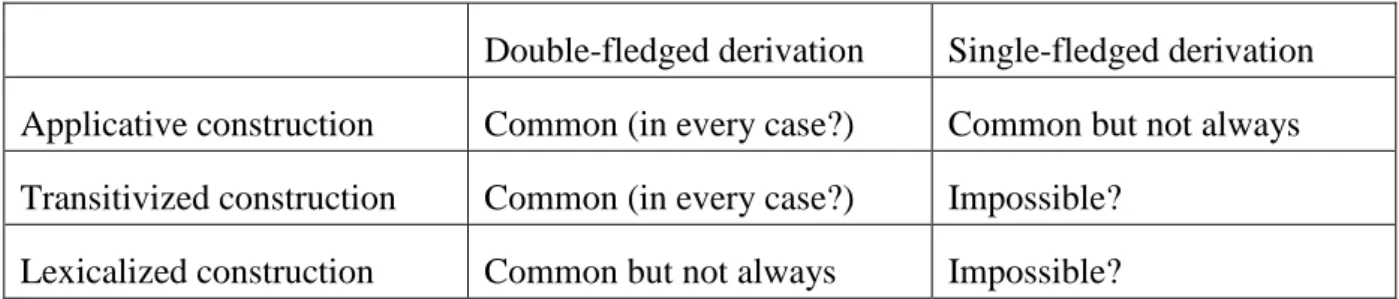
9. Relationship between each construction and two directions of derivation 45 10. Functions of derivations of each construction 45
11. Comparison of applicative construction and transitivized construction in relation to the two directions of derivation 45
1
1 Introduction
The linguistic phenomenon to be studied in this thesis is applicativization and applicative construction. In applicative construction, an argument of a verb which would otherwise be expressed as a peripheral argument (namely, adjunct) is expressed as a core argument, conferred direct object morphology and syntax. This in many cases results in increase of the valency of the verb and thereby applicative in general is counted as a valency-increasing category with causative the other major one. Here is an example from Latin:
(1) Latin1
a. Ad flumen eo. to river go.1SG ‘I go toward the river.’
(McGillivray 2013: 120) The propositional meanings of (1a) and (1b) are identical. Where the difference lies is syntactic coding of the allative role of the river. In (1a), flumen ‘river’ is expressed as a periphery, marked by the preposition ad ‘to’. In (1b), on the other hand, flumen is expressed as a direct object, receiving the accusative zero marker, without a preposition. We see this as a case of applicativization. When we interpret that (1b) is derived from (1a), it can be said that
flumen undergoes (syntactic) ‘promotion’, whereby the syntactic status changes from
periphery to core through the syntactic derivation, applicativization. In this case, (1a) is ‘base construction’ and (1b) is ‘derived construction’. Semantic roles of arguments which are
1 Cited glosses in the thesis are not always exactly the same as in sources but minimal modification is
made when necessary for purpose of symbolic consistency in the thesis. Abbreviations used in the thesis are indicated in page 65.
b. Flumen adeo. river to.go.1SG ‘I go toward the river.’
2
applicativized are peripheral ones, which include beneficiary, recipient, allative (as in the example), locative, instrumental, comitative, and so on.
The purpose of the present study is two-fold: ( Ⅰ ) propose a new approach to applicativization and thereby establish a classification of applicative constructions and (Ⅱ) apply this approach to Japanese benefactive construction to demonstrate its applicative nature. The organization of the thesis is as follows: in Chapter 2, the importance of noticing contrasts between applicative and other valency-changing operations will be pointed out. In Chapter 3, two views previous studies had toward applicative will be discussed and inutility of them for our purpose will be mentioned. In Chapter 4, I will propose the two-direction of derivation view as an alternative which defines double-fledged and single-fledged applicative derivations. In Chapter 5, what kind of syntactic and semantic changes are caused in each derivation defined will be discussed. In Chapter 6, I will show in what way classification and characterization are possible with by view proposed. In Chapter 7, I will apply the same analysis to ‘transitivization’, which is defined as similar to but different from applicativization. Thereby in Chapter 8, ultimate version of my classification will be exhibited. In Chapter 9, classifications of applicative constructions by two previous studies, Lehmann & Verhoeven (2006) and Pacchiarotti (2017), will be compared to mine respectively. Chapter 10 will conclude the new approach with some suggestion of how to do case studies by it. In Chapter 11, as a case study, I will apply the approach to Japanese benefactive construction and demonstrate possibilities of double-fledged and single-fledged applicative derivations in it.
3
2 Applicativization and the other valency-changing
operations
Applicativization can be compared with causativization, passivization, and antipassivization. The four are grouped together under the label ‘valency-changing’, a cover term of valency-increasing and valency-decreasing2. The former includes applicativization and causativization and the latter passivization and antipassivization.
‘Valency-decreasing’ and ‘valency-increasing’ respectively mean removal and addition of a core argument with regard to a certain clause. What makes it possible for there to be more than one valency-decreasing and more than one valency-increasing category is that there are several possibilities as to which participant role is chosen to be removed or added through an operation. Let us here take an overview of basic characteristics of the two valency-decreasing operations, passivization and antipassivization, and the other valency-increasing operation, causativization, in turn, to help clarify the position of applicativization as a valency-changing category.
2.1 Valency-decreasing operations
2.1.1 Passivization is commonly applied to transitive or ditransitive clauses. In this process, the valency is decreased in such a way that the original P (T or R in ditransitive cases) becomes S and the original A moves to the periphery or gets unexpressed3. Below is an example from English:
2
Sometimes further related grammatical phenomena are mentioned together with (some of) these, such as dative shift, noun incorporation, and anticausative. These are out of our scope. But, the former two in some cases can be regarded as kinds of applicativization.
3
This usage of symbols is in accordance with categorization by Haspelmath (2005, p.1) of arguments in terms of participant roles into: S (single argument of intransitive verb), A (agent-like argument of transitive verb), P (patient-like argument of transitive verb), T (theme-like argument of ditransitive verb), and R (recipient-like argument of ditransitive verb). These labels will also appear in glosses used in this thesis.
4
(2) English
a. John washed the car.
b. The car was washed (by John).
Passivization is also possible for intransitive clauses, but in such cases too, it is possible to suppose that there is a base construction and derived construction. This can be exemplified by Japanese adversative passivization illustrated below, where (3a) can be said to be a base construction and (3b) a derived construction. This is an exceptional case, given that the typical property of passivization is to cause changes like ones deriving (2b) from (2a).
(3) Japanese
*c. Seito-ga sensei-o sawai-da.
Student-NOM teacher-ACC make.noise.CNV-DCL
2.1.2 Antipassivization is commonly applied to transitive or ditransitive clauses. In this process, the valency is decreased in such a way that the original A becomes S and the original P (T or R in ditransitive clauses) moves to the periphery or gets unexpressed. Below is an example from Dyirbal:
(4) Dyirbal
a. Mayŋgu-Ø Jani-ŋgu jaŋga-ɲu. mango-ABS Johnny-ERG eat-PST a. Seito-ga sawai.-da.
student-NOM make.noise.CNV-PST ‘Students made noise.’
b. Sensei-ga seito-ni sawag-are-ta. teacher-NOM student-by make.noise-PSS-PST
5
‘Johnny ate the mango.’
(Dixon 2010a, p.167) Note that the intransitivity of the predicate of (4b) is indicated by the absolutive marking on
Jani ‘Johnny’, which is realized as zero.
From the above observations, it can be seen that participant roles which are chosen to be removed or at least to be deprived of core argument statuses are A in passivization and P (or T/R) in antipassivization.
2.2 Valency-increasing operations
2.2.1 Causativization is applied to clauses with any transitivity. In this process, the valency is increased in such a way that a new argument is introduced as A to cause the event described in the base construction (namely, ‘causer’) and the original S or A thereby moves to a small clause to become the whole sentence’s P or T4 (namely, ‘causee’). Consider the following example from Korean:
(5) Korean
a. Minsu-ga bab-ul meg-e-t-ta. Minsu-NOM meal-ACC eat-CNV-PST-DCL ‘Minsu got a meal.’
4
In Japanese, dative marking is also possible regardless of transitivity.
b. Jani-Ø jaŋga-na-ɲu (maygu-gu). Johnny-ABS eat-APSS-PST mango-DAT ‘Johnny ate (the mango).’
b. Chingu-ga Minsu-lul bab-ul meg-i-et-ta.
friend-NOM Minsu-ACC meal-ACC eat-CAUS-CNV-PST-DCL ‘My friend made Minsu get a meal.’
6
2.2.2 Applicativization is applied to clauses with any transitivity. Here I repeat (1) here as an example of applicativization:
(6) Latin
a. Ad flumen eo. to river go.1SG ‘I go toward the river.’
Therefore, one can see that the opposite of what we saw about valency-decreasing operations happens in the case of valency-increasing operations, that is to say, A and P (or T/R) in core argument statuses are added in causativization and applicativization, respectively.
One fact which can be confirmed from (2) - (6) is that individual passive, antipassive, causative, and applicative constructions are not primary constructions in themselves, but presuppose certain clause (construction)s which are what they were before undergoing passivization, antipassivization, causativization, and applicativization, respectively. This is the reason why the valency-changing categories are called ‘process’ or ‘operation’, which is supposed to be applied to clauses whose predicates are unmarked, neutral or active in terms of valency-changing5, which are to be altered thereby into corresponding constructions. This study will mainly use the terms ‘operations’ and ‘(syntactic) derivations’6 interchangeably
5
It must not be forgotten, on the other hand, that there are cases where, for example, applicative construction further undergoes passivization (see 5.1.1.2.1 in Chapter 5 for details), which means that base constructions are not always neutral in this sense.
6
Calling such changes whereby a new element (core argument) emerges out of null ‘derivations’ is justified when we recall that, in the processes generally called morphological ‘derivations’ too, a new arbitrary element (morpheme) emerges out of null, as in: invent→invent-ion, invent-or, etc, for example. Kibrik (1993, p.49) explicitly states that ‘propositional derivations’ are applied to ‘propositional structure’ in valency-changing operations.
b. Flumen adeo. river to.go.1SG ‘I go toward the river.’
7
and distinguish accordingly base constructions and derived constructions in individual cases, as we have so far done.
2.3 Relationships between the four valency-changing operations
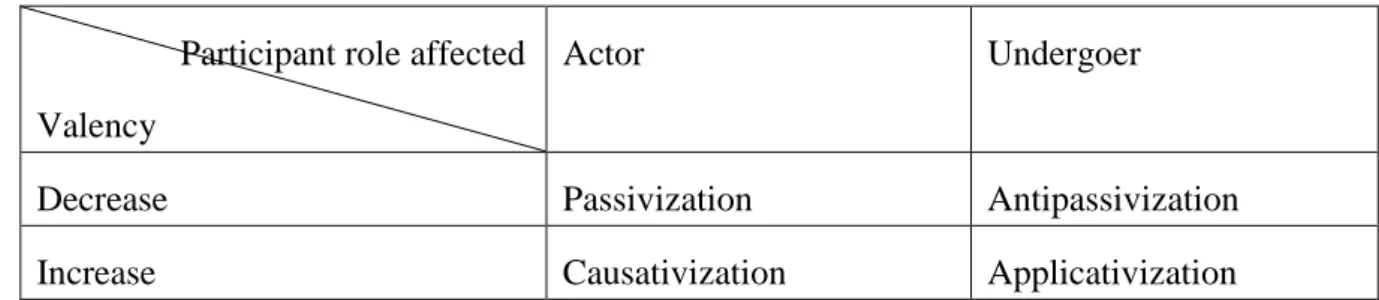
By noticing which macro participant role, actor or undergoer, is mainly affected in each valency-increasing and valency-decreasing operation, we can use this as another parameter from ‘valency decreasing or increasing’ for describing each operation. This results in the following table:
Table 1. The four valency-changing operations in terms of participant role affected and change of valency
Participant role affected Valency
Actor Undergoer
Decrease Passivization Antipassivization Increase Causativization Applicativization
When comparing research history of applicative in general with those of the other ones, especially with causative and passive, the poverty of studies of applicative stands out. First of all, the number of languages where there are phenomena which are clearly distinguishable as applicative is very small, being “no more than about a quarter” according to Dixon (2012, p.294)7. Furthermore, the large part of such languages are languages spoken in areas such as Africa, Americas, and Australia, where native languages have relatively scarce traditions of surveys, in comparison to areas such as Europe, Indo, China, and Japan. Descriptive grammars of such languages have some parts dedicated for applicative. But cross-linguistic studies to uncover the complex internal structure of how applicative forms and functions are arranged and distributed in general terms are at the stage of the dawn in every sense.
7
8
This general lack of interest toward applicative seems to have been responsible for some illusions concerning this category. When applicative is mentioned in general literature of typology, the tendency is that the topic of applicative is given a virtually parallel treatment with those of the other major valency-changing categories: passive, antipassive, and causative. This tendency is very natural given that doing so exhibits the symmetrical picture where valency-decreasing and valency-increasing are respectively allotted two sorts of category, passive and antipassive for the former and causative and applicative for the latter, presenting the quaternary situation involving two valency-decreasing and two valency-increasing categories, to be considered as four main constituents of the closed class of “valency-changing”. I myself did this in this chapter.
But, it is difficult in linguistics to find real symmetries in any senses. While surely the four operations constitute the closed category “valency-changing” in general terms and it is undoubtedly reasonable to group them together, looking at them parallel a priori fails to capture important facts concerning each category which are hidden behind the surface symmetry. Especially, noticing differences between applicative and causative serves to bring to light properties peculiar to applicative. Keeping this in mind, throughout the study, comparisons will be made between applicative and the other valency-changing operations in certain respects whenever it helps to make a certain property of applicative stand out. Lehmann (2015b, p.1575) suggested a similar point but all he pointed out was the importance of contrasting applicative with causative, and does not go further to mention the importance of contrasting applicative with the valency-decreasing operations. It is true that it is causative which is the valency-changing operation comparison of which with applicative is the most fruitful, as will be implied by the present study as well. However, extending the viewpoint and looking at the whole picture will make further contributions to our purpose.
9
3 Previous views toward applicative
To begin our discussion placing focus on applicative, it is appropriate to look at what kinds of approach have been taken toward this category. Two views can be identified: ‘the valency-increasing view’ and ‘the valency-increasing vs. valency-rearranging view’.
3.1 The valency-increasing view
‘The valency-increasing view’ named here is the most basic way of interpreting applicative. It merely regards applicative as operation which increases the valency of the verb it is applied to. It is thought that the study of applicative began with this view, which is suggested in Shibatani (1996, p. 159)’s note. One place where this view is typically manifested is Austin’s summarization of applicativization in Australian languages:
(7) Austin (2003, p. 169)’s summarization of applicativization S1 Vi → A1 O2 Vtr
, which is by no means sufficient8. In what way this view just sees the surface will be clarified in course of the following discussions.
3.2 The valency-increasing vs. valency-rearranging view
Considering the second view entails noticing a contrast between applicativization and the other valency-changing operations. This is that the functions of applicativization are far from being unique, in the sense that applicativization is not dedicated to valency-increasing in the same way as causativization is dedicated to valency-increasing and passivization and antipassivization are dedicated to valency-decreasing. What turns out true is rather that applicativization regularly causes changes which are more appropriately called
8
Another problem is that this formulation excludes cases where base constructions are polytransitive (transitive or ditransitive) clauses.
10
‘valency-rearranging’ than ‘valency-increasing’, in addition to changes caused in non-syntactic aspects.
Reflecting this fact, many previous studies’ approach toward applicativization had their bases on the view called here ‘the valency-increasing vs. valency-rearranging view’. This view is explicitly discernible in Comrie (1985, pp.312-322), Helmbrecht (2008, pp.136-137) and Shibatani (2016). Consider the following example from West Greenlandic:
(8) West Greenlandic
a. Niisi aningaasa-nik tuni-vaa.
Niisi money-INST.PL give-IND.3SG>3SG ‘He gave Nisi money.’
(Fortescue 1984: 88, cited in Malchukov 2013: 283) b. Aningaasa-t Niisi-mut tunni-up-pai.
money-PL.ABS Nisi-ALL give-APPL-IND.3SG>3PL ‘He gave money to Nisi.’
(Fortescue 1984: 88, cited in Malchukov 2013: 284) In (8a), which is an active ditransitive sentence, syntactically, Niisi is direct object and
aningaasa ‘money’ indirect object. Applicativizing this sentence results in (8b), in which it is aningaasa ‘money’ which is direct object and Niisi is indirect object, where thus one can see
‘promotion’. Here, as an applicative effect, valency increased in that aningaasa ‘money’ got direct object status. At the same time, however, Niisi lost its direct object status, where thus one can see ‘demotion’, which is opposite notion of ‘promotion’. Integrating these two changes, it can be said that the two arguments ‘exchanged’ their grammatical status. This is what is described as ‘valency-rearranging’.
This view is more advanced than the valency-increasing view, but is inutile in two ways. The first problem is that it is not suited to analyze what kinds of change are brought about in individual aspects of base constructions in the process of applicativization, because from this view it is quite hard to focus on one of them. For example, it is difficult to scrutinize the
11
nature of promotion, due to the fact that it is impossible to separate promotion from other syntactic changes brought about by applicativization, as long as it is seen from the perspective of valency-increasing vs. valency-rearranging. What is responsible for this situation is that these two concepts are not mutually exclusive but overlap; as a result, valency-increasing can be admitted in promotion in the sense that the number of syntactically core arguments is increased, and then, promotion, in turn, can be a part of valency-rearranging in the sense that valency-rearranging entails promotion together with valency-increasing, when applied to an already ditransitive construction such as (8a). Finally, it is as well the case that ‘valency-rearranging’ in a wider sense can subsume ‘valency-increasing’, especially if demotion happens together with introduction of a new argument, like in the following example from Halkomelem:
(9) Halkomelem
a. Nem̓ cən sem̓-ət θə-nə snəxʷəɬ. go 1SG.S sell-TR DT-1SG.POS canoe ‘I’m going to sell my car.’
b. Nem̓ cən sem̓-əs-t ɬə sɬeniʔ ʔə θə-nə snəxʷəɬ. go 1SG.A sell-DAT-TR DT woman OBL DT-1SG.POS canoe ‘I’m going to sell my car to the woman.’
(Gerdts 2010: 566) From the above discussion of the complicated picture of the situation, it can also be seen that not only promotion, but also another syntactic change in applicativization, valency-increasing, is difficult to abstract and scrutinize with this view.
And the second problem is that it is as well difficult to lead to any forms of classification of applicative constructions with this view. On the one hand this is because of their overlap discussed above. On the other hand this is because all the view is about is operations, not referring to constructions which are consequences of them, thus not serving for classifying constructions.
12
It therefore can be seen that in our purpose of classifying applicative constructions according to changes they experienced from base constructions, the valency-increasing vs. valency-rearranging view does not provide us with useful parameters of classification. Although Comrie (1985: 313,317) explicitly mentioned their indistinguishability, there has been no alternative approach proposed.
13
4 An alternative view: the two-direction of derivation view
4.1 The two-direction of derivation view
For the purpose of scrutinizing changes which are involved in applicative derivations and making a classification of applicative constructions, I propose a different view toward applicative. This is named ‘the two-direction of derivation view’.
To introduce it, another difference between applicative and other valency-changing operations will be discussed, a difference which composes a basis of the view proposed. This is concerned with focusing on the two ends of applicativizing processes, that is, base construction and derived construction as defined above, and in what way the two are connected to each other.
One assumption which can arise from the discussion in Chapter 2 is that there is one base construction per derived construction in each case of valency-changing derivations. As for passivization, it is obvious that active sentences are primary or unmarked in relation to their passive counterparts, so that virtually every passive construction has a base construction, (2a) being base construction and (2b) derived construction, for example9. The same thing applies to antipassivization, (4a) base construction and (4b) derived construction. As for causativization, (5a) is base construction, which, by undergoing causativization, gives rise to derived construction, which is (5b). Theoretically, any causative sentences can assume a base construction, since, to make some event happen, there has to be that ‘some event’, which can be expressed in form of a clause.
However, some different situation is presented by applicativization. That is, the following sentence (10) can be said to be a base construction of (6b), as well as (6a).
(10) Latin a. Eo. go.1SG 9
14
‘I go.’
Here we see that an applicative construction can have two base constructions. This is a unique nature of applicative, which cannot be seen in the other valency-changing operations.That is, as discussed above, passive, antipassive, and causative constructions only have one base construction at least in most cases so that there is only one derivation which leads to a certain construction. Rather, in cases of valency-decreasing, what should be paid much attention are derived constructions, not base constructions, in that, overt realizations, in oblique forms, of demoted arguments (A in passivization and patient P (T/R) antipassivization) are optional, yielding two different possibilities of derived construction, which is indicated by parentheses in the examples of (3) and (4). Applicativization allows options for base constructions, not for derived constructions, and therefore shows a contrastive nature. Note that the same does not necessarily apply to causativization, the other valency-increasing operation, given that (11a) below could be said to be base construction of (5b), rather than (5a). Furthermore, it is also possible to say that (11b) is derived construction of (11a).
(11) Korean
a. Chingu-ga bab-ul meg-e-t-ta. friend-NOM meal-ACC eat-CNV-PST-DCL ‘My friend got a meal.’
Summary of the comparison between applicativization and the other valency-changing operations made here is the following: per one construction set of valency-decreasing derivation, there is one base construction and two derived constructions. Per one construction b. Minsu-ga chingu-lul bab-ul meg-i-e-t-ta.
Minsu-NOM friend-ACC meal-ACC eat-CAUS-CNV-PST-DCL ‘Minsu made my friend get a meal.’
15
set of applicative derivation, there are two base constructions and one derived construction. Causativization presents the most complicated picture.
Thus, returning our focus to applicativization, the point we should notice now is that, when thinking about derivations yielding applicative constructions, it is possible to suppose two kinds of derivation arising from different directions, by taking different perspectives. The first perspective finds the derivation which alters an intransitive or transitive clause into a clause with an obligatory direct object which was not expressed in any way in the initial clause, yielding (6b) out of (10), for example. This is compatible with the relationships between (a) clauses and (b) clauses in the other valency-changing operation in (2)-(5), because each operation involves an addition of a new argument. On the other hand, the second perspective finds the derivation which alters a construction with a non-core argument into a construction with some accusative marking on it, yielding (6b) out of (6a), for example. One thing which should be noted is that difference between the two derivations stems from two parameters working behind each derivation to determine syntactic and semantic changes in the clause which are brought about by each direction of derivation. These are ‘syntactic valency’ and ‘participant number’, which are defined as follows in the present study:
(12) Syntactic valency and participant number
Syntactic valency: number of arguments which are syntactically realized as core arguments (non-adjuncts).
Participant number: number of arguments involved in the situation described, irrespective of what syntactic status they have.
Syntactic valency and participant number are not in relation of dependency, which allows the following situations. In the derivation from (10) to (1a), the goal of the event described, going, is not expressed in the base construction (1a). This means that both syntactic valency and paritipant number are increased. Let us label this direction of applicative derivation
16
‘double-fledged applicative derivation’. In the derivation from (1b) to (1a), on the other hand, the goal of going is expressed before undergoing applicativization as well, the difference between them being syntactic coding of the semantic role, goal. This means that syntactic valency was increased, while participant number itself remains the same. Let us label this direction of applicative derivation ‘single-fledged applicative derivation’. The following figure illustrates these two directions of derivation:
Figure 1. Two directions of applicative derivation
Base constructions: [a] VERB [b] VERB ARGUMENT (OBLIQUE) Double-fledged derivation Single-fledged derivation
Derived construction: VERB+APPL ARGUMENT(CORE,non-subject)
Note that, cases like the following cannot be regarded as single-fledged derivation, because the semantic role of flumen in light of the real situation described is marked in a rather formally periphrastic way; partem cannot be considered as a preposition, unlike ad in (1a).
(13) Latin
Part-em fluminis eo. direction-SG.ACC river.SG.GEN go.1SG ‘I go in the direction of the river.’
Logically, in our line of discussion, we can assume another single-fledged derivation, that is, situation where syntactic valency remains the same and participant number is increased. Such situation can be found when addition of an argument in an adjunct form to a sentence where the argument is not expressed in any way, as the change from (10) to (14) below. However, this is not a case of applicativization, since there is no applicative marker in the first place.
17
(14) Latin
Ad flumen eo.
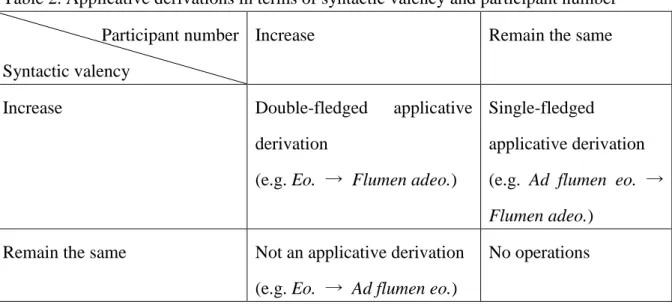
Thus, in summary, my proposal here is distinguishing the two directions of derivation which can lead to applicative constructions, being sensitive to the ambiguity of the concept of ‘valency’, in the way discussed above. These are double-fledged derivation and single-fledged derivation. In the following figure, it can be seen that they are clearly distinguishable, which we saw in Chapter 3 is not the case for valency-increasing and valency-rearranging. I will call this view ‘the two-direction of derivation view’ to make it standing parallel with the other ones.
Table 2. Applicative derivations in terms of syntactic valency and participant number Participant number
Syntactic valency
Increase Remain the same
Increase Double-fledged applicative derivation
(e.g. Eo. → Flumen adeo.)
Single-fledged
applicative derivation (e.g. Ad flumen eo. →
Flumen adeo.)
Remain the same Not an applicative derivation (e.g. Eo. → Ad flumen eo.)
No operations
A relevant fact should be mentioned here: there is a fundamental difference between the two derivations. This is difference of how frequently existent each derivation is for individual applicative constructions. As for single-fledged derivation, sometimes applicative constructions lack it, as in the following example from Tswana; according to Creissels (2006, p.74), applicativization is the only means to introduce a recipient argument to (15a), which yields (15b).
18
(15) Tswana10
a. Lorato o tlaa kwal-a lokwalo. 1Lorato A3:1 FUT write-FIN 11letter ‘Lorato will write a letter.’
(Creissels 2006: 74) As for double-fledged derivation, although it is not confirmed at this point and counterexamples cannot be denied, it is thought that applicative constructions have it in any case. Consequently, it is supposable that the two are in an implicational relationship, whereby:
(16) Implicational relationships between the two directions of derivation
Existence of single-fledged derivation presupposes that of double-fledged derivation. Nonexistence of double-fledged derivation presupposes that of single-fledged derivation.
4.2 Previous attitudes toward the two derivation directions
In the preceding section, it was discussed that there are two directions of applicative derivation: double-fledged derivation and single-fledged derivation, which were defined in relation to two possibilities of base construction. In this section, which directions of derivation previous literatures implicitly have focused on will be explored.
When applicative in general is talked about, which derivation to be mainly considered or to be used as a part of definition of applicative differs among authors. Almost all of them are not sensitive to the existence of the two directions and this has suppressed the possibility of attempt to make a classification of applicative constructions which I am going to make. It is
10
In the glosses, the figures 1 and 11 stand for noun classes and the figure 3 stands for number.
b. Lorato o tlaa kwal-el-a Kitso lokwalo. 1Lorato A3:1 FUT write-APPL-FIN 1Kitso 11letter ‘Lorato will write a letter to Kitso.’
19
thought that this tendency is more or less a reflection of their sticking to the valency-increasing view or valency-increasing vs. valency-rearranging view.
Dixon (2012, pp.299-301) puts importance on what we call single-fledged derivation and calls those with double-fledged derivation only ‘quasi-applicative’. Shibatani (2016)’s claim that the essence of applicativization is ‘alignment alternations’ have preferences for single-fledged derivation. Palmer (1994, pp.161-171) can also be counted in this group. It seems that they consider applicative mainly in terms of valency-rearranging.
On the other hand, authors like Mithun (2001), Austin (2003) and Creissels (2010) focus on what we call double-fledged derivation. Above all, it is double-fledged derivation which Austin’s summarization of applicativization cited as (7) in Chapter 3 immediately recalls, although this should not be taken as excluding single-fledged derivation completely. Mithun (2001, p.73) gives a definition that “prototypical applicatives are derivational processes within the verbal morphology that add a participant to the set of core arguments”. They seem to consider applicative in terms of valency-increasing.
Third parties such as Peterson (2007) are not conscious of the distinction. Payne (1997, p.186)’s description of applicatives as “operations whereby a verb is marked for the semantic role of a direct object” is the hardest to appreciate in our approach, since, along this interpretation, no applicative derivations can be supposed in the first place. In contradistinction to his approach, the assumption of the present study is that applicative marking is not preceded, but followed, by introduction of a new direct object argument.
It is not that there are no previous studies at all which recognize the distinction of the two derivation directions. The statement in Kulikov (2011, p.389) is on the most equal standpoint toward the two directions, but he does not go further to make a classification of applicative constructions. Lehmann and Verhoeven (2006) is somehow close to what the present study intends to show. They do have the idea of distinguishing the two derivation directions and insist on the importance of this distinction. However, their distinction cannot cover everything which is necessary for making a fine classification of applicative constructions. The detail of their classification and how it is incomplete will be discussed in Chapter 9.
20
What every author except the ones mentioned above lacks in common is an impartial view to double-fledged derivation and single-fledged derivation. Those who are inclined to double-fledged derivation fail to get aware how remarkable is promotion of applicativization, which is another syntactic function of it from valency-increasing. On the other hand, those who emphasize single-fledged derivation fail to admit syntactic changes caused by double-fledged derivation, which is valency-increasing. The attitude of the latter is further manifested in the situation where applicative constructions with no single-fledged derivation are expressed as ‘obligatory’ (Creissels 2006: 73,74 ; Peterson 2007: 45-51). This is misleading, since in cases of double-fledged derivation, derivations are not obligatory at all; sentences like (10) and (14) can stand without problems. It even appears that using labels like ‘quasi-applicative’ (Dixon 2012: 299-301) for such cases intends to exclude cases with double-fledged derivation only from applicativization. As a result, they fail to pay attention to the fact that just having double-fledged derivation is enough for a construction to be authorized as ‘valency-increasing’, which is what still should be regarded as one important property of applicativization, or to the fact that there is double-fledged derivation at all.
21
5 Changes brought by applicative derivations of each
direction
As was suggested in Chapter 3, there are two things which the previous views cannot and which the double-fledged vs. single-fledged derivation view can. The ultimate one of the two is classifying applicative constructions depending on the distinction of the two directions of derivation. Thus, that we introduced the distinction in the preceding chapter means that we gained basis for establishing a classification of applicative constructions, which is the main purpose of the study.
But, before embarking the classification, it will be appropriate to do the other one first, that is, scrutinizing functions or changes caused by each derivation. The changes to be discussed range from syntactic ones to semantic ones. Syntactic changes include valency-increasing (encompassing syntactic valency-increasing and participant number increasing) and promotion. It is thought that there are also pragmatic changes but we will not deal with them, to avoid making classification complicated by going beyond non-pragmatic aspects.
The reason why our taking the two-direction of derivation view makes that possible is that functions played by applicative derivations differ according to whether it is double-fledged derivation or single-fledged derivation. Thus, characterizing double-fledged derivation and single-fledged derivation by changes they cause to base constructions will contribute to characterizing classifications as well, as will be seen in Chapter 6. Let us begin by syntactic changes.
5.1
Promotion
Only one of the derivation directions, single-fledged derivation, has promotion caused. Therefore, what will be discussed about promotion in this subsection is only relevant with single-fledged derivation, not relevant with double-fledged derivation.
22
Promotion is the process whereby a peripheral argument in base construction becomes a core argument in derived construction with the semantic role retained. In the Latin cases (1) in Introduction, for example, the peripheral argument ad flumen in the base construction (1a) gets marked as a core argument flumen in the derived construction (1b).
It is also worth noting that sometimes promotion of an argument in single-fledged applicative derivation is accompanied by demotion of another argument. This is what we saw in the West Greenlandic example (8) in 3.2 for the discussion of valency-rearranging. But demotion will be excluded from our concern since we are taking the two-direction of derivation view and demotion itself is not involved in either derivation.
Below we will see how remarkable are evidence of syntactic promotion in single-fledged derivation. We will demonstrate it by distinguishing between ‘promotion markings’ and ‘promotion effects’. Let us begin with promotion markings.
5.1.1 Promotion markings
As is a repetition, promotion to a direct object means that argument in question receives the same grammatical treatment as a direct object in that language as if it is a direct object. The most conspicuous manifestation of promotion is employment of the same form as the direct object marker for indicating the grammatical relation of the argument which was affected in the single-fledged applicative derivation. In the case of (1a) and (1b), the argument, which was originally marked as periphery, receives zero marking, which is likewise employed as ordinary accusative marking of flumen. However, it is important to notice that this is not the only strategy of how grammatical relations of promoted arguments are marked. When recalling that core arguments (subjects and direct objects) in general have couple of marking strategies: case morpheme (case affix, clitic, or adposition), constituent order, and bound pronoun, it is suggested by a simple analogy that this variety as it is will also apply to the markings of applicativized direct objects, namely, direct objects which are results of being promoted from peripheral syntactic statuses. Therefore, we can assume at least three kinds of
23
applicativized object marking, as summarized in (17)11. As long as ordinary grammatical relation marking strategies are grouped together in this way, promoted (applicativized) argument marking strategies should reflect it. Let us look at examples of each strategy in turn.
(17) Promotion marking strategies Accusative morpheme Bound pronoun Constituent order
5.1.1.1 Accusative morpheme
‘Accusative morpheme’ here refers to morphemes of any forms attaching or adjacent to noun phrases to mark them with accusative case. These include adposition, clitic, and affix. As in the Latin case in (1b), in many cases the accusative morphemes employed for applicativized direct objects are zero according to Polinsky (2013).
An example of overt forms comes from Nez Perce. In (18b), which here is supposed to be an applicative construction derived by single-fledged derivation from the base construction (18a), láwtiwaa ‘friend’ accompanies the overt accusative suffix -na, replacing the instrumental marker -yiin in (18a).
(18) Nez Perce
a. Láwtiwaa-yiin hi-túuqi-six miyóoxat. friend-with 3S-smoke-ASP chief ‘The chief is smoking with a friend.’
b. Láwtiwaa-na pée-tuqi-twe-ce miyóoxato-m. friend-ACC 3A.3P-smoke-APPL-ASP chief-ERG ‘The chief is smoking-with a friend.’
11
There are further possibilities in ordinary grammatical relation marking: tone (e.g. Maasai) and consonant alternation (e.g. Celtic languages), for example. I could not detect these strategies used for applicativized direct object and so will not consider these.
24
(Rude 1985: 181, 1986: 142, cited in Dixon 2012: 323)
5.1.1.2 Bound pronoun Attaching an accusative morpheme to noun phrase is not the only way to mark direct object
by means of a formal device. When the form is on verb instead of on noun phrase, we see that the grammatical relation is marked by bound pronoun instead of by accusative morpheme. In many languages which are equipped with bound pronoun systems, there are only one or two slots of bound pronouns in one predicative complex. Thus it is a widely attested phenomenon, which is thought to the case in all languages which have two slots of bound pronouns in one predicative complex, that, in ditransitive clauses, the two undergoer participant roles T and R compete with each other to occupy the sole object slot in a predicative complex. And it is thought that applicativized arguments can unconditionally win the slot generally. Syntactically peripheral arguments cannot be coded by means of bound pronouns in the first place, as opposed to free noun phrases, which can be marked by virtually any kinds of grammatical or oblique relation. Therefore the fact that an argument occupies a bound pronoun slot at all is a sign that it got direct object status.
The West Greenlandic case we cited as (8) in 3.2 provides again a good example. In (8a), the two arguments, ‘he’ and Niisi are coded by the fused bound pronoun -vaa, and aningaasa ‘money’ is not coded in the same way and just accompanies the instrumental case morpheme -nik. In (8b), which is derived construction, on the other hand, it is aningaasa ‘money’, not
Niisi, which is coded together with ‘he’ by the fused bound pronoun -pai. Here we clearly see
promotion of aningaasa ‘money’ in the fact that its semantic role is marked through a bound pronoun, not through a case morpheme.
Here again, the Nez Perce case (18) above serves as another example. In (18a), which is an intransitive clause, there is only one bound pronoun in the predicative complex hi-túuqi-six , namely, hi, which codes the subject miyóoxat ’chief’. In (18b), on the other hand, the applicativized argument láwtiwaa is coded together with miyóoxat ‘chief’ by the fused bound pronoun pée-.
25
5.1.1.3 Constituent order
Constituent order is the third major grammatical relation marking strategy and this is also observed for promoted or applicativized objects. In Indonesian, according to Song (2018, p.386), direct object as a result of single-fledged applicative derivation comes to the position adjacent to the verb.
(19) Indonesian
a. Ali mem-buka pintu untuk guru. Ali TR-open door for teacher ‘Ali opens the door for the teacher.’
(Song 2018: 386) It seems that the same phenomenon happens in Rwanda (Kinyarwanda) single-fledged applicative derivation, too:
(20) Rwanda
a. Umwaalimu a-ra-andik-a imibare ku kibaaho. teacher he-PRES-write-ASP maths on blackboard ‘The teacher is writing maths on the blackboard.’
(Kimenyi 1988: 368-369, cited in Palmer 1994: 164) Moreover, Creissels (2006, p.86) exiplicitly reveals that the same change as these are obligatory in Tswana, another Bantu language from Rwanda.
b. Ali men-buka-kan guru pintu. Ali TR-open-BEN teacher door ‘Ali opens the door for the teacher.’
b. Umwaalimu a-ra-andik-a-ho ikibaaho imibare. teacher he-PRES-write-ASP-on blackboard maths ‘The teacher is writing maths on the blackboard.’
26
5.1.2 Promotion effects
What we saw above are not the whole story of promotion. It should be noticed that marking an argument as a direct object is merely an indication that there occurred promotion at all. In other words, what they are concerned with are forms, and they do not say anything about functions themselves they got able to play by becoming a direct object. Making new functions available for an argument through promotion can be paraphrased as ‘effects’ of promotion, as opposed to ‘markings’, which are no more than signs telling that certain functions were born out. Consequently, it can be said that there are two aspects in promotion: markings and effects.
All previous literatures dealing with promotion in applicativization I acknowledge do not differentiate these two, both being considered to be manifestations or evidence of ‘promotion’ altogether. However, it is necessary to see the two as separate concepts in a strict way in order to understand better the nature of the phenomenon called promotion.
Therefore, we should bear in mind that what we have so far seen above are promotion markings and what we will see below from now are promotion effects.
What promotion effects are about is as follows. Argument exhibits different syntactic behavior before and after single-fledged applicative derivation. Specifically, promotion newly allows the argument accesses to other syntactic operations from applicativization. These include a number of syntactic operations such as passivization, relativization, topicalization, cleft sentence derivation (Givón 1979: 159-206 ; Lemaréchal 1998: 207,208 ; Peterson 2007
passim et cetera), and interrogativization also. In other words, such operations are often not
accessible for every argument but only for arguments with high syntactic primacy to certain degrees (c.f. accessibility hierarchy by Keenan & Comrie 1977), which may be achieved through promotion. Promotion effects to be considered in the study are summarized below:
(21) Promotion effects
Passivization Relativization Topicalization Cleft sentence derivation Interrogativization
27
One tendency stemming from the confusion of promotion marking and effect is to treat bound pronominalization together with these syntactic operations (Hyman & Duranti 1982 ; Lemaréchal 1998: 207,208 et cetera). But it is not appropriate since bound pronoun should be regarded as one strategy clarifying argument structure rather than a syntactic operation12. Below, the three selected from (21): passivization, relativization and topicalization, will be exemplified.
5.1.2.1 Passivization
With the following example, Givón (1979) shows that in Rwanda13 a beneficiary argument needs to be applicativized in advance in order to get passivized. In the example, the recipient argument is amafaranga ‘money’ and the grammaticality of (22c) and ungrammaticality of (22d) indicate that promotion enables it to be passivized.
(22) Rwanda
a. Karoli y-a-koz-e ku-mafaranga. Charles he-PST-work-ASP for-money ‘Charles worked for money.’
b. Karoli y-a-kor-e-ye amafaranga. Charles he-PST-work-BEN-ASP money ‘Charles worked for the money.’
c. Amafaranga ya-a-kor-e-w-e.
money it-PST-work-BEN-PSS-ASP ‘The money was worked for.’
*d. Amafaranga ya-a-koz-w-e. money it-PST-work-PSS-ASP
(Givón 1979: 202)
12
‘The double-expression view’ toward argument indexing, which is summarized in Haspelmath (2013, p.212), is compatible with this point.
28
5.1.2.2 Relativization
Givón (1979) also shows that, in Swahili, a beneficiary argument needs to be applicativized in advance in order to get relativized. In the following example, the recipient argument is
mwanamke ‘woman’ and the grammaticality of (23c) and ungrammaticality of (23d) indicate
that promotion enables the relativization.
(23) Swahili
a. A-li-m-tuma baruwa kwa mwanamke. he-PST-her-send letter to woman ‘He sent a letter to the woman.’
b. A-li-m-tum-ia mwanamke baruwa. he-PST-her-send-BEN woman book (sic.) ‘He sent the woman a letter.’
c. Mwanamke a-li-ye-m-tum-ia baruwa. woman he-PST-REL-her-send-BEN letter ‘The woman to whom he sent a letter’
*d. Mwanmke (sic.) a-li-ye-m-tuma baruwa. woman he-PST-REL-her-send letter
(Givón 1979: 173) 5.1.2.3 Topicalization
In Bukusu, according to Peterson (2007, pp.30,31), only applicativized objects can undergo ‘left-dislocation’, which is thought to amount to ‘topicalization’ we are talking about. This is clear from the grammaticality of (24b) and ungrammaticality of (24c), which indicates promotion effect. (24c) has to mean ‘Tsewmang said it to Taaynaamkoong for Niihuu.’ to be grammatical.
(24) Bukusu
29
Tsewmang=ERG Taaynaamkoong Niihuu 3SG.A-3SG.P-say-BEN ‘Tsewmang said it to Niihuu for Taaynaamkoong.’
b. Taaynaamkooŋ Tsewmaŋ=niʔ Niihuu ʔa-Ø-tshiʔm-piak. Taaynaamkoong Tsewmang=ERG Niihuu 3SG.A-3SG.P-say-BEN ‘Tsewmang said it to Niihuu for Taaynaamkoong.’
*c. Niihuu Tsewmaŋ=niʔ Taaynaamkooŋ ʔa-Ø-tshiʔm-piak. Niihuu Tsewmang=ERG Taaynaamkoong 3SG.A-3SG.P-say-BEN Intended: ‘Tsewmang said it to Niihuu for Taaynaamkoong.’
Peterson (2007: 30)
5.2 Valency-increasing
Valency-changing is another syntactic change from promotion. This takes place both in double-fledged applicative derivation and single-fledged applicative derivation. Because the nature of valency-increasing in applicativization has already been discussed in some detail in Chapter 3 and 4, let us briefly review it, in terms of the two derivation directions.
In double-fledged applicative derivation, valency-increasing is the only syntactic change caused, since promotion does not occur. What happens is introduction of a direct object with a peripheral semantic role to base construction, whereby thus both syntactic valency and participant number are increased. It can be said that the change is substantial to some extent, because a direct object gets into the argument structure.
In single-fledged applicative derivation, there is a valency-increasing effect together with promotion, whereby syntactic valency is increased. It can be said that the effect is quite subtle, because participant number remains the same, showing weaker total degree of valency-increasing. The interpretation is that, in single-fledged derivation, promotion is in exchange for participant number increasing.
It is also worth noting that sometimes valency-increasing in double-fledged derivation is accompanied by demotion of another argument. This is what we saw in the Halkomelem example cited as (9) in 3.2 for the discussin of ‘valency-rearranging’. For the same reason mentioned in 5.1.1, demotion will be excluded from our concern.
30
5.3 Semantic changes
In semantic side, basically both double-fledged derivation and single-fledged derivation do not have such substantial changes to cause to base constructions. For, semantic role of applicativized direct object is peripheral one, not a core one as agent or patient. Single-fledged derivation clearly does not drastically affect the propositional meaning.
The subtlety of semantic effects in applicative derivations is further clearly captured through comparison with the case of causativiztion. Although the both are operations which entail valency-increasing, the participant roles to be added are different between double-fledged applicative derivation and causativization. In the former it is a peripheral role such as beneficiary, recipient or locative, while in the latter, it is an agent. Moreover, in cauastivization, adding the argument accompanies substitution or exchange of arguments. That is, in base construction (5a), the agent is Minsu but, in derived construction (5b), it is
chingu. What happened here is for Minsu to devolve its subject status to chingu, and to find its
new position in a small clause. In that agent, which is the most important participant role, is altered by an utterly new argument, we can see remarkable change in propositional meaning. When it is (11a) which is base construction of (5b), the change in propositional meaning is even greater. Originally, in (11a), it is chingu who gets the meal, but in (5b), it is Minsu. This is due to Minsu’s creating the small clause.
This is contrastive with double-fledged applicative derivation, which just ‘complements’ a participant which is functionally adverbial with regard to the predicate. Semantic change is even smaller in single-fledged applicative derivation, becausethe semantic role itself is intact, the only difference being syntactic marking of the arguments. The point is that original arguments to be mainly affected by both applicative derivations are semantically peripheral or non-core. This fact crucially contrasts applicativization with the other three valency-changing operations in that in most cases of derivations of the latter utterly new arguments are added, that is, it is difficult to find single-fledged derivation counterparts. And in the latter, core arguments are necessarily directly involved, affected, or exchanged in some way. In other
31
words, applicative is the only valency-changing operation which includes the possibility of retaining basic syntactic structure (c.f. Table 1 in 2.3). Lemaréchal (1998, p.205) makes a similar point and differentiates applicative from the other valency-changing operations by referring to applicative as ‘voix secondaire’ (second voice).
An analogous reasoning can also be made about valency-increasing, a syntactic change. That is, valency-changing effects of applicative derivations are not as great as those of the other valency-changing operations as well.
It is not impossible and rather common that an applicative affix has a special semantic effect and sometimes the semantic effects are substantially large. For details of such semantic changes applicative single-fledged derivation can cause, see Peterson (2007, pp.49,50), Pacchiarotti (2017) and Willemsen (2017). But remarkable cases of them should be interpreted as lexicalization or grammaticalization into other grammatical elements, which are not applicative anymore, rather than applicativization with outstanding semantic changes. One example of semantic change brought by applicative markers is the following, from Comrie (1985)14:
(25) Russian
a. Ivan po-seja-l psenic-u v pol-e.
Ivan.NOM PERF-sow-M.PST wheat-SG.ACC in field-SG.PREP ‘Ivan sowed wheat (in the field).’
b. Ivan za-seja-l pol-e psenic-ej. Ivan.NOM PERF-sow-M.PST field-SG.ACC wheat-SG.INST ‘Ivan sowed the field (with wheat).’
Comrie (1985: 314) As Comrie explains, (25b) implies that the whole of the field was sown with wheat, which is not implied by (25a). Therefore, while za- can be said to be an applicative marker, it can also
14
Comrie provided present tense versions together, but here only past tense versions are cited. Glosses are mine, because he did not give ones.
32
be used for semantic purpose at the same time, with wider effects than mere aspectual marking. This may be thought to be intermediate interface stage between applicative marker and aspect marker.
5.4 Summary
We saw that promotion is the most salient change caused in applicativization. In double-fledged derivation, there is no promotion and it is thought that some scholars are inclined to single-fledged derivations for this reason. This does not mean, however, that double-fledged derivation can be neglected. The derivation should still be considered as a part of applicativization as well as single-fledged derivation, as long as they surely are playing the grammatical function: valency-increasing, in the sense of syntactic valency-increasing. As for double-fledged derivation, because the importance of promotion is not valid anymore, valency-increasing should be taken as the main function. Labelling applicative merely valency-increasing (as does the valency-increasing view) fails to capture the fact that the fundamental function of applicativization is promotion, while it also should be remembered that valency-increasing in double-fledged derivation should be treated.
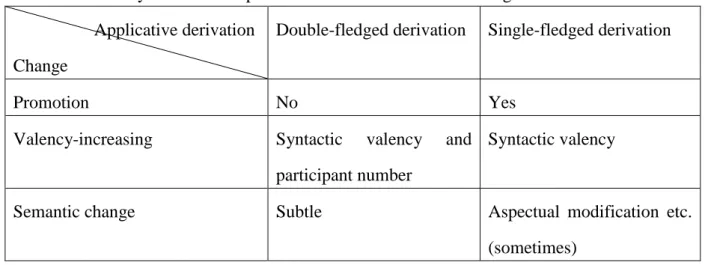
I end this chapter by summarizing the relationship between two derivations and changes in Table 3. This is characterization of double-fledged derivation and single-fledged derivation.
Table 3. Summary of relationship between each derivation and changes Applicative derivation
Change
Double-fledged derivation Single-fledged derivation
Promotion No Yes
Valency-increasing Syntactic valency and participant number
Syntactic valency
Semantic change Subtle Aspectual modification etc. (sometimes)
33
6 Classifying applicative constructions according to the two
directions of derivation
Based on the discussions made in Chapter 4 and 5, where applicative derivations were analyzed by the two-direction of derivation view, now we can fulfil the first step of classification of applicative constructions, which is the topic of this chapter.
6.1 Canonical and non-canonical applicative constructions
I classify applicative constructions according to which derivations they have. Thus, I define applicative constructions which have both double-fledged derivation and single-fledged derivation as ‘canonical applicative constructions’, and define applicative constructions only having either one of double-fledged derivation or single-fledged derivation as ‘non-canonical applicative constructions’ (Note that, throughout the study, the verb have in expressions such as applicative construction has double-fledged/single-fledged (applicative) (directions of)
derivation means that ‘it is possible to assume base construction which derives the applicative
construction through that direction of derivation’.)
These definitions allow two kinds of non-canonical constructions to arise, the one with double-fledged derivation only and the other one with single-fledged derivation only. It will be possible to name each non-canonical applicative construction A and B respectively, for example. However, as already indicated by (16) in 4.1, existence of the latter is rather dubious at least at present. Lemaréchel (1998, p.205) also has a connotation that it does not exist (although it is not that he was making a classification I am making). The reason why it is so dubious is that we would have to assume situation where a verb obligatorily requires an oblique, which is never natural. So, let us this time leave the column for this hypothetical case untouched, filling it by the word ‘unattested’. Therefore, for convenience, we will reserve the term ‘non-canonical applicative construction’ just for ones with double-fledged derivation only. Somewhat importantly, this implies that valency-increasing cannot be avoided in any case of applicativization, which is not the case for promotion. Calling them non-canonical
34
applicative constructions is opposed to ideas of the authors who are not willing to admit it as applicative derivation at all.When Dixon (2012) uses the term ‘quasi-applicative’, this can be taken as classifying of applicative constructions but it may as well be the case that the distinction of derivation and construction is not considered to be important by him.
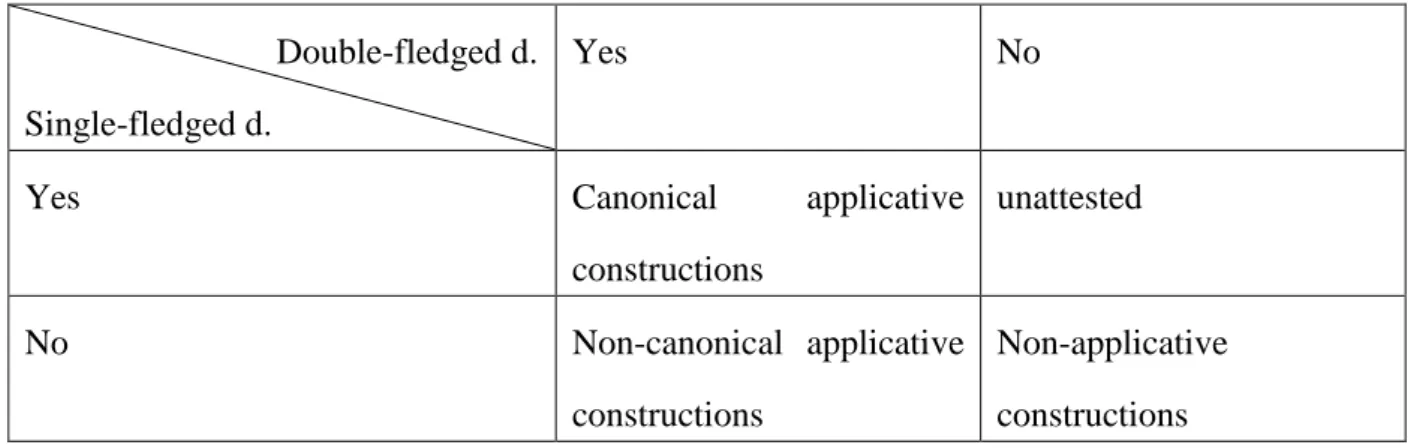
Consequently, the primary classification we get (as a tentative one) is the following:
Table 4. Primary classification of applicative constructions Double-fledged d.
Single-fledged d.
Yes No
Yes Canonical applicative constructions unattested No Non-canonical applicative constructions Non-applicative constructions
Furthermore, it is also possible to characterize the two constructions making use of the discussions made about changes caused by applicative derivations in Chapter 5. This is because changes can serve not only as characterizations of the two directions of derivation but at the same time as characterizations of the two constructions defined here, since the latter are defined depending on the former. Thus, we get the following table. Bold faces indicate that the changes are the most conspicuous ones for each construction.
Table 5. Relationship between constructions and changes
Constructions Functions of derivations
Canonical applicative constructions Promotion, Valency-increasing, Semantic modification