JAIST Repository
https://dspace.jaist.ac.jp/Title Tree-to-String Phrase-based Statistical Machine Translation
Author(s) NGUYEN, Thai Phuong Citation
Issue Date 2008-03
Type Thesis or Dissertation Text version author
URL http://hdl.handle.net/10119/12070 Rights
Tree-to-String Phrase-based Statistical Machine
Translation
by
NGUYEN PHUONG THAI
submitted to
Japan Advanced Institute of Science and Technology in partial fulfillment of the requirements
for the degree of Doctor of Philosophy
Supervisor: Professor AKIRA SHIMAZU
School of Information Science
Japan Advanced Institute of Science and Technology
c
°Copyright 2007 by
NGUYEN PHUONG THAI All Rights Reserved
Abstract
The major aim of our study is to improve phrase-based statistical machine translation (SMT) using syntactic information represented in constituent tree form. In recent years, there have been many studies about syntactic SMT. Most studies rely on formal grammars such as synchronous context-free grammars and tree transducers. The approaches can be different in a number of aspects such as input type for example string or tree, in rule form for example SCFG or xRs, in rule function including word reordering or word choice. Since these studies aim to improve both word reordering and word choice, their grammars have been fully lexicalized. We would like to make a distinction between word order and word choice when statistically modelling the translation process. We suppose that the input of a SMT system is a syntactic tree. Considering word order as a syntactic problem, we define syntactic transformation task which involves the word reordering, the deletion and the insertion of function words. We propose a syntactic transformation model based on the probabilistic context free grammar. By using this model, we studied a number of tree-to-string phrase-based SMT approaches which vary in the way syntactic information is used including preprocessing and decoding and the level of syntactic analysis including chunking and parsing. Our experimental results showed significant improvements in translation quality. Considering word choice as a semantic problem, we aim at incorporating WSD into phrase-based SMT. Our empirical study on this problem reveal various aspect of the integration. Our experiments showed a significant improvement in translation quality.
Key words: Computational Linguistics, Statistical Machine Translation, Syntactic Pars-ing, Word ReorderPars-ing, Word Sense Disambiguation, Word Choice.
Acknowledgments
In nearly three years of my PhD student life, there are many people help me stay focused and sane in pursuit of my goal.
First of all, I would like to express my deepest thanks to my advisor, Professor Akira Shimazu, for giving me the freedom to explore many paths of research and giving me guidance along the way. He also manages to ensure that my projects are always going somewhere useful. I gratefully appreciate his patient supervision, encouragement, and support over the years. I am proud to be one of his students.
I would like to say my special thanks to Professor Ho Tu Bao for his help during my PhD life. He gives me and other Vietnamese students lots of good advice not only for study but also for life. Besides, I have got valuable experiences from working with him.
I wish to say grateful thanks to Associate Professor Kiyoaki Shirai for gentle discus-sions. Besides, he always asks many questions in seminars of Vietnamese students. Since we often feel free when answering his questions, a seminar becomes more enjoyable.
I would like to thank Dr. Eiichiro Sumita and Associate Professor Kentaro Torisawa for giving comments on my thesis. Their comments help me improve both my thesis and presentation.
Besides, JAIST has been a great place for me to develop myself as a researcher. I receive a lot of inspiration, feedback, and insight that help me with my work, broaden my horizon from fellow students and researchers. I specially wish to say grateful thanks to Dr. Nguyen Le Minh, Lecturer Dam Hieu Chi, Assist. Prof. Huynh Van Nam, Assist. Prof. Makoto Nakamura, Mr. Kenji Takano, Dr. Le Anh Cuong, Mr. Nguyen Van Vinh, Mr. Nguyen Tri Thanh, Mr. Nguyen Anh Tuan, Dr. Phan Xuan Hieu, Dr. Doan Son, and Mr. Nguyen Canh Hao.
I would also like to express my grateful appreciation to my former teachers, Profes-sor Ha Quang Thuy and ProfesProfes-sor Dinh Manh Tuong, College of Technology, Vietnam National University, Hanoi (VNUH), for their kindly recommendations and constant en-couragement before and during my research at JAIST. Without their helps, I could not receive the permission to go to JAIST. I also appreciate the help and the encouragement from Professor Ho Si Dam, Dr. Hoang Xuan Huan, Dr. Pham Hong Thai, and many other faculty members of College of Technology, VNUH.
I specially express my thanks and my respect to my former advisor, Dr. Pham Hong Nguyen. He has guided me to the way of research in Natural Language Processing. I am very proud to be one of his students, and also a member in his Machine Translation group.
Last, but not least, I am grateful to have a loving family who always care about me: my father Nguyen Van Ton, my mother Pham Thi Xuan, my younger sisters Nguyen Phuong Lan and Nguyen Phuong Thuy. I would not have survived these years without their love and friendship.
Contents
Abstract iii
Acknowledgments iv
1 Introduction 1
1.1 Overview . . . 1
1.1.1 Machine Translation Problem . . . 1
1.1.2 Morphological Analysis and POS Tagging . . . 2
1.1.3 Word Sense Disambiguation . . . 3
1.1.4 Syntactic Parsing . . . 3 1.2 Motivations . . . 4 1.3 Our Approach . . . 5 1.4 Main Contributions . . . 7 1.5 Thesis Structure . . . 9 2 Related Works 10 2.1 Phrase-Based SMT . . . 10
2.2 Weighted Synchronous Context-Free Grammars . . . 11
2.3 Dependency Treelet Translation . . . 11
2.4 Tree-to-String Noisy Channel . . . 12
2.5 Tree-to-String Alignment Template . . . 13
2.6 Preprocessing and Postprocessing . . . 13
2.7 Syntax-Based Language Model . . . 14
2.8 Integration of WSD into SMT . . . 14
2.9 MT Evaluation Methods . . . 15
2.9.1 BLEU . . . 15
2.9.2 WER . . . 15
2.9.3 PER . . . 16
3 A Syntactic Transformation Model 17 3.1 Motivations and Assumptions . . . 17
3.2 Syntactic Transformation Model . . . 20
3.2.2 Markovization of Lexicalized CFG Rules . . . 21
3.3 Training . . . 22
3.3.1 Hierarchical Alignment . . . 23
3.3.2 Target CFG Rule Induction . . . 24
3.3.3 Insertion and Deletion . . . 24
3.3.4 Transformed Trees . . . 25
3.3.5 Parameter Estimation . . . 25
3.4 Applying . . . 26
3.5 Conclusion . . . 26
4 Improving Phrase-Based SMT with Morpho-Syntactic Transformation 28 4.1 Introduction . . . 28
4.2 Background . . . 30
4.2.1 Syntactic Preprocessing for SMT . . . 30
4.2.2 Morphological Analysis for SMT . . . 30
4.2.3 Vietnamese Language Features . . . 31
4.3 Morphological Transformation . . . 32
4.4 Experiments . . . 33
4.4.1 Experimental Settings . . . 33
4.4.2 Training the Transformational Model . . . 34
4.4.3 BLEU Scores . . . 34
4.4.4 Significance Tests . . . 36
4.4.5 Some Analyses of the Performance of Syntactic Transformation . . 36
4.4.6 Maximum Phrase Length . . . 38
4.4.7 Training-Set Size . . . 38
4.5 Conclusion . . . 38
5 Chunking-Based Reordering 40 5.1 Creating a Phrase Graph . . . 40
5.2 Decoder . . . 42
5.3 Experiments . . . 42
5.4 Two-phase Decoding . . . 43
5.4.1 Limitation of the Proposed Technique . . . 43
5.4.2 Two-phase Decoding . . . 44
5.5 Conclusion . . . 44
6 Syntax-Directed Phrase-Based SMT 45 6.1 A Stochastic Syntax-Directed Translation Schema for Phrase-Based SMT . 46 6.1.1 Stochastic Syntax-Directed Translation Schema . . . 46
6.1.2 A Tree-to-String SMT Model . . . 46
6.2 Transformation of a CFG Tree into a Phrase CFG Tree . . . 47
6.2.1 Penn Treebank’s Tree Structure . . . 47
6.2.2 An Algorithm for Word-to-Phrase Tree Transformation . . . 48
6.2.3 Probabilistic Word-to-Phrase Tree Transformation . . . 50
6.3.1 Translation Options . . . 52
6.3.2 Translation Hypotheses . . . 53
6.3.3 Decoding Algorithm . . . 53
6.4 Experimental Results . . . 55
6.5 Conclusions . . . 56
7 Integration of Word Sense Disambiguation into Phrase-Based Statistical Machine Translation 58 7.1 Introduction . . . 58 7.2 WSD . . . 59 7.2.1 WSD Models . . . 59 7.2.2 WSD Features . . . 59 7.3 SMT . . . 62 7.4 WSD for SMT . . . 63 7.4.1 WSD Task . . . 63
7.4.2 WSD Training Data Generation . . . 63
7.4.3 WSD Features . . . 64
7.4.4 Integration . . . 65
7.5 Experiments . . . 66
7.5.1 Corpora and Tools . . . 66
7.5.2 WSD Evaluation . . . 66 7.5.3 SMT Evaluation . . . 67 7.5.4 WSD Feature Evaluation . . . 68 7.6 Conclusions . . . 68 8 Conclusions 70 References 76 Publications 82
List of Figures
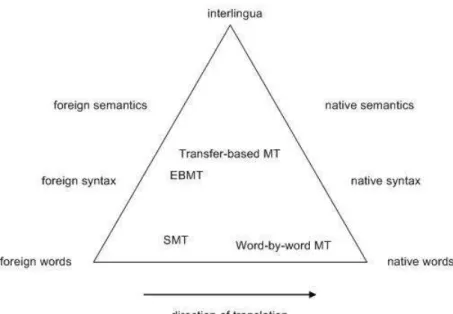
1.1 Levels of the use of linguistic knowledge according to various MT approaches 2
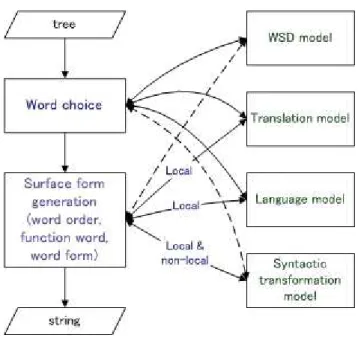
1.2 Conceptual architecture of our work. . . 6
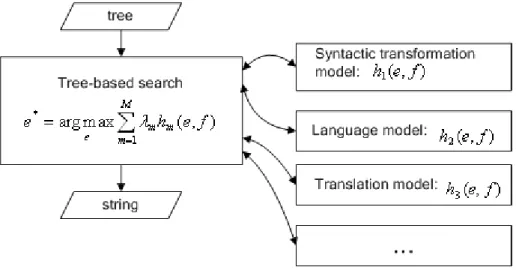
1.3 SMT with syntactic transformation in the preprocessing phase. . . 8
1.4 SMT with syntactic transformation in the decoding phase. . . 8
2.1 An English-French treelet translation pair. . . 12
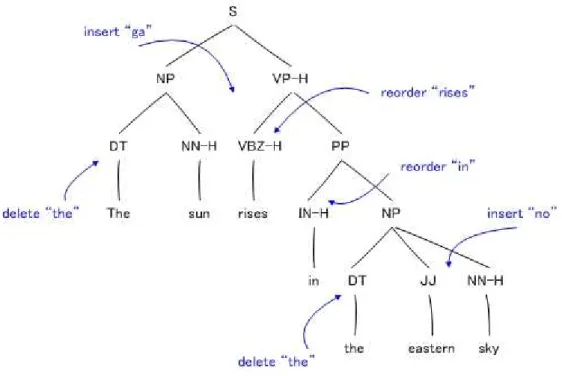
3.1 An English syntactic tree with possible transformations into a plausible Japanese syntactic structure. . . 18
3.2 An English syntactic tree after transformed into a Japanese syntactic struc-ture. . . 19
3.3 Inducing transformational rules . . . 23
3.4 Transformation rule induction for English-Japanese translation: step 1&2. 25 3.5 Transformation rule induction for English-Japanese translation: part of step 3. . . 26
4.1 The architecture of our SMT system . . . 29
4.2 Examples . . . 31
4.3 N-gram precisions . . . 37
4.4 Some examples of better translations . . . 37
5.1 A phrase graph before reordered . . . 41
5.2 A reordered subgraph . . . 42
6.1 Non-constituent phrasal translation (English-Vietnamese). . . 45
6.2 Tree transformation: Step 1. . . 49
6.3 Tree transformation: Step 2. . . 50
6.4 Dependency trees. . . 51
6.5 The phrase pair (”explanation with earphones”, ”iyahon de setsumei”) is consistent with the word alignment in the first sentence pair but it can not be applied to translate the second source sentence. . . 52
6.6 English source tree. . . 55
6.7 Translation according to phrase tree 1. . . 56
6.8 Translation according to phrase tree 2. . . 57
A.1 Examples of English-Japanese translation with preprocessing on Reuters corpus. . . 73
A.2 Examples of English-Japanese translation with WSD integration on Reuters corpus. . . 74
A.3 Examples of English-Vietnamese translation with WSD integration on EV50001 corpus. For each example, the first sentence is a source sentence, the sec-ond is the output of our phrase-based system, the third is the output of our system with WSD integration. . . 75
List of Tables
1.1 . . . 3
1.2 . . . 3
1.3 . . . 4
1.4 A comparison of several linguistic properties between English, Vietnamese, French, and Japanese. The properties in italic point out relative position of a modifier to its head noun. Languages without wh-movement are referred to as wh-in-situ languages. . . 4
4.1 . . . 29
4.2 . . . 32
4.3 Corpora and data sets. . . 33
4.4 Corpus statistics of English-Vietnamese translation task. . . 33
4.5 Corpus statistics of English-French translation task. . . 34
4.6 Unlexicalized CFG rules (UCFGRs), transformational rule groups (TRGs), and ambiguous groups (AGs). . . 34
4.7 BLEU scores. . . 35
4.8 Sign tests. . . 36
4.9 Effect of maximum phrase length on translation quality (BLEU score). . . 38
4.10 Effect of training-set size on translation quality (BLEU score). . . 38
4.11 Effect of training-set size on decoding time (seconds/sent). . . 39
5.1 . . . 41
5.2 BLEU score comparisons. . . 43
5.3 Phrase table size comparison. . . 43
6.1 An algorithm to transform a CFG tree to a phrase CFG tree. . . 48
6.2 Decoding algorithm. . . 54
6.3 An example of English-Japanese translation. . . 54
6.4 Bottom-up translation. . . 54
6.5 Corpus statistics of English-Japanese translation task. . . 55
6.6 BLEU score comparison between phrase-based SMT and syntax-directed SMT. PB=phrase-based; CBR=chunk-based reordering; SD=syntax-directed 55 7.1 Corpus statistics of English-Vietnamese translation task. . . 66
7.2 Corpus statistics of English-Japanese translation task. . . 66
7.4 BLEU scores of the WSD-SMT system. MEM classifier is used. Since 3 is very close to 7, we do not need to compute 4, WSD-5, and WSD-6. . . 68
7.5 BLEU scores with different WSD features. all=all kinds of features, POSs=collocation
of POSs and ordered POSs, words=collocation of words and ordered words.
MEM is used. . . 68
Chapter 1
Introduction
In this chapter we briefly state the research context, our motivations, as well as the major contributions of this thesis. Firstly, we briefly introduce the problem of machine translation and its important role in natural language processing. Secondly, we state the research problems which this thesis attempts to solve as well as the main motivations behind the work. Next, the main contributions of the thesis are shortly mentioned. Finally, the structure of the thesis will be outlined.
1.1
Overview
1.1.1
Machine Translation Problem
Natural language processing is one of the basic research fields of artificial intelligence. This research field studies how to create computer programs which can process human language. There are various problems concerning the human’s language ability ranging from very fundamental tasks such as morphological analysis, syntactic parsing, and word sense disambiguation to application problems such as machine translation and text sum-marization. NLP becomes more and more important because of the rapid growth of text documents and the need for automated text processing. Solving NLP problems are a long term dream of human.
Human translation requires linguistic knowledge of both source and target languages such as morphology, syntactics, semantics, pragmatics, and so on. Those knowledge are necessary to resolve the ambiguities of natural languages which exist at various levels. Machine translation also wants the same ability.
As an application of NLP, machine translation can claim to be one of the oldest field of study. One of the first proposed non-numerical use of computers. Up to now there are still five main obstacles to machine translation. The first difficulty is a word choice problem. The fundamental task solving this problem is word sense disambiguation (WSD). The second difficulty is a word order problem. For example, English has a SVO sentence structure while Japanese SOV. The third is tense and aspect. It is difficult to translate a
Figure 1.1: Levels of the use of linguistic knowledge according to various MT approaches
Vietnamese paragraph into English with a correct and coherent tense and aspect through the whole paragraph. The fourth difficulty is pronoun translation. This problem must be solved at the document level. The fifth obstacle is idiom translations. It is very difficult to collect all possible idioms.
Statistical machine translation is an approach to MT which is based on learning knowl-edge from bilingual corpora. Bitext contains parallel documents of two languages. Trans-lation patterns are learned from bitext automatically. At the first days of SMT, patterns are word translation. Recently, by using phrase as the basic unit of translation [Koehn et al., 2003], SMT achieves a big step. Figure 1.1 illustrates levels of the use of linguistic knowledge according to various MT approaches. Conventional phrase-based SMT [Koehn et al., 2003] almost belongs to the lowest level. There have been a growing trend towards employing advances in NLP for SMT1. We review this trend according to involved NLP
tasks including morphological analysis, POS tagging, syntactic parsing, and word sense disambiguation.
1.1.2
Morphological Analysis and POS Tagging
Morphological analysis was used to deal with the data sparseness problem [Goldwater & McClosky (2005)]. Words could be transformed using various ways in the SMT preprocess-ing phase. Many kinds of information were used such as word surface form, lemma, tense, case, etc. Koehn and Hoang (2007) proposed a factored translation model for phrase-based SMT. The authors modelled phrase-to-phrase translation as a generative process utilizing information at word level such as POS tag, lemma, case, etc. Using this kind of information is very useful for language pairs which are different in morphology.
1Another interesting trend is to applying new machine learning methods such as discriminative training
Approach Input Theoretical model Rule form
Koehn et al. (2003) string FSTs no
Yamada and Knight (2001) string SCFGs SCFG rule
Melamed (2003) string SCFGs SCFG rule
Chiang (2005) string SCFGs SCFG rule
Quirk et al. (2005) dependency tree Tree transducers Treelet pair Galley et al. (2006) string Tree transducers xRs rule
Liu et al. (2006) tree Tree transducers xRs rule
Our work tree SCFGs SCFG rule
Table 1.1: A comparison of syntactic SMT approaches (part 1). FST=Finite State Trans-ducer; SCFG=Synchronous Context-Free Grammar; xRs is a kind of rule which maps a syntactic pattern to a string, for example VP(AUX(does), RB(not),x0:VB) → ne, x0, pas.
Approach Decoding style Linguistic Phrase usage Performance
information
Koehn et al. (2003) beam search no yes baseline
Yamada and Knight (2001) parsing target no not better
Melamed (2003) parsing both sides no not better
Chiang (2005) parsing no yes better
Quirk et al. (2005) parsing source yes better
Galley et al. (2006) parsing target yes better
Liu et al. (2006) tree transformation source yes better
Our work tree transformation source yes better
Table 1.2: A comparison of syntactic SMT approaches (part 2)
1.1.3
Word Sense Disambiguation
Aiming to improve word choice ability, [Varea et al. (2001)] studied context sensitive lexical models. However, contextual features used by this study were not as rich as state-of-the-art WSD models [Ando(2006)]. Most recently, several studies focused on integrating WSD into SMT. Those studies were motivated by an observation that SMT made decision based on local context through translation models and language models rather than the context at sentence level or even document level. WSD did not have such limitations. There were successful integrations of WSD into phrase-based SMT [Carpuat and Wu (2007)] and hierarchical phrase-based SMT [Chan et al. (2007)].
1.1.4
Syntactic Parsing
In the previous sub-section, we only mentioned SMT systems which were weighted finite-state transducers (WFSTs) of the ”phrase”-based variety, meaning that they memorize the translations of word n-grams, rather than just single words. To advance the state of the art, SMT system designers began to experiment with tree-structured translation mod-els [Yamada and Knight (2001), Melamed (2004), Marcu et al. (2006)]. The underlying computational models were synchronous context-free grammars and weighted finite-state tree transducers which conceptually have a better expressive power than WFSTs.
Approach Rule function Rule lexicalization level
Koehn et al. (2003) no no
Yamada and Knight (2001) reorder and function-word ins./del. unlexicalized
Melamed (2003) reorder and word choice full
Chiang (2005) reorder and word choice full
Quirk et al. (2005) word choice full
Galley et al. (2006) reorder and word choice full Liu et al. (2006) reorder and word choice full Our work reorder and function-word ins./del. half
Table 1.3: A comparison of syntactic SMT approaches (part 3). In the column Rule lexicalization level: full=lexicalization using vocabularies of both source language and target language; half=using source vocabulary and function words of target vocabulary.
Property English Vietnamese French Japanese
Word delimiter Space No Space No
Inflection Suffixing Using function words Suffixing Suffixing
Derivation Suffixing Using functionhi words Suffixing Suffixing
Sentence word order SVO SVO SVO SOV
Adjective modifier order Preceding Following Both Preceding
Determiner modifier order Preceding Both Preceding Preceding
Numeral modifier order Preceding Preceding Preceding Preceding
Possessor modifier order Preceding Following Preceding Preceding
Relative clause order Following Following Following Preceding
Ad-position Preposition Preposition Preposition Postposition
Interrogative word position Wh-movement Wh-in-situ Wh-movement Wh-in-situ
Topic prominent No Yes No Yes
Table 1.4: A comparison of several linguistic properties between English, Vietnamese, French, and Japanese. The properties in italic point out relative position of a modifier to its head noun. Languages without wh-movement are referred to as wh-in-situ languages.
including ours. The first row is a baseline phrasal SMT approach. The second column in Table 1.1 only describes input types because the output type is always string. Syntactic SMT approaches are different in many aspects. Most approaches which make use of phrases (in either explicit or implicit way) can beat the baseline approach (Table 1.2). What can we infer from this observation? Researchers have used more complex patterns (than phrase), and with the support of machine learning methods, they have advanced the state of the art. Two main problems these models aim to deal with is word order and word choice. In order to accomplish this purpose, the underlying formal grammars (including synchronous context-free grammars and tree transducers) are fully lexicalized (Table 1.3).
1.2
Motivations
The conventional phrase-based statistical machine translation (SMT) approach makes use of linguistic knowledge little or indirectly (Och and Ney, 2004), while there are
many available high-performance linguistic tools such as parser, POS tagger or named entity recognizer (Manning and Schutze, 2003). An ideal phrase-based SMT system should take advantage of both bilingual corpora and linguistic analysis tools. For ex-ample, since phrases are limited in length, the word-order difference between languages is an obstacle for phrase-based SMT. Using morphological and syntactic information is a systematic way to deal with this problem. Our experiments involve three language pairs: English-Vietnamese, English-French, and English-Japanese. By surveying liter-atures [Kuno (1981), Gunji (1987), Cook (1988), Dung (2003)], we create Table 1.4 comparing a number of linguistic properties of these four languages.
In the field of compiler, the syntax-directed translation schemata has a dominant in-fluence. A compiler is likely to carry out several or all of the following operations: lexical analysis, preprocessing, parsing, semantic analysis, code generation, and code optimiza-tion. After the parsing step, the syntactic structure of a program is identified. The parse tree is often analyzed, augmented, and transformed by later phases in the compiler. Those phases are controlled by syntax. A similar schema is used for natural language translation in transfer-based approaches. Since natural languages are highly ambiguous, various techniques and resources have been employed for dealing with ambiguity. For example, parsing natural languages requires chart parsing algorithms such as CYK and Earley which can deal with CFG languages, while compilers use faster parsing algorithms for sub-classes of CFG languages. We also want a kind of syntax-control ability for SMT. Word order can be considered as a syntactic problem. Conversely, word choice is a semantic problem. Recently, in parsing research topic, [Klein and Manning (2003), Bikel (2004), Petrov et al. (2006)] have shown that un-lexicalized or lightly lexicalized parsers can achieve very high parsing accuracy. On the contrary, in WSD research topic, [Lee & Ng(2002)] have shown that lexical context made of words and POS tags has a main contribution to the performance of WSD systems. These observations suggest us to bring the discrimination between word order and word choice into designing a SMT system. We will design a reordering model which does not involve word choice for SMT. We also use WSD for SMT.
We aim to improve translation quality in which phrase-based SMT is considered as the baseline approach. We deal with two major problems: word order and word choice. Generally, for each problem, we design and use new feature functions. Each function is a probabilistic distribution and it takes into account a new kind of knowledge. For word order problem, we design a syntactic transformation model. This model requires syntactic knowledge of the source language. For word choice problem, we use WSD models. These models make use of non-local context including sentence level or paragraph level.
1.3
Our Approach
Figure 1.2 is an illustration of the conceptual architecture of our work. In a translation process, there are two major tasks: word choice and surface form generation. The first task is mainly concerned with the translation model, the language model, and the WSD model. The second task involves the syntactic transformation model at both local and non-local levels. The language model and the translation model can only impact this task locally. There are weak links between word choice and syntactic transformation and
Figure 1.2: Conceptual architecture of our work.
between surface form generation and WSD. In fact, the distinctions between the two tasks are relative.
We study a number of tree-to-string phrase-based SMT approaches demonstrated in Figures 1.3 and 1.4. The name ”tree-to-string” simply means the input of a SMT system is syntactic trees2. Suppose that an input sentence has been parsed resulting in a
phrase-structure tree of the source language. This tree will be reordered and translated into a string of the target language. The strength of phrases is not given up since the unit of translation is still phrases. Those approaches vary in syntactic analysis level (shallow or deep) and in how syntax is used for a SMT system (preprocessing or decoding). The postprocessing phase concerns with re-ranking n-best lists of possible target sentences, while our approach makes use of source linguistic information. Therefore we do not consider this phase. The properties of our approach are summarized in Tables 1.1 and 1.2. A number of advantages are as follow:
• Since translation is separated from parsing, parsers of the source language can be exploited.
• Since morphosyntactic information of the source side is made use of, more control over the translation process can be taken. In Figure 1.2, we have shown the relation between syntactic transformation and the translation process. We consider surface form generation is controlled (directed) by syntax. For example, about word order problem, without syntactic information (represented as a constituent tree), finding the best possible target word order is a NP-hard problem [Knight (1999)].
• Do not require syntactic information of the target side since for many languages good parsers are still not available.
• The rule form is simpler than other syntactic SMT approaches’.
• Do not give up the strength of the baseline approach: phrases.
• Can achieve better performances than the baseline approach. Following this approach, we have to deal with a number of issues:
• Design a syntactic transformation model
• Study different kinds of tree-to-string phrase-based (T2S PB) SMT:
T2S PB SMT which uses syntactic transformation in the preprocessing phase: This approach can be used to build a T2S PB SMT system from scratch or by using an existing phrase-based SMT system (black box).
T2S PB SMT which uses shallow-syntax transformation in the decoding phase: This kind of SMT system has an advantage of fast decoding.
T2S PB SMT which employs full syntactic structure in the decoding phase (a general framework).
• Integrate WSD into PB SMT (can apply to all T2S PB approaches)
In the next section, we will describe how we deal with these issues and describe them in details.
1.4
Main Contributions
We defined syntactic transformation including the word reordering, the deletion and the insertion of function words. This definition prevents our model from learning heavy gram-mars to solve the word choice problem. We proposed a syntactic transformation model based on the lexicalized probabilistic context-free grammar [Thai & Shimazu (2006a)]. Since this model is sensitive with both structural and lexical information, it can deal with transformational ambiguity. It is trained by using a bilingual corpus, a word alignment tool, and a broad coverage parser of the source language. The parser is a constituency analyzer which can produce parse tree in Penn Tree-bank’s style. The model is applicable to language pairs in which the target language is poor in resources.
We studied a phrase-based SMT approach [Thai & Shimazu (2006b)] which uses lin-guistic analysis in the preprocessing phase. The linlin-guistic analysis includes morphological transformation and syntactic transformation. Since the word-order problem is solved using syntactic transformation, there is no reordering in the decoding phase. For mor-phological transformation, we used hand-crafted transformational rules. Specifically, we present a morphological transformation schema for English-Vietnamese translation. Our various experiments, which were carried out with several language pairs such as English-Vietnamese and English-French, showed significant improvements in translation quality.
A number of MT applications such as Web translation require high speed. Since full parsing may be slow for such applications, we consider chunking as an alternative. We study a chunking-based reordering method for phrase-based SMT [Thai & Shimazu (2007)]. We employ the syntactic transformation model for phrase reordering within chunks. The transformation probability is also used for scoring translation hypotheses.
Figure 1.3: SMT with syntactic transformation in the preprocessing phase.
Figure 1.4: SMT with syntactic transformation in the decoding phase.
Chunk reordering is carried out in the decoding phase. This study shows another way to apply the syntactic transformation model to SMT.
Two tree-to-string SMT approaches have been mentioned, one with preprocessing and the other with decoding but limited to shallow syntactic structures. In order to overcome this limitation, we consider another phrase-based SMT approach based on stochastic syntax-directed translation schemata. We propose a tree transformation algorithm and a tree-based decoding algorithm. The transformation algorithm converts a tree with word leaves into a tree with phrase leaves (phrase tree). The decoding algorithm is a dynamic programming algorithm which processes an input tree in a bottom-up manner. The syn-tactic transformation model is employed to control and score reordering operations. The chunking-based translation approach can be considered as an instance of this approach. We conducted experiments with English-Vietnamese and English-Japanese language pairs. Experimental results showed a significant improvement in terms of translation quality.
phrase-based SMT has an advantage of word choice based on local context, exploiting larger context is an interesting research topic. We carried out an empirical study of integrating WSD into SMT. We implemented the approach proposed by [Carpuat and Wu (2007)]. Our experiments reinformed that WSD can improve SMT significantly. We used two WSD models including MEM and NB while [Carpuat and Wu (2007)] used an ensemble of four combined WSD models (NB, MEM, Boosting, and Kernel PCA-based) and [Chan et al. (2007)] employed SVM. We evaluated WSD accuracy, effect of phrase length, the use of syntactic relation feature for SMT.
We built a SMT system for phrase-based log-linear translation models. This system has three decoders: beam search, chunking-based, and syntax-based. We used the system for our experiments with reordering and WSD.
1.5
Thesis Structure
The dissertation can be summarized in the eight main chapters as follows.
• The first chapter presents the overall view of the thesis including an introduction of statistical machine translation, motivations, our approach and contributions.
• In the second chapter, we review previous works in SMT.
• In the third chapter, we present our syntactic transformation model.
• In the fourth chapter, we present empirical results of phrase-based SMT with mor-phosyntactic transformation in the preprocessing phase.
• In the fifth chapter, we present chunking-based reordering for SMT.
• In the sixth chapter, we present a stochastic syntax-directed phrase-based SMT approach.
• In the seventh chapter, we present our empirical results of the integration of WSD into SMT.
Chapter 2
Related Works
2.1
Phrase-Based SMT
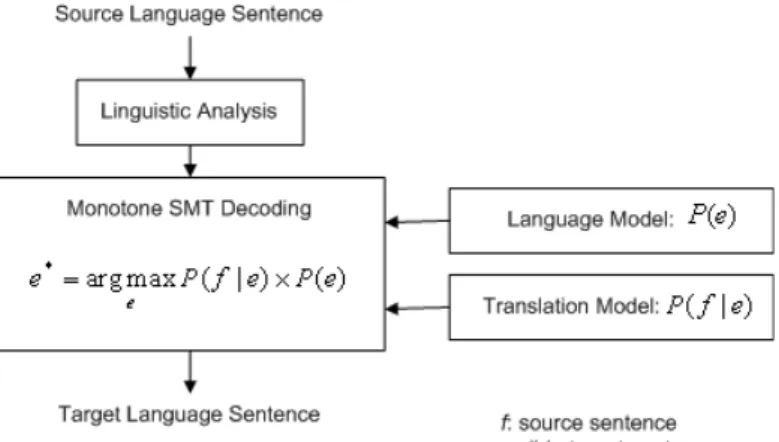
The noisy channel model is the basic model for phrase-based SMT [Koehn et al. (2003)]: arg max
e P (e|f ) = arg maxe [P (f |e) × P (e)] (2.1)
The model can be described as a generative story 1. First, an English sentence e is
generated with probability P (e). Second, e is segmented into phrases e1, ..., eI (assuming
a uniform probability distribution over all possible segmentations). Third, e is reordered according to a distortion model. Finally, French phrases fi are generated under a transla-tion model P (f |e) estimated from the bilingual corpus. Though other phrase-based mod-els follow a joint distribution model [Marcu and Wong (2002)], or use log-linear modmod-els [Och and Ney (2004)], the basic architecture of phrase segmentation, phrase reordering, and phrase translation remains the same.
As discussed in [Och (2003)], the direct translation model represents the probability of English target sentence e = e1, ..., eI being the translation for a French source sentence
f = f1, ..., fJ through an exponential, or log-linear model:
pλ(e|f ) = exp(Pm k=1 λk× hk(e, f )) P e0⊂E exp(Pn k=1 λm× hk(e, f )) (2.2)
where e is a single candidate translation for f from the set of all English translations E,
λ is the parameter vector for the model, and each hk is a feature function of e and f . 1We follow the convention in [Brown et al. (1993)], designating the source language as ”French” and
2.2
Weighted Synchronous Context-Free Grammars
[Chiang (2005)] proposed a hierarchical phrase-based SMT model which was formally a weighted synchronous CFG (Aho and Ullman, 1969). The rule form is:X →< γ, α, ∼> (2.3) where X is a nonterminal, γ and α are string of both terminals and nonterminals, and
∼ is a one-to-one mapping between nonterminal occurrences in γ and in α. The following
sentence pair is annotated with square brackets representing a possible hierarchical phrase structure:
[Aozhou] [shi] [[[yu [Bei Han] you [bangjiao]] de [shaoshu goujia]] zhiyi]
[Australia] [is] [one of [the [few countries] that [have [dipl. rels.] with [North Korea]]]]
The rules can be:
X → <yu X1 you X2, have X2 with X1> X → <X1 de X2, the X2 that X1>
X → <X1 zhiyi, one of X1>
where ∼ is represented by indices.
The author used only one nonterminal symbol instead of assigning syntactic categories to phrases. Two special rules were added to combine sequence of Xs to form an S (the starting symbol):
S →< S1X2, S1X2 > (2.4)
S →< X1, X1 > (2.5)
This kind of grammar can capture word order and word choice well. It can be learned from bitext without any syntactic annotation. Since phrases are encoded directly in CFG rules (seen as hierarchical phrases), and there are only two non-terminal symbols, the grammar relies very much on lexical knowledge. Chiang’s decoder was a CKY parser with beam search. His SMT system achieved better performance than the Pharaoh system [Koehn et al. (2003)] on a Chinese-English translation task.
[Melamed (2004)] used synchronous context-free grammars (SCFGs) for parsing both languages simultaneously. Melamed’s study showed that syntax-based SMT systems could be built using synchronous parsers. He also discussed binarization of multi-text grammars on a theoretical level, showing the importance and difficulty of binarization for efficient synchronous parsing.
2.3
Dependency Treelet Translation
[Quirk et al. (2005)] proposed a translation model which incorporates dependency repre-sentation of the source and target languages. The authors supposed that input sentences
were parsed by a dependency parser. An advantage in comparison with the phrase-based approach is that the dependency structure can capture non-local dependency be-tween words such as ne...pas(not). Since it is difficult to specify reordering information within elementary dependency structures, the authors used a separate reordering model. This reordering model is sensitive with lexical information such as words and POS tags. [Quirk et al. (2005)] reported better BLEU scores than the Pharaoh system on an English-French translation task.
Figure 2.1: An English-French treelet translation pair.
[Quirk et al. (2005)] defined a treelet is an arbitrary connected subgraph of a depen-dency tree. The unit of translation is treelet pairs (Figure 2.1). Treelet translation pairs can be learned from bitext in which the source text has been parsed by a dependency parser. Given a word aligned sentence pair and a source dependency tree, the authors used the alignment to project the source structure onto the target sentence. Their decod-ing algorithm is influenced by ITG (Wu, 1997). They used a log-linear translation model (Och and Ney, 2002).
2.4
Tree-to-String Noisy Channel
The first approach can be called statistical machine translation by parsing. [Yamada and Knight (2001)] proposed a SMT model that uses syntax information in the target language alone. The
model is based on a tree-to-string noisy channel model, and the translation task is trans-formed into a parsing problem.
(Galley et al., 2006) proposed a translation model based on weighted tree-to-string (xRs) transducers (Graehl and Knight, 2004). Their transformational rules ri are
equiv-alent to 1-state xRs transducers mapping a given pattern to a string. For example, ”does
VP(AUX(does), RB(not),x0:VB) → ne, x0, pas
The left hand side of ri can be arbitrary syntax tree fragment. Its leaves are either
lexicalized or variables. The right hand side of ri is represented as a sequence of target
language words and variables. This kind of rule can capture context-rich syntax of the target language. The authors trained their model using the EM algorithm. Their decoding algorithm was based on tree transformation. Their experimental results were higher than those of (Galley et al., 2004). According to their point of view, since the input sentence is fixed and is generally already grammatical, it is less benefit in modelling the source language syntax.
2.5
Tree-to-String Alignment Template
This study [Liu et al. (2006)] is based on tree-to-string transducers [Graehl and Knight (2004)] but the source language syntax is modelled. Rules are learned from bitext in which the source text has been parsed. Their system, Lynx, achieved a performance higher than Pharaoh. Under their experimental settings, the number of rules was only one forth the number of bilingual phrases. The system can gain further improvement if both bilingual phrases and rules are used.
In order to enhance the expressive power of their model, [Liu et al. (2007)] proposed forest-to-string rule. A rule is a map from a sequence of subtree to a string. This kind of rule can cover non-syntactic phrase pairs better than tree-to-string rule. The new rule form leads to an improvement in translation quality over their original model.
[Liu et al. (2007)] discussed about how the phenomenon of non-syntactic bilingual phrases is dealt with in other SMT approaches. [Galley et al. (2004)] handled non-constituent phrasal translation by traversing the tree upwards until reaches a node that subsumes the phrase. [Marcu et al. (2006)] reported that approximately 28% of bilingual phrases are non-syntactic on their English-Chinese corpus. They proposed using a pseudo nonterminal symbol that subsumes the phrase and corresponding multi-headed syntactic structure. One new xRs rule is required to explain how the new nonterminal symbol can be combined with others. This technique brought a significant improvement in performance to their string-to-tree noisy channel SMT system.
2.6
Preprocessing and Postprocessing
A simple approach to the use of syntactic knowledge is to focus on the preprocessing phase. [Xia and McCord (2004)] proposed a preprocessing method to deal with the word-order problem. During the training of a SMT system, rewrite patterns were learned from bitext by employing a source language parser and a target language parser. Then at testing time, the patterns were used to reorder the source sentences in order to make their word order similar to that of the target language. The method achieved improvements over a baseline French-English SMT system. [Collins et al. (2005)] proposed reordering rules for restructuring German clauses. The rules were applied in the preprocessing phase of a
German-English phrase-based SMT system. Their experiments showed that this method could also improve translation quality significantly.
Reranking [Shen et al. (2004), Och et al. (2004)] is a frequently-used postprocessing technique in SMT. However, most of the improvement in translation quality has come from the reranking of non-syntactic features, while the syntactic features have produced very small gains [Och et al. (2004)].
2.7
Syntax-Based Language Model
[Charniak et al. (2003)] proposed an alternative approach to using syntactic information for SMT. The method employs an existing statistical parsing model as a language model within a SMT system. Experimental results showed improvements in accuracy over a baseline syntax-based SMT system.
2.8
Integration of WSD into SMT
Conventional phrase based systems use local context information from phrase table and language model. Though phrase based SMT achieves a jump in translation quality in comparison with word based SMT, there are still cases in which local context can not capture well the correct meaning of source words. WSD can use features from much larger contexts and those features can overlap each other. The idea of integrating WSD and SMT rises naturally from this perspective.
Varea et al. (2001) directly used context sensitive lexical models for SMT. Their SMT system was a word-based MEM. They reported significant decreases in perplexities of training and testing corpora. Besides, they also used these lexical models for re-ranking n-best lists and achieved slight improvements in translation quality.
Carpuat and Wu (2005) described their first effort to directly use a state-of-the-art WSD system for SMT. They used a word-based translation model, the IBM Model 4. All trials did not achieve any significant improvement in translation quality. They used WSD in three phases of SMT including preprocessing, decoding, and postprocessing. This empirical study seemed casting the doubt that: does WSD improve SMT? But unimproved assumption.
Cabezas and Resnik (2005) reported their positive results though not statistical sig-nificant when they applied WSD techniques to support a phrase-based SMT system. A WSD model was used to create a context sensitive word translation model. This model was trained using data generated from bilingual corpus. Words in target language are considered as senses. Then this word translation model was integrated into the SMT sys-tem since the baseline SMT syssys-tem allows integration of alternative translation models. Carpuat et al. (2006) had the same approach as Cabezas and Resnik (2005) when they joined the IWSLT 2006. More than WSD, they also used NER to strengthen the semantic processing ability of a phrase-based SMT system. Those studies have same limitations that using WSD for single words and WSD have not integrated into SMT as a feature.
[Chan et al. (2007)] made use of WSD for hierarchical phrase-based translation. WSD training data was generated from bilingual corpus using word alignment information.
They used two new WSD features for SMT and proposed an algorithm for scoring syn-chronous rules. Phrases which does not exceed a length of two were computed WSD models. Their experiments, carried out using a standard Chinese to English translation task, showed that WSD can improve SMT significantly.
Simultaneously with [Chan et al. (2007)], [Carpuat and Wu (2007)] used a similar ap-proach to the problem. The main difference was that they focused on conventional phrase-based SMT [Koehn et al. (2003)] and used only one WSD feature for SMT. The limit of phrase length was the same as the value used by their SMT system. Their experiments led to the same conclusion: WSD can improve SMT.
2.9
MT Evaluation Methods
2.9.1
BLEU
BLEU2[Papineni et al., 2002] is currently one of the most popular metric in the field. The
central idea behind the metric is that, ”the closer a machine translation is to a professional human translation, the better it is”. The metric calculates scores for individual segments, generally sentences, and then averages these scores over the whole corpus in order to reach a final score. It has been shown to correlate highly with human judgements of quality at the corpus level. The quality of translation is indicated as a number between 0 and 1 and is measured as statistical closeness to a given set of good quality human reference translations. Therefore, it does not directly take into account translation intelligibility or grammatical correctness. BLEU should be used in a restricted manner, for comparing the results from two similar systems, and for tracking ”broad, incremental changes to a single system” [Callison-Burch et al. (2006)]. BLEU score can be computed as:
Score(e, r) = BP (e, r) × exp(1 N ×
N
X
n=1
log(pn)) (2.6)
where pn represent the precision of n-grams suggested in e and BP is a brevity penalty
measuring the relative shortness of e over the whole corpus.
2.9.2
WER
Word Error Rate (WER) is computed as the minimum number of substitution, deletion, and insertion operations that have to performed to convert a MT output sentence to a reference sentence. This metric is very sensitive to word order. Word error rate can be calculated as:
W ER = S + D + I
N (2.7)
where S is the number of substitutions, D is the number of the deletions, I is the number of the insertions, and N is the number of words in the reference.
2.9.3
PER
A shortcoming of the WER is the fact that it requires a perfect word order. The word order of an acceptable sentence can be different from that of the target sentence, so that the WER measure alone could be misleading. To overcome this problem, the position-independent word error rate (PER) has been proposed. This measure compares the words in the two sentences ignoring the word order.
Chapter 3
A Syntactic Transformation Model
For syntactic transformation, we propose a transformational model [Nguyen and Shimazu (2006a)] based on the probabilistic context free grammar (PCFG). The model’s knowledge is
learned from bitext in which the source text has been parsed.1 The model can be applied
to language pairs, in which the target language is poor in resources in the sense that it lacks of syntactically-annotated corpora and good syntactic parsers.
3.1
Motivations and Assumptions
When designing this model, we have a number of motivations:
• it is used for transforming syntactic structures of the source language into those of the target language
• under several assumptions stated later, syntactic transformation deals with the word order problem, the deletion and the insertion of function words. Syntactic transfor-mation does not solve the word choice problem which is primarily concerned with word sense disambiguation.
We make several assumptions as follows:
• The source language is generated by a PCFG Gs= (N, Σ, Rs, S) where
– N = a finite set of nonterminals including constituent tags and part-of-speech
(POS) tags;
– Σ = Σf ∪ Σc where Σf is a finite set of function words and Σcis a finite set of
content words of the source language;
– Rs = a finite set of rules of the form p : A → α for A in N, α in N∗ ∪ Σ,
0 < p ≤ 1;
– S in N = the starting symbol.
• The target language is generated by a PCFG Gt= (N, ∆, Rt, S) where
– ∆ = ∆f ∪ Σcwhere ∆f is a finite set of function words of the target language;
– Rt = a finite set of rules of the form p : B → β for B in N, β in N∗ ∪ ∆,
0 < p ≤ 1;
• From the previous assumptions: Gs and Gt are only different in the set of function
words and the rule set; Rs and Rt have two rule forms, one with a sequence of
nonterminals on the right hand side (RHS), the other with a word on the RHS. These rule forms are compatible with CFG rules directly extracted from Penn Treebank.
• A basic transformation operation is a conversion of a rule A → α in Gs into a rule
A → β in Gt. The nonterminals in β, which are constituent label or are POS label
of content words, are a permutation of those in α.
Figure 3.1: An English syntactic tree with possible transformations into a plausible Japanese syntactic structure.
We consider an example of English-Japanese syntactic transformation as follows:
English sentence: ”The sun rises in the eastern sky.”
Japanese sentence: ”taiyo ga | higashi no | sora ni | noboru”
”sun SUBJECT | east POSSESSIVE | sky LOCATIVE | rise”
The syntactic tree is shown in Figure 3.1. The transformed tree is in Figure 3.2. These two trees can be generated by two simple grammars described later. These grammars satisfy the assumptions.
Figure 3.2: An English syntactic tree after transformed into a Japanese syntactic struc-ture.
N = {S, NP, VP, PP, DT, NN, VBZ, IN, JJ, X}
Σf = {the, in}
Σc = {sun, rises, eastern, sky}
Rs = {S → NP VP-H; NP → DT NN-H; VP → VBZ-H PP; PP → IN-H NP; NP → DT JJ NN-H; DT → the; NN → sun | sky; VBZ → rises; IN → in; JJ → eastern}
S is the start symbol.
A possible corresponding Japanese grammar:
N = {S, NP, VP, PP, DT, NN, VBZ, IN, JJ, X}
∆f = {ga, no, in}
∆c = Σc = {sun, rises, eastern, sky}
Rt = {S → NP VP-H; NP → NN-H; VP → PP VBZ-H; PP → NP IN-H; NP → JJ X NN-H; NN → sun | sky; VBZ → rises; IN → in; X → ga | no; JJ → eastern}
3.2
Syntactic Transformation Model
One major difficulty in the syntactic transformation task is ambiguity. There can be many different ways to reorder a CFG rule. For example, the rule2 NP → DT JJNN
in English can become NP → DT N NJJ or NP → NNJJDT in Vietnamese. For the phrase ”a nice girl”, the first reordering is most appropriate, while for the phrase ”this weekly radio”, the second one is correct. Lexicalization of CFG rules is one way to deal with this problem. Therefore we propose a transformational model which is based on probabilistic decisions and also exploits lexical information.
3.2.1
Transformational Model
Suppose that S is a given lexicalized tree of the source language (whose nodes are aug-mented to include a word and a part of speech (POS) label). S contains n applications of lexicalized CFG rules LHSi → RHSi, 1 ≤ i ≤ n, (LHS stands for left-hand-side and
RHS stands for right-hand-side). We want to transform S into the target language word order by applying transformational rules to the CFG rules. A transformational rule is represented as a pair of unlexicalized CFG rules TR=(LHS → RHS, LHS → RHS’). For example, the rule (NP → JJ NN, NP → NN JJ) implies that the CFG rule NP → JJ NN in source language can be transformed into the rule NP → NN JJ in target language. Since the possible transformational rule for each CFG rule is not unique, there can be many transformed trees. The problem is how to choose the best one. Suppose that T is a possible transformed tree whose CFG rules are annotated as LHSi → RHSi0, which
is the result of converting LHSi → RHSi using a transformational rule T Ri. Using the
Bayes formula, we have:
P (T |S) = P (S|T ) × P (T )
P (S) (3.1)
The transformed tree T∗ which maximizes the probability P (T |S) will be chosen.
Since P (S) is the same for every T , and T is created by applying a sequence Q of n transformational rules to S, we can write:
Q∗ = arg max Q
[P (S|T ) × P (T )] (3.2)
The probability P (S|T ) can be decomposed into:
P (S|T ) =
n
Y
i=1
P (LHSi → RHSi|LHSi → RHSi0) (3.3)
where the conditional probability P (LHSi → RHSi|LHSi → RHSi0) is computed with 2NP: noun phrase, DT: determiner, JJ: adjective, NN: noun
the unlexicalized form of the CFG rules. Moreover, we constraint: X
RHSi
P (LHSi → RHSi|LHSi → RHSi0) = 1 (3.4)
To compute P (T ), a lexicalized probabilistic context free grammar (LPCFG) can be used. LPCFGs are sensitive to both structural and lexical information. Under a LPCFG, the probability of T is:
P (T ) =
n
Y
i=1
P (LHSi → RHSi0) (3.5)
Since application of a transformational rule only reorders the right-hand-side symbols of a CFG rule, we can rewrite (3.2):
Q∗ = {T R∗ i : T R∗i = arg max T Ri [P (LHSi → RHSi|LHSi → RHSi0)× P (LHSi → RHSi0)], i = 1, .., n} (3.6)
3.2.2
Markovization of Lexicalized CFG Rules
Suppose that a lexicalized CFG rule has the following form:
F (h) → Lm(lm)...L1(l1)H(h)R1(r1)...Rk(rk) (3.7)
where F (h), H(h), Ri(ri), and Li(li) are all lexicalized non-terminal symbols; F (h) is the
left-hand-side symbol or parent symbol, h is the pair of head word and its POS label; H is a head child symbol; and Ri(ri) and Li(li) are right and left modifiers of H. Either k or
m may be 0, k and m are 0 in unary rules. Since the number of possible lexicalized rules
is huge, direct estimation of P (LHS → RHS0) is not feasible. Fortunately, some LPCFG
models [Collins (1999), Charniak (2000)] can compute the lexicalized rule’s probability efficiently by using the rule-markovization technique [Collins (1999), Charniak (2000), Klein and Manning (2003)]. Given the left hand side, the generation process of the right hand side can be decomposed into three steps:
1. Generate the head constituent label with probability PH = P (H|F, h)
2. Generate the right modifiers with probability PR = k+1Q
i=1
P (Ri(ri)|F, h, H) where
Rk+1(rk+1) is a special symbol which is added to the set of nonterminal symbols.
The grammar model stops generating right modifiers when this symbol is generated (STOP symbol.)
3. Generate the left modifiers with probability PL = m+1Q
i=1
P (Li(li)|F, h, H) where Lm+1(lm+1)
This is zeroth order markovization (the generation of a modifier does not depend on previous generations). Higher orders can be used if necessary. The probability of a lexicalized CFG rule now becomes P (LHS → RHS0) = P
H × PR× PL.
The LPCFG which we used in our experiments is Collins’ Grammar Model 1 [Collins (1999)]. We implemented this grammar model with some linguistically-motivated refinements for non-recursive noun phrases, coordination, and punctuation [Collins (1999), Bikel (2004)]. We trained this grammar model on a treebank whose syntactic trees resulted from trans-forming source language trees. In the next section, we will show how we induced this kind of data.
3.3
Training
The required resources and tools include a bilingual corpus, a broad-coverage statis-tical parser of the source language, and a word alignment program such as GIZA++ [Och and Ney (2000)]. First, the source text is parsed by the statistical parser. Then the source text and the target text are aligned in both directions using GIZA++. Next, for each sentence pair, source syntactic constituents and target phrases (which are sequences of target words) are aligned. From this hierarchical alignment information, transfor-mational rules and a transformed syntactic tree are induced. Then the probabilities of transformational rules are computed. Finally, the transformed syntactic trees are used to train the LPCFG. We can summarize the description in the following steps:
• Step 1: Word alignment, parsing
• Step 2: Hierarchical alignment (project source sentence structure on target sentence)
• Step 3: Rule induction
• Step 4: Parameter estimation
Figure 3.3 shows an example of inducing transformational rules for English-Vietnamese translation. Source sentence and target sentence are in the middle of the figure, on the left. The source syntactic tree is at the upper left of the figure. The source constituents are numbered. Word links are represented by dotted lines. Words and aligned phrases of the target sentence are represented by lines (in the lower left of the figure) and are also numbered. Word alignment results, hierarchical alignment results, and induced transfor-mational rules are in the lower right part of the figure. The transformed tree is at the upper right.
Figure 3.3: Inducing transformational rules
3.3.1
Hierarchical Alignment
To determine the alignment of a source constituent, link scores between its span and all of the target phrases are computed using the following formula [Xia and McCord (2004)]:
score(s, t) = links(s, t)
words(s) + words(t) (3.8)
where s is a source phrase, t is a target phrase; links(s,t) is the total number of source words in s and target words in t that are aligned together; words(s) and words(t) are, respectively, the number of words in s and t. A threshold is used to filter bad alignment possibilities. After the link scores have been calculated, the target phrase, with the highest link score, and which does not conflict with the chosen phrases will be selected. Two target phrases do not conflict if they are separate or if they contain each other.
We supposed that there are only one-to-one links between source constituents and target phrases. We used a number of heuristics to deal with ambiguity. For source constituents whose span contains only one word which is aligned to many target words, we choose the best link based on the intersection of directional alignments and on word link score. When applying formula (3.8) in determining alignment of a source constituent, if there were several target phrases having the highest link score, we used an additional criterion:
• for every word outside s, there is no link to any word of t
3.3.2
Target CFG Rule Induction
Given a hierarchical alignment, transformational rules can be computed for each con-stituent of the source syntactic tree. Suppose that X is a source concon-stituent with children
X0, ..., Xn. Y0, ..., Ym is a sequence of target phrases in which Yj are sorted increasingly
according to the index of their first word. The criteria for inducing a transformational rule are as follows:
• Yj are adjacent to each other.
• for each Xi, it is aligned to a target phrase Yj or its span is a non-aligned word.
• for each Yj, it is aligned to a source constituent Xi or it is a non-aligned word.
If those criteria are satisfied, a transformational rule can be induced:
(X → X0...Xn, X → Z0...Zm) where Zj = Xi if Yj is aligned to Xi or Zj = Yj if Yj is
a non aligned word.
For example, in Fig. 4.1, the constituent SQ (9) has four children AUX0 (1), NP1 (6),
ADV P2 (7), and NP3 (8). Their aligned target phrases are3: Y (9), Y0 (1), Y1 (2), Y2
(3), and Y3 (8). The target-source alignment is
1-7 (Y0-ADV P2)
2-6 (Y1-N P1)
3-1 (Y2-AU X0)
8-8 (Y3-N P3)
Since all criteria are satisfied, a transformation rule is induced: (SQ → AUXN P ADV P NP, SQ → ADV P2NP1AUX0NP3)
3.3.3
Insertion and Deletion
The example in the previous sub-section does not have insertion or deletion operations. Now we consider another example demonstrated in Figure 3.4. In this figure we use another representation style (different from Figure 3.3) showing the hierarchical alignment more clearly. The 1-0 word alignments trigger deletion operations (the). The 0-1 word alignments trigger insertion operations (ga and no). ga and no are assigned default label X. Figure 3.5 shows a part of step 3 in which two transformation rules (NP →
DT NN, NP → NN ) and (NP → DT JJNN, N P → JJXNN ) are induced. Since X → no is not aligned to any source word, we use an heuristic which allocates that node
to the first node subsuming it (NP in this case).
Figure 3.4: Transformation rule induction for English-Japanese translation: step 1&2.
3.3.4
Transformed Trees
For a sentence pair, after transformational rules have been induced, the source syntac-tic tree will be transformed. The constituents which do not have a transformational rule remain unchanged (all constituents of the source syntactic tree in Fig. 3.3 have a transfor-mational rule). Their corresponding CFG rule applications are marked as untransformed and are not used in training the LPCFG.
3.3.5
Parameter Estimation
The conditional probability for a pair of rules is computed using the maximum likelihood estimate:
P (LHS → RHS|LHS → RHS0) = Count(LHS → RHS, LHS → RHS0)
Figure 3.5: Transformation rule induction for English-Japanese translation: part of step 3.
In training the LPCFG, a larger number of parameter classes have to be estimated such as head parameter class, modifying nonterminal parameter class, and modifying terminal parameter class. Very useful details for implementing Collins’ Grammar Model 1 were described in [Bikel (2004)].
3.4
Applying
After it has been trained, the transformational model is used in the preprocessing or decoding phase of an SMT system. Given a source syntactic tree, first the tree is lexicalized by associating each non-terminal node with a word and a part of speech (computed bottom-up, through head child).4 Next, the best sequence of transformational rules is
computed by formula (3.6). Finally, by applying transformational rules to the source tree, the best transformed tree is generated.
3.5
Conclusion
For syntactic transformation, we have proposed a transformational model based on the probabilistic context free grammar and a technique for inducing transformational rules
4For a CFG rule, which symbol in the right hand side is the head was determined using heuristic rules
from source-parsed bitext. Our method can be applied to language pairs in which the target language is poor in resources. In the future, we would like to extend the transfor-mational model to deal with non-local transformations. Moreover, we intend to use EM algorithm to estimate the transformation probability better.
Chapter 4
Improving Phrase-Based SMT with
Morpho-Syntactic Transformation
We present a phrase-based SMT approach which uses linguistic analysis in the preprocess-ing phase. The lpreprocess-inguistic analysis includes morphological transformation and syntactic transformation. Since the word-order problem is solved using syntactic transformation, there is no reordering in the decoding phase. For morphological transformation, we use hand-crafted transformational rules. For syntactic transformation, we employ the trans-formational model described in the previous chapter. This phrase-based SMT approach is applicable to language pairs in which the target language is poor in resources. We considered translation from English to Vietnamese and from English to French. Our ex-periments showed significant BLEU-score improvements in comparison with Pharaoh, a state-of-the-art phrase-based SMT system.
4.1
Introduction
In the field of statistical machine translation (SMT), several phrase-based SMT models [Och and Ney (2004), Marcu and Wong (2002), Koehn et al. (2003)] have achieved state-of-the-art performance. These models have a number of advantages in comparison with the original IBM SMT models [Brown et al. (1993)] such as word choice, idiomatic expression recognition, and local restructuring. These advantages are the result of moving from words to phrases as the basic unit of translation.
Although phrase-based SMT systems have been successful, they have some potential limitations when it comes to modelling word-order differences between languages. The reason is that the phrase-based systems make little or only indirect use of syntactic infor-mation. In other words, they are still ”non-linguistic”. That is, in phrase-based systems tokens are treated as words, phrases can be any sequence of tokens (and are not necessarily phrases in any syntactic sense), and reordering models are based solely on movement dis-tance [Och and Ney (2004), Koehn et al. (2003)] but not on the phrase content. Another
Figure 4.1: The architecture of our SMT system + Step 1: Parse the source sentence
+ Step 2: Transform the syntactic tree
+ Step 3: Analyze the words at leaf nodes morphologically to lemmas and suffixes + Step 4: Apply morphological transformation rules
+ Step 5: Extract the surface string
Table 4.1: Preprocessing procedure
limitation is the sparse data problem, because acquiring bitext is difficult and expensive. Since in phrase-based SMT differently inflected forms of the same word are often treated as different words, the problem is more serious when one or both of the source and target languages is an inflectional language.
In this chapter, we describe our study for improving SMT by using linguistic analysis in the preprocessing phase to attack these two problems (Figure 4.1). The word order problem is solved by parsing source sentences, and then transforming them into the target language structure. After this step, the resulting source sentences have the word order of the target language. In the decoding phase, the decoder searches for the best target sentence without reordering source phrases. The sparse data problem is solved by splitting the stem and the inflectional suffix of a word during translation. The preprocessing procedure which carries out morpho-syntactic transformations takes in a source sentence and performs five steps as shown in Table 4.1. This preprocessing procedure was applied to source sentences in both the training and testing phases.
In our experiments, we mainly considered translation from English to Vietnamese. Since there are significant differences between English and Vietnamese, this language pair is appropriate to demonstrate the effectiveness of the proposed method. We used Pharaoh [Koehn (2004)] as a baseline phrase-based SMT system. Our experiments showed significant improvements of BLEU score. We analyzed these experiments with respect to morphological transformation, syntactic transformation, and their combination. However, since our English-Vietnamese corpora are small, we carried out other experiments for the English-French language pair on the Europarl corpus [Koehn et al. (2003)], a large one. Within the range of data size with which we experimented, we found out that improvements made by syntactic transformation over Pharaoh do not change significantly