JAIST Repository
https://dspace.jaist.ac.jp/ Title 北陸先端科学技術大学院大学 共有計算サーバ使用成 果報告2015-2016 Author(s) 井口, 寧; 本郷, 研太; 宮下, 夏苗 CitationTechnical memorandum (School of Information Science, Graduate School of Advanced Science and Technology, Japan Advanced Institute of Science and Technology), IS-TM-2018-001: 1-59
Issue Date 2018-04-16
Type Others
Text version publisher
URL http://hdl.handle.net/10119/15099
Rights
Description テクニカルメモランダム(北陸先端科学技術大学院大
9
428S
6 5 I M , - 9 T 0314
1 . .
. 1 2
1 . 2 1 . 2 0 . 506
J
. 1
03
IS
7
A
2S
7
p fi m z u1AP EAOCH MF ,RDIM 1ILGEONOIL RPILG EP A ) 2:2:
C C a f
9
4
756
8A
2S
7
r x g d f l R k x f g f h to g 1 4 x r f d :HMLML P RDU MF ET OEKE U HIL PI ICML FI KP ALD CAOBML DIMTIDE KM ECR E ADPMON IML ML GOANHELEA .A A U IC ECHALIPKP FMO 0 EC OMCHEKICA 0LEOGU MOAGE
C 4L B h B E(g Yih g T P a g cZ v v fi g d g mr g f p
A
2S
7
p s am lx g be HK JLG IA
2S
7
v v d oy f c m z ,. 4 4 0: 1 1 -30 2 , 0 1 4 :3 3,6 . , 4 0 44 +, 411 4 0 ., 6 C C -060. 4. . 0 .,6. 6, 4 1 6, 0 0 :0 4 0 . : 64 6, , -4 41 4 4 60, 1 00 6 0 ,A -1 10 - . : A A . C .A A A C A -x u a sz nmg f NY h a e f c t a uo g f Z a rn y g b es f e :4 x g f f o M Z a9
4
756
8A
2S
7
, P RDU ML HE NOM ML CMLDRC ISE MOGALIVED NM UIKIDE HIL FI K C 4L B h B E(g Yih g
T P
ILG E M ECR E 4KAGILG MF A :M UKEO ALD , A MK IKR A IMLP
C . A g v v + d o rx S ik g u o g d g S ik . E EGALP g f p v v fi r g t d g k ,C ISE I EP 0LGILEEOILG FMO 0TCEN IMLA ALD 0 -IFRLC IMLA I U E A FOEE .A A UP P
C
A
2S
7
p s g
1. JAIST
1.1
JAIST MPC MPC MPC MPC MPC MPC mpc1.2 2015-2016
2015, 2016 JAIST MPC MPC 2015 4 21 MPC mpc kill MPC UV3000 XC40 MPI OpenMP Python, JAVA . 1 Matlab MaterialsStudio .Python anaconda python Python
module . JAIST
1.3
2015 2016 2
2016 2 SGI UV1000 , SGI UV3000 CPU
768 1,536 12TiB 32TiB
8 SPEC CPU
Rate SPECintR_rate_base2006 Baseline 50,200 SPECfpR_rate_base2006 Base-
line 51,500
2016 12 Cray XC30 Cray XC40
359TFlops 662TFlops
2017 6 Top500 337
JAIST
2017 1 Cray XC40 First Workshop
2016 11 Python@CX250 Cluster User Workshop
Cray XC30
2016 7 - UV3000 Python
2016 6 - PC
Cray XC30/MPI
2015 10 Cray XC30/
SGI UV1000 MPI-OpenMP
JAVA Multithreading@PC Cluster User workshop
2015 7 MATLAB Parallel Computing @ PC Cluster
2015 6 Cray XC30/MPI
SGI UV1000 / Parallel Programming GPGPU/OpenACC
1.4
2015-2016 2015 , 2016 mpc MPC 13 17 2 Matlab MaterialsStudio Python2:JAIST
(2015-2016)
Cray XC 0 (2017/1 ) 548 (1,096CPU, 19,728Core) : 662.8TFLOPS 68.5TiB : 200TB (Lustre)CPU: Intel Xeon E5-2695v4 2.1GHz 18Core x2 Memory: 128GiB (16GB DDR4-2133 ECC x8)
Cray XC30 ( 2016/12)
360 nodes (720CPU 8640 CPU cores) : 359 4TFLOPS
Memory 46TiB
: 200TB (Lustre)
CPU: Intel Xeon E5-2690v3 2 6GHz (12Core) x2 Memory: 128GB (16GB DDR4-2133 ECC x8)
SGI UV3000 (2016/3 )
(ccNUMA )
128 nodes, 1,536 CPU cores, 32TiB memory ccNUMA : 128 (256CPU, 1,536Core)
: 71,270GFLOPS 32TiB
CPU Intel Xeon Processor E5-4655v3 x 2 256GB (DDR4-2134MHz x 8 ) NUMA-link6 (6.7GB/ /node)
121TB
Gaussian16, Gaussian09, GaussView
SGI UV1000 (2012/3 2016/2)
(ccNUMA )
96 nodes, 1536 CPU cores, 12TB memory ccNUMA CPU Intel Xeon Processor E7-8837 x 2
128GB (DDR3-1033MHz x 4 ) NUMA-link5 (15GB/ /node)
51TB
Gaussian16, Gaussian09, GaussView
vSMP (2012/3 2016/2) (vSMP Foundation BIOS OS ) 8 128Core 870GB Infiniband QDR 4x : 32TB(pNFS) (Fujitsu Primergy RX300 S7) CPU: Intel Xeon E5-2690 2 90GHz x2 Memory: 128GB
Fujitsu CX250
(2014/3 2018/2)
Fujitsu Primergy CX250 S2
108nodes, 216CPU, 2160 CPU cores Infiniband FDR 4x
: 50TB, GPFS I/O
CPU: Intel Xeon E5-2680v2 2.80GHz (10Core) x2 Memory: 64GB (4GB DDR3-1866 ECC x16)
: 119GB/s
Gaussian16, Gaussian09, GaussView, Materials Studio, Matlab, Lammps, Python, Python TensorFlow, etc.
GPU
(2015/3 2019/2)
4nodes, 80CPU cores, 8 GPU
CPU : Intel Xeon E5-2680v2 2.8GHz (10core) x2 GPU : Tesla K40 x2
Memory: 64GB
, : CUDA 7.0 cula, PGI Compiler
[1] ( ),”JAIST 1992 -1993 ”, ,IS-TM-94-0001, (1994) [2] ( ),”JAIST 1994 -1996 ”, ,IS-TM-97-3, (1997) [3] ( ),”JAIST (1997 )”, ,IS-TM-98-1, (1998) [4] ( ),”JAIST (1998 -2000 )”, ,IS-TM-2002-003, (2002) [5] ( ),”JAIST (2001 )”, ,IS-TM-2002-004, (2002) [6] ( ),”JAIST (2002 )”, ,IS-TM-2003-001, (2003) [7] ( ),”JAIST (2003 )”, ,IS-TM-2004-002, (2004) [8] ( ),”JAIST (2004 )”, ,IS-TM-2005-001, (2005) [9] ( ) ” 2007” IS-TM-2008-002, (2008) [10] ( ) ” 2008” IS-TM-2009-001, (2009) [11] ( ) ” 2009”
IS-TM-2010-001, (2010) [12] ( ) ” 2010” IS-TM-2011-001, (2011) [13] , ( ) ” 2011” IS-TM-2012-001, (2012) [14] ( ) ” 2012” IS-TM-2013-001 (2013) [15] , ( ) ” 2013” IS-TM-2014-001 (2013) [16] , ( ) ” 2014” IS-TM-2015-001 (2014)
: Altix UV1000 CX250 DMC DMC 1 Altix UV1000/32 DMC B B-DNA 10 CX250/320
1) K. Hongo, M.A. Watson, T. Iitaka, A. Aspuru-Guzik, R. Maezono, “Diffusion Monte Carlo Study of Para-Diiodobenzene Polymorphism Revisited”, J. Chem. Theory Comput. 2015, 11, 907-917.
( )
2) 9
2015 9 17 ( 2E21).
3) K. Hongo and R. Maeozno, “QMC high performance computing of molecular interactions”, Pacifichem 2015, Honolulu, Hawaii, USA, 2015/12/20 ( ).
1) 27 B 15K21023 4,160 H27 4 H29 3 . R −10 −5 0 5 10 15 20 25 30 4 5 6 7 ∆ E [kcal/mol] R [Å] DFT−B3LYP DMC 01AA:TT 07GA:TC 08AG:CT 02AT:AT 06CG:CG 05GC:GC 04GG:CC 10GT:AC 03TA:TA 09TG:CA −80 −60 −40 −20 0 20 40 60 80
AA:TT AT:AT TA:TA GG:CC GC:GC CG:CG GA:TC AG:CT TG:CA GT:AC
∆
E
[kcal/mol]
B−DNA Base Pair Step CCSD(T) (reference) B3LYP (conventional DFT) QMC (proposed) 1 B-DNA 10 DMC DFT-B3LYP CCSD(T)/CBS
Fast Search of Audio Fingerprint using Tesla K40 GPGPU
School of Information Science, Inoguchi – Laboratory Nguyen Mau Toan
Machine:: pcc Abstract
Audio fingerprint is the digital fingerprint, that can help to identify the audio content. The most usage of audio fingerprint is detection the illegal contents to support the artists protect their copyright. Because nowadays, there are millions audio and video contents are uploaded to internet, so they can’t detect the intellectual property infringement by hand. This research will help the big companies analytic the big data and detect illegal contents by searching the fingerprints with the powerful of GPGPUs. The main principle of our method is using K-modes to divide database into groups with similar fingerprints, so each group will be stored in one GPGPU. In addition, each GPGPU have a hashing structure for support find the most similar fingerprint for multiple queries at the same time. Our method can handle parallel 1000 queries in the 10 million fingerprints database and 50x faster than the original method with sequence queries.
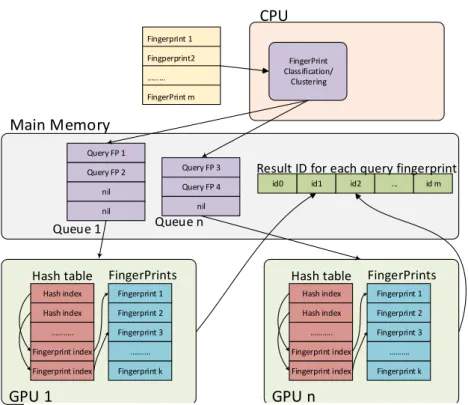
In the Figure 1, We have two GPGPUs in one node. Each GPGPU have its own data and the hash table for support of Locality-Sensitive Hashing (LSH). Depend of number cores of GPGPUs we can choose the best queue length for this GPGPU. The fingerprints in one queue will be handle at the same time on its device. And the role of CPU is cluster the input fingerprints and choose the most suitable GPGPU for every fingerprints. The most significant is that our system also parallel the threads of CPU and GPGPU. The CPU can still cluster when GPGPU is working.
Obtained budget (If you got.)
1) 10/2015-3/2016: JASO scholarship ¥48,000 /Month
2) 10/2015-3/2016: Lab Assistant (Inoguchi-lab) ¥27,000 /Month
-FingerPrint Classification/ Clustering Fingerprint 1 Fingperprint2 FingerPrint m Query FP 1 Query FP 2 nil nil Query FP 3 Query FP 4 nil GPU 1 GPU n Main Memory CPU Queue 1 Queue n Hash index Hash index .. Fingerprint index Fingerprint index Fingerprint 1 Fingerprint 2 Fingerprint 3 . Fingerprint k
Hash table FingerPrints
Hash index Hash index .. Fingerprint index Fingerprint index Fingerprint 1 Fingerprint 2 Fingerprint 3 . Fingerprint k
Hash table FingerPrints
id m ... id2 id1 id0
Result ID for each query fingerprint
数値流体解析を用いた脳動脈瘤に関する研究
金沢大学脳神経外科 南部育 使用計算機: lin, pcc.
研究概要
脳動脈瘤破裂によって生じるくも膜下出血は、高い死亡率と高い後遺症発現率を有する 疾患である。近年、数値流体力学 (Computational fluid dynamics: CFD) 解析を用いて動 脈瘤の破裂リスクを評価した報告が多数ある。今回は、新たな基準を設けて動脈瘤内の streamline を表示し、flow pattern と破裂リスクとの関連性を検討した。
内頚動脈後交通動脈分岐部瘤50 例 (破裂瘤 25 例、未破裂瘤 25 例) を対象とし、拍動流 によるCFD 解析を行った。親動脈の最大血流速度の 50 %以上を stream line として表示し、 瘤内のflow pattern を評価した。動脈瘤ドーム内に stream line が表示されるものを Dome type、動脈瘤頚部にのみ表示されるものを Neck type と分類し、破裂リスクを評価した。 また、それぞれのtype と形態学的・血行力学的特徴との関連性を評価した。
50 例中、Dome type は 44 例、Neck type は 6 例であり、Neck type では 6 例中 5 例 (83%) が破裂瘤であり、Neck type で破裂瘤の割合が高い傾向であった。Neck type の動脈瘤は Dome type と比較して瘤の高さが高く、頚部が小さい形態学的特徴を持ち、低い壁面せん 断応力、不規則な血流、うっ滞した血流を伴っていた。Neck type の flow pattern を示す 動脈瘤は破裂リスクが高い可能性がある。
各種CFD パラメーターの算出は、北陸先端科学技術大学が所有する共有計算サーバーを 使用した。
金クラスターの構造性能相関と溶媒和効果に関する計算化学的検討
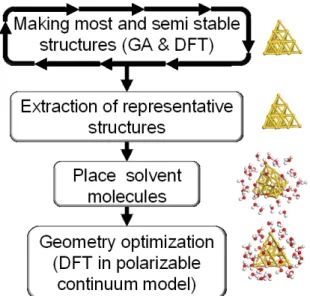
鈴木聖人・谷池俊明 【緒言】2 nm 以下の粒子として定義されるクラスターは、構成原子に対する表面原子の割合が著 しく高く、クラスターが置かれた物理化学的環境によって、多様な構造・電子状態をとりその反 応性が変化する。特に溶媒和効果による影響は広く、クラスター調製時や触媒反応時など多岐に わたって伺える。金はクラスターサイズとなることで初めて有用な触媒活性を発現することから 注目が集まっている。しかし、環境下における金属クラスターの構造を原子レベルで観測するこ とは現状難しい。計算化学においては、構造候補が膨大であるため魔法数クラスターなどの既知 構造に検討が限られてきた。そこで本研究では、遺伝子アルゴリズム(GA)と密度汎関数計算 (DFT)の併用に基づき、金クラスターの構造や性能に対する溶媒和効果を非経験に検討する方 法を確立した。 【計算手法】本研究で確立した方法をFigure 1 に 示す。まず、GA と DFT(GGA-PBE/DNP)を用い て上でAu13-25の真空中における最安定及び準安定 構造を非経験的に決定した。なお、本研究のDFT は主に Fujitsu CX250 Cluster で実行した。得られ た膨大な構造群を、階層的クラスター分析に基づ き分類し、クラスターごとに5 種類の代表構造を 抽出した。各代表構造の周囲を溶媒分子(water あるいはethanol)、続いて連続誘電体で囲み、DFT による構造最適化を実施した。この方法によって、 溶媒の分子レベルでの相互作用と計算コストを両 立した溶媒和効果の検討が可能となった。 【結果・考察】溶媒和効果は金クラスターの構造 に大きく依存し、構造間でエネルギー準位の逆転 が発生した。魔法数のAu20においては、四面体型 のクラスターが真空下では圧倒的に安定であるが、 水中では 2 番目に安定な構造となった(Figure. 2.)。更に構造間のエネルギー差は大きく減少し、 構造多様性の発現を示唆した。一方、他の原子数 では、特定の準安定構造が優先して安定化され、 構造多様性はむしろ減少した。Au13-25における各構 造の結果を総合すると球状かつ起伏を持った構造が 強い溶媒和効果を受け優先的に安定化することがわ かった。 Au-H2O(1 分子)相互作用を考慮した場合、平面に 比べエッジに対する溶媒和効果のほうが強いため起 伏が有利に働く。しかし、起伏が強すぎるとクラス ター周囲の水分子同士の水素結合が発生せず周囲の 水密度とともに吸着する水分子の数が減少するため、 溶媒和効果が弱くなる。結果、クラスター周囲の水 素結合ネットワークと強い吸着力を両立する適度な 起伏を持つ構造がより安定化される傾向を持つと結 論付けた。Keywords : Metal cluster; Structure; Solvation effect; Density functional theory
Figure 2. Solvation effects on the stability of most and metastable Au20
clusters.
Figure 1. A proposed scheme of ab-initio structure determination and investigation of solvent effects for metal clusters
有機トランジスタに用いる活性層材料の配向に関する研究
先端化学技術研究科 応用物理学領域 酒井平祐 使用計算機: pcc、Altix
概要
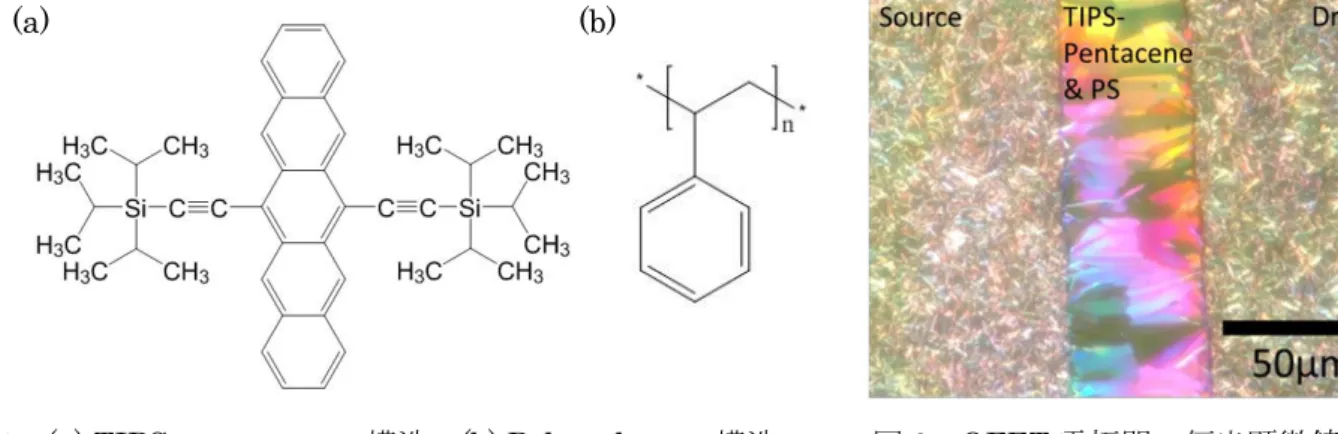
我々は、有機電界効果トランジスタ(Organic field-effect transistor, OFET)をベースとした感圧素子 の研究に取り組んでいる。この素子では、感圧部に印加された圧力のシグナルを低電圧駆動 OFET によ って検出している。この低電圧駆動OFET の活性層(半導体層)には 6,13-bis(triisopropylsilylethynyl)- pentacene (TIPS-pentacene、図 1a) と Polystylene(PS、図 1b)の混合物(TIPS-pentacene/PS)を溶液プロセス により製膜したものを用いている。1, 2 この OFET の低電圧駆動には TIPS-pentacene/PS 薄膜中の TIPS-pentacene が Source/Drain 電極間で結晶性が高くなるように成膜すること必須である(図 2)。
図2 の偏光顕微鏡写真から、本研究で用いている TIPS pentacene/PS 膜の結晶性は高いことが分 かり、Source/Drain 電極間に平行に配向していることが予想される。しかしながら、この配向を具体的に 評価し、OFET の電気特性と相関づけた研究報告例は未だ無い。OFET の Source/Drain 電極間における分 子配向は顕微Raman 分光法を用いることで評価が可能であることが知られている。3 そこで、本研究で は本学の計算機にて、Gaussian09,Gaussview を用いて TIPS-pentacene の基準振動計算を実施した。現段階 でTIPS-pentacene の基準振動計算は完了している。今後、Raman 分光法を用いた分光測定実験を実施し、 その実験結果と計算結果を照らし合わせて、配向の評価を進めていきたいと考えている。
図1 (a) TIPS-pentacene の構造 (b) Polystylene の構造 図 2 OFET 電極間の偏光顕微鏡写真
References
1. R. Hamilton, J. Smith, S. Ogier, M. Heeney, J. E. Anthony, I. McCulloch, J. Veres, D. D. C. Bradley and T. D. Anthopoulos, Adv. Mater. 21 (10-11), 1166-1171 (2009).
2. F. Linrun, T. Wei, X. Xiaoli, C. Qingyu and G. Xiaojun, Electron Device Letters, IEEE 34 (1), 129-131 (2013).
3. Y. Hosoi, D. M. Deyra, K. Nakajima and Y. Furukawa, Molecular Crystals and Liquid Crystals 491, 317 - 323 (2008).
水素化ケイ素化合物の
FT-IR スペクトルに関する研究
マテリアルサイエンス研究科 下田研究室 高岸秀行 使用計算機: pcc これまで下田研究室では、シクロペンタシラン(cyclopentasilane, Si5H10)を原料としたアモルファスシ リコン薄膜作製法を開発してきた。この原料は液体の水素化ケイ素化合物であり、一定以上の温度で熱 処理することで高品質の半導体アモルファスシリコン薄膜へと変換できる。ただし、これまでその反応 機構は未解明のままだった。そこで今回、フーリエ変換赤外分光法(Fourier Transform Infrared Spectroscopy, FT-IR)の測定と、密度汎関数法による振動計算を行い、それらを相互に参照することで 反応機構の解明に挑んだ。 計算にはGaussian09(B3LYP/6-311++G**)を利用した。有機化合物に関しては迅 かつ精度よく計 算できることが知られているためである。計算機はPC クラスタを利用した。 はじめに既知の水素化ケイ素化合物(約30 種類)に関して FT-IR ピーク位置の計算を行い、実測値と 比較した(図 1)。一定方向にズレが見られたので補正係数を算出した。求めた補正係数(Scaling factor =0.964)を利用することで、比較的良い精度(20 cm−1以内)でピーク位置を予測することが出来た。次 に反応中に出現すると想定されるケイ素化合物(約90 種類)に関して同様の計算と補正を行った(図 2)。 それらを分子構 (分子量、分岐、環構 など)に基づいて分類することで、分子構 と FT-IR ピーク 位置を関連付けた。 これらの計算結果を元に実験値をピーク分離し、構 を関連付けた。ピーク面積の変遷を追跡したと ころ、熱反応は3段階で進行すること、反応の進行と共に架橋が形成されている様子などが分かった。 この反応機構は、他の分析結果(たとえば熱重量-質量分析法)の結果とも矛盾しない。 図1 FT-IR の実測値と計算値の相関 図2 類似化合物の FT-IR ピーク位置予測の一例 以上のように、実験と計算を組み合わせることで反応を解釈することが可能となった。水素化ケイ素 化合物の合成や単離は容易ではなく、このため実測値を集めることは難しい。その点、計算機上であれ ば容易に分子を作成することができ、また精度よくFT-IR ピークを計算することもできる。実験と計算 を併用することで効率よく研究を進めることが可能となることが改めて示された。 関連発表論文Phonon study of extremely thin silicon films and carbon dioxide molecule
adsorption on graphene
M. Manoharan
Mizuta Lab, School of Material science, JAIST,
Machines used: Cray XC30, SGI Altix UV1000
Program code: OpenMX, SIESTA
XC30
256 cores/job; Altix UV1000:64-128CPUs/job
As the graphene has the highest surface-to-volume ratio, it is the most attractive candidate for the high sensitivity gas sensor. In this research, density functional simulations were performed to study the adsorption of carbon dioxide gas molecules on the graphene for different electric fields. Even though the local density approximation (LDA) and generalized gradient approximation (GGA) exchange and correlation functionals are successfully used in many materials properties study, they have poor description in van der Waals bonding. In the gas molecule physical adsorption, the van der Waals bonding plays a crucial role. In order to do more accurate gas adsorption calculations, we have used the nonlocal correlation functional proposed by Dion et al. (referred as vdW-DF). All the vdW-DF calculations were performed with the SIESTA package. vdW-DF calculations were performed with SIESTA and molecular dynamics simulations were done with OpenMX package.Publications:
1. Jian Sun, Manoharan Muruganathan, Hiroshi Mizuta “Room Temperature Detection of Individual Molecular Physisorption using Suspended Bilayer Graphene”, Science Advances, 2, 4 e1501518, 2016.
2. Le The Anh, Nguyen Tien Cuong, Pham Tien Lam, Manoharan Muruganathan, Hiroshi Mizuta, Hideki Matsumura, Nobuo Otsuka and Dam Hieu Chi “First-principles study of hydrogen-enhanced phosphorus diffusion in silicon”, Journal of Applied Physics, vol.119, 045703, 2016.
3. Jian Sun, Manoharan Muruganathan, and Hiroshi Mizuta “Detection of individual CO2 molecules adsorption with suspended graphene in an electrical field”, Proc. Of IEEE SENSORS, pp.1-4, Nov. 2015.
4. Manoharan Muruganathan, Jian Sun, Tomonori Imamura and Hiroshi Mizuta “Electrically Tunable van der Waals Interaction in Graphene-Molecule Complex”, Nano Letters, vol.15, no.12, pp. 8176-8180, 2015.
5. M. Manoharan, J. Sun and H. Mizuta “Graphene - Nano-electromechanical system switches and van der Waals (vdW) interaction controlled sensing of CO2“ to be presented at the EMN Meeting on Carbon Nanostructures, Hawaii, 27-31 March, 2016, USA (Invited Talk).
6. J. Sun, M. E. Schmidt, M. Manoharan, and H. Mizuta “Graphene-based Nanoelectromechanical (NEM) Switch”, KAUST-NSF Research Conference on Electronic Materials, Devices and Systems for Sustainable Future 2016, Thuwal, 14-16 March, 2016, Saudi Arabia (Invited Talk).
7. H. Mizuta, T. Iwasaki, S. Suzuki, Takechi, A. Hammam, J. Sun, M. E. Schmidt and M. Manoharan, “Downscaled graphene devices for low-power nanoelectronics and advanced sensing” IISc-JAIST Joint Workshop on Functional Inorganic and Organic Materials, Nomi, 7-8 March, 2016, Japan (Invited Talk). 8. Hiroshi Mizuta, Ohta Takechi, Takuya Iwasaki, Marek E. Schmidt, Jian Sun, Yoshishige Tsuchiya, Stuart
current state of the electronic properties application JSAP meeting “Phonon Engineering Perspectives", Kanazawa Institute of Technology Graduate School of Toranomon campus, November 25, 2015, Japan (Invited Talk).
9. Hiroshi Mizuta, Takuya Iwasaki, Shunei Suzuki, Ahmed Hammam, Jian Sun, Marek E. Schmidt and Manoharan Muruganathan “Recent progress of graphene nanoelectronic and NEM device technologies for advanced applications” Perspectives in Nano Information Processing Cambridge, 14-16 December, 2015, UK (Invited Talk).
10. Hiroshi Mizuta, Takuya Iwasaki, Shunei Suzuki, Ahmed Hammam, Jian Sun, Marek E. Schmidt and Manoharan Muruganathan “Downscaled graphene nanoelectronic and NEM devices for advanced applications” The 2nd Malaysia-Japan Joint Symposium on Nanotechnology, Ishikawa, 10-12 November, 2015, Japan (Invited Talk).
11. Le The Anh, Daniel Moraru, Manoharan Muruganathan, Michiharu Tabe, Hiroshi Mizuta “First-principles study of the impact of inter-dopants interaction on their wavefunctions in downscaled P-B codoped Si nanorods” The 63rd JSAP Spring Meeting, 2016, Ookayama Campus, Tokyo Institute of Technology, Tokyo, Japan, March 19-22, 2016.
Catalytic Mechanisms for Electrochemical Energy Storage
Name: Guo-Liang Chai
Affiliation: Department of Chemistry, University College London, UK.
Used machines: XC30 and PC cluster (HPCC)
Simulation codes used: Quantum‐Espresso and CPMD
Abstract
Fuel cells and metal air batteries are important devices for clean energy storage. Cathode oxygen reduction reaction (ORR) is crucial to the efficiency of these technologies. In recent years, carbon materials catalysts (CMC) are extensively investigated to replace expensive noble metal catalysts (NMC) for electrochemical oxygen reduction reaction (ORR) in electrochemical devices. For further development of CMC, two issues are urgent to be clarified. First, the CMC are always suffered from two-electron ORR (2e− ORR) to form H2O2, and the corresponding mechanism is unknown. Second,
the active sites for ORR on CMC are still under debate. There are at least two types of ORR reaction pathways for CMC, that is, direct four-electron pathway and two-electron pathway.
It was found that the 2e− ORR on CMC is much more intriguing than traditional ad-O2 mechanism
on NMC at least on two aspects. One is that the O2 adsorption barrier on metal free CMC surface is
relatively high (around or larger than 0.6 eV for N doped graphene), while H2O2 formation on them
is rather favorable. On the other hand, the maximum half-wave potential expected for the ad-O2
mechanism is 0.70 V versus reversible hydrogen electrode (RHE), while the half-wave potential for metal free CMC is around 0.40 V. These contradictions suggest that the dominating mechanism for the H2O2 formation on metal free CMC are different from the ad-O2 mechanism. A new mechanism
was derived for H2O2 formation on CMC based on both DFT and ab initio molecular dynamic
calculation results. The reaction barriers, free energy variations for elementary steps, half-wave potentials and X-ray photoelectron spectroscopy are simulated for many different catalytic structures. For CMC, the most favorable reaction pathway is through an indirect O2 activation that do not need
to be adsorbed on catalytic surface for 2e− ORR. The results also indicate that the active sites for this
2e− ORR mechanism should show low activation barrier and appropriate binding energy to CMC
surface. The calculated half-wave potentials for H2O2 formation via new mechanism also agree well
with experimental results. The current work not only important for developing new CMC for ORR but also provides insight for electrochemical synthesis of H2O2.
Publications:
1) Guo-Liang Chai, Z. Hou, T. Ikeda and K. Terakura, Two-electron Oxygen Reduction on Carbon Materials Catalysts: New Mechanisms and Active Sites, Under submission to J. Am. Chem. Soc. (2016).
3 e 3 5 c Moe c I 3 n 3 5 a c u k c c u r Pr r ps rG c bo Ur c Ur lb r c i Ss a G T a 3 n 3 5 u b bor c c u p bUr l c 3 3 5 c e c u G b 1 - 175 2 23 7 7 7 7 A 2 7 2 2 5 u G si c bo 3 c bor c g P Gi 3 5 c b Ur mg T rG 3 5 c u l iV bM r bor c u G c c u T c c u a a P Gi c c bo b Ur G c u T bor c u r t JrG aM xy c c b c 7 01 2C u T G b Ur u b UG
(1) H. Sano and G. Mizutani, “Ab initio calculations of the optical properties of crystalline and liquid InSb”, AIP Advances 5(11), 117110/1-9 (2015).
(2) H. Sano, T. Shima, M. Kuwahara, Y. Fujita, M. Uchiyama, and Y. Aono, “Study on response function of super-resolution readout of an optical disc by multi-physics simulation”, Technical Digest of International Symposium on Optical Memory 2015 (ISOM15), pp. 74-75 (2015). aT
(1) H. Sano, T. Shima, M. Kuwahara, Y. Fujita, M. Uchiyama, and Y. Aono, “Study on response function of super-resolution readout of an optical disc by multi-physics simulation”, International Symposium on Optical Memory 2015 (ISOM’15), Toyama Japan, October 4-8, 2015. Tu-I-04 October 6, 2015
(2) D borInSbc c 2015 9
13 13a-2A-6
x c bor c c
: Fujitsu CX250 Cluster NMR NMR 3 NMR NMR NMR MD MD NMR
Fujitsu CX250 Cluster AMBER12
MD 3 MD MD NMR 1) , “NMR ”, , , 2016 3 2 2) , Zhu Tong, , , “ NMR ”, 96 , , 2016 3 24
粗視化分子動力学シミュレーションによる荷電脂質二重膜の相分離と自発的膜変形 マテリアルサイエンス研究科 助教 下川 直史
使用計算機:SGI Altix UV1000 【概要】 生体膜の主成分であるリン脂質は親水基と疎水基を併せ持つ代表的な両親媒性分子であ る。リン脂質を水中に溶かすと自発的に二重膜構造を形成するため、リン脂質二重膜は生体 膜のモデル系として注目されている。多成分のリン脂質から成る人工脂質二重膜(リポソー ム)は十分低い温度において組成の不均一な構造を形成することが知られている。そのため、 物理的には水と油のように非相溶となるため相分離として理解されている。一方この相分 離構造は生物学的にはラフトと呼ばれる飽和脂質とコレステロールに富んだ領域のモデル として注目されている[1]。また、リポソームは浸透圧などの外部ストレスにより容易にそ の形態を変化させる。このダイナミックな膜変形も生細胞の機能発現において重要である。 したがって、多成分リン脂質二重膜における相分離ドメイン形成と膜変形の理解は物理・生 物の両面において重要な課題である。 リポソームを使った現在までの多くの研究では電気的に中性なリン脂質が使われてきた。 しかし、生体内には負電荷を親水頭部に有したリン脂質が存在しており、その静電相互作用 が相分離・膜変形にどのような影響を与えているかはいまだに明らかになっていない。そこ で、荷電脂質を含む脂質二重膜での相分離[2]と変形の挙動[3]を実験的に明らかにしてきた。 特に荷電不飽和脂質と中性飽和脂質の組み合わせのときに膜面上に膜孔が自発的に形成さ れることがわかった。実験結果に基づいて粗視化分子動力学シミュレーションにより計算 を行ったところ同様の結果を得ることに成功した。また、実験では確認できなかった、荷電 脂質が膜孔の縁に局在し膜孔を安定化している機構が明らかになった(Fig.1)。これらの結 果を学術論文としてまとめ発表した[3]。 シミュレーションにより相分離・膜変形を詳細に解析したところ、従来知られている電気 的に中性な相分離ドメインとは異なったドメイン成長則が明らかとなった。荷電相分離ド Fig.1 荷電脂質二重膜での膜孔形成の スナップショット。赤が荷電脂質、青が 中性脂質。 Fig.2 塩濃度と脂質間相互作用を変化させ たときのリポソーム形状。赤が荷電脂質、青 が中性脂質を表している。
メインの成長は三次元の相分離では見られない、二次元膜面特有の物理現象であり、その解 明は非常に有用であると言える。さらに静電相互作用による膜変形に関しても、ディスク 状・紐状・バイセルといった構造形成が示唆された(Fig.2)。また、現在はコロイド粒子と 脂質膜との相互作用を明らかにするためのシミュレーションを行っている。
【参考文献】
[1] K. Simons, E. Ikonen, Nature, 387, 569 (1997).
[2] H. Himeno, N. Shimokawa, S. Komura, D. Andelman, T. Hamada, M. Takagi, Soft Matter, 10, 7959 (2014).
[3] H. Himeno, H. Ito, Y. Higuchi, T. Hamada, N. Shimokawa, M. Takagi, Phys. Rev. E, 92, 062713 (2015).
【関連業績】 発表論文
1.“Coupling between pore formation and phase separation in charged lipid membranes” H. Himeno, H. Ito, Y. Higuchi, T. Hamada, N. Shimokawa, M. Takagi, Phys. Rev. E, 92, 062713 (2015).
2.「荷電リン脂質を含む脂質二重膜での相分離と膜変形の結合」
下川 直史、新学術領域研究「分子ロボティクス」News Letter, No.16, p.6 (2016). 学会発表 1.「粗視化分子動力学シミュレーションによる荷電脂質膜の相分離と変形」 下川 直史、新学術領域研究「分子ロボティクス」平成 27 年度公募班新規採択者発表会 東京工業大学 田町キャンパスイノベーションセンター(平成27 年 5 月 9 日) 2.「静電相互作用が作る脂質膜の構造と形状」 下川 直史、「分子ロボティクス」2015 年 7 月月例研究会(北陸) 石川県四高記念文化交流館(平成27 年 7 月 24 日)
3.“Coupling between pore formation and phase separation in charged lipid membranes” Naofumi Shimokawa, Hiroki Himeno, Hiroaki Ito, Yuji Higuchi, Tsutomu Hamada,
Masahiro Takagi, Physics of Cells: From Molecule of Systems (PhysCell 2015) Kloster Banz, Bad Staffelstein, Germany(平成 27 年 9 月 2,3 日)
4.「粗視化分子動力学シミュレーションによる荷電脂質膜の相分離と変形」 下川 直史、第7回新学術領域研究「分子ロボティクス」領域会議 西浦温泉ホテルたつき(平成28 年 3 月 15 日) 外部資金 科学研究費補助金 新学術領域研究[分子ロボティクス](公募研究)(代表) 「粗視化分子動力学シミュレーションによる荷電脂質膜の相分離と変形」 (平成27年度~平成28年度)
: CX250
1995 Vicsek Vicsek Vicsek
Vicsek Vicsek Vicsek 1 Vicsek 3
0
5
ρ
1:Cray XC30
X
(SiO
2)
SiO
CP2K
Cray XC30
3,000
SiO
(1)
,
,
,
,
,
,
E. G. Escolar,
, J. Akola,
,
,
,
X
29
2016
1
9 11
,
: UV3000/CX250 / (MI) MI MI
1) Kenta Hongo and Ryo Maezono, "Practical diffusion Monte Carlo simulations for large noncovalent systems" in Recent Progress in Quantum Monte Carlo, (ed. L. Mitas, P.-N. Roy, and S. Tanaka), ACS Division of Physical Chemistry, 2016, pp.124-147. ( )
2) Kousuke Nakano, Kenta Hongo, and Ryo Maezono, "Phonon dispersions and Fermi surfaces nesting explaining the variety of charge ordering in titanium-oxypnictides superconductors", Scientific Reports, 6, 29661, (2016). ( )
3) Hisaki Ikebata, Kenta Hongo, Tetsu Isomura, Ryo Maezono, Ryo Yoshida, "Bayesian molecular design with a chemical language model", Journal of Computer-Aided Molecular Design, 31, 379, (2017). ( ) 1) 27 (B) " : ( )", 27 4 - 29 3 2) 27 (B) " ( )", 27 4 - 32 3 3) 27 ( ) " ( )", 27 8 - 32 3 4) 27 JST " ( )", 27 10 - 33 3 5) 28 ( ), " ( )", 28 10 - 32 3
ACTIVITY REPORT OF FY2016
Ryo Maezono/Assoc. Prof./Information Science
The Investigation of Hydrodeoxygenation (HDO) and Decarbonylation (DCO)
Process of Methyl Butanoate on NiMoS Surfaces: Ab Initio Study
Collaboration with Institut Teknologi Bandung, IndonesiaOne of the main problem in palm oil refineries conversion to biofuel is to calculate the optimized reaction pathways. The reaction pathways are divided into two ways: decarbonylation (DCO) and hydrodeoxygenation (HDO). If both of the processes can be determined the production of palm oil based biofuel with a higher cetane number than that of fossil fuel might be a realizable process. This is a very complex interaction and to uncover the physical phenomena responsible for the interaction is a real challenge. The basic information needed to do so are:
1. Information of the reaction pathways connecting the reactant and product. Question to be answered here is how much activation energy required for each elementary reaction.
2. Catalyst material used to increase the rate of these reactions. The main problem here is the selectivity of catalyst materials that can facilitate the desired reaction pathways. Selectivity becomes an important issue because it is directly related to the efficiency of the reaction and the minimization of the unwanted products.
The purpose of this research is to answer two questions above in the context of the formation reaction of palm oil based biofuel; namely HDO and DCO reactions. In this research, we use transition metal sulfide catalysts such as MoS2 phase promoted by nickel. It is because NiMoS is known to be selective for the refineries process. Numerous experimentals and theoretical works have provided atomistic descriptions of the NiMoS active phases. Although some experimental investigations on NiMoS active phase had been conducted in the recent years, however some problems remain unresolved. The density functional theory (DFT) based on ab initio computational method will be used to simulate all possible reactions via calculating the activation energy at the elementary reaction and then screening against various selective catalyst candidates. Computational methods have been selected for this research because it can save time and cost when compared with the experimental method which for now still relies on trial and error. This method also allows us to reveal in detail the processes that take place at the atomic level that are often difficult to access experimentally.
This research will be performed in three step;
1. Investigation surface interaction between Methyl Butanoate (C5H10O2), Hydrogen (H2) and NiMoS surfaces. The purpose of this investigation is to find the active site of the molecules on the surface and also to know the effect of H2 molecules on the Methyl Butanoate adsorption process. 2. Investigation of HDO process. The purpose of this research is to know the elementary reaction pathways of the HDO process. 3. Investigation of DCO process. The purpose of this research is to know the elementary reaction pathways of the DCO process.
GAN Bandgap Calculation Using QMC
Collaboration with IIT Guwahati, INDIA
We studied bandgap of Group 3 Nitrides (AlN,GaN, and InN) using Quantum Monte Carlo methods motivated by their many possible applications in semiconductor industry especially GaN. After encouraging preliminary results using large core approximation of electrons, we decided to further study GaN using small core size such that number of valence electrons in study increased significantly (which also means higher computational resources required). The result from first run is very promising when compared to experimental results. Currently we are investigating GaN with even lower time-step which will allow us to further extrapolate to ideal time step of 0 which cannot be directly computed with finite computation resources. This study will lead to : 1) First QMC study of Group3 Nitrides in existing literature. 2)Comparison with other computational methods (most importantly DFT) for Nitrides which are known to have certain limitations/shortcomings. 3) Understanding of how semicore electron influence bandgap calculation in Group 3 Nitrides as well as associated computational cost with DMC which will be indicative of performance of DMC as a general QMC tool .
DMC study of TiO
2Collaboration with hahid Bahonar university of Kerman, Kerman, Iran
Among transition metal oxides, Titanium dioxide (TiO2) is a widely used material with many applications as photocatalyst, in solar cells for the production of hydrogen and electric energy, as gas sensor and so on. In addition, its unique properties in the form of nanoparticles such as high photocatalytic activity due to its large surface area has made it in top of researches. In particular, TiO2 nanotube has received more attention. On the other hand, it is reported that TiO2 nanotube have a band gap slightly larger than those of bulk structure. Therefore, it is attempted to narrow the band gap to improve the TiO2 nanotube functionality. Doping is one of the methods which can be referred. Usually, noble metal nanoparticles are used since they show high catalytic activity. However, they are expensive and rare. So, the use of non-noble metal catalyst having high activity is of considerable attention. Copper (Cu) based materials are getting more attention since they are abundant, have relatively low cost, and great catalytic activity.
In the present work, it is desired to investigate the structural and electrical properties of Cu-doped TiO2 nanotube in the framework of density functional theory (DFT) using plane wave pseudopotential method within PBE+U functional as implemented in Quantum ESPRESSO package. On the other hand, regarding the unique properties of TiO2, having information about its surface and the way of improving its operation is of great interest. It usually shows wide applications in fields such as photocatalysts, hydrophilic films and gas sensors. Meanwhile, it is shown that surface modification of TiO2 is one of the effective methods to improve its performance. In many cases, (110) surface of rutile TiO2 is used as a model substrate. Here, ab initio investigation of H-doped rutile TiO2 is preferred using Quantum ESPRESSO package within PBE+U functional and plane wave pseudopotential method.
Investigation of TiO
2surface reactivity
Collaboration with University College London, UKMaterials of the composition SiOx-TiO2 (0≤x≤2) are of particular interest for many technologies such as catalysis1, gas sensing2 or water splitting3. Many applications rely heavily on its surface properties and a good understanding of its surface electronic structure is crucial to build new and improved technologies. TiO2 is often used as a photocatalyst, be it for self-cleaning glasses, water purification or hydrogen production. Thus a great amount of research has been conducted investigating the interaction of water with TiO2 surfaces.4 The formation of Si-O-Ti bonds alters the electronic structure of the surface leading to unique catalytic properties while maintaining high thermal and chemical stability. TiO2 displays superhydrophilic behaviour under UV irradiation. This is commonly attributed to the generation of electron hole pairs and the charge carriers contribute to the oxidisation of molecules on the surface and the formation of hydroxyl groups is linked to a reduction in the water contact angle. Addition of silica may increase the photocatalytic activity if the two substrates are in close contact. In fact it has been reported that incorporation of SiO2 into TiO2 films will lead to a reduction in the water contact angle.5 Depositing SiOx on the TiO2 (110) surface in air leads to monolayer growth, nucleating at step edges and kink sites. Deposition in vacuum results in a much rougher surface. In both cases the wettability of the surface is reduced. Despite many experimental studies, theoretical work of SiOx on TiO2 surfaces is still rare. Previously we modelled a clean rutile TiO2 (110) surface and its interactions with SiO as well as SiO2. The adsorption of single molecules indicated an epitaxial growth of SiO on TiO2. However, Rutile TiO2 is readily reduced during annealing at 1000ºC forming surface oxygen vacancies and interstitial Titanium. Therefore we investigated the adsorption of SiO and SiO2 at an oxygen vacancy on the surface, elucidating on the structure formed by these compounds upon adsorption.
In a next step we want to continue our work on this system working towards understanding experimental data of epitaxially grown films of SiOx on TiO2. At high vacuum and high annealing temperatures the rutile TiO2 (110) surface may also reconstruct and we intend to model the adsorption of siliconoxide molecules on a reconstructed surface. In a next step we will move from modelling individual molecules to thin film overlayers. This will build a basis for investigating the interaction of H2O with such a surface.
Anharmonic Calculations in Hybrid Perovskite Solar Cells
Collaboration with Cambridge University, UKWe are conducting large-scale calculations including anharmonic vibrational effects on hybrid organic-inorganic perovskite systems. These systems have great potential as solar cell materials, but are not yet fully understood. Our calculations aim to study the effect of the motion of the organic molecule contained within the perovskite lattice on the electronic band structure. This is important as the band structure directly affects these materials’ use in solar cells. It is hoped that by understanding these systems better we can move towards using them in practical circumstances as solar cells.
TDDFT study of cage clusters
Collaboration with University of Yaounde I, Cameroon Fullerenes Cn (n being the number of carbon atoms) are allotropes of carbon that possess theinteresting applications. Indeed the are predicted to be used as enrollment for drugs pinpoint delivery to cure cancers for example, or to constitute traps for virus in medicine, and in electronics, they would be used as building tools for quantum computers. These kinds of applications require a good knowledge of the way the cage and the confined system interact together, how isolated the encapsulated system is in the cage and which modifications on the properties of the cage arise from the presence of the dopant system. How does the presence of the atoms modified the static an dynamical properties of C60 cage ? Is there any similarity in the behavior of these properties according to the type (centered or off-centered) of confined atom? How well can the presence of the atom and its type can be notice while studying external excitation by electron energy lost? How all those results are linked together? This project intends to study those questions.
Quantum Monte Carlo study of the energetics of rutile, anatase, brookite, and
columbite TiO2 polymorphs
Collaboration with Cambridge University, UKTitanium dioxide (TiO2) is a technologically preeminent material, which is used in photovoltaics, photocatalysis, and as a catalyst support. Despite its technological relevance, its fundamental properties are not fully understood: it is not even known what is the most stable structure of TiO2. In this project, we study four types of TiO2, the rutile, anatase, brookite, and columbite polymorphs, using state of the art computational methods. We use quantum Monte Carlo to describe the electrons and density functional theory to describe the atomic quantum and thermal motion, fully incorporating the effects of anharmonicity. Our calculations allow us to construct the most accurate phase diagram of this important material to date, predicting that at low temperatures the anatase structure is the most stable structure, but the rutile structure is stabilized above about 630 K. [1] J. Trail, B. Monserrat, P. Lopez Rios, R. Maezono, and R.J. Needs, Physical Review B, in press.
THE GROUND STATE OF IRON PHTHALOCYANINE (II):
A DIFFUSION MONTE CARLO STUDY
Tom Ichibha1,*, Zhufeng Hou2, Kenta Hongo1,2,3 and Ryo Maezono1
1School of Information Science, JAIST, Nomi, Ishikawa, Japan 2National Institute of Materials Science, Tsukuba, Ibaraki, Japan 3PRESTO, JST, Kawaguchi, Saitama, Japan *E-mail: [email protected]
A
BSTRACT:
The ground state of the iron (II) phthalocyanine (FePc) stands as a several decades of problem [1] and be still under controversy. Although the ground state is known as triplet state and its candidates are restricted in these four electronic configurations: A2g, B2g Eg(a) and Eg(b) [2], the previous DFT works gave different predictions depending on XC functionals [3]. We applied CASSCF+DMC and DFT (M06, M06L and M06-2X)+DMC to evaluate the relative energies of those four configurations reliably, without XC functionals. All of our DMC calculations consistently predicted A2g as the ground state and characteristic 'N-shape' prediction, which can be, we found, also justified by the recent spectroscopy experiment for gas phase [4].We considered how DFT predictions depend on XC functionals and perceived the balance of exchange and correlation is essential to reproduce DMC prediction: Comparing several DFT with DMC, with different percentages of exact exchange, we found exchange promotes the A2g ground state and 'N-shape', where short-range exchange is much more important than long-range one. Whereas, correlation suppresses this tendency in opposite, found from comparing HF, CASSCF and CASPT2. We identified the discrepancies being due to the assumptions made in the superposition model [5] in ligand field theory, which has also been employed in literature to explain the ground state of FePc. Our orbital analysis shows that the assumptions are too simple to describe the proper stabilizing mechanism explained by the orbital shapes: Oversimplified symmetry assumptions as well as the ignorance of outer ligand structures cannot capture the stabilization [destabilization] of b2g [eg] orbitals, those actually realizes A2g as the most stable state. This work is accepted by Scientific Reports in April, 2017 and the paper is uploaded in arXiv [6].
R
EFERENCES:
[1] J. Fernandez-Rodriguez et al., Phys. Rev. B 91, 214427 (2015). [2] K. Nakamura et al., Phys. Rev. B 85, 235129 (2012). [3] N. Marom and L. Kronik, Appl. Phys. A 95, 165 (2009). [4] B. Brena et al., J. Chem. Phys. 134, 074312 (2011). [5] D.J. Newman and B. Ng, Rep. Prog. Phys. 52, 699 (1989) [6] T. Ichibha et al., arXiv:1606:08706 (2016) [accepted by Sci. Rep. in April, 2017]A
CHIEVEMENTS:
[1] "A DMC study on FePc electronic state", T. Ichibha, K. Hongo and R. Maezono, APS March Meeting 2016, 2016/03/14, Baltimore Convention Center, Baltimore, Maryland, USA[2] "Essential factor for DFT predictions of relative energies in FePc: A Diffusion Monte Carlo study", T. Ichibha, Z. Hou, K. Hongo and R. Maezono, APS March Meeting 2017, 2017/03/13, Ernest N. Morial Convention Center, New Orleans, Louisiana, USA [3] , , , , 2016 , 2016/09/15, [4] T. Ichibha, Z. Hou, K. Hongo, and M., arXiv:1606:08706 (2016) [accepted by Sci. Rep. in April, 2017]
A
CHIEVEMENTS:
XC40, CX250, UV3000
ELECTRONIC STRUCTURE CALCULATIONS OF
LAYERED PEROVSKITE COMPOUND, LI
2LATA
2O
6N
Apichai Jomphoak, Kenta Hongo, and Ryo Maezono* *Graduate School of Information Science, JAIST E-mail: [email protected]The crystal structure of layered perovskite compound Li2LaTa2O6N, having the tetragonal unit cell with the space group I4/mmm, has been successfully synthesized and determined from laboratory X-ray powder diffraction. Li2LaTa2O6N has a layered perovskite structure similar to that of Li2LaTa2O7 [1]. All O/N sites consist of mixture of 85.70% O and 14.30% N atoms. The Li-O/N distance of 2.0812 Å is in good agreement with those of Li2LaTa2O7 and other oxides [2].
All the first-principle density functional theory (DFT) calculations described here were performed using virtual crystal approximation (VCA) in CASTEP [3] implementation based on the generalized gradient correction (GGA) to exchange-correlation potential in the Perdew-Burke-Ernzerhof (PBE) functional [4]. The authors restricted and treated the systems as non-spin-polarized in all calculation steps. The Vanderbilt ultrasoft pseudopotentials (UPP) were used with a plane wave basis set that was truncated at a kinetic energy of 380 eV. The k sampling with 6x6x1 k-point grid was set in the Brillouin zone. A sampling of reciprocal space was used such that distance between k-point separations was about 0.04 Å−1. The authors specified the convergence threshold for the maximum displacement during geometry optimization to be 5x10⁻⁴ Å.
As the detailed atomic coordinates for Li2LaTa2O6N were unknown, at the first stage, the full structural optimization of this phase was performed both over the lattice parameters and the atomic positions. However, due to symmetry, there are 3 possible sites of O/N. The BFGS optimization scheme [5] with the structural symmetries was used to find the stable positions. After the final self-consistency cycle, the theoretical equilibrium structures were obtained when the remaining forces acting on all the atoms were less than 0.01 eV/Å, and the remaining stress was less than 0.02 GPa. The present calculations are restricted to the athermal limit, in which temperature effects and zero-point motions are neglected, and the energy convergence criteria for self-consistent calculations were set to 5x10⁻⁶ eV/atom. After VCA calculations, the lattice parameters, atomic positions, band structures, density of states, and partial density of states were obtained. The Li atoms exclusively occupy the four-coordinated site Wyckoff position 4d with a full occupancy, which is located between the perovskite layers. Valence and conduction bands of this compound mainly consist of N-2p and Ta-5d, respectively. On the other hand, their hybridization between N-2p and O-2p from the calculation result seems smaller than authors’ expectation. For the case of TaON, hybridization between N-2p and O-2p was known to be large.
R
EFERENCES:
[1] N. K. McGuire and M. O’Keeffe, J. Solid State Chem. 54, 49 (1984). [2] M. Kaga, H. Kurachi, T. Asaka, B. Yue, J. Ye, and K. Fukuda, Powder Diffr. 26, 4 (2011).[3] S. J. Clark, M. D. Segall, C. J. Pickard, P. J. Hasnip, M. J. Probert, K. Refson, and M. C. Payne, Z. Kristallogr. 220, 567 (2005).
A
CHIEVEMENTS:
[1] A. Jomphoak, R. Maezono, and T. Onjun. "Density Functional Theory of Graphene/ Metallophthalocyanines: Electronic Structure of CuPc, NiPc, and CoPc on Graphene," in the 2nd International Conference Advanced in Functional Materials (AFM 2016), 8-11 August 2016, Jeju, South Korea (2016) S1:8PVS-60
[2] A. Jomphoak, R. Maezono, and T. Onjun. "Self-Interaction Effects of Transition Metal Phthalocyanines on Graphene: A DFT Study," in the 18th International Workshop on Computational Physics and Materials Science: Total Energy and Force Methods, 12-14 January 2017, Trieste, Italy (2017)
[3] A. Jomphoak, R. Maezono, and T. Onjun. "Density Functional Theory of Graphene/Cu Phthalocyanine Composite Material," Surf. Coat. Tech. 306, 236 (2016).
DOI: 10.1016/j.surfcoat.2016.06.015.
M
ACHINES:
CX250 [Program: Accelrys Materials Studio]
ION DIFUSSION IN LEAD-FREE SOLDER
Genki Prayogo and Ryo Maezono* *Graduate School of Material Science, JAIST E-mail: [email protected]Usage of Pb-based solder is being phased out because of its negative effects on human health. However, transition to lead-free solder is not without problems, with replacement alloys having several unfavorable properties. Of particular concern is formation of voids in Cu3Sn phase of Cu-Sn alloy, as it compromises solder joint strength. This void formation is known to be caused by differences in diffusion rate of constituent ions. Although these rates have been studied well, previous works gave differing conclusions [1].
We investigated how Cu and Sn ion diffuse in Cu3Sn alloy from ab initio approach and estimate their diffusion constant. Ion diffusion is modeled as a Markov chain, and diffusion constant is calculated from defects formation energy and energy barrier. Phonon frequencies for each diffused ions are also calculated to predict diffusion constant at finite temperature. The Cu3Sn phase is reported to be a long-range periodic structure, with ε-Cu3Ti and D019 type structures appear mutually [2]. All possible diffusions paths within one unit cell of both structure types are considered for Cu and Sn ions. In our model, each of these diffusion paths are optimized for minimum energy by climbing nudged elastic band method (c-NEB). Five-frequency model as described by M. Koiwa et al. and T. Ito et al. [3,4] is used to determine the final diffusion constant.
We have determined that ion diffusion in Cu3Sn phase occurs mainly in one planar direction. Finite temperature diffusion constant from phonon calculations also shows comparable result with previous experimental data.
R
EFERENCES:
[1] S. Kumar, C. A. Handwerker, and M. A. Dayananda. Intrinsic and Interdiffusion in Cu-Sn System. 2011. Journal of Phase Equilibria and Diffusion Vol. 32 No. 4 309-319.
[2] X. Sang, K. Du, and H. Ye. An ordered structure of Cu3Sn in Cu-Sn alloy investigated by transmission electron microscopy. 2009. Journal of Alloys and Compounds 469 129-136.
[3] M. Koiwa and S. Ishioka. Random Walk Properties of Lattices and Correlation Factors for Diffusion via the Vacancy Mechanism in Crystals. 1983. Journal of Statistical Physics Vol. 30 No. 2.
[4] T. Ito, S. Ishioka & M. Koiwa (1990) Correlation factor for diffusion via sublattice vacancy mechanism in the L12-type ordered alloy, Philosophical Magazine A, 62:5, 499-510, DOI: 10.1080/01418619008244915
DFT+U ON ND-FE-B COMPOUNDS
Adie Tri Hanindriyo*, Soumya Sridar#, KC Hari Kumar#, and Ryo Maezono* *Graduate School of Advanced Science and Technology, JAIST
#Department of Metallurgical and Materials Engineering, IITM
E-mail: [email protected]
The compound Nd2Fe14B is widely used in manufacturing permanent magnets. This interest has driven much of the research on the Nd-Fe-B system, including its phase diagram as the result of numerous thermodynamic experiments. Computational calculation of phase diagrams (CALPHAD) initially exclusively used experimental data, but has since begun to utilize the results of first-principles calculation. To this end, Density Functional Theory (DFT) is used to calculate formation enthalpies of Nd-Fe-B compounds.
Hubbard U correction is used to account for the localized nature of Nd 4f electrons, known to be a failure of the GGA exchange-correlation potential used[1]. Comparison between 2 methods of choosing Hubbard U value is drawn: a simplified implementation of GGA+U[2] using effective Hubbard U value (Ueff = U-J) and GGA+U+J from constrained random phase approximation (cRPA) for bulk Nd[3]. Formation enthalpies resulting from both Hubbard U values are compared with experimental values and plain GGA. It is shown that plain GGA fails to obtain good agreement with experimental data, while both Hubbard U correction methods are sufficient to accurately calculate formation enthalpies of several Nd-Fe-B compounds.
Besides formation enthalpy, CALPHAD can also use the specific heat under constant pressure (Cp) as
thermodynamic data to construct the proper phase diagram. To do this, GGA+U is used to obtain an energy vs. volume curve for Nd-Fe-B compounds, which is then fitted to the third order Birch-Murnaghan equation of state. Force constants are calculated using the frozen phonon method. Cp is then obtained for every 10 degrees increment from 0K to 1000K, where calculations results begin to fluctuate and lose reliability. This process has been completed for the compound NdB6.
R
EFERENCES:
[1] Anisimov, Vladimir I., Jan Zaanen, and Ole K. Andersen. (1991). "Band theory and Mott insulators: Hubbard U instead of Stoner I". Phys. Rev. B., 44, p.943-954 [2] Cococcioni, Matteo and Stefano de Gironcoli. (2005). "Linear response approach to the calculation of the effective interaction parameters in the LDA+U method". Phys. Rev. B., 71, 035105 [3] Nilsson, F., R. Sakuma, and F. Aryasetiawan. (2013). "Ab initio calculations of the Hubbard U for the early lanthanides using the constrained random-phase approximation". Phys. Rev. B., 88, 125123A
CHIEVEMENTS:
[1] "DFT+U on Nd-Fe-B compounds", Adie Tri Hanindriyo, Soumya Sridar, KC Hari Kumar, and Ryo Maezono, APS March Meeting 2017, 2017/03/13. Ernest N. Morial Convention Center, New Orleans, Louisiana, USAM
ACHINE:
CX250 [Program: Quantum Espresso v5.3.0]: SGI Altix UV3000 ( ) 1990 NP 1990 PC [3,4] 1. ( [1,2]) 2. NII ( [1])
1) T. Oikawa, K. Yamazaki, T. Taniguchi, and R. Uehara: A Peg Solitaire Font, Bridges 2017, 2017/07/27-2017/07/31, Ontario, Canada. ( )
2) T. Oikawa, K. Yamazaki, T. Taniguchi, R. Uehara: Development of Peg Solitaire Font, IEICE Technical Report, COMP2016-50, Vol. 116 No. 503, pp. 1-4, 2017/03/07. ( )
3) T. Oikawa, I. Kanemoto, T. Saitoh, M. Kiyomi, and R. Uehara: Experimental Enumeration of Solutions for Peg Solitaire (Short Talk), IPSJ SIG Technical Report, 2016-AL-159-3, p. 1, 2016/09/23. ( )
4) I. Kanemoto, T. Saitoh, M. Kiyomi, and R. Uehara: Counting the Number of Solutions for Peg Solitaire, IEICE Technical Report, COMP2016-14, Vol. 116, No. 211, pp. 1-5, 2016/09/06. (
)
2分探索木を利用した低演算量な ℓ1 正規化部分空間法に基づくチャネル推定
神戸大学工学研究科 高野泰洋 使用計算機 pcc
研究概要
従来の部分空間射影を用いた ℓ2 Minimum mean square error (MMSE) チャネル推定は、
Massive multi-input multi-output (MIMO)システムにおいて、Pilot contamination (PC) 問題 により推定性能の劣化を被る。この課題に対し,これまで本研究は,チャネル長制約を利用した ℓ1 正規化 MMSE チャネル推定法が PC 問題の解決策となる数学的根拠を示してきた.しかし,
断続的無線接続環境やDoubly selective fading channel において,ℓ1 正規化 MMSE 推定は貪
欲アプローチにより全ての候補解から最適解を導くため,高い演算量が課題となっていた.
そこで本研究は、低演算量なℓ1 正規化 MMSE 推定チャネル推定法を提案した.具体的には,
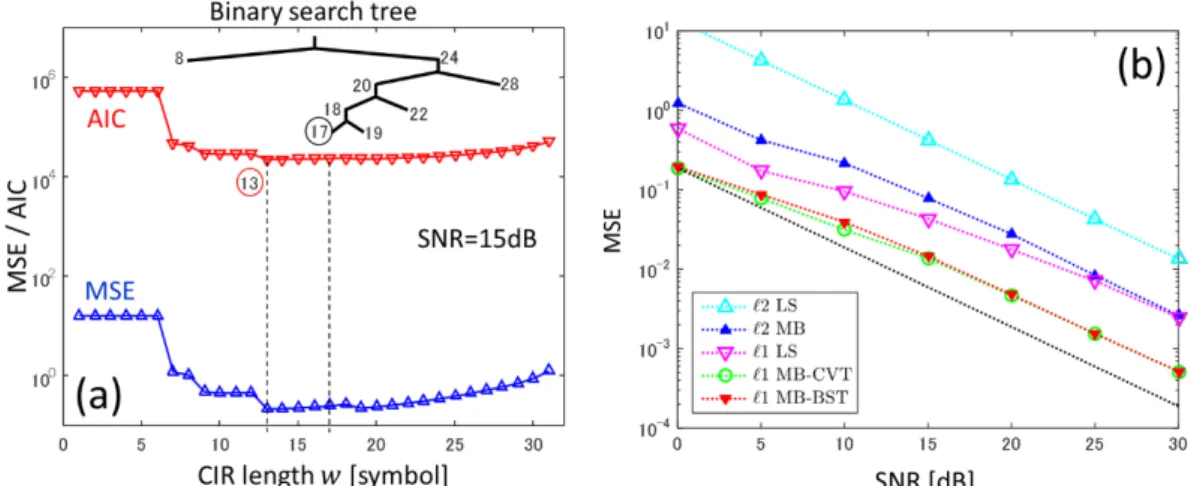
ℓ1 MMSE 推定の候補解の赤池情報規範(AIC)の曲線が Quasi convex 性を示すことに着目し,2 文探索木を利用して有意な解候補のみ算出する.これにより,演算量をO(W N )からO(logW ∙ W N )に削減した ℓ1 MMSE 推定チャネル推定アルゴリズムを実現した.ここで,W はチャネ ル長,N は送信アンテナ数である.Figure 1 に示すように,提案手法(ℓ1MB-BST)は全探索ア ルゴリズム(ℓ1MB-CVT)と同等の推定性能を達成する.なお,基準となる全探索アルゴリズムは 長時間の評価時間を要するが,並列計算機を利用することで,効率的に性能評価を実施すること ができた.
Figure 1 Vehicular-A チャネルにおける(a)AIC 値と(b)提案法(ℓ1MB-BST)の MSE 性能
研究業績
[1] Y. Takano, “A complexity efficient ℓ1 regularized subspace-based channel estimation using binary search trees”, 2016 10th International Conference on Signal Processing and Communication Systems (ICSPCS), Gold Coast, QLD, 2016, pp. 1-6.
数値流体解析を用いた脳動脈瘤コイル塞栓術後の再発に関する研究
金沢大学脳神経外科 南部育 使用計算機: lin, pcc. 研究概要 脳動脈瘤コイル塞栓術後の再発には血行力学的因子が関与していると考えられる.今回 は , 治 療 前 の モ デ ル と コ イ ル 塞 栓 術 後 の モ デ ル を 同 時 に 作 成 し , 数 値 流 体 力 学 (Computational fluid dynamics: CFD) 解析を用いて再発と関連する血行力学的因子を検 討した.コイル塞栓術を行った内頚動脈瘤50 例 (再発 7 例、非再発 43 例) を対象とし,術前の血 管撮影画像から,pre-coiling model と動脈瘤を人工的に削除した virtual post-coiling model を作成した (Figure 1).両モデルに対して CFD 解析を行い,pre-coiling model の neck 面 やvirtual post-coiling model の仮想コイル面における血行力学的因子を評価した.そして 再発と関連する血行力学的因子を検討した.
再発群では,非再発群と比較すると,pre-coiling model のネック面における inflow area とinflow rate が有意に高値であった.再発群では,virtual post-coiling model の仮想コイ ル面におけるpressure が有意に高値であった.ROC 解析を行うと,pressure の AUC は 0.967 であり,最も高値であった.
Virtual post-coiling model はコイル表面にかかる血行力学的因子を術前に評価できる点 で非常に有用であり,コイル面にかかるpressure が最も強い再発因子である可能性が考え られた. 各種CFD パラメーターの算出は、北陸先端科学技術大学が所有する共有計算サーバーを 使用した. 金沢大学脳神経外科 南部 育 情報社会基盤研究センター 井口 寧 情報科学研究科 河村 知記 金沢大学脳神経外科 南部 育 情報社会基盤研究センター 井口 寧 情報科学研究科 河村 知記
実行時の動的かつ頻繁なグループ変更に対応可能な
MPI マルチキャスト機能の実装に関する研究
福井大学大学院工学研究科情報・メディア工学専攻 長嶺祐輔,森眞一郎 情報社会基盤研究センター 井口 寧
使用計算機: Cray XC30 使用ソフト Cray MPICH 概要 本研究では,MPI を用いたマスタ・スレーブ型の大規模並列処理環境下で,実行時の動的かつ 頻繁なグループ変更に対応可能な動的マルチキャスト機構を提案・実装し,北陸先端科学技術大 学院大学の共有計算サーバを用いて有効性を検証した.また福井大学で構築したカスタムクラス タでの性能評価実験と比べて共有計算サーバでは極めて安定した性能を得ることができた. [1. 動的マルチキャスト機構の実装] 今回の実装においては,マルチキャストの受信対象となり得るスレーブノードは任意のノードからの MPI メッセージを受信可能な状態であると仮定する.このとき,マスタノードの負荷を軽減するため,マスタノー ドはマルチキャストの受信対象となったスレーブノード群の中から 1 台のスレーブノードのみに配信先の情 報と配信データを配信し,それ以降の配信動作は受信対象となったスレーブノード同士で分散配信を行う実装 を 行 な っ た . 使 用 す る 分 散 配 信 の ア ル ゴ リ ズ ム は , binomial-tree と binomial-tree_ring_all_gather とし、メッセ ージ長に応じて選択する. 1.1 動的な配信木の構築 マルチキャストの受信対象となるスレーブ・ノード群の構成 に応じた配信木の動的構築が必要である.マスタノードは配信 木の構築に必要な情報として,全スレーブノード分のビットマ ップデータを用意し,マルチキャストの受信対象となるスレー ブノードに対応したbit に 1 を,それ以外に 0 を記録した配信 先情報(以下 bmp と記す)を作成する.その後,最も rank 番号 の小さいスレーブノードに bmp を配信する.bmp を受け取っ たスレーブノードは,bmp を元に配信木を構成するランクのみからなる配信リストを動的に構築し,リスト 全体の長さならびにリスト上での自分の相対的な位置から,配信アルゴリズムにおける自らの役割を認識する. 図1 は,rank B,E,F,H,K,L,M,P にマルチキャストを行う場合の bmp および動的に構築された配 信リストとbinomial-tree を示している. 1.2 スレーブノードでの処理フロー 分配構 が動的変動することから,スレーブノードでは自らがマルチキャストの対象に含まれるか否か,ま た,マルチキャストの受信対象となった場合にどのrank から情報を受け取るかは,実際にビットマップ(bmp) を受けとるまで判らない.そこで,マルチキャストの対象に含まれる可能性をもったスレーブノードは任意 rank からのメッセージを受信可能にする MPI_ANY_SOURCE を送信元として設定して,MPI 受信を可能な
状態にしておく.受信したメッセージがマルチキャストに関連するものか否かの識別は MPI メッセージに付
随するtag 情報を用いて行う.
図1.rank 番号 K を例とした資源ノードにお けるマルチキャストの処理フロー