A General
Description
of
an
Information
Disseminating
Scheme and
Its Automorphism
情報散布方式の一般的記述と自己同型写像
Walter
Unger*,
Yoshihide
Igarashi (
五十嵐善英
)**,
and
Shingo
Osawa
(
大澤新吾
)**
*Mathematik-Informatik,
**Department
of
Computer
Universitat
GH-Paderborn,
Science,
Paderborn,
Germany
Gunma
University,
Kiryu,
376
Japan
Abstract
We describe an information disseminating scheme on a processor network in a general form. An automorphism with respect to the information disseminating process on the network is introduced. Conditions forthe existence ofsuch an auto-morphism and the effect of the start round to thefault tolerance of the scheme are studied. あらまし プロセッサネットワーク上の情報散布方式を一般的に記述する。 ネットワーク上の情報散布過程 に対応した自己同型写豫を紹介する。自己同型写像が存在する条件とスキームの耐故障性へのス タートラウンドの影響について議論する。
1
Introduction
Data broadcasting is a very fundamental operation in parallel and distributed systems. It can be accomplished by the data disseminating process in the network in a way that each processor repeatedly receives and forwards messages without physical broadcast. A scheme introduced by Alon et al[l] specifies such an information disseminating process by a simple procedure. Han and Finkel [3] generalized the scheme given by Alon et al, and
discussed its fault tolerance. A number of variations of binaryjumping scheme have been shown and discussed by Kanai et $a1[5][6]$. However, relations
among
the fault toleranceofthese schemes are far from being well understood.
In this paper we describe an information disseminating scheme in a general form. Our scheme includes binary jumping scheme and its variations as special cases of the scheme.
In general, the fault tolerance of an information disseminating procedure depends on not only the configuration of faulty processors but also the start round of broadcasting. However, we do not know precisely at present how the fault tolerance is affected by the change of the start round. To understand the effect of the start round we introduce an automorphism on an information disseminating scheme. If such an automorphism on a
scheme exists then the fault tolerance of the scheme is independent of the start round.
We study what conditions are required so that such an automorphism on an information disseminating scheme exists.
2
An
Information
Disseminating
Scheme
Throughout this paper we consider a network with $N$ processors. These processors are
synchronized with a global clock and are linked according to the disseminating scheme.
We assume that all links are faultless, but some processors in the network may be faulty. We consider only the case where a faulty processor cannot forward messages, but can receive messages. We do not consider cases where a faulty processor alters information and forwardswrong messages. The time interval forforwarding amessagefrom a processor to one of its neighbors is called a round. Each processor can receive a message and can forward a message in the same round. We also assume that the source processor of broadcasting is always faultless.
The processors in the network are addressed by integers from $0$ to $N-1$. We denote
$k$ modulo $m$ by $[k]_{m}$. We only consider broadcasting schemes that can be described by
the following procedure.
procedure broadcast(N, $R$)
{
$N$ isthe number of processors in the network, and $R$is a sequence of positiveintegers}
let $R=(a_{0}, \cdots, a_{t})$
repeat
for round:$=0$ to $t$ do
each processor $u$ sends amessage to processor $[u+a_{round}]_{N}$ concurrently
forever
The length of$R$ is denoted by $|R|$, and theperiod ofthe above procedure $is.|R|+1$. If $R$ is an infinite sequence, then $|R|$ is denoted by $\infty$. When $R=(1,$2, $\cdot$.
.
,2 $)$, theoccur at any timein any processor in the network. For any broadcasting scheme that can be specified by the above procedure, the realized network is symmetric with respect to the processors. When we discuss the fault tolerance of the network, without loss of generality we may therefore assume processor $0$ to be the source of broadcasting. The broadcast
starting at round $i(0\leq i\leq|R|)$ by the above procedure is denoted by $S_{i}(N, R)$.
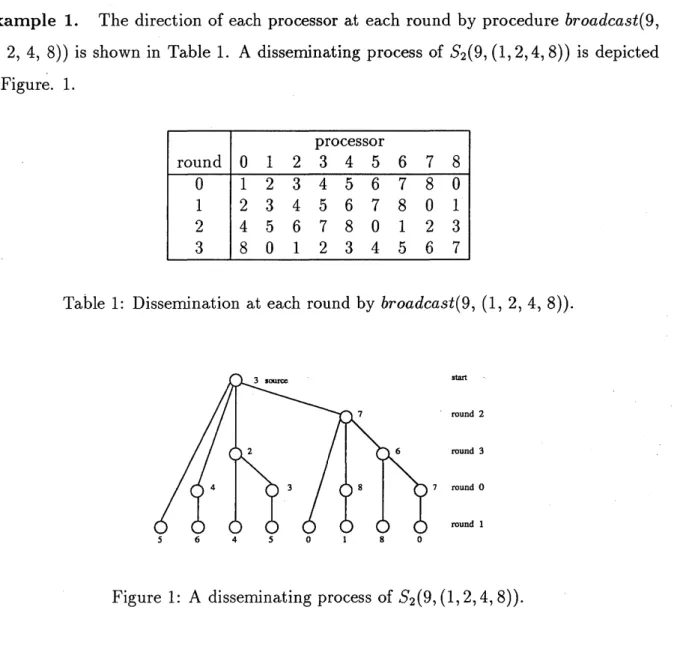
Example 1. The direction of each processor at each round by procedure broadcast(9, (1, 2, 4, 8)) is shown in Table 1. A disseminating process of $S_{2}(9, (1,2,4,8))$ is depicted in Figure. 1.
Table 1: Dissemination at each round by broadcast(9, (1, 2, 4, 8)).
$*taIt$
round2
round3
round$0$
round I
Figure 1: A disseminating process of $S_{2}(9, (1,2,4,8))$.
3
An Automorphism
In order to understand the effect of the start round of broadcasting we introduce an automorphism on the network with respect to the information disseminating process. Throughout this section we assume that processor $0$ is the source of broadcasting in the
The next proposition is immediate.
Proposition 1 For any $N\geq 1$, any
finite
sequence $R$of
positive integers and any startround $i,$ $S_{i}(N, R)$ can complete broadcasting within a certain number
of
roundsif
$R$con-tains 1 and no processors have
failed.
Let $R_{h}^{(t)}$ be a sequence $(a_{0}, a_{1}, \cdots, a_{t})$, where $a_{i}(0\leq i\leq t)$ is $h^{i}$ and $2\leq h$, and let $R_{h}^{1\infty)}$ be theinfinite sequence$(h^{0}, h^{1}, h^{2}, h^{3}, \cdots)$
.
In this section weonly consider procedurebroadcast(N, $R_{h}^{(t)}$), where $t$ is a nonnegative
integer
or $\infty$.
Note that $S_{i}(N, R_{h}^{(\infty)})$ maynot complete broadcasting forever. For example, if $N=h^{i},$ $S_{i}(N, R_{h}^{(\infty)})$ cannot send the
message to any processor from the source processor forever.
Definition 1 Two broadcasts $S_{i}(N, R_{h}^{\langle t)})$ and $S_{j}(N, R_{h}^{(t)})$ are equivalent if and only if
there exists a one-to-one function $f$ on $\{0, \cdots, N-1\}$ satisfying the following conditions:
1. $f(0)=0$
2. For any $k\geq 0$ and $0\leq p,$$q\leq N-1$, processor $p$ sends the
message
to processor $q$by $S_{i}(N, R_{h}^{(t)})$ at round $[i+k]_{t+1}$ if and only if processor $f(p)$ sends the message to
processor $f(q)$ by $S_{j}(N, R_{h}^{(t)})$ at round $[j+k]_{t+1}$.
A function $f$ satisfying the conditions in Definition 1 is called an automorphismfrom
$S_{i}(N, R_{h}^{(t)})$ to $S_{j}(N, R_{h}^{(t)})$
.
Definition 2 If. for any pair of $i$ and $j(0\leq i,j\leq t)S_{i}(N, R_{h}^{(t)})$ and $S_{j}(N, R_{h}^{(t)})$ are
equivalent, then procedure broadcast(N, $R_{h}^{(t)}$) is said to be automorphic.
Lemma 1
If
there exists an automorphismfrom
$S_{i}(N, R_{h}^{(t)})$ to $S_{j}(N, R_{h}^{(t)})$, then it isunique.
Proof. It issufficient to show that theassertion holds true for theautomorphism$f$ from
$S_{0}(N, R_{h}^{(t)})$ to $S_{i}(N, R_{h}^{\{t)})$. Suppose that thereexists an automorphism $f$ from $S_{0}(N, R_{h}^{(t)})$
to $S_{i}(N, R_{h}^{(t)})$. At the start round the source processor sends a message to processor 1 by $S_{0}(N, R_{h}^{(t)})$ and to processor $[h^{[i]_{t+1}}]_{N}$ by $S_{i}(N, R_{h}^{(t)})$. At the $x(t+1)$-th round after the
$S_{0}(N, R_{h}^{(t)})$ whereas the source processor sends a message to processor $[(x+1)h^{[i]_{t+1}}]_{N}$ by
$S_{i}(N, R_{h}^{(t)}\cdot)$. Therefore, from the definition of an automorphism, $f(x)=[h^{[i]_{t+1}}x]_{N}$ for all $0\leq x\leq N-1$ and the automorphism is uniquely determined. $\square$
Theorem 1 For any$0\leq t\leq\lceil\log_{h+1}N\rceil-1$ and$N\neq(h+1)^{n}-1$, procedure broadcast(N,
$R_{h}^{(t)})$ is not automorphic, where $n=\lceil\log_{h+1}N\rceil$
.
Proof. Suppose that there exists an automorphism $f$ from $S_{0}(N, R_{h}^{(t)})$ to $S_{1}(N, R_{h}^{(t)})$,
where $t\leq\lceil\log_{h+1}N\rceil-1$. Processor $0$ sends the message to processor $h^{t}$ at round $t$ by
$S_{0}(N, R_{h}^{(t)})$ and to processor 1 at round $[t+1]_{t+1}(=round0)$ by $S_{1}(N, R_{h}^{(t)})$
.
Hence, $f(h^{t})$should be 1. However, from the proof ofLemma 1, $f(x)=[hx]_{N}$ for any$x(0\leq x\leq N-1$
$)$, but $[h^{t+1}]_{N}$ cannot be 1. This is a contradiction. Therefore, there is no automorphism
from $S_{0}(N, R_{h}^{(t)})$ to $S_{1}(N, R_{h}^{(t)})$ if$0\leq t\leq\lceil\log_{h+1}N\rceil-1$. $\square$
Lemma 2 Let $N$ be relatively prime to $h$ and $i$ be a nonnegative integer. Let $f$ be a
function
on $\{0, \cdots, N-1\}$defined
as $f(x)=[h^{i}x]_{N}$for
all $0\leq x\leq N-1$. Then $f$ is aone-to-one
function.
Proof. Let $0\leq x<y\leq N-1$. $h^{i}y-h^{i}x=h^{i}(y-x)$. Since $N$ is relatively prime to
$h$ and $1\leq y-x\leq N-1,$ $h^{i}(y-x)$ cannot be a multiple of $N$. Hence, $[h^{i}x]_{N}\neq[h^{i}y]_{N}$.
Hence, $f$ is a one-to-one function. $\square$
Theorem 2 For any pair
of
nonnegative integers $i$ and $j,$ $S_{i}(N, R_{h}^{(\infty)})$ and $S_{j}(N, R_{h}^{(\infty)})$are equivalent
if
and onlyif
$N$ is relatively prime to $h$.Proof. Let $j>i$. Suppose that $N$ is not relatively prime to $h$ and that there exists an
automorphism $f$ from $S_{i}(N, R_{h}^{(\infty)})$ to $S_{j}(N, R_{h}^{(\infty)})$. From the proof of Lemma 1, $f(x)=$
$[h^{j-i}x]_{N}$ for all $0\leq x\leq N-1$
.
Hence, $f(N/h)=[h^{j-i-1}N]_{N}=0$, and then $f(O)=$$f(N/h)$. Therefore, $f$is not one-to-one and cannot be an automorphism from $S_{i}(N, R_{h}^{(\infty)})$
to $S_{j}(N, R_{h}^{(\infty)})$.
Let $N$ be relatively prime to $h$ and $f$ be a function defined as $f(x)=[h^{j-i}x]_{N}$. From
Lemma 2, $f$ is a one-to-one function on $\{0, \cdots, N-1\}$. Let $x$ be an arbitrary processor
message to processor $[x+h^{r+i}]_{N}$ at round $r+i$
.
We should prove that $f(x)$ will send themessage to processor $f([x+h^{r+i}]_{N})$ by $S_{j}(N, R_{h}^{t\infty)})$ at round $j+r$
.
$f(x)$ $=[h^{j-i}x]_{N}$,$f([x+h^{r+i}]_{N})$ $=[h^{j-i}[x+h^{r+i}]_{N}]_{N}$
$=[h^{j-i}x+h^{r+j}]_{N}$.
Hence, $S_{i}(N, R_{h}^{(\infty)})$ and $S_{j}(N, R_{h}^{(\infty)})$ are equivalent. 口 Theorem 3
If
$N$ is relatively prime to $h_{J}$ then there exists an integer $k$ such that $k\leq$$N-2$ and that
for
any $i$ andj $(0\leq i,j\leq k)S_{i}(N, R_{h}^{(k)})$ and $S_{j}(N, R_{h}^{\{k)})$ are equivalent.Proof. There exists a pair of$a$ and $b(0\leq a<b\leq N-1)$ such that $[h^{a}]_{N}=[h^{b}]_{N}$. For
such a pair of$a$and $b,$ $[h^{a}(h^{b-a}-1)]_{N}=0$. Since$N$ is relatively prime to $h,$ $[h^{b-a}-1]_{N}=0$.
Let
$k=b-a-1$
. Then $S_{i}(N, R_{h}^{t\infty)})$ and $S_{i}(N, R_{h}^{(k)})$ are the same broadcast, and$S_{j}(N, R_{h}^{(\infty)})$ and $S_{j}(N, R_{h}^{(k)})$ are the same broadcast. Hence, from Theorem 2, $S_{i}(N, R_{h}^{(k)})$
and $S_{j}(N, R_{h}^{(k)})$ are equivalent. $\square$
The next corollary is immediate from Theorem 3.
Corollary 1
If
$N$ is relativelyprime to $h$, thenfor
any$i\geq 0,$ $S_{i}(N, R_{h}^{(\infty)})$ can completebroadcasting within a certain number
of
rounds.Corollary 2
If
$N$ is a prime, thenfor
any $i$ and $j(0\leq i,j\leq N-1)S_{i}(N, R_{h}^{(N-2)})$and $S_{j}(N, R_{h}^{(N-2)})$ are equivalent.
Proof. It is immediate from Theorem 3 and the fact that $[h^{N-1}]_{N}=1$ for any prime. $\square$
Corollary 3
If
$N$ is not relatively prime to $h_{f}$ thenfor
any$t\geq 1$ procedure broadcast(N,$R_{h}^{(t)})$ is not automorphic.
Proof. From Lemma 1 and its proof, any automorphism$f$from$S_{0}(N, R_{h}^{(t)})$ to $S_{i}(N, R_{h}^{(t)})$
should be $f(x)=[h^{i}x]_{N}$ for all $0\leq x\leq N-1$. If$i$ is not $0$, this function is not one-to-one
since there exists
$y(0<y\leq N-1)$
such that $[h^{i}y]_{N}=0$ (e.g., if $y=N/h$ then $[h^{i}y]_{N}=0)$. Hence, in this case $f$ cannot be an automorphism. $\square$If procedurebroadcast(N, $R_{h}^{(t)}$) is automorphic, then for anypair of$i$ and$j(0\leq i,j\leq$ t) $S_{i}(N, R_{h}^{(t)})$ and $S_{j}(N, R_{h}^{(t)})$ have the samefault toleranceagainst faulty processors. This
Theorem 4 Suppose that the network with $N$ processors contains some faulty processors
and that procedure broadcast(N, $R_{h}^{(t)}$) is automorphic. Then
for
any pairof
$i$ and $j$ $($$0\leq i,j\leq t$ ), the broadcast by $S_{i}(N, R_{h}^{(t)})$ completes within $r$ rounds
for
any configurationof
$f$ faulty processorsif
and onlyif
the broadcast by$S_{i}(N, R_{h}^{(t)})$ completeswith in $r$ roundsfor
any configurationof
$f$ faulty processors.4
Concluding Remarks
We have shown that if the period of procedure broadcast(N, $R_{h}^{(t)}$) is less than
$\lceil 1og_{h+1}N\rceil$
and $N\neq(h+1)^{n}-1$then the schemeis not automorphic. We are interested in the relation
between the fault tolerance ofbroadcast(N, $R$) and the choice of $R$
.
This problem wouldbe worthy for further investigation. References
[1] N. Alon, A. Barak, and U. Manber, “On disseminating information reliably with-out broadcasting”, Proceidings of the 7th International Conference on Distributed Computing Systems, pp.74-81 (1987).
[2] J-C. Bermond and C. Peyrat, “Broadcasting in de Bruijn networks”, Congressus
Numerantium, 66, pp.283-292 (1988).
[3] Y. Han and R. Finkel, “An optimal scheme for disseminating information”, Pro-ceedings of 1988 International Conference on Parallel Processing, Chicago, Illinois, pp.198-203 (1988).
[4] M. Imase, T. Soneokaand K. Okada, “Connectivity of regular directed graphs with small diameters”, IEEE Trans. on Computer, 34, pp.267-273 (1985).
[5] K. Kanai, K. Miura and Y. Igarashi, “Information disseminating schemes for fault tolerance in computer networks”, IEICE Technical Report, Computation, COMP 90-35, pp.45-52 (1990).
[6] K. Kanai, Y. Igarashi and K. Miura, “Fault tolerance of Han-Finkel’s scheme for disseminating information”, Technical Report, Algorithms 91-AL-24-2, Information Processing Society of Japan, Vol. 91 No. 102 (1991).