SPECIAL ISSUE
T o w a r d s a U S G O O S : A s y n t h e s i s o f
l e s s o n s l e a r n e d f r o m p r e v i o u s
c o a s t a l m o n i t o r i n g e f f o r t s
Stephen B. Weisberg Southern California Coastal Water Research Project Authority ° Westminster, California USA
Thomas L. Hayward Scripps Institution of Oceanography • La Jolla, California USA Muriel Cole Natiollal OceatTic and Atmospheric Administration • Washington, DC USA
A b s t r a c t
The Global Ocean Observing System (GOOS) is an international initiative to collect, distribute, and exchange oceanographic data on a routine, long-term, systematic basis. Many of the programs that will be merged into GOOS, as well as other federal efforts with complementary long-term assessment missions, have previously undergone peer review and the lessons learned from these program reviews can provide instructive points for future GOOS planning efforts.
Seven key themes were extracted from these reviews, as well as from our own insights about
these programs, and are offered as a stimulus for discussion in planning for GOOS: 1) Clearly define program goals and anticipated management products; 2) Recognize the differences between physical and biological mon- itoring systems; 3) Differences in space-time scales among ecosystems
affect sampling design; 4) Develop an effective data dissemination strategy; 5) Develop data products that will be useful to decision makers; 6) Provide for period- ic program review and flexibility in program design;
and 7) Establish a stable funding base and management infrastructure.
I n t r o d u c t i o n
The Global Ocean Observing System (GOOS) is an international initiative to collect, distribute, and exchange oceanographic data on a routine, long-term, systematic basis (IOC, 1998). The program will have both oceanographic and coastal components. Many of the activities envisioned as part of the coastal compo-
G O O S will coordinate and enhance these efforts into a permanent, integrated program
w i t h a stable f u n d i n g base.
nent of the US GOOS are already ongoing, such as NOAAis Status and Trends Program, the coastal marine automated buoy network, the Physical Oceanographic Real-time Systems (PORTS) and the Global Coral Reef Monitoring Network (Malone and Nemazie, 1996). The principal difference between these ongoing efforts and GOOS is continuity and coordination. GOOS will be founded on recognition that long time series are the only way that episodic events can be detected, measured and predicted. Many of the ongoing efforts that would be integrated through GOOS are funded through short-term research grants and are administered through a variety of institutions.
GOOS will coordinate and enhance these efforts into a permanent, inte- grated program with a stable funding base.
Coastal GOOS is presently in the planning phase. Many of the programs that will potentially be merged into GOOS, as well as other fed- eral efforts with complementary long-term assessment missions, have a history of successes and failures which have been defined or recorded through the peer review process. The evolution of these programs and their peer reviews can provide instructive points for the future GOOS planning efforts.
This discussion paper presents seven key themes that we have extracted from reviews of previous coastal monitoring programs, as well as from our own insights about programs with which we are familiar. These themes are offered as a stimulus for discussion in plan- ning for GOOS. We have cited specific projects, reviews
54 Oceanography • VoL 13 • No. 1/2000
of specific projects and results of specific projects as examples, where useful. Our focus, though, is on broad themes which may help in the design of a new program, rather than on concerns specific to individual programs.
Theme #1: Clearly define program goals and anticipated management products
The dominant theme among program reviews and the authors' experience is the need to clearly define program objectives and anticipated products. The tendency with large new programs is to define encom- passing objectives in an attempt to develop consensus and a broad funding base. While consensus is desirable, it is not possible to be everything to everyone; over- promising may help in developing an initial funding base, but can seriously erode support, even among sci- entists, when programmatic promises are not met. One example of this is EPA's Environmental Monitoring and Assessment Program (EMAP), which started with a broad set of goals that included integration of land- based and estuarine/marine monitoring. EMAP successfully completed many of its goals within the estuarine environment, but its failure to address the integration objective became a focal point during program reviews (NRC, 1995a). GOOS is attempting to address a broad list of needs (Table 1) and also has the ambitious goal of integrating coastal and open ocean monitoring.
T A B L E I
Proposed needs to be addressed by US GOOS
• Detecting and forecasting oceanic components o f climate variability,
• Facilitating safe and efficient marine operations,
• Ensuring national security,
• Managing living resources for sustainable use,
• Preserving and r e s t o r i n g healthy marine ecosystems,
• Mitigating national hazards, and
• Ensuring public health.
The most successful programs have been those with clearly defined users for the data they produce, which requires early interaction between scientists responsible for designing the program and targeted data users.
These interactions broaden the horizons of decision- makers by familiarizing them with an array of possible data collection systems, as well as the limitations of these systems, while at the same time providing the technical experts who design the program an under- standing of which questions are most important to answer. Scientific findings are rarely applied to
management decisions without early and substantive involvement of stakeholders in the planning process.
Successful interaction between environmental managers and scientists requires recognition of language barriers. Managers are typically interested in broad level policy questions, while scientists require specificity and testable hypotheses to develop effective sampling designs (Table 2). Both parties must agree on the mapping from the general to the specific questions as part of the planning process.
T A B L E 2
Mapping between questions asked by managers and the decisions scientists must make
in developing a study plan
M a n a g e r ' s s t a t e d q u e s t i o n :
Possible specifications that scientists might interpret as part of the manager's question:
• W h a t is the health risk f r o m eating fish?
• A r e fish c o n t a m i n a n t c o n c e n t r a t i o n s higher in one area than another?
• Are tissue contaminants concentrations increasing or decreasing?
• W h a t are t h e primary sources o f contamination t o fish?
Some additional decisions that scientists must make in developing a sampling design:
• W h i c h fish species?
• C o l l e c t e d how?
• W h i c h tissues
• W h i c h contaminants?
• W h i c h c o r r e l a t i v e m e a s u r e m e n t s (e.g. lipids)?
Planning should include managers from a wide array of jurisdictions. Just as there are language barriers between scientists and managers, there are differences in perspective among federal, state and local managers, who each address a different set of management issues.
Similarly, there can be differences in perspective among managers from different parts of the country, who face different environmental hazards. For example, the hurricane concerns of managers in the southeastern United States are of less concern to the west coast man- ager, who is more likely to worry about flooding that accompanies an E1 Nifio event. Similarly, nutrient and hypoxia issues that are prevalent in many eastern estuaries and in Gulf of Mexico waters are of lesser concern to managers of west coast continental shelf
waters, where natural upwelling events can overwhelm anthropogenic nutrient sources. Few national programs, with the notable exceptions of the National Estuary Program and the National Estuarine Research Reserve System, have incorporated a large degree of regional control over monitoring program definition.
Part of planning requires recognition that budgets are never infinite and there are always tradeoffs among sampling frequency (degree of replication in space and time), sampling intensity (number and type of parame- ters measured during each collection), and data quality (precision, accuracy and sensitivity) (Andersen, 1997).
Often there is pressure to measure everything as precisely as possible, which may not be in the best inter- est of a program. For example, chlorophyll can be measured using fluorometry at one tenth the cost of measuring it with High Performance Liquid Chromatography. Depending on objectives, a program may gain more by measuring a greater number of sites with less precision than investing in greater precision at fewer sites. Similarly, there is typically a desire to measure as many things as possible, often to the detriment of the number of places sampled. Scientists must examine the cost-benefit of different measurement objectives to determine which are most feasible and cost-effective. The decision not to measure everything, or not to measure everything to the maximum precision possible, leaves a trail of winners and losers. These deci- sions should be documented in context of clearly defined management questions so as not to create insta- bility as program management evolves.
T h e m e #2: Recognize the differences b e t w e e n physical and biological monitoring
GOOS has a goal of integrating physical and biological systems data, which will be difficult because predictive models are better developed for physical than for biolog- ical systems. This is illustrated by the 1997-98 E1 Nifio event, in which deviations from normal Pacific water temperature were predicted with reasonable accuracy approximately six months in advance. Meteorological changes, such as increased rainfall along the southern California coast, were also predicted well in advance, though with less accuracy. In contrast, it was clear that large changes in chemical and biological structure would likely be connected with this event, but predictions for these components were largely guesses based upon limited observations from a few prior events.
Integrating physical and biological systems will also prove challenging because they are typically monitored using different techniques. Physical observing systems primarily depend upon electronic sensors, data teleme- try and assimilation modeling. In contrast, biological monitoring programs typically rely on direct observa- tion, such as trawling to assess fish communities or hand-counting abundance of benthic invertebrates to
assess sediment quality. This is particularly true in the coastal environment where the frequent management questions include "are the waters safe to swim in? "and
"are the fish safe to eat?". Both questions are typically addressed through collection of field samples and laboratory measurements that take days or months to complete.
While these differences may limit some questions that can be addressed by GOOS, they also present a challenge to develop new technologies. For instance, spectral sensors now serve as real-time surrogates for chlorophyll, which, a decade ago, was primarily measured by acetone extraction. Research on topics such as gene probes to assess presence of bacteria and viruses may yield advances in real-time biological mea- surements, provided GOOS invests in technology research.
T h e m e #3: Differences in space-time scales a m o n g ecosystems affect s a m p l i n g design
Open ocean patterns tend to be dominated by large- scale, low-frequency fluctuations, with long-term trends that can be spatially coherent over scales of hundreds to thousands of kilometers (Chelton et al., 1982; Hayward, 1997; Polovina et al., 1995; McGowan et al., 1998). These low-frequency trends are often well- correlated with indices of atmospheric and oceanic physical structure (e.g. climate change). In contrast, land-based impacts on the coastal ocean are dominated by small-scale/high frequency events. For example, runoff events that can add substantial amounts of sedi- ment, nutrients and contaminant, as well as change nearshore salinity patterns, occur on scales of days and kilometers. Programs that measure processes on these different scales have historically been separate and the challenge for GOOS will be in finding commonalties that link them.
While linking measurements at different scales may be difficult, it is a worthwhile challenge because effective coastal management can only be accomplished if multiple spatial scales are assessed. For example, a west coast sanctuary manager might observe sea lions dying along the beach during an E1 Nifio event without being able to distinguish whether this results from dis- ease, pollution, or other sources. The biologist sampling at the regional scale would observe spatial displace- ment of plankton and fish populations, but might not understand why. The oceanographer would measure global ocean temperature pattern, but only when all three scales are integrated will the local sanctuary manager understand that the sea lions were dying from starvation induced by temperature-based displacement of their primary prey.
No program can be realistically expected to meet the scale needs of all potential data users, which amplifies the need to clearly define program objectives and
56 Oceanography • VoL 13 • No. 1/2000
customers before assigning priorities to different types of measurements. Contrasting the different ends of this spectrum are the needs of coastal compliance monitor- ing and regional process research programs, both of which are likely users of GOOS data. Compliance mon- itoring tends to be local in scope, narrow in focus with very constrained data requirements. Process research, in contrast, typically requires data collected on larger spatial scales with changing data needs as the project progresses. There is little history of these different types of observational programs effectively using data from the other, even though they often measure the same parameters. The result is that the large programs such as CalCOFI, JGOFS, WOCE, which are likely to form the backbone of GOOS, have not developed the range of users outside of their specific research focus (e.g. fish- eries oceanography in CalCOFI, global change and carbon cycling in JGOFS, global change and ocean cir- culation in WOCE). Linkages between coastal research efforts and compliance monitoring need to be strength- ened locally, regionally, and nationally. Effective coordi- nation between these activities will provide information critical to the interpretation of monitoring results and improve the design of monitoring programs.
T h e m e #4: D e v e l o p an e f f e c t i v e data d i s s e m i n a t i o n strategy
One of GOOS's basic principles is full, open, timely sharing and exchange of data and products (IOC, 1998).
This challenge is substantial given the multitude of data types, the volume of data that will be collected, the number of data generators involved and the desire to make data available in near-real time. Most federal coastal programs have historically opted for centralized data management systems, such as the EPA STORET and NOAA's National Ocean Data Center, but the data diversity associated with GOOS may require a distrib- uted data system accessed through a common web interface. A distributed system enhances local control and provides for quicker data uploads; a common inter- face allows users to access all data types from a single point of contact.
While the use of distributed systems has been advocated and begun by several organizations, none of these systems yet combines the multi-dimensional data that GOOS will capture. GOOS's broad objectives will likely require integration of single dimensional data from discrete in-water sampling locations, two-dimen- sional data from satellites, and three-dimensional data from mobile underwater platforms. GOOS will add a fourth dimension by tracking these kinds of informa- tion through time. Some of these data are typically generated in vector format, while others are collected via raster image. Even the existing centralized data systems are not well positioned for integrating these diverse data types. Capturing them in a distributed system adds an additional level of complexity.
A frequent impediment to successful data dissemina- tion is that data management plans and dedicated funding for data management are rarely established prior to sample collection. Data management does not have the appeal of the scientific aspects of data collec- tion projects. Often data are not entered into a system with the intent of distribution until the project is complete and the reports have been written, which further diminishes the need and interest in the activity.
Programs that are most successful in developing ongo- ing funding have been those that make their data avail- able at an early date and allocate as much as 20°/,, of total budget towards data management (Sustainable Biosphere Initiative, 1996).
T h e m e #5: D e v e l o p data p r o d u c t s that w i l l be u s e f u l to d e c i s i o n m a k e r s
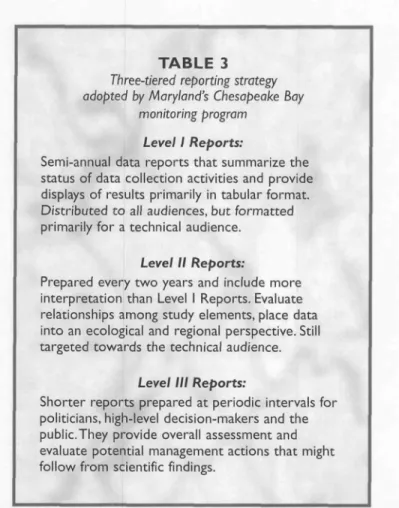
A successful data dissemination strategy needs to distribute information to multiple audiences at several technical levels. Maryland's Chesapeake Bay Monitoring Program has successfully addressed this issue (NRC, 1990a) by adopting a three tiered reporting strategy (Table 3) which recognizes that scientists want early access to data in whatever form they are available, while managers typically need a greater degree of syn- thesis. One challenge is getting scientists to recognize the importance of preparing synthesized reports for managers. The reward system for scientists typically places greater emphasis on technical reports that are amenable to publication in scientific journals. While journal publication is an important part of the process, the stakeholders who pay for monitoring programs are rarely interested in scientific data presented in journal format. Rather, they are interested in data integration that yields a forecast of the future or an assessment of present or past conditions in a manner that can be easi- ly translated for the public to understand. For example, the National Weather Service produces many fine scien- tific reports, but their continued funding depends more on success in working with local media to effectively transmit weather predictions to a larger audience.
Coastal GOOS may have a similar opportunity with beach and boating forecasts.
Much as there is a need for interaction between scientists and managers during initial program plan- ning, there is also a need to establish a feedback loop after reports are prepared to ensure that project data are integrated into the decision-making process (Christensen et al., 1996). Periodic meetings help the scientists understand the decisions their data can poten- tially affect, and help the managers become more famil- iar with the content of reports that they are often too busy to read closely. NRC (1995b) noted that these types of interactions happen too infrequently because there are few forums within which they can occur. One excep- tion is the Chesapeake Bay Program (mimicked by various National Estuary Programs), which has estab-
T A B L E 3
Three-tiered reporting strategy adopted by Maryland's Chesapeake Bay
monitoring program Level I Report~"
Semi-annual data reports that summarize the status of data collection activities and provide displays of results primarily in tabular format.
Distributed to all audiences, but formatted primarily for a technical audience.
Level II Reports:
Prepared every two years and include more interpretation than Level I Reports. Evaluate relationships among study elements, place data into an ecological and regional perspective. Still targeted towards the technical audience.
Level III Reports:
Shorter reports prepared at periodic intervals for politicians, high-level decision-makers and the public.They provide overall assessment and evaluate potential management actions that might follow from scientific findings.
lished clear relationships between management committees, public advisory committees and scientific advisory committees to ensure scientific input on substantial management decisions. Some U.S. federal agencies, notably NSF and NASA have instituted personnel exchange programs, in which academic scientists are temporarily assigned to management offices. EPA has a similar program in which scientists from EPAis Research and Development Laboratory are assigned to each of EPAis ten regional management offices on rotating two-year assignments. These programs are the exception, and because forums for sci- entist/manager interactions are so few, it is incumbent on individual programs to create new mechanisms.
Management familiarity with data products is proba- bly even more important for GOOS than it is for most existing coastal programs. Most existing coastal moni- toring programs are based on retrospective analysis.
GOOS is offering to change this paradigm by focusing on prospective analysis and data products that can be produced in near real-time. Many management deci- sions are politically driven and occur on short time scales (days/weeks/months) relative to those over which environmental science products have traditional- ly been generated (years/decades). As environmental science begins to rely more on remote sensors and real time telemetry, management and science time scales will converge, potentially allowing more effective use of science in the formulation and implementation of envi-
ronmental policies. Achieving this potential requires a more thorough understanding of the available data streams than most managers presently have.
T h e m e #6: Provide for periodic program r e v i e w and f l e x i b i l i t y i n
program d e s i g n
One presumption in a long-term program is that technology will change, providing opportunities for collecting new data types or collecting existing data more efficiently. Another presumption is that users will become more sophisticated, and their needs will change as they become accustomed to the data streams that are produced. Many successful programs incorporate periodic program review to assess how the program should change in response to these new collection opportunities and needs.
Periodic review also presents opportunity for enhancing academic involvement. The National Research Council's Ocean Studies Board (NRC, 1992) noted that many governmental ocean-related activities are coordinated poorly with academic scientists and recommended that stronger links be established, with permanent mechanisms for ensuring outside scientific advice, review, and interaction. Many new technologies are developed by academic researchers as part of small or short-term research projects. Academia and federal agencies must work together to ensure that appropriate long-term measurements are extended beyond the work of short-term research projects. While academic involvement is important, the review process should also involve data users. Reviews need to focus on whether program objectives are being met, or whether the initial objectives are still appropriate, which must largely be addressed by the intended users of the data.
Periodic program review is advisable, but long-term programs should only be modified when a compelling case can be made for an improved program. Long-term consistent data sets are rare in this country, particularly in the near coastal environment, and short term gains in
2500 7
i ,,ool
2000looo I
c
Figure 1. Contract funds (in current year dollars) expended by NOAA Status and Trends Mussel Watch Project since 1986. Trend line does not include the cost of agency personnel.
58 Oceanography • VoL 13 • No. 1/2000
T A B L E 4
Federal agencies with responsibility for collecting ocean data
• Depart of Commerce
• Department of the Navy
• Department of the Interior
• Department of Transportation
• Department of Energy
• National Science Foundation
• NationalAeronautics and Space Administration
• Environmental Protection Agency
data quality may not be worth the disruption in conti- nuity of the long-term record. Program reviewers should be instructed to consider these potentially com- peting interests in preparing their recommendations.
T h e m e #7: E s t a b l i s h a stable f u n d i n g b a s e and m a n a g e m e n t infrastructure Numerous federal programs have had the goal of deter- mining long-term trends in quality of the coastal envi- ronment, but most have had difficulty in developing or maintaining a stable funding base. One example is EPA's Environmental Monitoring and Assessment Program, which had as one of its original goals to devel- op an infrastructure for annual estuarine/marine monitoring throughout the country. Instead, the program has been reduced to a series of short-term regional assessment efforts. Similarly, NOAA's Status and Trends Program maintains national monitoring of chemical contamination and conducts regional surveys of sediment toxicity, but no longer monitors responses to chemical contamination among indigenous marine organisms. This program now has less than one-fourth of the funds allocated to it at its peak (Figure 1). Both the NOAA and EPA efforts were intended as long-term assessment programs, but were curtailed from their original objectives within five years of their initiation.
Much of the difficulty in developing and maintaining these federal programs, or in creating long-term remote sensing system programs, has been a failure to develop national consensus requiring the data and a failure to develop a management infrastructure to support it. One factor contributing to the lack of infrastructure support is the fragmentation of stakeholders in maritime trans- portation, recreational use of the nation's waterways, and stewardship of the environment. At least eight federal agencies (Table 4) have responsibilities for collecting ocean data. Agency budget requests and programs are reviewed and approved by 47 different Congressional Committees and Subcommittees (Table
T A B L E 5
Congressional committees and subcommittees that review and approve federal agency
budget requests for marine programs
H O U S E OF R E P R E S E N T A T I V E S Appropriations
Commerce, Justice, State, and Judicial Defense
Energy and Water Development Interior
Transportation
Veterans Affairs, HUD and Independent Agencies Armed Services
Military Research & Development Commerce
Energy and Power Health and Environment Oversight and investigations Government Reform
National Economic Growth, Natural Resources
& Regulatory Affairs
Oversight, Investigations, and Emergency Management Water Resources and Environment
Resources
Energy and Mineral Resources
Fisheries Conservation,Wildlife and Oceans Water and Power
Science
Basic Research
Energy and Environment Space and Aeronautics Technology
Select Intelligence
Technical and Tactical Intelligence Transportation and Infrastructure
Coast Guard and Maritime Transportation
Economic Development, Public Buildings, Hazardous Materials and Pipeline
Ways and Means
S E N A T E Appropriations
Commerce, Justice, State, and Judiciary Defense
Energy and Water Development Interior
Transportation
Veterans Affairs, HUD and IndependentAgencies Armed Services
Commerce, Science, and Transportation
Consumer Affairs, Foreign Commerce and Tourism Oceans and Fisheries
Energy and Natural Resources Environment and Public Works Science, Technology and Space
Surface Transportation and Merchant Marine
5), a process that creates difficulties in coordination and in uniformity of proposals. Different Congressional Committees have varying funding criteria, priorities and resources. Some funding requests may be reduced, substantially revised, or disappear entirely during the complicated annual legislative approval process.
Fragmentation in the federal management structure leads to inconsistent messages to the congressional clients who require consensus to allocate the large bud- gets necessary to maintain national programs.
An effective governance structure is required to over- come this fragmentation since no single organization has the responsibility to oversee the diversity of marine activities envisioned by GOOS (NRC, 1998). In its proposed national framework for integrating the nation's environmental monitoring and research programs, the National Science and Technology Council recommended a national interagency coordi- nating body for implementation (NSTC, 1997). The
T A B L I : 6
Cost (in thousands of dollars) of monitoring programs in southern California coastal waters
in 1987 (Source: NRC, 1990b).
NPDES Dischargers
Wastewater treatment plants 6,104
Electrical 8,085
Industrial Not Quantified
California Dept. of Fish and Game 2,585
CalCOFI 540
County Health Departments 310
Pacific Marine Fisheries 250
NOAA Status and Trends 175
$18,049
National Oceanographic Partnership Program (NOPP) is a small-scale example intended to address this need.
NOPP is a partnership among 12 federal agencies to share ocean science resources and focus national oceanographic research. Agency funds are earmarked as "NOPP funds" and pooled. Federal agencies and academic institutions compete for the funds with fund- ing decisions made jointly by an interagency group.
NOPP, however, is not presently set up to sponsor long- term activities, such as those required for an ocean observing system.
The programs that have been most successful in developing a stable funding base have been those with extensive local partnership. One way to achieve this is to leverage compliance monitoring programs, which can be substantial. For example, more than 75% of coastal shelf monitoring in southern California is com- pliance based (NRC, 1990b) (Table 6). While the goals of
compliance monitoring can differ in many ways from those of the federal programs, almost all compliance monitoring involves some component for establishing trends in background reference conditions. Some of the best long-term data records in this country, such as those for Hudson River fisheries (Barnthouse et al., 1988) and California continental shelf benthos (Zmarzly et al., 1994; Stull, 1995), have resulted from compliance- based programs. Compliance programs are also increas- ingly being redirected towards cooperative regional assessments. For instance, funding for the Chesapeake Bay Benthic Monitoring Program in Maryland is derived from integration of the federal Bay-wide program with a state program to monitor the effects of p o w e r plants. Another example is the Southern California Bight 1998 Regional Monitoring Program, in which 62 organizations pooled their effort to achieve a
$7M regional assessment of fish, sediment and water quality, funded almost entirely through redirection of local compliance monitoring (Hashimoto and Weisberg, 1998). One noteworthy part of the program was that it included a regional shoreline microbiology assessment (Noble et al., 199-9); beach quality assessment is one log- ical product of Coastal GOOS that will likely require local partnership since shoreline microbiological moni- toring is presently conducted primarily at the county level with almost no federal participation (Schiff et al., 1999).
Partnerships with state and local programs provide more than co-funding partners, they also provide the opportunity for developing a client base. Many federal programs have failed to establish funding because they donit have a network of data users who clamor for the information provided by the program. The open ocean component of GOOS has been more successful in their start-up activities in part because they have identified users among the general population for the meteoro- logical data; one clientele for the coastal component is the local environmental managers. Partnerships developed at the state and local level during program implementation will enhance their access to, and use of, the data produced.
REFERENCES
Andersen, N.R., 1997: An early warning system for the health of the oceans. Oceanography, 10, 14-23.
Barnthouse, L.W., R.J. Klauda, D.S. Vaughan and R.L.
Kendall (eds), 1988: Science, Law and Hudson River Power Plants: A case study in environmental impact assessment. American Fisheries Society Monograph 4. Bethesda, MD. 347 pp.
Chelton, D.B., P.A. Bernal and J.A. McGowan, 1982:
Large-scale interannual physical and biological interaction in the California Current. J. Mar. Res., 40, 1095-1125.
Christensen, N.L., A.M. Bartuska, J.H. Brown, S.
Carpenter, C. D'Antonio, R. Francis, J.E Franklin, J.A.
60 Oceanography • Vol. 13 • No. 1/2000
MacMahon, R.F., Noss, D.J. Parsons, C.H. Peterson, M.G. Turner and R.G. Woodmansbee, 1996: The report of the Ecological Society of America Committee on the Scientific Basis for Ecosystem Management. Ecol. Appl., 6, 665-691.
Hashimoto, J. and S.B. Weisberg, 1998: Coordinating site-specific NPDES monitoring to achieve regional monitoring in southern California. pp 41-48 in Monitoring: Critical Foundations to Protect Our Waters, Proceedings of the National Water Quality Monitoring Council Conference, Reno NV. Environmental Protection Agency, Washington, DC.
Hayward, T.L., 1997: Pacific ocean climate change:
atmospheric forcing, ocean circulation and ecosystem response. Trends in Ecology and Evolution 12, 150-154.
Intergovernmental Oceanographic Commission (I OC).
1998. Strategic Plan and Principles for the Global Ocean Observing System (GOOS), Version 1.0. GOOS Report No. 41, IOC/INF-1091.17 pp.
Malone, T.C. and D.A. Nemazie, 1996: Toward a nation- al agenda for research in the coastal zone: Where are we? Biol. Bull. 190, 245-251.
McGowan, J.A., D.R. Cayan and L.M. Dorman, 1998:
Climate-ocean variability and ecosystem response in the northeast pacific. Science, 281, 21.
National Research Council, 1990a: Managing Troubled Waters, The Role of Marine Environmental Monitoring.
National Academy Press, Washington, D.C. 125 pp.
National Research Council, 1990b: Monitoring Southern California% Coastal Waters. National Academy Press, Washington, D.C. 154 pp.
National Research Council, 1992: Oceanography in the Next Decade. National Academy Press. Washington, D.C. 202 pp.
National Research Council, 1995a: Review of EPA's Environmental Monitoring and Assessment Program:
Overall Evaluation. National Academy Press.
Washington, D.C. 178 pp.
National Research Council, 1995b: Science, Policy And
The Coast: hnproving Decisionmaking. National Academy Press. Washington, D.C. 85 pp.
National Research Council, 1998: The Meteorological Buoy and Coastal Marine Automated Network for the United States. National Academy Press, Washington, D.C. 97 pp.
National Science and Technology Council (NSTC), 1997:
Integrating the Nation's Environmental Monitoring and Research Networks and Programs: A Proposed Framework.
102 pp.
Noble, R.T., J.H. Dorsey, M. Leecaster, V. Orozco- Borbon, D. Reid, K. Schiff and S. B. Weisberg, 1999: A regional survey of the microbiological water quality along the shoreline of the Southern California Bight.
Environ. Monit. Assess. In Press.
Polovina J.J., G.T. Mitchum and G.T. Evans, 1995:
Decadal and basin-scale variation in mixed layer depth and the impact on biological production in the central and north Pacific, 1960-88. Deep-Sea Research 42, 1701-1716.
Schiff, K.C., S.B. Weisberg and J.H. Dorsey, 1999:
Microbiological monitoring of marine recreational waters in southern California. Environ. Manag., In press.
Stull, J., 1995: Two decades of biological monitoring, Palos Verdes, California, 1972 to 1992. Bull. Southern Calif. Acad. ScL, 94, 21-45.
Sustainable Biosphere Initiative, 1996: Ecological Resource Monitoring: Change and Trend Detection.
Recommendations from a workshop held May 1-3, 1996 in Laurel, Maryland. Ecological Society of America, Washington, DC.
Zmarzly, D.L., T.D. Stebbins, D. Pasko, R.M. Duggan and K.L. Barwick, 1994: Spatial patterns and tempo- ral succession in soft-bottom macroinvertebrate assemblages surrounding an ocean outfall on the southern San Diego shelf: Relation to anthropogenic and natural events. Mar. Biol., 118, 293-307.