Introduction
Vitex rotundifolia L. fil. (Verbenaceae) com- monly grows on sandy seashores in China, Southeastern Asia, Polynesia, Australia and Japan. However, it exceptionally inhibits the sandy lakeshore in inland fresh water lake, Lake Biwa, Central Japan. This lake is an ancient lake which was formed about four million years ago (Kawabe, 1989). In addition to V. rotundifolia, common seashore plant species, e.g. Arabis
kawasakiana Makino (Brassicaceae), Calystegia soldanella (L.) Roem. et Schult. (Convolvu- laceae), Dianthus japonicus Thunb. (Caryophyl- laceae), Lathyrus japonicus Willd. (Legumi- nosae) and Raphanus sativus L. var.
raphanistroides Makino (Brassicaceae), inhibit in the lake side. It is presumed that their species have migrated to the inland lake from coastal populations during the period when Lake Biwa had been adjacent to the seashore, and lake popu- lations might have later become isolated from the
Flavonoids from the Leaves of Vitex rotundifolia (Verbenaceae), and their Qualitative and Quantitative Comparison
between Coastal and Inland Populations
Tsukasa Iwashina
1,*, Hiroaki Setoguchi
2and Junichi Kitajima
31
Department of Botany, National Museum of Nature and Science, Amakubo 4–1–1, Tsukuba, Ibaraki, 305–0005 Japan
2
Graduate School of Human and Environmental Studies, Kyoto University, Yoshida Nihonmatsu-cho, Sakyo-ku, Kyoto, 606–8501 Japan
3
Showa Pharmaceutical University,
Higashi-tamagawagakuen 3, Machida, Tokyo, 194–8543 Japan
* E-mail: [email protected] (Received 20 February 2011; accepted 23 March 2011)
Abstracts The flavonoid compounds in the leaves of Vitex rotundifolia growing in coast and Lake Biwa were surveyed. Six flavonoids were isolated and five of them were identified as isoori- entin (1), luteolin 7-O-glucuronide (2), luteolin 7-O-glucoside (3), luteolin 3 -O-glucuronide (5) and isovitexin (6). Another one (4) was characterized as luteolin diglucoside. Nine populations of V. rotundifolia from coastal populations, i.e. each three Ise Bay in Pacific Ocean side and Wakasa Bay in Sea of Japan side, and inland populations, i.e. Lake Biwa, were qualitatively and quantita- tively compared by HPLC for flavonoids. It is known that the flavonoids in plants act as anti-stress products against UV radiation, salinity and so on. The seashore is a harsh environment for plants to inhabit due to their various stresses. Salinity and UV radiation are two of the major stresses in the coastal region, where limited plant species tolerable to those stresses become dominant. However, the flavonoids in the leaves of inland and coastal V. rotundifolia were qualitatively and quantitative- ly the almost same from each other. In general, it is shown that anti-stress activities of catechol type flavonoids such as luteolin and quercetin are stronger than those of B-ring monohydroxylated flavonoids such as apigenin and kaempferol. Since 96.4–97.1% of total flavonoids of V. rotundifolia is luteolin type, V. rotundifolia can originally synthesize a much amount of luteolin glycosides, so that we presumed that the species could adapt in coastal environment.
Key words : anti-stress activities, coastal populations, flavonoids, inland populations, luteolin,
Vitex rotundifolia.
coastal populations (Takaya, 1963; Kitamura, 1968). Commonly, the seashore plants may be exposed the various stresses, e.g. UV radiation, salinity etc. than inland plants of the same species. Coastal plants protect themselves from their stresses by various manners. In their plants, chemical compounds such as flavonoids act as stress scavengers. In this paper, we describe the isolation and identification of the flavonoids in the leaves of Vitex rotundifolia, and qualitatively and quantitatively compare the flavonoids in coastal and inland populations.
Materials and Methods
Plant materials
Each ten individuals were collected from nine populations, i.e. 1) Sakajiri-kaigan, 2) Takanosu- hama and 3) Sanri-hama in Sea of Japan side; 4) Maiami-hama, 5) Sanami-hama and 6) Shinkai- hama in Lake Biwa; and 7) Utsue, 8) Nishino- hama and 9) Koijiga-hama in Pacific Ocean side.
Voucher specimens were deposited in the herbar- ium of National Museum of Nature and Science, Japan (TNS).
Extraction and isolation of flavonoids
Fresh leaves (1272 g) were extracted with MeOH for isolation. After concentration, crude extracts were applied to preparative paper chro- matography using solvent systems: BAW (n- BuOH/HOAc/H
2O 4 : 1 : 5, upper phase), 15%
HOAc and then BEW (n-BuOH/EtOH/H
2O 4 : 1 : 2.2). The isolated flavonoids were finally purified by Sephadex LH-20 column chromatog- raphy using solvent system: 70% MeOH. Of six flavonoids (1–6) detected in this experiment, 1 (ca. 270 mg), 2 (ca. 10 mg), 3 (ca. 20 mg) and 5 (ca. 70 mg) were obtained as pale yellow powder.
Fresh leaves (5 g) of each sample were extract- ed with MeOH (40 ml) for quantitative HPLC survey.
High performance liquid chromatography (HPLC)
HPLC was performed with Shimadzu HPLC
systems using Senshu Pak PEGASIL ODS col- umn (I.D. 6.0 150 mm, Senshu Scientific Co.
Ltd.) at a flow-rate of 1.0 ml min
1. Detection was 350 nm and eluent was MeCN/H
2O/H
3PO
4(20 : 80 : 0.2).
Liquid chromatograph-mass spectra (LC-MS) LC-MS was performed with Shimadzu LC- MS systems using Senshu Pak PEGASIL ODS column (I.D. 2.0 150 mm, Senshu Scientific Co.
Ltd.) at a flow-rate of 0.1 ml min
1, ESI
4.5 kV and ESI
3.5 kV, 250°C. The eluent was MeCN/H
2O/HCOOH 18 : 77 : 5).
Acid hydrolysis
Acid hydrolysis was performed in 12% HCl, 100°C, 30 min. After shaking with diethyl ether, aglycones migrated to organic layers, and glyco- sidic sugars and C-glycosylflavones were left in aqueous layers.
Identification of flavonoids
Flavonoids were identified by UV spectral sur- vey according to Mabry et al. (1970), acid hydrolysis and characterization of its products, LC-MS,
1H and
13C NMR, and direct TLC and HPLC comparisons with authentic samples.
TLC, HPLC, LC-MS, and
1H and
13C NMR data of the isolated flavonoids are as follows.
Isoorientin (Luteolin 6-C-glucoside, 1). TLC:
Rf 0.49 (BAW), 0.57 (BEW), 0.28 (15%HOAc);
Color UV – dark purple, UV/NH
3– yellow.
HPLC: tR (min) 5.67. UV: lmax (nm) MeOH 257, 271, 350; NaOMe 272, 327sh, 412 (inc.);
AlCl
3276, 425; AlCl
3/HCl 263sh, 277, 296sh, 360, 383sh; NaOAc 272, 327sh, 402;
NaOAc/H
3BO
3266, 379. LC-MS: m/z 449 [M H]
, 447 [M H]
(luteolin 1 mol glu- cose).
Luteolin 7-O-glucuronide (2). TLC: Rf 0.36 (BAW), 0.38 (BEW), 0.10 (15%HOAc); Color UV – dark purple, UV/NH
3– dark yellow. HPLC:
tR (min) 9.40. UV: lmax (nm) MeOH 255, 265sh, 349; NaOMe 266, 390 (inc.); AlCl
3274, 426; AlCl
3/HCl 264sh, 273, 294sh, 360, 385; NaOAc 260, 403; NaOAc/H
3BO
3260,
88 Tsukasa Iwashina et al.
372. LC-MS: m/z 463 [M H]
(luteolin 1 mol glucuronic acid).
1H NMR (600 MHz, pyridine- d
5): d 7.82 (1H, d, J 2.3 Hz, H-2 ), 7.51 (1H, dd, J 1.5 and 8.3 Hz, H-6 ), 7.26 (1H, d, J 8.3 Hz, H-5 ), 7.04 (1H, d, J 1.7 Hz, H-8), 6.82 (1H, s, H-3), 6.77 (1H, d, J 2.1 Hz, H-6), 5.73 (1H, d, J 7.2 Hz, glucuronyl H-1), 4.54 (1H, t, J 8.4 Hz, glucuronyl H-5), 4.32 (2H, t, J 8.8 Hz, glucuronyl H-3, H-4), 4.24 (1H, m, glu- curonyl H-2).
13C NMR (150 MHz, pyridine-d
5):
(luteolin) d 165.6 (C-2), 104.0 (C-3), 183.1 (C- 4), 162.1 (C-5), 100.9 (C-6), 164.2 (C-7), 95.6 (C-8), 158.1 (C-9), 104.0 (C-10), 122.8 (C-1 ), 114.5 (C-2 ), 147.5 (C-3 ), 151.6 (C-4 ), 116.9 (C-5 ), 120.0 (C-6 ); (glucuronic acid) d 101.8 (C-1), 74.5 (C-2), 77.8 (C-3), 73.5 (C-4), 76.5 (C-5), 174.7 (C-6).
Luteolin 7-O-glucoside (3). TLC: Rf 0.44 (BAW), 0.51 (BEW), 0.08 (15%HOAc); Color UV – dark purple, UV/NH
3– dark yellow. HPLC:
tR (min) 8.96. UV: lmax (nm) MeOH 255, 266sh, 348; NaOMe 267, 391 (inc.); AlCl
3273, 426; AlCl
3/HCl 263sh, 273, 295sh, 358, 381; NaOAc 260, 402; NaOAc/H
3BO
3260, 372. LC-MS: m/z 449 [M H]
(luteolin 1 mol glucose).
1H NMR (600 MHz, pyridine-d
5): d 7.76 (1H, d, J 2.2 Hz, H-2 ), 7.54 (1H, dd, J 2.2 and 8.3 Hz, H-6 ), 7.24 (1H, d, J 8.3 Hz, H-5 ), 6.94 (1H, d, J 2.1 Hz, H-8), 6.80 (1H, s, H-3), 6.73 (1H, d, J 2.2 Hz, H-6), 5.60 (1H, d, J 7.2 Hz, glucosyl H-1), 4.40 (1H, d, J 12.8 Hz, glucosyl H-6a), 4.19 (2H, m, glucosyl H-3, H-6b), 4.12 (1H, t, J 16.6 Hz, glucosyl H-2), 4.06 (2H, m, glucosyl H-4, H-5).
13C NMR (150
Fig. 1. Chemical structures of the flavonoids obtained from the leaves of Vitex rotundifolia.
MHz, pyridine-d
5): (luteolin) d 165.7 (C-2), 104.1 (C-3), 183.2 (C-4), 162.4 (C-5), 100.7 (C- 6), 164.2 (C-7), 95.6 (C-8), 158.1 (C-9), 106.7 (C-10), 122.8 (C-1 ), 114.5 (C-2 ), 147.5 (C-3 ), 151.7 (C-4 ), 116.9 (C-5 ), 120.0 (C-6 ); (glu- cose) d 101.6 (C-1), 74.7 (C-2), 78.1 (C-3), 71.2 (C-4), 78.9 (C-5), 62.3 (C-6).
Luteolin diglucoside (4). HPLC: tR (min) 15.73. LC-MS: m/z 611 [M H]
, m/z 609 [M H]
(luteolin 2 mol glucose).
Luteolin 3 -O-glucuronide (5). TLC: Rf 0.51 (BAW), 0.50 (BEW), 0.08 (15%HOAc); Color UV – dark purple, UV/NH
3– dark greenish yel- low. HPLC: tR (min) 19.78. UV: lmax (nm) MeOH 269, 338; NaOMe 276, 329, 393 (inc.);
AlCl
3256, 278, 296, 348, 380sh; AlCl
3/HCl 248sh, 279, 293, 346, 380sh; NaOAc 255sh, 275, 333, 393; NaOAc/H
3BO
3269, 347. LC- MS: m/z 463 [M H]
, 461 [M H]
(luteolin 1 mol glucuronic acid).
1H NMR (600 MHz, pyridine-d
5): d 8.46 (1H, d, J 2.1 Hz, H-2 ), 7.66 (1H, dd, J 2.2 and 8.5 Hz, H-6 ), 7.24 (1H, d, J 8.5 Hz, H-5 ), 6.95 (1H, d, J 2.0 Hz, H-8), 6.92 (1H, s, H-3), 6.61 (1H, d, J 2.0 Hz, H-6), 5.42 (1H, d, J 7.3 Hz, glucuronyl H-1), 4.38 (1H, d, J 9.3 Hz, glucuronyl H-5), 4.21–
4.29 (3H, m, glucuronyl H-2, H-3, H-4).
13C NMR (150 MHz, pyridine-d
5): (luteolin) d 165.8 (C-2), 104.1 (C-3), 183.1 (C-4), 162.8 (C-5), 100.0 (C-6), 164.3 (C-7), 95.2 (C-8), 158.6 (C- 9), 105.3 (C-10), 123.6 (C-1 ), 117.9 (C-2 ), 147.3 (C-3 ), 153.2 (C-4 ), 118.7 (C-5 ), 123.1 (C-6 ); (glucuronic acid) d 105.6 (C-1), 74.7 (C- 2), 77.7 (C-3), 73.5 (C-4), 76.6 (C-5), 175.3 (C- 6).
Isovitexin (Apigenin 6-C-glucoside, 6). TLC:
Rf 0.71 (BAW), 0.75 (BEW), 0.40 (15%HOAc);
Color UV – dark purple, UV/NH
3– dark greenish yellow. HPLC: tR (min) 8.34. UV: l max (nm) MeOH 272, 333; NaOMe 277, 332, 396 (inc.);
AlCl
3265sh, 276, 303, 351, 377sh;
AlCl
3/HCl 257sh, 280, 302, 340, 377sh;
NaOAc 278, 310, 338, 391; NaOAc/H
3BO
3272, 348. LC-MS: m/z 433 [M H]
, 431 [M H]
(apigenin 1 mol glucose).
Results and Discussion
Identification of flavonoids
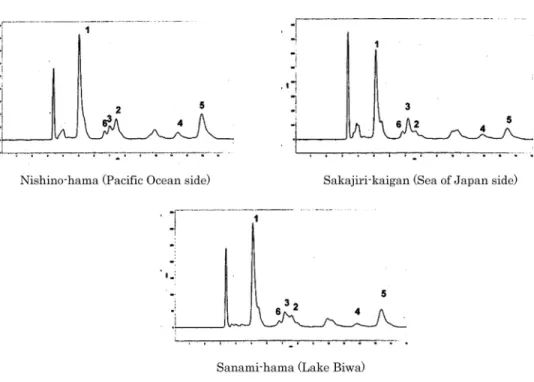
Six flavonoid peaks appeared on HPLC, and five compounds were completely identified except for 4. UV spectral properties of major flavonoid 1 were those of typical luteolin (5,7,3 ,4 -tetrahydroxyflavone). However, it could not be hydrolyzed by hot acid treatment, showing that the compound is C-glycosylflavone.
It was indicated by LC-MS that 1 mol hexose is attached to luteolin. Finally, flavonoid 1 was identified as isoorientin by direct TLC and HPLC comparison with authentic sample from the leaves of Japonolirion osense Nakai (Petrosavi- aceae) (Iwashina et al., 2005). Though isoori- entin has been isolated from a few Vitex species, e.g. V. megapotamica (Spreng.) Moldenke and V.
agnus-castus L. (Hänsel et al., 1965), it was found from V. rotundifolia for the first time.
Flavonoid 2 liberated luteolin and glucuronic acid by acid hydrolysis. The attachment of the sugar to 7-position of luteolin was proved by UV spectral survey, i.e. no shift of Band II in addition to NaOAc. Molecular ion peak, m/z 463 [M H]
appeared on LC-MS, showing the attachment of 1 mol glucuronic acid to luteolin. Attachment of glucuronic acid to 7-position of luteolin was con- firmed from the HMBC correlation between glu- curonyl anomeric proton at d 5.73 and C-7 car- bon signal at d 164.2. Finally, flavonoid 2 was identified as luteolin 7-O-b -glucuronopyranoside by TLC and HPLC comparison with authentic sample from the leaves of Myoporum bontioides (Sieb. et Zucc.) A. Gray (Myoporaceae) (Iwashina and Kokubugata, 2010). Luteolin 7-O- glucuronide was newly reported from Vitex species.
UV spectral properties of flavonoid 3 were es- sentially the same with those of 2, showing that the compound is 7-O-glycosylated luteolin. Prac- tically, luteolin was liberated by acid hydrolysis, together with glucose. The attachment of 1 mol glucose to luteolin was proved by LC-MS survey, i.e. appearance of a molecular ion peak, m/z 449 [M H]
. Moreover, its chemical structure was
90 Tsukasa Iwashina et al.
also determined by
1H and
13C NMR. Finally, flavonoid 3 was estimated as luteolin 7-O-b -glu- copyranoside by TLC and HPLC comparison with authentic sample from the leaves of Schmal- hausenia nidulans Petrak (Asteraceae) (Iwashina and Kadota, 1999). Though luteolin 7-O-gluco- side is widely distributed in plant kingdom and has been reported from a few Vitex species (Hänsel et al., 1965), it was isolated from V.
rotundifolia for the first time.
Luteolin and glucuronic acid were produced by acid hydrolysis of 5. However, its UV spectral properties, especially in addition to AlCl
3, were similar to those of apigenin, showing the pres- ence of monohydroxyl or substituted dihydroxyl group in B-ring. Attachment of 1 mol glucuronic acid to luteolin was shown by the occurrence of a molecular ion peaks, m/z 463 [M H]
and 461 [M H]
on LC-MS. In
1H NMR, six aromatic protons corresponding to H-3, H-6, H-8, H-2 , H-5 and H-6 , and an anomeric proton (d 5.42, d, J 7.3 Hz) appeared. The attachment of glu- curonic acid to 3 -position of luteolin was deter- mined from the HMBC correlation between glu-
curonyl anomeric proton at d 5.42 and C-3 car- bon signal at d 147.3. Thus, flavonoid 5 was identified as luteolin 3 -O-b -glucuronopyra- noside. Luteolin 3 -O-glucuronide was compara- tively rare glycoside in nature and has been re- ported from a few plant species, e.g. Lunularia cruciata (L.) Dumort. ex Lindb. (Lunulariaceae, liverwort) (Markham and Porter, 1974) and Melissa officinalis L. (Lamiaceae) (Heitz et al., 2000). However, it has not been found from Vitex species.
It was shown by UV spectral properties and hot acid treatment that flavonoid 6 is C-glyco- sylflavone of apigenin type. Its TLC and HPLC behaviors completely agreed with those of au- thentic isovitexin from the flowers of Iris ensata Thumb. (Iwashina et al., 1996). Thus, flavonoid 6 was identified as isovitexin (apigenin 6-C-gluco- side). Isovitexin is common in plants and has been reported from Vitex species such as V.
lucens T. Kirk. (Horowitz and Gentili, 1964).
Flavonoid 4 was presumed as luteolin digluco- side by HPLC and LC-MS.
Fig. 2. HPLC patterns of the flavonoids from the leaves of Vitex rotundifolia.
Qualitative and quantitative comparisons of flavonoids between coastal and inland Vitex rotundifolia
The genus Vitex consists of ca. 250–1,000 species and some ones have been surveyed for flavonoids (e.g. Hänsel et al., 1965; Horowitz and Gentili, 1966; Banerji et al., 1969; Misra and Subramanian, 1980; Thuy et al., 1998; Cheng et al., 2007; Chen et al., 2008). Various flavones and flavonols and their O-glycosides, flavanone and chalcones have been reported from their species, together with C-glycosylflavones.
Flavonoids have already been isolated from V. ro- tundifolia (Kondo et al., 1986; Yoshioka et al., 2004). Two flavones, luteolin and 5,5 -dihydroxy-
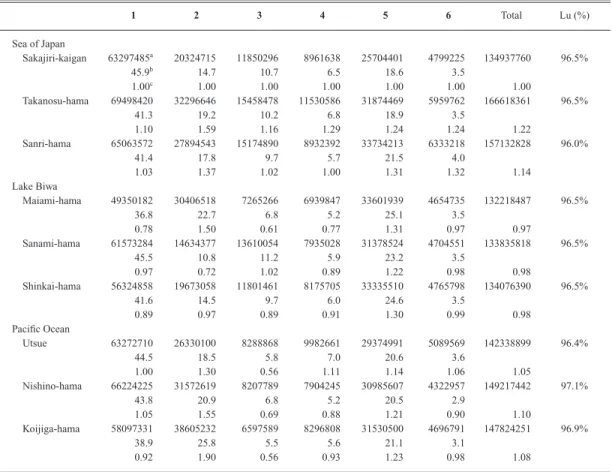
6,7,4 -trimethoxyflavone, and two flavonols, artemetin (5-hydroxy-3,6,7,3 ,4 -pentamethoxy- flavone) and casticin (5,3 -dihydroxy-3,6,7,4 - tetramethoxyflavone) have been found in the fruits and leaves. However, they are all free flavonoids and may be present as external flavonoids. In this survey, six flavone glycosides were isolated from the leaves of V. rotundifolia for the first time. Major flavonoid is isoorientin, i.e. luteolin 6-C-glucoside and 36.8–45.9% of total flavonoids. Though total flavonoid content (0.97–0.98) of Lake Biwa populations slightly decrease than those of Sea of Japan (1.00–1.22) and Pacific Ocean (1.05–1.10), they did not sig- nificantly vary. In general, it is shown that anti-
92 Tsukasa Iwashina et al.
Table 1. Quantitative HPLC analysis of foliar flavonoids from Vitex rotundifolia growing in Lake Biwa, Sea of Japan side and Pacific Ocean side
1 2 3 4 5 6 Total Lu (%)
Sea of Japan
Sakajiri-kaigan 63297485a 20324715 11850296 8961638 25704401 4799225 134937760 96.5%
45.9b 14.7 10.7 6.5 18.6 3.5
1.00c 1.00 1.00 1.00 1.00 1.00 1.00
Takanosu-hama 69498420 32296646 15458478 11530586 31874469 5959762 166618361 96.5%
41.3 19.2 10.2 6.8 18.9 3.5
1.10 1.59 1.16 1.29 1.24 1.24 1.22
Sanri-hama 65063572 27894543 15174890 8932392 33734213 6333218 157132828 96.0%
41.4 17.8 9.7 5.7 21.5 4.0
1.03 1.37 1.02 1.00 1.31 1.32 1.14
Lake Biwa
Maiami-hama 49350182 30406518 7265266 6939847 33601939 4654735 132218487 96.5%
36.8 22.7 6.8 5.2 25.1 3.5
0.78 1.50 0.61 0.77 1.31 0.97 0.97
Sanami-hama 61573284 14634377 13610054 7935028 31378524 4704551 133835818 96.5%
45.5 10.8 11.2 5.9 23.2 3.5
0.97 0.72 1.02 0.89 1.22 0.98 0.98
Shinkai-hama 56324858 19673058 11801461 8175705 33335510 4765798 134076390 96.5%
41.6 14.5 9.7 6.0 24.6 3.5
0.89 0.97 0.89 0.91 1.30 0.99 0.98
Pacific Ocean
Utsue 63272710 26330100 8288868 9982661 29374991 5089569 142338899 96.4%
44.5 18.5 5.8 7.0 20.6 3.6
1.00 1.30 0.56 1.11 1.14 1.06 1.05
Nishino-hama 66224225 31572619 8207789 7904245 30985607 4322957 149217442 97.1%
43.8 20.9 6.8 5.2 20.5 2.9
1.05 1.55 0.69 0.88 1.21 0.90 1.10
Koijiga-hama 58097331 38605232 6597589 8296808 31530500 4696791 147824251 96.9%
38.9 25.8 5.5 5.6 21.1 3.1
0.92 1.90 0.56 0.93 1.23 0.98 1.08
Each fresh leaves (5 g) was extracted with MeOH (40 ml).
a