Introduction
Vitex rotundifoliaL.fil. (Verbenaceae) is a de- ciduous creeping tree, which grows on sandy seashores in the temperate-tropic zone including Japan. The seed is covered with spongy pericarp and its dispersal is accomplished by seawater for long distance. V. rotundifoliainhabits frontline of coastal vegetation and never grows in inland, implying this plant grows under salinity stress by airborne salt and higher osmotic pressure of soil.
Tolerance to airborne saltwater is critical to the survival of the coastal populations; in coastal plant communities, the distribution of species can sometimes be determined according to their tolerance to airborne saltwater (Oosting and Billings, 1942; Oosting, 1945; Boyce, 1954; Bar- bour, 1978; Barbour et al., 1985; Rozema et al., 1985; Sykes and Wilson, 1988; Hesp, 1991;
Maun, 1994; Greipsson and Davy, 1996; Wilson
and Sykes, 1999). However, in Japan, this plant also inhabits the sandy lakeshore in Lake Biwa, a freshwater lake located in central Japan.
Lake Biwa is an ancient lake that was formed about four million years ago (Yokoyama, 1984;
Kawabe, 1989, 1994; Meyers et al., 1993), and harbors many other coastal plants that commonly inhabit the seashore, including Calystegia sol- danella(L.) Roem. et Schult. (Convolvulaceae), Lathyrus japonicus Willd. (Leguminosae), Arabis kawasakiana Makino (Cruciferae), Raphanus sativusL. var. raphanistroidesMakino (Cruciferae), Dianthus japonicus Thunb.
(Caryophyllaceae), and Pinus thunbergii Parl.
(Pinaceae) (Kitamura, 1968). These plants are as- sumed to have migrated to the inland lake from coastal populations during the period when Lake Biwa had been adjacent to the seashore, and inland lake populations might have later become isolated from the coastal populations (Takaya,
Leaf Blade Thickness Differentiation between Coastal and Freshwater Populations of the Coastal Plant Vitex rotundifolia (Verbenaceae)
Hiroaki Setoguchi*, Nobuchika Ishibashi, Koichi Fujita, Hisashi Matsubara, Keiko Terada and Haruki Yagi
Graduate School of Human and Environmental Studies, Kyoto University, Yoshida Nihonmatsu-cho, Sakyo-ku, Kyoto, 606–8501 Japan
* E-mail: [email protected] (Received 24 November 2009; accepted 24 March 2010)
Abstract Vitex rotundifolia(Verbenaceae) is one of the coastal plants that commonly grows on sandy seashores, but also occurs at Lake Biwa, a freshwater inland lake. To assess morphological differentiation between coastal and inland individuals with regard to the leaf thickness, we mea- sured nine populations of Vitex rotundifoliafrom Lake Biwa, Ise Bay in Pacific Ocean side and Wakasa Bay in Sea of Japan side. We measured leaf blade thickness and applied one-way analysis of variance (ANOVA) to test the difference. Post-hoc multiple comparison resulted in four major groups recognizing all inland populations from Lake Biwa as a distinct group while affiliation of coastal populations was assigned to other three groups regardless to localities. Inland individuals tended to have thinner leaves, implying intraspecific differentiation due to adaptation to habitat environments.
Key words: coastal plant, geographical variation, isolation, Lake Biwa, leaf thickness, salinity stress, Vitex rotundifolia.
Bull. Natl. Mus. Nat. Sci., Ser. B, 36(2), pp. 39–42, May 22, 2010
1963; Kitamura, 1968).
The landlocked plants at the freshwater lake may have become morphologically differentiated with regard to long-term isolation and/or salt-tol- erance as a result of adaptive evolution to the specific habitat over the long term. In particular, leaf succulence is correlated to exposure to salin- ity stress in coastal plants (Boyce, 1951; Hesp, 1991; Maun, 1994). Noda et al. (2009) assessed physiological differentiation between coastal and inland individuals of Calystegia soldanella with regard to the response to salinity stress, and found that inland individuals decrease leaf blade thickness than those of coastal ones.
Coastal plants which inhabit both in Lake Biwa and coast are appropriate example to deter- mine the allopatric differentiation in morphology in relation with adaptation to habitat environ- ment. In this study, we aimed to examine mor- phological differentiation in leaf blade thickness of coastal plant Vitex rotundifolia between the inland and coastal habitats. We have measured the leaf blade thickness for 183 individuals from nine populations that located in Lake Biwa and seashore, and discussed ecological factors and genetic background that may affect morphology.
Materials and Methods
Vitex rotundifoliais a deciduous tree and de- velops new leaves in early May and blooms in late July in Kinki district, Japan. To assess ma- ture leaves, measurements of V. rotundifoliaindi-
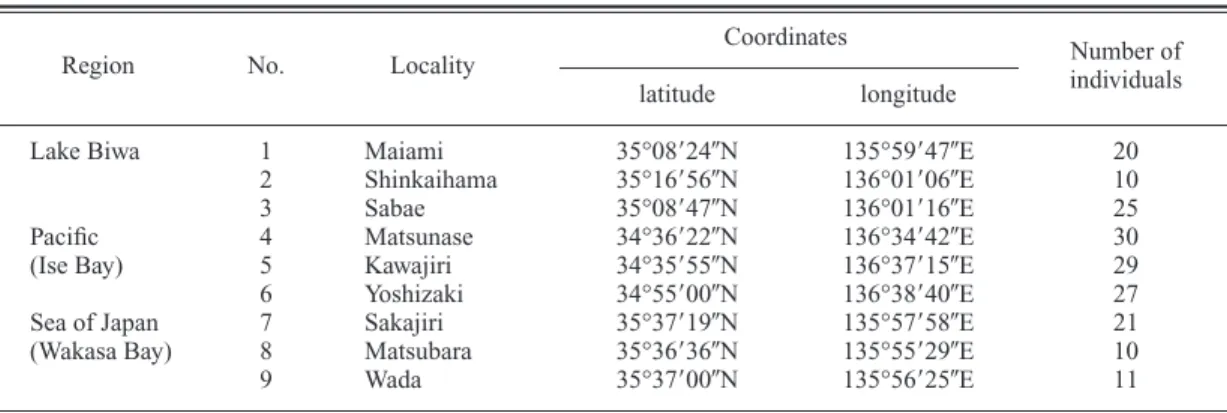
viduals were conducted in late July of 2008 and 2009 in natural habitats in Lake Biwa (three pop- ulations), Pacific Ocean side (Ise Bay, three pop- ulations) and Sea of Japan side (Wakasa Bay, three populations). Localities and their coordina- tion are summarized in Table 1. All voucher specimens were deposited in National Museum of Nature and Science, Japan (TNS). Inland pop- ulations in Lake Biwa have been decreased the number of populations, and only the three popu- lations are remained as small patches. We used electric callipers for measurement of leaf blade thickness. The average thickness of each leaf was estimated based on three measurements from dif- ferent part within a leaf, and then ten fully ma- tured leaves were examined for each individual.
Mean value was calculated for each individual, and data set of the ten individuals from each pop- ulation was subjected to One-way ANOVA to test the difference in the leaf blade thickness among the populations. Post-hoc multiple comparison by Tukey HSD test was used to determine the signif- icant difference between each population. The statistical analyses were performed using SPSS version 10 (SPSS, Chicago).
Results and Discussion
The leaf blade thickness was normally distrib- uted, and values were significantly different among populations (ANOVA, p0.001; Table 2).
Leaf blade thickness varied among populations ranging from 0.3020.002 mm (meanstandard
40 Hiroaki Setoguchi et al.
Table 1. Sampling localities, coordinates and number of individuals for Vitex rotundifolia
Region No. Locality
Coordinates
Number of
latitude longitude individuals
Lake Biwa 1 Maiami 35°0824N 135°5947E 20
2 Shinkaihama 35°1656N 136°0106E 10
3 Sabae 35°0847N 136°0116E 25
Pacific 4 Matsunase 34°3622N 136°3442E 30
(Ise Bay) 5 Kawajiri 34°3555N 136°3715E 29
6 Yoshizaki 34°5500N 136°3840E 27
Sea of Japan 7 Sakajiri 35°3719N 135°5758E 21
(Wakasa Bay) 8 Matsubara 35°3636N 135°5529E 10
9 Wada 35°3700N 135°5625E 11
error; 1. Maiami, Lake Biwa) to 0.3830.007 mm (8. Matsubara, Wakasa Bay) (Fig. 1). The leaf blade thickness suggested a geographical trend, where inland populations from Lake Biwa showed a thinner thickness than seashore popula- tions (Fig. 1, Turkey HSD). Post-hoc multiple comparison resulted in four groups recognizing all inland populations (populations 1–3) as a dis- tinct group while affiliation of seashore popula- tions was assigned to other three groups regard- less to their localities (Ise Bay on the Pacific side or Wakasa Bay on the Sea of Japan side).
Thus, inland individuals inhabited in Lake Biwa populations have significant thinner leaf blade. This result implies the landlocked coastal plants of Vitex rotundifolia in Lake Biwa may have adapted to the habitat environment, i.e., freshwater lakeshore without salinity stress. Leaf succulence in coastal plants is induced by salinity stress (airborne salt loading on the leaves and branches), resulting in salt-induced hypertrophy and the doubling or tripling of leaf thickness (Boyce, 1951). Noda et al. (2009) detected physi- ological differentiation between inland and coastal individuals of Calystegia soldanella in terms of their response to salinity stress. Inland individuals at Lake Biwa showed significant de- crease of photosynthetic ability as a result of salt- water sprayed onto leaf blades, corresponding to stomatal closure, whereas coastal individuals showed an insignificant decrease in the same pa- rameter. Additionally, coastal individuals tended to have thicker leaf blades than those of inland individuals even after freshwater irrigation. Con- versely, inland individuals developed thinner leaf blades than those of coastal ones even after salt- water irrigation and saltwater spray onto leaf
blades. Thus, the inland plants have adapted to freshwater environment in terms of physiological responses to surrounding environment in terms of genetic background. These findings suggest that the same responses to salinity stress would be also expected in Vitex rotundifolia.
Recent molecular phylogeography revealed the heterogeneous genetic structure between the inland and coastal populations, corroborating the long-term isolation of coastal plants at Lake Biwa (Noda et al., unpublished). Vitex rotundifo- lia plants at Lake Biwa may have caused a mor- phological differentiation in leaves in terms of loss of leaf succulence along with loss of salinity tolerance during long-term isolation within inland. Further studies including transplanting
Leaf Thickness Differentiation in Vitex rotundifolia 41 Table 2. Result of one-way analysis of variance (ANOVA) of leaf thickness among populations
Morpholoical Source of
SS dF MS Fvalue pvalue
characteristic variation
Leaf thickness Among groups 0.127 8 0.016 27.762 0.001
Within groups 0.099 174 0.001
Total 0.226 182
SS, Sum of Squares ; dF, degree of Freedom; MS, Mean Squares; F, F-statistics; p, pvalue for the null hypothesis.
Fig. 1. Means and standard errors of dimensions of the leaf thickness in Vitex rotundifolia. Dif- ferent abbreviation above the vertical bar means significant difference in post-hoc Tukey HSD test.
experiments and photosynthetic responses to salinity stress should be examined for under- standing the physiological background.
Acknowledgements
We thank Hajime Ikeda (Kyoto University) for assisting statistic analyses. This study was sup- ported by a Grant-in-Aid from the Japan Society for the Promotion of Science to HS (13575011).
References
Barbour, M. G. 1978. Salt spray as a microenvironmental factor in the distribution of beach plants at Point Reyes, California. Oecologia 32: 213–224.
Barbour, M. G, Jong, T. M. and Pavlik, B. M. 1985.
Marine beach and dune plant communities. In: Chabot, B. F. and Mooney, H. A. (eds.), Physiological Ecology of North American Plant Communities, pp. 296–322.
Chapman & Hall and Methuen, New York.
Boyce, S. G. 1951. Salt hypertrophy in succulent dune plants. Science 114: 544–545.
Boyce, S. G. 1954. The salt spray community. Ecological Monograph 24: 29–67.
Greipsson, S. and Davy, A. J. 1996. Sand accretion and salinity as constraints on the establishment of Leymus arenarius for land reclamation in Iceland. Annals of Botany 78: 611–618.
Hesp, P. A. 1991. Ecological processes and plant adapta- tions on coastal dunes.Journal of Arid Environments 21: 165–191.
Kawabe, T. 1989. Stragigraphy of the lower part of the Kobiwako Group around the Ueno Basin, Kinki Dis- trict, Japan. Journal of Geoscience of Osaka City Uni- versity 32: 39–90.
Kawabe, T. 1994. The history of Lake Biwa. In: The Research Group for the Natural History of Lake Biwa (ed.), The Natural History of Lake Biwa, pp. 25–72.
Yasaka Shoboo, Tokyo (in Japanese).
Kitamura, S. 1968. Flora of Ohmiensis. Hoikusha, Osaka.
Maun, M. A. 1994. Adaptations enhancing survival and establishment of seedlings on coastal dune systems.
Vegetatio 111: 59–70.
Meyers, P. A., Takemura, K. and Horie, S. 1993. Reinter- pretation of late Quaternary sediment chronology of Lake Biwa, Japan, from correlation with marine glacial-interglacial cycles. Quaternary Research 39:
154–162.
Noda, A., Nomura, N. and Setoguchi, H. 2009. Chloro- phyll fluorescence in response to salt stress in the coastal plant Calystegia soldanella: a comparison between coastal and freshwater populations. Bulletin of the National Museum of Nature and Science, Series B 35: 123–129.
Oosting, H. J. and Billings, W. D. 1942. Factors effecting vegetational zonation on coastal dunes. Ecology 23:
131–142.
Oosting H. J. 1945. Tolerance to salt spray of plants of coastal dunes. Ecology 26: 85–89.
Rozema, J., Bijwaard, P., Prast, G. and Bruekman, R.
1985. Ecophysiological adaptations of coastal halo- phytes from foredunes and salt marshes. Vegetatio 62:
499–521.
Sykes, M. T. and Wilson, J. B. 1988. An experimental investigation into the response of some New Zealand sand dune species to salt spray. Annals of Botany 62:
159–166.
Takaya, Y. 1963. Stratigraphy of the Paleo-Biwa group and the paleogeography of Lake Biwa. Memoirs of the College of Science, University of Kyoto, Series B 30:
81–119.
Wilson, J. B. and Sykes, M. T. 1999. Is zonation on coastal sand dunes determined primarily by sand burial or by salt spray? A test in New Zealand dunes. Ecologi- cal Letters 2: 233–235.
Yokoyama, T. 1984. Stratigraphy of the Quaternary sys- tems round Lake Biwa and geohistory of the ancient Lake Biwa. In: Horie, S. (ed.), Lake Biwa, Mono- graphiae Biologicae 54, pp. 43–138. Dr W. Junk Pub- lishers, Dordrecht.
42 Hiroaki Setoguchi et al.