The Identity and Phylogeny of Pseudanabaena Strain, NIES-512, Producing 2-methylisoborneol (2-MIB)
Akihiro Tuji * and Yuko Niiyama
Department of Botany, National Museum of Nature and Science, Amakubo 4–1–1, Tsukuba, Ibaraki 305–0005, Japan
* E-mail: [email protected] (Received 19 May 2016; accepted 22 June 2016)
Abstract A Pseudanabaena strain, NIES-512, has a morphological character that is intermediate between P. foetida and P. subfoetida. Although the 16S rRNA shows very high similarity among these species, the secondary structures of the 16S rRNA-23S rRNA spacer region were different between NIES-512 and these two species. Because of the morphological similarity and high simi- larity of the 16S rRNA region, we assigned these differences to the variety level. P. foetida var.
intermedia Tuji et Niiyama is here newly described based on NIES-512, and a new combination P.
foetida var. subfoetida is proposed.
Key words: 2-MIB, Pseudanabaena foetida var. intermedia, Pseudanabaena foetida var.
subfoetida, secondary structure.
Introduction
A Pseudanabaena strain, NIES-512 main- tained at the National Institute for Environmental Studies (NIES), was isolated from Nagoya castle, Nagoya, Aichi Prefecture, Japan by N. Yamada on 1 November 1981 as Phormidium tenue Gomont (Watanabe et al., 2000). It was re-identi- fied by T. Honma as Pseudanabaena galeata Böcher, and is now distributed by NIES using this identification (Kasai et al., 2009). Since the strain produces a musty-odor compound, 2-MIB, it has been used in a great deal of research (Yamada et al., 1985; Kasai et al., 2009; Iwase and Abe, 2010) and has become a model strain for 2-MIB producing cyanobacteria.
Recently, we described two new Pseudana- baena species that produce 2-MIB (Niiyama et al., 2016). Ecological characters are important on species level (Anagnostidis and Komárek, 1988;
Komárek and Anagnostidis, 1999). Pseudana- baena galeata is first observed on the muddy
bottom of shallow blackish lake (Böcher, 1949) and it is epiphytic or endogloeic (Komárek and Anaganostidis, 2005). Böcher (1949) describes that P. galeata is able to slowly move. Niiyama et al. (2016) point out the morphological similar- ity of P. foetida and P. galeata and differences of their habitat and motility. The identification of NIES-512 needed to be re-examined considering the morphology, habitat, motility and genetic characteristics. In this paper, we clarify the iden- tity and phylogeny of NIES-512.
Materials and Methods
Cultured strains, genomic DNA extraction, PCR amplification and sequencing
The strains were provided by NIES and main-
tained under the conditions described in Niiyama
et al. (2016). The methods of micro-photograph-
ing and fixing followed those used by Niiyama et
al. (2016), and information on other strains was
also obtained from the previous report. The
Secondary structure models of ITS regions The putative secondary structures of the 16S rRNA-23S rRNA spacer region were predicted with the Mfold Web server (Zuker, 2003), with default settings including folding temperature set at 37°C. Four parameters of constraint for Mfold, were set for D1-D1ʼ, RNA-Ile, RNA-Ala, and Box-B regions.
Results and Discussion
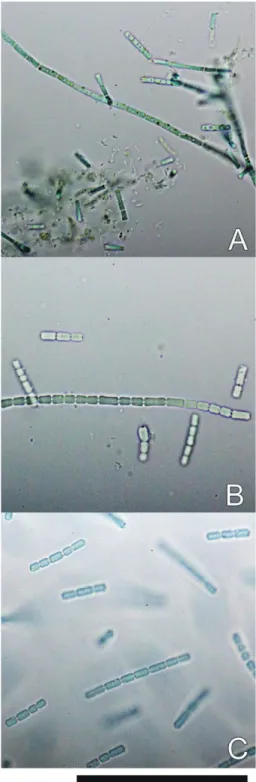
The micro-photographs of NIES-512 and related taxa are presented in Fig. 1. The cell sizes of NIES-512 were intermediate between those of Pseudanabaena foetida Niiyma, Tsuji et Ichise (strain PTG) and P. subfoetida Niiyma et Tuji (strain Ak1318). The cell width of NIES-512 was 1.6–2.2 μm and thicker than that of PTG (1.0–
1.5 μm) and thiner than that of Ak1318 (2.1–
2.9 μm). These sizes also overlapped. The cell lengths of NIES-512 was 3.0–8.3 μm, almost identical to that of Ak1318 (2.5–8.5 μm) and slightly shorter than that of PTG (3.9–11.0 μm).
The cell lengths of these strains also overlapped (Table 1). The color of the trichomes and cells was bright blue-green in all three strains. Other morphological characteristics were also shared among these three strains (Table 2).
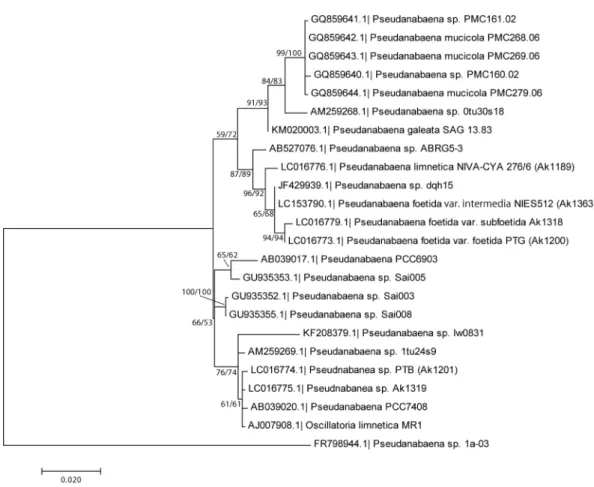
The phylogeny of 16S rRNA revealed similar- ity between NIES-512 (LC153790) and two new species described in Niiyama et al. (2016).
NIES-512 and dqh15 (JF429939.1) are almost identical. Differences were found near the 5′ and 3′ ends, and these might simply be sequencing errors.
NIES-512 and PTG have differences of 5 base positions (0.3% of 1467 bp), and NIES-512 and Ak1318 have differences of 12 base positions (0.8% of 1467 bp). These similarities showed that NIES-512 should be included in the P. foetida – subfoetida species complex.
Niiyama et al. (2016) divided this complex
Fig. 1. Micro-photographs of holotype specimens.
Scale bar=50 μm. A. Pseudanabaena foetida var. foetida (TNS-AL-57781 from PTG). B.
Pseudanabaena foetida var. subfoetida (TNS-AL- 58650 from Ak1318). C. Pseudanabaena foetida var. intermedia (TNS-AL-58658 from NIES-512).
Table 1. Cell size of cultured strains PTG, Ak1318, NIES-512, NIVA-CYA276/6, PTB and Ak1319 TaxonStrainCell widthCell lengthL/W Specimen no. TNS-ALAccession number 16S rRNAmin–max μmmean μm (std.)min–max μmmean μm (std.)min–maxmean (std.) Pseudanabaena foetida var. foetidaPTG (Ak1200)1.0–1.5 1.28 (0.153)
3.9–11.0
6.18 (1.803)
2.7–8.5
4.90 (1.477)
57781LC016773 P. foetida var. subfoetidaAk13182.1–2.9
2.42 (0.204)
2.5–8.5
4.61 (1.391)
0.9–4.0
1.94 (0.664)
58650LC016779 P. foetida var. intermediaNIES-512 (Ak1363)1.6–2.2
1.92 (0.138)
3.0–8.3
5.09 (1.255)
1.6–4.6
2.65 (0.677)
58658LC153790 P. sp.NIVA-CYA276/6 (Ak1189)2.0–3.0
2.52 (0.282)
3.0–8.0
5.35 (1.489)
1.0–3.6
2.15 (0.666)
58651LC016776 P. limneticaPTB (Ak1201)0.9–1.3
1.03 (0.131)
2.5–7.1
4.47 (1.276)
2.5–7.0
4.39 (1.269)
57780LC016774 P. limneticaAk13191.1–1.5
1.38 (0.11.5–5.0 13)
3.20 (0.947)
1.1–4.2
2.34 (0.735) 58649LC016775 Cell width and length (μm). L/W=cell length/cell width; std=standard deviation; N=50.
into two species, P. foetida and P. subfoetida, based on the secondary structure of the 16S rRNA-23S rRNA spacer region. Since the sec- ondary structures of RNA-Ile and RNA-Ala, pre- sented in Niiyama et al. (2016), have problems, four constraint for the D1-D1ʼ, RNA-Ile, RNA- Ala, and Box-B regions were set in the Mfold software. The secondary structures of the D1-D1ʼ, RNA-Ile, V2, RNA-Ala and Box-B regions were clearly recognized in these three strains (Fig. 3). The structures of RNA-Ile and BOX-B are almost identical within these three strains. The structure of the D1-D1ʼ region in NIES-512 agree with the structure of Ak1318 and differ from that of PTG. The structure of the V2 region in NIES-512 agrees with that of PTG.
A long insertion (53 bp) in the V2 region is also identical between NIES-512 and PTG, and does not exist in Ak1318. Several secondary structural differences were seen between NIES-512 and the other two strains. NIES-512 should be in a differ- ent taxon from P. foetida (PTG) and P. subfoetida (Ak1318) based on the secondary structure of the 16S rRNA-23S rRNA spacer region. The second- ary structure of this region has been widely used to recognize the taxon (Iteman et al., 2000;
Boyer et al., 2001; Siegesmund et al., 2008).
However, the 16S rRNA region shows very high similarity among these three strains (>99% sim- ilarity). Also, the morphologies of these three strains are very similar, and their dimensions mostly overlap. These three strains commonly
Fig. 2. Phylogenetic position of strains PTG, Ak1318, NIES-512 and related strains determined by Maximum Likelihood (ML) method using 16S rRNA gene. Accession numbers are followed by taxonomic names. Num- bers at branches indicate NJ (Neighbor Joining) / ML bootstrap support values (only values higher than 60 are shown).
produce 2-MIB. Because of these similarities and to avoid superfluous taxonomic confusion in applied environmental biology, we will divide these strain at the variety level on the basis of
their differences.
Fig. 3. Secondary structure of the 16S rRNA-23S rRNA spacer region. a. Strain PTG. b. Strain NIES-512.
c. Strain Ak1318.
Taxonomic description
Pseudanabaena foetida Niiyama, Tuji et Ichise in Niiyama et al., Fottea 16: 4-5. f. 6, 7, 14.
2016. (Fig. 1A)
Holotype: A formalin fixed specimen, TNS- AL-57781 in TNS, from cultured strain PTG.
Type strain: PTG maintained in the Lake Biwa Environmental Research Institute, Japan.
Type locality: Lake Biwa, Shiga Pref., Japan.
Habitat: Plankton in lakes.
Pseudanabaena foetida var. subfoetida (Niiyama et Tuji) Tuji et Niiyama comb. nov.
Basionym: Pseudanabaena subfoetida Niiyama et Tuji in Niiyama et al., Fottea 16: 5. f.
10, 11, 15. 2016. (Fig. 1B)
Holotype: A formalin fixed specimen, TNS- AL-58650 in TNS, from cultured strain Ak1318 (PS1306) maintained in the Department of Bot- any, National Museum of Nature and Science.
Type locality: Lake Kasumigaura, Ibaraki Pref., Japan.
Habitat: Plankton in lakes.
Pseudanabaena foetida var. intermedia Tuji et Niiyama, var. nov. (Fig. 1C)
Description: Trichomes solitary, straight, bright blue-green colored, with conspicuous constric- tions at cross-walls, 1.6–2.2 μm wide, without mucilage or sheath, not attenuated nor differenti- ated at the ends, without calyptra, infrequently
move. Cells cylindrical with rounded ends, bright blue-green, longer than wide, 3.0–8.3 μm long, ratio of width to length ca. 1.6–4.6, with aero- topes at both ends of cells, differentiated in cen- tro- and chro-matoplasmic regions. Cell division perpendicular to the longitudinal axis of a tri- chome. Trichomes separate between two neigh- boring cells or by fragmentation without necridic cells. Heterocytes are not known. Thallus has an extreme musty odor that comes from 2-methyl- isoborneol.
Holotype: A formalin fixed specimen, TNS- AL-58658 in TNS (Department of Botany, National Museum of Nature and Science), from cultured strain NIES-512.
Type strain: NIES-512 maintained in National Institute for Environmental Studies (NIES).
Type locality: Nagoya castle, Aichi Pref., Japan.
Habitat: Plankton in lakes and ponds.
Synonyms:
Phormidium tenue Gomont sensu N.Yamada in Watanabe et al. (2000).
Pseudanabaena galeata Böcher sensu T.
Honma in Kasai et al. (2009).
Acknowledgments
This work was supported by KAKENHI (Grant Number 15K00574) from the Japan Soci- ety for the Promotion of Science.
trichome color bright blue-green bright blue-green bright blue-green
sheath — — —
motility of trichome rarely trembling rarely trembling or rarely slowly go forward
rarely trembling
cell color bright blue-green bright blue-green bright blue-green
cell morphology long and thin cylindrical isodiametric
to longer than wide cylindrical apical cell long cylindrical with rounded end isodiamtetric to cylindrical
with rounded end cylindrical with rounded
poler aerotope + + +end
constriction at cross-wall + + +
musty odor + + +
References
Anagnostidis, K. and Komárek, J. 1988. Modern approach to the classification system of cyanophytes 3
—Oscillatoriales. Algological Studies 50–53: 327–472.
Böcher, T. W. 1949. Studies on the sapropelic flora of the lake Flyndersø with special reference to the Oscillatori- aceae. Kongelige Danske videnskabernes selskab, Biol- ogiske Meddelelser 21: 1–46.
Boyer, S. L., Flechtner, V. R. and Johansen, J. R. 2001. Is the 16S–23S rRNA internal transcribed spacer region a good tool for use in molecular systematics and popula- tion genetics? A case study in cyanobacteria. Molecular Biology and Evolution 18: 1057–1069.
Iteman, I., Rippka, R., Tandeau de Marsac, N. and Herd- man, M. 2000. Comparison of conserved structural and regulatory domains within divergent 16S rRNA–23S rRNA spacer sequences of cyanobacteria.
Microbiology 146:1275–1286.
Iwase, S. and Abe, T. 2010 Identification and change in concentration of musty-odor compounds during frowth in blue-green algae. Journal of the School of Marine Science and Technology, Tokai University 8: 27–33.
Kasai, F., Kawachi, M., Erata, M., Mori, F., Yumoto, K.
Sato, M. and Ishimoto, M. 2009. NIES-Collection List of Strains, 8th Edition. Japanese Journal of Phycology 57 (1) Suppl.: 1–350.
Komárek, J. and Anagnostidis, K. 1999. Cyanopro- karyota. 1. Chroococcales. In: Ettl, H., Gärtner, G.,
Heynig, H. and Mollenhauer, D. (eds.), Süßwasserflora von Mitteleuropa. Band 19/1, pp. 548, Elsevier, Heidel- berg & Berlin.
Komárek, J. and Anagnostidis, K. 2005. Cyanopro- karyota. 2. Teil: Oscillatoriales. In: Büdel, B., Gärdner, G., Krienitz, I. and Schagerl. M. (eds.), Süswasserflora von Mitteleuropa, vol. 19/2. pp. 759 pp, Elsevier, München.
Niiyama, Y., Tuji, A., Takemoto, K. and Ichise, S. 2016.
Pseudanabaena foetida sp. nov. and P. subfoetida sp.
nov. (Cyanophyta/Cyanobacteria) producing 2-methyl- isoborneol from Japan. Fottea 16: 1–11.
Siegesmund, M., Johansen, J. R., Karsten, U. and Friedl, T. 2008. Coleofasciculus gen. nov. (Cyanobacteria):
morphological and molecular criteria for revision of the genus Microcoleus Gomont. Journal of Phycology 44:
1572–1585.
Yamada, N., Aoyama, K., Yamada, M. and Hamamura, N.
1985. Studies on earthy-musty odor in natural water (1) Growth characteristics and 2-methylisoborneol produc- tion of Phormidium tenue. Japan Journal of Water Pol- lution Research 8: 515–521.
Watanabe, M. M., Kawachi, M., Hiroki, M. and Kasai, F.
2000. NIES-Collection List of strains. Sixth edition.
Microalgae and protozoa. 159 pp. National Institute for Environmental Studies, Environment Agency, Tsukuba.
Zuker, M. 2003. Mfold web server for nucleic acid fold- ing and hybridization prediction. Nucleic Acids Research 31: 3406–3015.