• 検索結果がありません。

Quadratic Fractional Programming Problems with Quadratic Constraints

N/A
N/A
Protected

Academic year: 2021

シェア "Quadratic Fractional Programming Problems with Quadratic Constraints"

Copied!
21
0
0

読み込み中.... (全文を見る)

全文

(1)

Quadratic Fractional Programming Problems with Quadratic Constraints

Guidance Professor Masao FUKUSHIMA Assistant Professor Shunsuke HAYASHI

Ailing ZHANG

2006 Graduate Course in

Department of Applied Mathematics and Physics Graduate School of Informatics

Kyoto University

KYOTO UNIVER SIT

Y

F OU

ND E D 1897 KYOTO JAPAN

February 2008

(2)

Abstract

We consider a fractional programming problem that minimizes the ratio of two indefinite quadratic functions subject to two quadratic constraints. The main difficulty with this problem is its noncovexity. Utilizing the relationship between fractional programming and parametric programming, we transform the original problem into a univariate nonlinear equation.

To evaluate the function in the univariate equation, we need to solve a problem of minimizing a nonconvex quadratic function subject to two quadratic constraints. This problem is commonly called a CDT subproblem, which arises in some trust region algorithms for equality constrained optimization. The properties of CDT subproblems have been studied by many researchers. For example, it was proved by Yuan that, if the Hessian of the Lagrangian is positive definite at the maximum of the dual problem, then the corresponding primal variable is the global optimum of the original CDT subproblem.

In this paper, we provide an algorithm for solving quadratic fractional programming problems

with two quadratic constraints. In the outer iterations, we employ Newton’s method, which is

expected to improve upon the bisection method used in the existing approaches. In the inner

iterations, we apply Yuan’s theorem to obtain the global optima of the CDT subproblems. We

also show some numerical results to examine the efficiency of the algorithm.

(3)

Contents

1 Introduction 1

2 Preliminaries 3

2.1 Parametric approach . . . . 3 2.2 Properties of the univariate function F(α) . . . . 4

3 CDT subproblems 7

3.1 Conditions for the global optimality . . . . 7 3.2 Dual problem . . . . 7

4 Algorithm 9

5 Numerical experiments 12

5.1 How to generate test problems . . . . 12 5.2 Numerical results . . . . 13

6 Concluding remarks 14

(4)

1 Introduction

In various applications of nonlinear programming, one often encounters the problem in which the ratio of given two functions is to be maximized or minimized. Such optimization problems are commonly called fractional programming problems. One of the earliest fractional programming problems is an equilibrium model for an expanding economy introduced by Von Neumann [18]

in 1937. However, besides a few isolated papers, a systematic study of fractional programming began much later. In 1962, Charnes and Cooper [6] published their classical paper in which they showed that a linear fractional programming problem with one ratio can be reduced to a linear programming problem using a nonlinear variable transformation. Also they suggested the term ‘fractional functionals programming problem’ which is now abbreviated to ‘fractional programming problem’. In 1967, the nonlinear model of fractional programming problems was studied by Dinkelbach [12], who showed an interesting and useful relationship between fractional and parametric programming problems.

Fractional programming problems have been studied extensively by many researchers [3, 4, 11, 13]. For example, motivated by the so-called regularized total least squares problem, Beck, Ben-Tal, and Teboulle [1] considered the problem in which the ratio of two indefinite quadratic functions is minimized subject to a quadratic form constraint. They have given an algorithm for the problem, and proved that a global optimal solution to the problem can be found by solving a sequence of convex minimization problems parameterized by a single parameter.

In this paper, we consider a problem which has the same objective function as in [1], but contains two quadratic constraints. Specifically the problem is stated as follows:

Minimize f

1

(x) f

2

(x)

subject to x ∈ F , (1.1)

where

f

i

(x) := x

T

A

i

x 2b

Ti

x + c

i

, (i = 1, 2) (1.2) F :=

n x

¯ ¯

¯ kxk ≤ ∆, kP

T

x + qk ≤ ξ o

(1.3) with A

1

,A

2

R

n×n

, b

1

,b

2

R

n

, c

1

,c

2

R, P R

n×m

, q R

m

, ∆ > 0 and ξ 0. We assume that A

i

is symmetric and f

2

(x) is positive and bounded away from zero on the feasible region F, but do not assume the positive semi-definiteness of A

i

. Without loss of generality, the sphere constraint kxk ≤ ∆ in F can be replaced by any ellipsoidal constraint with an arbitrary center.

Such a problem can be easily reformulated to (1.1) by using an appropriate linear transformation.

Utilizing the relationship between fractional and parametric programming problems, we can reformulate the above problem into the following univariate equation

F (α) = 0, (1.4)

where the function F : R R is defined by F(α) := min

x∈F

n

f

1

(x) αf

2

(x) o

. (1.5)

(5)

In order to calculate the value of function F , we need to solve the subproblem of the form:

Minimize x

T

Ax 2b

T

x + c

subject to x ∈ F. (1.6)

The problems of the form (1.6) are originally studied as a subproblem of some trust region algorithms [10] for nonlinear programming problems with equality constraints. Since Celis, Dennis and Tapia [5] first studied this problem, it is often called a CDT subproblem. Let f (x) and h(x) = (h

1

(x), · · · , h

m

(x))

T

= 0 denote the objective function and the equality constraints respectively for the original nonlinear programming problem. Then, at the kth iteration, the well-known sequential quadratic programming method tries to find a search direction d

k

by solving the following problem:

Minimize ∇f

kT

d + 1

2 d

T

B

k

d subject to h

k

+ ∇h

Tk

d = 0,

where ∇f

k

, h

k

and ∇h

k

denote ∇f (x

k

), h(x

k

) and ∇h(x

k

), respectively, and B is an approx- imation of the matrix

2

f(x

k

). In a trust region method for unconstrained optimization we usually add the trust region {d | kdk ≤

k

} with bound ∆

k

> 0 to the kth subproblem. In constrained optimization, however, if we add such a trust region constraint, then the subprob- lem may become infeasible. To overcome this difficulty, Celis, Dennis and Tapia [5] proposed to replace the equality constraint by the inequality constraint kh

k

+ ∇h

Tk

dk ≤ ξ

k

. Then, the step d

k

is calculated by solving the following problem:

Minimize ∇f

kT

d + 1

2 d

T

B

k

d

subject to kdk ≤

k

, kh

k

+ ∇h

Tk

dk ≤ ξ

k

.

Powell and Yuan [17] showed that a certain algorithm with such trust regions is globally and superlinearly convergent under certain conditions.

The properties and algorithms for the CDT subproblems have been studied by many re- searchers. For example, Yuan [20] proved that the Hessian of the Lagrangian has at most one negative eigenvalue at the global optimum of the CDT subproblem. He also proved that, if the Hessian of the Lagrangian is positive semidefinite at some KKT (Karush-Kuhn-Tucker) point, then it must be the global optimum. This implies that, if the Hessian of the Lagrangian is positive definite at the maximum of the dual problem, then the corresponding primal variable is the global optimum. Yuan [21] proposed an algorithm for the CDT subproblem (1.6) with positive definite A. Zhang [22] also proposed a different algorithm for the same type of CDT subproblems. On the other hand, Li and Yuan [15] proposed an algorithm for the general CDT subproblem (1.6) with indefinite A. Other studies on CDT subproblems are found in [2, 7, 8, 9, 16, 19]

In our algorithm, we employ the generalized Newton method in the outer iterations for

solving the univariate equation (1.4). We expect that the generalized Newton method improves

(6)

upon the bisection method which is often used in the existing approaches. Then, the CDT subproblems of the form (1.6) are solved by an algorithm that combines the generalized Newton method with the steepest ascent method. The algorithm is similar to the one proposed in [15], both of which are based on Yuan’s theorem [20, Theorem 2.5].

The paper is organized as follows. In the next section, we review preliminary results on fractional programming, and prove some properties of the function F(α) defined by (1.5). In section 3, we consider the CDT subproblem and give some theoretical background. In section 4, we present two algorithms for fractional programming problems, where a CDT subproblem is solved in each iteration. In section 5, we give some numerical results to examine the efficiency of the algorithms. In section 6, we conclude the paper with some remarks.

2 Preliminaries

In this section, we review some preliminary results on fractional programming. We first study the relationship between fractional programming and parametric programming. Then, we discuss some properties on function F defined by (1.5). We note that all the statements in this section hold for any continuous functions f

1

, f

2

and compact set F ⊂ R

n

.

Throughout the paper, we assume that the denominator f

2

(x) is positive and bounded away from zero on the feasible region F.

Assumption 1 There exists N > 0 such that f

2

(x) N for all x ∈ F .

This assumption is essential for general fractional programming problems, since we have inf

x∈F

[f

1

(x)/f

2

(x)] = −∞ if f

2

(x) = 0 for some x ∈ F. If f

2

(x) is negative and bounded away from zero on F, then we can set f

i

(x) := −f

i

(x) for i = 1, 2 so that Assumption 1 holds.

We are interested in the relationship between the original fractional programming problem (1.1) and the following parametric programming problem:

Minimize f

1

(x) αf

2

(x)

subject to x ∈ F , (2.1)

where α R is a scalar parameter. The above problems (1.1) and (2.1) are solvable since the feasible region F is compact, functions f

1

and f

2

are continuous in F, and min

x∈F

f

2

(x) > 0.

2.1 Parametric approach

From the studies by Jagannathan [14] and Dinkelbach [12], we can see that problems (1.1) and (2.1) have the following relationship.

Proposition 2.1 The following two statements are equivalent:

(a) min

x∈F

f

1

(x) f

2

(x) = α, (b) min

x∈F

n

f

1

(x) αf

2

(x) o

= 0.

(7)

Proof. We first show (a)⇒(b). Let x

0

be a solution of problem (1.1). Then we have α = f

1

(x

0

)

f

2

(x

0

) f

1

(x) f

2

(x) , which implies

f

1

(x) αf

2

(x) 0 ∀x ∈ F , (2.2)

f

1

(x

0

) αf

2

(x

0

) = 0 (2.3)

since f

2

(x) > 0 for any x ∈ F . From (2.2) and (2.3) we have min

x∈F

{f

1

(x) αf

2

(x)} = 0 and the minimum is attained at x

0

.

We next show (b)⇒(a). Let x

0

be a solution of problem (2.1). Then we have 0 = f

1

(x

0

) αf

2

(x

0

) f

1

(x) αf

2

(x)

for any x ∈ F . Dividing the above inequality by f

2

(x) > 0, we obtain f

1

(x)

f

2

(x) α ∀x ∈ F , and f

1

(x

0

) f

2

(x

0

) = α.

Hence we have min

x∈F

[f

1

(x)/f

2

(x)] = α and the minimum is attained at x

0

. This completes the proof.

We can expect that the parametric programming problem (2.1) is easier than the fractional programming problem (1.1) due to its simpler structure of the objective function. Moreover, Proposition 2.1 claims that, if we can find a parameter α such that the optimal value of (2.1) is 0, then an optimal solution of (2.1) is also an optimal solution of (1.1). Thus we consider the parametric programming problem (2.1) instead of the original fractional programming problem (1.1).

2.2 Properties of the univariate function F (α)

In the previous subsection, we have seen that the optimal solution of the fractional programming problem can be obtained by solving the parametric programming problem with its optimal value being zero. This implies that the univariate equation F (α) = 0, where F is defined by (1.5), is essentially equivalent to the original fractional programming problem (1.1). In this subsection, we give some properties of the univariate function F .

We first give the following theorem.

Theorem 2.1 Let F : R R be defined by (1.5). Then, the following statements hold.

(a) F is concave over R.

(b) F is continuous at any α R.

(c) F is is strictly decreasing.

(d) F (α) = 0 has a unique solution.

(8)

Proof. (a) Let real numbers α

1

and α

2

be arbitrarily chosen so that α

1

6= α

2

, and x

i

be defined by x

i

argmin

x∈F

{f

1

(x) α

i

f

2

(x)} for i = 1, 2. Then, for any β (0, 1), we have

βF(α

1

) + (1 β)F

2

)

= β n

f

1

(x

1

) α

1

f

2

(x

1

) o

+ (1 β) n

f

1

(x

2

) α

2

f

2

(x

2

) o

β n

f

1

(x

1

) α

1

f

2

(x

1

) o

+ (1 β) n

f

1

(x

1

) α

2

f

2

(x

1

) o

= f

1

(x

1

) (βα

1

+ (1 β)α

2

)f

2

(x

1

)

F (βα

1

+ (1 β)α

2

),

where the inequalities follow from the definition of F. Then we can see that F is concave.

(b) Since F is a concave mapping from R to R, we can easily see the continuity.

(c) Let α

1

> α

2

be chosen arbitrarily and x

2

argmin

x∈F

{f

1

(x) α

2

f

2

(x)}. Then we have F

2

) = min

x∈F

n

f

1

(x) α

2

f

2

(x) o

= f

1

(x

2

) α

2

f

2

(x

2

)

> f

1

(x

2

) α

1

f

2

(x

2

)

min

x∈F

n

f

1

(x) α

1

f

2

(x) o

= F

1

),

where the strict inequality follows from α

1

> α

2

and f

2

(x

2

) N > 0. Thus F is strictly decreasing.

(d) Since f

1

and f

2

are continuous and F is compact, there exist real scalars L

1

, U

1

and U

2

such that L

1

f

1

(x) U

1

and 0 < N f

2

(x) U

2

for any x ∈ F , where N is a positive number given in Assumption 1. Hence, for any α R, we have

F (α) = min

x∈F

{f

1

(x) αf

2

(x)}

= f

1

(x

α

) αf

2

(x

α

)

U

1

N α (2.4)

and

F (α) = min

x∈F

{f

1

(x) αf

2

(x)}

= f

1

(x

α

) αf

2

(x

α

)

L

1

U

2

α, (2.5)

where x

α

argmin

x∈F

{f

1

(x) αf

2

(x)}. Since 0 < N U

2

, we can see lim

α→+∞

F (α) = −∞

from (2.4) and lim

α→−∞

F (α) = +∞ from (2.5). These together with (b) and (c) yield the unique solvability of F (α) = 0.

For convenience, we define a convex function g : R R by g(α) := −F (α) = max

x∈F

{−f

1

(x) + αf

2

(x)}. (2.6)

From Theorem 2.1, we can easily derive the following corollary.

(9)

Corollary 2.1 Let g : R R be defined by (2.6). Then, the following statements hold.

(a) g is convex over R.

(b) g is continuous at any α R.

(c) g is is strictly increasing.

(d) g(α) = 0 has a unique solution.

Since g is defined by using a maximum operator, it is nondifferentiable in general. However, its subgradient can be obtained in an explicit manner. In the following, we give an explicit expression of the subgradient of function g.

Theorem 2.2 For any α R, let x

α

be defined by x

α

argmax

x∈F

{−f

1

(x) + αf

2

(x)}. Then, a subgradient of g at α is given by f

2

(x

α

), i.e.,

f

2

(x

α

) ∂g(α) where ∂g denotes the Clarke subdifferential of g.

Proof. Let α R be arbitrarily fixed. Then, for any α

0

R , we have g(α

0

) g(α) = max

x∈F

n

−f

1

(x) + α

0

f

2

(x) o

max

x∈F

n

−f

1

(x) + αf

2

(x) o

= n

−f

1

(x

α0

) + α

0

f

2

(x

α0

) o

n

−f

1

(x

α

) + αf

2

(x

α

) o

n

−f

1

(x

α

) + α

0

f

2

(x

α

) o

n

−f

1

(x

α

) + αf

2

(x

α

) o

= (α

0

α)f

2

(x

α

).

This implies that f

2

(x

α

) is a subgradient of the convex function g at α.

Considering these properties, we construct two kinds of methods for solving F (α) = 0: the generalized Newton method and the bisection method. Details of the algorithms will be discussed later.

To solve the fractional programming problem (1.1), we still need to consider how to solve the parametric subproblem (2.1) for each α. Using the notations

A = A

1

αA

2

, b = b

1

αb

2

,

c = c

1

αc

2

, the subproblem (2.1) with (1.2) and (1.3) reduces to

Minimize Φ(x) = x

T

Ax 2b

T

x + c

subject to kxk ≤ ∆ (2.7)

kP

T

x + qk ≤ ξ.

As we have mentioned in the previous section, this subproblem is also called a CDT subproblem,

and its properties have been studied by many researchers. In the next section we will discuss

the properties of this subproblem.

(10)

3 CDT subproblems

In this section, we introduce some theoretical background on the CDT subproblems. We first give necessary conditions and sufficient conditions for the global optimality of the CDT subproblem, both of which were proved by Yuan [20] in 1990. Then, we consider the dual problem to see that, if the Hessian of the Lagrangian is positive definite at a dual maximum, then the corresponding primal variable is a global optimum.

3.1 Conditions for the global optimality

We first introduce two theorems given by Yuan [20] which characterize a global optimum of problem (2.7).

Theorem 3.1 [20, Theorem 2.1] Let x

R

n

be a global optimum of the CDT subproblem (2.7). Then, there exist two nonnegative numbers λ

, µ

0 such that

(2A + λ

I + µ

PP

T

)x

= −(−2b + µ

Pq), (3.1) λ

(∆ − kx

k) = 0, (3.2) µ

− kP

T

x

+ qk) = 0. (3.3) Furthermore, the matrix

H = 2A + λ

I + µ

PP

T

(3.4)

has at most one negative eigenvalue if the multipliers λ

and µ

are unique.

Note that (3.2) and (3.3) implies the complementarity conditions, and H is the Hessian of the Lagrangian, that is, H =

2xx

L(x, λ, µ) with

L(x, λ, µ) := Φ(x) + λ

2 (kxk

2

2

) + µ

2 (kP

T

x + qk

2

ξ

2

).

Yuan [20] also gave sufficient conditions for the global optimality of the CDT subproblem (2.7).

Theorem 3.2 [20, Theorem 2.5] Suppose that a feasible point x

satisfies (3.1)–(3.3) for some λ

, µ

0. Then, if matrix H defined by (3.4) is positive semidefinite, x

is a global optimum for the CDT subproblem (2.7).

If λ

and µ

are arbitrarily fixed, then x

satisfying (3.1) is uniquely determined under the nonsingularity of H. Hence, the problem to find (x

, λ

, µ

) reduces to a certain equivalent problem with two variables λ and µ, which is actually the Lagrangian dual problem of the original CDT subproblem (2.7).

3.2 Dual problem

Next we introduce the dual problem for the CDT subproblem (2.7), and discuss the relation

between the optimality of the CDT subproblem and that of its dual problem. Let H : R

2

R

n×n

(11)

and x : R

2

R

n

be defined by

H(λ, µ) := 2A + λI + µPP

T

, (3.5) x(λ, µ) := −H(λ, µ)

(−2b + µPq), (3.6) where H(λ, µ)

denotes the Moore-Penrose pseudo inverse of H(λ, µ). For a general matrix K R

m×n

, the Moore-Penrose pseudo inverse K

R

n×m

is defined as a matrix satisfying

(a) KK

K = K (b) K

KK

= K

(c) KK

and K

K are both symmetric.

The Moore-Penrose pseudo inverse is determined uniquely, and K

= K

−1

if m = n and K is nonsingular.

Then we can define the Lagrangian dual function Ψ : R

2

R ∪ {−∞} as follows:

Ψ(λ, µ) :=

 

−∞, if H(λ, µ)x(λ, µ) 6= −(−2b + µPq), Φ(x(λ, µ)) + λ

2 (kx(λ, µ)k

2

2

) + µ

2 (kP

T

x(λ, µ) + qk

2

ξ

2

), otherwise, where Φ is defined in (2.7). Note that Ψ(λ, µ) is finite when H(λ, µ) is nonsingular. Moreover, even if H(λ, µ) is singular, Ψ(λ, µ) is also finite when min

x∈Rn

kH(λ, µ)x + (−2b + µPq)k = 0.

In such a case, there exist an infinite number of minimizers, and the point nearest to the origin among them is x(λ, µ).

Using the above definitions, we introduce the dual problem for the CDT subproblem (2.7):

Maximize Ψ(λ, µ)

subject to λ 0, µ 0. (3.7)

Since

∇Ψ(λ, µ) = 1 2

Ã

kx(λ, µ)k

2

2

kP

T

x(λ, µ) + qk

2

ξ

2

! ,

the KKT conditions for (3.7) are given by λ 0, ∆

2

− kx(λ, µ)k

2

0, λ

³

2

− kx(λ, µ)k

2

´

= 0, µ 0, ξ

2

− kP

T

x(λ, µ) + qk

2

0, µ

³

ξ

2

− kP

T

x(λ, µ) + qk

2

´

= 0.

(3.8)

Hence, one can easily see that a KKT point (λ

, µ

) of the dual problem (3.7) satisfies (3.2) and (3.3), and that x(λ

, µ

) satisfies (3.1).

Combining these arguments with Theorem 3.2, we have the following theorem.

Theorem 3.3 Let

, µ

) be a KKT point of the dual problem (3.7). Then, x(λ

, µ

) defined

by (3.6) is a global optimum of the CDT subproblem (2.7), provided that either of the following

conditions holds:

(12)

(a) H(λ

, µ

) is positive definite.

(b) H(λ

, µ

) is positive semidefinite, and H(λ

, µ

)x(λ

, µ

) = −(−2b + µ

Pq).

Due to this theorem, if one can obtain a KKT point of the dual problem (3.7) such that the Hessian of the Lagrangian is positive semidefinite, then the CDT subproblem (2.7) is solved and its global optimality is guaranteed. However, as Theorem 3.1 claims, H(λ

, µ

) may have one negative eigenvalue. In such a case, as long as we know, there is no effective way to guarantee the global optimality. In the last part of the next section, we give a procedure to solve the CDT subproblem (2.7), which first tries to solve the dual problem (3.7) with the additional constraint H(λ, µ) º 0, and then tries to find a KKT point of the original CDT subproblem.

4 Algorithm

In this section, we give some algorithms for solving the fractional programming problem (1.1).

As we have mentioned in the previous sections, we need to solve the parametric programming problem (2.1) for each value of parameter α, and to find the zero point for the univariate function F defined by (1.5). In the outer part of the algorithm, we employ the bisection method and the generalized Newton method for solving the univariate equation (1.4). In the inner part, we solve the parametric programming problem (2.1) by the CDT algorithm based on Theorem 3.3.

First we study the bisection method with referring to the existing work [1]. As the initial parameters, we need l

0

and u

0

such that

l

0

min

x∈F

f

1

(x)

f

2

(x) u

0

. (4.1)

Then, the sequence

k

} ⊂ R is defined by α

k

:= (l

k

+ u

k

)/2 with l

k

and u

k

such that F (l

k

) > 0, F(u

k

) 0, and lim

k→∞

(u

k

l

k

) = 0. The initial parameters l

0

and u

0

satisfying (4.1) can be easily found as follows. By using the positive number N defined in Assumption 1, we have for any x ∈ F

¯ ¯

¯ ¯ f

1

(x) f

2

(x)

¯ ¯

¯ ¯ =

¯ ¯

¯ ¯ x

T

A

1

x 2b

T1

x + c

1

x

T

A

2

x 2b

T2

x + c

2

¯ ¯

¯ ¯

1 N

¯ ¯

¯x

T

A

1

x 2b

T1

x + c

1

¯ ¯

¯

1 N

³

|x

T

A

1

x| + 2kb

1

kkxk + |c

1

|

´

1 N

³

ρ(A

1

)∆

2

+ 2kb

1

k∆ + |c

1

|

´ ,

where ρ(A

1

) denotes the spectral radius of A

1

, and the last inequality is due to |x

T

A

1

x| ≤ ρ(A

1

)kxk

2

and kxk ≤ ∆. So we can choose l

0

and u

0

as

u

0

:= 1 N

³

ρ(A

1

)∆

2

+ 2kb

1

k∆ + |c

1

|

´

, l

0

:= −u

0

. (4.2)

Also, the positive number N can be obtained by solving the following CDT type problem:

Minimize x

T

A

2

x 2b

T2

x + c

2

subject to x ∈ F.

(13)

The overview of the bisection method is given as follows.

Bisection method

¶ ³

Step 0: Choose l

0

and u

0

such that (4.1) holds. Set k := 1.

Step 1: Let

α

k

:= l

k−1

+ u

k−1

2 .

Then, calculate F(α

k

) by solving the following minimization problem:

Minimize f

1

(x) α

k

f

2

(x)

subject to x ∈ F . (4.3)

Step 2: If |F(α

k

)| ≤ ², then terminate. Otherwise, update l

k

and u

k

as follows:

(

l

k

:= l

k−1

u

k

:= α

k

if F(α

k

) 0,

(

l

k

:= α

k

u

k

:= u

k−1

if F

k

) > 0.

Step 3: Let k := k + 1. Return to Step 1.

µ ´

The sequence generated by the bisection method always converges to the solution if the global optimality for the subproblem (4.3) is guaranteed. Moreover, the error in the solution can be estimated since the interval is halved in each iteration. However, it has a disadvantage that the convergence is rather slow. Moreover, once the non-global minimum is obtained in Step 1 and the sign of F

k

) is incorrectly evaluated, then the termination criterion may never be satisfied. To overcome such shortcomings, we next consider the generalized Newton method, which is expected to be superlinearly convergent and robust to the incorrect evaluation of F(α

k

).

Newton’s method usually requires the derivative of the target function. However, the function F defined by (1.5) can be nondifferentiable since it is defined by using the minimum operator.

We therefore apply the generalized Newton method, in which a subgradient is used instead of the derivative. By (2.6) and Theorem 2.2, a subgradient of F is given by −f

2

(x

k

) with x

k

argmin

x∈F

[f

1

(x) α

k

f

2

(x)]. Hence, the generalized Newton iteration is obtained by

α

k+1

:= α

k

F

k

)

−f

2

(x

k

)

= α

k

f

1

(x

k

) α

k

f

2

(x

k

)

−f

2

(x

k

)

= f

1

(x

k

) f

2

(x

k

) .

The outline of the generalized Newton method is described as follows.

(14)

Generalized Newton method

¶ ³

Step 0: Choose α

1

R. Set k := 1.

Step 1: Solve the following minimization problem to obtain a global optimum x

k

and its optimal value F

k

):

Minimize f

1

(x) α

k

f

2

(x)

subject to x ∈ F . (4.4)

Step 2: If |F

k

)| ≤ ², then terminate. Otherwise, let α

k+1

:= f

1

(x

k

)

f

2

(x

k

) . Let k := k + 1 and return to Step 1.

µ ´

We already know that F is concave and the equation F(α) = 0 is uniquely solvable from Theorem 2.1. Hence, the global convergence of the generalized Newton method is guaranteed without any safeguard scheme, provided that a global optimum is always obtained in Step 1. Moreover, even if a global optimum is not obtained at some iteration k

0

, i.e., x

k0

and F

k0

) are incorrectly evaluated, the sequence

k

} still converges to the solution of (1.4) if x

k

and F

k

) are correctly evaluated for k k

0

+ 1. Indeed, a global optimum of (4.4) is obtained in most cases, and its optimality is guaranteed by Theorem 3.3.

Finally, we explain how to solve the subproblems (4.3) and (4.4). Since the subproblems take the form of the CDT subproblem (2.7), we give a procedure for solving (2.7).

Procedure for solving CDT subproblem

¶ ³

Step 1: Solve the following problem to find a local maximum (λ

+

, µ

+

).

Maximize Ψ(λ, µ)

subject to λ 0, µ 0, H(λ, µ) º 0. (4.5) Step 2: If (λ

+

, µ

+

) satisfies the KKT conditions (3.8), then output x

=

−H(λ

+

, µ

+

)

(−2b + µ

+

Pq) as a global optimum of (2.7). If (λ

+

, µ

+

) does not satisfy (3.8), then go to Step 3.

Step 3: Solve the CDT subproblem (2.7) directly by some general-purpose method.

µ ´

For solving (4.5), we employ the steepest ascent method and Newton’s method with keeping the

iteration points in the feasible region. In each iteration, we first try the Newton direction. If the

Newton direction is unacceptable, then we apply the steepest ascent direction. In most cases,

we can find a (λ

+

, µ

+

) such that H(λ

+

, µ

+

) Â 0 and (λ

+

, µ

+

) is a global or local maximum. If

(15)

+

, µ

+

) is a local maximum and H(λ

+

, µ

+

) Â 0, then (λ

+

, µ

+

) satisfies the KKT conditions (3.8) and hence the global optimality for the original CDT subproblem (2.7) is guaranteed.

However, if H(λ

+

, µ

+

) is singular, then the KKT conditions (3.8) may not hold. In such a case, as Theorem 3.1 indicates, H(λ, µ) may have one negative eigenvalue at a global optimum of (2.7), and we therefore need to solve (2.7) by another method. Unfortunately, there is no algorithm that always finds a global optimum of (2.7), as long as we know.

5 Numerical experiments

In this section, we conduct some numerical experiments to examine the efficiency of the algo- rithms.

5.1 How to generate test problems

Since there may be no standard benchmarks for the fractional programming problems of the form (1.1)–(1.3), we generate the test problems as follows.

First we determine the feasible region. We choose matrix P R

n×m

and vector q R

m

so that their components are randomly chosen from the interval [−1, 1]. Also, we randomly choose ∆ R and ξ R from the intervals [0,

n ] and [0,

m ], respectively. To make sure the nonemptiness of the feasible region {x | kxk ≤ ∆, kP

T

x + qk ≤ ξ}, we first solve the following unconstrained optimization problem:

Minimize kP

T

x + qk.

If kP

T

x

0

+ qk > 0.9 ξ for the optimum x

0

, then we re-generate {P, q, ∆, ξ}. Otherwise, we next solve the following constrained optimization problem:

Minimize kxk

subject to kP

T

x + qk ≤ ξ.

If kx

00

k > 0.9 ∆ for the optimum x

00

, then we re-generate {P, q, ∆, ξ}. By performing this procedure, we can obtain a nonempty and bounded feasible region.

Next we generate the objective function. We first generate matrices A e

1

, A e

2

R

n×n

, vectors b

1

, b

2

R

n

and scalars c

1

, ˜ c

2

R so that every component is randomly chosen from the interval [−1, 1]. Then, we define symmetric matrices A

i

by A

i

= ( A e

i

+ A e

Ti

)/2 for i = 1, 2. We also need to define c

2

so that Assumption 1 holds. To this end, we solve

Minimize x

T

A

2

x 2b

T2

x + ˜ c

2

subject to kxk ≤ ∆, kP

T

x + qk ≤ ξ

by the CDT algorithm. If the optimal value of the above problem is γ, then we set c

2

:=

˜

c

2

+ max(0, −2γ) + 0.01. As a result, Assumption 1 holds with N = | + 0.01.

(16)

5.2 Numerical results

We solve the generated test problems by the bisection method and the generalized Newton method. For the bisection method, the initial parameters u

0

and l

0

are set to be u

0

:=

1.01N

−1

(ρ(A

1

)∆

2

+ 2kb

1

k∆k + |c

1

|) and l

0

:= −u

0

in consideration of (4.2). Here, the value of N is calculated as in Subsection 5.1. For the generalized Newton method, the initial point is set to be α

0

:= u

0

. Also, we choose ² := 10

−6

as the tolerance of the optimality for both algo- rithms. For solving CDT subproblems, we first solve the dual problem (4.5) by combining the steepest ascent method with Newton’s method, with keeping the iteration points in the feasible region. If the termination criterion in Step 2 is satisfied, then we output the solution x

which is guaranteed to be a global optimum. Otherwise, we need to go to Step 3, in which we solve the original CDT subproblem (2.7) by the optimization tool box installed in MATLAB. In this case, the global optimality for the obtained solution is not guaranteed. All of our algorithms are implemented in MATLAB 7.4.0 and run on a machine with Intel(R) Core(TM)2 Duo CPU E6850 3.00GHz and RAM 3.20GB.

Experiment 1

In the first experiment, we change the size of problems as n = 10, 20, . . . , 100, and generate 100 test problems for each n. The number of columns of matrix P R

n×m

is set to be m = 0.8n.

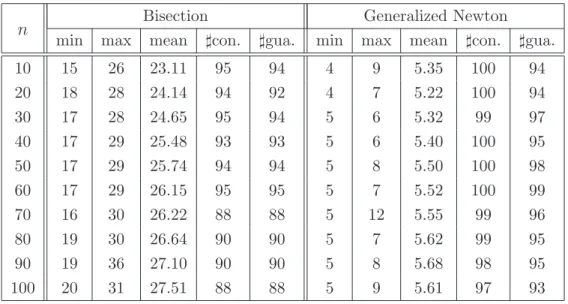
Then, we solve each subproblem by the bisection method and the generalized Newton method, and compare the number of iterations and the CPU time. The detailed results are shown in Tables 1 and 2, in which “min”, “max”, and “mean” denote the minimum, the maximum and the mean value of the data for each n. Moreover, “]con.” denotes the number of times the algorithm converges within 50 outer iterations, and “]gua.” denotes the number of times the obtained solution is guaranteed to be a global optimum, that is, the outer iteration terminates within 50 iterations and, at the last iteration, the termination criterion of the CDT subproblem is satisfied at Step 2. We note that the values of “min”, “max”, and “mean” are calculated only from the outputs whose global optimality is guaranteed by both the bisection method and the generalized Newton method.

From Table 2, we can see that the CPU time increases with the growth of the size of problems n. However, Table 1 shows that the number of iterations is not affected by the size of problems so much. This implies that the computational cost for each iteration mainly depends on the size of problems. We can also see that the generalized Newton method is obviously faster than the bisection method from the viewpoints of the CPU time and the numbers of iterations.

Unfortunately, for some problems, the optimality of a computed solution is not guaranteed, i.e., ]gua.< 100 since the global optimality for the subproblems are not always guaranteed.

However, the generalized Newton method converges within 50 iterations in most cases, whereas the bisection sometimes fails to converge. This is supposed to be from the following reason.

For the bisection method, once the sign of F

k

) is incorrectly evaluated, then the termination

criterion may never be satisfied. On the other hand, the generalized Newton method is robust

to the incorrect evaluation of F

k

) since the value of α

k+1

depends only on that of the previous

(17)

iteration point α

k

. Also, we note that the generalized Newton method could find global optima for some special problems that cannot be solved by the bisection method correctly.

Experiment 2

In the second experiment, we fix the size of problems to n = 50, and change the number of columns as m = 10, 20, . . . , 100. This also implies that the rank of matrix PP

T

is changed from 10 to 50. We solve 100 problems for each m by the bisection method and the generalized Newton method. The obtained results are shown in Tables 3 and 4, in which the values of “min”, “max”,

“mean”, “]con.” and “]gua.” are defined in a way analogous to Experiment 1.

As the tables show, the generalized Newton method also converges faster than the bisection method, and derives the global optimum in most cases. The CPU time for the bisection method grows monotonically as the value of m becomes larger, whereas that for the generalized Newton method seems to be a little disordered.

6 Concluding remarks

In this paper, we have studied the quadratic fractional programming problems with two quadratic constraints. Such a problem can be transformed into the univariate equation system, which is defined as the optimal value of the equivalent parametric programming problem. For solving the univariate equation system, we have applied the bisection method and the generalized Newton method to the outer part of the algorithm. For solving inner subproblems (parametric program- ming problems), we have employed the dual reformulation approach for solving so-called CDT subproblems. By means of numerical experiments, we have seen the efficiency of the algorithms.

Particularly, we have confirmed that the generalized Newton method is much faster and more robust to the erroneous evaluation for the univariate functions.

Table 1 : Number of iterations for various choices of n

Bisection Generalized Newton

n min max mean ]con. ]gua. min max mean ]con. ]gua.

10 15 26 23.11 95 94 4 9 5.35 100 94

20 18 28 24.14 94 92 4 7 5.22 100 94

30 17 28 24.65 95 94 5 6 5.32 99 97

40 17 29 25.48 93 93 5 6 5.40 100 95

50 17 29 25.74 94 94 5 8 5.50 100 98

60 17 29 26.15 95 95 5 7 5.52 100 99

70 16 30 26.22 88 88 5 12 5.55 99 96

80 19 30 26.64 90 90 5 7 5.62 99 95

90 19 36 27.10 90 90 5 8 5.68 98 95

100 20 31 27.51 88 88 5 9 5.61 97 93

(18)

Table 2 : CPU time for various choices of n Bisection Generalized Newton n min max mean min max mean

10 0.02 1.63 0.09 0.00 0.64 0.03 20 0.04 3.45 0.18 0.01 0.67 0.05 30 0.07 1.37 0.23 0.02 1.28 0.10 40 0.10 1.42 0.36 0.02 1.92 0.14 50 0.14 3.52 0.63 0.04 1.42 0.20 60 0.14 3.66 0.92 0.05 2.28 0.31 70 0.16 7.35 1.36 0.06 5.97 0.45 80 0.32 11.09 2.06 0.07 3.47 0.58 90 0.42 7.86 2.65 0.14 4.93 0.74 100 0.48 18.98 3.85 0.15 7.71 1.16

Table 3 : Number of iterations for various choices of m

Bisection Generalized Newton

m min max mean ]con. ]gua. min max mean ]con. ]gua.

10 18 29 25.78 95 95 5 6 5.34 98 98

20 15 30 25.73 93 93 5 6 5.40 96 95

30 19 29 25.96 97 97 4 8 5.53 100 97

40 20 29 25.88 94 94 5 8 5.48 100 96

50 17 29 26.02 89 89 5 8 5.57 100 95

60 20 30 26.10 93 93 5 7 5.49 100 95

70 15 29 25.52 94 94 5 6 5.40 100 99

80 20 29 25.78 93 93 5 8 5.59 100 100

90 17 29 25.29 89 89 5 6 5.56 99 97

100 20 29 25.87 90 89 5 8 5.63 99 95

(19)

Table 4 : CPU time for various choices of m Bisection Generalized Newton m min max mean min max mean

10 0.06 2.31 0.43 0.02 1.00 0.10 20 0.11 1.97 0.42 0.02 0.95 0.10 30 0.15 2.12 0.52 0.04 2.67 0.18 40 0.14 14.45 0.68 0.03 3.19 0.20 50 0.12 1.77 0.63 0.03 3.19 0.29 60 0.14 14.78 0.71 0.03 2.03 0.17 70 0.15 11.35 0.67 0.04 1.91 0.17 80 0.15 11.97 0.85 0.04 2.54 0.33 90 0.11 16.39 1.06 0.04 2.69 0.26 100 0.17 16.43 1.54 0.05 5.35 0.44

Acknowledgement

The author wishes to express her sincere thanks and appreciation to Professor Masao Fukushima for his kind guidance and direction in this study. The author wishes to express Associate Professor Nobuo Yamashita for his constructive comments and kind guidance. Most of all, the author wishes to express her sincerest thanks and appreciation to Assistant Professor Shunsuke Hayashi for his continual guidance, extreme patience, invaluable discussions and constructive criticisms in the writing of the manuscripts. Finally, the author would like to thank all the members of Optimization Laboratory.

References

[1] A. Beck, A. Ben-Tal, and M. Teboulle, Finding a global optimal solution for a quadrati- cally constrained fractional quadratic problem with applications to the regularized total least squares, SIAM Journal on Matrix Analysis and Applications, Vol. 28 (2006), pp. 425–445.

[2] A. Beck and Y. C. Eldar, Strong duality in nonconvex quadratic optimization with two quadratic constraints, SIAM Journal on Optimization, Vol. 17 (2006), pp. 844–860.

[3] H. P. Benson, Fractional programming with convex quadratic forms and functions, European Journal of Operational Research, Vol. 173 (2006), pp. 351–369.

[4] G. R. Bitran and T. L. Magnanti, Duality and sensitivity analysis for fractional programs, Operations Research, Vol. 24 (1976), pp. 675–699.

[5] M. R. Celis, J. E. Dennis and R. A. Tapia, A trust region strategy for nonlinear equality

constrained optimization, Numerical Optimization, P. T. Boggs, R. H. Byrd, R. B. Schnabel,

eds., SIAM, Philadelphia, 1985, pp. 71–82.

(20)

[6] A. Charnes and W. W. Cooper, Programming with linear fractional functionals, Naval Research Logistics Quarterly, Vol. 9 (1962), pp. 181–186.

[7] X. Chen and Y. Yuan, On local solutions of the Celis-Dennis-Tapia subproblem, SIAM Journal on Optimization, Vol. 10 (1999), pp. 359–383.

[8] X. Chen and Y. Yuan, On maxima of dual function of the CDT subproblem, Journal of Computational Mathematics, Vol. 19 (2001), pp. 113–124.

[9] X. Chen and Y. Yuan, Optimality conditions for CDT subproblem, Numerical Linear Alge- bra and Optimization, Y. Yuan, eds., Science Press, Beijing, New York, 1999, pp. 111–121.

[10] A. R. Conn, N. I. M. Gould and Ph. L. Toint, Trust-Region Methods, SIAM, Philadelphia, 2000.

[11] J. P. Crouzeix and J. A. Ferland, Algorithms for generalized fractional programming, Math- ematical Programming, Vol. 52 (1991), pp. 191–207.

[12] W. Dinkelbach, On nonlinear fractional programming, Management Science, Vol. 13 (1967), pp. 492–498.

[13] T. Ibaraki, H. Ishii, J. Iwase, T. Hasegawa and H. Mine, Algorithms for quadratic fractional programming problems, Journal of Operational Research Society of Japan, Vol. 19 (1976), pp. 174–191.

[14] R. Jagannathan, On some properties of programming problems in parametric form pertain- ing to fractional programming, Management Science, Vol. 12 (1966), pp. 609–615.

[15] G. Li and Y. Yuan, Compute a Celis-Dennis-Tapia step, Journal of Computational Math- ematics, Vol. 23 (2005), pp. 463–478.

[16] J. Peng and Y. Yuan, Optimality conditions for the minimization of a quadratic with two quadratic constraints, SIAM Journal on Optimization, Vol. 7 (1997), pp. 579–594.

[17] M. J. D. Powell and Y. Yuan, A trust region algorithm for equality constrained optimization, Mathematical Programming, Vol. 49 (1991), 189–211.

[18] J. Von Neumann, Uber ein es Gleichungssystem und eine Verallgemeinerung des Brouwer- ¨ schen Fixpuntsatzes, K. Menger, eds., Ergebnisse eines mathematicschen Kolloquiums (8), Leipzig und Wien, 1937, pp. 73–83.

[19] Y. Ye and S. Zhang, New results on quadratic minimization, SIAM Journal on Optimization, Vol. 14 (2003), pp. 245–267.

[20] Y. Yuan, On a subproblem of trust region algorithms for constrained optimization, Mathe-

matical Programming, Vol. 47 (1990), pp. 53–63.

(21)

[21] Y. Yuan, A dual algorithm for minimizing a quadratic function with two quadratic con- straints, Journal of Computational Mathematics, Vol. 9 (1991), pp. 348–359.

[22] Y. Zhang, Computing a Celis-Dennis-Tapia trust-region step for equality constrained opti-

mization, Mathematical Programming, Vol. 55 (1992), pp. 109–124.

Table 1 : Number of iterations for various choices of n
Table 2 : CPU time for various choices of n Bisection Generalized Newton n min max mean min max mean
Table 4 : CPU time for various choices of m Bisection Generalized Newton m min max mean min max mean

参照

関連したドキュメント

Methods suggested in this paper, due to specificity of problems solved, are less restric- tive than other methods for solving general convex quadratic programming problems, such

In recent years there has been much interest in the existence of positive solutions of nonlinear boundary value problems, with a positive nonlinearity f, where the boundary

Weighted analytic centers are used to improve the location of standing points for the Stand and Hit method of identi- fying necessary LMI constraints in semidefinite programming..

A limit theorem is obtained for the eigenvalues, eigenfunctions of stochastic eigenvalue problems respectively for the solutions of stochastic boundary problems, with weakly

The usual weak formulations of parabolic problems with initial data in L 1 do not ensure existence and uniqueness of solutions.. There then arose formulations which were more

The use of the Leray-Schauder nonlinear alternative theory in the study of the existence of solutions to boundary value problems for fractional differential equations with

M AASS , A generalized conditional gradient method for nonlinear operator equations with sparsity constraints, Inverse Problems, 23 (2007), pp.. M AASS , A generalized

In this paper, we extend this method to the homogenization in domains with holes, introducing the unfolding operator for functions defined on periodically perforated do- mains as