• 検索結果がありません。

Relationships between Markers of Bone Metabolism Used in the Treatment of Osteoporosis

N/A
N/A
Protected

Academic year: 2021

シェア "Relationships between Markers of Bone Metabolism Used in the Treatment of Osteoporosis"

Copied!
7
0
0

読み込み中.... (全文を見る)

全文

(1)

Objective

 Various markers of bone metabolism are used to help develop treatment plans for osteo- porosis or for assessing therapeutic effects of osteoporosis medications. Many investigations have examined the effects of various bone metabolism markers

1-3)

, but few have examined correlations across multiple types of bone metabolism markers. We investigated correlations

Relationships between Markers of Bone Metabolism Used in the Treatment of Osteoporosis

Takashi N

AGAI

, Keizo S

AKAMOTO

, Kennichi M

UNECHIKA

, Masayori F

UJITA

, Naoto T

SUCHIYA

, Takashi S

HIBUKI

and Katsunori I

NAGAKI

Abstract : Various markers of bone metabolism are used in the treatment of osteoporosis as they can help assess the condition of bony tissue/bone metabo- lism and can help predict the likelihood of fractures and bone loss in the near future. We investigated correlations between various bone metabolism markers to ascertain which could be used as a universal marker of bone metabolism and its associated care. Subjects comprised 144 female patients treated for osteoporosis at this facility between January and December 2009, in whom the following bone metabolism markers were measured on the same day : BAP, urine NTX, OC, ucOC, and TRACP-5b. The mean age of the subjects was 71.2 years. All subjects were analyzed as an entire group (total group) , and subjects were also divided into 2 groups and analyzed based on whether they were using an osteoporosis drug or not. Subjects currently being treated were included in the treated group (n=113 ; mean age : 71.9 years) . Subjects with no treatment experience were included in the untreated group (n=31 ; mean age : 68.6 years) . In the total group and treated group, significant correlations were revealed between BAP, urine NTX, OC, ucOC, and TRACP-5b. In the untreated group, no correlation was observed between BAP and ucOC, but correlations between BAP, urine NTX, OC, ucOC, and TRACP-5b were observed. ucOC is a marker of bone metabolism, and is also an indicator of the state of vitamin K intake. Based on the correlations with both bone resorption markers and osteoplastic markers found in this study, ucOC was found to be the best universal marker to use in the clinical setting.

Key words : osteoporosis, markers of bone metabolism, osteoclast, osteoblast, treatment plans

Original

Department of Orthopaedic Surgery, Showa University School of Medicine, 1—5-8 Hatanodai, Shinagawa-ku, Tokyo

142—8666, Japan.

(2)

between various bone metabolism markers to determine which could be used as a universal marker of bone metabolism and its associated care.

Subjects and Methods

 Subjects comprised female patients treated for osteoporosis at this facility between January and December 2009 in whom the following bone metabolism markers were measured on the same day : bone alkaline phosphatase (BAP) ; cross-linked N-telopeptide of type I col- lagen (urine NTX) ; osteocalcin (OC) ; undercarboxylated osteocalcin (ucOC) ; and tartrate- resistant acid phosphatase (TRACP-5b) . There were 144 subjects, with a mean age of 71.2 years (range : 34-92 years) . The pathology underlying the need for treatment was primary osteoporosis in 141 subjects, and secondary osteoporosis in 3 subjects (steroid induced in 2 subjects ; ovarian failure in 1 subject) .

 BAP, urine NTX, OC, ucOC, and TRACP-5b levels were measured at the initial visit or during a periodic checkup. In addition, samples were taken for hematology. Blood and urine biochemistry, and urine Ca/Cr levels were also investigated. Urine NTX and urine Ca/Cr were measured from the second morning urine.

 All 144 subjects were analyzed as a total group. The subjects were also divided into 2 groups and analyzed based on whether they were using an osteoporosis drug or not. Sub- jects currently using osteoporosis medications were included in the treated group (n=113 ; mean age : 71.9 years) , and subjects with no treatment experience were included in the untreated group (n=31 ; mean age : 68.6 years) . Drugs used by subjects in the treated group were as follows : 14 patients took etidronate (drug alone : n=8 ; concomitant vitamin D : n=3 ; concomitant calcium : n=3) ; 34 patients took alendronate (drug alone : n=20 ; con- comitant vitamin D : n=12 ; concomitant calcium : n=2) ; 27 patients took risedronate (drug alone : n=17 ; concomitant vitamin D : n=5 ; concomitant calcium : n=2 ; concomitant vitamin K : n=1 ; concomitant vitamin D and calcium : n=1 ; concomitant vitamin D and vitamin K : n=1) ; 10 patients took raloxifene (drug alone : n=8 ; concomitant vitamin D : n=1 ; concomi- tant calcium : n=1) ; 3 patients took vitamin K ; 16 patients took vitamin D ; 6 patients took vitamin D and calcium ; 1 patient took calcium ; 1 patient took vitamin K and calcium ; and one patient took conjugated estrogens. 2 subjects were taking warfarin in the present study.

 Data were statistically analyzed using Pearsonʼs correlation coefficient with a two-tailed significance level of P < 0.05. Statistical analysis was performed using Stat Mate III version 3.14 (ATMS, Tokyo, Japan) .

 The study protocol was reviewed and approved by the Medical Ethics Review Board of Showa University School of Medicine (approval number : 1053) .

Results

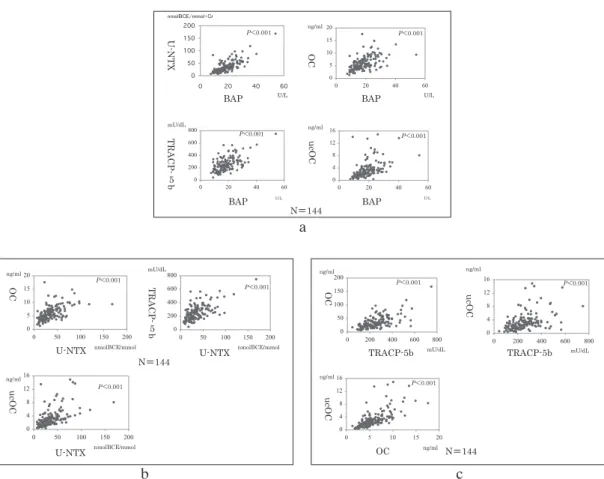
 In the total group, significant differences between parameters were observed for BAP,

urine NTX, OC, ucOC, and TRACP-5b (P < 0.05 to P < 0.001 ; Fig. 1a-c) . No correlations

(3)

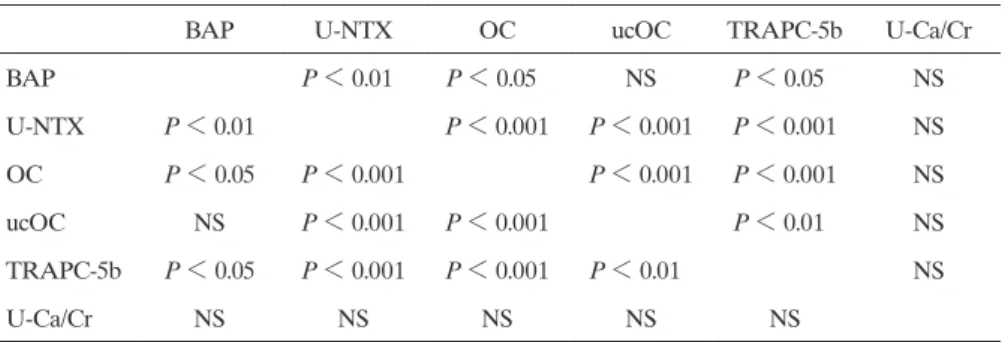
with urine Ca/Cr were observed (Table 1) . In the treated group, significant correlations between BAP, urine NTX, OC, ucOC, and TRACP-5b were observed (Table 2) . No cor- relations with urine Ca/Cr were apparent. In the untreated group, no significant correlation was observed between BAP and ucOC, but correlations between BAP, urine NTX, OC, ucOC, and TRACP-5b were observed (Table 3) . No correlation was seen between urine Ca/Cr and any other parameter.

Discussion

 Clinical measurement of bone metabolism markers enables the condition of bony tissue/

bone metabolism to be assessed

1)

, allows prediction of fracture risk

4, 5)

and risk of bone loss in the near future

2)

, and enables drug therapies for osteoporosis to be practically assessed.

In addition, conveying these results to patients can help increase patient compliance in taking osteoporosis medications. Results can also be used to screen for bone metastases from tumorous lesions

6)

. Changes in bone metabolism markers can occur due to age, sex,

a

b c

Fig. 1.   Correlation between bone metabolism markers in the total group. Significant correlations were

observed between BAP, urine NTX, TRACP-5b, OC, and ucOC.

(4)

Table 1.  Correlations between parameters in the total group.

N=144

BAP U-NTX OC ucOC TRAPC-5b U-Ca/Cr

BAP P < 0.001 P < 0.001 P < 0.001 P < 0.001 NS

U-NTX P < 0.001 P < 0.001 P < 0.001 P < 0.001 NS

OC P < 0.001 P < 0.001 P < 0.001 P < 0.001 NS

ucOC P < 0.001 P < 0.001 P < 0.001 P < 0.001 NS

TRAPC-5b P < 0.001 P < 0.001 P < 0.001 P < 0.001 NS

U-Ca/Cr NS NS NS NS NS

Significant correlations were observed between urine NTX, BAP, TRACP-5b, OC, and ucOC.

Urine Ca/Cr levels did not correlate with any parameter.

Table 2.  Correlations between parameters in the treated group.

N=113

BAP U-NTX OC ucOC TRAPC-5b U-Ca/Cr

BAP P < 0.001 P < 0.001 P < 0.001 P < 0.001 NS

U-NTX P < 0.001 P < 0.001 P < 0.001 P < 0.001 NS

OC P < 0.001 P < 0.001 P < 0.001 P < 0.001 NS

ucOC P < 0.001 P < 0.001 P < 0.001 P < 0.001 NS

TRAPC-5b P < 0.001 P < 0.001 P < 0.001 P < 0.001 NS

U-Ca/Cr NS NS NS NS NS

Significant correlations were observed between urine NTX, BAP, TRACP-5b, OC, and ucOC.

Table 3.  Correlations between parameters in the untreated group.

N=31

BAP U-NTX OC ucOC TRAPC-5b U-Ca/Cr

BAP P < 0.01 P < 0.05 NS P < 0.05 NS

U-NTX P < 0.01 P < 0.001 P < 0.001 P < 0.001 NS

OC P < 0.05 P < 0.001 P < 0.001 P < 0.001 NS

ucOC NS P < 0.001 P < 0.001 P < 0.01 NS

TRAPC-5b P < 0.05 P < 0.001 P < 0.001 P < 0.01 NS

U-Ca/Cr NS NS NS NS NS

Although no correlation was observed between BAP and ucOC, correlations were observed

between urine NTX, BAP, TRACP-5b, OC, and ucOC.

(5)

menopause, drugs, fracture

3)

, diabetes mellitus, and thyroid dysfunction

7, 8)

. In general, bone metabolism becomes more active at night than during the day, and after decreasing in the afternoon, almost all markers of bone metabolism are present at high levels at night then decrease in the morning

9, 10)

. As a result, samples must be taken within the same time frame. In the present study, most of the patients had primary osteoporosis, and their results could not be compared to the results from the 3 patients with secondary osteoporosis because of the small number. By increasing the number of subjects, we hope to conduct further analyses on correlations between bone metabolism markers and the causes of osteo- porosis, such as in patients with steroid-induced secondary osteoporosis.

 Various types of bone metabolism markers are known, but the present study only measured BAP, urine NTX, OC, ucOC, and TRACP-5b. The results revealed correlations between the various markers. Hosoi

11)

reported that TRACP-5b and NTX were significantly correlated (P < 0.0001) . Both are regarded as effective markers for ascertaining the condi- tion of bone metabolism in osteoporosis. However, each of these markers has a very wide range of normal values, ranging from 1 to 3 decimal places. This wide range of normal values can be advantageous in conducting drug therapy. If markers of bone metabolism show a large improvement, patient compliance in the clinical setting can increase, as larger variations in values appear to reflect drug efficacy more acutely than small variations. We believe that U-NTX is a more useful marker for the evaluation of bone resorption ; on the other hand, BAP is more useful as an osteoplastic marker. In addition, although two types of bone metabolism markers are available (bone resorption markers and osteoplastic markers) , the therapeutic effect of osteoporosis drugs is better assessed in clinical practice when the same type of bone metabolism marker is tested, rather than changing the type of marker with each test. In the present study, urine Ca/Cr levels showed no correlation with any other marker of bone metabolism in either the total group, untreated group, or treated group. However, we reported previously that significant differences in urine Ca/Cr levels are effective for assessing therapeutic effects

12)

. In view of the results from the present study, although problems remain with the use of urine Ca/Cr levels as a single indicator of bone metabolism, it is still a necessary parameter for the early detection of hypercalciuria.

 In the total group and the treated group, ucOC correlated with urine NTX, BAP, OC, and TRACP-5b. However, there was no correlation between ucOC and BAP in the untreated group. Although ucOC is a marker of bone metabolism, it is also useful as an indicator of the state of vitamin K intake

13)

. Vitamin K has an effect on the blood coagu- lation system, but an antagonistic action occurs when vitamin K is administered to patients taking the anticoagulant warfarin. As a result, caution is necessary when administering vitamin K to patients on warfarin. Vitamin K also functions as a coenzyme of γ -glutamyl carboxylase. Gamma-glutamyl carboxylase catalyzes the carboxylation of glutamate (Glu)

residues in vitamin-K-dependent proteins to produce γ -carboxyglutamate (Gla) residues. A

negative correlation exists between the formation of Gla and osteoporotic fractures

14, 15)

.

(6)

Low Gla-osteocalcin blood levels were reportedly more common in a group of patients with fractures than in a control group, and the incidence of new femoral neck fracture was higher in the group with a higher incidence of low Gla-osteocalcin blood levels

14)

. Only 2 subjects were taking warfarin in the present study. The ucOC level was slightly higher in case 1 and remarkably higher in case 2 than the average level (Table 4) . We think ucOC level was higher in the warfarin treated group because the intake of vitamin K was restricted in that group.

 The ultimate objective of osteoporosis treatment is fracture prevention. Although mark- ers of bone metabolism are useful for their evaluative and predictive properties, conducting simultaneous tests with many markers is not economical. ucOC is a marker of bone metabolism, and also indicates the state of vitamin K intake. Based on the results from this study, the correlations between both bone resorption markers and osteoplastic markers identified ucOC as the best universal bone metabolism marker to use in the clinical setting.

Acknowledgements

 The present study was conducted as part of a series sponsored by the Japan Osteoporosis Foundationʼ s 3rd Asahi Kasei QOL Research Fund.

References

1) Nenonen A, Cheng S, Ivaska KK, Alatalo SL, Lehtimäki T, Schmidt-Gayk H, Uusi-Rasi K, Heinonen A, Kannus P, Sievänen H, Vuori I, Väänänen HK and Halleen JM : Serum TRACP 5b is a useful marker for monitoring alendronate treatment : comparison with other markers of bone turnover. J Bone Miner Res 20 : 1804-1812 (2005)

2) Shidara K, Inaba M, Okuno S, Yamada S, Kumeda Y, Imanishi Y, Yamakawa T, Ishimura E and Nishizawa Y : Serum levels of TRAP5b, a new bone resorption marker unaffected by renal dysfunction, as a useful marker of cortical bone loss in hemodialysis patients. Calcif Tissue Int 82:278-287 (2008)

3) Ingle BM, Hay SM, Bottjer HM and Eastell R : Changes in bone mass and bone turnover following distal forearm fracture. Osteoporos Int 10:399-407 (1999)

4) Szulc P, Chapuy MC, Meunier PJ and Delmas PD : Serum undercarboxylated osteocalcin is a maker of the risk of hip fracture : a three year follow-up study. Bone 18:487-488 (1996)

5) Luukinen H, Käkönen SM, Pettersson K, Koski K, Laippala P, Lövgren T, Kivelä SL and Väänänen HK : Strong prediction of fractures among older adults by the ratio of carboxylated to total serum osteocalcin. J Bone Miner Res 15:2473-2478 (2000)

6) Jablonka F, Schindler F, Lajolo PP, Pinczowski H, Fonseca FL, Barbieri A, Massonetto LH, Katto FT and Del Giglio A : Serum cross-linked n-telopeptides of type 1 collagen (NTx) in patients with solid tumors. Sao Paulo Med J 127:19-22 (2009)

Table 4.  Osteoclastic and osteoplastic markers of the warfarin-treated group.

(normal value) ucOC

(ng/ml)

(〜 4.5)

U-NTX

(nmolBCE/mmol ・ Cr)

(9.3 〜 54.3)

(U/L) BAP

(7.9 〜 29.0)

(ng/ml) OC

(3.1 〜 12.7)

TRACP-5b

(mU/dl)

(120 〜 420)

Case 1 4.58 19.8 15.1  4.0 166

Case 2 8.31 22.7 17.6 17.6 225

(7)

7) Christensen JO and Svendsen OL : Bone mineral in pre- and postmenopausal women with insulin-dependent and non-insulin-dependent diabetes mellitus. Osteoporos Int 10:307-311 (1999)

8) Engler H, Oettli RE and Riesen WF : Biochemical markers of bone turnover in patients with thyroid dysfunc- tions and in euthyroid controls : a cross-sectional study. Clin Chim Acta 289:159-172 (1999)

9) Eastell R, Calvo MS, Burritt MF, Offord KP, Russell RG and Riggs BL : Abnormalities in circadian patterns of bone resorption and renal calcium conservation in type I osteoporosis. J Clin Endocrinol Metab 74:487-494

(1992)

10) Eastell R, Simmons PS, Colwell A, Assiri AM, Burritt MF, Russell RG and Riggs BL : Nyctohemeral changes in bone turnover assessed by serum bone Gla-protein concentration and urinary deoxypyridinoline excretion : effects of growth and ageing. Clin Sci 83:375-382 (1992)

11) Hosoi T : Clinical implications of undercarboxylated osteocalcin. Clin Calcium 19:1815-1821 (2009)(in Japanese)

12) Nagai T, Sakamoto K and Miyaoka H : The effect of bisphosphonate (Risedronate) on bone metabolic marker and urinary calcium excretion in patients with osteoporosis. Orthop Surg 56:1302-1305 (2003) (in Japanese)

13) Shiraki M, Shiraki Y, Aoki C and Miura M : Vitamin k2 (menatetrenone) effectively prevents fractures and sustains lumbar bone mineral density in osteoporosis. J Bone Miner Res 15:515-521 (2000)

14) Szulc P, Chapuy MC, Meunier PJ and Delmas PD : Serum undercaroxylated osteocalcin is a marker of the risk of hip fracture in elderly women. J Clin Invest 91:1769-1774 (1993)

15) Vergnaud P, Garnero P, Meunier PJ, Bréart G, Kamihagi K and Delmas PD : Undercarboxylated osteocalcin measured with a specific immunoassay predicts hip fracture in elderly women : the EPIDOS study. J Clin Endocrinol Metab 82:719-724 (1997)

[Received April 5, 2011 : Accepted May 9, 2011]

Fig. 1.   Correlation  between  bone  metabolism  markers  in  the  total  group.  Significant  correlations  were  observed  between  BAP,  urine  NTX,  TRACP-5b,  OC,  and  ucOC.
Table 3.  Correlations  between  parameters  in  the  untreated  group.
Table 4.  Osteoclastic  and  osteoplastic  markers  of  the  warfarin-treated  group.

参照

関連したドキュメント

In our paper we tried to characterize the automorphism group of all integral circulant graphs based on the idea that for some divisors d | n the classes modulo d permute under

The construction proceeds by creating a collection of 2 N −1 demipotent elements, which we call diagram demipotents, each indexed by a copy of the Dynkin diagram with signs attached

In this section we describe the structure of fixed subgroups of exponential au- tomorphisms where the fixed subgroup has rank one less than the ambient free group.. In order to do

We present sufficient conditions for the existence of solutions to Neu- mann and periodic boundary-value problems for some class of quasilinear ordinary differential equations.. We

Answering a question of de la Harpe and Bridson in the Kourovka Notebook, we build the explicit embeddings of the additive group of rational numbers Q in a finitely generated group

Then it follows immediately from a suitable version of “Hensel’s Lemma” [cf., e.g., the argument of [4], Lemma 2.1] that S may be obtained, as the notation suggests, as the m A

Definition An embeddable tiled surface is a tiled surface which is actually achieved as the graph of singular leaves of some embedded orientable surface with closed braid

We give a Dehn–Nielsen type theorem for the homology cobordism group of homol- ogy cylinders by considering its action on the acyclic closure, which was defined by Levine in [12]