How do high performance work practices influence turnover intention in China?
Focusing on the mediating role of organizational commitment
Xingchen Wang (Meiji University) Soyeon Kim (Shujitsu University)
Abstract
Managing and sustaining talents is important for organizational success. The present study investigated the influence and internal mechanism of high performance work practices (HPWP) on employee’s turnover intention in China. With a survey data from 257 civil servants in China, the study intended to clarify the relationships among HPWP, organizational commitment, and turnover intention. The finding shows that HPWP positively influences organization commitment, which in turn reduces turnover intention. Furthermore, it reveals that organizational commitment partially mediates the relationship between ability- and motivation-related HPWP and turnover intention while it fully mediates the relationship between opportunity-related HPWP and turnover intention.
Based on the findings, contributions and limitations were suggested.
Keywords : high performance work practices, organizational commitment, turnover intention, China
Introduction
Sustaining quality employees is important for organizational performance. Thus, employee’s turnover intention is a vital indicator to determine potential organizational performance and competitiveness. In accordance with fierce competition in the labor market in China, it becomes difficult to recruit and sustain talents. Indeed, a recent survey on human resources in China indicates that Chinese companies have high turnover rates in particular among young people (ZLRA, 2015). It also shows that such pattern is notable in the governmental and public sectors, which indicates a drastic increase of turnover rate in 2015, 34% more than that in the previous year. Such outflow of talents from the public sectors in China will cause a serious problem in terms of sustaining competitiveness of the public sectors, thus an academic attention to the issue should be made to solve the problem.
Employees' turnover entails high costs in organizations due to the loss of resources allocated to all the processes of recruiting and training employees. A study shows that the cost paid for the replacement resulted from a turnover is almost two times more than the remuneration paid for an employee (Kepner-Tregoe Business Issues Research Group, 1999). Also, employee turnover results in the invisible and hidden costs such as decreased performance derived from discontinuity
in works, disconnected customer relationships, and further loss in business opportunities (Danford et al., 2008; Hancock, et al., 2013; Chang, 1999), which consequently raises possibility of organizational failure (Harley, 2007). Given such costs expected from employee turnover, more attention and preparation on employee turnover should be made in organizations.
Research on employee turnover showed that organizational factors are closely related to employee turnover. It was found that human resource management (HRM) practices determine employee turnover (Karatepe, 2013). Studies have evidenced that HRM practices contribute to changing employee attitudes and behaviors, which finally determines organizational outcomes (Huselid, 1995). Research further highlighted that HRM practices, particularly those related to performance, which is called as high performance work practices (hereafter referred to as HPWP) have significant effects on organization. Because HPWP is more closely associated with works of employees and working conditions for them, it has a significantly direct effect on employees' work moral and motivation. Structurally organized HPWP to enhance employees’ knowledge, skills, and capacities helps them to work better, which results in higher organizational performance (Paul, 2010). Considering the strategic and practical importance of HPWP, the present study intended to elucidate the effects of HPWP on employees in organization. Building on the theoretical framework of AMO model and social exchange theory (Blau, 1964), the study aimed to clarify the direct effect and the internal mechanism of HPWP on turnover intention. Furthermore, noticing the lack of such study in the Asian public sector (Wang, 2014; Bordia et al., 2017), the present study investigated such issue in that area. The study first reviews relevant literature, and the method applied and analysis are explained. Based on the findings, theoretical and practical implications are suggested.
Literature review and hypotheses development HPWP and AMO model
HPWP comprised of performance-focused HRM practices was evidenced to have a direct association with the changes in employee’s attitudes and behaviors (Gong et al., 2009; Kehoe &
Wright, 2013). Research on HPWP have documented that they draw positive and quality outcome and also financial performance in organization. AMO model suggests that HPWP works in the three main areas: 1) fostering ability, 2) enhancing motivation and commitment, and 3) increasing opportunities to participate and information sharing (Appelbaum, et al., 2000; Combs et al., 2006). Thus, HPWP includes main HRM practices spanning those of skill and career development, training, rewards, performance evaluation, and communication and participation (Chuang & Liao, 2010; Jensen et al., 2013).
Organizational commitment and turnover intention
Organizational commitment is defined by “an emotional attachment to, identification with, and involvement in the organization” (Meyer & Allen, 1990, p. 63). Organizational commitment is considered important in determining positive outcomes. It was evidenced that organizational commitment increases quality work outcomes and working behaviors such as organizational citizenship behaviors, and also enhances performance (Czarniawska, 2001). Research suggests that organizational commitment among employees is engendered when employees understand and share organizational values (Meyer et al., 2002). According to social exchange theory (Blau, 1964), employees are committed to an organization whose structure and system make them feel supported. Given that organizational commitment, termed as a “psychological bond” between employee and employer (Meyer & Allen, 1997, p. 14) is influenced by organizational conditions, such organizational factors that positively influence organizational commitment should be clarified. Turnover intention is defined as “a conscious and deliberate willfulness to leave the organization” (Tett & Meyer, 1993, p. 262). Because behaviors are followed by plan and intentions, such turnover intention has a high potential to consequently link to turnover (Lee & Jimenez, 2011;
Mowday et al., 1984). Thus, as a critical surrogate of potential actual turnover, turnover intention and its determining factors should be in consideration for clarification.
The effect of HPWP on turnover intention
Researchers argue that HPWP positively influences organizational outcomes (Ramsay et al., 2000;
Gong et al., 2009; Kehoe & Wright, 2013). Employees feel supported by HPWP which is designed to provide more skill and capability development and training for employees, opportunities to be a part of decision making, and also enhance motivation to work. Such feeling supported from organization makes employees to continue their membership with the organization, which resigns other opportunities or alternatives to work at another company and consequently, lessen their turnover intention. Therefore, this suggests the following assumption between HPWP and turnover intention.
H1. HPWP is negatively related to employees’ turnover intention.
The mediating effect of organizational commitment
Determinants of organizational commitment have been well documented (Meyer & Allen 1997;
Cohen, 2003). Social exchange theory posits that employer and employee are in an exchange relationship such that they reciprocate each other (Blau, 1983). So, if an employer provides monetary and non-monetary benefits to employees, employees return some commensurate with
those they receive from the employer. HPWP which is structured to support employees in terms of fostering their human, psychological, and social capitals let employees feel supported and satisfied.
Thus, employees return such provisions by showing more committed and positive working behaviors. Such commitment derived from HPWP strengthens organizational membership, which leads employees to be boned with organization and eager to achieve an organizational goal as a part of it (Wright & Gardner, 2003; Cohen, 2003; Kehoe & Wright, 2013). Therefore, those with such bonding and devotion to an organization are less likely to leave the organization (Mayer &
Allen, 1997). This suggests organizational commitment as a mediator that links HPWP to turnover intention. Therefore, such rationale draws the following hypothesis:
H2. Organizational commitment mediates the relationship between HPWP and turnover intention
Methods Data collection and measures
A Chinese version of survey was prepared and with cooperation of HR managers in organizations, it was distributed to 350 civil servants. They are working for the three major departments of the local government in Yunnan Province, Shangri-la; Bureau of Finance, Commission of CPC (Communist Party of China) Discipline Inspection and Bureau of Foreign Business Affaire. Among 350 surveys distributed, 267 responses were returned, which indicates a response rate of 76.2%.
Removing the responses with missing information left 257 usable data for the analysis. Among those, male and female employees were almost equal in numbers (male=130, female=127). Most of them were highly educated; 80.5% of them were 4-year university graduates and post graduates.
Positions were dispersed from entry to top-level positions; 71.2% of them were at their entry, first and second level managerial positions. Also, average current tenure of them was 8 years and 4 months.
Items on the survey were used by the established scales. HPWP was measured following previous research (Appelbaum et al., 2000; Kroon et al., 2013). The items comprise of sub- dimensions of ability, motivation, and opportunity. Five items were used to refer to HPWP related to employee’s ability enhancement. A sample item is “The organization offers the possibility to develop skills.” Motivation-related HPWP included six items whose sample items are “Employees receive a bonus or another financial reward beside their normal wage,” and “Employees are informed about all future plans of the organization.” Opportunity-related HPWP used three items.
A sample item is “Employees are involved in policy-making.” Organizational commitment was measured using five items based on the prior research (Meyer & Allen, 1997; Kehoe & Wright,
2013). A sample item is “I am willing to work harder to help this company succeed.” Turnover intention was measured using four items (Kehoe & Wright, 2013; Van Breukelen et al., 2004). A sample item is “I plan to spend my career at this organization.” In the analysis, it was reversed to indicate turnover intention. All items included in the survey were measured using a five-point scale that ranged from 1 (strongly disagree) to 5 (strongly agree). Control variables included demographic information of respondents, which included age, gender, education level, position, organization tenure (the length of working for the current organization), and department dummies.
Results Descriptive Statistics & Correlation Analysis
Table 1 shows the mean, standard deviation, and correlations among variables. It shows that HPWP, organizational commitment (OC), and turnover intention (TI) are significantly correlated.
HPWP is significantly correlated with OC (r = 0.71, p < 0.01) and also with TI (r = -0.73, p < 0.01).
OC is also significantly correlated with TI (r = -0.72, p < 0.01). To test hypotheses, regression analysis was conducted. Table 2 indicates the findings from the analysis. Model 1 includes only control variables. The finding shows that the variables explain 6.2% of the total variance of TI.
Among the demographic variables, it shows that education is related with TI (β = -0.159, p < 0.1), which implies that the higher educated employees are, the less they intend to leave organization.
Model 2 added HPWP and it shows that HPWP has a significant negative effect on TI (β = -0.949, p < 0.01). This suggests that HPWP decreases turnover intention among employees, thus the finding supports hypothesis 1. To test the mediation effect of organizational commitment, control variables and HPWP were regressed on OC in Model 3. The finding indicates that HPWP is significantly related to OC (β = 0.780, p < 0.01). As we assumed, HPWP was found to enhance OC among employees. Model 4 shows the finding from the regression analysis by adding OC to Model 2.
The finding reports that both HPWP and OC have significant negative effects on TI, but the effect of HPWP on TI has been reduced (β = -0.949, p < 0.01 to β = -0.583, p < 0.01), which supports the conditions of mediation test (Baron & Kenny, 1986). Thus, hypothesis 2 was supported by proving the mediating effect of OC on the relationship between HPWP and TI.
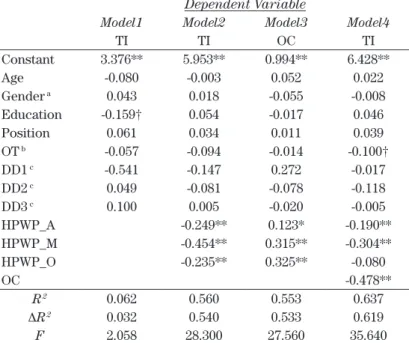
Given the multi-dimensionality of HPWP, an additional test was conducted to clarify the relationships of each dimension of HPWP, OC, and TI. Model 2 in Table 3 indicates that all three dimensions of HPWP; Ability-related HPWP (HPWP_A), Motivation-related HPWP (HPWP_M), and Opportunity-related HPWP (HPWP_O) have significantly negative effects on OC (β = -0.249, p < 0.01; β = -0.454, p < 0.01; β = -0.235, p < 0.01, respectively). Model 3 also indicates that they are positively related to OC (β = 0.123, p < 0.05; β = 0.315, p < 0.01; β = 0.325, p < 0.01, respectively).
In Model 4 which added OC to Model 2, the finding indicated that adding OC reduced the
effect size of the three dimensions on TI. Interestingly, the effect of HPWP_O on TI becomes insignificant, which implies a full mediation of OC on the relationship between HPWP_O and TI.
Discussion Conclusion
Building on AMO model and social exchange theory, the study investigated the relationships among HPWP, organizational commitment, and turnover intention in the Chinese public sector.
The findings clarified that HPWP has a significantly positive effect on OC, which is in line with the prior findings (Ramsay et al., 2000; Gong et al., 2009; Kehoe & Wright, 2013). Importantly, it revealed that OC mediates the relationship between HPWP and TI. The finding highlights the managerial significance of OC in the realm of human resource management. It confirmed how HPWP is connected to positive organizational outcome by clarifying the mediating role of OC.
From the additional analysis, it was found that all the sub-dimensions of HPWP are important to increase organizational commitment. Specifically, the finding indicated that motivation- and opportunity-related HPWP relatively have more effects on OC than ability-related HPWP.
Interestingly, it further showed that opportunity-related HPWP are fully mediated by OC to determine TI, which elucidates the internal mechanism generated by each sub-dimension of HPWP.
Given the complex and fast changing labour market in China, the findings from the study provide practical implications. When retaining human resources in China, human resources practices which enhance human, psychological, and also social capital of employees should be adopted and strategically implemented. Particularly, motivation- and opportunity-related practices would enhance employees’ strong attachment and bonding to organizations. The characteristics of young generation and their pursuing work values are different from those of previous generation. So, to properly manage and keep them in organization, AMO-based practices should be devised and implemented. The strategic management of human resources with the proper use of HPWP would contribute to sustaining organizational competitiveness by reducing outflow of quality human resources.
Limitations and Further Research
In spite of the contributions from the findings, some limitations should be addressed. First is related to generalization issue of the study. China is a huge country which is various in cultures depending on areas. Thus, the finding observed here may not be applicable to other areas of China.
Therefore, future study should test and confirm the findings in other parts of China. Second, organizational structure or culture may influence organizational commitment; however, this
study didn’t control the potential influences of such factors. Thus, future study needs to clarify the effects of such factors to ensure the refined effect of HPWP on employees. This is hoped that findings from the study inspire other relevant studies in this domain of research.
References
Appelbaum, E., Bailey, T., Berg, P., & Kalleberg, A. (2000). Manufacturing Advantage: Why High- Performance Work Systems Pay Off. Ithaca: Cornell University Press.
Bordia, P., Restubog, S., & Tang, R. (2017). Effects of Resource Availability on Social Exchange Relationships: The Case of Employee Psychological Contract Obligations. Journal of Management, 43(5), 1447-1471.
Blau, M. P. (1964). Exchange and Power in Social Life. New York: Wiley.
Blau, P. M. (1983). On the Nature of Organizations. Malabar, FL: Krieger.
Chang, E. (1999). Career commitment as a complex moderator of organizational commitment and turnover intention. Human relations, 52(10), 1257-1278.
Chuang, C.H., & Liao, H.U.I. (2010). Strategic Human Resource Management in Service Context:
Taking Care of Business by Taking Care of Employees and Customers. Personnel Psychology, 63(1), 153-196.
Combs, J., Liu, Y., Hall, A., & Ketchen, D. (2006). How Much Do High-performance Work Practices Matter? A Meta-analysis of Their Effects on Organizational Performance. Personnel Psychology, 59(3), 501-523.
Czarniawska, B. (2001). Anthropology and Organizational Learning. In M. Dierkes, A. Berthoin Antal, J. Child & I. Nonaka (Eds.), Handbook of Organizational Learning and Knowledge (118-136). Oxford, UK: Oxford University Press.
Cohen, A. (2003). Multiple Commitments in the Workplace An Integrative Approach. Mahwah, NJ: Erlbaum.
Danford, A., Richardson, M., Stewart, P., Tailby, S., & Upchurch, M. (2008). Partnership, High Performance Work Systems and Quality of Working Life. New Technology, Work and Employment, 23(3), 51-166.
Gong, Y., Law, K. S., Chang, S., & Xin, K. R. (2009). Human Resource Management and Firm Performance in China: The Different Role of Managerial Affective and Continuance Commitment. Journal of Applied Psychology, 94(1), 263-275.
Hancock, J. I., Allen, D. G., Bosco, F. A., McDaniel, K. R., & Pierce, C. A. (2013). Meta-analytic review of employee turnover as a predictor of firm performance. Journal of Management, 39(3), 573-603.
Huselid, M. A. (1995). The Impact of Human Resource Practices on Turnover, Productivity, and
Corporate Financial Performance. Academy of Management Journal, 38(3), 635-667.
Harley, B., Allen, B., & Sargent, L. (2007). High Performance Work Systems and Employee Experience of Work in the Service Sector: The Case of Aged-care. British Journal of Industrial Relation, 45(3), 607-633.
Jensen, M. J., Patel, P. C., & Messersmith, J. G. (2013). High-performance Work Systems and Job Control: Consequences for Anxiety, Role Overload, and Turnover Intentions. Journal of Management, 39(6), 1699-1724.
Karatepe, O. M. (2013). High-performance work practices, work social support and their effects on job embeddedness and turnover intentions. International Journal of Contemporary Hospitality Management, 25(6), 903-921.
Kepner-Tregoe Business Issues Research Group. (1999). Avoiding the Brain Drain: What Companies Are Doing to Lock in Their Talent. Princeton, NJ:Kepner-Tregoe.
Kehoe, R. R. & Wright, P. M. (2013). The impact of high-performance human resource practices on employees’ attitudes and behaviors. Journal of Management, 39(2), 366-391.
Kroon, B., Van De Voorde, K., & Timmers, J. (2013). High performance work practices in small firms: a resource-poverty and strategic decision-making perspective. Small Business Economics, 41(1), 71-91.
Lee, G., & Jimenez, S. B. (2011). Does Performance Management Affect Job Turnover Intention in the Federal Government? The American Review of Public Administration, 41(2), 168-184.
Mowday, R. T. Koberg, C. S., & McArthur, A. W. (1984). The Phycology of Withdrawal Process: A Cross-validation Test of Mobley’s Intermediate Linkage Model of Turnover in Two Samples.
Academy of Management Journal, 27(1), 79-94.
Meyer, J.P., & Allen, N.A. (1990). A Three-component Conceptualization of Organizational Commitment. Human Resource Management Review, 1(1), 62-89.
Meyer, J. P., & Allen, N. J. (1997). Commitment in the Workplace. Thousand Oaks, CA: Sage.
Meyer, J. P., Stanley, D., Herscovitch, L., & Topolnytsky, L. (2002). Affective, Continuance, and Normative Commitment to the Organization: A Meta-analysis of Antecedents, Correlates, and Consequences. Journal of Vocational Behavior, 61(1), 20-52.
Paul, B. (2010). High Performance Work Practices in the Health Care Sector: A Dutch Case Study.
International Journal of Manpower, 31(1), 42-58.
Ramsay, H., Scholarios, D., & Harley, B. (2000). Employees and High-performance Work Systems:
Testing Inside the Black Box. British Journal of Industrial Relations, 38(4), 501-531.
Tett, R. P., & Meyer, J. P. (1993). Job satisfaction, organizational commitment, turnover intention, and turnover: path analyses based on meta‐analytic findings. Personnel psychology, 46(2), 259- 293.
Van Breukelen, W., Van der Vlist, R., & Steensma, H. (2004). Voluntary employee turnover:
Combining variables from the “traditional” turnover literature with the theory of planned behavior. Journal of Organizational Behavior, 25(7), 893-914.
Wang, M. M. (2014). Research Indicates Service Industry Face the Severest Turnover Issue Public Servers Join the Job-hopping, Xinhua Newspaper. Retrieved February 16, 2015, from
http://news.xinhuanet.com/fortune/2014-02/12/c_119295670.htm
Wright, P. M., & Gardner, T. M. (2003). The Human Resource Firm Performance Relationship:
Method-logical and Theoretical Challenges, In Holman, D., Wall, T. D., Clegg, C. W., Sparrow, P.
and Howard, A. (Eds), The New Workplace: A Guide to the Human Impact of Modern Working Practices. Chichester: Wiley, 311-328.
Zhi Lian Recruitment Agency. (2015). 2015 Spring Talent Flow Analysis Report. Retrieved February 2, 2015, from http://edu.southcn.com/e/2015-04/23/content_122874699.htm
Tables Table 1. Mean, standard deviation, and correlations among variables (n=257
) VariableMeanS.D.1234567891011121314 1. Age2.821.681 2. Gendera0.490.500.051 3. Education4.950.67-0.05-0.001 4. Position2.591.350.35**0.120.25**1 5. OTb4.151.020.82**0.020.040.40**1 6. DD1c0.030.16-0.0110.0737-0.05-0.00-0.011 7. DD2c0.230.42-0.14*-0.070.110.21**-0.08-0.091 8. DD3c0.600.490.040.04-0.04-0.19**0.02-0.20**-0.67**1 9. HPWP_A3.950.710.05-0.000.14*-0.030.010.050.03-0.041 10. HPWP_M3.620.790.17**0.020.17**0.070.12*0.13*-0.08-0.010.55**1 11. HPWP_O3.880.880.04-0.050.14*0.030.070.05-0.04-0.020.53**0.51**1 12. HPWP3.790.650.12*-0.000.18**0.030.090.10-0.04-0.030.82**0.88**0.76**1 13. OC3.860.740.20**0.01-0.08-0.02-0.16**-0.100.02-0.010.51**0.63**0.63**0.71**1 14. TI2.360.85-0.17**0.01-0.08-0.02-0.16**-0.100.020.04-0.57**-0.66**-0.57**-0.73**-0.72**1 Note: Gender a : male =1, female=0, OT b = ln
(month
) DD1 c, DD2 c, DD3 c : Department Dummies, ** p<0.01, * p<0.05
Table 2. Regression analysis for the relationship among HPWP, AC, and TI (n=257) Dependent Variable
Model1 Model2 Model3 Model4
TI TI OC TI
Constant 3.376** 6.031** 0.901** 6.453**
Age -0.080 -0.001 0.036 0.016
Gender a 0.043 0.023 -0.072 -0.011
Education -0.159† 0.053 -0.020 0.043
Position 0.061 0.029 0.019 0.038
OT b -0.057 -0.098 0.007 -0.094
DD1 c -0.541 -0.157 0.245 -0.042
DD2 c 0.049 -0.056 -0.127 -0.116
DD3 c 0.100 0.012 -0.040 -0.007
HPWP -0.949** 0.780** -0.583**
OC -0.468**
R2 0.062 0.556 0.526 0.634
∆R2 0.032 0.540 0.509 0.620
F 2.058 34.340 30.490 42.690
Note: Gender a : male =1, female=0 , OT b = ln(month) DD1 c, DD2 c, DD3 c : Department Dummies,
** p<0.01, * p<0.05, †p<0.1
Table 3. Regression Result: three sub-dimensions of HPWP (n=257) Dependent Variable
Model1 Model2 Model3 Model4
TI TI OC TI
Constant 3.376** 5.953** 0.994** 6.428**
Age -0.080 -0.003 0.052 0.022
Gender a 0.043 0.018 -0.055 -0.008
Education -0.159† 0.054 -0.017 0.046
Position 0.061 0.034 0.011 0.039
OT b -0.057 -0.094 -0.014 -0.100†
DD1 c -0.541 -0.147 0.272 -0.017
DD2 c 0.049 -0.081 -0.078 -0.118
DD3 c 0.100 0.005 -0.020 -0.005
HPWP_A -0.249** 0.123* -0.190**
HPWP_M -0.454** 0.315** -0.304**
HPWP_O -0.235** 0.325** -0.080
OC -0.478**
R2 0.062 0.560 0.553 0.637
∆R2 0.032 0.540 0.533 0.619
F 2.058 28.300 27.560 35.640
Note: Gender a : male =1, female=0 , OT b = ln(month) DD1 c, DD2 c, DD3 c : Department Dummies
** p<0.01, * p<0.05, †p<0.1