Quantum chemistry study for uranyl nitrate complexes
Yoshihiro Oda* Tomozo Koyama* Hideyuki Funasaka*
The structure and stability of the aqua uranyl nitrate complexes were studied by using the density functional theory code with the basis set including the relativistic effects. If only two water molecules of the first coordination sphere are concerned in the calculation, the bond lengths and angles of the optimized structure do not show a good agreement with the experimental values. But these values are improved by considering the influence of outer four water molecules of the second coordination sphere in hexahydrate, which have hydrogen bonding with inner water molecules. The optimized structure determined for hexahydrate by DMol3 showed better agreement with the reported experimentally determined structure than Gaussian 92 showed. These results suggest that the water molecules of second coordination sphere have an important role at the complex structures and stability. In other words, the solvent effect is not negligible for the ligands like water.
Keywords: aqua uranyl nitrate complex, density functional theory, solvent effect, DMol3
1 Introduction
For the reprocessing of spent nuclear fuels, aqua uranyl nitrate complex is the most important and familiar actinide complex, since it has an important role in the chemical process in the nuclear industry, especially in solvent extraction. In order to improve the solvent extraction process, so many extractants have been extensively researched and developed based on a lot of empirical data concerning the chemical processes.
Furthermore, many experiments have been carried out to elucidate the extraction mechanism. But very few attempts have been made for quantitative theoretical work on the aqua uranyl nitrate complex structure and stability. The aqua uranyl nitrate complex is most familiar and most important complex in the reprocessing process. Because the structure and stability of aqua uranyl nitrate complex are well known through experimental study by many researchers, they are very important and useful to calculate other actinide cmopexes.
There are several reports of the study of ab initio molecular orbital calculations for actinide complexes [1-6]. The solvent effects to the complex structure and stability are not discussed in detail. Only Spencer’s have reported the solvent effect for the hydration of UO22+ and PuO22+ [3] by employing the ellipsoidal cavity model by Onsager. In Onsager’s model, the solvent effect is introduced by the relative dielectric constant of the solvent.
Then the relative dielectric constant plays key role in this method. But in the nitric acid solution, this value is highly sensitive to pH value and the metal ion concentration, and was not determined for aqua uranyl nitrate complex. In addition, pH value and the metal ion concentration influence the coordination number [7]. Thus, we studied the solvent effects by comparing the calculation result of uranyl with closely binding ligands and with including the secondary coordinating ligands, with concerning the outer water molecules as solvent.
2 Computational Methods and Models
2.1 Calculation models
The structural studies for some uranyl nitrate complexes have been performed by several experimental methods [8-17]. The structure of aqua uranyl nitrate complex was determined by X-ray [10] and neutron diffraction data [17]. Especially, the neutron diffraction data shows the hydrogen positions in water molecule. From these reports, the structure of uranyl nitrate complex is approximately a hexagonal bipyramidal arrangement of eight oxygen atoms around the central uranium atom. Although, it is well known that the aqua uranyl nitrate complex can take various number of water molecules [18], here, we chose the basic common structure of uranyl with two nitrate groups and two closely binding water molecules:
[UO2(NO3)2 ·2(H2O)]. The two nitrate ions, which are bidentate ligand, and two water molecules, are in the trans position in the equatorial plane in this complex. The uranyl group is perpendicular to this plane. The overall symmetry of this complex is D2h. In this work, the electronic structure of this complex was calculated, which is named basic model. The basic model is important, because this structure is considered as the fundamental structure for actinyl nitrate complex with monodentate ligands, like as TBP.
The structure of uranyl nitrate hexahydrate was reported in the experimental study [10, 17]. This complex includes the
O
U
O O
H H
O
H H
O
O
O O
H H
H H
H
H
H
H O
O
N O
O
O N
O
r1
r2 r4
r5 r6
r3 θ1
θ2 r7
r8 r10
r9
θ3 θ4
a
b c
d
e f h
g
This article was presented in Japan-China Workshop on Nuclear Waste Management and Reprocessing .
Quantum chemistry study for uranyl nitrate complexes, by Yoshihiro Oda ([email protected]), Tomozo Koyama, Hideyuki Funasaka
*Japan Nuclear Cycle Development Institute, Tokai Works
Muramatsu 4-33, Tokai-Mura, Naka-Gun, Ibaraki 319-1194, Japan Fig.1 Schematic representation of aqua uranyl nitrate complex
above basic structure. The outer four water molecules are in the second coordination sphere, which have hydrogen bonding with the inner two water molecules. These four water molecules are in the equatorial plane. The complex structure of [UO2(NO3)2
·6(H2O)] is shown in Fig.1, with D2h symmetry. This structure was prepared to study for the solvent effect by comparing with basic model, and was referred as hexahydrate model.
Table 1. The optimized geometries for aqua uranyl
This study.
UO22+
exp G92 nitrate complexes, with experimental values [17]
(averaged) and Gaussian 92 results [2] (Å and deg).
Basic hexa
r1 1.72 1.79 1.79 1.760 1.72 r2 2.95 3.02 2.970 3.04 r3 2.57 2.49 2.397 2.49 r4 1.29 1.29 1.266 1.31 r5 1.21 1.22 1.219 1.20
r6 2.49 2.56 2.526
r7 0.97 0.99 0.970
r8 1.74 1.737
r9 0.98 0.900
r10 0.97 0.960
θ1 113.7 1 112
ee Fig.1. basic: basic model, haxa: hexahydrate model, .2 Computational method
rmed by using the DMol3 program [1
Results and Discussion
.1 The binding energies and structures
this work. The inner el
plex, which is relative to free at
lex] - Σ{TE[atom]}.
14.0 115.1 .5
θ2 109.1 108.0 106.9 115.0
θ3 107.7 110.7
θ4 169.7 170.5
S
exp: experiment, G92: Gaussian92. The Gaussian 92 results were optimized at the Hartree-Fock level using the relativistic ECP of Hay. UO22+ is calculated by DMol3 in vacuum state.
2
All calculations were perfo
9-21]. We used the basis set of the double numerical valence set including the relativistic effects in all electrons plus polarization functions for hydrogen, oxygen, and nitrogen [22].
The basis set of uranium up to 7s orbital, and the polarization function on hydrogen is 2p, and those for nitrogen and oxygen are 3d. The generalized gradient corrected functional by Perdew and Wang [23] was employed for the density functional.
3
3
All electrons were taken into account in
ectrons of uranium, up to 4f orbital, have no role in the bonding. In the complex, 5s, 5p, and 5d orbitals slightly influence the bonding, and the orbital populations of 5s, 5p, and 5d are slightly changed. But the influence and the orbital population of these orbitals are not so different between the basic and hexahydrate model.
The binding energy of com oms, was calculated by,
BE = TE[comp
Here, TE means the total energy of complex or atom, and BE means the binding energy. The binding energy of the hexahydrate model is more stable than basic model with 1,006.7kJ/mol. But binding energy of hexahydrate model included the binding energies of the outer four water molecules, which were not included in the basic model. For the comparison of the stability of each complex, the binding energies of outer water molecules have to be removed. Then the energy change from the basic model to the hexahydrate model was calculated by,
BE = TE[UO2(NO3)2 ·6(H2O)] - {TE[UO2(NO3)2 ·2(H2O)]
+ 4×TE[H2O]}.
And this energy is 44.5kJ/mol. This result means that the four water molecules in the second coordination sphere have great contribution to the stability of aqua uranyl nitrate complex.
The optimized geometries for aqua uranyl nitrate complexes are shown in Table 1, with experimental values [17] and Gaussian 92 results [2], which were optimized at the Hartree-Fock level using the relativistic effective core potential of Hay and performed for the basic model without concerning any solvent effects. The bond lengths and angles of basic model did not show a good agreement with the experimental values, and were poorer than these of Gaussian 92, especially for water coordination. The nitrate group coordination was shorter compared with the experimental bond length. Other bond lengths were over estimated with the order of 10-2 angstrom, but the bond length of water molecule was worst of all with 10-1 order. By consideration the existence of outer four water molecules, these values were greatly improved and showed a good agreement with the experimental structure data. The agreement between experimental and calculation result is also good for the second coordination water. The bonding of inner water molecule became shorter and showed the largest change, contrary that the coordination of the nitrate group moved outside a little. The uranyl bond length is not changed. It is considered that the outer four water molecules have not influenced on the uranyl bonding, because oxygen of uranyl is out of the equatorial plane and far from these molecules. The inner water molecules have been mostly influenced by outer molecules, and next nitrate ions. The inner structure of aqua uranyl nitrate complex with concerning the existence of the secondary coordinating molecules has better agreement with the experimental values than the Gaussian 92 result.
3.2 The Mulliken charges and the overlap populations
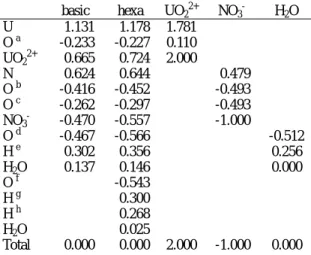
Table 2 shows the Mulliken charges of atoms and groups in aqua uranyl nitrate complexes and monomer. In this table, each value shows the change form neutral atom. Thus, the minus sign shows the atom get more charge, and plus lost. The charge of the uranyl group of the basic model is greater than that of the hexahydrate model. The most of the charge decrease of uranyl
group occurs on uranium atom. From Table 3 for the orbital populations of uranium, it is shown that the atomic charge of uranium is mainly determined by the population of 5f orbital, next 6d. The uranyl group revealed to accept charge mostly from nitrate group. For the hexahydrate model, the charge donation of nitrate ion decreases, and water molecule in the first coordination sphere donates more charges than the basic model.
For the outside water, the amount of charge is so small as to be one-sixths of that of the inner one. What has to be noticed is that the coordination site oxygen of ligands for the hexahydrate model has a larger amount of the charge compared with basic
model, while hydrogen and nitrogen lost the charge. This result means that the polarizations of the ligands are increased in the hexahydrate model.
Table 2. The Mulliken charges for aqua uranyl nitrate complexes and others.
basic hexa UO22+
NO3-
H2O
U 1.131 1.178 1.781
O a -0.233 -0.227 0.110
UO22+
0.665 0.724 2.000
N 0.624 0.644 0.479
O b -0.416 -0.452 -0.493
O c -0.262 -0.297 -0.493
NO3-
-0.470 -0.557 -1.000
O d -0.467 -0.566 -0.512
H e 0.302 0.356 0.256
H2O 0.137 0.146 0.000
O f -0.543
H g 0.300
H h 0.268
H2O 0.025
Total 0.000 0.000 2.000 -1.000 0.000
a-h See Fig.1. basic: basic model, haxa: hexahydrate model.
The Mulliken charges of UO22+, NO3-, and H2O are for monomer state. UO22+, H2O, and NO3- are calculated by DMol3 in vacuum state.
The overlap populations between central uranium and coordinating oxygen are given in Table 4. These values mean the strength of covalent bonding, and minus sign means bonding, plus anti-bonding. For these two models, the overlap population of uranyl group is the largest of all, next is nitrate coordination, and last water. For the hexahydrate model, the overlap population of nitrate group is almost same as water, but the total bond strength of nitrate ion must be twice and considered that the nitrate group has the bidentate manner in this complex (i.e., the entropy effect must be considered for poly-dentate ligands). The overlap population between each uranium orbital and coordination side oxygen shows the 5f, 6d, and 7s orbitals work as bonding and 6s and 6p as anti-bonding.
The contribution of valence orbital of uranium atom to overlap population takes the order that 6d, 6p, 5f, 7s and 6s from large contribution for each ligand bonding in the hexahydrate and the basic model. For the hexahydrate model, the total overlap populations are not so changed for uranyl bonding, and slightly decreased for nitrate ion coordination. For water, the total overlap population grows significantly, because the bonding of 5f and 6d grows faster than anti-bonding of 6p and 6s with respect to bond length. The 5f and 6d orbitals get more charge than 6p and 6s, and these charges enlarge the overlap population of 5f and 6d orbital.
3.3 The electron densities
The counter plots of the electron density for the equatorial plane of aqua uranyl nitrate complexes are shown in Fig.2. The electron density for nitrate group and water molecule in the complex is not so changed for each model, and that of nitrate coordination is not changed too. The electron density of outer and inner water molecules has approximately same profiles in hexahydrate model. It seems that the electron density of uranium is decreased and that of water molecule is delocalized around the line between uranium and water for the hexahydrate model compared with the basic model. For the hexahydrate model, the bonding between nitrate ion and outer water molecule can be seen, but it is weaker than the binding between the outer and inner water molecules. The bonding between nitrate group and inner water molecule are not seen for each model.
Table 3. The orbital populations for U.
5f 6s 6p 6d 7s Total
UO22+
2.803 1.946 5.882 1.494 0.100 90.219 basic 2.963 1.957 5.917 1.748 0.289 90.869 hexa 2.934 1.957 5.921 1.731 0.285 90.822
basic: basic model, haxa: hexahydrate model.
Table 4. The overlap populations between the uranium and the coordination site oxygen (per one atom).
UO22+ 5f 6s 6p 6d 7s Total
O (UO22+) 0.289 0.004 -0.351 0.166 0.048 0.135
basic 5f 6s 6p 6d 7s Total
O (UO22+) 0.432 -0.023 -0.372 0.611 0.046 0.669 O (NO3-) 0.088 -0.009 -0.121 0.109 0.056 0.120 O (H2O) 0.065 -0.007 -0.106 0.083 0.036 0.029
hexa 5f 6s 6p 6d 7s Total
O (UO22+
) 0.432 -0.020 -0.375 0.609 0.045 0.666 O (NO3-) 0.074 -0.008 -0.099 0.089 0.050 0.105 O (H2O) 0.093 -0.012 -0.141 0.119 0.047 0.104
basic: basic model, haxa: hexahydrate model. UO22+ is calculated by DMol3 in the vacuum state.
Figuer 3 shows the differential electron densities on the equatorial plane for two aqua uranyl nitrate complexes, which was calculated by the electron density of complex minus that of free atoms. The ligands gained the charge and the uranium lost it in the hexahydrate model in comparison to the basic model.
For the basic model, the charge transferred from water molecule to uranium can be seen on the direction to water molecules, and they seem to form islands surrounding the central uranium atom.
(a) (b) Fig.2 The electron densities for aqua uranyl nitrate complexes.
The counter plot of the electron density for aqua uranyl nitrate complexes on the equatorial plane with nitrate group on horizontal and water molecule on vertical axis: (a) basic model, (b) hexahydrate model
(a) (b)
Fig.3 The differential electron densities for aqua uranyl nitrate complexes.
The counter plot of the differential electron density for aqua uranyl nitrate complexes on the equatorial plane with nitrate group on horizontal and water molecule on vertical axis: (a) basic model, (b) hexahydrate model.
The bridging electron can be seen between this charge island and oxygen of water. This bridging electron was greatly enlargedfor hexahydrate model, but the island had disappeared.
It seems that the nonbonding electron pair of oxygen in water molecule is included the uranium nonbonding electrons. Or, it seems that no charge transfer from water to uranium had occurred. This figure and table 2, 3 indicate that the covalent bonding between uranium and water molecule is increased for the hexahydrate model with a small amount of charge transfer.
On the other hand, the strength of uranyl bonding is enhanced and nitrate ion coordination is weakened for the hexahydrate model compared with the basic model. But the change is not so
great.
4 Conclusions
The electronic structures of uranyl nitrate complex with two or six water molecules were calculated by density functional calculation code. The optimized structure and stability are greatly improved by concerning the existence of the secondary coordinating water molecules. The atomic charge distributions for these complexes show that the uranium atomic charge becomes small for the hexahydrate complex and is determined by uranium 5f and 6d orbital populations. The ligands of the
first coordination sphere in hexahydrate complex have great polarization. The bond overlap populations between ligands and uranium are greatly influenced by the atomic charge of coordination site oxygen from the table of bond overlap populations and the figure of the differential electron density.
This means that the charge transfer from ligands to uranium are not important, the charge of coordination site oxygen atom is most significant.
The method of adding the surrounding molecules is simpler than the ellipsoidal cavity model to take into account the solvent effect. The adding of outer surrounding molecules must be carefully conducted. Because, when the influence of the outer molecules to the inner molecule is vanishing slowly, the calculation needs to include more and more outer molecules and to take so many computer resources. For aqua nitrate complex, the bond length of the inner water molecules are significantly improved by accounting the secondary coordinating water molecules. But the other groups that are far from outer molecules especially uranyl group are not so influenced. It is considered that the structure of these groups is improved by taking into account the outer molecules that close to these groups.
Acknowledgement
The authors wish to thank Ex-Professor C. Miyake of Osaka University, for useful discussions.
References
[1] Pepper, M., Bursten, B. E.: The electronic structure of actinide-containing molecules; A challenge to applied quantum chemistry. Chem. Rev., 91, 719-741(1991).
[2] Craw, J. S. et al.: Ab Initio quantum chemical calculations on uranyl UO22+, pulutonyl PuO22+, and their nitrates and sulfates. J. Phys. Chem., 99, 10181-10185(1995).
[3] Spencer, S. et al.: Hydration of UO22+
and PuO22+
. J. Phys.
Chem. A, 103, 1831-1837(1999).
[4] Hirata, M. et al.: Valence electronic structure of uranyl nitrate UO2(NO3)2 ·2(H2O). J. Electron Spectrosc. Relat.
Phenom., 83, 59-64(1997).
[5] Hirata, M. et al.: Electronic structures of actinyl nitrate-triethyl phosphate complexes using the DV-DS method. J. Alloys Comp., 271-273, 128-132(1998).
[6] Oda, Y. et al.: Discrete-variational dirac-slater calculation of uranyl(VI) nitrate complexes. J. Alloys Comp., 255, 24-30(1997).
[7] Allen, P. G. et al.: Investigation of aquo and chloro complexes of UO22+
, NpO2+
, Np4+, and Pu3+ by X-ray absorption fine structure spectroscopy. Inorg. Chem., 36, 4676-4683(1997).
[8] Agostini, G. et al.: Crystal and molecular structure of uranyl nitrate trimethylphosphate. Inorg. Chim. Acta., 62,
237-240(1982).
[9] Fleming, J. E., Lynton, H.: Crystal structure of the complex uranyl nitrate-tri-ethyl phosphate. Chem. Ind., 79, 1415-1416(1960).
[10] Fleming, J. E., Lynton, H.: Crystal structure of uranyl nitrate hexahydrate. Chem. Ind., 79, 1416-1417(1960).
[11] Auwer, C. D. et al.: XAS study of actinide and lanthanide solvent extraction compounds-I. UO2(NO3)2(TIBP)2 and UO2(NO3)2(TBP)2 (with TIBP=tri-isobutylphosphate and TBP=tributylphosphate). Polyhedron, 13, 2233-2238(1997).
[12] Auwer, C. D. et al.: XAS study of actinide and lanthanide solvent extraction compounds-II. UO2(NO3)2L2 (with L=tri-isobutylphosphate, trimethylphosphate and triphenylphospate). Polyhedron, 17, 4507-4517(1998).
[13] Auwer, C. D. et al.: Actinide coordination sphere in various U, Np and Pu nitrato coordination complexes. J.
Synchrotron Rad., 6, 101-104(1999).
[14] Burns, J. H., Brown, G. M., Ryan, R. R.: Structure of Dinitratodioxobis(triisobutyl phosphate)uranium(VI) at 139 K*. Acta. Cryst., C41, 1446-1448(1985).
[15] Burns, J. H.: Solvent-extraction complexes of the uranyl ion. 1. Crystal and molecular structure of bis(nitrato) bis(tri-n-butylphosphine oxide)dioxouranium(VI). Inorg.
Chem., 20, 3868-3871 (1981).
[16] Burns, J. H.: Solvent-extraction complexes of the uranyl ion. 2. Crystal and molecular structure of catena-bis (µ-di-n-butyl phosphate-O,O’) dioxouranium(VI) and Bis(µ-di-n-butyl phosphate-O,O’) bis[(nitrato) (tri-n-butylphosphine oxide)dioxouranium(VI)]. Inorg.
Chem., 22, 1174-1178(1983).
[17] Taylor, J. C., Mueller, M. H.: A neutron diffraction study of uranyl nitrate hexahydrate. Acta Cryst., 19, 536-543(1965).
[18] Katz, J. J., Seaborg, G. T., Morse, L. R.: The Chemistry of the Actinide Elements, 2nd edn., Chapman and Hall, London(1986).
[19] Computational results obtained using DMol3, Density Functional Theory Electronic Structure Program from MSI of San Diego. Delley, B.: An all-electron numerical method for solving the local density functional for polyatomic molecules. J. Chem. Phys., 92, 508-517(1990).
[20] Delley, B.: Analytic energy derivatives in the numerical local-density-functional approach. J. Chem. Phys., 94, 7245-7250(1991).
[21] Delley, B., Ellis, D. E., Freeman, A. J.: Binding energy and electronic structure of small copper particles. Phys. Rev., B27, 2132-2144(1983).
[22] Delley, B.: A Scattering Theoretic approach to scalar relativistic corrections on bonding. Int. J. Quant. Chem., 69, 423-433(1998).
[23] Perdew, J. P., Wang, Y.: Accurate and simple analytic representation of the electron gas correction energy. Phys.
Rev., B45, 13244-13249(1992).