ARNOLD, Laura, 2018. ‘A preliminary archaeology of tone in Raja Ampat’. In Antoinette SCHAPPER, ed. Contact and substrate in the languages of Wallacea PART 2.
NUSA 64: 7–37. [Permanent URL: http://hdl.handle.net/10108/92289] [doi:
10.5281/zenodo.1450778]
The University of Edinburgh
At least three Austronesian languages spoken in the Raja Ampat archipelago have lexical tone: Maˈya, Matbat, and Ambel. The objective of this paper is to examine data from these three languages, in order to determine how tone originated and developed. Using comparative data from monosyllabic cognates, I will show that, in the case of Maˈya and Matbat, tone was inherited from a single common ancestor; but that tone developed separately in Ambel. Possible scenarios for tonogenesis in proto-Maˈya-Matbat and proto- Ambel will then be explored. I will conclude that, in the absence of evidence for spontaneous, independent tonogenesis, the most likely scenario was that proto-Maˈya- Matbat developed tone through contact with a now-extinct tonal Papuan substrate. Proto- Ambel also likely developed tone through contact; however, it is at present unclear whether this contact was also with a Papuan substrate, or with tonal proto-Maˈya-Matbat or one of its descendants.
1. Introduction1
The Raja Ampat archipelago lies off the Bird’s Head peninsula, at the western tip of New Guinea. As shown in Map 1, the archipelago consists of four large islands – Waigeo, Batanta, Salawati, and Misool – and hundreds of smaller islands.
Administratively, the archipelago is part of West Papua province, in eastern Indonesia.
There are several languages spoken in Raja Ampat. At least seven of these belong to the South Halmahera-West New Guinea (SHWNG) subgroup of Austronesian, the lesser- known sister of Oceanic; within SHWNG, these languages are classified in the Raja Ampat-South Halmahera branch (RASH; Remijsen 2001a:34–7; Kamholz 2014). The RASH languages spoken in and around Raja Ampat are marked in Map 1, and are as follows: Maˈya, spoken in villages throughout the archipelago; Ambel, spoken on Waigeo; Bata, spoken on Batanta; Fiawat, spoken on Salawati; Matbat and Biga, both spoken on Misool; and Gebe, spoken on the small island of Gag and the Gebe islands between Waigeo and Halmahera.2 Biak, a language belonging to the Cenderawasih Bay branch of SHWNG, is also spoken throughout Raja Ampat; as, increasingly, are dialects of Malay. These non-RASH Austronesian languages are relatively recent incomers to the archipelago (Remijsen 2001a:30–1; Arnold 2018a:17–8); as such, they will not receive further comment in this paper. Remijsen (2001a:30–1) also lists two non-
1 The Ambel data presented in this paper are the result of five periods of fieldwork between January 2014 and June 2017. I would like to extend my gratitude to the Ambel community, for their hospitality, hard work, and patience during this time. I would also like to thank Dylan Gaffney, Ben Macaulay, Laurent Sagart, and the participants at the Workshop on Contact and Substrate in the Languages of Wallacea (1–2 December 2016, KITLV, Leiden), for interesting and helpful discussions; and Bert Remijsen and two anonymous reviewers for feedback on an earlier draft. All errors are my own.
2 As, which is also a RASH language, is spoken in three villages on the coast of the Bird’s Head. As is not marked in Map 1.
Austronesian, Papuan languages that are spoken to a limited extent in the archipelago, both of which have arrived recently. The first is Duriankari, whose speakers migrated from the south coast of the Bird’s Head to a single village on south Salawati (Polansky 1957, cited in Remijsen 2001a:20; Voorhoeve 1975); de Vries (1998:644) reports that Duriankari may now be extinct. The second is Moi, speakers of which have migrated from the Bird’s Head to east and south Salawati.
The internal classification of the RASH subgroup is still in its early stages: while the RASH languages spoken in the south of Halmahera form a primary branch of RASH (Kamholz 2014), it is unclear whether those spoken in and near Raja Ampat form a separate primary branch. Kamholz (2014), based on phonological and morphological innovations in the languages, concludes that they constitute several primary branches of RASH: Ambel-Biga, Maˈya-Matbat, Fiawat, and As. However, Kamholz (2015), a reconstruction of proto-SHWNG morphology, casts doubt on the validity of the Maˈya- Matbat branch, and Kamholz (2017:10 f.n. 4) has since retracted the Ambel-Biga branch.
To date, the best described of the RASH languages of Raja Ampat are Maˈya (van der Leeden 1993, n.d.; Remijsen 2001a, 2001b, 2002), Matbat (Remijsen 2001a, 2007, 2010), and Ambel (Arnold 2018a, 2018b). One curious feature of these three languages is that they all have systems of lexical tone. Tone is only sporadically attested in Austronesian languages; the question therefore arises as to how tone developed in the Austronesian languages of Raja Ampat. This paper aims to provide a preliminary answer to this question, and in the process contribute to the question of the internal Map 1. The Raja Ampat archipelago (based on Remijsen 2001a:16 and Arnold
2018a:5)
subgrouping of the RASH branch. Only data from these three languages will be compared in the first instance because phonological analyses of the word-prosodic systems of the other RASH languages of Raja Ampat have not yet been carried out.
This paper is structured as follows. Following a brief description of the segmental phonologies and word-prosodic systems of Maˈya, Matbat, and Ambel in section 2, monosyllabic cognates in the three languages will be compared in section 3, in order to determine the extent to which tone has been inherited, and hence the point at which the languages became tonal. I will present evidence to support the hypothesis that tone in Maˈya and Matbat has been inherited from a common ancestor, but that the tone system of Ambel developed independently. In section 4, two possible mechanisms for tonogenesis in proto-Maˈya-Matbat and proto-Ambel will be considered: independent innovation through the spontaneous phonemicisation of previously allophonic pitch differences; and contact-induced tonogenesis. I will show that tone likely developed in the Austronesian languages of Raja Ampat as the result of contact with a now-extinct Papuan substrate. In section 5, I will discuss the timescale and nature of Austronesian- Papuan contact in Raja Ampat. Finally, the conclusions of this paper are summarised in section 6, where I also outline directions for future research.
2. Outline of the phonological systems
In this section, the segmental and suprasegmental phonologies of Maˈya, Matbat, and Ambel are outlined. This information will provide the necessary background for the comparison of the prosodic systems in section 3.
2.1 Maˈya
Of the three Raja Ampat languages discussed in this paper, the phonology of Maˈya has received the most attention. There are five dialects of Maˈya: Kawe, Wauyai, and Laganyan Maˈya, all spoken on Waigeo; Salawati Maˈya, spoken on Salawati; and Misool Maˈya, spoken on Misool. Maˈya has 14 consonant phonemes (/p b t d k g f s m n l r j w/) and five vowel phonemes (/i e a o u/; van der Leeden 1993).
While the segmental phonology of Maˈya is unremarkable, the prosodic system is unusual, in that the Laganyan, Misool, and Salawati dialects of the language have both lexical tone and lexical stress systems (Remijsen 2001a, 2001b, 2002).3 The following is a summary of the word-prosodic system of Salawati Maˈya.
Lexical tone is restricted to word-final syllables. There is a three-way contrast between High (/3/), Rise (/12/), and toneless syllables.4 Phonetically, High syllables are realised with high pitch in all utterance positions; Rise syllables are realised utterance-finally with rising pitch, and utterance-medially with low pitch; and toneless syllables are realised with falling pitch. Lexical stress is restricted to the penultimate and final syllables of a word; the primary acoustic correlate is length. If a word has penultimate
3 The Kawe and Wauyai dialects do not have lexical tone, only lexical stress (Remijsen 2001a:87;
2001b:479). Remijsen (2001a:494–5) concludes that the Kawe and Wauyai dialects also once had tone systems, which they have subsequently lost.
4 Remijsen (2001a, 2001b, 2002) describes toneless, stressed syllables as bearing a ‘Fall’ toneme.
However, as these syllables do not have an underlying specification for tone, in this paper I refer to them as ‘toneless stressed’ syllables. While superscript numerals may be used to transcribe phonetic pitch, in Remijsen (2001a, 2001b, 2002, 2007) and throughout this paper they are representative of phonological tone.
stress, the final syllable cannot bear the Rise toneme. There is a strong tendency for words with penultimate stress to have the same vowels in the penultimate and final syllables (e.g., /ˈtala3/ ‘banana’, /ˈlomo3s/ ‘blood’). Finally, words with final syllables that are both stressed and toneless are realised with an epenthetic final -o in sentence- final position.
Remijsen (2001b) describes the variation in the tone systems of the three tonal Maˈya dialects. There is one structural difference between the Misool dialect and the Salawati dialect: the Rise toneme in Salawati Maˈya is cognate with a Low toneme in Misool Maˈya. This Low toneme is realised with low pitch both utterance-medially and utterance-finally. Another difference between the Salawati and Misool dialects is distributional: whereas polysyllabic words with penultimate stress tend to have High tone on the final syllable in Salawati Maˈya, the final syllable bears Low tone in the Misool dialect.
There are two differences between the Laganyan dialect and the Salawati dialect described in Remijsen (2001b). First, there is an utterance-final fall boundary tone in Laganyan Maˈya, which is realised on voiced codas. This boundary tone means that High syllables with a voiced coda are realised with high falling pitch utterance-finally, and that utterance-final Rise syllables with a voiced coda are realised with rise-fall pitch.
Second, if a Rise syllable in Laganyan Maˈya is followed by another prosodically marked syllable (i.e., a syllable marked for either stress or tone), the realisation is nearly identical with utterance-medial toneless syllables.
Remijsen concludes that the differences in the Misool and Laganyan dialects are recent developments, and that the tone system of Salawati Maˈya is the most conservative of the three dialects, reflecting most closely the tone system of proto-Maˈya (2001b:492).
As there has not to date been any systematic reconstruction of proto-Maˈya, data from the Salawati dialect will be used as representative of Maˈya for the remainder of this paper. Henceforth, unless otherwise noted, I will use the term ‘Maˈya’ to refer to the Salawati Maˈya dialect.
2.2 Matbat
There are two dialects of Matbat: Magey Matbat, and Tomolol Matbat (Remijsen 2007:9–10). Only Magey Matbat has so far been described (Remijsen 2007, 2010). Data from Magey Matbat will therefore be used as representative of Matbat in this study.
Magey Matbat has 16 consonant phonemes (/p b t d k g m n ŋ s f h l w j/, plus a shallowly-integrated loan phoneme /r/) and seven vowels (/i e ɛ a ɔ o u/; Remijsen 2010). The syllable structure of Matbat is (C)V(C), and there is a strong preference for monosyllabic words. Matbat does not have lexical stress; it does, however, have an unusually rich tone system. Remijsen (2007) analyses Matbat with six tonemes: Low (/1/), High (/3/), Extra-high Fall (/41/), Low Fall (/21/), Low Rise (/12/), and Rise-Fall (/121/). The domain of tonal specification in Matbat is the syllable; while toneless syllables are permitted, tonal specification is obligatory in content words. If the final syllable of a word is specified with the Low Fall, an epenthetic final -o occurs in utterance-final position; as will be returned to in section 3.3 below, this -o is related to the epenthetic -o found in Maˈya.
2.3 Ambel
There are two dialects of Ambel: Metsam Ambel, spoken in two villages on Waigeo;
and Metnyo Ambel, spoken in nine further villages on the island. Like Maˈya and Matbat, the segmental phonology of Ambel is simple. There are 14 native consonant
phonemes in Metnyo Ambel (/p b t d k g s h m n l r j w/);5 Metsam Ambel has /f/ for Metnyo /h/. Both dialects have a simple five-vowel system (/i e a o u/; Arnold 2018a).
Both Metsam and Metnyo Ambel have tone systems. Tone in Metnyo Ambel is binary and privative: High syllables contrast with toneless syllables. The system is culminative, in that there is a maximum of one High syllable per morpheme, and one realisation of High tone per word; but not obligatory, in that toneless words are attested, including toneless monosyllables. Utterance-medially, High syllables are realised with high pitch, and toneless syllables are realised with low pitch. Utterance-finally, there is a HL%
boundary tone, the Low component of which is only realised on heavy syllables, i.e., syllables with a vowel plus sonorant coda. This boundary tone leads to utterance-final realisations that are acoustically and perceptually very similar to those described above for the High and Rise syllables in the Laganyan dialect of Maˈya: heavy High syllables are realised with high falling pitch, and heavy toneless syllables are realised with rise- fall pitch. This similarity will be returned to in section 4.2, where it will be used as evidence for contact between speakers of Ambel and speakers of Laganyan Maˈya.
Work on the tone system of Metsam Ambel is still preliminary. However, there are two or possibly three underlying tones in this dialect. Syllables can be sorted into one of three groups, depending on utterance-medial realisation: those realised with high, rising, and low pitch. For the purposes of this paper, I will work from the assumption that high- pitched syllables are underlyingly High (/3/), syllables realised with utterance-medial rising pitch underlyingly bear Rise tone (/12/), and low-pitched syllables are underlyingly toneless.6 While Metnyo Ambel does not have lexical stress, at present it is unclear whether Metsam Ambel only has a lexical tone system (as in Metnyo Ambel);
or whether it combines lexical stress and lexical tone (as in Maˈya). Like Metnyo Ambel, the Metsam dialect has an utterance-final HL% boundary tone, again with the Low component only realised on heavy syllables. Utterance-finally, heavy High syllables are realised with high falling pitch; and both heavy Rise and toneless syllables are realised with rise-fall pitch.
Ongoing comparative work between the two dialects shows that the tone system of proto-Ambel (pA) was identical with the present-day tone system of Metsam Ambel:
pA, like Metsam Ambel, had a three-way contrast between *High, *Rise, and *toneless syllables (Arnold submitted). The utterance-final HL% boundary tone found in both dialects is also reconstructed to proto-Ambel. In this way, the reconstructed pA system is typologically identical with the present-day Maˈya system, which also distinguishes High, Rise, and toneless syllables; in addition, the Laganyan Maˈya dialect has an utterance-final fall boundary tone. This point will be discussed in more detail in section 4.2.
In Arnold (submitted), the development of the pA tone system is described in detail.
The proto-forms reconstructed in that study will be used as comparanda for the remainder of this paper. Only monosyllables have so far been reconstructed in pA: this is due to the lack of clarity mentioned above regarding the presence of lexical stress in
5 The palatal glide /j/ will henceforth be transcribed y for all three languages.
6 In Arnold (2018a, 2018b, submitted), Ambel tone is transcribed with diacritics on the vowel: High tone is transcribed á, and Rise tone is transcribed ǎ. However, as tone in Maˈya and Matbat is conventionally transcribed with superscript numerals, to facilitate comparison Ambel tone is also transcribed in this way in this paper.
Metsam Ambel. By restricting the comparanda to monosyllables, which are intrinsically stressed, we avoid erroneously analysed forms entering the data.
2.4 Summary
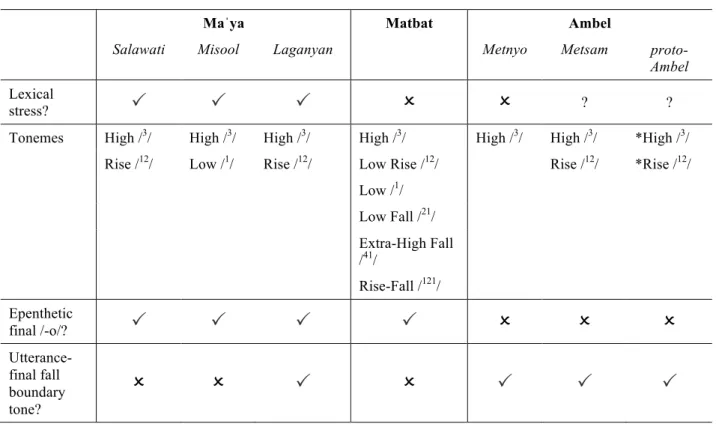
The properties of the word-prosodic systems discussed in this section are given in table 1. Only the tonal dialects of Maˈya are included in this table.
Table 1. Summary of the word-prosodic systems of Maˈya, Matbat, and Ambel
Maˈya Matbat Ambel
Salawati Misool Laganyan Metnyo Metsam proto-
Ambel Lexical
stress?
P P P O O
? ?Tonemes High /3/ High /3/ High /3/ High /3/ High /3/ High /3/ *High /3/ Rise /12/ Low /1/ Rise /12/ Low Rise /12/ Rise /12/ *Rise /12/
Low /1/ Low Fall /21/ Extra-High Fall /41/
Rise-Fall /121/ Epenthetic
final /-o/?
P P P P O O O
Utterance- final fall boundary tone?
O O P O P P P
3. Tone and inheritance in Raja Ampat
In this section, the hypothesis that the tone systems of Maˈya, Matbat, and Ambel were inherited from a common ancestor will be considered. The aim of this section is primarily to determine at what point in the history of the three languages tone was first innovated; and secondarily to contribute to the subgrouping of the RASH languages. As I will show below, there is evidence that the tone systems of Maˈya and Matbat have been inherited from a common ancestor, to the exclusion of Ambel, which developed tone independently.
In the following sections, monosyllabic cognates will be compared pairwise for the three Raja Ampat languages.7 The Maˈya and Ambel cognates will be compared and discussed in section 3.1; the Matbat and Ambel cognates in section 3.2; and the Maˈya and Matbat cognates in section 3.3. The full list of cognates for all three languages, alphabetised by meaning, is provided in the Appendix.
7 The present study is limited to monosyllabic cognates because, as described in section 2.3, only monosyllabic forms have been reconstructed in proto-Ambel.
3.1 Maˈya and Ambel
The monosyllabic cognates in Salawati Maˈya and proto-Ambel are given in table 2. 35 monosyllabic cognates were identified in the two languages.8 To facilitate discussion, the data are divided into cognate sets: group A.1 (Maˈya High :: pA High); group A.2 (Maˈya High :: pA toneless); group A.3 (Maˈya High :: pA Rise); group A.4 (Maˈya Rise :: pA High); group A.5 (Maˈya Rise :: pA toneless); group A.6 (Maˈya toneless ::
pA High); and group A.7 (Maˈya toneless :: pA Low).9
Table 2. Monosyllabic cognates in Salawati Maˈya and proto-Ambel
Salawati Maˈya Proto-Ambel Group A.1: Maˈya High :: proto-Ambel High
1. ‘eight’ ˈwa3l *wa3l
2. ‘mountain’ ˈye3l *i3l
3. ‘sea turtle’ ˈfe3n *fi3n
4, ‘three’ ˈto3l *tu3l
Group A.2: Maˈya High :: proto-Ambel toneless
5. ‘enter’ ˈsu3n *sun
6. ‘fish’ ˈdo3n *dun
7. ‘five’ ˈli3m *lim
8. ‘good’ ˈfi3 *fi
9. ‘kill’ ˈbu3n *bun
10. ‘rise, ascend’ ˈsa3 *sa
11. ‘two’ ˈlu3 *lu
12. ‘village’ ˈpnu3 *nu ‘house’
13. ‘white’ ˈbu3s *bus
14. ‘woman’ ˈpi3n *bin
Group A.3: Maˈya High :: proto-Ambel Rise
15. ‘louse’ ˈu3t *o12wt
16. ‘sago’ ˈbi3 *bi12
Group A.4: Maˈya Rise :: proto-Ambel High
17. ‘die’ ˈma12t *mna3t
18. ‘four’ ˈfa12t *fa3t
19. ‘ground, earth’ ˈba12t *ba3t
8 Cognacy judgements are taken from Kamholz (2014, n.d.), supplemented by the author.
9 Although it is transcribed in Remijsen (2001a), Maˈya epenthetic final -o is not represented in this paper, as it is not underlyingly present. For some meanings, data are not available for Salawati Maˈya; in these cases, data from Misool Maˈya are given, as the primary difference with regards to monosyllabic words in the two dialects is in the realisation of tone, rather than tonal category (see section 2.1; in Remijsen 2001a, 2001b, the transcription of the Salawati Rise toneme and the Misool cognate Low toneme is identical, i.e.,
<12>).
Salawati Maˈya Proto-Ambel 20. ‘man’ ˈma12n (Misool) *ma3n
21. ‘mother’ ˈne12n *ne3n
22. ‘see’ ˈ-e12m *e3m
23. ‘swim’ ˈ-a12s (Misool) *la3 Group A.5: Maˈya Rise :: proto-Ambel toneless
24. ‘betel leaf’ ˈnya12n *nyan
25. ‘canoe’ ˈwa12k *wan
26. ‘fire’ ˈla12p *lap
27. ‘full’ ˈfo12n *fon
28. ‘rice’ ˈfa12s *fa
29. ‘sand’ ˈle12n *layn
30. ‘snake’ ˈko12k *kok
Group A.6: Maˈya toneless :: proto-Ambel High
31. ‘person’ ˈmat *me3t
32. ‘tree, wood’ ˈai *a3y
33. ‘walk’ ˈdak (Misool) *ta3n
Group A.7: Maˈya toneless :: proto-Ambel toneless
34. ‘give’ ˈbe (Misool) *bi
35. ‘know’ -ˈun (Misool) *un
The typological similarity between the tone systems of Maˈya and pA was noted above:
both systems contrast High, Rise, and toneless syllables. Despite this, table 2 shows that no systematic tonal correspondences can be identified between the two languages. High monosyllables in Maˈya have pA cognates with High (A.1), Rise (A.2), and no tone (A.3); Rise monosyllables in Maˈya have cognates with High (A.4) or no tone (A.5);
and toneless monosyllables in Maˈya have cognates with High (A.6) or no tone (A.7).
Nor can any segmental features be identified that might provide a conditioning environment. For example, the cognate of Maˈya ˈma12n ‘man, male’, with Rise tone, is pA *ma3n, with High tone; while the cognate of the near-minimal Maˈya ˈnya12n ‘betel leaf’, with Rise tone, is the toneless pA *nyan. Similarly, the cognate of Maˈya ˈbi3
‘sago’, with High tone, is pA *bi12, with Rise tone; however, the cognate of Maˈya ˈbu3n ‘kill’, also with High tone, is the toneless pA *bun.
On the basis of the data presented in table 2, we can conclude that the tone systems of Maˈya and Ambel have not been inherited from a common ancestor. The two languages have developed tone independently from one another.
3.2 Matbat and Ambel
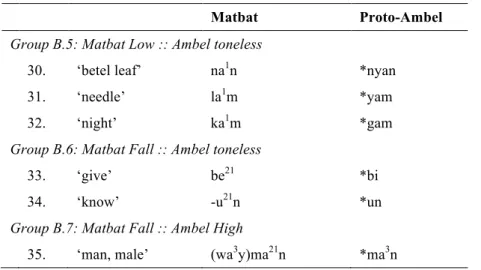
The monosyllabic cognates between Matbat and proto-Ambel are given in table 3. In total, 35 monosyllabic cognates were identified. As in the previous section, the data are divided into cognate sets: group B.1 (Matbat High :: pA High); group B.2 (Matbat High :: pA toneless); group B.3 (Matbat High :: pA Rise); group B.4 (Matbat Rise :: pA High); group B.5 (Matbat Low :: pA toneless); group B.6 (Matbat Fall :: pA toneless);
and group B.7 (Matbat Fall :: pA High).
Table 3. Monosyllabic cognates in Matbat and proto-Ambel
Matbat Proto-Ambel
Group B.1: Matbat High :: proto-Ambel High
1. ‘eight’ -wa3l *wa3l
2. ‘four’ fa3t *fa3t
3. ‘ground, earth’ ba3t *ba3t
4. ‘mother’ ne3n *ne3n
5. ‘mountain’ he3l *i3l
6. ‘person’ ma3t *me3t
7. ‘sea turtle’ fe3n *fi3n
8. ‘see’ -ɛ3ŋ *e3m
9. ‘swim’ la3s *la3
10. ‘three’ to3l *tu3l
11. ‘tree, wood’ ha3y *a3y
Group B.2: Matbat High :: proto-Ambel toneless
12. ‘canoe’ wa3ŋ *wan
13. ‘enter’ hu3ŋ *sun
14. ‘fire’ ya3p *lap
15. ‘five’ li3m *lim
16. ‘full’ fo3n *fon
17. ‘good’ fi3 *fi
18. ‘kill’ bu3n *bun
19. ‘rice’ fa3s *fa
20. ‘rise, ascend’ ha3 *sa
21. ‘sand’ ye3n *layn
22. ‘snake’ ko3k *kok
23. ‘two’ lu3 *lu
24. ‘village’ nu3 *nu ‘house’
25. ‘white’ bu3 *bus
26. ‘woman’ (wa1t)bi3n ‘kind of mangrove’10
*bin
Group B.3: Matbat High :: proto-Ambel Rise
27. ‘louse’ wu3t *o12wt
Group B.4: Matbat Rise :: proto-Ambel High
28. ‘die’ ma12t *mna3t
29. ‘green/blue’ bla12w *bya3w
10 Compare Ambel pray bin ‘kind of mangrove’, literally ‘female mangrove’.
Matbat Proto-Ambel Group B.5: Matbat Low :: Ambel toneless
30. ‘betel leaf’ na1n *nyan
31. ‘needle’ la1m *yam
32. ‘night’ ka1m *gam
Group B.6: Matbat Fall :: Ambel toneless
33. ‘give’ be21 *bi
34. ‘know’ -u21n *un
Group B.7: Matbat Fall :: Ambel High
35. ‘man, male’ (wa3y)ma21n *ma3n
Similar to the comparison of the Maˈya and Ambel data in the previous section, no tonal correspondences between Matbat and Ambel can be identified. Cognates of Matbat High monosyllables are High (B.1), toneless (B.2), or Rise (B.3) in pA; cognates of Matbat Fall monosyllables are toneless (B.6) and High (B.7) in pA. Similarly, there are no obvious segmental environments that might condition tonal splits or mergers in one or both of the languages. For example, the cognate of Matbat wa3l ‘eight’, with High tone, is pA *wa3l, with High tone, whereas the cognate of the near-minimal Matbat wa3ŋ ‘canoe’, also with High tone, is the toneless pA *wan. Similarly, the cognate of Matbat ne3n ‘mother’, with High tone, is pA *ne3n, with High tone, while the cognate of Matbat ye3n ‘sand’ is the toneless pA *layn.
Based on these data, we can again conclude that the tone systems of Ambel and Matbat have not descended from a common ancestor, but have developed independently.
3.3 Matbat and Maˈya
The monosyllabic cognates in Matbat and Salawati Maˈya are given in table 4. 41 monosyllabic cognates were identified. As above, the data are divided into groups:
group C.1 (Matbat Extra-High :: Maˈya Rise); group C.2 (Matbat High :: Maˈya High);
group C.3 (Matbat High :: Maˈya Rise); group C.4 (Matbat High :: Maˈya toneless);
group C.5 (Matbat Rise :: Maˈya Rise); group C.6 (Matbat Low :: Maˈya Rise); group C.7 (Matbat Low Fall :: Maˈya toneless); and group C.8 (Matbat Low Fall :: Maˈya Rise).
Table 4. Monosyllabic cognates in Matbat and Salawati Maˈya
Matbat Salawati Maˈya
Group C.1: Matbat Extra-High :: Maˈya Rise
1. ‘hear’ no41ŋ ˈdo12n
Group C.2: Matbat High :: Maˈya High
2. ‘breast’ su3 ˈsu3s
3. ‘come’ bo3t ˈbo3t
4. ‘eight’ -wa3l ˈwa3l
5. ‘enter’ hu3ŋ ˈsu3n
6. ‘five’ li3m ˈli3m
Matbat Salawati Maˈya
7. ‘good’ fi3 ˈfi3
8. ‘kill’ bu3n ˈbu3n
9. ‘louse’ wu3t ˈu3t
10. ‘mountain’ he3l ˈye3l
11. ‘rise, ascend’ ha3 ˈsa3
12. ‘sea turtle’ fe3n ˈfe3n
13. ‘seawards’ lo3w ˈlo3l
14. ‘three’ to3l ˈto3l
15. ‘two’ lu3 ˈlu3
16. ‘village’ nu3 ˈpnu3
17. ‘white’ bu3 ˈbu3s
18. ‘woman’ (wa1t)bi3n ‘kind of mangrove’ ˈpi3n Group C.3: Matbat High :: Maˈya Rise
19. ‘canoe’ wa3ŋ ˈwa12k
20. ‘fire’ ya3p ˈla12p
21. ‘four’ fa3t ˈfa12t
22. ‘full’ fo3n ˈfo12n
23. ‘ground, earth’ ba3t ˈba12t
24. ‘mother’ ne3n ˈne12n
25. ‘rice’ fa3s ˈfa12s
26. ‘sand’ ye3n ˈle12n
27. ‘see’ -ɛ3ŋ ˈ-e12m
28. ‘snake’ ko3k ˈko12k
29. ‘swim’ la3s ˈ-a12s (Misool)
30. ‘under’ (pa)pa3p ˈpa12p
Group C.4: Matbat High :: Maˈya toneless
31. ‘person’ ma3t ˈmat
Group C.5: Matbat Rise :: Maˈya Rise
32. ‘die’ ma12t ˈma12t
33. ‘much’ to12 ˈmo12t
Group C.6: Matbat Low :: Maˈya Rise
34. ‘shoot’ -a1n ˈfa12n
35. ‘betel leaf’ na1n ˈnya12n
Group C.7: Matbat Low Fall :: Maˈya toneless
36. ‘eat (tr.)’ -a21 ˈ-a
37. ‘give’ be21 ˈbe (Misool)
38. ‘know’ -u21n ˈ-un (Misool)
Matbat Salawati Maˈya
39. ‘mouth’ ga21l ˈgal
Group C.8: Matbat Low Fall :: Maˈya Rise
40. ‘egg’ to21l ˈto12l
41. ‘man’ (wa3y)ma21n ˈma12n (Misool)
At first glance, it does not appear that the Matbat and Maˈya data correspond in any meaningful way. However, some patterns can be identified. These patterns provide evidence that the tone systems of the two languages have been inherited from a common source.
Let us begin with the cognates in groups C.2, C.3, and C.4. In these groups, we see that High monosyllables in Matbat are cognate with High (C.2), Rise (C.3), or toneless (C.4) monosyllables in Maˈya (e.g., Matbat wu3t ‘louse’ :: Maˈya ˈu3t; Matbat ne3n ‘mother’ ::
Maˈya ˈne12n; Matbat ma3t ‘person’ :: Maˈya ˈmat). Leaving group C.4 to one side for the moment, the correlation between Matbat High and Maˈya High and Rise is striking.
If we assume inheritance as the explanation for the tone of the extant forms, two hypotheses arise: there was a split in Maˈya (i.e., proto-Maˈya-Matbat *High > Maˈya High, Rise), or there was a merger in Matbat (i.e., pMM *High, *Rise > Matbat High).
From the available data, we find evidence that the monosyllables in groups C.2 and C.3 originally bore *High tone, and that there has been a split in Maˈya, conditioned by vowel height.
The evidence for this split is as follows. First, in group C.3 (Matbat High :: Maˈya Rise), none of the 12 cognates have a close vowel nucleus /i/ or /u/ in either of the languages.
In other words, where Matbat High corresponds to Maˈya Rise, all of the cognates contain the vowel /e/, /a/, or /o/ (e.g., Matbat ne3n ‘mother’ :: Maˈya ˈne12n; Matbat wa3ŋ ‘canoe’ :: Maˈya ˈwa12k; Matbat ko3k ‘snake’ :: Maˈya ˈko12k). Second, a small majority of the monosyllables in group C.2 contain the close vowels /i/ or /u/ in both languages (e.g., Matbat li3m ‘five’ :: Maˈya ˈli3m; Matbat lu3 ‘two’ :: Maˈya ˈlu3; 10/17 cognates, or 59%). This correlation between vowel height and tone in Maˈya suggests that, for the monosyllables in groups C.2 and C.3, we can reconstruct *High tone to pMM. This *High tone split in Maˈya: syllables with close vowel nuclei *i or *u remained High, while those with open vowel nuclei *e, *a, or *o developed Rise.
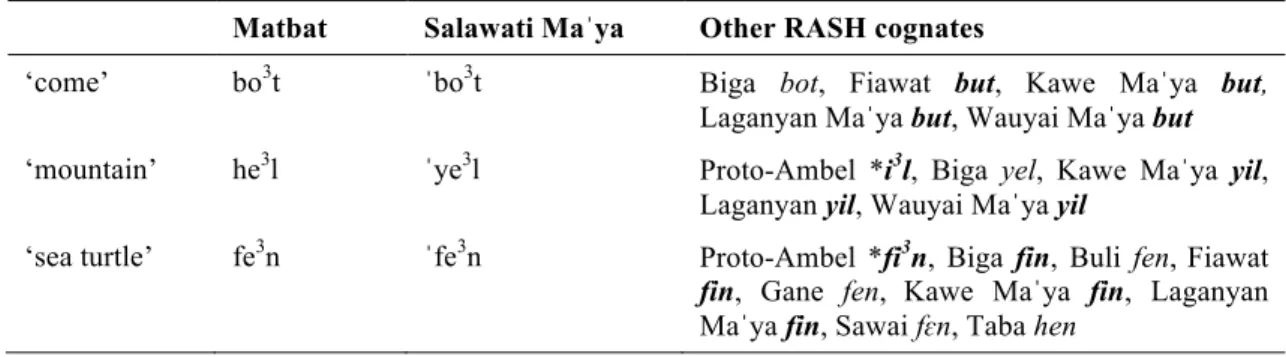
However, seven of the 17 cognates in group C.2 contain the open vowels /e/, /a/, or /o/, and thus constitute exceptions to the stated conditions. But if we look at data from other RASH languages, including other dialects of Maˈya, we find evidence to support reconstruction of at least three of these cognates with a close vowel *i or *u further up the family tree. These three cognates, with the cognate forms in the other RASH languages for which data are available, are given in table 5. Cognates with a close vowel nucleus are highlighted in bold.
Table 5. Other RASH cognates for group C.2 (cognates with a close vowel nucleus highlighted in bold)
Matbat Salawati Maˈya Other RASH cognates
‘come’ bo3t ˈbo3t Biga bot, Fiawat but, Kawe Maˈya but, Laganyan Maˈya but, Wauyai Maˈya but
‘mountain’ he3l ˈye3l Proto-Ambel *i3l, Biga yel, Kawe Maˈya yil, Laganyan yil, Wauyai Maˈya yil
‘sea turtle’ fe3n ˈfe3n Proto-Ambel *fi3n, Biga fin, Buli fen, Fiawat fin, Gane fen, Kawe Maˈya fin, Laganyan Maˈya fin, Sawai fɛn, Taba hen
Based on the data in table 5, it is possible that the ancestor vowel for these three cognates sets can also be reconstructed as a close vowel, i.e., *i in the case of the
‘mountain’ and ‘sea turtle’ sets, and *u in the case of the ‘come’ set, and that these vowels have subsequently lowered in Matbat and Salawati Maˈya.11 A systematic reconstruction of proto-RASH phonology is required to confirm this hypothesis.
However, even if the three cognates in table 5 can be reconstructed with *i or *u, several unexplained reflexes remain: the remaining four cognates in group C.2 (4.
‘eight’, 11. ‘rise, ascend’, 13. ‘seawards’, and 14. ‘three’), all of which would be predicted by the conditions to bear Rise tone in Maˈya; and the one cognate in group C.4 (31. ‘person’) which would also be predicted to bear Rise tone. Despite these exceptions, a conservative count of the reflexes shows that the stated conditions account for 22 of the 30 cognates in groups C.2, C.3, and C.4 (73.3%); a Fisher’s exact test shows that p=0.001, so this distribution is highly unlikely to be due to chance. If further investigations confirm that the cognates in table 5 can be reconstructed with close vowels in proto-Maˈya-Matbat, this number rises to 25 of the 30 cognates (83.3%;
p=0.00004).12
11 As pointed out by an anonymous reviewer, the words for ‘sea turtle’ are reflexes of proto-Malayo- Polynesian (PMP) *peñu, with a non-high vowel. The cognate forms in the South Halmahera (SH) branch of RASH (i.e., Buli, Gane, Sawai, and Taba) all have a non-high vowel e or ɛ, suggesting a proto-RASH reconstruction with *e; elsewhere in SHWNG, PMP *e is also retained (e.g., Waropen eni). It is therefore possible that the Matbat and Salawati Maˈya vowels are retentions of the PMP vowel, and that the high vowels in the other non-SH RASH languages are innovations. While the subgrouping of the non-SH RASH langauges is at present unclear, the minimum possible number of times that a high vowel was innovated in this scenario is two: once in a putative ancestor to Ambel, Biga, and Fiawat; and once in an ancestor of Kawe and Laganyan Maˈya. If the languages can be subgrouped in this way, then the hypothesis that Matbat and Salawati Maˈya retain proto-RASH *e is more likely than the hypothesis that they have both innovated e: the former requires fewer innovations (two) than the latter (three – one innovation of *fen > *fin in a common ancestor to the non-SH RASH languages, and an independent innovation of *fin > fe3n in both Matbat and Salawati Maˈya). However, if further research shows that Ambel, Biga, and Fiawat do not share a common ancestor to the exclusion of Maˈya and Matbat, more innovations are required, making the retention hypothesis as likely as, or less likely than, the *fin > fe3n in Matbat and Salawati Maˈya hypothesis.
12 Some comments can be made about the exceptions found in group C.2. As more data come in from other RASH languages, 13. ‘seawards’ may also turn out to be reconstructable with a close vowel – at present, the only other known RASH cognates of Matbat lo3w ‘seawards’ and Maˈya ˈlo3l are Buli lau
‘seaside’ and Metnyo Ambel lu3l ‘seawards direction’, both of which contain a close vowel. For the remaining three, however, there is no evidence that a close vowel can be reconstructed: the Matbat and
Tone splits conditioned by vowel height are very rare cross-linguistically (Kingston 2011). However, several cases of tonal developments conditioned by vowel height have now been described in Eastern Malayo-Polynesian languages (i.e., SHWNG and Oceanic; see Blust 2005, 2017 for a discussion of unusually-conditioned phonological developments unexpectedly clustering within genetic groupings elsewhere in Austronesian). Within Raja Ampat, Arnold (submitted) describes how vowel height conditioned a tone split in the Metnyo dialect of Ambel: proto-Ambel toneless monosyllables split in Metnyo, with those with an open vowel nucleus developing High tone, and those with a close vowel remaining toneless. Kamholz (2014:106–114) describes how word-final a triggered a tone shift from *High > Low on either the second mora of the penult or on word-final syllables in Yerisiam, a SHWNG language spoken near Cenderawasih Bay, on the other side of the Bird’s Head from Raja Ampat.
Finally, in Cèmuhî, a tonal Oceanic language spoken in New Caledonia, the reflex of the proto-sequences *aqa, *ao, and *oa, all with low vowels, is Low-toned à (Rivierre 2001).
For the remaining cognate sets in table 4, the data are too few to draw any firm conclusions. However, two preliminary hypotheses are suggested. First, note that all of the Matbat monosyllables bearing Extra-High, Rise, and Low in the data (i.e., those in groups C.1, C.5, and C.6) correspond to Rise monosyllables in Maˈya: for example, Matbat no41ŋ ‘hear’ :: Maˈya ˈdo12n; Matbat ma12t ‘die’ :: Maˈya ma12t; and Matbat na1n ‘betel leaf’ :: Maya ˈnya12n. There is only a total of five cognates in these three groups – surely too few for us to conclude anything. However, that these patterns are exceptionless in the available data suggests the preliminary hypothesis that they are descended from a single source: possibly from something akin to the Maˈya Rise, which then split in Matbat; or possibly from something more like the three separate tones in Matbat, which merged in Maˈya. Confirmation of this hypothesis awaits further data and analysis.
The second preliminary hypothesis concerns four of the six Matbat Low Fall monosyllables in the data (those in group C.7), which correspond to toneless monosyllables in Maˈya: for example, Matbat ga21l ‘mouth’ :: Maˈya ˈgal. Phonetically, stressed toneless syllables in Salawati Maˈya are realised with falling pitch (Remijsen 2001a, 2001b). While again the data are too few for us to be confident, this correlation suggests that the monosyllables in C.7 are reflexes of forms which, in an ancestral language, were realised with falling pitch (either because they bore Fall tone, or for some phonetic or other prosodic reason). However, this pattern is not exceptionless: two Matbat Low Fall monosyllables (those in group C.8) are cognate with Rise
Maˈya forms for 4. ‘eight’, for example, are descended from proto-Austronesian (PAN) *walu ‘eight (of non-humans)’, and SHWNG cognates include proto-Ambel *wa3l, Biak wār, Sawai pɛ-wal, and Taba -wal; the forms for 11. ‘rise, ascend’ descend from PAN *sakat ‘rise, climb up’, and only one other SHWNG cognate has been identified, proto-Ambel *sa; and the forms for 14. ‘three’ descend from proto- Central-Eastern Malayo-Polynesian *təlu ‘three’, with many SHWNG cognates including Ansus toru, Biga tol, Dusner tori, Kowiai tor, Sawai pɛ-tel, Taba -tol, and Wandamen toru, all of which have open vowel nuclei (although note proto-Ambel *tu3l ‘three’, with a close vowel). As suggested by an anonymous reviewer, the High tone of 4. ‘eight’ and 14. ‘three’ in Maˈya may be due to contamination: in the case of ˈto3l ‘three’, the preceding numeral ˈlu3 ‘two’ has High tone (although the following numeral, ˈfa12t ‘four’, bears Rise); and in the case of ˈwa3l ‘eight’, both the preceding and following numerals are High (ˈfi3t ‘seven’, ˈsi3 ‘nine’).
monosyllables in Maˈya. The tone of these cognates is unexplained, and requires further investigation.13
The data presented above support the hypothesis that the tone systems of Maˈya and Matbat have descended from a common ancestor, called here proto-Maˈya-Matbat (pMM).14 There is weak support for the hypotheses that the tonal correlations between Matbat Extra-High, Rise, and Low monosyllables and Maˈya Rise monosyllables (i.e., the data in groups C.1, C.5, and C.6), and between Matbat Low Fall and Maˈya toneless monosyllables (i.e., group C.7), are due to descent from a common source. There is stronger evidence to suggest that the Matbat High monosyllables and Maˈya High and Rise monosyllables in groups C.2 and C.3 have descended from monosyllables which bore pMM *High, and that this *High split in Maˈya, with pMM *High monosyllables with close vowels *i or *u developing High tone (group C.2), and pMM *High monosyllables with open vowels *e, *a, or *o tending to develop Rise tone (group C.3).
While there are some unexplained developments, in total these conditions account for the tonal specification of 31 of the 41 cognates (75.61%) in table 4, rising to 34/41 (82.93%) of the cognates if we are able to reconstruct the cognates in table 5 with close vowels.
Further support for the hypothesis that the prosodic systems of Maˈya and Matbat descend from a common ancestor comes from the presence of epenthetic final -o in the two languages, described in sections 2.1 and 2.2. This segment occurs in similar contexts in the two languages: sentence-finally on words with final toneless, stressed syllables (realised phonetically with falling pitch) in Maˈya; and utterance-finally on words with final Low Fall in Matbat. Remijsen (2007:25) suggests that the two languages may share this feature due to contact. Kamholz (2014:137), however, considers this epenthetic -o to have been inherited from a common ancestor, identifying it as one of the two innovations that define a Maˈya-Matbat subgroup within RASH.
Taken with the tonal correspondences discussed above, this latter hypothesis seems to be more likely: both the tone systems, and epenthetic -o, were inherited from pMM.
4. Mechanisms for tonogenesis
Now that we have established that tone was inherited from a common ancestor into Maˈya and Matbat, and that it was innovated separately in Ambel, mechanisms for tonogenesis in pMM and pA can be explored. Independent, spontaneous innovation without external influence will be discussed in section 4.1, and contact-induced change will be addressed in section 4.2.
4.1 Independent innovation
One possible source of a tone system is the through the spontaneous phonemicisation of an earlier phonetic pitch difference conditioned by segmental features; for example, through the transfer of laryngeal features of an onset voicing contrast to the following vowel (Hombert, Ohala & Ewan 1979). Kamholz (2014:96–101) explores independent
13 It is noteworthy that the Matbat cognate of Maˈya ˈma12n ‘man’ is only preserved in the compound wa3yma21n; it is possible that derived forms undergo some kind of prosodic alternation in Matbat.
14 Further investigations may show that other less well-described Raja Ampat languages can also be classified with Maˈya and Matbat, in which case this name should be reconsidered.
innovation as a possible mechanism for tonogenesis in Maˈya and Matbat.15 As Ambel has only recently been discovered to be tonal (Arnold 2018a, 2018b), no previous studies have looked at whether tone patterns with segmental features in ancestral forms.
Therefore, following a summary of the findings presented in Kamholz (2014:96–101), I address the question of whether there is any evidence for independent innovation in proto-Ambel.
Kamholz (2014:96–101) considers words with Austronesian etymologies in Maˈya and Matbat. He finds 53 words with Austronesian etymologies for Maˈya, and 33 for Matbat.
He then attempts to determine whether there are any systematic patterns between the segmental form of the reconstructed Austronesian form, and the tonal specifications on the Maˈya and Matbat reflexes.
On the basis of the Maˈya data, Kamholz concludes that “there are no very convincing segmental predictors of tone” (2014:97). However, he notes two correlations between segment and tone: (1) syllable onset *q correlates with Rise in four out of five examples in the 53 reflexes (e.g., PMP *qasu ‘smoke’ > ˈla12s; exception PMP *t<in>aqi
‘intestines’ > ˈna(o) ‘belly’); and (2) word-final *R correlates with Rise in three examples with no exceptions (e.g., PMP *qitəluR ‘egg’ > ˈto3l; this correlation was also noted in Remijsen 2001a:120). Kamholz notes that there are no obvious phonetic motivations for the Maˈya predictors; I would also add that the number of reflexes is too low to draw any firm conclusions regarding whether tone developed from the onset *q or word-final *R.
In Matbat, only one potential predictor of tone is found: onset *p correlates with High tone in five examples in the 33 reflexes, with no exceptions (e.g., PMP *pəñu ‘sea turtle’
> fe3n). However, Kamholz notes that, while the voiceless stop *p predictor is a well- known source for the development of high tone (Hombert, Ohala & Ewan 1979), there are again too few examples of this pattern to be confident that this was the origin of High tone in Matbat. In addition, even if the segment *p were the origin of High tone in Matbat, the origin of the five tones other than High from segmental predictors is unclear.
For these reasons, it does not appear likely that pMM independently innovated tone.
However, a reconstruction of pMM is required before we reject this hypothesis completely.
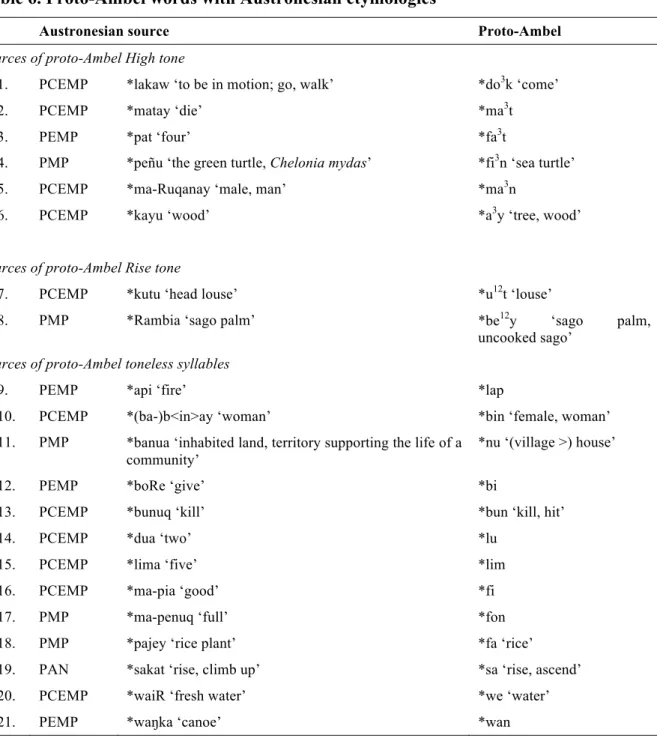
Turning now to the Ambel data, proto-Ambel words with Austronesian etymologies were identified, using the data in Kamholz (n.d.), supplemented by additional data from Arnold (2018a). 22 pA words with Austronesian etymologies were identified; these are presented in table 6.16
15 Based on the conclusion in the previous section, that that Maˈya and Matbat likely inherited their tone systems from a common ancestor, ideally we would want to examine reconstructed data from proto- Maˈya-Matbat. Unfortunately, no such reconstructions are yet available. Nonetheless, if Maˈya and Matbat have descended from a common ancestor, as hypothesised here, we should expect to see segmental predictors in the daughter languages.
16 The Austronesian etymologies in Kamholz (n.d.) are taken from Blust & Trussel (2010–), supplemented by Blust (1978, 1993, 1999). Once again, as only monosyllables have been reconstructed to proto-Ambel, this discussion is limited to monosyllabic words with Austronesian etymologies. The following abbreviations are used in this table: ‘PAN’ = Proto-Austronesian, ‘PMP’ = Proto-Malayo- Polynesian, ‘PCEMP’ = Proto-Central-Eastern Malayo-Polynesian, ‘PEMP’ = Proto-Eastern Malayo- Polynesian.
Table 6. Proto-Ambel words with Austronesian etymologies
Austronesian source Proto-Ambel
Sources of proto-Ambel High tone
1. PCEMP *lakaw ‘to be in motion; go, walk’ *do3k ‘come’
2. PCEMP *matay ‘die’ *ma3t
3. PEMP *pat ‘four’ *fa3t
4. PMP *peñu ‘the green turtle, Chelonia mydas’ *fi3n ‘sea turtle’
5. PCEMP *ma-Ruqanay ‘male, man’ *ma3n
6. PCEMP *kayu ‘wood’ *a3y ‘tree, wood’
Sources of proto-Ambel Rise tone
7. PCEMP *kutu ‘head louse’ *u12t ‘louse’
8. PMP *Rambia ‘sago palm’ *be12y ‘sago palm,
uncooked sago’
Sources of proto-Ambel toneless syllables
9. PEMP *api ‘fire’ *lap
10. PCEMP *(ba-)b<in>ay ‘woman’ *bin ‘female, woman’
11. PMP *banua ‘inhabited land, territory supporting the life of a community’
*nu ‘(village >) house’
12. PEMP *boRe ‘give’ *bi
13. PCEMP *bunuq ‘kill’ *bun ‘kill, hit’
14. PCEMP *dua ‘two’ *lu
15. PCEMP *lima ‘five’ *lim
16. PCEMP *ma-pia ‘good’ *fi
17. PMP *ma-penuq ‘full’ *fon
18. PMP *pajey ‘rice plant’ *fa ‘rice’
19. PAN *sakat ‘rise, climb up’ *sa ‘rise, ascend’
20. PCEMP *waiR ‘fresh water’ *we ‘water’
21. PEMP *waŋka ‘canoe’ *wan
As with the Maˈya and Matbat data, there are no obvious segmental predictors of tone in pA. The best candidate is word-initial *b, which correlates with tonelessness in four examples, with no exceptions (e.g., PEMP *boRe ‘give’ > pA *bi; PCEMP *bunuq ‘kill’
> pA *bun ‘kill, hit’). There is a phonetic motivation for this correlation: onset voiced stops tend to lead to the development of low tone (Hombert, Ohala & Ewan 1979).17 However, as above, there are too few data for this correlation to be significant. In addition, the origin of pA *Rise is unexplained.
17 Recall from section 2.3 that utterance-medial toneless syllables are realised with low pitch in both Metsam and Metnyo Ambel.