講演録
著者 法政大学 イノベーション・マネジメント研究セン ター
出版者 法政大学イノベーション・マネジメント研究センタ ー
雑誌名 法政大学イノベーション・マネジメント研究センタ ー ワーキングペーパーシリーズ
巻 155
ページ 1‑61
発行年 2014‑05‑27
URL http://hdl.handle.net/10114/11355
法政大学イノベーション・マネジメント研究センター国際シンポジウム
都市地域における産業転換
−米英イノベーション先進地域のエコシステム−
Industry Change in Urban Region:
Ecosystems in Innovative Region in the US and UK
講 演 録
目 次
(所属は当時のもの)
Ⅰ.問題提起
米英 3 都市
―シリコンバレーとは異なるエコシステムに学ぶ
……… 1 田路則子(法政大学経営学部教授、イノベーション・マネジメント研究センター所長)
Ⅱ.講演①
Technology Development Consultancies
and the High-Tech Cluster in Cambridge (UK)
……… 9 Jocelyn Probert氏(Centre for Business Research, University of Cambridge)
Ⅲ.講演②
米国オースティン
―クラスター形成におけるスピンオフと学びあう地域
……… 24 福嶋 路氏(東北大学大学院経済学研究科教授)
Ⅳ.講演③
米国シアトル
―ソフトウエア産業エコシステムの新展開
……… 33 山縣宏之氏(立教大学経済学部准教授)
Ⅴ.パネルディスカッション
……… 43 司会 田路則子
松本敦則(法政大学大学院イノベーション・マネジメント研究科准教授)
パネリスト Ana Colovic氏(ネオマビジネススクール准教授)
Gabi dei Ottati氏(フィレンツェ大学教授)
Jocelyn Probert氏 福嶋 路氏
山縣宏之氏
都市地域における産業転換
-米英イノベーション先進地域のエコシステム-
Industry Change in Urban Region:
Ecosystems in Innovative Region in the US and UK
〒102-8160 東京都千代田区富士見2-17-1 TEL: 03(3264)9420 FAX: 03(3264)4690 2014年
2
月1
日(土) 13:00 ~ 17:40 (開場 12:30 ) 法政大学市ケ谷キャンパス ボアソナード・タワー 26
階スカイホール
無 料 法政大学市ケ谷キャンパス案内図
先着150名(定員に達し次第締切)
■下記専用サイトよりお申込みください。
【パソコン】
https://www.event-u.jp/fm/10355
【携帯電話・スマートフォン】
https://www.event-u.jp/fm/m10355
※個人情報の扱いは厳重に管理しております。法政大学に関連する イベント開催等の通知を目的としており、それ以外の目的では使用
しておりません。
1月30日(木)
お車でのご来場はご遠慮ください。
※ご不明な点は、下記までお問い合わせください。 法政大学市ケ谷キャンパス(富士見校地)ボアソナード・タワー26階スカイホール
米国は、シリコンバレーのみならず、産業転換を連鎖的に果たした優等生都市を有している。シアトルは、ソフトウエア産業 のエコシステムを構築した後に、インタラクティブ・メディア産業、航空宇宙産業、バイオテクノロジー産業に波及していった。オ ースティンは、コンピュータと半導体産業の興隆によって、中部のハイテク都市として名前を轟かせた。一方、英国を代表する 大学城下町であるケンブリッジは、コンピュータ、IT、そしてバイオテクノロジーのグローバル企業を輩出してきた。3つの地域の エコシステムを理解し、起業家、投資家、大企業、大学等の役割と連携について議論する。
《総合司会》松本 敦則(法政大学大学院イノベーション・マネジメント研究科准教授)
ま つ も と あ つ の り
■13:00~13:35【問題提起】米英3都市―シリコンバレーとは異なるエコシステムに学ぶ
田路 則子(法政大学経営学部教授、イノベーション・マネジメント研究センター所長)
た じ の り こ
■13:35~14:20【講 演 ①】英国ケンブリッジ―ハイテク・クラスターにおける技術コンサルタントの役割 Jocelyn Probert氏(ケンブリッジ大学教授、同大学経営研究センターシニアリサーチフェロー)
ジ ヨ セ リ ン プ ロ バ ー ト
■14:20~15:05【講 演 ②】米国オースティン―クラスター形成におけるスピンオフと学びあう地域 福嶋 路氏(東北大学大学院経済学研究科教授)
ふ く し ま み ち
〈休 憩〉
■15:20~16:05【講 演 ③】米国シアトル―ソフトウェア産業エコシステムの新展開 山縣 宏之氏(立教大学経済学部准教授)
や ま が た ひ ろ ゆ き
■16:05~17:35【パネルディスカッション】
《司会》田路 則子、松本 敦則
《パネリスト》Ana Colovic氏(ネオマビジネススクール准教授)、Gabi dei Ottati氏
(フィレンツェ大学教授)、Jocelyn Probert氏、福嶋 路氏、山縣 宏之氏
■17:35~17:40【閉会挨拶】田路 則子
主催:法政大学イノベーション・マネジメント研究センター
後援:日本ベンチャー学会 法政大学経営学部 法政大学地域研究センター
※日本語・英語同時通訳付き
Jocelyn Probert
ジ ヨ セ リ ン プ ロ バ ー ト(ケンブリッジ大学教授、同大学経営研究センターシニアリサーチフェロー)■ケンブリッジ大学ジャッジビジネススクール博士課程修了(経営学博士)。2006年バーミンガムビジネス スクール准教授、後に現職。同志社大学、上海大学の客員研究員の経験も持つ。専門は、イノベーション経 営、ハイテク・スタートアップの成長、産学連携、イノベーションエコシステム。ケンブリッジのエコシス テムおよび英国の産業に詳しく、多くの学術および政策研究プログラムに参画してきた。日本に長期滞在し、
著作も発表している。
福嶋 路
ふくしま みち(東北大学大学院経済学研究科教授)■一橋大学大学院商学研究科博士課程単位修得退学(経営学博士)。1997年から東北大学大学院経済学研究 科准教授、2000年から2002年までテキサス大学IC2&マコーム・スクール・オブ・ビジネス客員研究員を経て 現職。専門は地域企業論、クラスター、イノベーション。資源が乏しい地域や困窮する地域が、いかに知恵 を絞って自らの道を切り開いていったのかにとても関心がある。現在は被災と企業家的活動について、東北 を主なフィールドとして研究をしている。
山 縣 宏 之
(立教大学経済学部准教授)やまがた ひろゆき
■京都大学大学院経済学研究科博士課程修了(経済学博士)。2003年米国ワシントン大学訪問研究員、2004 年から2008年まで九州国際大学経済学部専任講師・准教授を経て現職。専門はアメリカ経済論(産業政策 論)、地域産業論、産業集積、産業エコシステム。先進国が経済的な停滞を乗り越えるために、産業づくりの 面でどのような取り組みを行ってきたのか。地域や都市における動向を踏まえつつ、主としてアメリカの到 達点と課題を研究している。
田路 則子
た じ のり こ(法政大学経営学部教授、イノベーション・マネジメント研究センター所長)■神戸大学大学院経営学研究科博士課程修了(経営学博士)。政府系金融機関、IT企業等勤務の後、学術に転 向し、2006年法政大学経営学部准教授、2008年教授。専門は、イノベーションマネジメント、ハイテク・ス タートアップの戦略、アントレプレヌールシップ。ハイテク・スタートアップの成長プロセスを資源調達と 大企業のアライアンスから調査している。シリコンバレー、ケンブリッジ、台湾新竹を中心に、最近はスウ ェーデンも対象としている。
(敬称略)
I. 問題提起「米英 3 都市―シリコンバレーとは異なるエコシステムに学ぶ」
講師 田路 則子(法政大学経営学部教授、イノベーション・マネジメント研究センター 所長)
皆さん、法政大学にお越しいただきまして、ありがとうございます。本日は「都市地域 における産業転換」というテーマでシンポジウムを開催させていただきます。
昨日は非都市地域(ルーラルリージョン)で、今日は都市地域(アーバンリージョン)
ということで、対になったシンポジウムを企画いたしました。昨日は岡本義行先生がつく られた研究所である地域研究センターの主催で、本日は私が所長を務めているイノベーシ ョン・マネジメント研究センターの主催です。
当センターはハーバードにある研究所を見本にしたデポジットライブラリーで、普通に 図書館で保存するのが難しい資料、希少というか、閲覧する人が少ないような珍しい資料 を保管するという機能があります。そして、今時の時流に合わせて国際化ということで、
セミナーや国際シンポジウム等を開催しています。
本日は、アメリカのオースティンとシアトル、イギリスのケンブリッジという三つの地 域に学ぼうということで、「シリコンバレーとは異なるエコシステムに学ぶ」と題しました。
スマートバレー構想などがあったのを覚えている方もいらっしゃると思いますが、日本に もシリコンバレーをつくりたいという無謀な構想も昔ありました。しかし、もちろんそれ はできません。なぜできないか。まずそんなに移民が来ないだろうという大前提がありま す。では、シリコンバレーと似たようなエコシステムを他の地域が持っているかというと、
そうではなく、成功している町でもそれなりに苦労しながらイノベーションのシステムを 育ててきているのです。
1.シリコンバレーの概要
まず、世界で唯一、まねすることができないと言われているシリコンバレーとはどんな ところかをお話ししたいと思います。シリコンバレーのジャイアンツとしてはGoogleがあ りますが、これがつい最近、日本のス
タートアップを買収したことで市場を にぎわしました。オンラインで見られ る「週刊ダイヤモンド」にもこの記事 が載りました。
アメリカの国防省のロボットコンテ ストで12月に優勝したばかりです。ブ ロックの上を非常に器用に歩いてみせ るロボットで、これを開発したのが東 大の助教をやっていた男性2人です。2 人は東大を辞めて、スタートアップを つくりました。東京大学には、アメリ カの国防省のコンテストにファカルテ
ィが出ることはできないという規定があったので、彼らはアカデミアを辞めて会社をつく 図表 I-1
ったわけです。
ただ、実際にはコンテストに出る前に既に Google に買収されていました。なぜ Google に買収されたか。別にアメリカ企業に売りたかったわけではなく、非常に研究開発費に苦 労した揚げ句に、Googleに売らざるを得なかったというのが結論のようです。創業者の一 人の中西さんは、私の実のおいの中高の同級生で、おいから話を聞いたのですが、ずっと 日本のベンチャーキャピタル回りをしたらしいです。大企業も回って、1~2人のエンジェ ル(個人投資家)から投資を受けただけで、どこも見向きもしなかったということです。
ところが、Googleは見せたら一発で決めたようです。Googleはロボットのスタートアッ プをこの半年から1年で十何個買っていて、そのうちの一つだったのです。これをこれ以 上お話しすると、日本はなぜこんなに企業環境が貧しいのかということになってしまうの で、それは本日のイシューではないので置いておきたいのですが、そのGoogleです。もち ろんシリコンバレーで大きくなったわけです。
シリコンバレーは、産業転換(インダストリーエクスチェンジ)を見事に果たした地域 としても有名です。1938年にヒューレット・パッカードが創業します。ヒューレットとパ ッカードがつくった会社が一番有名になったのですが、その後に半導体が来て、Apple、
Oracleのパーソナルコンピューターとデータ管理の会社が来て、90年代にインターネット
が普及します。ここでGoogleが登場するわけです。Googleが公開されたのが2002年だっ たと思います。その後、モバイルのビジネス、ソーシャルメディアが立ち上がり、私たち がよく知るFacebook、Twitter、Skypeが登場しました。実にきれいに産業転換を果たしてき ています。本日は、最近の事例として、ウェブとモバイル関連のビジネスのお話をご紹介 します。
シリコンバレーはカリフォルニアの北の方にあります。カリフォルニアにはサンフラン シスコ湾があり、その南側がシリコンバレーと呼ばれているところです。一番北にあるの
がTwitterで、サンフランシスコ市内
にあります。ずっと南に下りてきて、
一番南にサンノゼという町がありま す。サンノゼとサンフランシスコの 間の西側が通称シリコンバレーとい われています。サンフランシスコ市 内ではなく、サンノゼに近いところ にたくさん企業が生まれて、Apple やIntel、Google、Facebookなどはそ の辺で起こりました。しかし、最近 の傾向として、サンフランシスコで 起業することが多くなりました。ソ ーシャルメディアのビジネスは場所 が要らないからです。Twitterは育ち
ましたが、まだ育っていない小さいスタートアップがサンフランシスコ市内にぽこぽこと 出てきているというのがこの3年以内の現象です。
2010年に訪ねたときには、Twitterのオフィスには有名な3名の創業者のスナップショッ トが飾ってありました。それから、建物の中の駐輪場には世界地図が貼ってあります。社
図表 I-2
員が自転車で通勤してくるのです。サンフランシスコ市内に住んでいる、独身の20代の男 の子と女の子が自転車で通勤してきて、そのままエレベーターを上がってきて、張り出し てある世界地図の前に停めます。世界地図には旗が立っており、Twitterが進出した地域に 旗が増えていくという感じでした。まだ今ほど大きくなる前です。当時の食堂では、ラン チしか提供していなかったと記憶しています。
10 カ月前の 2013 年の春には、同じサンフランシスコの市内で大きなスペースに移りま した。撮ってきたのは2014年1月の写真です。非常に大きな食堂になっていました。食堂 が足りなくて、2.5個ぐらい造っています。大きいものが二つ、半分ぐらいの大きさのもの をまた1個造ったと言っていましたが、社員が2000~3000人いるので、全然足りないとい う話をしていました。
食堂の前がテラスです。まだ建設中という感じです。各階には飲み物が置いてあり、ビ バレッジとビールです。ビールはなぜかいろいろな種類があって、勤務中にも飲んでいい そうで、各階に備えてあります。食事は3食、朝昼晩を全部提供しています。これがシリ コンバレーでいう福利厚生です。日本は普通、社食はお昼だけで、少なくとも200円か300 円は払うと思うのですが、向こうは朝昼夜が完全にフリーで、独身さんは大喜びという感 じです。
一方、Googleはかなり南の方に あります。町中ではありません。
法政大学が三つ入るぐらいの敷地 の中に四つぐらい、彼らはキャン パスと呼んでいるのですが、大学 のような大きな建物があります。
移動が大変なので、カラフルな自 転車をみんなが乗り捨てていくと いう感じです。中庭で社員がオー ガニックベジタブルを栽培してい て、これをお昼に食べたり、家に 持って帰って食べたりしていると いうところです。全く都会ではあ りません。
基本、サンフランシスコ以外のシリコンバレーといわれるところはこういう感じです。
車で行かなければ絶対に着けない、タクシーも駅に停まっていないような場所です。日本 人がここに行くと、なぜこんな田舎でハイテク企業が育ったのかと思うでしょうが、アメ リカはモータリゼーションの社会なので、そういう場所になのです。
先行研究におけるシリコンバレーの特徴についてご紹介します。アナリー・サクセニア
ンが1994年に『Regional Advantage』という本を書いて、非常に有名になりました。その本
ではシリコンバレーが分かりやすく解説されています。
三つの特徴があります。まず企業の新陳代謝が激しいということで、どんどん新しい企 業が生まれて、育たなかった古いものは退出していくということが起こっています。二つ 目は、特にアジアや中東から移民として優秀な技術系の人材がたくさん来ることです。実 はエンジニアはほとんどが白人ではないと言ってもいいぐらい、インド人、台湾人、中国
図表 I-3
人、時にはパキスタンやイラン辺りからも来ます。オーストラリアから来ることもありま す。三つ目が、ベンチャーキャピタルの豊富な資金とノウハウを提供していて、優秀な営 業マンや財務担当役員(CFO)を紹介することもあります。
カリフォルニア州全体で、創業者のうち30%は移民です。シリコンバレーでは50%を超 えているという状況です。町の名前でいうと、サニーベールやマウンテンビューの辺りは 白人の比率が50%を切ってきています。ですから、われわれが歩いていると、日本人なの か、台湾人なのか、中国人なのか、韓国人なのか分からないということで、「あなたはチャ イニーズか」とよく聞かれます。それぐらいたくさんアジアの人が歩いているところです。
2.WEB&モバイルビジネス―投資と育成
全米のベンチャーキャピタル投資のうち 56%がカリフォルニアにお金が落ちていると 言われています。カリフォルニアのうち、シリコンバレーはかなり多くを占めています。
最近の傾向として、2008年のリーマンショック以降は、バイオテックや半導体の投資が かなり減りました。早く育つビジネスということで、モバイルとソーシャルメディアがか なり投資を集めてしまいました。iPhoneアプリだけを作るスタートアップに投資をする投 資組合、ファンドがつくられたのが2009~2010年です。
もう一つの特徴として、投資&育成型のインキュベーターがあります。皆さん、Y
combinatorをご存じですか。1年ほど前に日本でも訳本が出ました。Y combinatorというの
が特別なインキュベーションです。滞在ビザの期間である3カ月でビジネスモデルをつく らせて、投資家の前でプレゼンします。世界からスタートアップチームを集めるのです。2 人、3人、5人でやってきます。3カ月
滞在させて、アプリやシステムをとに かく、つくらせます。3 カ月後にベン チャーキャピタルを招いてプレゼンを させて、良ければ投資してもらえます。
そこから起業家ビザを取って、シリコ ンバレーで起業家になるという仕組み をつくるコンペティションをやってい るインキュベーターです。かなり特殊 な イ ン キ ュ ベ ー タ ー な の で す が 、Y combinator だけではなく、500 startups というものもあります。最近また 500
startupsからスピンアウトして、新しいインキュベーターができたと聞いています。このビ
ジネスはまだまだ続きそうです。
そして、スペインやフランスといったヨーロッパからインキュベーターがオフィスや拠 点をサンフランシスコ市内にオープンするということが起きています。そういうビジネス のエグジットストラテジーはIPOではなく、ほとんどがバイアウト(売却)です。どこに 買ってもらうのか。Facebook、Google、Apple をだけではなく、シアトルの Microsoft も買 い手です。ですから、買ってもらうつもりのビジネスモデルをつくって、それを実行して いるわけです。
図表 I-4
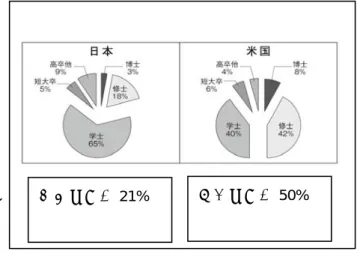
日本は院卒21% 米国は院卒50%
ここから質問票のデータを紹介したい と思います。2012年に東京とシリコンバ レーで票を集めました。日本が114人集 め、アメリカは50人しか集まりませんで した。日本では、ほとんどの日本人が市 民権を持っています。アメリカでは48% しか持っていません。第1世代の移民が いかに多いかが分かります。平均年齢は 日本が35歳、アメリカは 37歳で、アメ リカの方がむしろ高いぐらいです。マー ク・ザッカーバーグのように在学中に起 業する人ばかりではありません。普通に 大企業に勤めていて起業する人がかな りいるということです。理工系の学部 や大学院を出た人は、アメリカでは 80%、大学院卒も50%います。これは 日本とかなり差があります。
それから、今回が2回目以上の起業 の人たち(シリアルアントレプレナー)
は、日本は26%で、アメリカは56%で、
これは予想どおりの数字です。
勤務経験は、アメリカのサンプルで も、実は全く働いたことがない層はほ とんどいなくて、10人に1人しかいま
せん。かなりいろいろな企業で働いていて、アメリカでは平均年齢37歳で3社以上勤務し た人が 66%います。かなり人が動いている、かなり高い転職率であることが分かります。
一方、日本でも今まで三つの会社で働いた人が35%います。日本の中ではかなり特殊な層 がこういうビジネスを起業しているということになります。
アメリカでは、インド、ルーマニア、スリランカから来ていて、勤めていた会社はApple、 Vodafone、Yahoo!、Sun Microsystemsなど、ITの大企業です。その会社でやったことにかな り近いビジネスをしている、大企業に勤務して、勤務時代に培ったスキルやネットワーク を生かしたビジネスを起こしている人たちだということです。
また、日本は基本的には1人創業者が多いはずなのですが、(半導体であれば、もっと日 本の1人創業者は多いはずなのですが)、このビジネスは私の想像よりは2人でやっていま した。日本の1人創業者は33%で、そのうち、2年以内に、経営チームを追加したのは34% です。それに対してアメリカは、1 人創業は 20%しかいなくて、2 年以内に追加したのが
47%です。
アメリカ投資のルールでは、ベンチャーキャピタル(VC)投資を受けるためには、CEO
(最高経営責任者)とCTO(最高技術責任者)の2人がいなければいけません。交通事故 で倒れてしまったら、もう何も立ち行かないということでは困りますし、会社の経営をす る人と技術を扱う人とが別々にいないと早く成長しないという原則があるのです。ですか
図表 I-5
図表 I-6
日本の3社以上勤務 35%はかなり高い転職率
米国の3社以上勤務 66%はもちろん高い転職
シリアル・アントレ 日本は26%
シリアル・アントレ 米国は56%
ら、アメリカでは、ベンチャーキャピタル投資が欲しければ、必ず2人をそろえるという 大原則に従うわけです。
ベンチャーキャピタル投資には三つの外部投資があります。一つがビジネスエンジェル
(個人投資家)、もう一つが VC(ベンチャーキャピタル)、事業会社はその他です。例え
ばMicrosoftが投資してくれるということもあります。投資は二つに分けていて、シードは
会社立ち上げ時の投資ラウンドで、シリーズAが追加の投資ラウンドです。日本では、シ ード投資を受けられるのは全体の30%、2年以内に追加の投資を受けられるのは40%と増 えています。ですから、追加投資を受けるのは日本ではたやすいわけです。シードで投資 を受けられなくても、シリーズAで受けられる会社がかなりあるということです。アメリ カに行くと全く反対です。シードは
46%受けているのに対して、シリー ズAはその半分以下で、投資家にか なり厳しく見られているということ だと思います。
この投資と経営チーム、創業した ときのメンバーの関係を見るために、
回帰分析を使います。二つに分けて いて、まず創業チームの多様性を見 ます。CEO、CTO、CMO(最高マー ケティング責任者)など、創業時の 経営陣(取締役)の人数です。チー ム変更というのは2年以内に追加し
た、入れ替えたというものを見ます。それと先ほどのシードとシリーズAを足した投資に どう影響をしているのかを見ています。
日本ではチーム変更が一番利い ていて、プラスで10%の有意水準 です。創業チームの多様性は若干 利いているけれども、モデル3に なると創業チームは消えますから、
チーム変更の方が利いていること になります。一方、アメリカでは、
チーム変更は全く影響がありませ ん。むしろ創業したときのチーム の多様性が 1%の有意水準で、か なり強く影響しています。
これをまとめると、日本では創 業からやや時間がたって、チーム
が固まった段階で投資をする傾向があります。ベンチャーキャピタルもビジネスエンジェ ルも待つのです。アメリカでは、創業したときにどういう人が、どういうチームでやって いるかがとても重要で、それだけを評価していて、その後にチーム変更したことをほとん ど評価していないことになります。結論としては、シリコンバレーでは、経営チームとビ
図表 I-7
図表 I-8
ジネスモデルを早期に固めたスタートアップが外部投資を獲得し、できるだけ速い成長を 目指す。とにかく速くなければいけないという経営をします。
3.シリコンバレーのエコシステム
移民が企業の担い手というお話をしました。Apple、Google、Facebookといった成長した IT企業から社員が辞めて、スピンオフしてくるという状況があります。近所で会社をつく るのです。Googleにいた3人で新しい会社をつくろうかということになったとしましょう。
近所にベンチャーキャピタリストもエンジェルも大勢住んでいるので、車で10分くらいの ところにすぐにビジネスプランを見せにいきます。立ち上げから外部資金を獲得すること は、先ほどの回帰分析でお話ししたとおりです。
シリコンバレーのモデルは特殊なものであって、恐らく他の地域が全く同じようにまね することはできないでしょう。例えば、山ほどは移民が来ないでしょう。もともと住んで いた白人の人数を超えるほど、町がアジアの人間であふれかえるというのはすごいことで、
他にはなかなかなく、ベンチャーキャピタルもこれだけ密集して存在しているということ もほとんどありません。
では、オースティン、シアトル、ケンブリッジの三つの地域はどうやってエコシステム を形成してきたのか。これを皆さんに確認していただきたいと思います。非常に大きな役 割を担うアクターとして、オースティンはIBMがオフィスを出しました。それは大きな影 響があることでした。それからオースティンでは大学、コンソーシアム、半導体、エンジ ェルの役割が大きかったです。シアトルでは、成長したMicrosoftがかなりスピンオフを生 んでいます。Amazon も、かなり考えた末に、ジェフ・ベゾスが、そこにヘッドクオータ ーを置きました。それもすごく意味がありました。そして、シアトルにもいい大学があり ます。あとケンブリッジですが、イギリスは非常に面白いモデルを持っていて、コンサル タント会社が起業をかなり支援しています。技術コンサルが研究開発を支援するというモ デルを築きました。非常に特色あるアメリカにはないシステムをつくっていて、それを今 日はプロバートさんにお話しいただくことになっています。ケンブリッジからお話をして いただきます。非常に長い歴史のある美しい観光地です。アメリカには全くない風景なの で、ぜひ皆さんには行っていただきたいです。
1441年にキングスカレッジがつくられました。カレッジというのは寮という意味で、ド ミトリーなのです。ここにいろいろな学部の学生が住んで、どこの寮に所属しているかが 卒業しても分かるのです。魔法使いの映画の話ではありませんが、どこの寮出身かという ことに意味があるのです。
そして、トリニティカレッジというのがあります。ニュートンが入学したのが1661年で す。庭にはニュートンの木が植樹されています。最近サイエンスパークをケンブリッジに つくらせたのがトリニティカレッジで、卒業生からの大きな寄付によって大学のそばにサ イエンスパークをつくっています。大学が大きく関わっている。それと、研究開発の機能 を果たす技術コンサル会社をプロバートさんにお話ししていただきたいと思います。
プロバートさんは日本語がすごく堪能で、私はその堪能ぶりを昨夜発見して、かなりシ ョックでした。私の英語よりはるかにプロバートさんの日本語の方が素晴らしかったです。
ケンブリッジ大学のジャッジビジネススクールという MBA があるのですが、その附属の 研究センターのシニアリサーチフェローをなさっています。日本には結構長くいらっしゃ
って、4 年間リサーチャーとして働いていらっしゃった時期があって、そこからイギリス にお戻りになって、その後1年、また日本にいらっしゃったことがあります。ですから、
日本のことはよく理解していらっしゃるお立場で、このケンブリッジのシステムをお話し いただきます。
II. 講演①「 Technology Development Consultancies and the High-Tech Cluster in Cambridge (UK) 」
講師 Jocelyn Probert 氏(Centre for Business Research, University of Cambridge)
Let me begin by saying thank you to Professor Taji for inviting me to participate in this symposium. It is my great pleasure to be here today.
Outline
I was asked to talk to you today about the role of technology consultancy firms in the Cambridge high-tech cluster, which is the topic of an article I and my colleagues at the University of Cambridge, Dr Andrea Mina and David Connell, published in the journal Research Policy last year. But I will try to put that topic into broader context by first making some comments about Cambridge and the development of the high-tech cluster there – the so-called Cambridge Phenomenon.
Locating Cambridge
Perhaps I should start by explaining the location of Cambridge. As you can see from the map it is in the East of England region, about 50 minutes by train north of London. Oxford is approximately 85 miles (130 kms) north-west of London. The area between these three cities is often called the Golden Triangle because there are so many high-tech businesses located within it. Unfortunately, although it is very easy to get from London to Cambridge and from London to Oxford, the journey between Cambridge and Oxford is much more difficult!
Cambridge has a population of about 130,000 people, of whom around 25,000 are undergraduate and graduate students at the University of Cambridge. The boundaries of the Cambridge cluster encompass the villages and towns within a 30 km radius of the city, covering a total population of roughly 450,000 people. The population is well educated, too: over 40% have at least an undergraduate degree, which is about twice the UK average.
The Cambridge cluster
The so-called Cambridge Phenomenon began to emerge about 50 years ago, in the 1960s, thanks to the benign attitude of the University towards exploitation of the intellectual property generated by its professors, researchers and students; the presence of many bright young graduates and postgraduates in sciences and engineering; and the decision by Trinity College to establish a science park on the edge of town, followed some years later by St John’s College’s investment in an innovation centre to incubate young technology companies. One of the triggers for the Cambridge Phenomenon development was the Mott Report, produced by a committee of the University in the late 1960s, which considered the town planning aspects underlying the relationship between new science-based industry and the university. That Mott report encouraged the construction of the UK’s first science park by Trinity College in 1970 on some land on the north side of the city that it had owned since the college was founded in 1546. (Trinity is the largest, richest and most prestigious of the 31 colleges at the university.) Over time, many new firms started up and some established firms moved to Cambridge or set up their research operations.
Since then, a large number of science parks have grown up in and around Cambridge to house the many firms that want to be part of the Cambridge cluster. One of the main reasons for firms being in Cambridge is to get access to the many highly qualified people in the city.
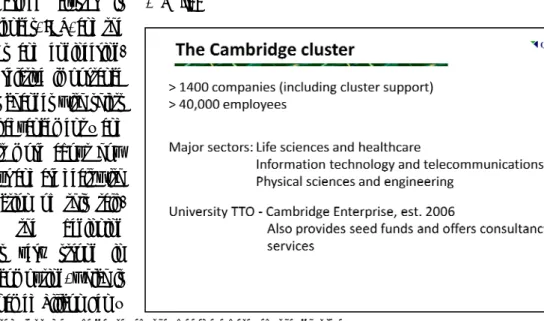
Today, there are estimated to be around 1,400 companies in the Cambridge cluster, employing over 40,000 people and generating annual revenues of £13 billion. It is perhaps not surprising that Cambridge has one of the lowest unemployment rates in the country, at just 2.2% in October 2013. At least five companies have grown into $1 billion companies, the most recent being Abcam, ARM, Autonomy, CSR and Domino Printing – although Autonomy no longer exists as an independent company so we are back down to four. Others in the past include Ionica and Virata. ARM has come to dominate one of the fastest-growing markets in the world, by licensing its designs for the processor chips that power smartphones and other mobile devices.
The Cambridge cluster is strong in life sciences, ICT, and the physical sciences and engineering.
Of course the relative importance of these sectors changes with shifts in technological advancement – and I will say a bit more about how those shifts occur and are dealt with in the next section of this talk.
Certainly in the beginning Cambridge was very strong in electronics and computing, which is why it was nicknamed Silicon Fen –
a name that is used less now because of the broader base of the cluster.
Cambridge Enterprise is a relatively new organisation that is part of the University of Cambridge.
It was established in 2006 to manage the University’s technology transfer activities after the University produced guidelines to govern the commercial exploitation of IP generated in its facilities through externally funded research. In addition to facilitating technology transfers, Cambridge Enterprise offers consultancy services and provides seed funds for university spin-out companies. High tech start-ups have been spinning out of the University for many years, of course, well before Cambridge Enterprise was founded. Other parts of the university, including Judge Business School where my research unit is based, are very much engaged in teaching undergraduates and graduate students about entrepreneurship and in encouraging networking opportunities with local entrepreneurs and investors.
The cluster ecosystem
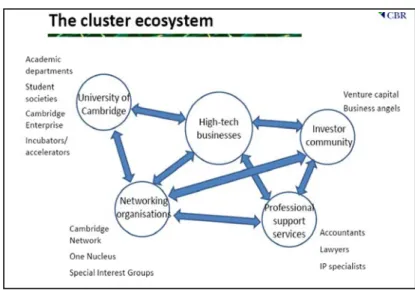
This slide shows the main components that make up the Cambridge cluster ecosystem: the high-tech businesses themselves, the university, the investor community, professional support services, and various networking organisations. They are all interlinked because of the many different ways in which they interact. It is an ecosystem that has grown organically, mostly from the bottom up: there was no government policy to establish a high-tech cluster in Cambridge. The Cambridge Science Park
図表 II-1
built by Trinity College was developed in response to demand, not to encourage it. The university, apart from attracting and then
graduating a lot of very bright students and employing some brilliant and inventive academics, especially in the physical and life sciences and engineering, also responded to demand for more focused teaching and training. I have already mentioned Judge Business School. One of the units within the school is the Centre for Entrepreneurial Learning, which was launched in 2003 with the mission to “spread the spirit of
enterprise” and is where budding entrepreneurs can learn the skills they need to turn their business ideas into successful business ventures. The Institute for Manufacturing, which is part of the Engineering faculty, is also very much involved in educating entrepreneurs. In fact, there are so many different initiatives springing up around the University to engage with local business on either the research or the educational level that I have just started a new piece of research to try to map them all.
Student groups, such as CUE (Cambridge University Entrepreneurs) and CUTEC (Cambridge University Technology Enterprise Club), are also active in arranging speakers from the cluster to give talks on various aspects of getting started in business and in providing networking opportunities for like-minded students to meet each other and spark new ideas. Then there are the services provided by Cambridge Enterprise, which I have already mentioned, and university-owned innovation-centres and incubators, such as St John’s Innovation Centre, a now well-established centre where young firms can rent space flexibly and have access to support facilities and mentoring; and ideaSpace, which is a relatively new incubator for university-led fledgling ventures.
Turning to the investor community, Cambridge has several business angel groups, including Cambridge Angels and Cambridge Capital Group, and a corporate angel investor called Martlet.
Cambridge Angels, for example, is a group of high net worth individuals who invest in and mentor high quality start-up and early-stage companies in the Cambridge area. They all have proven experience as successful entrepreneurs in internet, software, technology and bio-technology, and those are the sectors they are actively involved in. Membership is by invitation only, and there is no public list of who is a member! Then there are the venture capital funds based in Cambridge. They include Amadeus, which was founded by Hermann Hauser who is one of the big names in the cluster – he was very much involved in the founding and development of Acorn Computers in the 1980s and several other important Cambridge firms – and IQ Capital, which runs various seed capital funds and was set up by a man called Nigel Brown who built up his own investment firm in Cambridge 40 years ago. There are other venture capital firms that are active, although many of the big international ones no longer truly provide venture funding – but that is a different topic to the one we are discussing today.
図表 II-2
Then there is a rich collection of lawyers, intellectual property advisers, accountants, market researchers, designers and other sorts of professional services firms in the city. And, bringing together all these different groups are the networking organisations. The biggest and best known is Cambridge Network, which was founded in 1998 by the vice-chancellor of the university and influential businessmen and entrepreneurs including ones I have mentioned already. Its mission is to encourage collaboration for shared success, which it does by facilitating co-operation, action and resource sharing, being a focal point for organisations, encouraging networking and idea-sharing through members’
events, and helping member companies to find and attract quality candidates to work in Cambridge.
Then we have One Nucleus, which is a group of businesses in the biotech arena, and there are all sorts of special interest groups such as on cleantech, wireless networks and so on.
Expansion of the Cambridge ecosystem
This chart, produced by one of my colleagues in the Centre for Entrepreneurial Learning, shows how the Cambridge ecosystem has expanded since the 1960s. I’m sorry the chart is rather hard to read – and it only goes up until 2002 – but it gives you some idea of how the ecosystem developed. Even in the early days, in the 1960s and 1970s, various elements of the ecosystem were already present. There is no need to try to read the names in the various boxes, but the purple boxes are university departments and research labs, the blue-grey ones are commercial enterprises, the yellow ones are finance services, i.e. part of the professional support services group, the brown ones are science parks and innovation centres, the green ones are the parts of the university involved in teaching and fostering entrepreneurship, and the pale blue ones are networking organisations. Of course not every 図表 II-3
name is present, but you can see how the chart becomes more and more crowded as we move through the decades.
The Cambridge cluster – key aspects
In short, the Cambridge cluster is highly networked. The driving force are the entrepreneurs, but they are surrounded by strong ecosystem support both within the university and outside. One of the aspects that helps the Cambridge cluster endure, despite economic downturns and competition from other clusters abroad but also in London, is that it is composed of a fertile combination of experienced and novice entrepreneurs. There are many serial entrepreneurs in Cambridge, who have made money on the sale of their first venture but who have gone on to set up other ventures, bringing into their teams younger people who benefit from their insights, knowhow and networks. Somehow, people like to stay in Cambridge, and that is good because a vibrant cluster needs people to stay around for the long term. One threat to the cluster model is that high-tech entrepreneurs looking to re-invest their capital after an exit can now choose from among opportunities globally, in a way that they could not 10 or 15 years ago, but fortunately Cambridge Angels remains very strongly focused on Cambridge.
Overall we can say that there has been a relatively small group of people – serial entrepreneurs, business angels and venture capitalists – who have been highly influential in fostering the growth and success of the Cambridge cluster. The social capital created by the links between their activities is a very important glue, in terms of both structures and relationships.
Connections in the high-tech cluster
You can see the density of the connections from this slide, which also comes from my colleague Yupar. Again there is no need to try to read it, but I will just say that around the edge are the names of individuals and the thickness of the lines connecting them show the number of links between them.
So for example, Hermann Hauser (at the top) – whom I have mentioned before – has multiple connections with Andy Hopper (on the right-hand side), who is head of the University’s Computing Laboratory. They first worked together at Acorn Computers, which Hermann Hauser founded and Andy Hopper joined while still finishing his PhD at the University. And they have worked together on multiple ventures since then. Andy Hopper decided after some years to return to academia, but he is still intimately involved in at least two of the more than ten companies he has founded over the years, and in some of which Hermann Hauser has invested through Amadeus (and perhaps also as a business angel). You can see there are lots of connections between people – the thickness of the lines shows how strongly one individual is connected to another.
Outline
So let me now turn to the main theme of my talk to you today: the contribution to the growth of the Cambridge cluster, and the innovation economy more broadly, of a particular type of high-tech business which falls under the general heading of knowledge-intensive business services. This is the R&D service firm, and in particular the model of the technology development consultancy. My colleagues David Connell, Andrea Mina and I set out in our research to examine how the provision of
R&D services can grow over time into a mechanism to develop new technologies directly and through spin-out. We wanted to fill in gaps in the empirical evidence base on the R&D service business model and its implications for the development of new technologies and new firms. It is a business model that is poorly understood, yet it has been crucial to the growth and sustainability of the Cambridge high tech cluster.
R&D service firms
First, what do I mean by R&D service firms? They are a subset of new technology-based KIBS which take on contracts from third parties to conduct bespoke R&D projects. Although many of these firms are grouped under SIC code 73.10 (research and experimental development on natural sciences and engineering), in fact examples can be found in many industry sectors including pharmaceuticals, automobiles, aerospace, instrumentation and physics-based engineering. These firms could spend all their time undertaking R&D services for other organisations, or it may be only part of their business activity. For example, a pharmaceutical firm could have one division dedicated to conducting contract research for clients and another division doing its own proprietary research. Using the understanding they gain from working in particular technology areas for clients, R&D services firms could be working towards commercialising their own platform technology, and even developing standard products. I will talk in more detail about this aspect later.
The purest form of R&D services firm is the technology development consultancy, or TDC.
They depend for their revenue almost entirely on R&D services provision to third parties. In Cambridge, TDCs have been crucial to the growth of the high-tech cluster in a variety of ways, as I will explain over the next few minutes. Curiously, Cambridge seems to be the only cluster certainly in the UK and, as far as I am aware, internationally to have a large number of these firms and yet they have been very successful in developing new platform technologies and spinning out new firms or licensing out technologies. In some respects they are the UK’s nearest equivalent to intermediate research institutes such as the Fraunhofer Institutes in Germany and IMEC in Belgium, but unlike those institutes they receive no core government funding because they are private enterprises. And they have managed to survive very well compared with some product-based new ventures.
Technology development consultancies – The sample
So who are these TDCs? This is the sample of TDCs we interviewed. As you can see, the first one was founded in 1960 by a small group of Cambridge undergraduates, so that firm has been around for well over 50 years. The first four on the list are very well known in the Cambridge area, and have been almost ever since the term ‘Cambridge Phenomenon’ was coined in the 1980s. The other six firms in the list, although smaller – in some cases much smaller – than the first four, are probably the next biggest TDCs we have in Cambridge. There are many smaller technical consultancies in the area as well, often one- or two-man bands who have set up on their own or have split off from a larger firm, plus one or two other firms that are much younger than these ones. The four broadly-based TDCs work on consultancy contracts for firms in many different industrial sectors. The rest of the firms on this list tend to specialise in a narrower range of industries, or else concentrate on particular types of project such as product engineering development or industrial design, primarily because they are
smaller companies. Even in the larger companies, though, employment seems to peak naturally at around 300 people, which is about the maximum number so that everybody knows everybody else.
When employment rises much above that number, groups of consultants might spin out into a separate venture, with or without the blessing of the top management, or in economic downturns there may be redundancies.
The other point to make is that these firms operate a very flat organisation: there are many junior technologists from a range of scientific disciplines – physics, biology, and mechanical, electronics and software engineering – and they do most of the work under the guidance of a small number of senior people. These TDCs also all operate in an extremely global marketplace. International operations typically account for well over half of annual revenues. That is partly because of the loss of manufacturing industry from the UK, so the TDCs are forced to seek out overseas clients. But the other important factor is that their advanced problem-solving skills enable them to win work from prestigious multinational corporations. Because their technological contributions to client firms’
products are highly sensitive for both commercial and competitive reasons, it is not possible to collect systematic information about the number of customers or projects running at any one time. But we can say that both the large and the smaller consultancies have venture-backed firms among their clients, and this underlines the (rather hidden) role they play in the innovation system. Smaller TDCs are often more intensively networked into the local Cambridge VC-backed technology cluster than the large TDCs, because the large firms charge higher fees for their services than start-ups can generally afford.
In addition, the large TDCs operate their own venture capital funds which invest alongside third-party funds in young entrepreneurial technology firms – so they are also part of the Cambridge cluster investor community.
Cambridge’s technology development consultancy heritage
I just wanted to show you this chart very quickly, because it explains the heritage of many of the TDCs that operate around Cambridge. As you can see, it all started with Cambridge Consultants in the 1960s, as I mentioned before. Then, in 1970, a group of consultants who disagreed with the strategy of their employer moved to set up the technology development consultancy arm of a firm called PA Consulting, and they insisted the new unit should be set up near Cambridge. That worked very successfully for several years, but then there was another disagreement about strategy so there was a breakaway from PA Technology in 1986 to form Scientific Generics, now called Sagentia. Yet another group left PA Technology the following year to create The Technology Partnership, now called TTP Group, again based in the Cambridge area. And then you can see that the smaller TDCs have also mostly set themselves up after breakaways in the late 1980s. Although each of these firms have their own characteristics, their heritage is clearly rooted in the ethos of R&D contract work established by Cambridge Consultants all those years ago.
R&D contracts and the management of uncertainty
So, how do these firms actually operate? Highly skilled researchers undertake technology development and problem-solving projects for clients in industries such as electronics, aerospace, defence, medical devices, printing and telecommunications. The larger TDCs have extremely
well-equipped laboratories and workshops and, by working with manufacturing subcontractors in countries with labour-cost advantages, they are able to take a wide range of products from the concept stage through to volume manufacturing. So the TDCs do all the clever stuff themselves, and then if necessary they help their clients to find a suitable outsource manufacturer, for example in China.
Customers approach TDCs directly with problems they need solving or new products or processes they need developing. And TDCs themselves also propose development projects pro-actively to current and potential clients in areas where they have, or are building, expertise and IP.
An R&D contract typically involves the development and delivery of a demonstrator, prototype or ‘ready to use’ physical deliverable, and then there are possible subsequent opportunities for low volume manufacturing or the sub-assembly of mission-critical components for an industrial customer.
The intellectual property developed during contract work for a client is usually signed over to the client unless the development work revolves around the TDC’s existing technology, in which case the client is granted a licence for the commercial exploitation of the work the consultancy is doing. By working on multiple contracts for multiple clients within the same technological space, the TDC is able to gain new insights and expertise into the technology that could lead to the creation of its own proprietary intellectual property around a different application – and I’ll show you an example of that a bit later on.
But careful management of ownership and commercialisation rights is crucial to the development of a robust IP package that the TDC can license out later, or use to form product-based subsidiaries, or assign to spin-out companies.
One of the big areas of risk is predicting the time it will take to develop a technology – if indeed it is possible to produce the desired outcome at all. TDCs prefer not to quote to clients a fixed price in advance, in order to avoid bearing the cost of project overruns, which are very common especially where the science is untested or where the client hasn’t clearly specified the outcome. As you can imagine, a wrongly priced fixed contract could be financially disastrous for the TDC. At their simplest, payment terms are based on time and materials used, like in other professional service organisations such as law and accountancy firms and management consultancies. But often, TDCs get up-front fees for the purchase of materials and specialised equipment, and there may be milestone payments as each key stage is reached. One way to mitigate the risks inherent in technology projects is to divide the work into phases of increasing size, which allows key uncertainties to be investigated first. If those uncertainties are technologically just too hard to solve, the research contract simply comes to an end at that point. The other advantage of phased projects is that they allow the consultancy to refine its pricing quotations for later stages of the work.
A distinctive capability of TDCs – in fact a core competence – is their expertise in advancing the innovation process from market need to a finished product using novel, high risk technologies. Often they can do this even when the customer’s requirements are unvoiced or poorly defined – when they say they want one thing but actually want something else. This expertise is a big contrast with large-company clients or even VC-backed Silicon Valley firms, where very few successful project managers have the opportunity to manage an entire engineering project from start to finish more than once. The first step in the development process is actually to identify the key technical risks early on and to establish whether they can be overcome. It is not to create a prototype, as most people generally assume. Repeated practice on many client R&D contracts gives TDC engineers a sophisticated
understanding of where the risk in a project lies, and they gain an intuitive experience-based approach towards managing technological uncertainty. Breaking the project into stages, efficient costing, and managing to tight deadlines are crucial to profitable TDC operation.
The key characteristics of an ‘innovation business’ like a TDC are: multi-disciplinary thinking, managerial judgment about the viability of the proposed technology path, a distinctive cultural mindset focused on collaborative working and a talent for team construction. So we see multi-disciplinary teams formed around client projects, and multi-tasking is common. Employees work on new project proposals, feasibility studies and development projects in parallel, and they also provide specialist inputs to other teams. Because the work is project-based, the size of a team and its duration varies enormously. Indeed, one of the competitive advantages of the TDCs revolves around their flexibility and the speed with which fully-functioning teams can be formed and re-formed. This organisational adaptability allows a TDC to incubate new technologies and respond rapidly to new market opportunities. It gives the ability to shift staff quickly onto other projects, for example if clients are hesitating over whether to proceed to the next phase of a project or when a major project comes to an end. It enables the firm to survive, even when there is a long time-lag between initial customer engagement with a technological application and widespread customer demand. And when a technology sector has matured to the extent that TDCs can no longer charge premium rates for rare skills (for example because specialized suppliers of off-the-shelf technology have entered the market), they quickly disband those teams, reassign technologists to new areas and change recruitment policies to reflect new commercial or industrial priorities. So, for example, 20 years ago all the Cambridge-based TDCs were active in designing microelectronics and microprocessors into traditional household and industrial products, which was a pretty exotic thing to do back then, but today none of them work in that area because most engineering companies have the necessary expertise in-house.
The entrepreneurial virtuous circle
In short, the TDCs offer a work environment that is demanding, highly varied because of the range of projects that clients bring, and it is a place where creativity can flourish. But successful contract R&D depends on uncodified knowledge about how to balance creativity with the need to deliver on a short time scale, knowing when to be inventive and when to focus on the detail, and how to handle conflict within the project team and turn it into a positive force.
Recruits acquire non-technical skills, in addition to fostering their technical ones, by learning how to sell (and how to sell themselves, both externally to clients and internally to project leaders), and they learn how to run projects and manage teams, while also picking up elements of marketing and finance.
There is intense pressure for project managers to deliver against short-term goals on client projects, and for technologists to find a team and perform well within it – the workplace operates almost as a pure market in skills. This competence-based approach to turning ‘good’ technologists into people with a broad understanding of business/commercial issues and softer skills is often referred to by the TDCs as a “finishing school for engineers” or “boot camp”. That accumulation of skills is crucial to forming well-balanced teams for the product-based ventures that sometimes spin out from a TDC.
So TDCs effectively function as an entrepreneurial virtuous circle: they recruit entrepreneurially-minded technologists and encourage them to develop both technical and
non-technical skills. After several years a team might spot an opportunity to package together various pieces of proprietary IP around a particular platform technology into a product-related venture, and they would then approach the TDC senior management with a view to spinning it out. Since TDCs usually produce many more fully-rounded technology managers than they can use internally, a spin-out is a good way to capture a share of the value the leavers create after they move. And when spin-outs turn into successful companies in their own right, it helps the TDCs to attract more entrepreneurially-minded recruits to start the cycle again.
Paths to growth
Now let me talk through how the TDC business model acts as a path to growth. Generally speaking, project-based organizations are ideally suited to the gradual accumulation of capabilities combined with market understanding. At its simplest, in a start-up phase, a TDC can take on paper-based technology evaluations and problem-solving projects that could naturally lead on to contract development work later. Management complexity at this stage is significantly lower than it would be in a product-based start-up. During meetings with many potential clients to win work, market intelligence can be obtained that enables the firm to orient itself to technology applications where contracts are likely to be sold. Good market intelligence limits the risk that the firm develops a business strategy based on market misconceptions. Close contact with multiple customers allows exploratory development, where new ideas, techniques and solutions are tried out in a relatively risk-free manner for both sides. But it is the client who bears the responsibility for gauging the market potential of the development.
In the growth phase, the firm begins to undertake more projects for a greater variety of clients.
As its credibility grows, it can take on progressively more complex work and develop bigger opportunities as client relationships evolve. Individual scientists and engineers also develop their capabilities through their exposure to clients and their work with more experienced peers. Sales meetings are the conduit for an on-going intelligence-gathering process about emerging market needs, because if several firms in a sector mention a problem there probably is real demand for a solution.
Even time not charged to customers can be put to good use by developing new product concepts, perhaps in response to discussions with potential customers, or by exploring how technology developed for one application can be applied in another. Only modest amounts of money may be needed to turn these ideas into outline designs, collect basic experimental data, write patent applications, and develop a commercial case to take to potential customers to persuade them to fund the development. Presenting propositions pro-actively like this enhances the value of the development expertise offered to customers. If the idea sits in the right space for the client, the project could progress through many phases, ultimately involving large sums of money, a large team of people, and many years of work.
This accumulated expertise within the TDC can lead to a growth path that complements the standard fee-for-service activity, by earning technology access fees, licences, milestone payments and royalties. There may occasionally be an opportunity to turn a one-off bespoke project into a product that can be developed and resold to other customers, and there are often ‘orphan’ projects – when the customer for whatever reason has discontinued funding – where the TDC may be able to recover the
IP involved and develop it further with new customers on enhanced terms (reflecting ownership of the IP), or else continue the work in-house and eventually move towards a spin-out.
Case study 1: TTP LabTech
I’m now going to talk through a couple of case studies to show how TDCs can grow businesses and overcome the challenges they encounter. The first case demonstrates how a simple industrial design project can be incubated into a much more significant product development business. The second case will show the ‘slow burn’ of technology development over more than 30 years, evolving from a couple of initial client contracts into a substantial body of IP connected to orphan projects.
Those projects in turn formed the basis for a series of spin-offs into what is now a significant local cluster of product-based firms.
So, LabTech began when a VC-backed reagents company came to TTP with a technology to detect bacteria in water samples for pharmaceuticals manufacturers. At that stage they thought it only needed some simple industrial design work to finish the product. But while working on the design, TTP technologists discovered problems with the underlying science. The small initial contract therefore led to a sequence of much larger ones to redevelop the instrument completely. Since the client company did not have the capability to manufacture the instrument itself, TTP became its small-volume manufacturing subcontractor.
Over the next few years TTP learned much more about the technology through problem-solving and troubleshooting, and it put in place increasingly sophisticated production management and after-sales service. During this period, it also discovered the technology could be applied to high throughput screening for the drug discovery process. A very small amount of in-house funding enabled the TTP team to put together a crude model to demonstrate how such a machine would work, even though at that stage the engineers had not yet managed to resolve a difficult but crucial technology problem. Still, the crude prototype was good enough for them eventually to assemble a small consortium of pharmaceutical companies to fund the development of a novel instrument called Acumen Explorer. Without initial commitments from the consortium members – two orders in the first instance, followed by a further five – the project would have terminated, following the TDC principle that every product-based venture should know where its first revenues are coming from.
Several years of hard work finally led to the launch of the product in 2000.
A new wholly-owned subsidiary, TTP Labtech, was created in 1997 to facilitate the sale of this proprietary product. Altogether it had taken 10 years from the first small third-party industrial design contract to the launch of the Acumen Explorer product, and a further four years before significant sales were achieved. But by 2010 TTP LabTech employed nearly 90 people and had revenues of £14.5 million, a substantial proportion of which derived from the Acumen Explorer and other proprietary products for drug discovery developed subsequently.
This is an example of how the creation and exploitation of intellectual property around a different application of a technology developed under contract can move a TDC into more speculative R&D activity. But it also illustrates a key difference between incubating a product firm within a TDC environment on the one hand, and establishing a completely product-focused start-up firm on the other: the gap between initial customer engagement and the take-off of more widespread customer