九州大学学術情報リポジトリ
Kyushu University Institutional Repository
PREPARATION, MODIFICATION AND CHARACTERIZATION OF BAMBOO CHARCOAL AND SEWAGE SLUDGE MOLTEN SLAG AND ITS APPLICATION FOR CESIUM ADSORPTION FROM AQUEOUS PHASE
シャジャラール, カンダカー
http://hdl.handle.net/2324/1959121
出版情報:九州大学, 2018, 博士(工学), 課程博士 バージョン:
権利関係:
I
PREPARATION, MODIFICATION AND
CHARACTERIZATION OF BAMBOO CHARCOAL AND SEWAGE SLUDGE MOLTEN SLAG AND ITS
APPLICATION FOR CESIUM ADSORPTION FROM AQUEOUS PHASE
Shahjalal Khandaker
II
Preparation, modification and characterization of bamboo charcoal and sewage sludge molten slag and its application for cesium adsorption from aqueous phase
A Thesis Submitted
In Partial Fulfillment of the Requirements For the Degree of
Doctor of Engineering
By
Shahjalal Khandaker
To the
DEPARTMENT OF URBAN AND ENVIRONMENTAL ENGINEERING GRADUATE SCHOOL OF ENGINEERING
KYUSHU UNIVERSITY FUKUOKA, JAPAN
JULY, 2018
III
DECLARATION
I hereby certify that the research work reported in this thesis has been performed by me and this work has not been submitted elsewhere for any other purposes (except for publications).
Professor Takahiro KUBA, Dr. Eng.
Counter singed by the supervisor
Shahjalal Khandaker Signature of the candidate
IV DEPARTMENT OF URBAN AND ENVIRONMENTAL ENGINEERING
GRADUATE SCHOOL OF ENGINEERING KYUSHU UNIVERSITY
FUKUOKA, JAPAN
CERTIFICATE
The undersigned hereby certify that they have read and recommended to the Graduate School of Engineering for the acceptance of this thesis entitled, ‟Preparation, modification and characterization of bamboo charcoal and sewage sludge Molten Slag and Its Application for Cesium Adsorption from Aqueous Phaseˮ by Shahjalal Khandaker in partial fulfillment of the requirements for the degree of Doctor of Engineering.
July, 2018
Thesis Supervisor:
Prof. Takahiro KUBA, Dr. Eng.
Examination Committee:
Prof. Takahiro KUBA, Dr. Eng.
Prof. Takayuki SHIMAOKA, Dr. Eng.
Prof. Shinichiro YANO, Dr. Eng.
V ABSTRACT
The nuclear power generation has been attracted more attention all over the world to reduce the production of carbon dioxide from the traditional fossil fuel-based energy sources (petroleum oil, coal, and natural gasoline) for attenuating the global warming problem. However, the nuclear power plants are one of the essential jeopardies for the generation of nuclear waste during the operation and unforeseen accidents. In 2011, the Fukushima Daiichi nuclear power plant disaster due to the severe earthquake followed by a terrible tsunami in Japan released 630,000–770,000 Tera Becquerel (TBq) of radioactive materials into the environment. Among the several radio isotopes, 137Cs is considered one of the most dangerous nuclides and attracted special attention due to its high specific radioactivity and long half-life (30.17 years). It has a significant hazardous effect on human health and environment, especially create thyroid cancer. Therefore, it is important to dispose of the radioactive materials in a proper manner. In the recent time, environmental scientists are highly interested in finding a suitable technology for removing radioactive cesium from the aquatic environment.
Among the different cesium removal approaches, adsorption is one of the attractive techniques due to its excellent removal performance, operation simplicity, and also availability of adsorbents. The aim of this research was to develop the potential adsorbents from lignocellulosic materials (bamboo) and bi-product of sewage treatment (sewage sludge molten (SSM) slag) for adsorptive removal of cesium (Cs) from aqueous phase under the different experimental conditions.
The bamboo charcoal (BC) was carbonized at 500˚C, and modified by air oxidation at 380˚C and concentrated boiling nitric acid oxidation. The physicochemical properties of the raw and modified bamboo charcoal were investigated by the BET method, the FESEM, the FTIR, the XPS and the pHpzc (point of zero charge) technique. On the other hand, the SSM slag was modified by using the alkali (NaOH) hydrothermal treatment process. The raw and modified slags were analyzed by using the BET method, the FESEM, the XRF, and the XRD. The cation exchange capacity (CEC) of the materials was also determined.
VI The batch method was employed to investigate the cesium removal performance of the developed adsorbents under the several experimental conditions such as contact time, solution pH, adsorbent dosages, different initial cesium concentrations, the presence of different cations (Na+, K+), and the temperature.
Moreover, adsorption kinetics, isotherm and thermodynamics were investigated following the experimental results. The cesium adsorption mechanism of bamboo charcoal and slag was also described. The regeneration and reusability study was also conducted to understand the cost-effectiveness.
The surface area of the BC (312.50 m2/g) was increased by 12% after air oxidation (347.72 m2/g). Moreover, the surface porosity was developed and a few amounts oxygen-containing acidic functional groups (-C=O, -O-H) were formed on the surface. However, after the nitric acid modification, the surface area of the BC drastically decreased more than 99% (2.3 m2/g) and also the porous properties were destroyed. Simultaneously, a remarkable amount of oxygen holding acidic functional groups (-C=O, -COOH) were produced. The exclusive porous surface and the acidic functional groups both are important for the cesium adsorption.
In the cesium removal investigation, the maximum values of the cesium adsorption capacity of raw BC, air oxidized BC and nitric acid oxidized BC was found to be 0.17 mg/g, 55.25 mg/g, and 48.54 mg/g, respectively. Among these, nitric acid modified BC was highly effective and could remove almost 100% of cesium up to 400 mg/L concentrated cesium solution. The cesium removal performance was significantly affected by the adsorption time, solution pH, adsorbent dose whereas;
the temperature did not significantly affect the cesium adsorption. The presence of Na+ and K+ as competitive ions did not remarkably affect the cesium removal efficiency at their lower molar concentration (Cs: Na+/K+=1:80 for BC-AO and Cs:
Na+/K+=1:100) while the adsorption of cesium significantly affected by their higher concentrations (Cs: Na+/K+ = 1:1000) for BC-AC. The Langmuir isotherm model shows better fit compared to Freundlich isotherm by air oxidized-BC. However, only Langmuir isotherm is appropriated for nitric acid modified BC. The cesium removal by air oxidized BC follows physisorption and chemisorption mechanism while the nitric acid modified BC follows only chemisorption mechanism.
The modified slag surface was enriched with some synthetic zeolites (zeolite A, zeolite X, zeolite Y, sodalite etc.). The surface area of the modified slag was increased about 10 times which is comparable with other common synthetic zeolites.
VII Moreover, the CEC of the modified slag was increased almost 2 times when compared to the raw slag. The calculated cesium saturation capability of the raw slag and modified slag was 0.248 and 0.422 g of Cs+/g respectively. Above findings confirmed that the modified slag could be a promising ion-exchanger in cesium adsorption process.
The cesium removal efficiency of almost 100% (for 20-100 mg/L of initial cesium ions concentration) was achieved by the modified slag and the maximum adsorption capacity was found to be 52.36 mg/g which was much higher than that of the raw slag. The cesium adsorption by modified slag finished within few minutes and the optimum adsorption pH was slightly acidic to neutral. In the competitive ions effect, the modified slag effectively captured the cesium ions in the presence of Na+ and K+, especially at their lower concentrations (Molar ratio of Cs and Na+/K+ = 1:10).
Kinetic parameters were fitted by the pseudo-second order model. The adsorption isotherms data of modified slag were well-fitted to the Langmuir and Freundlich isotherms model. The modified slag could be reused several cycles after regeneration without deterioration of its original adsorption performance. The adsorption mechanism of modified slag mostly dominated by the chemisorption (ion-exchange) process.
In conclusion, the findings of this study showed that the developed potential adsorbent from the bamboo charcoal and the sewage sludge molten slag can be effectively applied for the adsorptive removal of cesium from the aqueous environment.
VIII ACKNOWLEDGEMENT
Alhamdulillah……
All praise to the Almighty ALLAH (SWT) for all his mercy and kindness, so that I could finish my doctoral study by publishing this thesis.
First of all, I would like to give my deepest gratitude to my supervisor, Professor Takahiro KUBA sensei for introducing the interesting research problem and helped to cultivate my independent research ability. His continuous guidance, valuable time, advice and lots of encouragement assisted me to accomplish this study successfully. Moreover, I like to thanks for his attention and suggestion about the daily life during my stay in Japan.
Also, it is my great pleasure to show my great gratitude to Professor Takayuki SHIMAOKA sensei and Professor Shinichiro YANO sensei, examiners of my dissertation. Thanks a lot for spending their precious time on the reading of my detestation and providing the valuable suggestions to improve the quality of the thesis.
I also like to give my thanks to the Dr. Tsuyohiko Fujigaya, Department of Applied Chemistry, Graduate School of Engineering and Dr. Midori Watanabe, Center of Advanced Instrumental Analysis, for their cooperation during my experimental study.
I like to give thanks to the Ministry of Education, Culture, Sports, Science, and Technology (MEXT) Japan for their financial support for my three years doctoral study. Moreover, my thanks for the different staff of the Kyushu University for their sincere help and cordial cooperation in this three years. My thanks to all of my lab members who helped me in different ways during my study and also for my social life.
I also express my gratitude to all of my well-wishers; especially I like to mention the name one of my best friends Dr. Ruhul Amin Khandaker who made me more ambitious in research and always helped me providing the valuable guidelines.
Finally, thanks to my wife Mrs. Farhana Nazneen and my beloved son Sadaf Khandaker for their immense support, encouragement which made my life easier in Japan. Furthermore, my deepest appreciation to all of my relatives and my sisters who have a lot of sacrifice for my study. Especially, my younger sister Ms. Nadira Akter who sacrificed a lot and missed me during my staying in Japan.
IX TABLE OF CONTENTS
ABSTRACT ... V ACKNOWLEDGEMENT ... VIII TABLE OF CONTENTS ... IX LIST OF FIGURES ... XIV LIST OF TABLES ... XVI NOMENCLATURE………..XVII
CHAPTER 1: GENERAL INTRODUCTION
1.1 Background of the research ... 1
1.2 Research problem... 2
1.3 Objectives of the research ... 3
1.4 Structure of the thesis... 4
References ... 6
CHAPTER 2: LITERATURE REVIEW 2.1 Radioactive waste and wastewater... 10
2.1.1 Radioactive waste ... 10
2.1.2 Radioactive wastewater ... 11
2.1.3 Radioactive wastewater treatment ... 13
2.1.4 Biological effect of radioactive waste ... 15
2.1.5 Fukushima nuclear power plant accident ... 16
2.1.6 Radioactive cesium ... 17
2.2 Bamboo charcoal ... 18
2.2.1 Bamboo ... 18
2.2.2 Chemical composition of bamboo... 18
2.2.3 Production of bamboo charcoal... 19
2.2.4 Characteristics of the physical and chemical activation process ... 20
2.2.5 Application of bamboo charcoal for environmental remediation ... 21
2.3 Sewage sludge management ... 23
2.3.1 Sewage wastewater ... 23
2.3.2 The composition of sewage sludge ... 24
2.3.3 Sludge management systems in Japan ... 25
X
2.3.4 Sewage sludge molten (SSM) slag ... 27
2.3.5 Current uses of slag ... 28
2.3.6 Zeolites ... 29
2.4 Adsorption... 31
2.4.1 What is adsorption ... 31
2.4.2 Mechanism of adsorption ... 32
2.4.3 Factors affecting the adsorption ... 33
2.4.4 Equilibrium adsorption isotherm models ... 35
2.4.5 Adsorption kinetic models ... 37
2.4.6 Adsorption thermodynamic ... 39
References ... 40
CHAPTER 3: PREPARATION, MODIFICATION AND CHARACTERIZATION OF BAMBOO CHARCOAL Abstract ... 49
3.1 Introduction ... 50
3.2 Materials and methods ... 52
3.2.1 Preparation of bamboo charcoal ... 52
3.2.2 Modification/Activation of BC ... 53
3.2.3 Characterization methods ... 53
3.3 Experimental Results ... 55
3.3.1 Carbon yield, porosity and surface area analysis ... 55
3.3.2 FESEM observation ... 57
3.3.3 FTIR analysis ... 58
3.3.4 XPS analysis ... 60
3.3.5 The point of zero charge (pHPZC) ... 63
3.4 Discussions ... 64
3.4.1 Physical and chemical modification ... 64
3.4.2 The physical changes of modified bamboo charcoal ... 65
3.4.3 The changing of the surface chemistry of the modified bamboo charcoal ... 65
3.5 Conclusions ... 67
References ... 68
XI CHAPTER 4: ADSORPTION OF CESIUM FROM AQUEOUS SOLUTION USING RAW AND MODIFIED BAMBOO CHARCOAL
Abstract ... 72
4.1 Introduction ... 73
4.2 Materials and Methods ... 75
4.2.1 Materials ... 75
4.2.2 Cesium removal experiments ... 75
4.2.3 Experimental calculations ... 77
4.3 Experimental results... 78
4.3.1 Effect of contact time ... 78
4.3.2 Effect of solution pH ... 79
4.3.3 Effect of adsorbent dose ... 80
4.3.4 Effect of initial cesium concentration ... 81
4.3.5 Effect of competitive ions on adsorption ... 82
4.3.6 Effect of temperature on adsorption ... 84
4.4 Discussions ... 85
4.4.1 Cesium adsorption under different experimental conditions ... 85
4.4.2 Adsorption isotherm studies ... 87
4.4.3 Adsorption kinetics model studies ... 89
4.4.4 Thermodynamics studies ... 91
4.4.5 Cesium adsorption mechanism of modified BC ... 93
4.4.6 Comparison of cesium adsorption capacity ... 94
4.5 Conclusions ... 94
References ... 96
CHAPTER 5: PREPARATION, MODIFICATION AND CHARACTERIZATION OF SEWAGE SLUDGE MOLTEN SLAG Abstract ... 100
5.1 Introduction ... 101
5.2 Materials and methods ... 103
5.2.1 Chemicals ... 103
5.2.2 Preparation of raw slag ... 103
5.2.3 Modification of raw slag ... 104
5.2.4 Characterization and analysis ... 104
XII
5.3 Experimental results... 106
5.3.1 Surface area and porosity analysis ... 106
5.3.2 FESEM observations ... 107
5.3.3 XRF analysis ... 108
5.3.4 XRD analysis... 110
5.3.5 The CEC of the raw and modified slag ... 110
5.4 Discussions ... 111
5.4.1 Development of the porous properties ... 111
5.4.2 Formation of zeolites ... 111
5.5 Conclusions ... 113
References ... 114
CHAPTER 6: A COMPARATIVE STUDY ON CESIUM IONS REMOVAL FROM AQUEOUS SOLUTION BY USING RAW AND MODIFIED SEWAGE SLUDGE MOLTEN SLAG AS LOW-COST ADSORBENT Abstract ... 118
6.1 Introduction ... 119
6.2 Materials and methods ... 121
6.2.1 Materials ... 121
6.2.2 Cesium removal experiments ... 121
6.2.3 Investigation of elution and reusability ... 122
6.2.4 Experimental calculations ... 123
6.3 Experimental results... 123
6.3.1 Equilibrium contact time ... 123
6.3.2 Effect of the cesium solution pH ... 124
6.3.3 Effect of adsorbents dose ... 125
6.3.4. Effect of initial cesium concentration ... 126
6.3.5 Effect of competitive ions ... 127
6.3.6 Effect of temperature ... 128
6.4 Elution and reusability study ... 128
6.5 Discussions ... 130
6.5.1 Factors affecting the cesium adsorption ... 130
6.5.2 Adsorption kinetic modeling ... 131
6.5.3 Adsorption isotherm studies ... 132
XIII
6.5.4 Adsorption thermodynamic studies ... 134
6.5.5 The mechanism of cesium adsorption by modified slag ... 136
6.5.6 Evaluation of the adsorption capacity ... 137
6.6 Conclusions ... 137
References ... 139
CHAPTER 7: CONCLUSIONS AND RECOMMENDATIONS 7.1 Conclusions ... 145
7.2 Recommendations ... 147
XIV LIST OF FIGURES
Figure 2.1 : The basic steps of radioactive waste management 12 Figure 2.2 : The diagram of the radioactive waste spreading into the environment 15 Figure 2.3 : The location of the Fukushima NPP and contaminated area for the
explosion.
17 Figure 2.4 : The basic steps of bamboo charcoal production. 20
Figure 2.5 : Trend of sewage sludge recycles. 27
Figure 2.6 : Trends in the utilization of sewage sludge molten slag as construction materials in Japan.
29 Figure 2.7 : Dispersion of adsorbates on adsorbents in adsorption process. 32
Figure 3.1 : The outline of chapter three. 52
Figure 3.2 : N2 adsorption-desorption isotherm of (A) BC (B) BC-AO and (C) BC-AC.
57 Figure 3.3 : FESEM image of (A) BC (B) BC-AO and (C) BC-AC at 10.0 K
magnification.
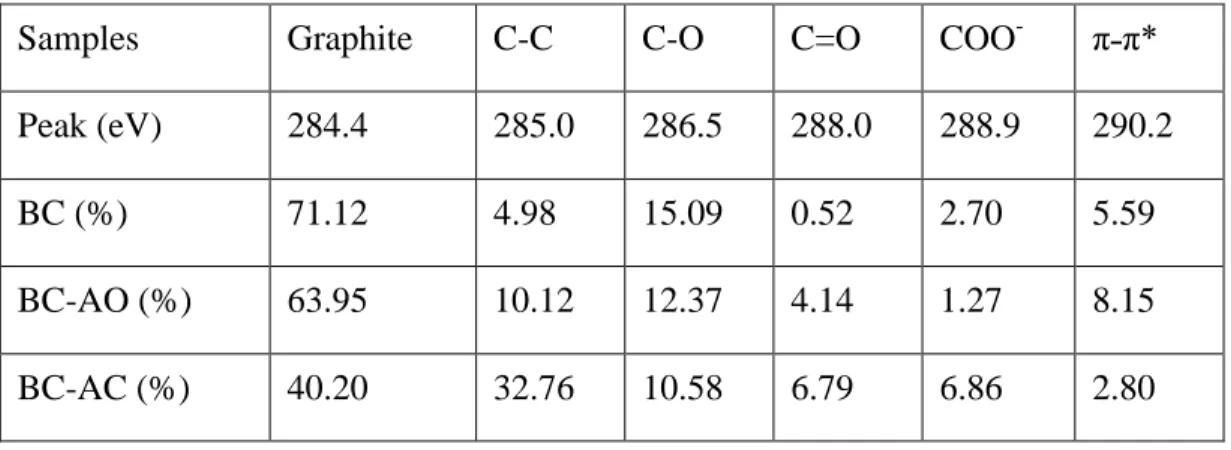
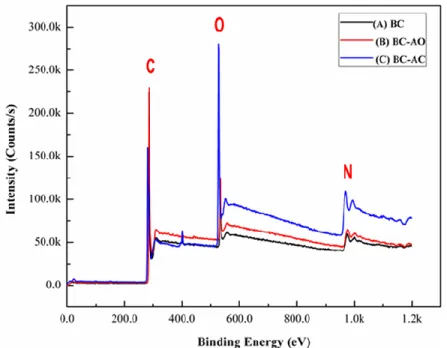
58 Figure 3.4 : FTIR spectra of (A) BC, (B) BC-AO and (C) BC-AC. 59 Figure 3.5 : XPS survey spectra of (A) BC, (B) BC-AO and (C) BC-AC. 62 Figure 3.6 : XPS peaks deconvolution of C1s for (A) BC, (B) BC-AO and (C)
BC-AC.
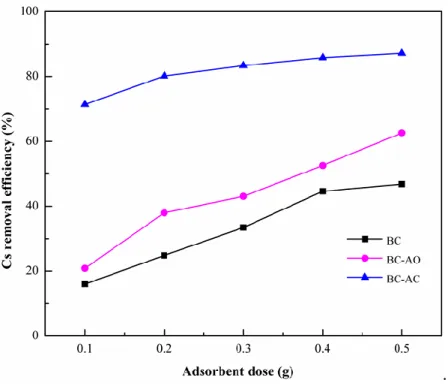
62 Figure 3.7 : The pHpzc of (A) BC, (B) BC-AO and (C) BC-AC. 63 Figure 4.1 : Effect of contact time on cesium adsorption. 79 Figure 4.2 : Effect of cesium solution pH on adsorption. 80 Figure 4.3 : Effect of adsorbents dose on cesium removal rate. 81 Figure 4.4 : Effect of different initial concentration of cesium on adsorption. 82 Figure 4.5 : Effect of competitive ions on cesium removal performance (A)
presence of Na+ for BC-AO (B) Presence of K+ for BC-AO (C) Presence of Na+ for BC-AC (D) Presence of K+ for BC-AC.
83
Figure 4.6 : Effect of temperature on cesium adsorption by (A) BC-AO and (B) BC-AC.
84 Figure 4.7 : Langmuir adsorption isotherm for Cs adsorption by BC-AC and
BC-AO (non-linear form).
89
XV Figure 4.8 : The plot of separation factor against initial concentration on cesium
adsorption by (A) BC-AO and (B) BC-AC.
89 Figure 4.9 : The plots of pseudo-second order kinetic model for adsorption of
cesium by (A) BC (B) BC-AO and (C) BC-AC.
91 Figure 4.10 : The cesium adsorption mechanism of modified BC (chemisorption
process).
93
Figure 5.1 : The outline of chapter five. 103
Figure 5.2 : The image of the raw slag (A) before and (B) after crushing. 104 Figure 5.3 : N2 adsorption-desorption isotherms of (A) raw slag and (B)
modified slag.
107 Figure 5.4 : FESEM images of (a) raw and (b) modified slag. 108 Figure 5.5 : XRD patterns of (A) raw and (B) modified slag. 110 Figure 6.1 : Effect of contact time on the evaluation of cesium removal
efficiency by raw and modified slag.
124 Figure 6.2 : Effect of pH on cesium removal efficiency by raw and modified slag 125 Figure 6.3 : Effect of adsorbents dose on cesium sorption efficiency by raw and
modified slag.
126 Figure 6.4 : Effect of initial cesium concentration on its removal performance by
(A) raw and (B) modified slag.
127 Figure 6.5 : Effect of different concentration of (A) Na+ and (B) K+ ions on the
removal efficiency of cesium by modified slag.
128 Figure 6.6 : The influence of temperature on the cesium removal efficiency by
modified Slag.
128 Figure 6.7 : Reuse of modified slag in several adsorption-elution-regeneration
processes after elution with H2SO4.
129 Figure 6.8 : Langmuir isotherm for Cs adsorption by raw and modified slag
(non- linear form).
134 Figure 6.9 : Plot of separation factor (RL) against initial concentration (A) and
surface coverage against initial concentration (B) on cesium removal efficiency by modified slag.
134
Figure 6.10 : The linear plot of ln Kd versus 1/T for the variation of temperature. 135 Figure 6.11 : Cesium adsorption mechanism by modified slag. 136
XVI LIST OF TABLES
Table 2.1 : The classification of radioactive waste. 12 Table 2.2 : Sources and the characteristics of radioactive wastewater. 13 Table 2.3 : Typical features and shortcomings of different liquid radioactive
wastewater treatment technology.
14 Table 2.4 : Advantages and disadvantages of different activation processes. 21
Table 2.5 : Applications of BC as an adsorbent. 22
Table 2.6 : Typical domestic sewage characteristics (mg/l). 24 Table 2.7 : Typical composition and properties of sewage sludge. 25 Table 3.1 : The BET results of BC, BC-AO and BC-AC adsorbents. 56 Table 3.2 : FTIR spectra and their identity in the raw (BC) and modified (BC-
AO and BC-AC) adsorbent.
60 Table 3.3
(A)
: The percentage of elemental composition in BC and modified BC. 61 Table 3.3
(B)
: The percentage of functional groups on adsorbents from XPS analysis.
61 Table 4.1 : Langmuir and Freundlich isotherms parameters for the adsorption
of cesium onto BC BC-AO and BC- AC.
88 Table 4.2 : Pseudo-second order kinetic model parameters for the adsorption
of cesium by BC, BC-AO and BC-AC.
90 Table 4.3 : Thermodynamic parameters of cesium adsorption by BC-AO and
BC-AC.
92 Table 4.4 : The comparison of cesium adsorption capacity by different
charcoal and activated carbon.
94 Table 5.1 : The BET analysis results of the raw and modified slag. 107 Table 5.2 : Chemical composition of raw and modified slag. 109 Table 5.3 : Elemental composition of raw and modified slag. 109 Table 6.1 : Pseudo-second order kinetic parameters for the adsorption of
cesium by raw and modified slag.
132 Table 6.2 : Langmuir and Freundlich isotherm parameters for the adsorption
of cesium on raw and modified slag.
133 Table 6.3 : Thermodynamic parameters of Cs adsorption by modified slag. 135 Table 6.4 : Comparison of maximum adsorption capacities of cesium with
some low-cost clay minerals.
137
XVII NOMENCLATURE
BOD5 Biochemical oxygen demand
BC Bamboo charcoal
BC-AO Air oxidized bamboo charcoal
BC-AC Nitric acid oxidized bamboo charcoal
BE Binding energy
BET Brunauer, Emmett and Teller
37Cs Radioactive cesium
133Cs Non-radioactive cesium
C0 Initial concentrations of the adsorbate ions in solution (mg/L) Ci Different initial concentrations of adsorbate ions in solution
(mg/L)
Ce Equilibrium concentration (mg/l) CEC Cation exchange capacity (meq/100g)
EW Excepted wastes
FESEM Field emission scanning electron microscope FTIR Fourier transform infrared
Change of free energy (kJ/mol)
HLW High-level wastes
Change of enthalpy (kJ/mol)
H3O+ Hydronium ions
H+ Hydrogen ions
Kd Distribution coefficient
KL Langmuir constant (l/mg)
KF Freundlich constant (mg/g)
K1 First-order kinetic equation rate constant (1/min)
K2 Second-order kinetic equation rate constant (g/mg. min)
kV Kilovolts
LILW Low and intermediate level wastes
LILW-SL Low and intermediate level wastes short-lived LILW-LL Low and intermediate level wastes long-lived m weight of the adsorbent (g)
XVIII
mM Millimole
NPP Nuclear power plant
n Coefficient of heterogeneity
PBq Petabecquerel
pzc Point of zero charge
P/PO Relative pressure
qm maximum adsorption capacity (mg/g) qe Equilibrium adsorption capacity (mg/g) qt Adsorption capacity at time t (mg/g)
RL Separation factor
R Gas constant (8.314 KJ/mol)
RE Removal efficiency
R2 Regression coefficient Change of entropy (kJ/mol) SSM Sewage sludge molten
T Temperature
TBq Tera-becquerel
Half-life
235U Radioactive uranium
V Volume of adsorbate solution (ml)
XRD X-ray diffraction
XRF X-ray fluorescence
XPS X-ray photoelectron spectroscopy
θ Surface coverage
1
CHAPTER 1
GENERAL INTRODUCTION
1.1 Background of the research
Due to the rapid urbanization and industrialization, the power consumption has been rocketed all over the world. The traditional power generation technologies produce a significant amount of carbon dioxide which is one of the principal causes of global warming. Therefore, for the sake of carbon dioxide production during power generation, the planners and technologists are looking for the alternative technologies to combat global warming problem. In order to attenuate the global warming effect on the environment, nuclear energy is one of the most sensible alternatives in terms of low greenhouse gas emissions, efficiency, reliability, and good cost-effectiveness compared to the traditional limited fossil fuel based energy sources, including petroleum oil, coal and natural gasoline [1]. Currently, it contributes to a considerable amount (approximately 11%) of environment-friendly electricity regarding global warming to fulfill the total global demand [2]. However, radioactive wastes are basically generated from the nuclear power plant’s operation and unforeseen accidents.
The nuclear tragedy at Fukushima Daiichi nuclear power plant in Japan, due to the Great East Japan Earthquake in March 2011, leading to a long-term radiation contamination issue. The radioisotopes on the order of 630,000–770,000 Tera Becquerel (TBq) were released into the environment during this power plant disaster [3][4][5].
These were 134Cs, 137Cs, 131I, and 90Sr which dispersed in the surrounding area and incorporated with local ecosystem and food chain [6][7]. Among the several nuclides, 137Cs is considered one of the most dangerous nuclides and attracted special attention due to its high specific radioactivity and long half-life (30.17 years) [4][8][9]. It is currently used in a range of applications; and is one of the major products generated in the nuclear fission reaction [10]. However, it has a significant hazardous effect on human health and environment. Cesium is chemically similar to sodium and potassium. Due to
2 its high solubility and accumulation in food and water, it can be easily deposited into the human body and create thyroid cancer [11]. Therefore, it is crucially important to dispose of the radioactive materials in a proper manner. Environmental scientists are highly interested in finding a suitable technology for removing radioactive cesium from contaminated water.
A considerable effort has been employed over the years to introduce an efficient and sustainable approach for the decontamination of radionuclide cesium from wastewater. This includes solvent extraction, chemical precipitation, membrane process, electrochemical separation, ion exchange, and adsorption [12][13][14][15][16]. However, high amount of chemical cost, excessive installation expenditure, and operation cost are the cardinal shortcomings of these technologies for frontline applications [17].
Among the radioactive wastewater treatment technologies, the adsorption process is broadly exercised for its several advantages such as process simplicity, high removal efficiency, and availability of the low-cost adsorbents [13][17][18]. Moreover, adsorption and ion exchange process can be applied for the removal of radioactive cesium from low contaminated wastewater, flexible for using batch and continuous process, and a possibility for regeneration and recycling [8][19]. Nevertheless, development of the reliable and low-cost adsorbents for practical cesium adsorption from the aquatic environment is still now an important area of research.
1.2 Research problem
The cost-effective and efficient adsorbents are extremely important for the removal of cesium from the radioactive wastewater in adsorption technology. Inorganic ion exchangers such as titanium phosphate, zirconium phosphate, ferrocyanide molybdates, hexacyanoferrate compounds, aluminosilicates and ammonium molybdophosphate were investigated last few decades for their application to cesium removal from wastewater [10][20][21][22]. Moreover, in the recent years, several synthetic and synthetic-polymer composite adsorbents have been developed for cesium removal such as poly (acrylic acid-co-benzo-18-crown-6 acrylamide) hydrogel [23], PVA (polyvinyl alcohol)-alginate encapsulated Prussian blue-graphene oxide hydrogel beads [24], dibenzo-18-crown-6 ether immobilized mesoporous silica [6], potassium
3 titanium hexacyanoferrate[25], zeolite-polymer composite fiber [26]. However, the preparation and commercial application of these adsorbents are little bit complicated and not efficient for the wide range of cesium-contaminated wastewater treatment.
In the recent years, the low-cost and natural adsorbents draw a great attention in order to use this purpose. Bamboo is one of the naturally abundant and low-cost bioresources. The activated carbon prepared from the bamboo is enriched with a porous structure as well as the high surface area which a suitable property for the adsorption. On the other hand, natural zeolites are widely known as exclusive adsorbents for cesium adsorption over the years. However, recently, adsorbents derived from the waste materials (coal fly ash, blast oxygen furnace slag etc.) have attracted much attention, mainly due to the cost-effectiveness and use of such wastes for secondary applications [27][28][29]. The sewage sludge molten slag (incinerated sludge), developed with aluminosilicate is a cheap source of preparing synthesized artificial zeolites. These artificial zeolites can be used for the radioactive cesium adsorption as an alternative to the natural zeolites as well as the reduction of the secondary pollution from sludge.
1.3 Objectives of the research
The overall objective of this work is to prepare the effective adsorbents from lignocellulosic materials (bamboo) and bi-product of sewage treatment (sewage sludge molten slag) and to apply of these adsorbents for cesium adsorption from aqueous phase at different experimental conditions. To achieve this general objective, the works encompassed in this thesis have been organized to fit the following specific objectives.
1. To prepare and modify the charcoal (adsorbent) made from raw bamboo (Japanese moso bamboo) and systematically characterizes of the physicochemical properties of raw and modified bamboo charcoal.
2. To remove the cesium from aqueous solution using raw and modified bamboo charcoal under the different experimental conditions such as contact time, cesium solution pH, adsorbent dose, the effect of initial cesium concentration, temperature, and effect of coexistence of cations (Na+ and K+).
4 3. To develop the synthetic zeolites properties on the sewage sludge molten slag by modification and examine the physicochemical characteristics of the raw and modified slag.
4. To evaluate the cesium removal capability of the raw and modified slag from aqueous phase under the different adsorption conditions and also investigates the adsorption kinetics, isotherm, thermodynamics, and reusability.
1.4 Structure of the thesis
This thesis consists of research background, objectives, literature review and some research topics which have been already published in one peer-reviewed conference and three journals. The total thesis has been organized into seven chapters which are outlined as below.
CHAPTER 1 discusses the background and the research problem of this study in details.
Moreover, research objectives and structure of the thesis are included in this chapter.
CHAPTER 2 contains the detailed literature review on various topics related to the present work. These include radioactive wastewater, bamboo charcoal, sewage sludge and sludge molten slag, zeolites, and adsorption.
CHAPTER 3 presents the preparation and modification process of bamboo charcoal. The physicochemical properties of raw and modified bamboo charcoal are illustrated obtained from the different experimental results. The morphological changing of surface structure and surface chemistry of bamboo charcoal is discussed.
CHAPTER 4 describes the cesium adsorption from aqueous solution using the raw and modified bamboo charcoal. Different experimental conditions are applied to understand the potential of the modified bamboo charcoal. Adsorption data are analyzed by adsorption kinetic, isotherm and thermodynamic studies. The cesium adsorption mechanism by modified slag was also discussed.
CHAPTER 5 highlights the preparation and modification of the sewage sludge molten slag by alkali hydrothermal treatment. The details characterization process of the raw and
5 modified slag was described. The changing of physical and chemical properties is discussed based on the experimental results.
CHAPTER 6 discusses the application of raw and modified slag for cesium adsorption under the several experimental conditions. Cesium adsorption data is used to justify the different adsorption isotherm and kinetic models. Thermodynamic parameters also discussed. The economic study of modified slag is also presented in this chapter.
CHAPTER 7 draws the conclusions and recommendations. This chapter summarizes the whole research work and actual findings are briefly mentioned based on the objective of the thesis. Moreover, this chapter also incorporates some limitations and recommendations for future works.
6 References
[1] F. Jing, Z. Hao, W. He, X. Fan, J. Zhang, Y. Miao, & J. Jin, A novel hydrothermal method to convert incineration ash into pollucite for the immobilization of a simulant radioactive cesium, J. Hazard. Mater. 306 (2016) 220–229.
[2] World Energy Needs and Nuclear Power - World Nuclear Association.
http://www.world-nuclear.org/information-library/current-and-
futuregeneration/world-energy-needs-and-nuclear-power. aspx, 2016.
[3] B. Hu, B. Fugetsu, H. Yu, Y. Abe, Prussian blue caged in spongiform adsorbents using diatomite and carbon nanotubes for elimination of cesium, J. Hazard. Mater.
217–218 (2012) 85–91. doi:10.1016/j. jhazmat. 2012.02.071.
[4] Y. Namiki, T. Namiki, Y. Ishii, S. Koido, Y. Nagase, A. Tsubota, N. Tada, Y.
Kitamoto, Inorganic-organic magnetic nanocomposites for use in preventive medicine: A rapid and reliable elimination system for cesium, Pharm. Res. 29 (2012) 1404–1418. doi:10.1007/s11095-011-0628-x.
[5] C. Jeon, J-H. Cha, Removal of cesium ions from waste solution using sericite incorporated into nickel hexacyanoferrate, Korean J. Chem. Eng. 32 (2015) 2273–
2279. doi:10.1007/s11814-015-0061-7.
[6] M.R. Awual, S. Suzuki, T. Taguchi, H. Shiwaku, Y. Okamoto, T. Yaita, Radioactive cesium removal from nuclear wastewater by novel inorganic and conjugate adsorbents, Chem. Eng. J. 242 (2014) 127–135.
doi:10.1016/j.cej.2013.12.072.
[7] M.R. Awual, T. Yaita, Y. Miyazaki, D. Matsumura, H. Shiwaku, T. Taguchi, A reliable hybrid adsorbent for efficient radioactive cesium accumulation from contaminated wastewater, Sci. Rep. 6 (2016) 19937. doi:10.1038/srep19937.
[8] K.Y. Lee, M. Park, J. Kim, M. Oh, E.H. Lee, K.W. Kim, D.Y. Chung, J.K. Moon, Equilibrium, kinetic and thermodynamic study of cesium adsorption onto nanocrystalline mordenite from high-salt solution, Chemosphere. 150 (2016) 765–
771. doi:10.1016/j.chemosphere.2015.11.072.
[9] T.H. Wang, C.L. Chen, L.Y. Ou, Y.Y. Wei, F.L. Chang, S.P. Teng, Cs sorption to potential host rock of low-level radioactive waste repository in Taiwan:
7 Experiments and numerical fitting study, J. Hazard. Mater. 192 (2011) 1079–1087.
doi:10.1016/j.jhazmat.2011.06.012.
[10] C. Mahendra, P.M. Sathya Sai, C. Anand Babu, K. Revathy, K.K. Rajan, Analysis and modeling of fixed bed sorption of cesium by AMP-PAN, J. Environ. Chem.
Eng. 3 (2015) 1546–1554. doi:10.1016/j.jece.2015.05.002.
[11] T. Sangvanich, V. Sukwarotwat, R.J. Wiacek, R.M. Grudzien, G.E. Fryxell, R.S.
Addleman, C. Timchalk, W. Yantasee, Selective capture of cesium and thallium from natural waters and simulated wastes with copper ferrocyanide functionalized mesoporous silica, J. Hazard. Mater. 182 (2010) 225–231.
doi:10.1016/j.jhazmat.2010.06.019.
[12] B. Sun, X.G. Hao, Z. De Wang, G.Q. Guan, Z.L. Zhang, Y. Bin Li, S. Bin Liu, Separation of low concentration of cesium ion from wastewater by electrochemically switched ion exchange method: Experimental adsorption kinetics analysis, J. Hazard. Mater. 233–234 (2012) 177–183.
doi:10.1016/j.jhazmat.2012.07.010.
[13] Y. Park, Y.C. Lee, W.S. Shin, S.J. Choi, Removal of cobalt, strontium and cesium from radioactive laundry wastewater by ammonium molybdophosphate- polyacrylonitrile (AMP-PAN), Chem. Eng. J. 162 (2010) 685–695.
doi:10.1016/j.cej.2010.06.026.
[14] L. Danilin, V. Drozhzhin, Inorganic sorbents based on modified microspheres for treatment of liquid radioactive waste, Radiochemistry. 49 (2007) 319–322.
doi:10.1134/S1066362207030204.
[15] C. Chen, J. Wang, Removal of Pb2+, Ag+, Cs+ and Sr2+ from aqueous solution by brewery’s waste biomass, J. Hazard. Mater. 151 (2008) 65–70.
doi:10.1016/j.jhazmat.2007.05.046.
[16] A. Iwanade, N. Kasai, H. Hoshina, Y. Ueki, S. Saiki, N. Seko, Hybrid grafted ion exchanger for decontamination of radioactive cesium in Fukushima Prefecture and other contaminated areas, J. Radioanal. Nucl. Chem. 293 (2012) 703–709.
doi:10.1007/s10967-012-1721-2.
[17] D. Ding, Y. Zhao, S. Yang, W. Shi, Z. Zhang, Z. Lei, Y. Yang, Adsorption of cesium from aqueous solution using agricultural residue - Walnut shell:
8 Equilibrium, kinetic and thermodynamic modeling studies, Water Res. 47 (2013) 2563–2571. doi:10.1016/j.watres.2013.02.014.
[18] M. Dubourg, Review of advanced methods for treating radioactive contaminated water, off. proceedings. International Water Conf. 33 (1996) 307–316.
[19] J.O. Kim, S.M. Lee, C. Jeon, Adsorption characteristics of sericite for cesium ions from an aqueous solution, Chem. Eng. Res. Des. 92 (2014) 368–374.
doi:10.1016/j.cherd.2013.07.020.
[20] G.S. Murthy, M. V. Sivaiah, S.S. Kumar, V.N. Reddy, R.M. Krishna, S.
Lakshminarayana, Adsorption of cesium on a composite inorganic exchanger zirconium phosphate - Ammonium molybdophosphate, J. Radioanal. Nucl. Chem.
260 (2004) 109–114. doi:10.1023/B:JRNC.0000027068.15669.
[21] C. Loos-Neskovic, S. Ayrault, V. Badillo, B. Jimenez, E. Garnier, M. Fedoroff, D.J. Jones, B. Merinov, Structure of copper-potassium hexacyanoferrate (II) and sorption mechanisms of cesium, J. Solid State Chem. 177 (2004) 1817–1828.
doi:10.1016/j.jssc.2004.01.018.
[22] T.A. Todd, V.N. Romanovskiy, A comparison of crystalline silicotitanate and ammonium molybdophosphate-polyacrylonitrile composite sorbent for the separation of cesium from acidic waste, Radiochemistry. 47 (2005) 398–402.
doi:10.1007/s11137-005-0109-3.
[23] H. Yu, J. Hu, Z. Liu, X. Ju, R. Xie, W. Wang, L. Chu, Ion-recognizable hydrogels for efficient removal of cesium ions from aqueous environment, J. Hazard. Mater.
323 (2016) 1–9. doi:10.1016/j.jhazmat.2016.10.024.
[24] J. Jang, D.S. Lee, Enhanced adsorption of cesium on PVA-alginate encapsulated prussian blue-graphene oxide hydrogel beads in a fixed-bed column system, Bioresour. Technol. 218 (2016) 294–300. doi:10.1016/j.biortech.2016.06.100.
[25] H. Zhang, X. Zhao, J. Wei, F. Li, Removal of cesium from low-level radioactive wastewaters using magnetic potassium titanium hexacyanoferrate, Chem. Eng. J.
275 (2015) 262–270. doi:10.1016/j.cej.2015.04.052.
[26] T. Kobayashi, M. Ohshiro, K. Nakamoto, S. Uchida, Decontamination of extra- diluted radioactive cesium in Fukushima water using zeolite-polymer composite fibers, Ind. Eng. Chem. Res. 55 (2016) 6996–7002. doi:10.1021/acs.iecr.6b00903.
9 [27] S. Pan, C. Lin, D. Tseng, Reusing sewage sludge ash as adsorbent for copper
removal from wastewater, Resour. Conserv. Recycl. 39 (2003) 79–90.
[28] T.W. Cheng, M.L. Lee, M.S. Ko, T.H. Ueng, S.F. Yang, The heavy metal adsorption characteristics on metakaolin-based geopolymer, Appl. Clay Sci. 56 (2012) 90–96. doi:10.1016/j.clay.2011.11.027.
[29] N.K. Lee, H.R. Khalid, H.K. Lee, Adsorption characteristics of cesium onto mesoporous geopolymers containing nano-crystalline zeolites, Microporous Mesoporous Mater. 242 (2017) 238–244. doi:10.1016/j.micromeso.2017.01.030.
10
CHAPTER 2
LITERATURE REVIEW
2.1 Radioactive waste and wastewater
2.1.1 Radioactive waste
Radioactive wastes are one kind of hazardous waste that contains radioactive material. It is usually a by-product of nuclear power generation and other applications of nuclear fission or nuclear technology. The radioactive waste can be in the different forms such as a solid, liquid, gas, or sludge. The physical form of the radioactive waste may be primarily liquid, soil, paper, metal, ash, ceramic, and mixture of the above. The chemical form of the radioactive waste also varies. It can contain lightweight elements, such as radioactive hydrogen (tritium), or heavyweight elements, such as uranium. Radionuclides are unbalanced atoms of an element that naturally break down and releasing energy in the form of radiation. Antoine Henri Becquerel discovered the radioactivity in 1896.
Radioactive waste is generally produced from the human activities including military armaments testing, mining, nuclear power plants operation and accidents, medical diagnosis and treatment, biological and chemical research and other industrial uses of radioisotopes [1]. There are about five thousands of natural and artificial radionuclides have been recognized which are characterized with the different half-life. The total time required to decrease the amount of radioactivity of a radioactive material to half of its initial is termed as half-life. Depending on the radionuclides in radioactive wastes, it can remain radioactive from few second to millions of years. The radioactive waste is classified into different categories depending on their activity level and half-life. These include excepted wastes (EW), low and intermediate level wastes (LILW) and high-level wastes (HLW). The LILW may be subdivided into short-lived (LILW-SL) and long-lived (LILW-LL) wastes [2]. The objective of these classifications is to confirm the handling, storing and disposing of these materials according to their characteristics. The characteristics of the waste briefly summarized in Table 2.1. In 2010, the total amount of
11 the HLW worldwide disposed roughly of over 250,000 tons which does not incorporate the amount that has leaked into the environment from tests or accidents [3]. The radioactive waste is hazardous to the environment and most forms of life, and radioactivity naturally decays over time, so the radioactive waste has to be separated and confined inappropriate disposal facilities for a long time until it no longer poses a threat [4]. Therefore, a higher concern should be paid for the proper management and safe disposal of the radioactive waste. Figure 2.1 presents a brief summary of the radioactive waste management practice in different countries.
2.1.2 Radioactive waste water
Due to the rapid increase of urbanization and industrialization all over the world, the amount of wastewater generation has been increased overwhelmingly. When the natural quality of water undesirably affected by the human activities is known as wastewater. The radioactive liquid waste as a material which contaminated the radionuclides. The concentration level of the radioactivity should be greater than the clearance level that established by the appropriate authority and for which no use is foreseen [5]. Generally, the environmental water is not reactive. However, when the natural water is contaminated by the radioactive wastes such as 137Cs, 235U etc. then it is known as radioactive wastewater. Radioactive wastewater causes nuclear radiation exposure and affects the human health and environment [6][7]. Radioactive wastewater usually produced from the nuclear fuel cycle operation, production and uses of radioisotope for different purposes, industrial applications, and institutional research [8]
etc. The chemical compositions and the level of the radioactivity of liquid waste depend on the conducted operations. The common source of radioactive wastewater and their characteristics are presented in Table 2.2
12 Table 2.1: The classification of radioactive waste [9].
Waste
classes General properties
EW Activity levels which are based on an annual dose of public (less than 0.01 mSv). This type of waste is suitable for disposal with some specified conditions with ordinary waste.
LILW Activity levels are above the clearance levels and thermal power is below about 2 kW/m3.
LILW-SL Radioactive waste that does not contain significant levels of radionuclides with a half-life greater than 30 years.
(Limitation of long-lived alpha-emitting radionuclides to 4,000 Bq/g in individual waste packages and to an overall average of 400 Bq/g per waste package).
LILW-LL Long-lived radionuclide concentrations exceeding limitations for short- lived waste.
HLW A high-level waste is the thermal power above about 2 kW/m3 and long-lived radionuclide concentrations exceeding limitations for short- lived waste.
Figure 2.1: The basic steps of radioactive waste management [10].
Treatment Radioactive
waste
Pretreatment
Conditioning
Disposal
Nuclear material for recycle/reuse Exempt waste
13 Table 2.2: Sources and the characteristics of radioactive wastewater [8].
Sources Common radioisotopes Characteristics
Nuclear research centers
May be included relatively long-lived, mixed with short-lived
Usually even batches with closely neutral pH from the regeneration of ion exchange resins
Radioisotopes laboratory production
Wide variety depending upon production and the purity of targets
Small volumes of high specific activity and high chemical concentrations
Radio-labeling and
radiopharmaceuticals 14C, 3H, 32P, 35S, 125I
The larger volume of low specific activity and a small volume of predictable chemical composition Medical diagnosis
and treatment 99Tcm, 131I, 85Sr
Large volumes of urine from patients and small volumes from preparation and treatment
Scientific research Variable with short and long-lived radioisotopes
Extremely variable Industrial and pilot
plants
Depend upon applications
Volumes could be large and chemical composition undefined Laundry and
decontamination
Wide variety likely Large volumes with low specific activity but containing complexion agents
2.1.3 Radioactive wastewater treatment
The liquid radioactive waste is mainly generated during nuclear reactor operations and commercial and institutional application of radioisotopes. The chemical properties and the level of radioactivity of the liquid waste generated from the different sources depend on the kind of operations and applications [11]. The liquid radioactive waste containing short-lived beta or gamma activity is stored for a certain time. After the decay to exclusion limit, the reactivity of the waste is checked. If the waste meets the regulatory requirements on chemical and biological hazards they can be safely discharged into the
14 environment. However, the aqueous waste with higher radioactivity and contained long- lived radionuclides are considered for further treatment. The treatment and removal of radioactive wastewater is a challenging work due to lack of proper knowledge, suitable technology etc. Different methods were practiced over the years for the decontamination of radionuclides from wastewater. These include solvent extraction, chemical precipitation, membrane process, coagulation, ultrafiltration, and ion-exchange [12][13][14][15] etc. The advantages and disadvantages of the different radioactive wastewater treatments process are summarized in Table 2.3.
Table 2.3: Typical features and shortcomings of different liquid radioactive wastewater treatment technology [8].
Technology Features Shortcomings
Precipitation Suitable for large volumes and high salt content waste
Low-cost operation
Low decontamination factor
Efficiency depends on solid- liquid separation step
Ion-exchange Good chemical, thermal and radiation stability
Proper chemical or ion-exchanger can ensure high selectivity
Affected by the presence of other salt contents
Blockage problem Evaporation Well established technology
High volume reduction factor
Suitable for a verity of radionuclides
Process limitation (scaling formation, corrosion, volatility of certain radionuclides).
High operation and capital costs
Reverse osmoses
Removes dissolve salts
Economical
Established for large-scale operations
High-pressure system
No back washable, which creates fouling
Ultrafiltration Separation of dissolved salts from colloidal materials
Good chemical and radiation stability for inorganic membranes
Fouling
Organic membranes subject to radiation damage
Microfiltration High recovery (99%)
Low fouling when air backwash
Sensitive to impurities in the waste stream
Solvent extraction
Selectivity enables removal, recovery or recycles of actinides
Generates aqueous and organic secondary waste
15 2.1.4 Biological effect of radioactive waste
The radioactive waste is one of the most dangerous wastes which remain radioactivity for few moments to millions of years. The ecosystem and environment are greatly affected by the radioactive waste. The radioactive waste easily accumulated with groundwater or surface water, soil, and air. Human and other animals are affected by the radiation directly or indirectly. The radioactive wastewater can easily contaminate the environment during the accident and leaks of the nuclear reactors, such as Three-mile Island in Pennsylvania in 1979, Chernobyl nuclear accident in 1981, and Fukushima in 2011. During these accidents a huge amount of radioactive materials scattered into the environment and accumulated with the food chain. For example, when the radioactive waste dispersed into the surface water, aquaculture may be significantly affected and indirectly human and other animals can be affected by the radiation [16]. The accumulation of radioactive waste with the environment is illustrated in Figure 2.2.
Figure 2.2: The diagram of the radioactive waste spreading into the environment.
The nuclear radiation has sufficient energy to cause the biochemical modification in cells and damage (abnormal or die) permanently. The radiation can cause cancer to the
16 body by destroying the DNA of body cell. Moreover, the bone can be broken in the macromolecule that carries out life processes. Some cells may die or become abnormal, either temporarily or permanently. By damaging the genetic material (DNA) contained in the body’s cells, radiation can cause cancer. Fortunately, our bodies are extremely efficient at repairing cell damage. The extent of the damage to the cells depends upon the amount and duration of the exposure, as well as the organs exposed. In cases of acute radiation poisoning, bone marrow that produces red blood cells is destroyed and the concentration of red blood cells is diminished [17][16]. However, the severity of the human body damage depends on the radiation dose, level of radioactivity and also the exposure time.
2.1.5 Fukushima nuclear power plant accident
On March 11, 2011, the Great East Japan Earthquake with 9.0 magnitudes attacked the northeast Honshu-island, Japan. After the gigantic earthquake, a terrible tsunami hit the east coast of the northeast Honshu Island and seriously damaged the electric system of the Fukushima Daiichi Nuclear Power Plant (NPP) (37.42 N, 140.97 E).
The location of the Fukushima nuclear power plant and also the contaminated area is shown in Figure 2.3. As a result, the cooling system of nuclear reactors in the power plant was smashed. The explosion of the power plant leads to a huge amount of radionuclides released in the atmosphere [18]. Japanese government estimated to be 160 PBq of 131I and 15 PBq of 137Cs as total atmospheric releases of radioactivity from the Fukushima Daiichi NPP [19] which are about one order of magnitude less than the Chernobyl accident [20]. Along with these radionuclides, a huge amount of 132Te, 140Ba, and 90Sr were also emitted and into the surrounding environment, and the eventual impact them will have on human health. Therefore, the situation has become extremely severe for Japan after the Second World War. The serious accident became not only an issue for Japan itself but also has raised the concerns around the world about the safety of nuclear power plants.
17 Figure 2.3: The location of the Fukushima NPP and contaminated area for explosion [21].
2.1.6 Radioactive cesium
Cesium-137 (137Cs) is a radioactive isotope of cesium which is one of the most common fission products, mostly generated as a by-product from the nuclear reactors and nuclear weapons. It is also used in industries for different purposes as well as for medicine as a form of radio therapy. Radioactive cesium is one of the most dangerous radionuclides due to its chemical and bio-chemical behaviors. It poses a serious threat to human health and environment because of its strong gamma emission and high solubility.
These properties basically enhance its migration through groundwater to the biosphere [22][23]. Moreover, the behavior of the cesium is similar to that of potassium and rubidium. After entering the body, cesium is usually uniformly distributed throughout the body, with the highest concentrations in soft tissue. 137Cs is the major cause of thyroid cancer in human body [24]. Besides, it can also be incorporated in terrestrial ecosystem and distributed into the food chain due to its high solubility [7]. The removal of radioactive cesium from the wastewater is very difficult task for its chemical nature. In aqueous media, cesium presents as free ions and also unaffected even after changes of solution pH or redox conditions. The coexistence of different salts especially Na and K
18 makes it more challenging. The co-adsorption may be occurred during cesium adsorption from the aqueous media [17].
2.2 Bamboo charcoal
2.2.1 Bamboo
Bamboo is one of the well-known plant resources of the grass family, grown in the different geographical locations in the world. The bamboo is distributed in tropical and subtropical to mild temperate regions, with the heaviest concentration and the largest number of species in the East and Southeast Asia and on islands of the Indian and Pacific oceans. There are about 22 million hectors of bamboo forest area in the worldwide.
According to the botanical taxonomy, bamboo plant is recognized as species of Bambusoideae subfamily and its family is Gramineae [25]. Bamboo is one of the rapidly growing plants and its mature time is 4 to 8 months. The optimum specific gravity and mechanical properties are obtained during its mature period. Bamboo is a sort of renewable, eco-friendly, and cheap resource for sustainable development.
The Japanese moso bamboo is known by the scientific names ‟Phyllostachys Pubescensˮ and ‟Phyllostachys Edulisˮ. Moso bamboo is mostly grown in Japan and China among the South-East Asian countries. Wide applications of bamboo are observed as household products and many industrial uses due to the increase of extensive demands for availability, price, and flexible uses. In Asian countries, the bamboo has been used for household utilities such as containers, chopsticks, woven mats, fishing poles, cricket boxes, handicrafts, chairs, etc. It is also used in building applications such as flooring, ceiling, walls, windows, doors, fences, housing roofs, trusses, rafters, and purlins.
Bamboo is one of the important raw materials in papers industries.
2.2.2 Chemical composition of bamboo
The chemical composition of bamboo is similar to that of wood. The main components of bamboo culms are cellulose, hemicellulose, and lignin, which amount to over 90% of the total mass. A minor portion of resins, tannins, waxes and inorganic salts are also contained. Moreover, the higher alkaline extractives, ash and silica contents are
19 comparable with wood. The other chemical constituents are about 2-6% starch, 2%
deoxidized saccharide, 2-4% fat, and 0.8-6% protein [26]. The presence of carbohydrate plays a key role in its high level of durability and serviceability. The durability of bamboo against mold, fungal and borers attack is strongly associated with its chemical composition. The resistance of bamboo to fungal and insect attack is poor. The natural durability of bamboo varies between 1 and 36 months depending on the species and climatic condition [27]. The presence of large amounts of starch makes bamboo highly vulnerable to attack by staining fungi and powder-post beetles. Higher benzene-ethanol extractives of some bamboo species could be an advantage for decay resistance [28].
2.2.3 Production of bamboo charcoal
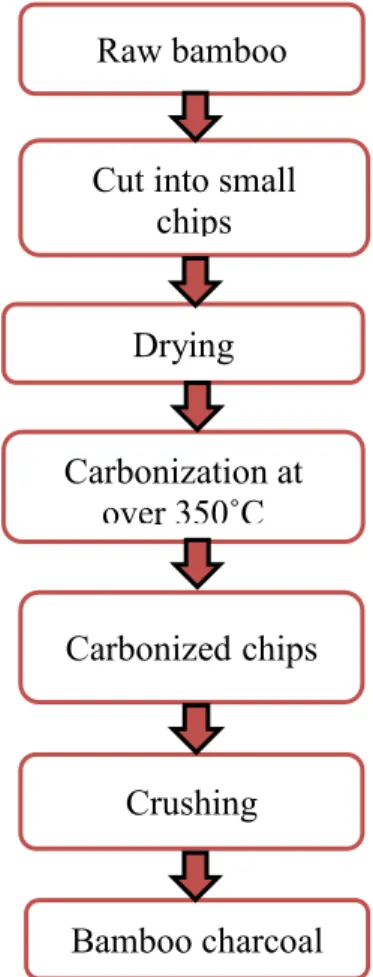
Bamboo is one of the lignocellulosic plant materials. The preparation process of activated carbon from lignicelluosic materials generally involved two processes, the carbonization, and activation. The carbonization process involves pyrolysis of the precursor’s material at a certain temperature in the absence of air. The basic steps of bamboo charcoal production are shown in Figure 2.4. During the carbonization process, the fundamental porosity is developed on the carbon structure. Besides, most of the non- carbon elements such as oxygen, hydrogen and nitrogen in form of gases and tars, leaving a rigid carbon skeleton formed by aromatic structures [29].
In the activation process, generally the surface area and surface functional properties are increased by physical and chemical activation. In the physical activation process, the pyrolyzed carbon char from carbonization process is heated at temperature 400°C to 900°C in the inert gas flow [30]. Many inert gases such as nitrogen, carbon dioxide, water steam etc. are commonly used for the physical activation process. In the chemical activation process, usually carbonization and activation process is performed simultaneously [31]. The raw materials are impregnated with activation chemical as well the carbonization process is progressed at high temperature in an inert gas flow. In this case, H3PO4, H2SO4, HNO3, NaOH, KOH, and H2O2 are mostly used as activation chemicals. However, in this study bamboo charcoal prepared by carbonization process.
The activation (physical and chemical) process performed separately due to understanding the physical changes that subjected to activation or chemical modification
20 [32]. It is well established that the high carbonization temperature would result in a greater amount of volatiles being released from raw materials and eventually produce a highly porous carbon with a surface basicity. However, carbonization at lower temperature generally produces a slightly acidic surface of the charcoal materials.
Moreover, there is also a risk for less decomposition of volatiles materials and improper carbonization. Therefore, proper carbonization temperature selection is mostly important depending on the applications of the charcoal materials.
Figure 2.4: The basic steps of bamboo charcoal production.
2.2.4 Characteristics of the physical and chemical activation process
The main aim of the activation process is to increase the adsorption properties of charcoal materials by changing their physical or chemical functionalities. The major advantages and drawbacks of the physical and chemical modification process are presented in Table 2.4.
Raw bamboo
Cut into small chips Drying Carbonization at
over 350˚C
Carbonizedchips
Crushing
Bamboo charcoal
21 Table 2.4: Advantages and disadvantages of different activation processes.
Activation process Advantages Disadvantages
Physical
Increase porosity and surface area
The process is not corrosive
A washing stage is not required
Process is cheap; no chemicals are required.
Need higher temperature for activation
Proper control of porosity of the charcoal is difficult
Chemical
Improved surface functionalities.
shorter activation time
Better control of textural properties
Activation carbons are obtained in one step or two steps
Corrosiveness of the process
Required a washing stage
Inorganic impurities
More expensive 2.2.5 Application of bamboo charcoal for environmental remediation
Wastewater treatment has become a serious environmental issue due to the rising of the environmental consciousness all over the world. Bamboo charcoal is an eco- friendly, low-cost and renewable bioresource with the porous structure. The uses of bamboo charcoal have been increased rapidly in the recent years for the several reasons;
(1) the use of wood charcoal has been reduced rapidly and almost exhausted; (2) the harvest cycles of the bamboo is short and it grows fast. Therefore, it does not have any influence on the deforestation and environment; (3) a surface area of porous bamboo charcoal is wider than wood charcoal. Hence, it is easily replaceable with hardwood charcoal. The application of bamboo charcoal is observed a variety of fields that include food, pharmaceutical, chemical, metallurgical industries, purifying drinking water, indoor humidity control, health care, and odor adsorption etc. In the last few years, bamboo charcoal has drawn interest to the researchers as a novel adsorbent for environmental remediation due to its special microporous structure [33][34]. Some applications of bamboo charcoal as adsorbents are listed in Table 2.5.
22 Table 2.5: Applications of BC as an adsorbent.
Carbonization temperature
of bamboo charcoal Modification Applications Ref.
800˚C and 600˚C ˗ Removal of copper, lead,
chromium and cadmium [35]
Pre-carbonization 150- 270°C and carbonization 270°C and 450°C
Modification with H2SO4 and NaOH
Adsorption of
chloramphenicol (CAP) [36]
600°C, 700°C, 800°C,
900°C, and 1000°C ˗
Removal of carbon
dioxide [37]
500°C,700°C and 1000°C ˗ Removal of benzene,
toluene, formaldehyde [38]
BC collected Activation with ZnCl2
and FeCl3 Removal of mercury [39]
400°C, 700°C and 1000°C Modification with H2SO4
Adsorption of ammonia
gas [40]
BC collected ˗ Adsorption of cadmium
(II) ions [41]
600°C
Activation with KMnO4 and followed
by HNO3 in
microwave heating
Adsorption of lead (II)
ions [42]
BC collected Modification with
NaOH
Adsorption of arsenic
[43]
800°C and 900°C temperature
Activation with carbon dioxide and steam
Adsorption of chromium
nickel, and cadmium [34]
BC collected
Activation with H3PO4 and KOH at different
concentrations.
Adsorption of lead (II) [44]
550°C
˗
Adsorption of 131I (radioactive) from the contaminated air
[45]
![Figure 2.5: Trend of sewage sludge recycles [57].](https://thumb-ap.123doks.com/thumbv2/123deta/9880283.1906111/46.918.211.809.212.595/figure-trend-sewage-sludge-recycles.webp)
![Figure 2.6. Trends in the utilization of sewage sludge molten slag as construction materials in Japan [61]](https://thumb-ap.123doks.com/thumbv2/123deta/9880283.1906111/48.918.186.784.541.792/figure-trends-utilization-sewage-sludge-molten-construction-materials.webp)