A Study on the Fatigue Characteristics of Bonded Parts of the Carbon Fiber Reinforced Dental P.M.M.A.
journal or
publication title
福井大学工学部研究報告
volume 27
number 2
page range 297‑304
year 1979‑09
URL http://hdl.handle.net/10098/4430
FUKUI UNIVERSITY
VOL.27 No. 2 1979
A Study on the Fatigue Characteristics of Bonded Parts of the Carbon Fiber Reinforced Dental P.M.M.A.
Hiroshi KIMURA*, Takuji YAMAGUCHI*, Tetsuro SHIRAISHI*, Masakazu TSUBOKAWA*, Takashi OGITA*
(Received Jul. 5, 1979)
In this paper we describe an experimental study. Reported in this article are results of tensile fatigue test under constant stress amplitude applied to bonded section of carbon fiber rein- forced dental P.M.M.A., which tensile fatigue test was conducted in comparison with that of the parent material in order to find out fatigue characteristics of the bonded section of the dental P.M.M.A.
As a result of the research of test and experiments, i t is found that;
1) It is noted that fatigue characteristics of composite material of C.F. 1 wt.%/P.M.M.A. are good.
2) For adhesion of composite material of C.F. 1 wt.%/P.M.M.A., a scarf joint should be adopted.
3) Adhesion by heat-cured type acrylic resin is effective.
1. INTRODUCTION
Dental material in cavum oris is always subjected to repeated load and is under stress, thus fatigue characteristics of the dental mate- rial itself in cavum oris become a matter of concern. Many of the dental material in cavum oris has combined structures, and the load, when applied repeatedly, produces fatigue. Generally speaking, failure of the dental material in cavum oris under repeated load occurs at the combined structure. Reported in this article are results of tensile fatigue test under constant stress amplitude applied to bonded section of carbon fiber reinforced dental P.M.M.A., which tensile fatigue test was conducted in comparison with that of the parent material in order
*
Department of Textile Engineering298
to find out fatigue characteristics of the bonded section of the dental P.M.M.A~~ Reported in this article as well are mechanical properties of composite materials which were made by way of trial
, b f ' b ' f p 3) ... 1 2)
uSlng car on 1 er to reln orce .M.M.A ..
2. EXPERIMENTAL MATERIAL AND EXPERIMENTAL METHOD
Series of experiments consisted of tension, bending and fatigue tests of composite materials of P.M.M.A./chopped strands, tension and fatigue tests of bonded materials of such composite materials, tension, bending and fatigue tests of bonded material of the P.M.M.A./prepreg composite material, and observation by S.E.M. of fatigue fracture of composite material of P.M.M.A./chopped strands. Test pieces were made of (i) acrylic resin of heat-cured type (Denture Acrylic, SHOFU "Bio"
Resin) heated for 4S minutes in IOOoC under IOOkg/cm2 pressure and molded by natural cooling, (ii) the same acrylic resin as above, but at first mixed with chopped strands of carbon fiber (Toreca T300; 3,000 filaments) which was cut into 3mm in length, washed with acetone and dried, thence heat- and pressure-molded, and (iii) prepreg of C.F./
epoxy. Adhesion was by acrylic resin of low temperature cured type and of heat-cured type; but in case of P.M.M.A./prepreg composite mate- rial, self-adhesion was adopted. Apparatuses used for experiments were Shimazu's Autograph IS-2000 for tension and bending tests and Shimazu's Servopet Lab-SP for fatigue test with which tension was applied to pre-
r
(a) Base material
110
t T3
+---f--
I i= ~ I
(b) Adhered material
Fig.l Specimens for fatigue test.
Table I Mechanical properties of C.F./P.M.M.A. composite mate- rials.
Mechanical Content ratio of carbon fiber(wt·,.)
properties 0 1 2 3
Tensile streng-
7.0 7.5 7.5 7.6
th (kg/mm2 )
Young's modu-
200 230 260 280
Ius (kg I mm2)
Elongation
3.29 3.21 3.14 3.11 ( "10)
Bending streng-
9.0 11.4 11.4 11.4 th (kg/mm2)
Bendi ng elastic
modulus (kg/mm2) 260 330 350 370 Deflection
- 9.3 9.0 8.9 (mm)
stressed test pieces at 22Hz.
3. EXPERIMENTAL RESULTS AND CONSIDERATION
Table 1 shows summary of results of tension and bending tests con- ducted with trial-manufactured carbon fiber reinforced P.M.M.A. having 0-3 wt.% carbon content. It is k~own from Table 1 that strength and elastic modulus increased, while elongation and deflection decreased, as C.F. content became bigger, and effectiveness of reinforcement of P.M.M.A. is proved. Fig.l shows shape and size of test piece for fatigue test, which applied correspondingly to fatigue test piece for Baldwin SF-Ole S-N curves of P.M.M.A. parent material and of bonded materials of P.M.M.A. bonded with acrylic resins of heat-cured type and low temperature type are shown in Fig.2. It is known from this figure that fatigue strength was 2.0, 1.8 and 1.4kg/mm2 respectively, which means that fatigue strength of the specimen bonded with heat- cured type acrylic resin was 90% and the specimen bonded with low temperature type acrylic resin was 70% against that of the parent material respectively. Fatigue limit with repeated stress with any of the specimens was 106• Fig.3 is the comparison of S-N curve of self- adhered material of C.F./P.M.M.A. sandwich material and fluid acrylic resin with that of bonded material of P.M.M.A .. Fatigue strength of self-adhered material of composite material and fluid acrylic resin
Fig.2 Relation between stress amplitude and number of cycles to failure for adhered P.M.M.A .•
: ...' I "'-':
o---PMMA baSE'malenal
•• --Adhered matenal of PMMA .--Adheslon by heat-cured acrylic
rt'sin
.--Adht'Slon by low temperature acrylic resin
0
-
I
!30\N-{
~20r--
\ - • •--.--~-'?=:-+--==--- I
~_o _ _: .~. ·~_I_._·-..-_--
~
I I
I .-- ... -
•
II .
•
•
Vl10I - - - + - - - + - - - t - - - t - - - i
105 lOG 107
Number of cycles to failurE' (N)
300
was 0.7kg/mm2, which was only 35% of that of P.M.M.A. parent material and 39% of that of P.M.M.A. bonded material. Fig.4 is the comparison of S-N curves of composite materials having 0.5 and 1.0 wt.% of C.F.
mixed in acrylic resin and the S-N curve of P.M.M.A. parent material.
Fatigue strength of the C.F. 0.5 wt.%/P.M.M.A. material was 2.2kg/mm2,
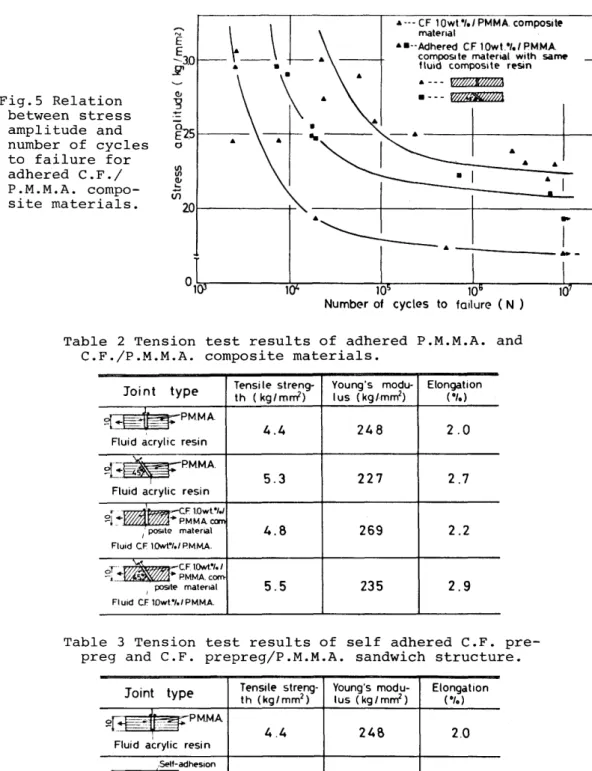
while that of C.F. 1.0 wt.%/P.M.M.A. material was 2.3kg/mm2, which corresponded to 110 and 115% of that of the parent material respective- ly. S-N curves of P.M.M.A. material reinforced with 1 wt.% of C.F. and two kinds of bonded materials bonded with heat-cured type acrylic resin are shown in Fig.5. Fatigue strength was 2.3, 2.1 and 1.7kg/mm2, while
Fig.3 Relation between stress amplitude and number of cycles to failure for self adhered C.F. prepreg/
P.M.M.A. sand- wich and fluid acrylic resin.
Fig.4 Relation between stress amplitude and number of cycles to failure for C.F./P.M.M.A.
composite mate- rials.
U CI :J
·~20
-zr.
o E
III III ~
ViJ.O
~
..
• •
• • •
'"
••~.
104
104
.··Adhered material of PMMA
(Adhe>5Ion by heal-cured acrylic resin) .--AclhE'red matenalof CFprE'prE'g/PMMA
sandwIch and fluId acrylic fE'Sln
.- • .--e--
--
lOS lOG 107
Number of cycles to 'failure (N)
.--PMMA baSE' malE'nal .-CF contE'nt O.5wlo',/PMMA.
composIte matE'nal .--CF content 10 wl'l, I PMMA.
composite material
lOS lOG
Number of cycles to failure (N) -
Fig.S Relation between stress amplitude and number of cycles to failure for adhered C.F./
P.M.M.A. compo- site materials.
...
f
E --3.0 Jl'C!J
~_\ •
,,--- CF lOw!"'.' PMMA. composite matenal
".--Adhered CF 10wt"t.I PMMA.
composite material with same fluid composite re-sin .. - - - Vlffdlw//,@
• - - - Wd4-WiWA
\f \. ~~I---=--
.~
-g
~.51---
o .... .. ..
.. I
~ C!J
"-
Vi
2o1---+-
. ..
..
_-;--- --
°1~---~---~1~0r---~---~~
10 NUmber of cycles to ( N ) Table 2 Tension test results of adhered P.M.M.A. and
C.F./P.M.M.A. composite materials.
Joint type Tensi Ie stren~ Young's modu- Elongation th (kg/mlT'f) I us (kgrmm2) (
.,.)
. PMMA
- ... ~u.'-=t+
4.4 248 2.0
Fluid acrylic resin
~~§.PMMA
5.3 227 2.7
Fluid acrylic resin
.. W'ilm
C.Fl.Owt·,.1~~ ~ .. PMMA. taT1
i pOSIte material 4.8 269 2.2
Fluid C.F lONt~/.1 PM.MA.
~ C.F 10Nt~/.1
oT~ • PMMAcom
- j . _ - -
I poSIte matenal 5.5 235 2.9
FI uid C.F lDwl·/oI PM.M.A.
Table 3 Tension test results of self adhered C.F. pre- preg and C.F. prepreg/P.M.M.A. sandwich structure.
Joint type Tensile streng- Young's modu- Elongation th (kg/mm2) I us (kg I mm2 ) ( 0,.)
~l~lt~PMMA
4.4 248 2.0
Fluid a~rylic resin ,self-adhesion
£~Fluidacry.
lie resin 1.5 296 0.5
C.F prep reg Self- adhesion o~~Auidacry.
- . he re51n
c.F. prepregl PMMA. sand- 3.2 280 1.3
wich structure
302
(a) P.M.M.A.; cr=2.3kg/mm2
(c) Adhesion with C.F. 1.0 wt.%/P.M.M.A.; cr=1.8kg/mm2
(e) Adhesion with C.F. 1.0 wt.%/P.M.M.A.; cr=3.0kg/mm2
(b) P.M.M.A.; cr=3.0kg/mm2
(d) Adhesion with C.F. 1.0 wt.%/P.M.M.A.; cr=1.8kg/mm2
(f) Adhesion with C.F. 1.0 wt.%/P.M.M.A.; cr=3.0kg/mm2
Photo.l The appearances of fatigue fracture of P.M.M.A. and C.F./P.M.M.A. composite material by S.E.M. (Hitachi HSM-2A).
joint efficiencies of butt joint and 45° scarf joint were 74% and 91%
respectively, which were in proportion to adhesion area. Tensile stren- gth, elastic modulus and elongation of various bonded materials of P.M.M.A. and C.F.R.P.M.M.A. are shown in Tables 2 and 3. It is known that tensile strength and elongation of C.F. prepreg are low, but this is considered to be due to resin content ratio (40%). It is also found that a scarf joint is superior with regard to adhesion strength and elongation, and is correlative with adhesion area. Photo.l shows S.E.M.
pictures of fatigue fracture of bonded section of P.M.M.A. and C.F.R.- P.M.M.A. bonded with C.F.R. acrylic resin. Stress concentration on account of existence of reinforcement was little, and the fracture on the contrary looked like fatigue failure on adhesion interface.
4. CONCLUSION
The following summary can be made from the results of the present research. I} It is noted that fatigue characteristics of composite material of C.F. 1 wt.%/P.M.M.A. are good. 2} For adhesion of compo- site material of C.F. 1 wt.%/P.M.M.A., a scarf joint should be adopted.
3) Adhesion by heat-cured type acrylic resin is effective.
ACKNOWLEDGMENTS
The authors wish to express his sincere thanks to Prof. Dr. Y.Kawa- mura, Prof. Dr. S.Kawai, Prof. Dr. R.Yamaga, Prof. Dr. Y.Tsuchiya, Dr. Y.Okuno, Dr. Y.Moriwaki and Dr. H.Matsushiro of Osaka University for their encouragements and valuable discussions.
The work is supported by the Grant-in-Aid from the Ministry of Education of Japan.
REFERENCES
1) Tore: Technical Sheet of Carbon Fiber Toreca, CF-08Rl, 1972;
CF-06R1, 1972.
2) The Society for the Study of Standard Testing Method of Plastics:
Plastics Testing Handbook, Publication of Nikkan Kogyo Press Co.
Ltd., p.117, 1969.
3) H.Maki, etc.: Collection of Composite Material Technology, Indust- rial Technology Center, p.709, 1976.
4) T.Hayashi, etc.: Composite Material Engineering, Nikkagiren, p.900, 1971.
304
5) The Society of Dental Science and Engineering: Dental Science and Engineering, Ishiyaku Press Co. Ltd., p.362, 1976.
6) H.Kimura, etc.: A Study on the Self Adhesion of Carbon Fiber Pre- preg and Dental Acrylic Resin on the Hybrid Composites of Thin Plate, The Journal of the Japan Research Society of Dental Mate- rials & Appliances, Vol.34, No.2, p.l68-l77, 1977.
7) H.Kimura, etc.: A Study on the Fiber Orientation Effects of Carbon Fiber Reinforced Anisotropy Dental Polymer Hybrid Composites on the Extreme Thin Plate, The Journal of the Japan Research Society of Dental Materials & Appliances, Vol.35, No.2, p.115-l22, 1978.
8) H.Kimura, etc.: A Study on the Adhesion of the Composite Artificial Teeth, The Journal of the Japan Research Society of Dental Mate- rials & Appliances, Vol.35, No.2, p.177-l83, 1978.
9) H.Kimura, etc.: A Study on the Denture Base with Carbon Fiber Rein- forced Hybrid Composite, The Journal of the Japan Research Society of Dental Materials & Appliances, Vol.33, No.3, p.297-305, 1976.
10) H.Kimura, etc.: A Study on the Welding of Dental Acrylic Resin, The Journal of the Japan Research Society of Dental Materials &
Appliances, Vol.34, No.4, p.269-275, 1978.
11) H.Kimura, etc.: A Study on the Carbon Fiber Reinforced Denture Resin Base, The Journal of the Japan Research Society of Dental Materials & Appliances, Vol.34, No.2, p.ll6-125, 1977.
12) H.Kimura, etc.: A Study on the Carbon Fiber Reinforced Dental P.M.M.A. Composites of Thin Plate with Brush on Technical Method, The Journal of the Japan Research Society of Dental Materials &
Appliances, Vol.35, No.2, p.l23-l29, 1978.