Convenient Synthesis and Physiological Activities of 4-(Hydroxyphenyl)-2-butanols
Masato NAKAMOTO
2), Mayu OKAMURA
1), Yoshiharu OKADA*
1), Chiaki OISHI
1), Riho URUSHIHARA
1), Hatsune SUNAMI
1), Daisuke NAKABO
1), Kensuke NAKAMURA
1),
Ayane YOKOUCHI
1), Michiko MOTOYA
2), and Masato NOMURA
1)ABSTRACT
4-(Hydroxyphenyl)-2-butanols were conveniently synthesized from the corresponding aryl aldehydes and dimethyl 2-oxopropylphophonate in moderate yields. The Physiological activities of these compounds were assessed on the basis of DPPH free radical scavenging assay and tyrosinase inhibition activity assay. When the tyrosinase activity inhibition rate of these compounds using L-DOPA as a substrate was compared with arbutin as reference compound, the activity of 4-(4-hydroxypheny)-2-butanol (rhododenol), 4-(4-hydroxy-3- methoxyphenyl)-2-butanol, 4-(3-hydroxy-4-methoxyphenyl)-2-butanol, 4-(2,4-dihydroxyphenyl)-2-butanol, and 4-(3,5-dihydroxyphenyl)-2-butanol were superior to that of arbutin.
Keywords: Rhododenol, Antioxidant, Tyrosinase
INTRODUCTION
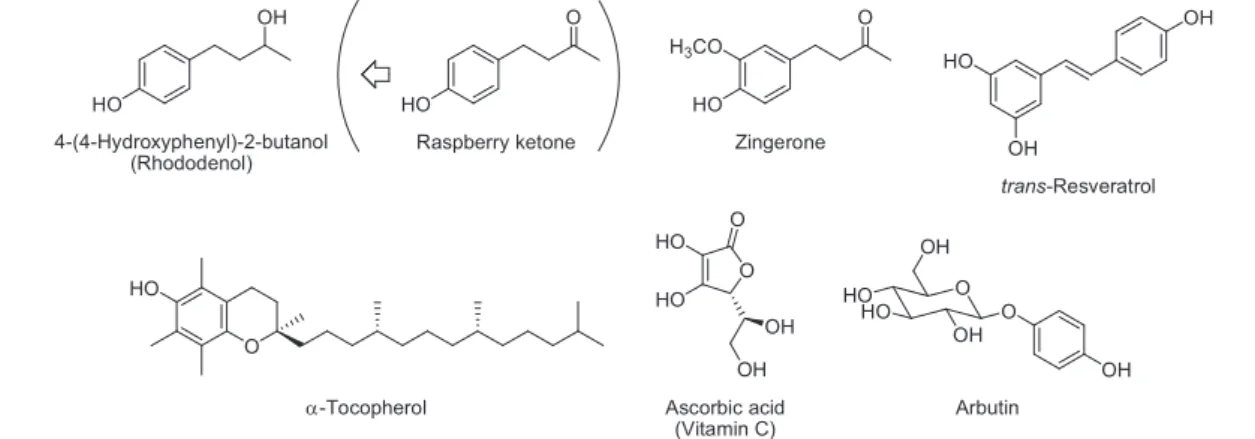
Polyphenols such as trans-resveratrol were widely known as antioxidant compounds.
Especially vitamin E (-tocopherol) and vitamin C (ascorbic acid) were popular antioxidant compounds to use foods and cosmetics. On the other hand,
4-(4-hydroxyphenyl)-2-butanol (rhododenol) was isolated from Rhododendron brachycarpum, bark of Acer nikoence, and bark of Betula platyphylla and has high whitening effect1). But, this compound was reported to damage the skin in 2013. We have interested in this natural occurring compound and
1)
近畿大学工学部化学生命工学科
Department of Biotechnology and Chemistry, Faculty of Engineering, Kinki University2)
近畿大学大学院システム工学研究科
Graduate School of Systems Engineering, Kinki UniversityHO
OH
4-(4-Hydroxyphenyl)-2-butanol (Rhododenol)
O OH
HO OH
HO O
OH Arbutin
O HO HO
O
Ascorbic acid (Vitamin C)
OH O OH
HO
-Tocopherol HO
O
HO
O H3CO
Zingerone Raspberry ketone
Fig. 1. Structures of Popular Antioxidative and Whitening Compounds.
OH HO
OH
trans-Resveratrol
近畿大学工学部研究報告 No.49,2015年,pp.7-13 Research Reports of the Faculty of Engineering, Kinki University No.49 2015, pp.7-13
0 10 20 30 40 50 60 70 80 90 100
Scavenging or Inhibition rate (%)
DPPH Radical Scavenging Assay Superoxide Dismutase like Activity Assay Tyrosinase Activity Inhibition Assay
OH R=
Fig. 2. Physiological Activities of 3a-k.
g)
1a-k 2a-k
THF, r.t.
DBU, Pd/C, H2
EtOH, r.t.
3a-k R3
O
R7
O CH
R3 O
P(OMe)2
O O
NaBH4 R7
OH R6
R1 R2
R1 R2
R5
R6 R5
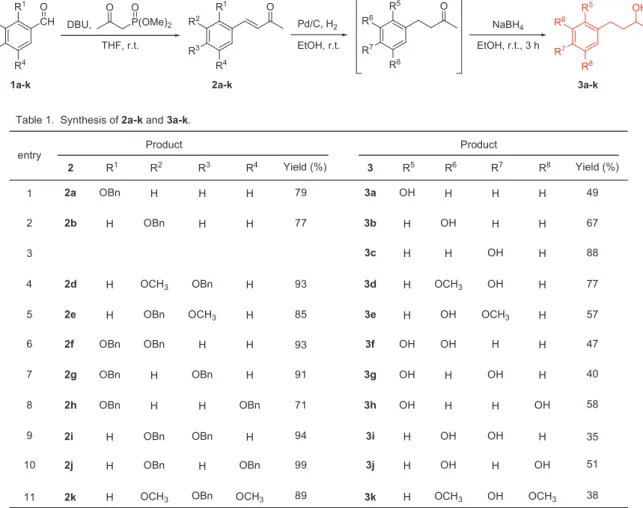
Scheme 1. Synthesis of 4-(Hydroxyphenyl)-2-butanols 3a-k
R4 R4 R8 R8
EtOH, r.t., 3 h
R HO
R HO H3CO
R H3CO
HO
R HO R
OH
R
HO R
OH R OH
R HO H3CO HO R
OCH3
HO
OAc OH
HO
OH
R HO
OH HO
entry Product
2 R1 R2 R3 Yield (%)
2a 2b
2d 2e 2f 2g 2h
OBn H H
H OBn H
H OCH3 OBn
OCH3
H OBn
OBn H OBn
H OBn OBn
OBn H H
1 2 3 4 5 6 7 8
79 77
93 85 93 91 71
3 R5 R6 R7 Yield (%)
3a 3b 3c 3d 3e 3f 3g 3h
OH H H
H OH H
H OH
H
H OCH3 OH
OCH3
H OH
H OH OH
H OH OH
OH H H
49 67 88 77 57 47 40 58 Product
Table 1. Synthesis of 2a-k and 3a-k.
H R4
H
H H H H OBn
H OBn
2i H OBn OBn
2j H OBn H
2k H OCH3 OBn OCH3
9 10 11
94 99 89
H OH
3i H OH OH
3j H OH H
3k H OCH3 OH OCH3
35 51 38 H
R8
H H H H H H OH
investigated the activity of its analogues. So, we report here the convenient synthesis of 4-(hydroxy- phenyl)-2-butanols and their physiological activities.
RESULTS and DISCUSSION
Protection of salicylaldehyde, 3-hydroxybenzalde- hyde, vanillin, isovanillin, 2,3-dihydroxybenzalde- hyde, 2,4-dihydroxybenzaldehyde, 2,5-dihydroxy- benzaldehyde, 3,4-dihydroxybenzaldehyde, 3,5-di- hydroxybenzaldehyde, 2,3,4-trihydroxybenaldehyde, 2,4,5-trihydroxybenzaldehyde, and silingaldehyde with benzyl chloride in the presence of potassium carbonate in ethanol at reflux afforded the corresponding benzyloxybenzaldehydes 1a-k in good yields. Horner-Wadsworth-Emmons reaction of 1a-k with dimethyl 2-oxopropylphosphonate in the presence of 1,7-diazabicyclo[5.4.0]undec-7-ene (DBU) afforded the ,-unsaturated ketones 2a-k in
good yields. Hydrogenation and deprotection of 2a-k in ethanol in hydrogen atmosphere at room temperature gave the 4-(hydroxylphenyl)-2-butan- ones and subsequent reduction of the crude 2-butanones with sodium borohydride in ethanol afforded the corresponding 2-butanols 3a-k in moderate yields (Scheme 1, Table 1). Also similar reduction of raspberry ketone afforded rhododenol 3c in good yield. The physiological activities of 3a-k were assessed in the basis of DPPH-radical scavenging assay2) and superoxide dismutase (SOD)-like activity assay3) as an antioxidant activity, and tyrosinase activity inhibition assay3) as a whitening effect. The results were summa- rized in Table 2 and Fig. 2. 4-(2,3-Dihydroxyphen- yl)-2-butanol 3f, 4-(2,5-dihydroxyphenyl)-2-butanol 3h, 4-(3,4-dihydroxyphenyl)-2-butanol 3i, and 4-(4- hydroxy-3,5-dimethoxyphenyl)-2-butanol 3k showed high radical scavenging activity equal to that of -
Table 2. Antioxidant Activity, Superoxide Dismutase like Activity, and Tyrosinase Activity Inhibition of 3a-k.
3 R5 R6 R7 R8
3a OH H H H 0.5 - 4.2
3b H OH H H 0.0 - 0.0
3c H H OH H 5.8 2.9 30.6
3d H OCH3 OH H 61.5 4.4 4.2
3e H OH OCH3 H 57.8 0.0 8.8
3f OH OH H H 91.0 2.3 5.0
3g OH H OH H 28.9 0.0 93.5
3g OH H OH H - - 82.4 g)
3h OH H H OH 92.6 0.5 4.6 g)
3i H OH OH H 96.1 11.2 0.0 h)
3j H OH H OH 10.5 1.9 8.9
3k H OCH3 OH OCH3 87.0 0.0 3.1
3c-Ac H H OH H - - 21.5
96.1 - -
- 5.7 -
- - 3.5
g) Final Concentration: 0.10 mM. h) Final Concentration: 0.70 mM.
Compound DPPH Radical
Scavenging Assaya)
Superoxide Dismutase like Activity Assayc)
Tyrosinase Activity Inhibition Assaye) Scavenging Rate (%)b) Inhibition Rate (%)d) Inhibition Rate (%)f)
α-Tocopherol Ascorbic acid
Arbutin
a) Sample Concentration: 0.10 mM. b) Final Concentration: 0.040 mM. c) Sample Concentration: 0.10 mM.
d) Final Concentration: 0.0043 mM. e) Sample Concentration: 30.0 mM. f) Final Concentration: 1.0 mM.
tocopherol, but not showed inhibition of tyrosinase activity. Rhododenol 3c was found that inhibition rate of tyrosinase activity showed higher than that of arbutin, but rare antioxidant activity. 4-(4- Hydroxy-3-methoxyphenyl)-2-butanol 3d derived from zingeron showed middle antioxidant activity and tyrosinase activity inhibition effect equal to arbutin. Displaced hydroxyl group and methoxy group was not influenced activities. In the antioxidant activity, ortho or para hydroquinone moiety of phenyl group plays important role. 4- (2,4-Dihydroxyphenyl)-2-butanol 3g showed highest tyrosinase activity inhibition rate, but antioxidant activity was low. 4-(3,5-Dihydroxyphenyl)-2-buta- nol 3j showed low antioxidant activity and lower tyrosinase activity inhibition rate than that of 3g.
4-(4-Hydroxyphenyl)-2-butyl acetate 3c-Ac, which was protected hydroxyl group of side chain with acetyl group, showed lower tyrosinase activity inhibition than that of 3c. That is, 2-butanol group was also important in the activity.
CONCLUSION
Horner-Wadsworth-Emmons reaction of hydroxy- benzaldehydes with dimethyl 2-oxopropylphos- phonate was simply proceeded without anhydrous condition in the presence of DBU to give the corresponding ,-unsaturated ketones in moderate yields. Although compounds 3g,j bearing of dihydroxyphenyl group like as resorcinol showed lower antioxidant activity, 3g was highest inhibition of tyrosinase activity.
EXPERIMENTAL
General Procedures. 1H NMR spectra were obtained on a JEOL JNM-EX400 spectrometer in CDCl3 and CD3OD operating at 400 MHz with Me4Si as internal standard.
Materials. Tetrahydrofuran (THF) was purified by distillation from benzophenone ketyl under an argon atmosphere before use.
Synthesis of 4-(Benzyloxyphenyl)-3-buten-2-ones 2a-k.
A solution of aryl aldehydes 1a-k (3 mmol), dimethyl 2-oxopropylphosphonate (0.60 g, 3.6 mmol) and 1,8-diazabicyclo[5.4.0]undec-7-ene (0.91
g, 6 mmol) in THF (15 mL) was stirred at room temperature for 24 hours. Reaction mixture was quenched by the addition of 2M HCl. The mixture was extracted with Et2O, washed with water and saturated NaCl, dried over anhydrous MgSO4, and evaporated in vacuo. The residue was chromato- graphed on preparative TLC (CHCl3:Et2O=95:5) to give 4-(benzyloxyphenyl)-3-buten-2-ones 2a-k.
4-(2-Benzyloxyphenyl)-3-buten-2-one (2a): 0.60 g (79%); 1H NMR (CDCl3) 2.34 (s, 3H, CH3), 5.16 (s, 2H, CH2), 6.76 (d, J=16.4 Hz, 1H, olefinic H), 6.97 (d, J=8.8 Hz, 1H, ArH), 7.32-7.50 (m, 7H, ArH), 7.56 (d, J=7.3 Hz, 1H, ArH), 7.95 (d, J=16.4 Hz, 1H, olefinic H).
4-(3-Benzyloxyphenyl)-3-buten-2-one (2b): 0.58 g (77%); 1H NMR (CDCl3) 2.36 (s, 3H, CH3), 5.07 (s, 2H, CH2), 6.68 (d, J=16.1 Hz, 1H, olefinic H), 7.01 (d, J=8.3 Hz, 1H, ArH), 7.14 (s, 1H, ArH), 7.24-7.48 (m, 7H, ArH), 7.46 (d, J=16.1 Hz, 1H, olefinic H).
4-(4-Benzyloxy-3-methoxyphenyl)-3-buten-2-one (2d): 0.79 g (93%); 1H NMR (CDCl3) 2.36 (s, 3H, CH3), 3.92 (s, 3H, OCH3), 5.19 (s, 2H, CH2), 6.59 (d, 1H, olefinic H), 6.88 (d, J=8.3 Hz, 1H, ArH), 7.05 (d, J=8.3 Hz, 1H, ArH), 7.09 (s, 1H, ArH), 7.32-7.47 (m, 6H, olefinic H and ArH).
4-(3-Benzyloxy-4-methoxyphenyl)-3-buten-2-one (2e): 0.72 g (85%); 1H NMR (CDCl3) 2.34 (s, 3H, CH3), 3.91 (s, 3H, OCH3), 5.17 (s, 2H, CH2), 6.50 (d, J=16.4 Hz, 1H, olefinic H), 6.89 (d, J=8.1 Hz, 1H, ArH), 7.10 (s, 1H, ArH), 7.13 (d, J=8.3 Hz, 1H, ArH), 7.26-7.47 (m, 5H, ArH), 7.40 (d, J=16.4 Hz, 1H, olefinic H).
4-(2,3-Dibenzyloxyphenyl)-3-buten-2-one (2f): 0.99 g (93%); 1H NMR (CDCl3) 2.23 (s, 3H, CH3), 5.08 (s, 2H, CH2), 5.17 (s, 2H, CH2), 6.56 (d, J=16.6 Hz, 1H, olefinic H), 7.05 (s, 1H, ArH), 7.06 (d, J=2.2 Hz, 1H, ArH), 7.17 (dd, J=3.4 and 5.9 Hz, 1H, ArH), 7.30-7.49 (m, 10H, ArH), 7.71 (d, J=16.6 Hz, 1H, olefinic H).
4-(2,4-Dibenzyloxyphenyl)-3-buten-2-one (2g): 0.97 g (91%); 1H NMR (CDCl3) 2.32 (s, 3H, CH3), 5.05 (s, 2H, CH2), 5.12 (s, 2H, CH2), 6.59 (s, 1H, ArH), 6.60 (d, J=8.1 Hz, 1H, ArH), 6.69 (d, J=16.6 Hz, 1H, olefinic H), 7.26-7.41 (m, 10H, ArH), 7.51 (d, J=8.3 Hz, 1H, ArH), 7.87 (d, J=16.4 Hz, 1H, olefinic H).
4-(2,5-Dibenzyloxyphenyl)-3-buten-2-one (2h): 0.76
g (71%); 1H NMR (CDCl3) 2.34 (s, 3H, CH3), 5.03 (s, 2H, CH2), 5.11 (s, 2H, CH2), 6.69 (d, J=16.6 Hz, 1H, olefinic H), 6.90 (d, J=9.0 Hz, 1H, ArH), 6.96 (dd, J=2.9 and 9.0 Hz, 1H, ArH), 7.17 (d, J=2.9 Hz, 1H, ArH), 7.30-7.44 (m, 10H, ArH), 7.90 (d, J=16.4 Hz, 1H, olefinic H).
4-(3,4-Dibenzyloxyphenyl)-3-buten-2-one (2i): 1.01 g (94%); 1H NMR (CDCl3) 2.34 (s, 3H, CH3), 5.18 (s, 2H, CH2), 5.20 (s, 2H, CH2), 6.53 (d, J=16.4 Hz, 1H, olefinic H), 6.92 (d, J=8.3 Hz, 1H, ArH), 7.09 (d, J=8.3 Hz, 1H, ArH), 7.13 (s, 1H, ArH), 7.26-7.44 (m, 10H, ArH), 7.39 (d, J=16.4 Hz, 1H, olefinic H).
4-(3,5-Dibenzyloxyphenyl)-3-buten-2-one (2j): 1.06 g (99%); 1H NMR (CDCl3) 2.37 (s, 3H, CH3), 5.05 (s, 4H, CH2), 6.65 (d, J=16.4 Hz, 1H, olefinic H), 6.66 (t, J=2.0 Hz, 1H, ArH), 6.77 (d, J=2.2 Hz, 2H, ArH), 7.31-7.43 (m, 10H, ArH), 7.41 (d, J=16.1 Hz, 1H, olefinic H).
4-(4-Benzyloxy-3,5-dimethoxyphenyl)-3-buten-2-one (2k): 0.83 g (89%); 1H NMR (CDCl3) 2.38 (s, 3H, CH3), 3.86 (s, 6H, OCH3), 5.06 (s, 2H, CH2), 6.63 (d, J=16.1 Hz, 1H, olefinic H), 6.76 (s, 2H, ArH), 7.29-7.37 (m, 3H, ArH), 7.43 (d, J=16.1 Hz, 1H, olefinic H), 7.47 (d, J=6.8 Hz, 2H, ArH).
Synthesis of 4-(Hydroxyphenyl)-2-butanols 3a-k.
A solution of 2a-k (1 mmol) and 10% palladium carbon (0.05 g) in ethanol (20 mL) was stirred at room temperature for 2 days under hydrogen atmosphere. After being filtered off palladium carbon through the celite pad, sodium borohydride (0.04 g, 1 mmol) was added to the filtrate. The mixture was stirred at room temperature for 5 h.
Reaction mixture was quenched by the addition of 2M HCl. The mixture was extracted with Et2O, washed with water and saturated NaCl, dried over anhydrous MgSO4, and evaporated in vacuo. The residue was chromatographed on preparative TLC (CHCl3:Et2O=1:1) to give 4-(hydroxyphenyl)-2-butanols 3a-k.
4-(2-Hydroxyphenyl)-2-butanol (3a): 0.08 g (49%);
1H NMR (CDCl3) 1.20 (d, J=6.3 Hz, 3H, CH3), 1.67-1.81 (m, 2H, CH2), 2.60-2.67 (m, 1H, CH2), 2.89 (ddd, J=6.3, 10.3, and 14.2 Hz, 1H, CH2), 3.17 (brs, 1H, OH), 3.71-3.77 (m, 1H, CH), 6.85 (d, J=8.8 Hz, 1H, ArH), 6.87 (d, J=7.3 Hz, 1H, ArH), 7.09 (dd, J=2.4 and 8.8 Hz, 1H, ArH), 7.10 (d, J=7.1 Hz, 1H,
ArH), 7.84 (s, 1H, OH).
4-(3-Hydroxyphenyl)-2-butanol (3b): 0.11 g (67%);
1H NMR (CDCl3) 1.20 (d, J=6.1 Hz, 3H, CH3), 1.72-1.78 (m, 2H, CH2), 2.40-2.66 (m, 3H, CH2 and OH), 3.72-3.84 (m, 1H, CH), 6.68 (d, J=7.1 Hz, 1H, ArH), 6.69 (s, 1H, ArH), 6.72 (s, 1H, ArH), 7.11 (t, J=7.1 Hz, 1H, ArH), 7.35 (brs, 1H, OH).
4-(4-Hydroxyphenyl)-2-butanol (3c): 0.15 g (88%);
1H NMR (CDCl3) 1.22 (d, J=6.3 Hz, 3H, CH3), 1.66-1.81 (m, 2H, CH2), 1.99 (brs, 1H, OH), 2.55-2.69 (m, 2H, CH2), 3.83 (sext, J=6.1 Hz, 1H, CH), 6.25 (brs, 1H, OH), 6.74 (d, J=8.5 Hz, 2H, ArH), 7.02 (d, J=8.5 Hz, 2H, ArH).
4-(4-Hydroxy-3-methoxyphenyl)-2-butanol (3d):
0.15 g (77%); 1H NMR (CDCl3) 1.22 (d, J=6.3 Hz, 3H, CH3), 1.61 (brs, 1H, OH), 1.67-1.81 (m, 2H, CH2), 2.56-2.72 (m, 2H, CH2), 3.82 (sext, J=6.1 Hz, 1H, CH), 3.86 (s, 3H, OCH3), 5.60 (brs, 1H, OH), 6.68 (dd, J=1.5 and 8.3 Hz, 1H, ArH), 6.70 (d, J=1.5 Hz, 1H, ArH), 6.82 (d, J=7.8 Hz, 1H, ArH).
4-(3-Hydroxy-4-methoxyphenyl)-2-butanol (3e): 0.11 g (57%); 1H NMR (CDCl3) 1.21 (d, J=6.1 Hz, 3H, CH3), 1.50-1.77 (m, 3H, CH2 and OH), 2.53-2.70 (m, 2H, CH2), 3.78-3.84 (m, 1H, CH), 3.85 (s, 3H, OCH3), 5.74 (s, 1H, OH), 6.67 (d, J=8.3 Hz, 1H, ArH), 6.77 (d, J=8.8 Hz, 1H, ArH), 6.78 (s, 1H, ArH).
4-(2,3-Dihydroxyphenyl)-2-butanol (3f): 0.09 g (47%); 1H NMR (CDCl3) 1.23 (d, J=6.1 Hz, 3H, CH3), 1.72-1.78 (m, 2H, CH2), 2.22 (brs, 1H, OH), 2.64 (dt, J=4.6 and 14.2 Hz, 1H, CH2), 2.87-2.95 (m, 1H, CH2), 3.70-3.77 (m, 1H, CH), 5.93 (brs, 1H, OH), 6.63 (dd, J=2.4 and 6.6 Hz, 1H, ArH), 6.73-6.79 (m, 2H, ArH), 7.92 (brs, 1H, OH).
4-(2,4-Dihydroxyphenyl)-2-butanol (3g): 0.07 g (40%); 1H NMR (CDCl3) 1.17 (d, J=6.1 Hz, 3H, CH3), 1.62-1.70 (m, 2H, CH2), 2.55 (ddd, J=5.1, 7.1, and 13.9 Hz, 1H, CH2), 2.67-2.76 (m, 1H, CH2), 3.68-3.74 (m, 1H, CH), 6.32 (s, 1H, ArH), 6.33 (d, J=8.3 Hz, 1H, ArH), 6.90 (d, J=7.8 Hz, 1H, ArH).
4-(2,5-Dihydroxyphenyl)-2-butanol (3h): 0.11 g (58%); 1H NMR (CD3OD) 1.18 (d, J=6.1 Hz, 3H, CH3), 1.57-1.73 (m, 2H, CH2), 2.51-2.63 (m, 2H, CH2), 3.71 (sext, J=6.1 Hz, 1H, CH), 6.45 (dd, J=2.9 and 8.5 Hz, 1H, ArH), 6.55 (d, J=2.9 Hz, 1H, ArH), 6.58 (d, J=8.5 Hz, 1H, ArH).
4-(3,4-Dihdyroxyphenyl)-2-butanol (3i): 0.06 g
(79%); 1H NMR (CDCl3) 1.19 (d, J=5.9 Hz, 3H, CH3), 1.65-1.74 (m, 2H, CH2), 2.47-2.64 (m, 2H, CH2), 3.76 (q, J=5.9 Hz, 1H, CH), 6.56 (d, J=7.8 Hz, 1H, ArH), 6.68 (s, 1H, ArH), 6.73 (d, J=8.1 Hz, 1H, ArH).
4-(3,5-Dihydroxyphenyl)-2-butanol (3j): 0.09 g (51%); 1H NMR (CD3OD) 1.17 (d, J=6.3 Hz, 3H, CH3), 1.60-1.75 (m, 2H, CH2), 2.43-2.61 (m, 2H, CH2), 3.72 (sext, J=6.3 Hz, 1H, CH), 6.08 (t, J=2.0 Hz, 1H, ArH), 6.15 (d, J=2.0Hz, 2H, ArH).
4-(4-Hydroxy-3,5-dimethoxyphenyl)-2-butanol (3k):
0.09 g (38%); 1H NMR (CDCl3) 1.24 (d, J=6.1 Hz, 3H, CH3), 1.43 (brs, 1H, OH), 1.72-1.79 (m, 2H, CH2), 2.56-2.64 (m, 1H, CH2), 2.66-2.74 (m, 1H, CH2), 3.82-3.89 (m, 1H, CH), 3.88 (s, 6H, OCH3), 5.41 (s, 1H, OH), 6.43 (s, 2H, ArH).
DPPH Radical Scavenging Assay.
The measurement of DPPH radical scavenging effect was performed to according the established procedure2).
Sample compounds were dissolved in ethanol to obtain the concentration of 0.1 mM. 2,2-Diphenyl- 1-picrylhydrazyl (DPPH) free radical was dissolved in ethanol to obtain the concentration of 0.2 mM.
To a sample solution (100 L) on 96 well transparent microplate was added ethanol (100 L) and DPPH solution (50 L). The mix solution was mixed on a plate-mixer for 1 minute. The mix solution was stand at 25 °C for 30 min under dark, followed by measuring absorbance with a microplate reader at 570 nm. The sample blank test (B) was carried out with ethanol instead of sample solution with similar procedure. The blank test of sample (C) was similarly done with ethanol instead of DPPH solution. The blank test of sample blank (D) was similarly done with ethanol instead of sample and DPPH solution, respectively.
DPPH radical scavenging rate was calculated as follows.
DPPH Radical Scavenging Rate (%) = {(B-D)-(A-C)}/(B-D)*100
A: Abs. of Sample, B: Abs. of Sample Blank, C: Abs.
of Blank of Sample, D: Abs. of Blank of Sample Blank
SOD-like Activity Assay.
SOD-like activity was determined by the nitroblue tetrazolium (NBT) reduction method with a SOD Activity Detection Kit (Wako Pure Chemical Ind. Ltd.)3). Sample compounds were dissolved in DMSO to obtain the concentration of 0.10 mM. To a sample solution (10 L) on 96 well transparent microplate was added Color-producing Solution (100 L). The mix solution was mixed on a plate-mixer for 1 minute. To the solution was added Enzyme Solution (100 L). The mix solution was mixed on a plate-mixer for 1 minute, followed by incubating accurately for 28 minutes at 37 °C in gaseous phase. To the solution was added Stop Solution (20 L). The mix solution was mixed on a plate-mixer for 5 minutes, followed by measuring absorbance with a microplate reader at 560 nm.
The sample blank test (B) was carried out with DMSO instead of sample solution with similar procedure. The blank test of sample (C) was similarly done with Blank Solution instead of Enzyme Solution. The blank test of sample blank (D) was similarly done with DMSO and Blank Solution instead of sample and Enzyme Solution, respectively. Inhibition rate was calculated as follows.
Inhibition Rate (%) = {(B-D)-(A-C)}/(B-D)*100
A: Abs. of Sample, B: Abs. of Sample Blank, C: Abs.
of Blank of Sample, D: Abs. of Blank of Sample Blank
Tyrosinase Activity Inhibition Assay.
Tyrosinase activity was determined by the dopachrome method with L-3-(3,4-dihydroxy- phenyl)alanine (L-DOPA) as substrate3). The reaction mixture of L-DOPA (1.66 mM in 0.2 M phosphate buffer solution (PBS, pH 6.8), 2.8 mL), enzyme tyrosinase from mushroom (20 units/mL in PBS, 0.1 mL) and the sample (30 mM DMSO solution, 0.1 mL) was incubated at 25 °C for 10 min.
The mixture was measured absorbance at 475 nm.
The sample blank test (B) was carried out with DMSO instead of sample solution with similar procedure. The blank test of sample (C) was
similarly done with PBS instead of enzyme solution.
The blank test of sample blank (D) was similarly done with DMSO and PBS instead of sample and enzyme solution, respectively. The percentage inhibition of tyrosinase activity was calculated as follows.
Tyrosinase Activity Inhibition Rate (%) = {(B-D)-(A-C)}/(B-D)*100
A: Abs. of Sample, B: Abs. of Sample Blank, C: Abs.
of Blank of Sample, D: Abs. of Blank of Sample Blank.
REFERENCES
1) R. Kawaguchi, K.-G. Kim, and H.-K. Kim, Yakugaku Zasshi, 62, 4-6 (1942). H. Ando, M. S.
Matsui, and M. Ichihashi, Int. J. Mol. Sci., 11, 2566-2575 (2010). T. Inoue, Y. Ishidate, M. Fujita, M. Kubo, M. Fukushima, and M. Nagai, Yakugaku Zasshi, 98, 41-46 (1978). T. Fujita, H. Hatamoto, M. Miyamoto, T. Iwasaki, and S. Takafuji, Biotec.
Lett., 20, 1057-1061 (1998). T. Akihisa, A. Takeda, H. Akazawa, T. Kikuchi, S. Yokokawa, M. Ukiya, M.
Fukatsu, and K. Watanabe, Chem. Biodiv., 9, 1475-1489 (2012). M. Sasaki, M. Kondo, K. Sato, M Umeda, K. Kawabata, Y. Takahashi, T. Suzuki, K.
Matsunaga, and S. Inoue, Pigment Cell Melanoma Res., 27, 754-763 (2014).
2) H. Tominaga, Y. Kobayashi, T. Goto, K. Kasemura, and M. Nomura, Yakugaku Zasshi, 125, 371-375 (2005).
3) T. Tada, M. Nomura, K. Shimomura, and Y.
Fujihara, Biosci. Biotech. Biochem., 60, 1421-1424 (1996).