LETTER
A New Construction of ( m + k, m)-Functions with Low Differential Uniformity ∗
Tailin NIU†, Xi CHEN†,Nonmembers, Longjiang QU†,††a),Member,andChao LI†,Nonmember
SUMMARY (m+k,m)-functions with good cryptographic properties when 1 ≤ k < mplay an important role in several block ciphers. In this paper, based on the method introduced by Carlet et al. in 2018, we construct infinite families of(m+k,m)-functions with low differential uniformity by constructing a class of pairwise disjoint special subsets in Fk2. Such class of subsetsUi are chosen to generate multisets such that all elements inF2k appears as many times as possible in each of these multisets. We construct explicitly such kind of special subsets by linearized polynomials, and provide differentially∆-uniform (m+k,m)-functions with∆<2k+1,k≤m−2. Specifically whenk=m−2, the differential uniformity of our functions are lower than the function constructed by Carlet et al. The constructed functions provide more choices for the design of Feistel ciphers.
key words: substitution boxes, Feistel structures, differential uniformity
1. Introduction
Substitution boxes (S-boxes) play an important role in many block ciphers since they are the only nonlinear component and provide nonlinear relationship between the input bits and the output bits in a controllable fashion. These S-boxes are functions fromFn2 toF2m, which are also called (n,m)- functions[14]. Permutations withn = mare widely used in the Substitution-Permutation-Network (SPN) structure as S-boxes such as the AES[11], Serpent[1], PRESENT[3], MISTY [16], LED[13] and Kuznyechik[12]. Studies on (n,n)-permutations with good cryptographic properties were very active in the last decade, please refer to[2],[5],[6], [9],[20]–[24]and the references therein. However, (n,m)- functions withm<nor evenm>ncan also be used in the Feistel structure as S-boxes. For example, the DES cipher has eight S-boxes each mapping 6 bits to 4 bits. Compared with (n,n)-permutations, little theoretical work has been done on (n,m)-functions with good cryptographic properties when
n2 <m<n.
In order to prevent various attacks on the cipher, such (n,m)-functions are required to have low differential unifor- mity[19], high nonlinearity[19]and high algebraic degree
Manuscript received March 16, 2019.
Manuscript revised January 10, 2020.
†The authors are with the Department of Mathematics, National University of Defense Technology, Changsha, 410073, China.
††The author is also with the State Key Laboratory of Cryptol- ogy, Beijing, 100878, China.
∗This work is supported by the Nature Science Foundation of China (NSFC) under Grant 11531002, 61722213, National Key R&D Program of China (No. 2017YFB0802001), and the Open Foundation of State Key Laboratory of Cryptology.
a) E-mail: [email protected] (Corresponding author) DOI: 10.1587/transfun.2019EAL2030
[17]. Since we mainly focus on the case n > mhere, we let n = k+mwithk ≥ 1. According to Nyberg’s results [10],[18], the differential uniformity of(m+k,m)-functions with m > k ≥ 1 is bounded below by 2k +2, which is calledNyberg’s bound. An(n,n)-function is calledalmost perfect nonlinear (APN)if its differential uniformity equals 2, which is the lowest possible value. Differentially 2k+1- uniform(m+k,m)-functions are easily found by composing on the left any APN(m+k,m+k)-function by a surjective affine (m+k,m)-function. When k = 1, these functions achieve Nyberg’s bound which is 4. Very recently, Carlet et al.[8]introduced a method to construct(m+k,m)-functions (1 ≤k ≤m−1) of the formF(x,z)=φ(z)I(x)with differ- ential uniformity∆<2k+1, whereI(x)is the(m,m)-inverse function andφ(z)is a(k,m)-function. Then fork=m−1, they constructed an infinite family of(m+k,m)-functions achieveing Nyberg’s bound, while fork≤m−2, they intro- duced a class of special subsets to construct infinite families of low differential uniformity functions (see Proposition 2.1 for details). However, for the latter case, they only gave one specific construction withk =m−2 (see Proposition 2.2).
As pointed out in[8], it is still an interesting question to con- struct explicit differentially∆-uniform(m+k,m)-functions with 2≤k≤m−3 and∆<2k+1.
In this paper, we construct special sets suitable for Proposition 2.1 by linearized polynomials. These sets lead to specific families of(m+k,m)-functions with differential uniformity∆<2k+1, high nonlinearity and not too low al- gebraic degree when k ≤ m−2. Thus we partly answer the above interesting quesiton. Even when k =m−2, our constructions have better cryptographic properties than the function constructed in[8]. The constructed functions in this paper provide more choices for the design of Feistel ciphers.
2. Preliminaries
In this section, we give some necessary definitions and no- tions related to(n,m)-functions and then recall the previous results.
2.1 Necessary Definitions
Let F2n be an extension field of the finite field F2. Let Γ(x) ∈F2[x] be a primitive monic polynomial of degreen andαbe a root ofΓ(x)in its splitting field. Then
F2n =(
a0+a1α+· · ·+an−1αn−1
a0,a1,· · ·,an−1 ∈F2) . Copyright © 2020 The Institute of Electronics, Information and Communication Engineers
For anya =a0+a1α+· · ·+an−1αn−1 ∈F2n, the mapping a → ~a :=(a0,a1,· · ·,an−1)Tis a bijection fromF2n to the linear spaceFn2. Thus, the finite fieldF2n is also viewed as the linear spaceFn2overF2[15, Definition 1.83]. Throughout this note, we will switch between these two points of view without explanation if the context is clear. The set of all nonzero elements ofF2n (resp. Fn2) is denoted byF∗2n (resp.
Fn∗2 ). In the note, we always defineI(0) =0 for the multi- plicative inverse functionI(x) =1/x. For the convenience and clarity, the zero vector in a linear spaceVis denoted by 0V. We use Span(A)to denote the linear span of a setAin Fn2. A polynomial of the form
L(x)=
n
X
i=0
αix2i
with coefficients in F2n is called a linearized polynomial over F2n. If L(x) permutes F2n, the unique polynomial L−1(x) overF2n such that L
L−1(x)
≡ L−1(L(x)) ≡ x (modx2n −x)is calledthe compositional inverseofL(x).
There exist several types of unique representations for (n,m)-functions. One such representation is thealgebraic normal form(ANF):
F(x)=(f1(x), . . . ,fm(x))
=* . ,
X
P⊆ {1,2,...,n}
b1,P Y
i∈P
xi
, . . ., X
P⊆ {1,2,...,n}
bm,P Y
i∈P
xi
+ / -
= X
P⊆ {1,2,...,n}
aP Y
i∈P
xi ,
(1) wherex= (x1, . . . ,xn) ∈ Fn2,aP =(b1,P,. . . ,bm,P) ∈F2m and the algebraic normal form of fj(x) (the j-th coor- dinate function of F(x), 1 ≤ j ≤ m) is defined by
P
P⊆ {1,2,...,n}bj,P
Q
i∈Pxi .
Thealgebraic degreeof an (n,m)-function is defined by the global degree of its ANF:
d◦(F)=max{#P, whereaP,0}, where #Pdenotes the cardinality of a setP.
LetFbe an(n,m)-function. Thedifferential uniformity ofFis defined as:
∆F= max
a∈F2n∗,b∈Fm2 #(
x∈F2n|F(x+a)+F(x)=b) . The Walsh transform FW : Fn2 ×Fm∗2 → C of F is defined by:
FW(u, v)= X
x∈Fn2
(−1)v·F(x)+u·x, where “·” denotes the inner product inFn2.
ThenonlinearityofFis defined as
N L(F)=2n−1−1
2 max
(u,v)∈Fn2×Fm∗2
|FW(u, v)|.
The nonlinearity of(n,m)-functions is bounded above by 2n−1 − 2n/2−1 according to the Parseval identity P
u∈F2nFW(u, v)2 = 22n and the fact that the maximum value of a list of real numbers must not be less than their average.
2.2 Previous Results
Very recently, Carlet et al. [8] proposed a new method to construct infinite families of(m+k,m)-functions with low differential uniformity.
Proposition 2.1. [8, Proposition 4.6] Letm,l be positive integers and1≤k≤m−2. LetUi (1 ≤i≤m−k−1)be disjoint sets inFk2 satisfying
m−k−1
P
i=1 #Ui ≤2k−2−l and such that, for anyUi, any element inFk2 appears at least2ltimes in the multiset{∗z1+z2|(z1,z2)∈Ui×Ui∗}.
Consider the functionF:Fm+k2 →F2min the formF(x,z)= φ(z)I(x), whereI(x)is the(m,m)-inverse function andφ: Fk2 →F2mis defined as
φ(z)=
L(z)+ci, when z∈Ui, L(z)+c0, when z∈Fk2\m−k−S1
i=1 Ui, and satisfies Rank{φ(z)|z ∈ Fk2} = m, L : Fk2 → F2m is linear andci (0≤i≤m−k−1)are constants inF2m. Then Fis a differentially∆-uniform function with∆≤2k+1−4l+2. According to Proposition 2.1, the problem of construct- ing (m+k,m)-functions with low differential uniformity
∆ < 2k+1 was transformed to the problem of construct- ing these suitable special sets. Furthermore, the differential uniformity of such functions are highly depending on the properties of the constructed sets.
In the case k =m−2, these pairwise disjoint setsUi become one setU1. According to Proposition 2.1, an infinite family of(2m−2,m)-functions with∆≤2m−1−2m−6+2 and algebraic degreem+5 for anym≥8 was constructed.
Proposition 2.2. [8, Proposition 4.7] Let m ≥ 8 be an integer. Assume that
f(z)=((z1+1)(z2+1)(z3+1)+1)((z4+1)(z5+1)(z6+1)+1)+1, where zi,1 ≤ i ≤ 6 are the first 6 bits of z ∈ Fm−2 2. Consider the function F : F2m−2 2 → F2m in the form F(x,z)=φ(z)I(x). HereI(x)is the(m,m)-inverse function andφ(z)=(z,f(z),f(z)+1). ThenFis a differentially∆- uniform function with∆≤2m−1−2m−6+2and the algebraic degree ofFism+5.
Let U1 =
(x,0F3
2, y)|x∈F32, y ∈Fm−2 8 [
(0F3
2,x, y)|x∈F32, y ∈Fm−2 8 .
Then theφ(z)in Proposition 2.2 can be expressed by φ(z)=
( (z,1,0), when z∈U1; (z,0,1), when z∈F2m−2\U1. 3. Construction of Special Sets
In this section, we generalize the setU1 ⊆Fm−2 2in Proposi- tion 2.2 and construct pairwise disjoint special setsUi ⊆Fk2, wherek is not necessary equal tom−2. We first give a useful basic lemma.
Lemma 3.1. For j = 1,2, let kj,lj be positive integers satisfyingkj ≥4, andAj be a set with elements inFk2j such that any element in Fk2j appears at least 2lj times in the multiset{∗z1+z2|(z1,z2)∈ Aj×Aj∗}. Define
A={(x, y) |x∈ A1, y ∈A2} ⊆Fk21+k2.
Then any element inFk21+k2 appears at least4l1l2 times in the multiset
{∗z1+z2|(z1,z2)∈ A×A∗}.
Proof:According to the assumption,x0∈Fk21has at least 2l1 orderly addictive decompositions in A1. Thus for each or- derly addictive decomposition ofy0∈Fk22inA2, the element (x0, y0)∈F2k1+k2 has at least 2l1orderly addictive decompo- sitions. Since y0 ∈ Fk22 have at least 2l2 orderly addictive decompositions in A2, we obtain that(x0, y0) ∈ Fk21+k2 has at least 4l1l2orderly addictive decompositions inA. We can generalize the setU1 in Proposition 2.2. By linearized polynomials, we construct pairwise disjoint sets Ui ⊆Fk2 in the following two propositions.
Proposition 3.2. Letm,k,s,t be positive integers such that 1 ≤ k ≤ m−2,2 ≤t and2 ≤ s ≤ 2t−1. AssumeLi,j(x) are linearized polynomials overF2t satisfying that(Li1,j1+ Li2,j2)(x) is a permutation for any (i1,j1) , (i2,j2) (i.e., i1 ,i2 or j1 , j2), where1 ≤i ≤ m−k−1,1 ≤ j ≤ s.
Define the sets
Ui0= [s
j=1
Wi,0j,
where Wi,0j =(
(x,Li,j(x))| x∈Ft∗2 )⊆F2t2.
ThenUi0 (1 ≤ i ≤ m−k−1) are pairwise disjoint sets in F2t2 ,
m−k−1
P
i=1 #Ui0= (2t−1)s(m−k−1)and for anyUi0, all elements inF2t2 appear at leasts(s−1)times in the multiset
Ti0=(
∗z1+z2|(z1,z2)∈Ui0×Ui0∗) .
Proof:We first show thatUi0(1≤i ≤m−k−1) are pairwise
disjoint sets inF2t2 satisfying
m−k−1
X
i=1
#Ui0=(2t−1)s(m−k−1).
Notice that (Li1,j1 + Li2,j2)(x) is a permutation for any (i1,j1) , (i2,j2). Then Li1,j1(x) = Li2,j2(x) if and only if x = 0, and thus we haveWi0
1,j1TWi0
2,j2 =∅. Therefore, Ui0= Ss
j=1Wi,0j (1≤i ≤m−k−1) are pairwise disjoint sets andm−k−P 1
i=1 #Ui0=(2t−1)s(m−k−1).
Secondly, we prove that any element (x0,x00) ∈ F2t2 appears at least s(s−1) times in the multiset Ti0, where x0,x00 ∈ Ft2. It is clear that 0F2t2 <Ui0. The rest of proof is divided into three cases.
Case 1: (x0,x00)=0F2t 2.
Since 0F2t2 =z+zholds for anyz ∈Ui0, 0F2t2 appears at least #Ui0times in the multisetTi0. Clearly we have #Ui0= (2t−1)s≥ (s−1)s, where the inequality holds since 2 ≤ s≤2t−1.
Case 2: (x0,x00)<
0F2t 2
SUi0.
We first prove that for any j1 , j2, (x0,x00) ∈ F2t2 appears at least 2 times in the multiset
(∗z1+z2|(z1,z2)∈Wi,0j1[
Wi,j02×Wi,j01[ Wi,0j2∗)
. Without lost of generality, we assume j1 =1,j2 =2 here.
Since (x0,x00) <
0F2t 2
SUi0, the addictive decomposition of (x0,x00)into two elements inWi,10 SWi,20 is equivalent to the following linear equation system:
( x1+x2=x0
Li,1(x1)+Li,2(x2)=x00, (2) wherex1,x2 ∈Ft∗2 are unknowns. Pluggingx1=x2+x0and x2=x1+x0into the second equation of Eq. (2) respectively, we obtain
( x1=(Li,1+Li,2)−1(Li,2(x0)+x00)
x2 =(Li,1+Li,2)−1(Li,1(x0)+x00), (3) where(Li,1+Li,2)−1(x)denotes the compositional inverse of (Li,1+Li,2)(x). Since(x0,x00) <
0F2t 2
SUi0, we have x1,x2 ,0Ft2according to Eq. (3). Then we obtain two orderly addictive decompositions
(x0,x00)=(x1,Li,1(x1))+(x2,Li,2(x2))
=(x2,Li,2(x2))+(x1,Li,1(x1)),
where(x1,Li,1(x1)) ∈Wi,10 and(x2,Li,2(x2)) ∈Wi,20 . That is,(x0,x00)∈F2t2 appears at least 2 times in the multiset
(∗z1+z2 |(z1,z2)∈Wi,10 [
Wi,20 ×Wi,10 [ Wi,20 ∗)
. After that, we prove (x0,x00) ∈ F2t2 appears at least
s(s−1) times in the multisetTi0. Actually, there are s
2
combinations of Wi,j0
1
SWi,0j
2 for any 1 ≤ j1 , j2 ≤ s. Notice thatUi0 = Ss
j=1Wi,j0 andWi01,j1T
Wi02,j2 = ∅ for any (i1,j1) , (i2,j2). Thus we have (x0,x00) ∈ F2t2 appears at least 2s
2
=s(s−1)times in the multisetTi0. Case 3: (x0,x00)∈Ui0.
Without lost of generality, assume that(x0,x00)∈Wi,10 . On one hand, we show that(x0,x00) ∈ F2t2 appears at least 2t−2 times in the multiset
(∗z1+z2|(z1,z2)∈Wi,10 ×Wi,10 ∗) .
For any z ∈ Ft∗2 \ {x0}, it is clear that z,Li,1(z), z+x0,Li,1(z+x0)∈Wi,10 are distinct and
(x0,Li,1(x0))= z,Li,1(z)+ z+x0,Li,1(z+x0). Thus(x0,x00)∈F2t2 appears at least 2t−2 times in the multiset {∗z1+z2|(z1,z2)∈Wi,10 ×Wi,10 ∗}. On the other hand, since (x0,x00) <
0F2t
2
SSs
j=2Wi,j0 , clearly(x0,x00) ∈ F2t2 appears at least(s−1)(s−2)times in the multiset
∗z1+z2|(z1,z2)∈ [s j=2
Wi,0j× [s
j=2
Wi,j0 ∗
similarly to Case 2. Thus(x0,x00)appears at least 2t−2+ (s−1)(s−2)≥s(s−1)times in the multisetTi0, where the inequality holds since 2≤s≤2t−1.
All in all,Ui0(1≤i≤m−k−1)are pairwise disjoint inF2t2 ,m−k−P 1
i=1 #Ui0=(2t−1)s(m−k−1)and for anyUi0, any element inF2t2 appears at leasts(s−1)times in the multiset
Ti0.
For each 1 ≤ i ≤ m−k −1, if we let A1 = Ui0 ⊆ F2t2,A2 =Fk−2 2t in Lemma 3.1, then we have the following proposition.
Proposition 3.3. For any1 ≤i≤m−k−1,1 ≤ j ≤s, let Li,j be defined as in Proposition 3.2. Define the sets
Ui = [s j=1
Wi,j,
where Wi,j =(
(x,Li,j(x), y)|x∈Ft∗2, y∈Fk−2 2t ) ⊆Fk2. ThenUi (1 ≤ i ≤ m−k−1) are pairwise disjoint sets in F2k satisfying m−k
−1
P
i=1 #Ui = 2k−2t(2t −1)s(m−k −1) and such that, for any Ui, any element inFk2 appears at least2k−2ts(s−1)times in the multiset{∗z1+z2|(z1,z2)∈ Ui×Ui ∗}.
Remark 3.4. Letai,j ∈F2t (1≤i ≤m−k−1,1 ≤ j ≤s) be pairwise distinct. LetLi,j(x)=ai,jx2d +G(x)∈F2t[x], where d is an integer andG(x)is a linearized polynomial over F2t. It is easy to verify that (Li1,j1 +Li2,j2)(x) is a permutation for any(i1,j1),(i2,j2).
4. Low Differential Uniformity(m+k,m)-Functions Now we use the new construction of special sets to build low differential uniformity(m+k,m)-functions in the form F(x,z)=φ(z)I(x), wherekis not necessarily equal tom−2.
The following theorem is a generalization of Proposition 2.2.
Theorem 4.1. Letm,k,t,s,dbe integers satisfying1≤k≤ m−2,1 ≤t ≤ bk/2c,2 ≤s ≤min(
2t−1,2t/(m−k−1)) . Assumeai,j ∈ Ft2 satisfyingai1,j1 ,ai2,j2 for any (i1,j1) , (i2,j2). Let
Ui =
s
[
j=1
Wi,j ⊆Fk2,
where for any1≤i ≤m−k−1,1≤j ≤s, Wi,j=(
(x,ai,jx2d+G(x), y)|x∈Ft∗2, y ∈Fk2−2t ) ⊆Fk2
andG(x)is a fixed linearized polynomial overF2t.
Consider the functionF :F2m+k →F2min the formF(x,z)= φ(z)I(x). HereI(x)is the (m,m)-inverse function andφ: Fk2 →F2mis defined as follows:
φ(z)=
z,0Fm−k
2
+em+1−i, when z∈Ui; z,0Fm−k
2
+ek+1, when z∈F2k\m−k−S1
i=1 Ui, where e1,e2, ...,em denote the standard basis ofF2m. Then F is a differentially∆-uniform function with ∆ ≤ 2k+1 − 4lm,k(s,t)+2and the algebraic degree of F is at leastm, wherelm,k(s,t)
=min(
2k−2−2k−2t(2t−1)s(m−k−1),2k−2t−1s(s−1)) is a positive integer.
Proof: Sinces≤2t/(m−k−1), there are enough distinct ai,j ∈Ft2to constituteUi. LetLi,j(x) =ai,jx2d +G(x)in Proposition 3.3 and we obtain that (Li1,j1 +Li2,j2)(x) is a permutation for any (i1,j1) ,(i2,j2)according to Remark 3.4. Furthermore, according to Proposition 3.3, we have
m−k−1
X
i=1
#Ui =2k−2t(2t−1)s(m−k−1) ≤2k−2−lm,k(s,t) and for anyUi, any element inFk2appears at least
2k−2ts(s−1)≥2lm,k(s,t)
times in the multiset{∗z1+z2 |(z1,z2)∈Ui×Ui ∗}.
Thus we only need to prove the last condition in Propo- sition 2.1, i.e., Rank{φ(z)|z ∈ Fk2} = m. For clarity, here we use e(m)1 ,e2(m), ...,em(m) denote the standard basis of F2m ande1(k),e(k)2 , ...,e(kk )denote the standard basis ofFk2. Firstly, we prove e(m)k+1,ek+2(m), . . . ,e(m)m ∈ Span(
φ(z)|z∈Fk2 ). No- tice that 0Fk
2 ∈ Fk2 \
m−k−1
S
i=1 Ui, we have φ(0Fk
2) = ek+1(m) ∈ Span(
φ(z)|z∈F2k
). Then for each 1≤i ≤m−k−1, let βi ∈Ui. Since βi ∈Ui appears at least 2k−2ts(s−1) ≥1 times in the multiset{∗z1+z2 |(z1,z2)∈Ui×Ui∗}, there exists θi, ηi ∈ Ui such that βi = θi +ηi. Thus for any 1≤i≤m−k−1, we have
e(m)m+1−i =
βi,0Fm−k
2
+em+1(m)−i+ θi,0Fm−k
2
+e(m)m+1−i +
ηi,0Fm−k
2
+e(m)m+1−i
=φ(βi)+φ(θi)+φ(ηi)∈Span(
φ(z)|z∈Fk2 ), i.e., e(m)k+2, . . . ,em(m) ∈ Span(
φ(z)|z∈Fk2
). Secondly, we provee1(m),e2(m), . . . ,ek(m) ∈ Span(
φ(z)|z∈Fk2
). For each 1 ≤ j ≤ k, if there exists 1 ≤ ij ≤ m − k − 1 such that e(k)j ∈ Uij, then we have e(m)j = φ(e(kj )) + e(m)m+1−i
j ∈Span(
φ(z)|z∈Fk2
), whereφ(e(kj ))+e(m)m+1−i
j ∈ Span(
φ(z)|z∈F2k
) holds since e(m)k+1,e(m)k+2, . . . ,e(m)m ∈ Span(
φ(z)|z∈F2k
). Otherwise, we have e(k)j ∈ Fk2 \
m−k−1
S
i=1 Ui ande(m)j =φ(e(k)j )+e(m)k+1 ∈Span(
φ(z)|z∈F2k ). Thus all the standard basis of Fm2 are contained in Span(
φ(z)|z∈F2k
). This means Rank{φ(z)|z∈Fk2}=m. All in all,Fis a differentially∆-uniform function with
∆≤2k+1−4lm,k(s,t)+2 according to Proposition 2.1. Since the algebraic degree ofI(x)ism−1, the algebraic degree of the(m+k,m)-functionF(x,z)=φ(z)I(x)is at leastm. Remark 4.2. Any parameterstandssatisfyinglm,k(s,t)≥1 can be used to build differentially ∆-uniform (m+k,m)- functions with∆≤Dm,k(s,t)=2k+1−4lm,k(s,t)+2, where
lm,k(s,t)=minfm,k(s,t), gm,k(s,t)
fm,k(s,t)=2k−2−2k−2t(2t−1)s(m−k−1), gm,k(s,t)=2k−2t−1s(s−1).
Algorithm 1 provides a fast way to obtain the minimal value of Dm,k(s,t)for fixedm,k. For any fixedt, regardfm,k(s,t)and gm,k(s,t) as functions with independent variables. Since fm,k(s,t)monotonically decreases whilegm,k(s,t)increases assincreases from2toc,lm,k(s,t)will be possible to reach its maximum only whensis the boundary point or near the positive solution of the equationfm,k(s,t)=gm,k(s,t). Thus only whens ∈ Ht(see line 7 of Algorithm 1), the value of Dm,k(s,t)will be possible to reach its minimal value for each m,k,t. Furthermore, we find most of the outputTm,kis equal or close tobk/2cfor eachm,k.
Algorithm 1The minimal value ofDm,k(s,t)
1: Inputm,k. 2: lm,k :=0;
3: fortin [1..bk/2c]do 4: c:=min(
2t−1,2t/(m−k−1))
;
5: b:=1/2−(2t−1)(m−k−1); s1:=b+√
22t−1+b2; 6: Ht0:={2,c,ds1e,bs1c };Ht :=(
x∈Ht0 |2≤x≤c) 7: forsinHtdo ;
8: iflm,k(s,t)≥lm,kthen
9: lm,k:=lm,k(s,t); Sm,k:=s;Tm,k:=t; 10: end if
11: end for 12: end for 13: iflm,k ≥1then
14: Dm,k:=2k+1−4lm,k+2;
15: OutputDm,k,Sm,k,Tm,k. 16: end if
According to Algorithm 1, we calculate by Magma[4]
the minimal upper bound of differential uniformity of spe- cific(m+k,m)-functions constructed by Theorem 4.1 when m ≤ 24 (see Table 1). Based on these results, we obtain specific differentially∆-uniform(m+k,m)-functions with
∆<2k+1,k ≤m−2 butkis close tom−2. As far as the authors know, this is the first time when specific∆-uniform (m+k,m)-functions with∆ < 2k+1, k < m−2 are con- structed.
The existence of differentially∆-uniform (m+k,m)-
Table 1 The minimal upper boundDm,k of differential uniformity of (m+k,m)-functions constructed by Theorem 4.1.
m Dm,k k
m−2 m−3 m−4 m−5
8 27−2 — — —
9 28−6 — — —
10 29−14 — — —
11 210−30 29−2 — —
12 211−82 210−6 — —
13 212−166 211−22 — —
14 213−362 212−46 211−2 —
15 214−726 213−94 212−6 211−2 16 215−1622 214−190 213−38 212−6 17 216−3246 215−418 214−78 213−22 18 217−6494 216−838 215−178 214−46 19 218−12990 217−1858 216−358 215−110 20 219−26218 218−3718 217−838 216−222 21 220−52438 219−7562 218−1678 217−446 22 221−105338 220−15126 219−3442 218−894 23 222−210678 221−30502 220−6886 219−1858 24 223−422278 222−610006 221−13942 220−3718
m Dm,k k
m−6 m−7 m−8 m−9 m−10
17 — — — — —
18 213−10 — — — —
19 214−22 213−2 — — —
20 215−58 214−6 213−2 — —
21 216−118 215−38 214−6 213−2 — 22 217−262 216−78 215−22 214−6 — 23 218−526 217−178 216−46 215−22 — 24 219−1198 218−358 217−142 216−46 215−10
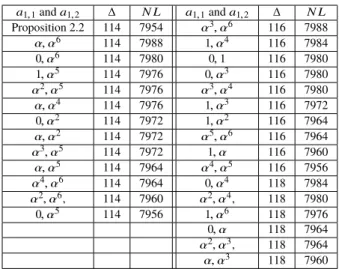
Table 2 The differential uniformity∆and nonlinearityN Lof(14,8)- functions constructed by Theorem 4.1 withG(x)=0,d=1.
a1,1anda1,2 ∆ N L a1,1anda1,2 ∆ N L Proposition 2.2 114 7954 α3, α6 116 7988
α, α6 114 7988 1, α4 116 7984
0, α6 114 7980 0,1 116 7980
1, α5 114 7976 0, α3 116 7980
α2, α5 114 7976 α3, α4 116 7980
α, α4 114 7976 1, α3 116 7972
0, α2 114 7972 1, α2 116 7964
α, α2 114 7972 α5, α6 116 7964
α3, α5 114 7972 1, α 116 7960
α, α5 114 7964 α4, α5 116 7956
α4, α6 114 7964 0, α4 118 7984
α2, α6, 114 7960 α2, α4, 118 7980
0, α5 114 7956 1, α6 118 7976
0, α 118 7964
α2, α3, 118 7964
α, α3 118 7960
functions withk=m−2,m≥8,∆<2k+1is unknown before [8]. The following examples show that even whenk=m−2, our constructions have better cryptographic properties than the function constructed in Proposition 2.2.
Example 1. Let m = 8,k = 6,d = 0 and G(x) = 0 in Theorem 4.1. By Algorithm 1 we pickt =T8,6 =3ands= S8,6 =2. Then we haveW1,1 =(
(x,a1,1x)|x∈F32∗
),W1,2 = ((x,a1,2x)|x∈F32∗
) and U1 = W1,1SW1,2, where a1,1 , a1,2. Thus(14,8)-functions with low differential uniformity are obtained by all possible combinations ofa1,1 ,a1,2 ∈ F23(see Table 2).
The differential uniformity and nonlinearity of the (14,8)-function constructed by Theorem 4.1 with parame- tersa1,1 =α,a1,2 =α6 achieve114and7988=213−204 respectively. It is an improvement comparing with7954= 213 −238, which is the nonlinearity of the function con- structed in Proposition 2.2. Furthermore, most of these functions in Table 2 are pairwise CCZ inequivalent, since it is well known that CCZ equivalence preserves the differential uniformity and the nonlinearity[7].
Example 2. Letm =12,k =10. By Algorithm 1, we pick t=T12,10=5ands=S12,10=7. Then Theorem 4.1 builds differentially∆-uniform(22,12)-functions with∆≤211−82. However, the function constructed in Proposition 2.2 is only
∆≤211−62.
References
[1] E. Biham, R. Anderson, and L. Knudsen, “Serpent: A new block cipher proposal,” Fast Software Encryption, pp.222–238, Springer, 1998.
[2] C. Blondeau and K. Nyberg, “Perfect nonlinear functions and cryp- tography,” Finite Fields and Their Applications, vol.32, pp.120–147, 2015.
[3] A. Bogdanov, L.R. Knudsen, G. Leander, C. Paar, A. Poschmann, M.J. Robshaw, Y. Seurin, and C. Vikkelsoe, “PRESENT: An ultra- lightweight block cipher,” International Workshop on Cryptographic Hardware and Embedded Systems, pp.450–466, Springer, 2007.
[4] W. Bosma, J. Cannon, and C. Playoust, “The magma algebra system I: The user language,” J. Symb. Comput., vol.24, no.3-4, pp.235–265, 1997.
[5] L. Budaghyan, T. Helleseth, N. Li, and B. Sun, “Some results on the known classes of quadratic APN functions,” International Con- ference on Codes, Cryptology, and Information Security, pp.3–16, Springer, 2017.
[6] A. Canteaut, S. Duval, and L. Perrin, “A generalisation of dillon’s APN permutation with the best known differential and nonlinear properties for all fields of size 24k+2,” IEEE Trans. Inf. Theory, vol.63, no.11, pp.7575–7591, Nov. 2017.
[7] C. Carlet, P. Charpin, and V. Zinoviev, “Codes, bent functions and permutations suitable for des-like cryptosystems,” Des. Codes Cryp- togr., vol.15, no.2, pp.125–156, 1998.
[8] C. Carlet, X. Chen, and L. Qu, “Constructing infinite families of low differential uniformity(n,m)-functions withm>n/2,” Des. Codes Cryptogr., vol.87, no.7, pp.1577–1599, 2019.
[9] C. Carlet, “Vectorial Boolean functions for cryptography,” Boolean Models and Methods in Mathematics, Computer Science, and Engi- neering, vol.134, pp.398–469, 2010.
[10] C. Carlet, “Open questions on nonlinearity and on APN functions,”
International Workshop on the Arithmetic of Finite Fields, pp.83–
107, Springer, 2014.
[11] J. Daemen and V. Rijmen, “Rijndael, the advanced encryption stan- dard,” Dr. Dobb’s Journal, vol.26, no.3, pp.137–139, 2001.
[12] V. Dolmatov, “GOST R 34.12-2015: Block cipher “Kuznyechik”,”
RFC, vol.7801, pp.1–14, 2016.
[13] J. Guo, T. Peyrin, A. Poschmann, and M.J.B. Robshaw, “The LED block cipher,” Cryptographic Hardware and Embedded Systems - CHES 2011 - 13th International Workshop, Proceedings, pp.326–
341, Nara, Japan, 2011.
[14] L.R. Knudsen and M. Robshaw, The Block Cipher Companion, Springer Science & Business Media, 2011.
[15] R. Lidl and H. Niederreiter, Finite Fields, Cambridge University Press, 1997.
[16] M. Matsui, “New block encryption algorithm misty,” International Workshop on Fast Software Encryption, pp.54–68, Springer, 1997.
[17] Y. Nawaz, K.C. Gupta, and G. Gong, “Algebraic immunity of s-boxes based on power mappings: Analysis and construction,” IEEE Trans.
Inf. Theory, vol.55, no.9, pp.4263–4273, 2009.
[18] K. Nyberg, “Perfect nonlinear S-boxes,” Advances in Cryptology — EUROCRYPT’91, pp.378–386, Springer, 1991.
[19] K. Nyberg, “S-boxes and round functions with controllable linearity and differential uniformity,” International Workshop on Fast Soft- ware Encryption, pp.111–130, Springer, 1994.
[20] J. Peng, C.H. Tan, Q. Wang, J. Gao, and H. Kan, “More new classes of differentially 4-uniform permutations with good cryptographic properties,” IEICE Trans. Fundamentals, vol.E101-A, no.6, pp.945–
952, June 2018.
[21] A. Pott, “Almost perfect and planar functions,” Des. Codes Cryptogr., vol.78, no.1, pp.141–195, 2016.
[22] L. Qu, Y. Tan, C. Li, and G. Gong, “More constructions of differen- tially 4-uniform permutations onF2k2 ,” Des. Codes Cryptogr., vol.78, no.2, pp.391–408, 2016.
[23] L. Qu, Y. Tan, C.H. Tan, and C. Li, “Constructing differentially 4-uniform permutations overF2k2 via the switching method,” IEEE Trans. Inf. Theory, vol.59, no.7, pp.4675–4686, 2013.
[24] D. Tang, C. Carlet, and X. Tang, “Differentially 4-uniform bijections by permuting the inverse function,” Des. Codes Cryptogr., vol.77, no.1, pp.117–141, 2015.