■Article■
Away
from
Home:The
Movement
and
Settlement
of Refugees
from
East
Pakistan
in
West
Bengal,
India
●
Tetsuya
Nakatani
1.•@ Introduction
India achieved her independence in 1947 through the partition of the
Indian subcontinent into two states, India and Pakistan. The partition
caused the mass exodus of refugees from both states. Since Pakistan
consisted of West Pakistan and East Pakistan, the exodus took place in
two regions. According to the Census of India 1951, 4.7 million Hindu
and Sikh refugees came over from West Pakistan. The majority of them
came from West Punjab (72.5%) and Sind(16.5%). They were scattered
in many places in India, but the major concentration of them can be
found in Punjab (50.5%), Delhi (10.5%), and Uttar Pradesh (9.5%). From
East Pakistan came 2.55 million Hindu refugees with 94% of them being
from East Bengal. Refugees from East Pakistan were not scattered like
refugees from West Pakistan, that is, 81.2% them were concentrated in
West Bengal, though Assam (10.7%) and Tripura (4.0%) accepted many
refugees, too [Government of India 1954]. Furthermore, the influx of
refugees to West Bengal continued for decades even after partition.
中谷哲弥
Tetsuya Nakatani, Department of Commerce, Nara University of Commerce.Subject:Cultural Anthropology.
Publications:(in Japanese)"Kyodotai saisei no hibiki (The Sound of reviving Commu-nity:Kirtan in West Bengal,India)," Kikan Minzokugaku 70, pp. 74-83, 1994. "Refugees
," in Veena Das (ed.) Oxford India Companion to Sociology and Social An-thropology, New Delhi, Oxford University Press, forthcoming.
74 Journal of the Japanese Association for South Asian Studies, 12, 2000
In spite of the fact that the independence
of India and Pakistan,
ac-companied by a large-scale population
movement, was, as Hague [1995:
186] states, an important historical event, the number of refugee studies
for the subcontinent
is limited to a handful, whereas studies on the
historical explanations
of partition are voluminous.
It seems to be true
that refugee issues have not attracted much attention of scholars in
com-parison with partition
itself. In particular,
Bengal has been given
rela-tively little scholarly attention [Kudaisya 1996: 25].
In recent years, however, with the growing concern of scholarly works
on transnational
phenomena
like international
migration , the relation
between the nation and the state, ethnicity and so on, the population
movement
in or from South Asia, particularly
South Asians who
mi-grated overseas, has attracted much attention
[see Clarke 1990; van der
Veer 1995]. In relation to refugees, too, studies have gradually appeared
that try to give a comprehensive
picture of refugee issues in the
subcon-tinent, though their number is still limited (see [Muni and Baral 1996;
Weiner 1993; Zolberg et al. 1989]).
Concerning
the partition
refugees, some studies that reflect recent
scholarly interests have been made since the mid-1980s.
For example,
there are works on the partition
refugees' identities
[Chatterjee
1990,
1992; Kudaisya
1996], experiences
and memories
[Chakrabarty
1996;
Raj 1997;Samaddar
1997], the relation between nationalism and
house-hold worship [Ghosh 1998], gender and state [Butalia 1993; Das 1995;
Menon and Bhasin 1998], and adaptation [Mukerji 1991(1985); Talukdar
1986; Waseem 1997]. These studies seem to be successful for
under-standing refugees from a particular aspect, such as the squatters'
move-ment [Chatterjee
1990], worship [Ghosh 1998], environment
[Mukerji
1991(1985)] , recovery of abducted women [Butalia 1993; Das 1995; Menon
and Bhasin 1998], and so on. However,
it is also true that while these
studies take into account the context of the macro process of partition ,
they tend to represent the refugees as collective beings in the respective
context. Chatterjee [1990] represents refugees as subject-agents,
denying
the image of a passive mass, Ghosh [1998] as the bhadralok class, and
Butalia [1993] as women under state patriarchy. In this sense they treated
refugees as having a homogeneous
existence in a particular
context and
did not pay enough attention to the micro factors of individual refugees.
of refugees from East Pakistan both in the context of the macro process
of partition and the micro aspect of individual refugees. By tracing the
process of movement and settlement of refugees from East Pakistan who
settled in West Bengal since the partition
of India, I will attempt to
illustrate how such factors as policy and measures taken by the
govern-ment, the geographical
condition of migration,
the choice by refugees,
and caste affiliation interrelated
with each other, and had a combined
effect on the identity of refugees.
In other words, this paper tries to unite the macro and micro
perspec-tives. Refugee studies have usually been categorized into macro and
mi-cro approaches
within the framework
of "migration"
studies. Actually
the "refugee" was regarded as a type of migrant. For example, Holborn
[1968: 362] stated, "the refugee is an involuntary
migrant,
a victim of
politics, war, or natural catastrophe.
Every refugee is naturally a
mi-grant, but not every migrant is a refugee." That the refugees had been
treated in the context of migration studies naturally affected the field of
refugee studies. First, the difference between refugees and migrants was
attributed
to whether or not someone's
movement
was "involuntary
(forced)" migration.
Then, under the "push and pull theory" it is
as-sumed that the "push" factor was dominant
for refugees. Therefore,
refugee studies primarily shared their efforts in the pursuit of the macro
factors that pushed refugees and induced their flight. In addition, the
legal aspects of refugees were another major concern because of the
practical needs of how to deal with them. The concerns on the micro
aspects of refugees also basically followed migration studies: the mental
and psychological condition, motivation, decision-making,
adaptation to
the host society, and so on. However,
in both refugee and migration
studies, studies to unite the above mentioned macro and micro approaches
have not been yet done sufficiently (see [Richmond
1988, 1993; Miyaji
1993; Koizumi 1998]).
At first, I will briefly illustrate the macro process of refugee influx to
West Bengal. As Muni and Baral [1996: 11] argued, the generation of
refugees in South Asia has been related to state and nation-building
processes in this region. As will be shown later, the refugee influx shows
a sharp fluctuation in accordance with the political process, particularly
incidents like riots, of this region. In this sense, refugees were
by-prod-ucts of the nation-building
process and also the reflection of how such a
76 Journal of the Japanese Association for South Asian Studies, 12, 2000
process was going on. The other significant aspect of the macro process
is the series of policies and measures taken by the Indian government.
How policy and the relief and rehabilitation
activities of the government
affected the process of the movement and settlement of refugees is one of
the major concerns of this paper. However, we must at the same time
consider the fact that refugees are usually not homogeneous
existences.
Refugees responded in different ways to the macro process. Therefore, it
is necessary to look at how the individual micro aspects of refugees such
as the distance of migration,
the timing of the movement,
choice by
refugees, and caste affiliation played an important role affecting the process
of refugee settlement,
and to construct the experiences and identities of
refugees.
Another concern of this paper is that it will focus not on the relation
between refugees and hosts, but on the relation between refugees.
Stud-ies dealing with refugees used to focus on the relation between refugees
and their host society. One of the reasons for this is that intensive
re-search on refugees has mainly dealt with the integration of refugees from
developing countries into a cross-cultural
context in developed countries
[Kuhlman
1991: 1]. In such cases, it is understandable
that the relation
between refugees and hosts is a prime and decisive factor for refugee
settlement.
However, it is also a fact that refugees do not always enter
into a cross-cultural
situation, but very often enter into a neighboring
and culturally homogenous situation. In that case, relations between
refu-gees have relatively more importance, particularly
where the number of
refugees is huge and outnumbers
the host population.
The case study
that I have attempted though fieldwork in a village of the Nadia district ,
West Bengal, is an example of this.
In the next section we will look at the chronological process of refugee
influx from East Bengal and review the policies and measures taken by
the government.
The third section outlines the village where I
con-ducted fieldwork. In the fourth section, we will look at the reasons for
the refugees' flight, the contexts of the movement,
and the refugees'
response to government
measures. The fifth section deals with patterns
of refugee settlement. In the sixth section, we will discuss the identity of
refugees.
Figure1 West Bengal and East Pakistan, 1947
Source:[Chatterji 1995: 258].
Note:"The Radcliffe Line" was a model of border line which was awarded by Sir Cyril Radcliffe, the chairman of the Boundary Commission. It is not identical with the present international border between two regions.
78 Journal of the Japanese Association for South Asian Studies, 12, 2000
2.•@ Refugee Influx into West Bengal and Government Policy 2.1•@ The Influx of Refugees into West Bengal
First of all, it must be noted that the process of population movement
from East Pakistan showed a sharp contrast with the situation in the
west. Over five million Hindus and Sikhs were said to have fled from
West Pakistan by the middle of 1948, leaving only a few thousands
behind [Rao 1967: 141]. This means that the flight of refugees was so
acute that in the west the influx of population
was completed by 1948.
As Table 11) shows, the influx of refugees from East Pakistan was
characterized
as an unending trail, and the trend of the influx reflects the
communal and political processes in India and Pakistan at the time. The
exodus began a year before actual partition. A call by the Muslim League
for "direct action" on August 16, 1946 to force the two-nation
concept
resulted in riots in Calcutta. The flames of the riots spread eastward to
Noakhali and Tipperah
in East Pakistan and then spread westward
to
Bihar, Punjab and North-West
Frontier
Province [Rao 1967: 4]. The
peak of the influx was not in the year of independence.
The year of 1948
saw more refugees because the annexation
of the Muslim princely state
of Hyderabad
by the Indian government
caused a fear among Hindus of
retaliation by Muslims. From December 1949, anti-Hindu
riots occurred
in Khulna and Barisal, and the peak of the influx came in 1950. Later,
unrest in East Pakistan in the mid-1950s over the national language issue
and the adoption of an Islamic Constitution
led to the flight of Hindus to
India. In 1964 a mass exodus again took place when the theft of holy hair
from the Hazrat Bal mosque in Kashmir was attributed
to the Hindus.
This incident led to a series of attacks and retaliation between Muslims
and Hindus, which turned into a communal
riot in both West Bengal
and East Pakistan. When Bangladesh won independence
from Pakistan,
about 7.5 million people came to India in 1971, though a large number
of them are said to have returned to Bangladesh.
As a result of these
continuous
influxes, the total number of refugees in West Bengal stood
at 3, 959, 000 in 1971.2)
2.2•@ Policy and Measures Taken by the Government on
Refu-gees from East Pakistan
the west, although both the governments
of India and Pakistan initially
tried to discourage the flight of their people, both of them soon changed
their policy and began organizing evacuations. Consequently,
a so-called
"exchange of population" took place between the two countries . In Punjab,
the "exchange of population"
created a vacuum filled by refugees from
West Pakistan. Evacuee properties
left by Muslims
who migrated
to
Table1 Chronological Distribution of Refugee Influx from East Pakistan
80 Journal of the Japanese Association for South Asian Studies, 12, 2000
Pakistan became the most important
resources for rehabilitating
refu-gees in East Punjab. Therefore,
it was stated in the Second Five Year
Plan that the greater part of the task of rehabilitating
West Pakistan
displaced persons had been accomplished
before the end of the first plan
(1951-56) [Government
of India 1956: 611].
In contrast, in Bengal the movement of refugees was almost one way
from East Pakistan to West Bengal, now merely one-third
the area of
United Bengal. The number of evacuees to East Pakistan was less, and
more importantly,
evacuee properties
were not available in Bengal
be-cause the Muslims who left for East Bengal were relatively poor and did
not possess substantial land holdings [Kudaisya 1995: 89]. For this
rea-son the shortage of resources made the government,
particularly
the
central government,
very reluctant to accept and rehabilitate
refugees.
Therefore,
a series of measures was taken to restrict the inflow of
refu-gees from East Pakistan.
In April 1950 the Nehru-Liaquat
Ali Pact was enforced to assure the
rights of minorities
in the two countries.
However,
the migration
of
Hindus to India did not cease, because the pact failed to create
confi-dence in the minds of Hindus about their security [Bengal Rehabilitation
Organization
1950: 1-3]. In October 1952, the "passports system" was
introduced
to regulate the population
movement.
Actually the border
was still open after partition
in 1947. This attempt,
however, caused
panic among the Hindu minorities
in East Pakistan and invited a fresh
exodus of refugees who tried to migrate before the implementation
of
the system. In October 1956, the Indian government introduced
another
measure that was called the "migration certificate" to control refugees by
regulating
it as authorized
migration.
Subsequently,
the government
decided that no relief or rehabilitation
would be given to persons coming
over to India after March 31,1958. Despite these measures, the influx of
refugees did not cease.
According to the report of the government
of West Bengal, it was only
in and after 1955 that the Indian government
really settled down to
tackle the problem of refugees from East Pakistan [Government
of West
Bengal 1973: 4]. This was because there had been the expectation
that
refugees from East Pakistan were temporary
migrants
and they would
return home when conditions
in East Pakistan recovered. The
The
measures
taken
for refugees
from
East
Pakistan
were
broadly
divided
into "relief"
and "rehabilitation".
For relief work, transit
camps
were set up by the government
of West
Bengal
where
food and shelter
were provided
to newcomers
until
they moved
to rehabilitation
sites.
Rehabilitation
work was divided
into rural and urban
rehabilitation.
For
rural
rehabilitation,
various
types of loans for housing,
land purchase,
agriculture,
and small
trade
were provided.
In urban
areas,
refugees
received
loans for land purchase,
housing,
small trade
and business.
In
addition,
the opportunities
for education
and technical
and vocational
training
were offered.
Along with them, the important task of the government was the
devel-opment of refugee colonies. In the mid-70's,
there were 1570 refugee
colonies in West Bengal which included 496 government sponsored
colo-nies, 324 squatters'
colonies and 750 private colonies [Government
of
India 1976: 42].3) The government
colony was the outcome of
govern-ment rehabilitation
but it covered only a small proportion
of refugee
families.4) For this reason, it can be said that the majority of refugees
lived in settlements
that were not developed and maintained by the
gov-ernment. The village where I conducted my fieldwork is one such
settle-ment.
3.•@ Setting of the Village
My fieldwork was carried out in a village in the Nadia district, West
Bengal (see Figure 1). Nadia had the second largest refugee population
in West Bengal and 75.0% of it has settled in rural areas.5) The village,
hereafter to be called "village M," is located about 150 km north of
Calcutta, the capital city of West Bengal, and it is not far from the border
with Bangladesh.
The population
of village M was 16, 037 in the 1991
census. The major agricultural
products are rice, jute and wheat, and
there are some fisheries, which utilize ponds, embanked
low land and
marshy land. Along the bus road there are various shops, a bank branch,
the office of the "gram panchayat
(village council),"
wholesale fish
of-fices, and so on. Village M is characterized
as a rural settlement and is
not a "refugee colony" developed by the government,
though some
refu-gees received government
loans for rehabilitation.
82 Journal of the Japanese Association for South Asian Studies, 12, 2000
households,
19 had their origin in West Bengal
and 188 were from East
Pakistan.
It can be said that village M is apparently
a refugee
dominant
village.
Table
2 shows
the
caste
structure
of the
207 households.
Namalfidra
considerably
outnumbers
other
castes.
All of them
came
from East Pakistan.
Mahisya
and Mdlo are respectively
the second
and
the third largest
groups
and a large part of both groups
came from East
Pakistan,
too.
Those groups that had their origin in West Bengal include Bagdi and
Muci as relatively large groups, and next in size Miihisya and Mezlo.
However, this does not mean that all of them had settled in village M
before partition.
Out of 19 households,
only 5 (Bagdi[3], Miihisya[1],
Tanti[1])
were identified
as being there even before partition.
Others
Table2 Caste Structure
Source: Author's fieldwork.
came to village M after partition for reasons such as seeking better agri-cultural or residential land, or for family reasons.
At present there is no Muslim population in Village M. According to
the old refugees, when they came in the early 50's, the area surrounding
the village was less populated. Jungle remained everywhere. There were
houses left by the Muslims
who had evacuated to Pakistan, and they
settled down in those houses for a while. Thus, when the influx of
refu-gees in village M commenced,
the Muslims had already left and a
rela-tively small number of Hindus remained.
4.•@ Process of Refugee Movement
4.1•@ Refugee Population in Village M
As Table 3 shows, the trend of refugee influx in village M was gener-ally similar to that of West Bengal as a whole. It is, however, remarkable that only Namaifidras have shown continuous influx over two decades. On the other hand, the influx of Meihisyas was completed by 1951 and the main influx of Mdlos and Baniks ceased by 1949 and 1948 respec-tively.
If we look at the place of origin in East Pakistan, there is an another
characteristic
in relation to caste. Table 4 shows the place of refugee
origin by caste. Faridpur
and Nadia were the two major areas from
which refugees originated. About 90% of the sampled households
were
from these two districts. Since Nadia was divided into two regions
fol-lowing partition, here Nadia means the other side of the district that was
incorporated
into East Pakistan.') While all the Meihisyas, Malos,
Goyalas, Tantis, and Mucis and most Baniks and Mayrds came from
Nadia (particularly
from Meherpur
sub-division, which had shared 93%
of them), 86% of Namaifidras
came from Faridpur.
Namaiiidras
were
nearly the only people who came from Faridpur.8) Therefore,
we can
observe two major groups in village M: Mahisyas and others from Nadia
and Namaifidras
from Faridpur.
Some comment on castes in pre-partition Bengal is necessary here.
The castes in Bengal, like castes in other regions, had both a hierarchical
and a territorial character. In terms of the so-called varna system there
are only two varnas in Bengal, the Brahmans and the &-tdras. Baidyas
(physicians) and Kayasthas (scribes) occupy the highest position among
84 Journal of the Japanese Association for South Asian Studies, 12, 2000
Table3 Chronological Distribution
86 Journal of the Japanese Association for South Asian Studies, 12, 2000
the Sutdras [Sanyal 1981: 17-19] .9) In the British period, the number of
castes were enumerated
in the census. In the census of 1941, 118 castes
were counted in Bengal, including
62 scheduled
castes [Sarma 1980:
28]. There were five castes in Bengal which were numerically dominant
(in the 1931 census). Mahisya was the largest and Reljbamii, Namaifidra,
Kayastha and Brahman were next to in that order. Thus, both Miihisya
and Namasiidra, the two most numerous
castes in village M, were major
castes in pre-partition
Bengal. Each of them had a territorial character.
While Mahisyas
predominated
in the Burdwan
and Presidency
divi-sions, Namasudras
were found in large numbers
in the Dhaka and
Chittagong divisions of East Bengal10) [Sarma 1980: 31]. This means that
Mahisya
was the major caste in the western
region of Bengal and
Namasiidra
in the eastern region.")
4.2•@ Reasons of Flight from Home
We will here examine the reasons for the refugees' flight from home.
According to the orthodox understanding, refugees are regarded as
"forced -migrants
." Their movements often take place suddenly and
un-der highly stressful, life-threatening circumstances [Independent
Com-mission on International Humanitarian Issues 1986: 14-15]. The
expla-Table4 Place of
Origin by Caste
nations of some refugees in village M remind us of such an understand-ing. They told me that riots broke out in their village and their houses were burned down by Muslims.
However,
as shown
in Table
5, if we closely
look at the conditions
faced by the refugees,
the cause of their flight was more complex.
First,
while many people mentioned
arson, riots, or violence
in different
forms,
the number
of those who actually
suffered
from such violence
was only
9. Other
people
gave up their
home
not because
of the actual violence
they suffered,
but because
of their fear of suffering
it.
Second, though the people did not necessary experience violence, they claimed the experience of daily harassment by Muslims. Some told that Muslims stole their harvests, cows, and boats. Others mentioned the changed attitude of Muslims. For example, the way Muslims talked to Hindus became rough and a poor Muslim day laborer demanded to marry a rich Hindu girl. We can observe that when they felt that their position in society had changed, they preferred to move.
Third,
the recognition
that their position
had changed
in society seemed
to be borne out by their sense that the two countries
had been built
for
the two communities.
Not a few people commented
that Muslims
said to
them,
"Go to your country.
Go to Hindustan."
Similarly,
the refugees
88 Journal of the Japanese Association for South Asian Studies, 12, 2000
themselves shared this idea with the Muslims, saying, "Our country became a Muslim country."
Fourth,
the recognition
of a Muslim
country
caused
another
fear, that
is, a fear about
the future.
They
insisted
that there
was no future
for
Hindus
in a Muslim
country.
This
fear gave them
the idea that there
would
be more
opportunities
for better
education
and employment
in
India.
Fifth, the loss of social relations in the native village caused further flight. Some people came to India because "Everybody got out of the village and no one remained there. We could not live alone ." Others said, "landlords and other rich men had gone. How can a poor man like me be there alone."
In many cases these five factors overlapped and had compound ef-fects. There were a few cases where suffering from flood or land erosion by the river simultaneously added motives for flight. It is to be noted that in any case if some family members or relatives were already in India, migration was easier. Thus, the case of village M suggests that the flight of refugees took place not only through macro factors like riots or political events that pushed refugees and induced sudden and imminent flight. The reason for their flight was complex and micro aspects of individual refugees simultaneously played important roles too. It means that their movement was based on how each refugee recognized his
indi-Table5 Reasons for the Flight of Refugees
vidual situation at the time and that their decision to leave was not sudden but very often gradual and voluntarily made. In this sense, it is not easy to distinguish involuntary and voluntary movement. Therefore, it is important to examine the reasons of the flight both from the macro process and the micro aspects of individual refugees.
4.3•@ The Contexts of Movement
The refugees who passed the border did not necessarily reach village
M directly from their home in the east. While some people went to stay
with their relatives, others surrendered
themselves to government
offi-cers at the border check point and were sent to camps. Out of 188
samples, only 56 (29.8%) directly came to, and settled down in, village
M. Others settled in village M after changing their living place again and
again. 64 (34.0%) households
stayed at least at another place for a while
before coming to village M. 44 (23.4%) households stayed at 2 places, 14
(7.4%) at 3 places and 9 (4.8%) at 4 places.
Table6 Contexts of the Arrival at Village M
90 Journal of the Japanese Association for South Asian Studies, 12, 2000
Refugees migrated in various contexts, but here only the basic
charac-teristics are noted. As Table 6 shows,12) nearly half (83 cases) of the
sampled households came over to village M through relatives . They
utilized not only kinship relations, but also affinal relations. Social ties
like "people from same locality" and "caste" played an important role,
too. Quite a few (19 cases) people came without any connection.
The process
of migration
to India was not always accomplished
at one
time. There
were 24 cases in which
people
came and went repeatedly.
For example,
some people came to the west, purchased
a certain
amount
of land for migration
in the future,
and went back to sell their land
in
East Pakistan,
and then migrated
to the west after a while.
Other
people
went back to East Pakistan
with the expectation
that the situation
in East
Pakistan
had recovered.
But in most cases, they migrated
to India again
later.
4.4•@ Refugee Responses to the Measures Taken by the
Govern-ment
As already mentioned above, a series of measures was taken by the government to control the influx of refugees from East Pakistan. It is worth examining the patterns of the responses taken by individual
refu-Table7 Types of Migration by the Place of Origin
gees to these measures because whether to utilize the measures
or not
was an important factor influencing the later process of settlement. Table
7 shows the number of household with the category of the district place
of origin that applied such measures. 142 (75.5%) households
relied on
neither the passport system nor a migration
certificate. They came to
India without any documented
procedures.
If we think about the matter in relation to the pattern of settlement,
the "migration certificate" was important because it legitimized the
mi-gration of Pakistani nationals to India. 37 (19.7%) households
migrated
this way. Legitimacy of migration enabled refugees to access educational
opportunities
or to apply for government
employment
in India. There
were 3 cases among them where students from the east gained the
op-portunity for higher education in West Bengal and 2 cases for
employ-ment.
The certificate provided them with the chance to get assistance from the government, that is, admission to camps and the chance of subse-quent rehabilitation. Out of 37 households, 16 were admitted to camps and out of them, 8 households received rehabilitation by the govern-ment. Though the number of rehabilitated refugees was limited, it is a fact that the migration certificate functioned as a way to access the reha-bilitation. For example, there was a case where a refugee, who had al-ready been in India when the migration certificate system was intro-duced, went back to East Pakistan to apply for it and came to India again with the certificate. He was successfully admitted to a camp and granted rehabilitation in village M. This point is reinforced by the fact that out of the 22 cases of rehabilitation which will be examined in the next section, 19 cases were through this certificate.
It is also to be noted
that migration
certificates
were applied
for only
by those
from
Faridpur
and Dhaka.
Both
districts
were
relatively
far
from
the border.
All the refugees
were Namaiiidras.
By contrast,
the
refugees
from Nadia
did not have the opportunity
to apply
for the
mi-gration
certificate
as they had already
migrated
before
the introduction
of the system.
The distance
from home
and the timing
of the migration
also correlated
with the patterns
of settlement,
as will be discussed
in the
next section.
92 Journal of the Japanese Association for South Asian Studies, 12, 2000
5.•@ Three Patterns of Refugee Settlement
This section
deals with the patterns
of refugee
settlement
in village
M
by focusing
on the matter
of "land,"
because
land was the most crucial
concern
of both the refugees
and the governments,
at least in the initial
stage of the settlement.
At the same
time,
the most
difficult
problem
which
the governments
faced was the scarcity
of land
in West
Bengal
able to be utilized
for the rehabilitation
of refugees.
While
this problem
caused
squatting
on land in urban
areas of Calcutta,
it also caused
great
difficulties
in rural areas, especially
for the rehabilitation
of agriculturist
refugees.
To examine the different patterns of settlement sought by individual refugees, we will focus on three patterns in the acquisition of land.") The first was through rehabilitation by the government. The second was an "exchange of properties" bet
ween Hindus who left their properties in East Pakistan and Muslims who left their properties in India. They exchanged their properties with each other. The third was the purchase of land by the refugees themselves.
5.1•@ Settlement through the Government Rehabilitation
In spite of the scarcity of land in West Bengal, the government
pro-vided assistance to refugees in one form or another including loans to
purchase agricultural
land.14) As already mentioned,
out of 188 sample
households
in village M, 8 (4.3%) households
were rehabilitated
with
such loans. In addition to these 8, we will take another 14 cases, which I
collected in village M, into account to elaborate the discussion. Table 8
shows in outline 22 cases of government
rehabilitation.
In village M, there were two types of rehabilitation
scheme. I shall
denote them as type A and type B. The aim of the schemes was to
provide agricultural
land to agriculturist
refugees. Both types of scheme
were implemented
based on the same category of loan, called
"agricul-tural land purchase
(L. P.) loan,"") mainly in the second half of the
1950s. The rate of land purchase was prescribed
at 100 rupees per 0.33
acres (1 bighd). It is to be noted that the land for rehabilitation
was not
only procured from the local habitants but also from the refugees who
had come earlier and purchased a large amount of land in village M.
operated. Type A can be expressed as a "voluntary scheme" in the sense
that the land was voluntarily
found by the refugees themselves.
Camp
refugees sought land by making use of their own connections with people
like relatives who had already settled in village M, and negotiated
pri-vately with landholders.
When refugees found suitable land, they
ap-plied to the government
authority in charge. After certifying the
legiti-macy of the title of the landholder
and conducting
other necessary
pro-cedures, the government paid the money to the landholder. But this does
not mean the land was given free. The cost for acquisition of the land
was then advanced to the applicant as a land purchase loan along with a
certain amount as a house building loan and an agricultural
loan. In this
scheme applicants were entitled to 3 acres (9 bighiis) for agricultural land
and 0.17 acres (0.5 bighiis) for a housing site per family.
Type B was locally known as the "Candranath
Basu scheme." In this
scheme, refugees did not need to find land by themselves,
because a
social worker called Candranath
Base)
arranged everything
for them
with the help of his associates. Basu and his associates visited several
camps in West Bengal and recruited candidates who wanted to be
reha-bilitated in a rural area like village M [Nakatani 1999]. At the same time,
they tried to procure land in village M that could be supplied under this
scheme. In type B scheme, 4 acres (12 bighds) for agricultural
land and
0.17 acres (0.5 bighas) for a housing site were prescribed
per family.
As Table
8 shows,
it is noteworthy
that all of the 22 recipients
were
Namasiidras
from Faridpur
and that all of them were ex-camp
refugees,
since
the targets
of rehabilitation
were
camp
refugees
who
had been
stranded
in camps
for years.
Admission
to camps
was not necessarily
difficult
for them,
because
their route
of migration
was connected
with
camps
through
the arrangements
of the government.
They
came to the
border
by train
and crossed
over it through
government
check points.
From
there,
they
"were in the hands
of the government,
" as they
de-scribed
it. The government
automatically
sent them to camps.
If we make a comparison
between the scale of landholding
in East
Pakistan before migration
and that given by rehabilitation,
we can see
that in 10 out of 18 cases (excluding the unknown 4 cases), the scale of
landholding
increased after migration as a result of rehabilitation.17) It
seems to be clear that rehabilitation
provided the refugees with a means
of a livelihood at the initial stage of settlement.
94 Journal of the Japanese Association for South Asian Studies, 12, 2000
However, the maintenance of the rehabilitation land was not easy for many people. Table 8 shows that only 4 households still maintain the scale of the original rehabilitation land today. In 6 cases, the
rehabilita-Table 8 Households Rehabilitated by the Government
(in acre)
tion land was lost totally. There are some reasons for the loss or decrease of land. Some people sold the land either partially or totally, because it usually did not consist of a single plot but of several plots scattered in different places. The maintenance of such land was not easy. In
addi-tion, the quality of the land for cultivation
was not uniform.
The unfertile
land was likely to be sold or abandoned.
There
were quite a few cases
where the lands were gradually
sold for the sustenance
of the household.
5.2
Settlement
through
the Exchange
of Properties
The exchange of properties was a popular and a favored way to get land, and it might be regarded as an alternative to compensate for the properties left behind in the homeland. In village M, when I visited villagers for interviews, quite a few people said without being asked,
"We could not exchange our property ."
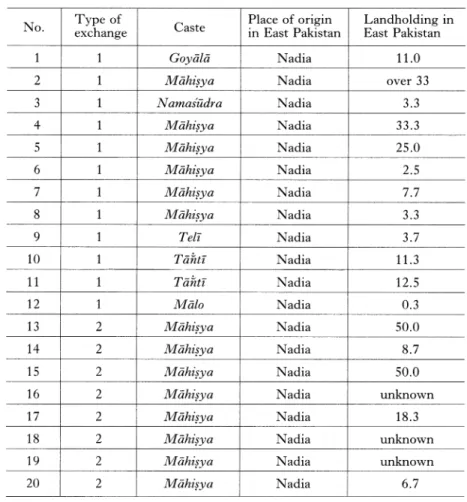
As Table 9 shows, out of 188 sampled households, there were 20 cases of exchange in village M, in which all of the people migrated from the other side of Nadia. Most of them migrated to West Bengal between
1949 and 1950. Ml ithisyas were dominant in number among them.
The process of exchange had to be based on legal procedures, though
negotiations were on a private basis. As India and Pakistan were already
partitioned,
the purchase and sale of land between the two regions were
not allowed. Therefore,
people resorted to the procedure of the general
"power of attorney (ammoktarniimei)
,"18) and the Hindus and Muslims
exchanged documents of power of attorney with each other. This power of attorney was to entrust a particular person with the management of one's properties. For example, Muslim A entrusted Hindu B to manage his properties in India and Hindu B as a trustee had the power either to maintain or sell the properties on behalf of Muslim A. Similarly, Mus-lim A had the same power over the properties of Hindu B in East Paki-stan. Since a trustee was not allowed to sell the properties to himself or to register them in his name, he sold and registered the land in the name of his wife, son or his close relatives.
We found two types of exchange. In type 1, the necessary negotiations and procedures were carried out by the individual refugees. However in
type 2, they were carried
out by a single person,
namely
a village leader.
I was sometimes
told during
my fieldwork
in West Bengal that in some
places an entire
village
was exchanged.
Later
I found
that this meant
96 Journal of the Japanese Association for South Asian Studies, 12, 2000
that a village leader
had the responsibility
of the exchange
of other
vil-lagers'
properties,
too. Since the procedure
for exchange
needed
a
cer-tain knowledge
of, and experience
with, the legal formalities
regarding
land, it was not possible
for ordinary
villagers
to do it by themselves.
For
this reason, villagers relied on their leader, who was regarded as an educated man, and was used to taking care of other villagers. In Table 9, 8 cases of type 2 were done by the same village leader. This leader wasTable 9 Exchange of Properties between
said to have accompanied all the villagers to India and arranged ex-changes in different villages.
Exchange did not necessary mean the equivalent exchange of proper-ties. In most cases, the area of the land received from Muslims was smaller than the land given to Muslims. While there were some cases where people sold the land gained from Muslims and bought alternative lands, many people gradually sold the land during the course of time for Hindu Refugees and Evacuated Muslims
98 Journal of the Japanese Association for South Asian Studies, 12, 2000
such reasons as the sustenance of the household, the distress caused by disease or the payment related to the marriage of daughters. As a result, only 5 households still maintain a certain amount of land gained from Muslims.
In contrast to settlement by rehabilitation, the exchange of properties was executed mostly by Meihisyas and others from Nadia. The reason for this is related to the distance of migration. Village M was only about 10 km from their native village in Nadia. So, village M and its surround-ing area were within the territory of their daily movements. Therefore, they came over to the Indian side without any documented procedures and without being admitted to camps. The counterpart for exchange was sought in the context of daily comings and goings. There was no need of middleman-like persons.
By contrast, the exchange of properties was difficult for those who came from a long distance like most Namasrldras, because the longer distance did not allow the parties to check each other's land during negotiations. In such cases, the alternative method based on the power of attorney, was applied, though this was not an "exchange of properties." For example, some people from Faridpur gained an alternative method based on the power of attorney from Muslims who left for East Pakistan. They themselves gave money to the Muslims instead of giving them the power of attorney over their own properties left behind in Faridpur. In other words, they bought the power of attorney from Muslims.
5.3
Settlement
by Refugees
Themselves
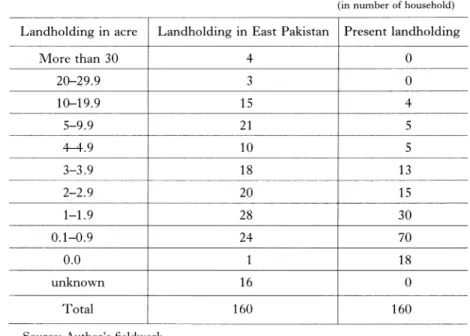
Out of 188 samples,
160 households
relied neither
on rehabilitation
by
the government
nor on the exchange
of properties.
This,
however,
does
not mean that these people did not wish to apply for rehabilitation
or the
exchange of properties. There were some people who wanted to be ad-mitted to camps but were not. Others were once in camps but had left them on their own, before they received rehabilitation. In fact, 18 more households were in camps beside the above 8 households but theydis-persed
themselves
from the camps
for different
reasons.
One hated the
poor conditions
in the camp
and others
escaped
from
it as they were
about
to be transferred
to remote
rehabilitation
sites outside
West
Ben-gal.
about being admitted to camps. Such people even today contemptuously mention, "The camp refugees were lazy, solely depended on handouts, and spent several years in vain." They by intention avoided camps out of pride.19)
For those who resorted neither to rehabilitation nor the exchange of properties, it was very hard to get land at the initial stage of the settle-ment. One might receive help from persons like relatives, villagers, or friends who came earlier, but it was very rare that a refugee got land from them free of cost.
Therefore, the only way was to bring movable property with them and purchase land. Some refugees sold immovable property such as land and house buildings in East Pakistan and brought the money with them.
Others brought the money or gold that they had saved down to the time
of migration.
Out of 160 samples, there were 32 (20.0%) cases of such
transfer of properties
to India. Of these, in 27 (16.9%) cases, refugees
sold their land and brought the sale money with them, and in 5 (3.1%)
cases refugees brought their savings. There are, however, 9 (5.6%) cases
in which such money was lost on the way to India. They claimed that
Muslims, middlemen
or policemen
at the border seized their money.
Some people successfully brought money but the money was gradually
spent for daily maintenance
during the initial period of settlement.
For
these reasons, we see only 8 (5.0%) cases in which refugees were able to
buy a certain area of land as soon as they came to India. The majority of
people said that they came to India with their hands empty because the
unstable condition
did not allow them to sell their properties
before
migration. Therefore, as already mentioned,
not a few people went back
again to East Pakistan after they settled down in India and tried to sell
the land left there. In addition, there are 21 (13.1%) cases in which
refugees
intentionally
did not sell their properties,
because
their
broth-ers, fathbroth-ers,
or relatives
still remained
in East Pakistan
after they left for
India.
Lastly,
Table
10 shows the landholdings
among
those who settled by
themselves.
At present
88 (55.0%) households
hold less than 1 acre,
including
18 (11.3%) landless households.
If we compare the present
landholding
scale as a whole with the scale in East Pakistan, there has
been a relative fall after migration to India. In fact, 112 (70.0%)
100 Journal of the Japanese Association for South Asian Studies, 12, 2000
Only 28 (17.5%) cases saw an increase in land after migration.21)
6.
The
Identity
of Refugees
and
Settlement
We have seen above the different
patterns
of movement
and
settle-ment of refugee.
Here,
how such patterns
are related
with the identities
of refugees
is examined.
First
of all, the distance
of migration
played
an
important role in mutual perceptions
among refugees. Namasiidras from
Faridpur often call the people from Nadia "local people (sthaniya lok)."
For Namasiidaras,
people like Mähisyas,
Goyfilds and Ma-los are local
people since they came from a very near place, despite the fact that they
crossed over the border, too. Actually, village M had been within an area of daily movement for the people from Nadia. However, this does not imply that they have not felt themselves to be refugees. In fact, the experience being uprooted within their own territory gave them complex feelings.
Table 10 Households Settled by Themselves
(in number of household)
In addition to distance, the "time" or "date" has created different feelings among refugees. As mentioned earlier, the timing of migration to India was different for each caste. While in the case of Miihisyas, Goyiilas and Miilos, their migration was completed by 1951 at the latest, the migration of Namasrldras continued for decades. For Ma-hisyas and others, migration was over long ago and most of the people of the first generation are of a great age today. But Namaifidras still have among the
first generation of refugees relatively younger people. For this reason,
migration
is still an ongoing reality for them. The fact that not a few
households
of Namaiiidras
(37 cases), having experienced
the
long-last-ing chain migration of brothers and close relatives, have maintained
the
continued
mental ties of Namairtdras
with East Pakistan even after
mi-gration to India.
The difference of identities can be observed in the cultural sphere,
too. In village M, a religious function called "ndm-kirtan (repeated
reci-tation of the name of the gods with music)" has been carried on every
year by the people from East Pakistan. In the beginning, Mahisyas and
others from Nadia
commenced
the nam-kirtan
in the 1950s, and
Namasildras joined it later. However, from 1986, Namaifidras
separated
themselves and started to organize their own nam-kirtan.
The reason
was not only discord over hegemony in the organization of the function,
but also the discontent felt by Namaifidras over the quality of the music. The nam-kirtan was not satisfactory for Namaslidras because it was dif-ferent from the one they used to perform in East Pakistan. According to Namaiiidras, they used to spend more money on this function, inviting professional music groups, but most importantly their nam-kirtan must
be performed
based
on "raga
and ragini",
a classical
music
system
of
India.
The nam-kirtan
organized
by Miihisyas
and others,
however,
had
been
modified
by the tunes
of modern
songs,
performed
by amateur
musicians,
and
organized
at minimum
expenditure.
In this
way,
Namasrldras hold to the cultural identities derived from their former life in East Pakistan, which differ from those of Mahisyas and others.There have been mutual tensions particularly between Namasrldras and Mahisyas. In daily conversation, both of them often mention that they had a different culture, held antagonistic feelings to each other, and
stayed away from each other. They say, "It has been only recently that we came closer and mixed with each other."
102 Journal of the Japanese Association for South Asian Studies, 12, 2000
7.
Concluding
Remarks
In this paper,
I have tried to illustrate
the experience
and identity
of
refugees
from East Pakistan
by uniting
the macro
and micro
perspec-tives. In particular,
I put the focus on the micro
aspects
of individual
refugees,
because
while they have left home
following
the macro process
of political
and communal
conditions,
the actual process
of their
move-ment and settlement has been determined by micro factors. In this sense, refugees are not always a mass that was involuntary pushed according to the highly stressful macro circumstances, and neither are they collective or homogeneous beings in a particular situation. Each refugee had dif-ferent reasons for flight. They came to India at different times, from different distances, and responded in different ways to government policy and measures. All these differences had a close connection with the caste affiliations and identities of the refugees. We have seen these most ap-parently in two caste groups, the Namasiidras from Faridpur and Mithisyas from Nadia.Namasiidras came over longer distances for longer periods. They could not practice the "exchange of properties" which was popular at that time. Instead, they had the chance of government rehabilitation if they wished. Some Namaifidras by intention went to camps, expecting subse-quent rehabilitation. Mahisyas came from a short distance within a short period. Village M was a place well-known to them prior to migration. This fact enabled them to practice the exchange of properties, though it was not always successful. They did not go to camps and received no rehabilitation. The migration from a longer distance makes Namalfidras feel that Miihisyas are "local people". The long-lasting migration over decades of Namaifidras has created the sense of the on-going reality of migration and their continued mental ties with the east. There has been a sense of cultural difference between Namairtdras and Milhisyas.
I have focused in this paper on the initial stage of settlement in village M and paid special attention to the relation between refugees, namely Namasiidras and Mahisyas. However, if we look at the subsequent proc-ess of settlement, some points should to be noted. First, neither Namaliaras nor Mahisyas constituted a singular being. A large commu-nity such as Namasiidras, in particular, naturally shows internal differen-tiation in terms of educational, occupational, political, and religious
char-acteristics. Second, the continuous existence of the leadership must be given attention. I have already mentioned how the leadership played an important role in the process of settlement, i.e., rehabilitation and the exchange of properties. Such leadership continued to exist even after the
initial stage of settlement.") Lastly, a long-term perspective is indispens-able for the study of refugees like the people from East Pakistan whose influx and settlement process has lasted for years. As the process of settlement is not always accomplished within a generation, but very of-ten requires several generations, the long-term perspectives that cross over generations are significant.
Notes
1) The breakdown of figures for West Bengal between 1946 and 1952 was 14,000 in 1946, 258,000 in 1947, 590,000 in 1948, 182,000 in 1949, 1,182,000 in 1950, 140,000 in 1951, and 152,000 in 1952 [Chatterjee 1992: 27].
2) The enumeration of refugees was problematic because it was very difficult to check all the people who came in from different directions. According to estimates by the Government of West Bengal, the refugee population in 1973 was 5,999,475, 13.5% of the total population of West Bengal [Government of West Bengal 1974]. Apart from simple enumerations, some sporadic surveys were conducted by the govern-mental organizations from time to time. For example, [Chatterjee 1975], [Govern-ment of West Bengal 1981: chapter xi], and [State Statistical Bureau 1951; 1956]. Also see [Pakrasi 1971].
3) The government-sponsored colony was a settlement where the government acquired land and prepared a layout plan, and then refugees in transit camps were brought. Squatters' colonies emerged as refugees sought shelter by illegally occupying vacant land and these colonies received no government aid. Private colonies were set up by the refugees themselves, with or without government assistance, mostly through legal means, i.e., by acquiring or purchasing land [Chaudhuri 1983: 14-30]. There were other refugee colonies outside West Bengal developed by the government, too.
Dandakaranya, which was located over the borders of Orissa and Madhya Pradesh States, was the most famous and also controversial project of this kind (see [Kudaisya 1996; Mukerji 1991(1985); Nakatani 1999]).
4) According to a government report in 1976 [Government of India 1976: 42], the number of families covered by the government sponsored colonies was only 95,000. This figure is quite small compared with the refugee population, 3,959,000 even in 1971.