寒山拾得図 : 修復報告書 : 在外日本古美術品保存 修復協力事業 : No.2011‑3
著者 文化遺産国際協力センター
出版年月日 2015‑03‑31
URL http://id.nii.ac.jp/1440/00008993/
ケルン市博物館東洋美術館(ドイツ連邦共和国)所蔵
Museum für Ostasiatische Kunst, Museen Köln
平成23年度修復事業 2011 Japanese Fiscal Year
寒山拾得図
Hanshan and Shide
伊藤若冲 作 紙本墨画 掛軸装
1
幅1763
年By Ito Jakuchu
A hanging scroll, ink and light color on paper 1763
No. 2011 - 3
在外日本古美術品保存修復協力事業
The Cooperative Program for the Conservation of
Japanese Art Objects Overseas
目 次
1.修復報告
1.1. 名称等 ...1
1.2. 工期及び施工者等 ...1
1.3. 修復前の状態 ...1
1.4. 修復方針 ...1
1.5. 修復工程 ...2
1.6. 修復銘 ...3
1.7. 特記事項 ...3
2.作品解説 ...19
付録 付録1. 修復前損傷図面 ...22
付録2. 透過光写真 裏打紙除去前 ...23
付録3. 透過光写真 中裏紙除去後 ...23
付録4. 繊維組成分析 ...24
付録5. 肌裏紙除去後写真 ...25
付録6. デンプン分解酵素除去について ...26
付録7. 測色 ...27
付録8. 調湿 ...28
Table of Contents
1. Restoration Report
1.1. Data ... 4
1.2. Restoration Data ... 4
1.3. Condition before Restoration ... 4
1.4. Restoration Concept... 4
1.5. Restoration Process ... 5
1.6. Inscription regarding Restoration ... 7
1.7. Note ... 7
2. Description of the Artwork ...20
Appendix Appendix 1. Mapping of damages before restoration ... 22
Appendix 2. Photograph under transmitted light, before removal of the lining paper ... 23
Appendix 3. Photograph under transmitted light, after removal of the fourth lining paper ... 23
Appendix 4. Fiber furnish analysis ... 24
Appendix 5. Photograph after removal of the first lining paper ...25
Appendix 6. Removal of the starch-decomposing enzyme ... 26
Appendix 7. Color measurement ... 27
Appendix 8. Conditioning ... 28
1.1. 名称等
名称 寒山拾得図
制作者 伊藤若冲 制作年代 1763年
所蔵者 ケルン市博物館東洋美術館(ドイツ連邦共和国)
品質・形状 紙本墨画 掛軸装 1幅 本紙繊維 タケ
1.2. 工期及び施工者等
工期 平成23年5月10日〜平成23年10月20日
施工場所 独立行政法人国立文化財機構 東京文化財研究所 修復アトリエ(紙)
保存修復担当者 東京文化財研究所 加藤雅人、楠京子、山田祐子 国宝修理装潢師連盟 山本記子、君嶋隆幸、井上さやか
1.3. 修復前の状態(Fig. 1.1.a、Fig. 1.2.a)
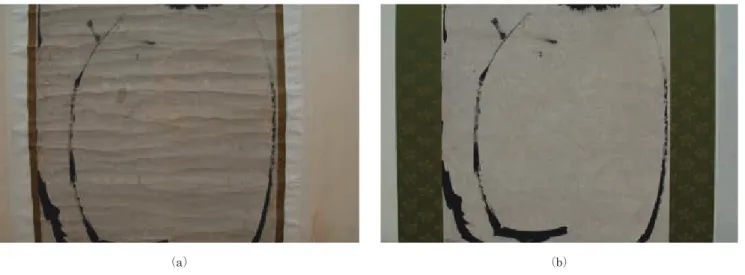
• 横折れが多数発生していた (Fig. 1.3.a)。
• 折れ山が擦れて亀裂や欠失が生じていた。 それに伴い本紙が肌裏紙から浮いていた (Fig. 1.4.a)。
• 旧修復において肌裏紙を除去せず仕立てた形跡が確認できた。 そのため、 欠失箇所からは紙質の異なる2 種類の裏打ち紙が露出し、鑑賞を妨げていた (Fig. 1.5.a)。
• 旧修復時に本紙料紙が相剥ぎにされた形跡があった。
• 本紙表面に虫による食害がみられた。
• 旧補修の小口から糊浮きが生じ、本紙が肌裏紙から剥離していた (Fig. 1.5.a)。
• 総裏の上から折れ伏せが施されていた。
• 経年による汚れがあった。
• 表装裂に汚れや損傷が生じていた。
• 表装裂は日本への輸送に際して所蔵館で本紙周囲0.5~3.3 cm程度を残して切除されていた。
1.4. 修復方針
• 原状回復、現状維持を基本として修復を行うこととした。
• 今回、 過去の修復の際にそれ以前の旧肌裏紙を除去せずに仕立てた形跡が確認できた。 それが原因で本紙 が硬くなり折れや欠失を生じていたため、全ての旧裏打紙を除去して新たな裏打ちに替えることとした。
• 表装裂を新調して新たに掛軸に仕立てることとした。 表装の形式は、 修復前と同様の三段表装にすること とした。
• 本作品の旧軸首は象牙軸であったが、返送時の輸出入を考慮し新しい軸首は牛骨軸を用いることにした。
• 保存のための桐太巻添軸、包裂、箱、四方帙を新調することとした。
1. 修復報告
東京文化財研究所 山田 祐子、国宝修理装潢師連盟 井上 さやか 東京文化財研究所 楠 京子、東京文化財研究所 加藤 雅人
1.5. 修復工程
⑴表装裂取り合わせ
輸入時に所蔵館担当者と表装裂の取り合わせを確認した。
⑵修復前調査(Fig. 1.6.1)
写真撮影を行い、修復前の損傷状況の調査と記録を作成した(付録1)。
⑶埃や付着物の除去
刷毛を用い、埃や付着物を除去した。
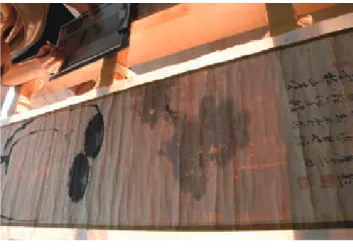
⑷旧裏打ち紙除去(Fig. 1.6.2、Fig. 1.6.3)
旧総裏紙、中裏紙、増裏紙を除去した(本作品には2層の増裏紙が施されており、そのうちの 1層を除去した)(付録2、3)。
⑸繊維分析
付け廻し部分より微量の本紙繊維を採取し、C染色液による繊維組成試験を行った。
分析の結果、本紙にはタケの繊維が用いられていることが確認できた(付録4)。
⑹クリーニング(Fig. 1.6.4)
イオン交換水を本紙表面から噴霧し、本紙の下に敷いた吸い取り紙に吸収させた。
⑺増裏紙除去(Fig. 1.6.5)
⑷で除去せずに残しておいた増裏紙を全て除去した。
⑻表打ち(Fig. 1.6.6)
本紙が非常に薄く脆弱であったため旧肌裏層を除去するにあたって画面の保護のために表打ちが必要で あると判断した。室温で抽出したフノリ水溶液とレーヨン紙を用い、2層の表打ちを行った。
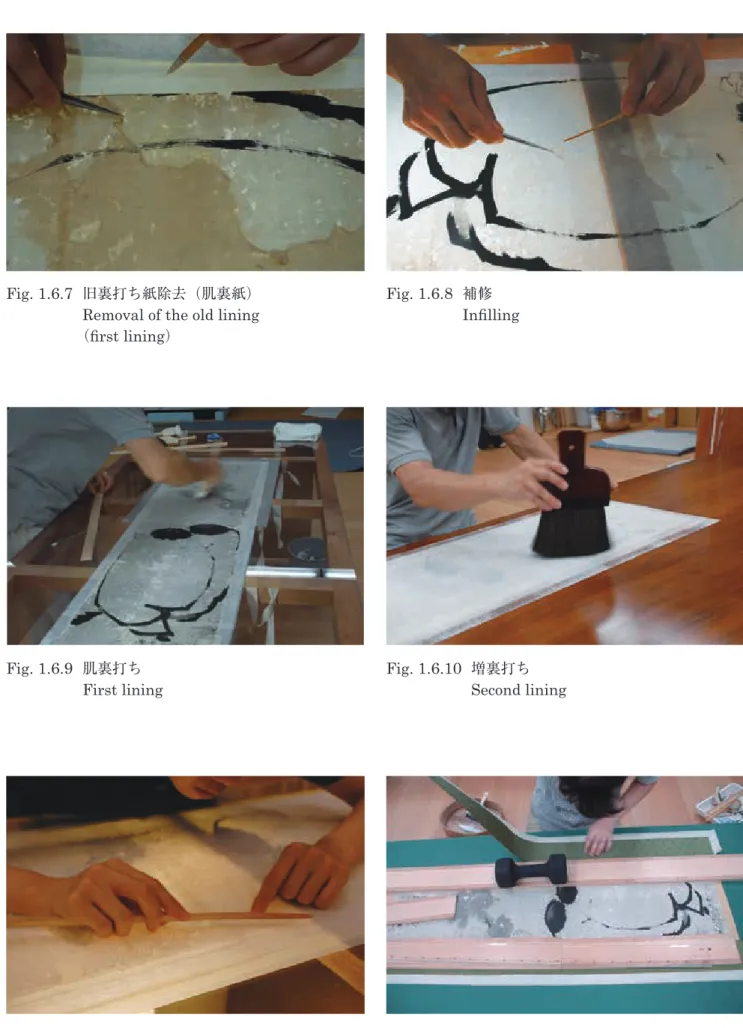
⑼旧肌裏紙除去(Fig. 1.6.7)
本作品では本紙の脆弱さに対して裏打ちの接着が強く、水のみで肌裏紙を除去するのは非常に困難な状 況であった。そこで、結晶α-アミラーゼ(ナガセケムテックス)を使ってデンプンを分解し、除去するこ ととした。本紙の状況と肌上げ除去の作業性から、使用濃度を5.0×10⁻⁴wt-%に決定した。より低い濃 度で活性化させるため、酵素液を約40℃に温め、画面裏側から筆で塗布しながら旧肌裏紙を除去した(付 録5)。
⑽デンプン分解酵素除去
デンプン分解酵素の残留により新たに塗布した糊が分解されないように、酵素及びデンプン分解物の除 去を行った(付録6)。
⑾補修
(11-1)補修紙の準備
本紙調査(付録4)から得た情報をもとに、補修に使用する紙には厚み、簀の目幅、糸目幅の近い竹紙 を選んだ。色調を調整するため、矢車で引き染めした後、炭酸カリウム処理(pH10.5)を行った。染色 前後の色変化を確認するため、作製した補修紙の測色を行った。また、染色後、裏打ちとドーサ引きテス トを行い、修復作業時の水による色素の移動がみられないこと、ドーサ液などによる色変化が問題ない範 囲であることを確認した。本試料においては、肌裏打ちとドーサ引き処置を行う順番が前後してもその測 色結果に大きな差はみられなかった(付録7)。
(11-2)補修(Fig. 1.6.8)
本紙欠失箇所に補修紙を補填した。
⑿肌裏打ち(Fig. 1.6.9)
本紙の色調に合わせて薄美濃紙を染色し、新糊を用いて肌裏打ちを行った。染色には矢車を用い、炭酸 カリウム(pH10.5)処置を行った。
⒀増裏打ち(Fig. 1.6.10)
美栖紙と古糊を用いて増裏打ちを行った。
⒁折れ伏せ入れ(Fig. 1.6.11)
折れの発生していた箇所及び今後折れが発生する恐れがある箇所に、美濃紙と新糊を用いて折れ伏せを 施した。
⒂表装裂地調整
すべての表装裂に美濃紙と新糊を用いて肌裏打ちを行った後、美栖紙と古糊を用いて増裏打ちを行った。
⒃付け廻し(Fig. 1.6.12)
本紙と表装裂地を三段表装の形に付け廻しした。
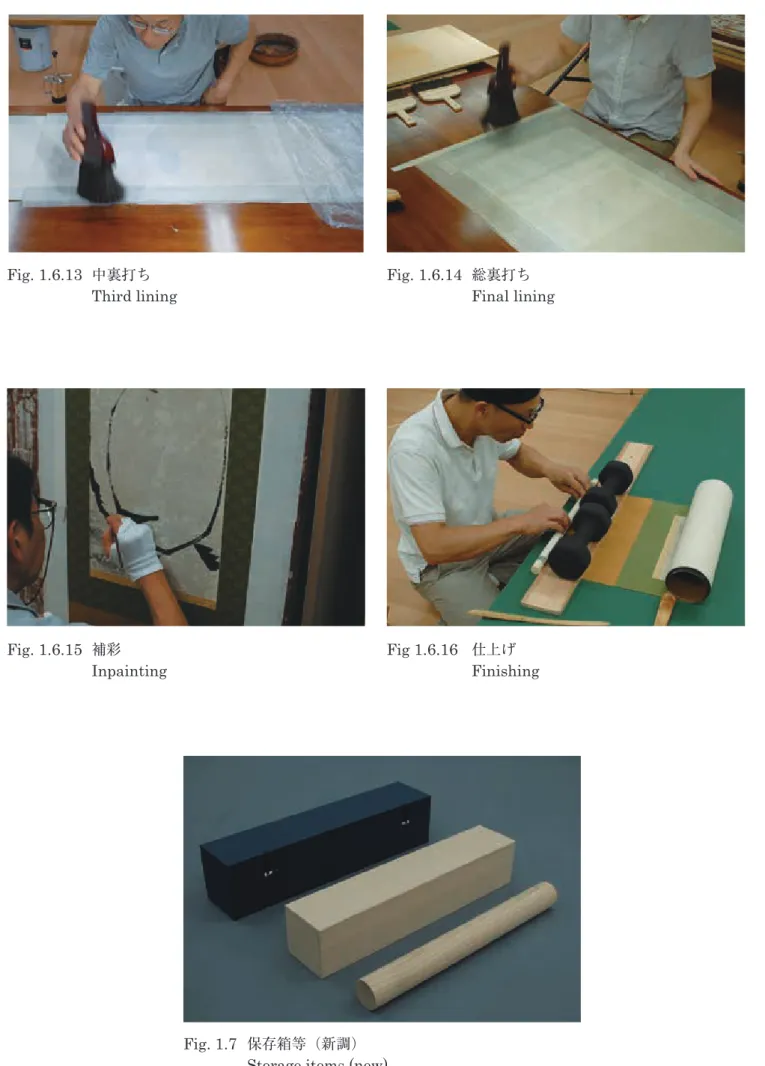
⒄中裏打ち(Fig. 1.6.13)
美栖紙と古糊を用いて中裏打ちを行った。
⒅総裏打ち(Fig. 1.6.14)
宇陀紙と古糊を用いて総裏打ちを行った。
⒆仮張り
表張りし、十分に乾燥させた。
⒇補彩(Fig. 1.6.15)
新たに補修紙を施した箇所に、本紙基調色の補彩を施した。
(21) 調湿
伝統的には表具後の寸法を安定させるためには十分な仮張り期間を設ける必要があるとされてきた。し かし、近年の空調による安定した環境下での長期間の仮張りの効果に関しては検証されていない。また、
一般に紙は数回の乾燥、湿潤を繰り返すことにより寸法安定性が向上することが知られている。そこで、
より伝統的手法に近くかつ、論理的にも寸法が安定すると考えられる、温度湿度の変化を伴う仮張りを行っ た(付録8)。なおこの際、本紙は仮張りに伏せ張りした状態で行った。
(22)仕上げ(Fig. 1.6.16)
軸首、八双、軸木、吊鐶、啄木を新調し、掛軸装に仕立てた。
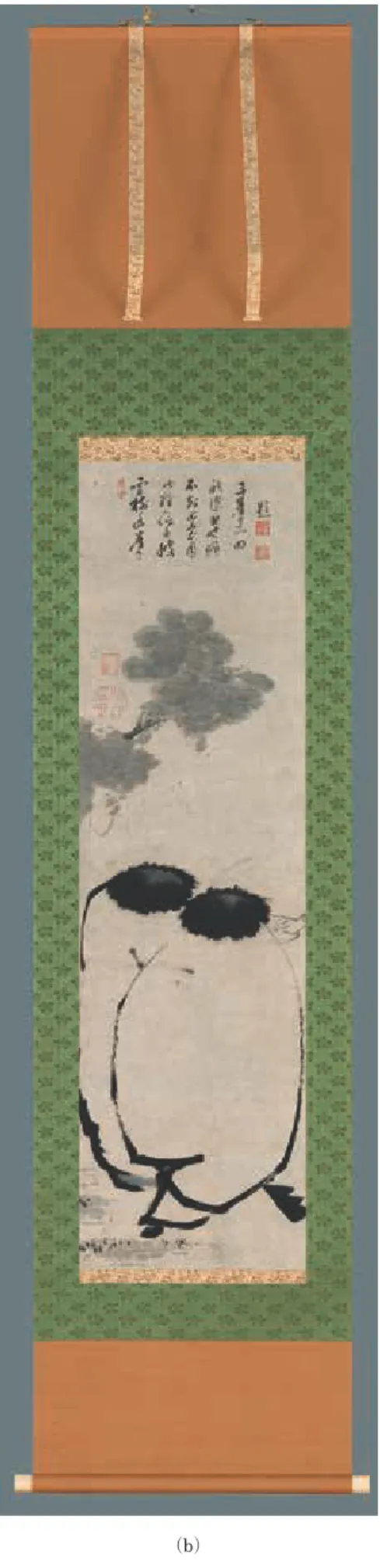
(23)記録(Fig. 1.1.b、Fig.1.2.b)
今回の修復に関する記録、修復後写真撮影を行った。
(24) 保存(Fig. 1.7)
桐太巻添軸、桐屋郎箱、四方帙を新調し、正絹袷包裂に包み納入した。
1.6. 修復銘
下軸に以下の文を墨書した。
『紙本墨画 寒山拾得図 伊藤若冲筆 一幅 ケルン東洋美術館所蔵
平成二十三年(2011年)十月修理了 独立行政法人国立文化財機構 東京文化財研究所による平成 二十三年度在外日本古美術品保存修復協力事業によって東京文化財研究所修復アトリエ(紙)に於いて 施工す
国宝修理装潢師連盟 関東支部』
1.7. 特記事項
日本受け入れ時に残存していた旧表装裂と旧裏打ち紙は所蔵館に返却した。
1.1. Data
Title Hanshan and Shide
Painter Ito Jakuchu
Period 1763
Owner Museum für Ostasiatische Kunst, Museen Köln Media and format Hanging scroll, ink and light color on paper Paper for artwork Bamboo
1.2. Restoration Data
Duration May 10, 2011-October 20, 2011
Conservators in charge Masato Kato, Kyoko Kusunoki and Yuko Yamada (National Research Institute for Cultural Properties, Tokyo)
Noriko Yamamoto, Takayuki Kimishima and Sayaka Inoue (The Association for Conservation of National Treasures)
Place Restoration Studio (Paper) of the National Research Institute for Cultural Properties, Tokyo
1.3. Condition before Restoration (Fig. 1.1.a, Fig. 1.2.a)
• Many horizontal creases were seen (Fig. 1.3.a).
• The top of the creases had become abraded, causing cracks and losses that led to the lifting of the artwork from the first lining (Fig. 1.4.a).
• It was found that the first lining had not been removed in a past restoration. Because of this, two types of lining paper with different texture were exposed on the missing areas, inhibiting appreciation (Fig. 1.5.a).
• There were traces where the artwork had been thinned down in a past restoration.
• The surface of the artwork had suffered from insect damage.
• Separation had also progressed from the edge of the old infill, causing the artwork to become lifted from the first lining (Fig. 1.5.a).
• Crease reinforcement paper strips had been applied over the final lining.
• There were stains due to the passage of years.
• Staining and damage were found on the mounting fabric.
• The mounting fabric was removed by the Museum before transporting the artwork to Japan, leaving approximately 0.5-3.3 cm around the artwork.
1.4. Restoration Concept
• It was decided that the restoration of the artwork to its original state and maintenance of the present condition would be the fundamental concept of restoration.
• In this restoration, it was found that in a past restoration the artwork had been finished without
1. Restoration Report
Yuko Yamada. National Research Institute for Cultural Properties, Tokyo Sayaka Inoue. The Association for Conserration of National Treasures Kyoko kusunoki and Masato Kato. National Research Institute for Cultural Properties, Tokyo
having removed the previous first lining. This had caused the artwork to become stiff, leading to creases and damage. So it was decided to remove all old lining paper and to reline the artwork anew.
• It was decided that the mounting fabric would be made anew and the artwork would be finished as a hanging scroll. The style of mounting would be a three-tier mounting, the same as that before restoration.
• Although the old roller knobs were made of ivory, it was decided to use cow bone for the new roller knobs, considering the recent prohibition of the use of ivory.
• It was decided that a paulownia roller clamp, wrapping cloth, storage box and an outer case would be newly made.
1.5. Restoration Process
⑴ Coordinating the mounting fabric
The person in charge at the Museum was consulted in coordinating the mounting fabric.
⑵ Investigation before restoration (Fig. 1.6.1)
Photographs were taken and condition of damage before restoration was investigated and recorded (Appendix 1).
⑶ Removal of dust and accretions
A brush was used to remove dust and accretions.
⑷ Removal of the old lining paper (Fig. 1.6.2, Fig. 1.6.3)
Three of the five layers of lining paper were removed (Appendix 2, Appendix 3).
⑸ Fiber analysis
A very small amount of fiber was sampled from the paste margin and analyzed by using C stain.
As a result, it was found that the paper was made of bamboo fibers (Appendix 4).
⑹ Cleaning (Fig. 1.6.4)
Cleaning was done by spraying ion-exchanged water to the surface of the artwork and absorbing moisture with a sheet of blotting paper placed under it.
⑺ Removal of the old second lining (Fig. 1.6.5)
The fourth of the five layers of lining paper was removed.
⑻ Facing (Fig. 1.6.6)
Because the artwork was extremely thin and fragile, it was necessary to apply facing in order to protect the artwork while removing the old first lining. Two layers of facing were applied using seaweed paste extracted at room temperature and rayon paper.
⑼ Removal of the old first lining (Fig. 1.6.7)
Since the adhesion of the lining was strong in comparison with the fragile condition of the artwork, it was extremely difficult to remove the first lining with water only. So removing the lining by decomposing starch with a crystalline α- amylase (Nagase ChemteX) was debated. It was decided to use a concentration of 5.0×10⁻⁴ wt-%, based on the condition of the artwork. In order to make the enzyme more active at low concentration, solution warmed to body temperature was applied from the back with a brush (Appendix 5).
⑽ Removal of the starch-decomposing enzyme
Since there was a risk of the paste used for lining to become decomposed, if the enzyme to decompose starch were to be left, the enzyme and the decomposed starch were removed (Appendix 6).
⑾ Infilling
(11-1) Preparing infill paper
Based on information obtained from the investigation of the artwork (Appendix 4), bamboo paper close in thickness as well as in the widths of the chain line and laid line was selected. In order to adjust the color tone, this paper was lightly dyed; dye of a plant (Alnus firma) was applied with a brush and then the paper was treated with potassium carbonate (pH 10.5).
After dyeing, the paper was cut into test pieces for testing. Half of the pieces were first lined and then sized, while the other half were first sized and then lined. Then they were tested in order to confirm that the dyestuff does not move with water used during restoration work and that color change caused by the sizing agent is within permissible range. As far as these test pieces were concerned, the order in which the lining and sizing were done did not produce much difference in color (Appendix 7).
(11-2) Infilling (Fig. 1.6.8)
Infill paper was applied to the missing areas.
⑿ First lining (Fig. 1.6.9)
Thin mino paper was dyed to match the color tone of the artwork and new paste was used to apply the first lining. A plant (Alnus firma) was used for dyeing, and the paper was treated with potassium carbonate (pH 10.5).
⒀ Second lining (Fig. 1.6.10)
Misu paper and aged paste were used to apply the second lining.
⒁ Application of crease reinforcement paper strips (Fig. 1.6.11)
Mino paper and new paste were used to apply crease reinforcement paper strips to places where creases had occurred and places where they were feared to appear in the future.
⒂ Preparation of the mounting fabric
First lining was applied to all the mounting fabric pieces using mino paper and new paste; second lining was then applied using misu paper and aged paste.
⒃ Assembling (Fig. 1.6.12)
The artwork and the mounting fabric were assembled in the three-tier mounting style.
⒄ Third lining (Fig. 1.6.13)
Misu paper and aged paste were used for the third lining.
⒅ Final lining (Fig. 1.6.14)
Uda paper and aged paste were used for the final lining.
⒆ Drying
The artwork was placed face up on a drying board with restraint.
⒇ Inpainting (Fig. 1.6.15)
Inpainting was done to parts where new infill paper had been applied.
(21) Conditioning
Traditionally, sufficient period of time is considered necessary after mounting to ensure that the size of the artwork would become stable. However, the effect of a long duration of drying process in an environment that is stabilized by air conditioning, as is seen recently, has not yet been tested.
Furthermore, it is known that the stability of the size of paper improves, generally, after repeated drying and humidifying. Thus, drying that is close to the traditional method and that also entails changing of temperature and humidity, which is thought logically to better stabilize the size of paper, was chosen (Appendix 8). In this case, paste was applied only to the paste margin, and the
artwork was placed face down on the drying board and conditioned with restraint.
(22) Finishing (Fig. 1.6.16)
Roller knobs, hanging rod, roller rod, ring tacks and wrapping cord were made anew, and the artwork was finished as a hanging scroll.
(23) Documentation (Fig. 1.1.b, Fig. 1.2.b)
Records of the present restoration were compiled and photographs of the artwork after restoration were taken.
(24) Storage (Fig. 1.7)
A paulownia roller clamp, paulownia yaro-style storage box and an outer case were made anew.
The artwork was wrapped in a piece of silk cloth folded in two and sewn in a French-seam style, and placed in the storage box.
1.6. Inscription regarding Restoration
The following inscription was made in ink on the roller rod.
『紙本墨画 寒山拾得図 伊藤若冲筆 一幅 ケルン東洋美術館所蔵
平成二十三年(2011年)十月修理了 独立行政法人国立文化財機構 東京文化財研究所による平成 二十三年度在外日本古美術品保存修復協力事業によって東京文化財研究所修復アトリエ(紙)に於いて 施工す
国宝修理装潢師連盟 関東支部』
(English translation of the inscription) Hanshan and Shide
Ito Jakuchu, ink on paper, hanging scroll Museum für Ostasiatische Kunst, Köln Restoration completed in October 2011
Independent Administrative Institution, National Institutes for Cultural Heritage, National Research Institute for Cultural Properties, Tokyo
A project of the Cooperative Program for the Conservation of Japanese Art Objects Overseas, 2011.
Restoration Studio (Paper) of the National Research Institute for Cultural Properties, Tokyo The Association for Conservation of National Treasures, Kanto Branch
1.7. Note
Old mounting fabric and lining paper that accompanied the artwork at the time it was transported to Japan were returned to the Museum.
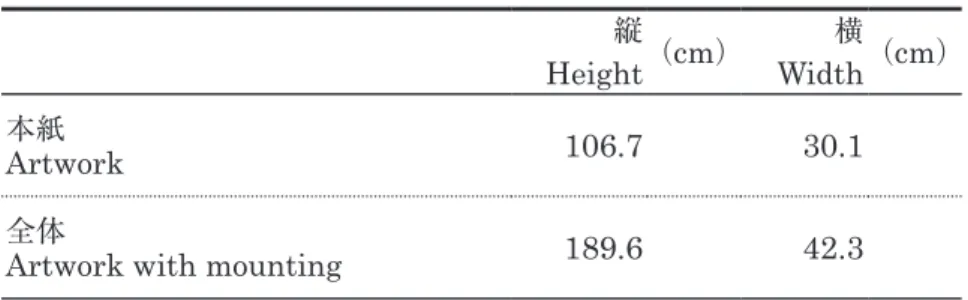
Table 1.1 寸法 修復前Dimensions, before restoration
縦(cm) 横
(cm)
Height Width
本紙 最大
Artwork in maximum dimension 106.3 29.7
全体Artwork with mounting (182.3) (41.2)
寸法;( )内は現地調査時による
Dimensions; The bracketed figures were acquired during on-site investigation
Table 1.2 寸法 修復後
Dimensions, after restoration
縦(cm) 横(cm)
Height Width
本紙Artwork 106.7 30.1
全体Artwork with mounting 189.6 42.3
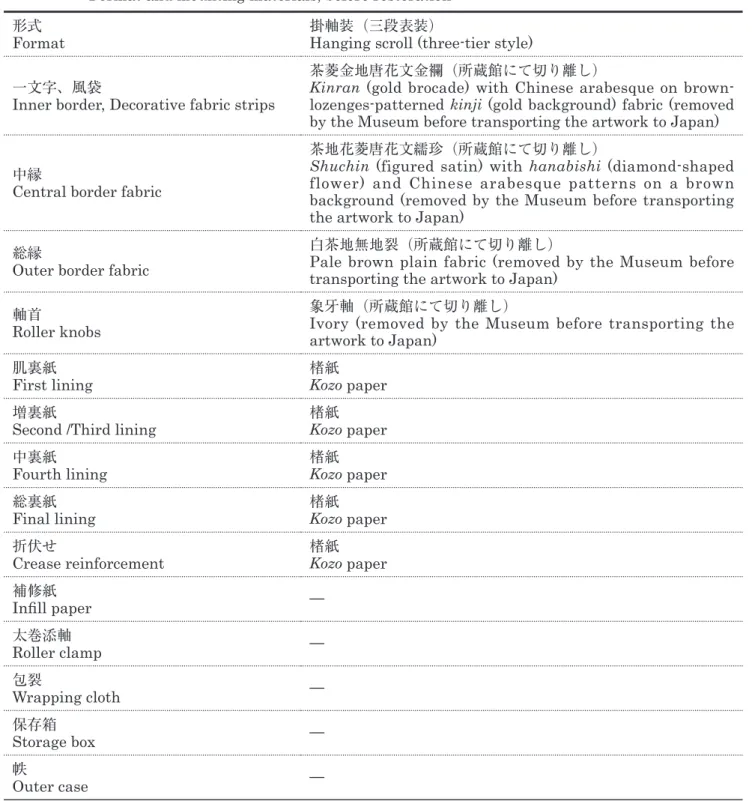
Table 1.3 形式・仕様等 修復前Format and mounting materials, before restoration
形式Format 掛軸装(三段表装)Hanging scroll (three-tier style)
一文字、風袋
Inner border, Decorative fabric strips
茶菱金地唐花文金襴(所蔵館にて切り離し)
Kinran (gold brocade) with Chinese arabesque on brown- lozenges-patterned kinji (gold background) fabric (removed by the Museum before transporting the artwork to Japan) 中縁Central border fabric
茶地花菱唐花文繻珍(所蔵館にて切り離し)
Shuchin (figured satin) with hanabishi (diamond-shaped flower) and Chinese arabesque patterns on a brown background (removed by the Museum before transporting the artwork to Japan)
総縁Outer border fabric
白茶地無地裂(所蔵館にて切り離し)
Pale brown plain fabric (removed by the Museum before transporting the artwork to Japan)
軸首Roller knobs
象牙軸(所蔵館にて切り離し)
Ivory (removed by the Museum before transporting the artwork to Japan)
肌裏紙First lining 楮紙Kozo paper
増裏紙Second /Third lining 楮紙Kozo paper
中裏紙Fourth lining 楮紙Kozo paper
総裏紙Final lining 楮紙Kozo paper
折伏せCrease reinforcement 楮紙Kozo paper
補修紙Infill paper ―
太巻添軸Roller clamp ―
包裂Wrapping cloth ―
保存箱Storage box ―
帙Outer case ―
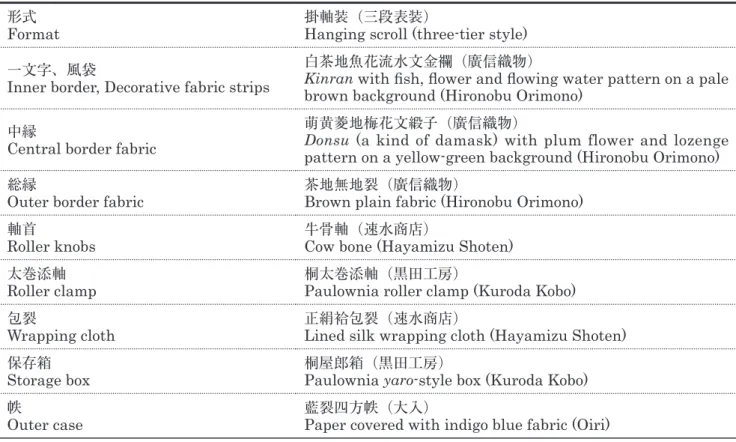
Table 1.4 形式・仕様等 修復後
Format and mounting materials, after restoration
形式Format 掛軸装(三段表装)Hanging scroll (three-tier style)
一文字、風袋
Inner border, Decorative fabric strips
白茶地魚花流水文金襴(廣信織物)
Kinran with fish, flower and flowing water pattern on a pale brown background (Hironobu Orimono)
中縁Central border fabric
萌黄菱地梅花文緞子(廣信織物)
Donsu (a kind of damask) with plum flower and lozenge pattern on a yellow-green background (Hironobu Orimono)
総縁Outer border fabric 茶地無地裂(廣信織物)
Brown plain fabric (Hironobu Orimono) 軸首Roller knobs 牛骨軸(速水商店)Cow bone (Hayamizu Shoten)
太巻添軸Roller clamp 桐太巻添軸(黒田工房)
Paulownia roller clamp (Kuroda Kobo)
包裂Wrapping cloth 正絹袷包裂(速水商店)
Lined silk wrapping cloth (Hayamizu Shoten) 保存箱Storage box 桐屋郎箱(黒田工房)Paulownia yaro-style box (Kuroda Kobo)
帙Outer case 藍裂四方帙(大入)Paper covered with indigo blue fabric (Oiri)
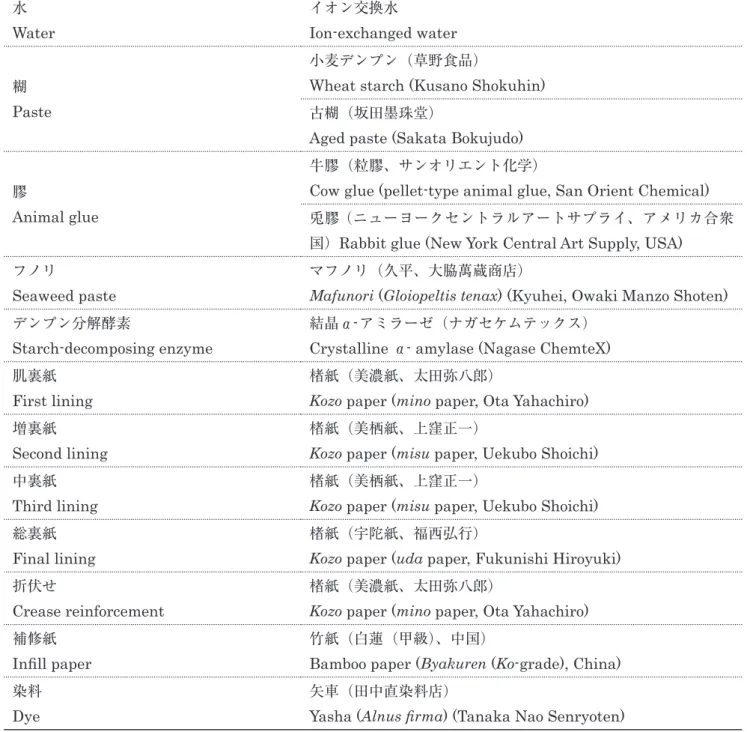
Table 1.5 修復材料Restoration materials 水
Water
イオン交換水
Ion-exchanged water
糊 Paste
小麦デンプン(草野食品)
Wheat starch (Kusano Shokuhin) 古糊(坂田墨珠堂)
Aged paste (Sakata Bokujudo)
膠
Animal glue
牛膠(粒膠、サンオリエント化学)
Cow glue (pellet-type animal glue, San Orient Chemical) 兎膠(ニューヨークセントラルアートサプライ、アメリカ合衆 国)Rabbit glue (New York Central Art Supply, USA)
フノリ
Seaweed paste
マフノリ(久平、大脇萬蔵商店)
Mafunori (Gloiopeltis tenax) (Kyuhei, Owaki Manzo Shoten) デンプン分解酵素
Starch-decomposing enzyme
結晶α-アミラーゼ(ナガセケムテックス)
Crystalline α- amylase (Nagase ChemteX) 肌裏紙
First lining
楮紙(美濃紙、太田弥八郎)
Kozo paper (mino paper, Ota Yahachiro) 増裏紙
Second lining
楮紙(美栖紙、上窪正一)
Kozo paper (misu paper, Uekubo Shoichi) 中裏紙
Third lining
楮紙(美栖紙、上窪正一)
Kozo paper (misu paper, Uekubo Shoichi) 総裏紙
Final lining
楮紙(宇陀紙、福西弘行)
Kozo paper (uda paper, Fukunishi Hiroyuki) 折伏せ
Crease reinforcement
楮紙(美濃紙、太田弥八郎)
Kozo paper (mino paper, Ota Yahachiro) 補修紙
Infill paper
竹紙(白蓮(甲級)、中国)
Bamboo paper (Byakuren (Ko-grade), China) 染料
Dye
矢車(田中直染料店)
Yasha (Alnus firma) (Tanaka Nao Senryoten)
(a) (b)
Fig. 1.1 寒山拾得図(全体)(a)修復前(現地調査時)、(b)修復後 Hanshan and Shide, artwork with mounting
(a) before restoration (at the time of investigation at the Museum), (b) after restoration
(a) (b)
Fig. 1.3 折れ (a) 修復前、(b) 修復後
Creases, (a) before restoration, (b) after restoration
(a)
(a)
(a)
(b)
(b)
(b)
Fig. 1.4 折れ部分の欠失 (a) 修復前、(b) 修復後
Losses on the creases, (a) before restoration, (b) after restoration
Fig. 1.5 欠失 (a) 修復前、(b) 修復後
Losses, (a) before restoration, (b) after restoration
Fig. 1.6.1 修復前調査
Investigation before restoration Fig. 1.6.2 旧裏打ち紙除去(総・中裏紙)
Removal of the old lining (final and fourth lining paper)
Fig. 1.6.3 旧裏打ち紙除去(2層目増裏紙)
Removal of the old lining (third lining paper)
Fig. 1.6.5 旧裏打ち紙除去(1層目増裏紙)
Fig. 1.6.4 クリーニング Cleaning
Fig. 1.6.6 表打ち
Fig. 1.6.7 旧裏打ち紙除去(肌裏紙)
Removal of the old lining
(first lining)
Fig. 1.6.9 肌裏打ち First lining
Fig. 1.6.11 折れ伏せ
Application of crease reinforcement paper strips
Fig. 1.6.8 補修 Infilling
Fig. 1.6.10 増裏打ち Second lining
Fig. 1.6.12 付け廻し Assembling
Fig. 1.6.13 中裏打ち Third lining
Fig. 1.6.15 補彩 Inpainting
Fig. 1.7 保存箱等(新調)
Fig. 1.6.14 総裏打ち Final lining
Fig 1.6.16 仕上げ Finishing
本報告の内容の一部は学会で発表した。
A part of this restoration report was presented at a conference.
•楠京子、山田祐子、君嶋隆幸、加藤雅人「裏打ち紙除去に使用した酵素の除去確認方法について」文化財保存修復学会第35回 大会要旨集 pp. 312-313(2013)
The 34th Conference of The Japan Society for the Conservation of Cultural Property, Abstracts, pp. 312-313(2013)
参考文献;
東京文化財研究所「在外日本古美術品保存修復協力事業平成20年度修復報告」p.96(2010)
東京文化財研究所「在外日本古美術品保存修復協力事業平成23年度修復報告霊照女図」付録5(2015)
東京文化財研究所「33回文化財の保存及び修復に関する国際研究集会 日本絵画の修復―先端と伝統―」p.J-179(2011) 竹上幸宏、君嶋隆幸、岡岩太郎、木川りか、川野邊渉「装潢技術における酵素利用の可能性について」保存科学第37号 pp.76- 83(1998)
National Research Institute for Cultural Properties, Tokyo. The Cooperative Program for the Conservation of Japanese Art Objects Overseas 2008 JFY, p.106 (2010)
National Research Institute for Cultural Properties, Tokyo. The Cooperative Program for the Conservation of Japanese Art Objects Overseas, 2011 JFY, Reisho-jo, Appendix 5 (2015)
National Research Institute for Cultural Properties, Tokyo. 33rd International Symposium on the Conservation and Restoration of Cultural Property, Restoration of Japanese Paintings –Advanced Technology and Traditional Techniques–, p.E-163 (2011)
Yukihiro Takegami, Takayuki Kimishima, Iwataro Oka, Rika Kigawa and Wataru Kawanobe. An Attempt at Application of Highly Purified α-amylase to Japanese hyogu Technique . Conservation Science No.37, pp.76-83 (1998)
本作品は、後ろ姿の寒山と拾得を重なり合うように表した水墨人物画である。寒山拾得は中国・唐代に浙江 省天台山国清寺にいたとされ、世俗を離れ融通無碍な境涯を過ごしたことから、禅宗を中心に伝統的な画題と なり、数多くの作品が制作された。本作品では奥で経巻を拡げるのが寒山、手前で竹箒を持つのが拾得にあたり、
両者の蓬髪は濃墨の早い筆致で表され、袋のような輪郭線で人体を表す「袋人物」の描写手法で画幅いっぱい に描かれている。人物の輪郭線はかすれながらも太い線で力強く表される一方、拾得の持つ箒の柄には、淡墨 とやや濃い墨で竹の節がさりげなく入念に表されている。上部にはやや淡い墨で蔦の絡まった樹木が描かれて おり、葉叢には「筋目描き」と呼ばれる、紙上でにじんだ墨の面と面が隣接すると、その境界が縞模様のよう になって残る性質を表現に活かした技法を用いて、ボリューム感豊かに描かれている。
画面上部には丹崖こと無染浄善(1693-1764)によって次のように五言絶句が記されている。「雲樹幽崖下 此経信手披 不知五台月 皎潔照峨嵋 丹崖七十一歳翁 題」詩賛は左より記されており、左上に「如々室」
朱文長方印、末尾に「浄善之印」白文方印、「東湖釣客」朱文方印が捺されている。無染は近江神崎郡(現・滋 賀県東近江市)に生まれ、嵯峨直指庵の覚天元朗の法嗣となり、野洲秀峰寺の住持を経て、直指庵第8世となっ た人物で、詩文書画に長じ、当代有数の黄檗文人僧であった。若冲の作品に着賛した禅僧は数多くいるが、現 存作品の中で最も多くの作品の賛を揮毫しており、深い親交があったと考えられている。本作品の無染の行年 書きによれば、その遷化する前年、宝暦13年(1763)に着賛されたもので、絵も同時期とすると若冲48歳 の制作と考えられる。葉叢の左には「藤汝鈞印」白文方印と、「若冲居士」朱文円印が捺されている。この組み 合わせによる印章の使用例は、「動植綵絵」(全30幅、宮内庁三の丸尚蔵館蔵)のなかの「池辺群虫図」や、や はり宝暦11年(1761)の無染浄善の賛を有する「海老図」(細見美術館蔵)などが確認でき、若冲中期の作品 として位置づけられる。
なお、本作品とほぼ図様を同じくし、さらに無染浄善のほぼ同様の賛を持つ作例が確認できる*。特に若冲の 水墨画には、同じ画題や構図を繰り返し描いたものが多く、若冲が頻繁に出入りしていた相国寺の塔頭にもこ のような掛幅が数多く伝わっている。最晩年の無染に賛を求める者が多く、また若冲の軽妙な水墨画が好まれ ていたことが推測される。無染の賛の「五台山の月光が同じく峨嵋山を白く清らかに照らし出す」という詩意 には、寒山拾得が天台山にいたことを思い起こせば、中国仏教の三大霊場である天台山・五台山・峨嵋山を詠 い巡るといいう壮大な幻想が込められていることがわかる。後ろ向きの寒山拾得という飄逸な表現とともに詩 書画が相俟って禅味の豊かな作品と言える。
参考文献;*『若冲ワンダーランド』展図録、作品番号32(MIHO MUSEUM、2009年9月)および『伊藤若冲―アナザーワールド―』展 図録、作品番号42(千葉市美術館、静岡県立美術館、2010年4月)
2. 作品解説
東京文化財研究所 江村 知子
2. Description of the Artwork
Tomoko Emura National Research Institute for Cultural Properties, Tokyo
This is a figure painting in ink in which Hanshan and Shide are depicted standing very closely together with their backs turned away from the viewers. Hanshan and Shide are said to have lived at Guo-qing-si temple at Mt. Tiantai in Zhejiang Province, China during the Tang dynasty, leading a resourceful life away from the secular world. For this reason, they have traditionally been the subject of many paintings, particularly of Zen Buddhism, and have been depicted in many works of art. In this particular work, the figure at the back holding a sutra scroll is Hanshan and the figure toward the front with a bamboo broom in his hands is Shide. Their disheveled hair is expressed with a quickly drawn touch of dark ink, while their bodies, which cover almost the entire width of the art work, are drawn with fukurojimbutsu technique in which a persons body is expressed in a bag-like outline. Although faint at places, there is force in the bold lines used to express the outline of the figures, while the nodes of the bamboo of the broom in Shide s hands are carefully drawn, though in a casual manner, using both light and slightly dark ink. The tree with a vine above the figures is expressed with a slightly light shade of ink. A technique called sujimegaki, which is characterized by a stripe-like effect that is created when the smeared lines of ink are placed close to each other, is used for the thick foliage of the tree.
On the upper part of the painting is a poem of four lines, each line having five characters, by Musen Jozen (1693-1764), also known as Tangai. This poem is written from the left to the right and accompanied by a rectangular seal in red that reads Jojoshitsu (如々室)at its top left, and a square seal in white that reads Jozen no in(浄善之印)and a square seal in red that reads Toko Chokyaku(東 湖釣客)at the end. Musen was born in Kanzaki County in Omi (todays Higashi-omi City, Shiga Prefecture).
He became a disciple of Kakuten Genro of Jikishi-an in Saga, Kyoto. After having been the monk of Yasu Shuho-ji temple, he became the 8th head priest of Jikishi-an. He was well versed in literary works and the arts and was a prominent monk of Obaku Sect of Buddhism. There are numerous Zen monks that wrote poems on works by Jakuchu, but Musen has written poems on the greatest number of extant works by Jakuchu, suggesting that they were on very close terms. Since in the inscription Musen writes that he is 71 years old, it is thought that the poem was written in 1763, a year before his death. If the painting was drawn at the same time, it may be said that Jakuchu was 48 years old at the time. To the left of the tree are a square seal in white that reads To Jokin in (藤汝鈞印)and a round seal in red that reads Jakuchu Koji (若冲居士). This combination of seals can also be found on such works as the Pond and Insects - Colorful Realm of Living Beings (a set of 30 vertical hanging scrolls, Sannomaru Shozokan, Imperial Household Agency, Japan) and the Lobster (Hosomi Museum). For this reason, this work may be considered to be among those from the middle of Jakuchu s career.
There is another work with a motif very similar to that of this one; it also has a poem very similar in content to that by Musen Jozen.* Same motifs and structures are repeatedly found on many of Jakuchu s ink paintings, and many hanging scrolls of this type have been handed down at a sub-temple of Sokoku-ji. This shows that many people requested Musen to write poems in the last years of his life and that Jakuchu s lambent ink paintings were favored. The words of Musen s poem, that the light of the moon over Mt. Wutai also sheds light on Mt. Emei making it appear white and clean, suggest a spectacular vision of Hanshan and Shide who are at Mt. Tiantai and thinking of the three sacred places
of Chinese Buddhism – Mt. Tiantai, Mt. Wutai and Mt. Emei. The poem and the writings, together with the other-worldly expression of Hanshan and Shide, make this work one rich in refined simplicity of Zen.
*cf. JAKUCHU Wonderland exhibition catalogue, exhibit no. 32 (Miho Museum, September 2009) and Ito Jakuchu:
Another World exhibition catalogue, exhibit no. 42 (Chiba City Museum of Art, Shizuoka Prefectural Museum of Art, April 2010)
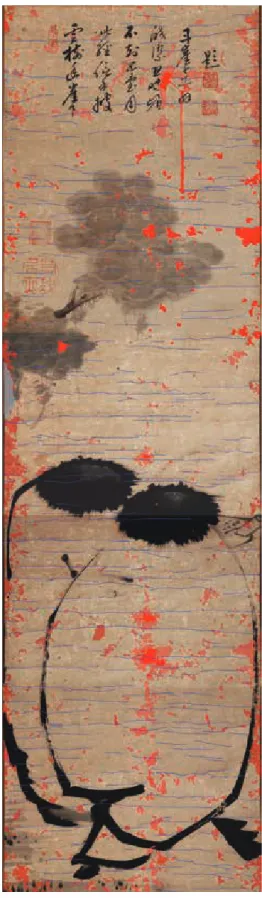
付録 1. 修復前損傷図面
Appendix 1. Mapping of damages before restoration
■欠失 Losses
■本紙表面の欠失(薄くなっているが穴には 至っていない)
Loss of the surface of the artwork (parts that have become very thin although not completely lost)
■折れ Creases
■汚れ ・ 付着物 Dust, accretions
■補紙 Infilling
Fig. A.1 修復前損傷図面
Mapping of damages before restoration
付録 Appendix
東京文化財研究所 山田 祐子、楠 京子、加藤 雅人 Yuko Yamada, Kyoko kusunoki and Masato Kato National Research Institute for Cultural Properties, Tokyo
Fig. A.2 裏打紙除去前 裏面 付録 2. 透過光写真 裏打紙除去前
Appendix 2. Photograph under transmitted light, before removal of the lining paper
Fig. A.3 中裏紙除去後 付録 3. 透過光写真 中裏紙除去後
Appendix 3. Photograph under transmitted light, after removal of the fourth lining paper
付録 4. 繊維組成分析
Appendix 4. Fiber furnish analysis
試験方法;JIS P8120を参考にC染色液を用いて繊維を染色し、顕微鏡による観察を行った。
使用機器;顕微鏡オリンパスSZX12、デジタルカメラオリンパスDP20-5 ピクセル数;1600×1200
画像フォーマット;JPEG
Analysis method;The fibers were dyed by C stain and observed with a microscope. Japanese Industrial Standard P8120 (cf. ISO9184-4).
Apparatus;microscope (Olympus SZX12 equipped with a digital camera Olympus DP20-5) Number of pixels;1600×1200
Image format;JPEG
Fig. A.3 本紙繊維
Fibers of the artwork
0.1mm
付録 5. 肌裏紙除去後
Appendix 5. Photograph after removal of the first lining paper
付録 6. デンプン分解酵素除去について
Appendix 6. Removal of the starch-decomposing enzyme
使用酵素;結晶α-アミラーゼ150×104DUN(Dextrinogenic Unit of Nagase)(ナガセケムテックス)
使用濃度;5.0×10⁻⁴wt-%
方法;イオン交換水を本紙表面から噴霧し、本紙の下に敷いた吸い取り紙に吸収させて酵素の抽出を行った。
得られた抽出液を約1wt-%のデンプン水溶液に加え、抽出液中の酵素と反応させた。(デンプン水溶液は小麦 デンプンと水を重量比約1:2.7の割合で調整し45〜50分間加熱撹拌して作製した小麦デンプン糊を水で薄 めて調整した。)得られた溶液にヨウ素液を加え、その呈色によって酵素の残留を確認した(1)。
Enzyme: Crystallineα-amylase, 150×104DUN (Dextrinogenic Unit of Nagase), Nagase ChemteX Concentration: 5.0×10⁻⁴wt-%
Method: Ion-exchanged water was sprayed from over the artwork and absorbed by a sheet of blotting paper placed underneath. The extracted liquid was added to about 1 wt-% aqueous starch solution to decompose starch. (The starch solution was prepared by continuously stirring starch powder and ion- exchanged water in the weight ratio of about 1:2.7 for about 45 to 50 minutes. Obtained starch solution was diluted to ca. 1 wt-%.) The amount of remaining enzyme was evaluated by the method reported in (1).
参考文献
(1)「在外日本古美術品保存修復協力事業 霊照女図 平成23年度修復」付録5(2015年3月)
The Cooperative Program for the Conservation of Japanese Art Objests Overseas, 2011, JFY, Reisho-jo, Appendix 5 (March 2015)
付録 7. 測色
Appendix 7. Color measurement
分光測色計; CM-2600d(コニカミノルタ)
測定条件; 光源D65 観察視野角10°
測定径8mm
試料の下に撮影用の白色標準板(X-rite Color Checker、ホワイトバランスカード)を敷いて測定を行った。
Colorimeter;CM-2600d, Konica-Minolta Measurement conditions; D65 (illuminant)
10°(observation visual field) 8mm (measurement area)
A white balance card (X-rite Color Checker) was placed under the sample for measurement.
Table A.7 新規補修紙試料のL*a*b*(同試料での3箇所の平均値)
L*a*b* of the sample of new infill paper (average of the measured values taken at 3 points on the same sample)
L* a* b* L* a* b*
正反射光を含む値(SCI)
Specular component included (SCI) 正反射光を含まない値(SCE) Specular component excluded (SCE)
未処置Control 94.46 -0.98 6.15 94.05 -0.80 6.19
染色Dyeing 88.95 -0.66 12.34 88.70 -0.50 12.37
染色→裏打ち→ドーサ引き
Dyeing→lining→sizing 85.73 0.30 15.29 85.49 0.43 15.31
染色→ドーサ引き→裏打ち
Dyeing→sizing→lining 85.80 0.33 15.61 85.56 0.46 15.61
付録 8. 調湿
Appendix 8. Conditioning
使用機器;恒温恒湿槽TBL-3HW2G2AC(タバイエスペック)
調湿期間;3週間
Apparatus;a temperature and humidity testing chamber, TBL-3HW2G2AC, TABAI ESPEC Duration;3 weeks
Fig. A.8 調湿期間中の温湿度設定
Temperature and humidity during conditioning 0
10 20 30 40 50 60 70 80 90 100
relative humidity, %-rh temperature, absolute humidity, g/
Time, day
relative humidity temperature
absolute humidity
0 5 10 15 20
東京文化財研究所
平成 23 年度
在外日本古美術品保存修復協力事業 寒山拾得図 修復報告書
発行日 ; 平成 27 年 3 月 31 日 編集責任 ; 文化遺産国際協力センター
National Research Institute for Cultural Properties, Tokyo