SECURITY OF AUDIO SECRET SHARING SCHEME ENCRYPTING AUDIO SECRETS WITH BOUNDED SHARES
Shinya Washio and Yodai Watanabe
Department of Computer Science and Engineering, University of Aizu Aizu-Wakamatsu City, Fukushima 9658580, Japan
ABSTRACT
Secret sharing is a method of encrypting a secret into multi- ple pieces called shares so that only qualified sets of shares can be employed to reconstruct the secret. Audio secret shar- ing (ASS) is an example of secret sharing whose decryption can be performed by human ears. This paper examines the security of an audio secret sharing scheme encrypting audio secrets with bounded shares, and optimizes the security with respect to the probability distribution used in its encryption.
Index Terms— Audio Secret Sharing, Information- Theoretic Security, Variation Distance
1. INTRODUCTION
A secret sharing (SS) scheme is a cryptosystem that encrypts a secret into multiple pieces called shares so that only quali- fied sets of shares can be employed to reconstruct the secret.
Therefore the SS scheme is one of the most fundamental tech- nologies to realize secure access control. A typical example of secret sharing schemes is a(k, n)-threshold secret sharing scheme, which was originated by Shamir [1] and Blakley [2]
independently. In(k, n)-threshold secret sharing schemes, a secret is encrypted intonshares in such a way that anykor more shares can be employed to reconstruct the secret, while nok−1or less shares leak any information about the secret.
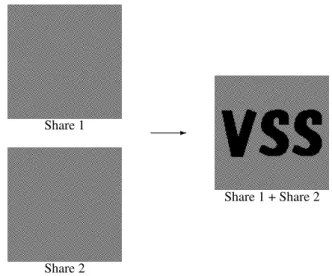
In the ordinary secret sharing schemes, secrets and shares are both numerical data, and their encryption and decryption are performed by computers. In contrast, there exist secret sharing schemes whose decryption does not require any nu- merical computations but can be performed by a human. A visual secret sharing (VSS) scheme, which originated from Naor and Shamir [3], is an example of such secret sharing schemes. In VSS schemes, secrets and shares are both visual data such as printed texts, hand written notes, pictures, and so on. The schemes encrypt a visual secret into visual shares so that humans can recover the visual secret with their eyes by superposing a qualified set of visual shares printed on trans-
This work was supported in part by a Grant-in-Aid for Young Scientists (B) No. 21700021, and Fukushima Prefectural Foundation for Advancement of Science and Education.
Share 2 Share 1
Share 1 + Share 2 -
Fig. 1. Two shares and their superposition of a (2,2)- threshold VSS scheme
parencies. Figure 1 illustrates an example of two shares and their superposition of a(2,2)-threshold VSS scheme.
An audio secret sharing (ASS) scheme is another example of secret sharing schemes whose decryption can be performed by human without any numerical computations. The scheme encrypts a secret into audio shares so that humans can recover the secret with their ears by playing a qualified set of au- dio shares simultaneously. Here, in contrast to VSS schemes, there have been proposed two types of ASS schemes, which differ in the types of secrets. More precisely, Desmedt et al. [4] proposed information-theoretically secure schemes that encrypt a binary string secret, while Ehdaie et al. [5] proposed schemes that can encrypt an audio secret. Figure 2 illustrates an example of two shares and their superposition of a(2,2)- threshold ASS scheme proposed by Desmedt et al. [4]. Al- though it is an advantage of the latter schemes that they can encrypt arbitrary audio secrets, the security analysis in [5] is invalid because the analysis is essentially based on impossible requirement that the amplitude of the audio shares should be uniformly distributed over (the whole)R; in fact, such shares should have infinite amount of acoustic energy, and also, such shares can no longer be approximated by any acoustic waves
Table 1. Comparison among audio and visual secret sharing schemes
ASS VSS
Desmedt et al. [4] Ehdaie et al. [5] Yoshida & Watanabe [6] This work Naor & Shamir [3]
Secret Binary string Audio Audio Audio Visual
Share Audio Audio Audio Audio Visual
Distribution Uniform over a finite set Uniform overR Normal overR Normal over[−B, B] Uniform over a finite set
Share 1 Share 2
Share 1 + Share 2
1 0 1 0
?
Fig. 2. Two shares and their superposition of an ASS scheme proposed by Desmedt et al. [4]
with bounded amplitude (with probability 1). To solve this problem, Yoshida and Watanabe [6] used a normal distribu- tion overR for the encryption of ASS schemes encrypting audio secrets, and evaluated their security. The aim of this work is to improve the result of [6] so that shares of ASS schemes encrypting audio secrets should have bounded am- plitude with probability 1; for this purpose, this work uses a normal distribution over a bounded domain for the encryption of an ASS scheme encrypting audio secrets, and evaluates its security. Table 1 summarizes the existing works on ASS and VSS schemes as well as this work.
The rest of this paper is organized as follows. In Section 2, we provide notations and definitions that will be used later.
Section 3 is devoted to evaluating the security of an audio se- cret sharing scheme encrypting audio secrets with bounded shares. Section 4 concludes this paper with mentioning prob- lems for future work.
2. PRELIMINARIES
In this section, we provide notations and definitions that will be used later. For details of definitions in information theory and secret sharing, see, e.g., [7, 8, 9].
Let P = {P1,· · ·, Pn} and S be finite sets. For s = (s1,· · ·, sn)∈ S|P|anda⊂ P, let[s]adenote an element of {∅ ∪ S}|P|such that
([s]a)i= (
si forPi∈a,
∅ forPi∈/a.
For a setM, letR(M)denote the set of all random variables overM.
The normal distributionN(µ, σ2)with meanµand vari- anceσ2is a probability distribution with a probability density function
pN(µ,σ2)(x) = 1
√2πσ2e−(x−µ)22σ2 . It is straightforward to confirm that
Z b
a
pN(µ,σ2)(x)dx= 1 2
erf b−µ
√2σ
−erf a−µ
√2σ
,
whereerf(x)is the error function defined by
erf(x) = 2
√π Z x
0
e−t2dt.
For probability distributionspandqover a measurable space (X, µ), thevariation distanced(p, q)betweenpandqis de- fined by
d(p, q) = 1 2 Z
x∈X
p(x)−q(x) dµ(x).
It is conventional to use the mutual information to mea- sure the statistical independence between random variables.
Here, the mutual informationI(X :Y)between random vari- ablesX andY can be written as
I(X:Y) =D(p(x, y)||p(x)p(y)),
whereD(p||q)is the relative entropy between probability dis- tributionspandqover(X, µ)defined by
D(p||q) = Z
x∈X
p(x) logp(x) q(x)dµ(x).
Note that the relative entropyD(p||q)is defined for probabil- ity distributionspandqsuch that
{x|p(x)>0} ⊃ {x|q(x)>0},
which is inconvenient for our purpose. Therefore, we define the independenced(X:Y)between random variablesXand Y by using the variation distance instead of the relative en- tropy as
d(X :Y) =d(p(x, y), p(x)p(y)).
It should be stated that the security described by the variation distance has already been considered in existing works; for
example, the universal composability [10] in quantum cryp- tography is defined by use of the trace distance, which is the quantum generalization of the variation distance.
LetP = {P1,· · ·, Pn} be a set of participants, and let 2P denote the set of all the subsets of P. Let M and S be sets of all possible values of secrets and shares, respec- tively. In an SS scheme, a secretm ∈ Mis encrypted into (s1,· · ·, sn) ∈ Sn, called shares, and each sharesi is dis- tributed to the corresponding participantPi. Here, any el- ement of AQ ⊂ 2P can reconstruct m with their shares, while any element ofAF ⊂ 2P can obtain no information aboutm. The setAQandAF are called the qualified set and the forbidden set, respectively, and the pair ofAQ andAF, Γ = (AQ, AF), is called an access structure on P. Formal definitions of an access structure and a secret sharing scheme are described below.
Definition 1(Access structure). LetPbe a finite set, and let AQ andAF be subsets of 2P. A pair of sets AQ andAF, Γ = (AQ, AF), is called anaccess structure onPifAQand AF satisfy the following conditions:
AQ∩AF =∅, a∈AQ∧a⊂b→b∈AQ, b∈AF∧a⊂b→a∈AF.
For an access structureΓ = (AQ, AF),AQandAFare called thequalified setand theforbidden set, respectively.
Definition 2(Secret sharing scheme). LetP, MandS be finite sets, andΓ = (AQ, AF)be an access structure onP. LetEnc(·)be a probabilistic function fromMtoS|P| and Dec(·)be a deterministic function from{∅ ∪ S}|P|toM. A pair of functionsEncandDec,SS = (Enc,Dec), is called a secret sharing scheme realizingΓifEncandDecsatisfy the following conditions:
∀a∈AF∀M ∈R(M) d(M : [Enc(M)]a) = 0 ,
∀a∈AQ∀m∈ M Dec([Enc(m)]a) =m .
This definition is slightly different from but is equivalent to the standard one (see e.g. [9]).
Example 1 ((k, n)-threshold access structure). A (k, n)- threshold access structure on a finite set P consists of the qualified setAQand the forbidden setAFgiven by
AQ= a⊂ P
k≤ |a| and AF = a⊂ P
k >|a| . In particular, a (2,2)-threshold access structure on P = {P1, P2} consists of the qualified setAQ and the forbidden setAF given by
AQ=
{P1, P2} and AF =
∅,{P1},{P2} . A secret sharing scheme realizing a(k, n)-threshold access structure is called a(k, n)-threshold secret sharing scheme.
3. MAIN RESULTS
In this section, we evaluate the security of an audio secret sharing scheme encrypting audio secrets with bounded shares.
First, we provide a formal definition of ASS schemes and a construction of the simplest ASS scheme, namely a(2,2)- threshold ASS scheme.
Definition 3(-secure audio secret sharing scheme [6]). Let P be a finite set, andΓ = (AQ, AF)be an access structure onP. LetMandS be subsets ofRorZ. LetEnc(·)be a probabilistic function fromM toS|P| andDec(·)be a de- terministic function from{∅ ∪ S}|P| toM. For ≥ 0, a pair of functionsEncandDec,ASS = (Enc,Dec), is called an-secure audio secret sharing scheme realizingΓifDecis defined byDec([s]a) =P
i:Pi∈asifors∈ S|P| anda⊂ P, andEncandDecsatisfy the following conditions:
∀a∈AF∀M ∈R(M) d(M : [Enc(M)]a)≤ ,
∀a∈AQ∃α6= 0∀m∈ M Dec([Enc(m)]a) =αm . Construction 1((2,2)-threshold audio secret sharing scheme).
LetSandMbe subsets ofRandZ, respectively, bounded by B >0:S =
s∈R
|s| ≤B andM= z∈Z
|z| ≤B . Forα >0,m∈ Mands1, s2∈ S, defineEncandDecby
Enc(m) = α
2m+r,α 2m−r
, Dec(s1, s2) =s1+s2, respectively, whereris a random variable (whose distribution should be chosen to minimize).
Let N∆(µ, σ2)be the normal distribution with mean µ and varianceσ2 over bounded domain[−∆,∆]; its density function is given by
pN∆(µ,σ2)(x) = (
c−1
√2πσ2e−(x−µ)22σ2 if −∆≤x≤∆,
0 otherwise,
wherec−1is a normalization constant defined by
c= Z µ+∆
µ−∆
pN(µ,σ2)(x)dx= erf ∆
√2σ
.
If we require that shares s1 and s2 should be bounded as
|s1|,|s2| ≤ B, then it follows from |m| ≤ B that |r| ≤ 1−α2
B. Therefore, we consider a normal distribution over − 1−α2
B, 1−α2 B
:
Theorem 1. An ASS schemeASS = (Enc,Dec)defined by Construction 1 withα < 1andr ∼ N(1−α2)B(0,(βB)2)is -secure, where= erf √α8β
/erf 2−α√8β .
Proof. Let M andSi (i ∈ {1,2}) denote the random vari- ables representing a secret and two shares, respectively. We
begin with the definition of the independence betweenM and S1:
d(M :S1) =d(p(m, s1), p(m)p(s1))
=1 2
X
m
Z p(m)p(s1|m)−p(m)p(s1) ds1
=1 2
X
m
p(m) Z
X
m0
p(m0)p(s1|m)
−X
m0
p(m0)p(s1|m0) ds1
≤ X
m,m0
p(m)p(m0)d(p(s1|m), p(s1|m0))
≤max
m,m0d(N∆(α2m,(βB)2), N∆(α2m0,(βB)2)) with∆ = 1−α2
B. Since|m|,|m0| ≤Band
d(N∆(µ, σ2), N∆(µ0, σ2)) = erf |µ−µ√ 0|
8σ
erf
√∆ 8σ
,
it follows that
d(M :S1)≤max
m,m0
erf
α 2m−α
2m0
√
8βB
erf
(2−α)B√ 8βB
≤ erf α 2 2B
√8βB
erf
(2−α)B√ 8βB
=erf
√α 8β
erf
2−α√ 8β
.
In the same way, we haveI(M :S2)≤erf √α8β
/erf 2−α√8β . Since the forbidden set of a (2,2)-threshold access struc- ture on {P1, P2} is given by AF =
∅,{P1},{P2} , these two inequalities yield that ASS is -secure, where = erf √α8β
/erf 2−α√8β
. This completes the proof.
In the above theorem, we have required that each share should be bounded. This allows not only practical implemen- tation, but also the optimization (i.e. minimization) ofwith respect to the variance parameterβ. Note thatN∆(µ, σ2)be- comes the uniform distribution over[µ−∆, µ+ ∆]in the limitσ → ∞. Therefore, the following lemma states that takes the optimum (i.e. minimum) value of 2−αα when ris uniformly distributed over
− 1−α2
B, 1−α2 B
. Lemma 2. Letbe as above. Then
β>0inf = lim
β→∞
erf √α8β erf 2−α√8β = α
2−α.
Proof. The first equality follows from Lemma 3 (see below), and the second one from L’Hopital’s rule.
Lemma 3. Letf(x)andF(x)be functions onRdefined by f(x) =ce−sx2 and F(x) =
Z x
0
f(z)dz
forc, s >0. Then, the function ofxdefined byF(ax)/F(bx) is monotone increasing forx >0and0< a < b.
Proof. Lemma 4 (see below) gives F(ax)
F(bx) 0
= F(ax) xF(bx)
axf(ax)
F(ax) −bxf(bx) F(bx)
>0.
This completes the proof.
Lemma 4. Letf(x)andF(x)be as above. Then, the func- tion ofxdefined byxf(x)/F(x)is monotone decreasing for x >0.
Proof. Since0< f(x)< cforx >0, 0< F(x) =
Z x
0
f(z)dz <
Z x
0
cdz=cx.
Therefore xf(x)
F(x) 0
= f(x) F(x)
1 +xf0(x)
f(x) −xf(x) F(x)
< f(x)g(x) F(x) , where we have definedg(x) = 1−2sx2−e−sx2. By this definition,
g(0) = 0 and g0(x) = 2sx(e−sx2−2)<0, and sog(x)<0. Consequently,
xf(x) F(x)
0
<f(x)g(x) F(x) <0.
This completes the proof.
4. CONCLUSION
In this paper, we considered ASS schemes encrypting audio secrets with bounded shares. In particular, we evaluated the security of an ASS scheme whose encryption uses a random variable sampled according to a normal distribution over a bounded domain. The result indicates that the security is optimized when the variance of the normal distribution ap- proaches infinity; in other words, the random variable is sam- pled according to the uniform distribution over the domain.
In contrast to the ordinary cryptosystems, users even without special knowledge can directly participate in the computation of the ASS decryption. This may increase their confidence and interest in the computation of cryptosystems, which could yield “unusual” applications of ASS schemes.
Search for such applications, as well as the optimization of the upper boundon the mutual information with respect to all probability distributions over a bounded domain, will be the subject of future work.
5. REFERENCES
[1] Adi Shamir, “How to share a secret,” Communications of the ACM, vol. 22, no. 11, pp. 612–613, 1979.
[2] George Robert Blakley, “Safeguarding cryptographic keys,” inProceedings of the National Computer Con- ference, Monval, NJ, USA, 1979, pp. 313–317, AFIPS Press.
[3] Moni Naor and Adi Shamir, “Visual cryptography,” in Proceedings of Advances in Cryptology – Eurocrypt ’94, Perugia, Italy, 1994, vol. 950 ofLecture Notes in Com- puter Science, pp. 1–12, Springer-Verlag.
[4] Yvo Desmedt, Shuang Hou, and Jean-Jacques Quisquater, “Audio and optical cryptography,” in Proceedings of Advances in Cryptology – ASIACRYPT
’98, Kazuo Ohta and Dingyi Pei, Eds., Beijing, China, 1998, vol. 1514 ofLecture Notes in Computer Science, pp. 392–404, Springer-Verlag.
[5] Mohammad Ehdaie, Taraneh Eghlidos, and Moham- mad Reza Aref, “A novel secret sharing scheme from audio perspective,” in Proceedings of International Symposium on Telecommunications (IST 2008), Tehran, Iran, 2008, pp. 13–18, IEEE.
[6] K. Yoshida and Y. Watanabe, “Security of audio secret sharing scheme encrypting audio secrets,” inProceed- ings of International Conferece for Internet Technology and Secured Transactions (ICITST 2012), London, UK, 2012, pp. 294–295, IEEE.
[7] Thomas M. Cover and Joy A. Thomas, Elements of Information Theory, Wiley-Interscience, 2nd edition, 2006.
[8] Imre Csisz´ar and J´anos K¨orner, Information Theory:
Coding Theorems for Discrete Memoryless Systems, Cambridge University Press, 2nd edition, 2011.
[9] Douglas Robert Stinson, Cryptography: Theory and Practice, Chapman & Hall, CRC, 3rd edition, 2005.
[10] Renato Renner and Robert K¨onig, “Universally com- posable privacy amplification against quantum adver- saries,” inProceedings of Theory of Cryptography Con- ference (TCC 2005), Joe Kilian, Ed., Cambridge, MA, USA, 2005, vol. 3378 ofLecture Notes in Computer Sci- ence, pp. 407–425, Springer-Verlag.