This text is intended to offer some observations on what is generically referred to as the ‘theory of the firm’. It is clear that we shall not attempt to address all of the (extremely vast) issues raised by the development of this theory. Our main concern is neither to make an exhaustive summary of the different approaches nor to reconstruct a new theoretical model of general significance.
Rather, it is our intention to initiate a dialogue with the advocates of the various axiomatic models. This dialogue will be based on the empirical knowledge that we have been
able to accumulate during twenty years in the course of our comparative research on relations between the firm and society.
In the first part, we review the different currents of the theory of the firm developped over the past twenty-five years in the light of Neoclassical theory. In the second part, we focus our remarks on a new vision of the firm, based on the concept of 'competence accumulation', which is part of the 'evolutionary' approach that has itself emerged from the 'theory of technological innovation'. Finnally, we discuss about the
Revisiting the theory of the firm from the ‘societal approach’ viewpoint
Hiroatsu Nohara
【Abstracts】
This text is intended to offer retrospective observations on what is generically referred to as the
‘theory of the firm’. We aim to initiate a dialogue with the advocates of the various axiomatic models of Neoclassical school, as the authors of ‘Plea for a Pluralistic and Rigorous Economics’
(Hodgson, Mäki, MacClosky 1992) invite us. This dialogue is based on the empirical knowledge that we have been able to accumulate during twenty-five years in the course of our comparative research on relations between the firm and society. We review first the different currents of the theory of the firm recently developed in the light of Neoclassical theory. After several comments on its three currents, we focus our remarks on a new vision of the firm, based on the concept of 'competence accumulation', which is part of the 'evolutionary' approach. We then discuss about the possible development of ‘societal approach’ which emphasizes the importance of the role of institutions both in the construction of firm and in learning process. Finally, we attempt to frame a possible path for the ‘institutionalist’ theory of the firm which aims to integrate the firm into its social and institutional contexts.
【Keywords】
Firm, Institution, Society, Linkage, Co-operation, Societal Approach
possible contribution of ‘societal approach’
developed by the Aix group.
1In our conclusion, we attempt to frame a possible path for the ‘institutionalist’ theory of the firm which aims to integrate the firm into its social and institutional contexts.
I. Theories of the firm: an overview
N e o c l a s s i c a l e c o n o m i c t h e o r y i s characterised by a high level of analytical abstraction where the firm is reduced to the production function, and such an analytical bias corresponds to an extreme simplification of the economic reality. This point has been for a longtime criticized by some academics (Coase 1937; Hodgson, Mäki, MacClosky 1992) for its lack of realism. By contrast, the theory of the firm recently developed, regardless of its different currents, is situated at a less normative level where the firm acquires a
semi-autonomous status in a kind of dualism between the market and the organisation. The latter is thus concerned with both the source of the efficiency of organisational co-ordination- -as opposed to co-ordination by market price- -and the efforts of the agents making up the firm to gain the 'organisational quasi-rent'.
2The firm is thus conceived as the nexus of the contracts concluded -implicitly or explicitly- by the multiple (and differently motivated) agents who interact in the course of production as well as in the distribution of added value.
Unlike the standard theory which assimilates the enterprise to the basic unit of technical or mechanical choices, here the concept of the firm is enhanced by the addition of new dimensions:
- Over time, the firm structures the multiple relations with the various agents rather than limiting itself to sporadic exchanges on the markets.
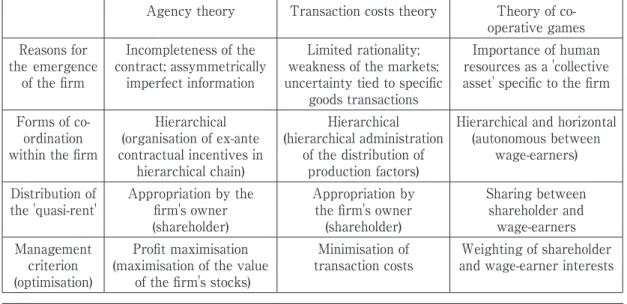
TABLE : Comparison of three approaches
Agency theory Transaction costs theory Theory of co- operative games Reasons for
the emergence of the firm
Incompleteness of the contract; assymmetrically
imperfect information
Limited rationality;
weakness of the markets;
uncertainty tied to specific goods transactions
Importance of human resources as a 'collective asset' specific to the firm Forms of co-
ordination within the firm
Hierarchical (organisation of ex-ante contractual incentives in
hierarchical chain)
Hierarchical (hierarchical administration
of the distribution of production factors)
Hierarchical and horizontal (autonomous between
wage-earners) Distribution of
the 'quasi-rent' Appropriation by the firm's owner (shareholder)
Appropriation by the firm's owner
(shareholder)
Sharing between shareholder and
wage-earners Management
criterion (optimisation)
Profit maximisation (maximisation of the value
of the firm's stocks)
Minimisation of
transaction costs Weighting of shareholder and wage-earner interests
1
Aix group is composed of a dozen of researchers based on the LEST laboratory in France who are searching for a new approach to apprehend the nature of the firm. Their bibliographic references are quoted at the last page.
2
According to Coase (1937), in the market economy, the firm only has a reason to exist if it allows greater efficiency
(i.e. economic efficiency of transaction costs). Such an advantage in relation to the market should theoretically result in
a 'surplus' which would remain after the payment of all the production factors at market price. Aoki calls this kind of
surplus an 'organisational quasi-income'.
It is itself an 'organised' structure, and this self-organisation has costs which may be compared to market costs.
- It is not only a recipient for but also a creator of collective knowledge.
- It represents an arena for continual trade-offs amongst the potentially divergent interests of the different players.
In spite of certain points of consensus, however, the theory of the firm hardly r e p r e s e n t s a h o m o g e n e o u s b o d y o f interpretations. On the contrary, it includes different approaches which compete with each other and take various positions relative to standard Neoclassical theory. Three of these may be singled out by way of example:
the agency theory, which, closest to the Neoclassical model, takes the price mechanism into account; the transaction cost theory (Williamson 1975), for which the enterprise is basically defined by default relative to the weakness of the markets; and the theory of co-operative games, which gives the most positive definition of the firm and above all raises very interesting possibilities for the institutionalist reformulation of the firm.
In order to simplify the argument, the following table offers a schematic view of these three approaches.
This summary comparison of the three approaches brings out a certain convergence in their methodological orientations: all of them attempt to analyse 'economic efficiency' (between the market and the organisation or between the different kinds of organisation).
At the same time, it reveals a fairly considerable divergence in the way that each construes the firm and its consequences for the different interpretive dimensions.
According to agency theory, which is the
most consistent with standard Neoclassical theory, the basic postulate is that the shareholder, who is the only legitimate owner and risk-taker, appropriates the totality of the organisational quasi-rent through hierarchical co-ordination and remunerates the other agents on the basis of their marginal productivity (Alchian and Demsetz 1972). The question that arises is how hierarchical co- ordination manages to ensure shareholder interest when it employs agents who do not necessarily share this interest or may even be opposed to it. The logic involved in solving this problem relies on (successive) contractual incentives between the principal and the agent: the shareholder delegates strategic decision-making power to company management by contract. This contract thus regulates ex-ante the relationship between effort and reward (under the supervision of the board of directors). Management in turn parcels out operational decision-making power to the middle managers, who agree to assume this responsibility in exchange for appropriate compensation; these managers intervene at the level of operational objectives to mobilise the rank and file, who adjust their level of effort according to the wages offered (theory of efficiency wages).
Such hierarchical co-ordination, which corresponds to the Taylorist model, functions through a chain of contractual incentives alternating monetary stimulation with market sanctions. Even in a world of incomplete information, this mechanism is thus supposed to guarantee the maximisation of stock values in conformity with the shareholder's initial interest (Jensen and Meckling 1976).
According to the transaction theory
(Williamson 1975), the basis of the firm is the
ex-post economy of transaction costs relative to the classic market exchange. Indeed, the integration of certain specific assets-- which the market is not able to provide--into the organisation allows the minimisation of transaction costs through the reduction of uncertainty (tied to the limited rationality) and the opportunism of the players. Once the boundaries of the firm are determined through comparative calculation, the principle of hierarchical organisation is systematically applied within the firms for reasons of allocative efficiency: hierarchical co-ordination serves to centralise the most relevant information concerning the allocation of resources; the (hierarchical) division of labour leads to economies through specialisation;
through the centralisation of decision-making, the hierarchy permits a diminuation of effects on the organisation of changes in the work environment, etc. As we can see, transaction theory thus deals with the allocation of resources. Williamson discusses the efficiency (in comparative terms, between organisation and market) of the kind of transaction according to the nature of the assets to be exchanged but rarely raises the problems of either the creation of new resources or of the distribution of the resulting profits.
We may ask, for example, who appropriates the organisational quasi-rent within this theoretical framework. Insofar as Williamson treats the work contract--a transaction involving the specific human asset--as an action that is contractual (long term) but basically individual, the overall distribution pattern does not seem very different from that developped by agency theory.
Relative to these views of the 'atomistic' firm combining methodological individualism, shareholder sovereignty and hierarchical co- ordination, Aoki introduces a new model of shareholder-wage-earner co-operation (Aoki 1988). This model is intended to be normative, or even generalisable, although it is derived from the stylised facts of the Japanese firm. Its originality lies in the emphasis placed on the primacy of wage- earner actions in the production of wealth.
Indeed, the author considers that the efficiency of the organisation in an uncertain world increasingly depends on the wage- earners' collective ability to co-ordinate themselves horizontally in the very acts of production as well as in the learning of this collective capacity. It is thus as if the wage- earners became a specific collective asset to the firm like the financial asset.
3In order to maintain an organisational equilibrium in the firm, the shareholder is thus required to accept the sharing of the organisational quasi- rent with the wage-earner, and the latter, along with the union representing his or her interest, acquires an advantage allowing the negotiation of not only the remuneration but also all the employment conditions influencing the acquisition of competences and a real influence on the firm's orientations. At first sight, such a situation of negotiation--or bargaining--seems potentially unstable and even conflictual. But the recent contribution of the games theory, according to Aoki, shows that a stable solution for the organisational optimum can exist if management -here assumed to be neutral and impartial- elaborates the firm's strategies by taking into
3