A Gloomy, Frail Rivalry
MORI Kazuko
Introduction
For three weeks during April 2005 such large cities as Shang- hai and Beijing became scenes of violent anti-Japanese demon- strations staged by mainly young people attracted to them by infor- mation sent via such media as the Internet and cell phones.
The Chinese government turned a blind eye to the protests at first, but eventually intervened with strong-arm methods to quell a series of disturbances that mark the lowest ebb reached in Sino- Japanese relations since the normalization of diplomatic relations in 1972.
In contrast to such political upheaval, 21st century East Asia as a whole has been tending more and more towards cooperation and the development of a de facto regional integration, on the strength of close, interdependence economic relations that have developed among its countries. This is why the political trouble that is occur- ring between the two most powerful members who should be forming the nucleus of cooperation in the region is a cause for uneasiness in terms of both security and prosperity.
Although the event that directly triggered the demonstrations
was Japanese Prime Minister Koizumi’s rejection of Chinese
government demands that he put a stop to his yearly visits to wor-
ship Japan’s war dead (including internationally convicted A-class
war criminals) at Shinto ceremonies held at Yasukuni Shrine, the
root causes are far more serious, since they are attributable to the
structural changes taking place in Sino-Japanese relations and the
change taking place in the balance of power in East Asia due to China’s economic and military emergence.
In my opinion, Sino-Japanese relations have gone through four distinct phases since normalization in 1972.
Phase 1, during the 1970s, was characterized by a tone of friend- ship, albeit in differing degrees, which gave birth to rough expectations about the development of new relations between the two countries. It was a time in which China was deeply concerned about strategic affairs and Japan responded positively to them, creating an era of “strategic friendship.”
The period was marked by the fall of the Deng Xianping regime, the death of Mao Zedong, the arrest and trial of the “Gang of Four,” and continuing turmoil within Communist Party ranks at the Central Working Conference convened by Deng Xiaoping, Ye Jianying and Chen Yun at the end of 1978, extending to the 11th Central Committee of the Chinese Communist Party (CCP ). It was also a time of the conclusion of a Peace and Friendship Treaty after the addition of an anti-hegemony article directed at the Soviet Union was cleared with Japan.
Phase 2, spanning the 1980s and early 90s, saw China’s efforts at reform and open-up policy supported by Japan in the spirit of the China’s “modernization.” While we cannot ignore the economic troubles stemming from China’s balance of payments deficit, the Japanese textbook controversy and litigation between the Nationalists and Communists governments over the rights to a Chinese-owned dormitory “Koukaryo” in Kyoto, Japan and China both recognized the structure of “aid-giving country” and “aid- recipient country.”
It was a time when the United States was seeking a “strong, stable China,” and has been called the “golden age” or “ honey- moon era” in relations between the three countries.
11 Ezra F. Vogel, Yuan Ming and Tanaka Akihiko eds., The Golden Age of the US- China-Japan Triangle,1972-1989, Harvard Univ. Press, 2002.
Phase 3, from the late 1990s to 2004, was a time of “structural fluctuation,” during which the Cold War ended, Taiwan demanded national independence, the US-Japan security system was restructured and China grew into an economic super power. During this time, the Japanese public began to feel that the “postwar” era of apologizing to China over what had happened in the past had come to an end.
Phase 4, has been ushered in by the recent anti-Japanese demon- strations of April 2005. The perception gap concerning the modern history is widening between the two countries as they enter a relationship of rivalry in both areas of economics and military security within East Asia. The petition opposing a bid by Japan for a permanent seat on the UN Security Council that was circulating during the time of the demonstrations among the world’s overseas Chinese community over the Internet suggests that the rivalry may turn out to be more nasty than friendly in the years to come.
This article aims at reexamining diplomatic normalization between the two countries that took place over thirty years ago, review the decade and a half “honeymoon” that began in the 1980s, analyze the structure of relations as we entered the “era of rivalry”
in 2005, and finally offer six proposals about how to rebuild relations between the two countries.
I. The Meaning of Normalization
1. US-China Reconciliation as a Precondition
[Strategic intentions of the US and China] Contact between the United States and China, which began in secret during the spring of 1969, took place while China was feeling a threat from the USSR after Warsaw Pact military troop intervention in the Czechoslovakian “liberalization” movement in August 1968 and a skirmish between Soviet and Chinese border guards at the Ussuri River in March of 1969. It was also a time during which the Nixon Administration was trying to extricate itself from the quagmire it had created in Vietnam.
Then from November 1970, secret US-Chinese talks got
2 Henry Kissinger, White House Years, Weidenfeld & Nicolson and Michael Joseph, 1979.
3 “Memorandum for the President’s Files, “Meeting Between President, Dr.
Kissinger, and General Haig, July 1, 1971,” in National Security Archive Electronic Briefing Book No. 66, William Burr ed., The Beijing—Washington Back-Channel and Henry Kissinger’s Secret Trip to China, September 1970-July 1971, Feb. 27, 2002.
underway in earnest through the mediation of Pakistan President Yahya Kahn, followed by a secret visit to China in July 1971 by then Special Assistant to the President for National Security Affairs, Henry Kissinger, and leading to the world-shaking US-Chinese communiqué that announced Nixon’s official visit to China in early 1972.
What the newly inaugurated Nixon expected of China was to get it involved in the Vietnam appeasement process and use improvement in US-Chinese relations as leverage in strategic negotiations with the Soviet Union.
As Nixon’s strategist, Kissinger, who believed that the conventional opinion of China in the eyes of US policymakers as a mixed up, reckless, irrelevant country with expansionist desires and crazy ideological views was mistaken, felt that the two countries should search for common interests and that China should be considered not in ideological, but rather geopolitical terms.
He believed that the Nixon administration was embarking on a new era of international relations and that one way of building a new perspective regarding American diplomacy was by making friends with a country inhabited by a quarter of the world’s population.
2According to a recently declassified memorandum of a meeting
between Nixon, Kissinger and security advisor Alexander Haig
held 1 July 1971, before the opening of negotiations with China,
they felt that it was necessary to impress on the Chinese that a
possible threat from Japan was on the horizon, to instill fear in the
Chinese concerning Japanese remilitarization and the Soviet threat,
and be as vague as possible on the question of Taiwan.
34 Niu Jun, “Historical Background to Changes in China’s US Policy at the End of the 1960s,” Dangdai Zhongguoshi Yanjiu, No. 1, 2000.
5Shen Zhihua ed., Zhongsi Guanxi Dangan (Archives on the Sino-Soviet Relations), Jan. 2000.
Concerning China’s motivation, among the various opinions posed among Chinese scholars, the Soviet factor, particularly the 1969 border incident, is most often cited. However, there is also the opinion that North Vietnam’s ability to overcome initial Chinese opposition and open secret talks with the US in the spring of 1968 had a lot to do with China following suit.
4Meanwhile, within the center of the Communist Party, which was controlled by Lin Biao and the “Gang of Four,” Zhou Enlai was operating carefully but persistently, as shown by the 8-point report on US-Chinese relations and the questions of Taiwan and Indochina he submitted to a meeting of the Political Bureau of the CC of CCP on 26 May 1971, including :
1. All US military forces and facilities be completely evacuated and removed from Taiwan Province and the Strait of Taiwan vicinity within a fixed timetable.
2. Taiwan is a territory of China and the question of its liberation is a Chinese internal affair closed to foreigners. In particular, Taiwan must be protected from Japanese militarism at all costs.
3. China will cooperate fully in the peaceful liberation of Taiwan, and conduct its Taiwan operations with the greatest care.
4. Unconditional opposition to any movement advocating “two Chinas” or “one China, one Taiwan.”
5. Until the above conditions are fully realized, no diplomatic negotiations will take place, but liaison offices can be set up in the two capitals.
6. China will not bring up the question of a PRC seat in the United Nations.
5[Major points of Kissinger / Zhou Talks] Kissinger and Zhou met
in July and October of 1971 to discuss future relations between the
two countries, Taiwan, Indochina, Japan, Korea, India-Pakistan
relations, the Soviet Union and what to tell everybody when Nixon’s
visit China.
Concerning the Taiwan question, Kissinger started out by proposing,
1. Two-thirds of the US forces stationed on Taiwan will be evacu- ated as soon as the war in Indochina is over. The remaining one-third will be gradually reduced in proportion to the progress made in US-China relations. This is the personal decision of the president that has not been divulged to either Congress or the executive branch.
2. The United States is pushing neither a “two Chinas” nor a “one China, one Taiwan” solution.
3. The US does not support the Taiwanese independence move- ment.
4. What we do want is a quick solution to our military problems during the president’s present term of office, if the War ends, and solution to political problems during the early part of his second term.
Zhou responded with his own conditions for a breakthrough of Sino-US relations.
1. It must be recognized that the Government of the People’s Republic of China is the sole legitimate government representing the Chinese people.
2. It must be recognized that Taiwan belongs to China; that it is an inalienable part of China which was returned to China after World War II.
3. US dose not support a two Chinas or a one China, one Taiwan policy and does not support the so-called Taiwan independence movement.
4. The spokesman of the Department of State no longer reiterates what he said, that the status of Taiwan is undetermined.”
6While expressing reservations about a “sole legitimate govern- ment,” Kissinger accepted Zhou’s demands and stated that diplomatic talks with China would be possible during the early part of Nixon’s second term.
6 “Memcon, Kissinger and Zhou, 10 July 1971 Afternoon,” Document 35, Document 36, in ibid., National Security Archive Electronic Briefing Book No. 66.
Heated debate continued on such issues as whether Taiwan should be excluded from the UN, whether the military alliance treaty between the US and Taiwan should be rescinded and where to compromise on the question of “sole legitimate government.”
In the end, driven by the choice to exclude Taiwan from the UN and allow the People’s Republic a UN seat, Kissinger drafted a joint communiqué stating in effect that the United States would not oppose the idea of one China inclusive of all Chinese people residing on either sides of the Strait of Taiwan.
[Nixon’s Visit to China and the Shanghai Communiqué] In Feb- ruary 1972, when Richard Nixon became the first American president to make a formal visit to China, Mao Zedong was more interested in talking about “philosophy” and left the diplomatic particulars up to Zhou Enlai.
7The political discussion that ensued between Nixon-Kissinger and Zhou included such diversified topics as the Taiwan question, the withdrawal of US troops from there, Vietnam, normalization of Sino-US diplomatic relations, releasing information about the Soviet Union, the US security alliance with Japan, Korea, and the India-Pakistan dispute. The result of these tough negotiations is the US-China Shanghai Communiqué.
In the Communiqué, both countries recognized the normaliza- tion of diplomatic relations as in their mutual interests and denied that they had any plans for hegemony in the Asia Pacific region.
Then the Chinese side went on to state that 1) the People’s Republic constituted the sole legal government of China, Taiwan is a province of China, 2) all U.S. forces and military installations must be withdrawn from Taiwan and 3) Chinese Government firmly opposes any activities which aim at the creation of “one China, one Taiwan,” “one China, two governments,” “two Chinas,”
and “independent Taiwan” or advocate that “the status of Taiwan remains to be determined.”
7 “Memcon of Nixon and Mao, 21 February 1972,” in William Burr ed., The Kissinger Transcripts —The Top-Secret Talks with Beijing & Moscow, The New Press, New York, 1999.
On the other hand, U.S. side declared: The United States acknowledges that all Chinese on either side of the Taiwan Strait maintain there is but one China and that Taiwan is a part of China.
The United States Government does not challenge that position. It reaffirms its interest in a peaceful settlement of the Taiwan question by the Chinese themselves. With this prospect in mind, it affirms the ultimate objective of the withdrawal of all U.S. forces and military installations from Taiwan. In the meantime, it will progressively reduce its forces and military installations on Taiwan as the tension in the area diminishes.
8While both countries also agreed on continued contact through liaison offices, etc. to discuss diplomatic normalization, it was not achieved until January 1979, due to such events as Nixon’s resigna- tion over the Watergate affair, the political attacks launched on Zhou and Deng by the “Gang of Four”, and the deaths of Zhou and Mao.
From these negotiations, it was China who gained the most.
Zhou must have breathed a huge sigh of relief when hearing Kissinger’s four conditions at the beginning of the talks of July 1971, for according to James Man of the Los Angeles Times, “in short, the discussions of Taiwan on Kissinger ’s trip were considerably more extensive than Kissinger or Nixon ever wanted to admit. The Nixon administration made many, though not all, of the concessions China had sought.”
9[US and China strategies towards Japan] In these negotiations between the US and Chinese leaders, it is interesting how freely they were able to talk about their respective images of and strategies toward Japan.
Zhou urged Kissinger of the need to beware of Japan, stating that if the US military forces were to withdraw from Asia, Japan in
8 Joint Communiqué Between the People’s Republic of China and the United States, 27 Feb. 1972.
9 James Man, Abour Face—A History of America’s Curious Relationship with China, From Nixon to Clinton, Vintage Books, 1998.
its newly found economic prosperity would return to Taiwan and the Korean Peninsula in military regalia, and demanding that Kissinger promise such a scenario would not come about, at least in Taiwan (9 July). Zhou continued,
Thus there is a great possibility that before the U.S. forces have withdrawn from these areas and from Taiwan, armed forces of Japan shall enter. Entry into Taiwan would be possible because Japan and Taiwan still have a treaty, concluded with Chiang Kai-shek – the so-called Peace Treaty, and they are now stressing that fact.
10Zhou cited Japan’s imperial institution as the basis of Japanese militarism, and severely criticized US policy and the strengthening of the US-Japan security agreement as supporting the gradual revival of militarism there. Even in October, during the final stages of drafting the Communiqué, Zhou was adamant about gradual US withdrawal promoting the deployment of Japanese troops to Taiwan.
In response, Kissinger repeated that the presence of US troops was a deterrent (“bottle cap”) to Japanese military escalation and that the US-Japan Security Agreement existed for that purpose.
On 9 July, Kissinger told Zhou who arguing the evacuation of US troops from Japan,
In fact, Mr. Prime Minister, from the point of view of the sort of theory which I used to teach in universities, it would make good sense for us to withdraw from Japan, allow Japan to re- arm, and then let Japan and China balance each other off in the Pacific. This is not our policy. A heavily rearmed Japan could easily repeat the policies of the 1930’s.
11At Feb. 1972 talks, President Nixon stated,
The Japanese, with their enormously productive economy,
10Memcon, Kissinger and Zhou, 10 July 1971, in ibid., National Security Archive Electronic Briefing Book No. 66, The Beijing—Washington Back-Channel and Henry Kissinger’s Secret Trip to China, September 1970- July 1971, Document 35.
11“Memcon, Kissinger and Zhou, 9 July 1971,” in ibid., National Security Archive Electronic Briefing Book No. 66, ibid., Document 34.
their great natural drive and their memories of the war they lost, could well turn toward building their own defenses in the event that the U.S. guarantee were removed. That’ s why I say that where Taiwan is concerned, and I would add where Korea is concerned, the U.S. policy is opposed to Japan mov- ing in as the U.S. moves out, but we cannot guarantee that.
And if we had no defense arrangement with Japan, we would have no influence where that is concerned…It is our policy to discourage Japan from any military intervention in Korea……I cannot guarantee it, but we believe we can very strongly influence Japan and our purpose will be to dis- courage any Japanese adventure against Korea or Taiwan.
12On the other hand, both parties held surprisingly similar images of Japan. To Kissinger’s comment that in contrast to the universal points of view held by the Chinese in accordance with tradition, Japanese points of view tend to be narrow in scope, Zhou replied,
“They’re a group of islanders.” Kissinger went on to complain;
The Japanese have no sensibility for the attitudes of other people because of this cultural concentration on themselves. I say this because this peculiarity of Japan imposes special responsibilities on all who have to deal with them. You as well as us (22 October 1971).
13National characteristics aside, Zhou was being contradictory in his statements about US policy towards Japan: on the one hand, asking the US to pull in the reins on Japan military escalation, while at the same time calling for American withdrawal from the region. Zhou had no doubt put his hopes in a neutral Japan and a peace-loving Japanese people. After the 1971 October talks, a rather ambivalent Kissinger reported to Nixon, “we agree that an
12 “Memorandum of Conversation, 23 Feb. 1972,” in National Security Archive, William Burr ed., Nixon’s Trip to China: Records Now Completely Declassified, Posted, 11 Dec. 2003, Document 4.
13National Security Archive Electric Briefing Book, No. 70, in Negotiating U.S.- Chinese Rapprochement, New American and Chinese Documentation Leading up to Nixon's 1972 Trip, Document 13, 22 Oct. 1971.
expansionist Japan would be dangerous, but we disagree on how to prevent this. Our triangular relationship could prove to be one of our most difficult problems.”
14The greatest problems for Zhou was on what ideological and strategic basis to decide about normalization of relations with Japan coming up next year, given his present pessimistic view about that country in general and what to do about it politically. I wonder how much stock he put in Kissinger’s “guarantees” to “put a lid on”
possible Japanese military escalation.
2. Negotiations over Sino-Japanese Diplomatic Normalization
[Tanaka’s visit to China] With the above rapprochement reached between China and the United States, the dam that had held back unofficial political and economic ties between China and Japan to a trickle suddenly burst.
In particular, during his visit to China in July 1972, Komei Party Chairman Takeiri Yoshikatsu was surprised to hear Zhou said that Chairman Mao had mentioned relinquishing China’s right to demand war reparations from Japan, since such demands would overburden the Japanese people, and that Mao was also thinking that a joint statement to that effect would be in order. Takeiri recalls, “Thinking we would have to pay somewhere in the range of fifty billion dollars, I began shaking all over after such a bomb- shell.”
15It was in this way that one of the most serious barriers separating the two countries was eliminated before Prime Minister Tanaka Kakuei’s official China visit.
Concerning another large barrier, Taiwan, in the Zhou-Takeiri
14 Kissinger to Nixon, “My October China Visit: Discussions of the Issues,” in ibid., Document 20.
15 Takeiri Memorandum, in Isii Akira, Zhu Jianrong, Soeya Yoshihide, Lin Xiaoguang eds., Kiroku to Koushou : Nitchukokkouseijouka—Nitchuheiwayukou- jouyakuteiketu Koushou (Negotiations Leading Up to Sino-Japanese Diplomatic Normalization and Conclusion of the Treaty of Peace and Friendship: Records and Historical Analysis), Iwanami Shoten, 2003.
talks and others, Japan refused a Chinese proposal for a gentlemen’s agreement to break political ties with Taiwan and left that issue for Tanaka’s visit during September 1972, about two months after he had been appointed prime minister.
It was on the 29th of that month that Tanaka reached an agreement with Mao and Zhou concerning the “joint communiqué,”
which ended twenty-seven years of “abnormal” relations between the two countries.
[Sino-Japanese Joint Communiqué] The four most important points in these epoch-making negotiations were ;
1. As a result of Japan’s reflection over the past war, all hostilities would end between the two countries. The communiqué said in preamble and Article 1 as follows;
The Japanese side is keenly conscious of the responsibility for the serious damage that Japan caused in the past to the Chinese people through war, and deeply reproaches itself. The abnormal state of affairs that has hitherto existed between Japan and the People's Republic of China is terminated on the date on which this Joint com- muniqué is issued.2. The PRC was recognized as the “sole legal government” of China, and Japan agreed to cut off all political relations established with Taiwan (the Republic of China) since 1952.
Article 2 of the Communiqué said;
The Government of Japan recog- nizes the Government of the People's Republic of China as the sole legal Government of China.3. China abandoned all demands for war reparations from Japan.
Article 5 of the Communiqué said;
The Government of the People's Republic of China declares that in the interest of the friendship between the Chinese and the Japanese peoples, it renounces its demand for war reparation from Japan.4. The inclusion of an article, implicating the Soviet Union, opposed to any country’s attempt to gain hegemony over the Asia Pacific region. Article 7 of the Communiqué said;
neither of the two countries should seek hegemony in the Asia-Pacific region and each is opposed to efforts by any other country or group of countries to estab-lish such hegemony.5. Japan cut all political ties to Taiwan in accordance with Article
VIII of the Potsdam Agreement. However, the Communiqué did not mention the “Taiwan question,” which was left up to such comments made by Foreign Minister Ohira Masayoshi as;
“Diplomatic relations with the ruling government of Taiwan will come to an end,” “In the future as well, we do not hold to [the idea of] ‘two Chinas’ nor do we have any inclination of backing the ‘Taiwanese independent movement’” (written statement by Ohira Masayoshi at the last summit talks), and
“As a result of the normalization of relations between Japan and China, any further continuation of the peace treaty between Japan and the Nationalist Republic of China is meaningless and we consider it defunct.”
163. How to Evaluate Normalization
[From Japanese side] Despite being a by-product of rapproche- ment between China and the United States, the normalization of Sino-Japanese relations in 1972 marked the first time since the end of 19th century that equality and peace was established between the two countries—in only four days of negotiations. However, looking back, one cannot avoid seeing the many problems stemming from this negotiation.
On the Japanese side, the government, especially its foreign relations sector, was deeply concerned about how to legitimize its diplomatic relations with the Republic of China government on Taiwan since 1952.
There was not even the narrowest overview about how it was going to relate to the Mainland and no serious questioning about whether normalization marked the final solution to problems surrounding the Sino-Japanese War.
Concerning what originally should have been the most outstanding problems: i.e., war reparations and the US-Japan
16 For the Sino-Japanese Joint Communiqué, see China Division, Asia Bureaou, Japan Foreign Office, Nitchukankei Kihonshiryoushu 1949-1997 (Basic Sources on Sino-Japanese Relations 1949-1997), Kazankai, 1998; for Ohira’s memo and press conference, see op. cit., Kiroku to Koushou.
Security Treaty, China chose not to pursue the former and not to bring up the latter.
The only problem left for the summit talks to solve was the Taiwan question. On the last day of those talks, Tanaka out and out told Zhou,
I came here with a strange resolve that the question of Taiwan was a Japanese domestic problem, particularly within the confines of the Liberal Democratic Party…because of the long history of relations between our two countries, I was prepared for a comparable amount of difficulty.
17In an interview conducted ten years later, Tanaka reiterated, It was a domestic rather than a diplomatic problem. Over the one hundred years since the Meiji Restoration, every cabinet has faced the same vexing problem. The fact that Sino- Japanese problems have developed into a large cancer growth within Japan is not healthy for this country. If we were to solve those problems, we could reduce all the existing domestic difficulties by about two-thirds.
18Here we see clearly the true grit of Japanese diplomacy: never forget that domestic politics gets top priority.
[Were historical issues resolved?] Secondly, one can observe that the Japanese government and its Foreign Office at the time probably figured that the negotiations marked the final solution to the problems confronting the two countries regarding the Sino- Japanese War—which have come to be known as “our historical issues.” After all, in the Communiqué, China accepted Japan’s
“remorse” over the past and forwent demands for war reparations.
As expressed by Foreign Office Treaty Bureau Chief Takashima Masuo at the stage of the first foreign ministerial level talks, “It is my hope that the problems related to settling abnormal relations between Japan and China in the past, including the War,
17Ibid., Kiroku to Koushou.
18For Memoirs of Tanaka Kakuei, see Yanagida Kunio, Nihon wa Moeteiruka? (Is Japan Burning?), Koudansha, 1983.
will all be solved by the present talks and resulting Communiqué, thus eliminating any more backward-looking tasks.”
19However, is it really possible or feasible to “settle all” the misery, damage and emotional scars caused by fifteen years of military invasion and occupation in a couple of days of negotiations and a resulting Communiqué?
Should not the deep significance embedded in the short phrase
“forgo reparations” have conjured up a feeling that there were problems still to solve?
The reason why the “pattern of a China demanding apologies for the War on the basis of the emotional state of its people and a Japan declaring ‘everything is solved’ on the basis of law”
20has continued to the present day can be attributed to the lack of
“historical consciousness” on the part of Japanese negotiators in 1972.
[Political solution] Thirdly, let us compare the situation to the process of US-China rapprochement. Unlike the US-China case, the normalization of Sino-Japanese relations was achieved in just four days, but despite differences in pace, both sets of negotiations constituted “political solutions” to the problems at hand.
In the case of the US, Nixon and his chief strategist Kissinger had decided to bypass both the State Department and public opin- ion and go the route of top secret talks. In the case of Japan, as well, strong political leadership was assumed by both Tanaka and Ohira. According to Hashimoto Hiroshi, China Section chief at the time, the mainstream thinking at the Foreign Office was still embrac- ing “two Chinas,” resulting in its opposition to normalization with the Mainland at the cost of severed relations with Taiwan.
21The greatest difference between Japan and the US, on the other hand, was the decision by Tanaka Kakuei to embark on a political
19Ibid., Kiroku to Koushou.
20 Iokibe Makoto ed., Sengo Nihon Gaikoushi—New Edition (History of Postwar Japanese Diplomacy, New Edition), Yuhikaku, 2006.
21Op. cit., Kiroku to Koushou.
solution to normalization based on widespread public support, including that of the pro-China faction (a.k.a. “the well-diggers”) within the Liberal Democratic Party and of the business commu- nity, which was enjoying a “China boom” at the time. It may even be said that Tanaka obtained the premiership on the strength of his clear statements in favor of normalization.
Soeya Yoshihide, an expert of Sino-Japanese relations, has argued that Japan, which during the postwar era never attained the status of a “world power” on the level of the US or China due to its stigma as a former military aggressor-cum-loser, refused to play the strategic game on their level and was in turn left out, thus “having to lean towards quick normalization in the wake of US-China rapprochement.” In addition, during the China-Japan negotiations
“solutions were reached for the most part by China showing understanding about Japanese demands,” Soeya observed.
In Soeya’s opinion, in contrast to their counterparts in the US- China negotiations, “Japanese leaders chose to understand normali- zation in the light of domestic politics and the international legal aspects of the existing treaty with the Nationalist Republic,” indi- cating “Japan’s postwar character,” “a lack of strategic sense.”
22In my opinion, the problem lies not in a lack of strategic sense, but rather one of diplomatic sense in trying to solve by far the most important foreign relations problem in Japan’s postwar history like it was a domestic political issue which, by the way, has continued unsolved for over thirty years now.
[From Chinese side] Turning to the Chinese side, if one looks in detail at its rapprochement with the US and normalization of relations with Japan, from China’s standpoint, the latter appears as an extrapolation of the former, in a scenario the motivation for
22 Soeya Yoshihide, “US-China Relations and Japanese Diplomacy During the 1970s” in Nenpou Seijigaku, 1997—Kikino Nihon Gaikou 1970 nendai (Political Science Annual 1997: Japan’s Diplomatic Peril of the 1970s), Iwanami Shoten, 1998; Soeya, “From US-China Rapprochement to Sino-Japanese Diplomatic Normalization,” in op. cit., Kiroku to Koushou.
which stems from 1) strategic concerns about the Soviet Union and 2) putting an end to Japan-Taiwan relations once and for all. The
“strategic sense” in such a scenario may have raised China’s strategic status in international politics, but it also brought about compromises with Japan and showed a brand of diplomacy having little or no relevance to the needs of its people.
Let us consider first the problem of war reparations, the aban- donment of which, as we shall see, solidified the strategy of the top Chinese leaders.
It was only after the official visit of Prime Minister Tanaka was confirmed that Communist Party cadres and the Chinese public learned of such an important decision, for it was around the end of July 1972 that Zhou Enlai drew up a directive explaining the reparations question to the nation.
According to Chinese expert Li Zhengtang and others, Zhou’s argument consisted of three main points.
1. Since prior to the normalization of diplomatic relations in 1972, Taiwan’s Jiang Jieshi had already relinquished China’s claim to reparations, the Communist Party must not show any less magnanimity.
2. In order to revive diplomatic relations with China, Japan had to first cut off relations with Taiwan. If the central government took a tolerant attitude concerning reparations, the Japanese would follow suit concerning its relations with Taiwan.
3. If China had demanded reparations, the burden of payment would ultimately have fallen upon the Japan people as a whole, and heaped even more hardship on their lives. That is not the kind of friendship China wanted to form with them.
23On 14 September, a gathering of 10,000 was convened in Shanghai, and its decision was broadcast to 140 thousand party cadres across the country. The decision said;
many of you will probably be angered to see the Hi-no-Maru [Japanese flag] again…However, the Japanese people are,
23Li Zhengtang, Zhongguoren Guanzhude Huati: Zhanzheng Suopei (An Issues of Concern to Chinese: War Reparations), Xinhua Chubanshe, 1999.
like us, also victims of militaristic aggression and war, and thus should not be forced to take responsibility for the crimes committed by Japan against China in the past…We call upon the whole nation to understand the significance of our invitation to Prime Minister Tanaka and make preparations to entertain his diplomatic party.
24In other words, during its negotiations with Japan in 1972, the Chinese leadership was mainly concerned with cutting off political relations between Japan and Taiwan, and in the end, the most effective means for achieving that goal turned out be the abandon- ment of claims to war reparations.
According to Zhang Xiangshan, “Because of Chairman Mao’s extremely strong influence on Chinese public opinion, no one dared criticize his decision to relinquish reparations.”
25However, in 2005, three years after Zhang’s disclosure, in the midst of the anti-Japanese demonstrations, the internet was suddenly filled with invective over Mao and Zhou’s fundamental policy towards Japan first conceived in the early 1950s, including their distinguishing Japanese militarists from the masses and their relinquishing war reparations claims.
[Balance of power strategy] China’s normalization of relations with Japan, which was born out of rapprochement with the United States, was strongly characterized by strategic decision-making and a belief in the idea of “the balance of power,” Especially with regard to the Soviet Union.
This situation is best indicated by a comment made by a very jolly Mao to Henry Kissinger on 17 February 1973;
It’s been a year since President Nixon’s visit and already we
24 Luo Pinghan, Zhongguo Duirizhengce yu Zhongri Bangjiaozhengchanhua (China’s Japan Policy and Sino-Japanese Diplomatic Normalization), Shishichu- banshe, 2000.
25 Zhang Xiangshan (Suzuki Eiji Translation), Nitchukankei no Kanken to Kenshou—Kokkouseijouka 30nen no Ayumi (Observation and Analysis of Sino- Japanese Relations: Thirty Years of Diplomatic Normalization), Sanwashoseki, 2002.
are in agreement over the hegemony issue. Our relations with Japan are also progressing since we changed our fundamental thinking about them. China now looks upon Japan as an important force in the [anti-Soviet] struggle against hegem- ony…
We are all part of a united front now, wouldn’t you say? The US, Japan, China, Pakistan, Iran, Turkey, Europe…
26Mao was under the impression that all the countries named above were members of some united anti-Soviet bloc.
Furthermore, in his meeting with Japanese Foreign Minister Ohira on 5 January 1974, Mao revealed his idea of the combined utilizable international power of countries including the Unites States and Japan that would resist Soviet expansion as “one large fragment.”
27In sum, Mao and Zhou’s decision to normalize relations with Japan arose mainly from strategic considerations regarding the US, USSR and Taiwan, not from any analysis or practical policy to- wards Japan per se.
In particular, their failure to seek a popular consensus over war reparations would breed discontent in China under a growing atmosphere of a political thaw from the 1990s on.
[Mao-Zhou’s “liangfen-lun”] Turning to Mao and Zhou’s idea of distinguishing Japanese militarists from the masses [ liangfen-lun ], as a moral reason why reparations should not be sought, to begin with, it was in 1952 that China embarked on “Japanese operations”
with the establishment of an official liaison section headed by Zhou and put in charge of Liao Chengzhi; and 1953 marked the inception of the policy direction followed by Mao and Zhou that the responsibility for Japan’s invasion of China lay in the government and a faction of militarists, which should be distinguished from the
26Gong Li, “From Rapprochement of Sino-US Relations to ‘(Anti-USSR) United Front Strategy,’” Zhonggong Zhongyang Dangxiao Xuebao, No. 2, 2002.
27Ibid.
Japanese people as a whole.
28The Communist Party’s first five-point policy towards Japan issued in March 1955 called for opposition to the revival of milita- rism, distancing Japan from the US and “treating the Japanese people with understanding and sympathy.
29This policy has not changed in official circles to the present day.
Secondly, the decision to relinquish claims to war reparations was made in January 1964 (according to the article written by Zhu Jianrong in 1992), when Zhou took steps to suppress (under the auspices of Mao) calls for payments emanating from among the Chinese leadership for the following reasons:
1. Neither Taiwan nor the United States were claiming such repa- rations.
2. Any payments themselves would do little to stimulate the Chinese economy.
3. Reparations defied Mao’s thought to distinguish between militarists and the Japanese people they victimized.
4. Demand for large sums of reparations would delay negotiations with the Japanese over normalization of diplomatic relations.
30The above Chinese policy strategy can be looked upon as quite honorable and was indeed welcomed with gratitude by Japan.
Be that as it may, the decision to relinquish claims to repara- tions does not reflect in any way the voice of the people who suffer- ed at the hands of their Japanese occupiers during the War, not to mention the fact that they only heard of the decision during Prime Minister Tanaka’s visit. In the convincing words of Zhu Jiangrong;
There is the belief in China that the decision by leaders like Mao and Zhou “not to seek reparations” on ideological grounds was too hasty, in that public opinion was not sought.
This belief forms the background of recent efforts to seek
28Wu Xuewen, Fengyuyinqing— Wosuojinglide Zhongriguanxi (Ce Sera-Sera: My Journey Through Sino-Japanese Relations), Shijiezhishi Chubanshe, 2002.
29Zhang Xiangshan, op. cit.
30 Zhu Jianrong, “Why China Abstained from War Reparations,” Gaikou foram, Oct., 1992.
reparations…
[It is fine that Sino-Japanese relations are in good standing, but] when one hears complaints from Japan about China being ungrateful for ODA allotments, the reaction from China is that ODA was supposed to be a gesture in response to the abandonment of war reparations. China’s relinquishing such claims should be etched in the hearts of the Japanese people, and ODA from Japan should be warmly greeted in China as how the Japanese feel.
31Therefore, it is in this sense that the normalization of Sino- Japanese relations in 1972 revealed a “lack of strategy” on the part of Japanese leaders, who were concerned only with their own domestic agendas in a display of incredibly poor diplomatic skills, while the Chinese leadership, despite a powerful display of inter- national political savvy and basic moral fortitude, was out of step with public opinion at home.
To put it one way, Chinese diplomacy was replete with Wilsonian idealism, Marxist internationalism and the ideals of traditional Chinese kingship.
Nevertheless, Japanese leaders at that time and since the 1990s have failed to understand, reflect upon or respect China’s diplomat- ic gestures towards Japan at that time. Indeed, one must again marvel at the completely different diplomatic character and style displayed by both countries in moralization negotiations.
[Views of Jin Xide] Let us turn here to the discussion about the so- called “1972 Sino-Japanese regime,” which is still legally in effect after over thirty years. There is strong recent opinion in China that it is time for both countries to return to the fundamentals of the “72 Regime” as the prototype in any future relations.
One example is Jin Xide, an expert in Sino-Japanese relations at the Institute of Japanese Studies, Chinese Academy of Social Sciences who has termed the Taiwan question and the historical
31 Zhu Jianrong, “Implications for the 21st Century Pioneered by Our Predeces- sors,” in op. cit., Kiroku to Koushou.
issues existing between the two countries “very crucial and delicate problems,” two fundamental preconditions of normalization in 1972, which face “very important challenges” today in the 21st century.
According to Jin,
32the “Regime of 1972” constitutes a consen- sus formed between the two countries about the principles for dealing with such problems as Taiwan, history, regional security and territory. It is the culmination of the mutual experience, lessons learned and national interest considerations of leaders in both countries. Therefore, let us review what actually makes up the
“Regime of 1972.”
To begin with, there is the “historical issues” part, in which, according to Jin, “both Japan, in reflection upon its war of aggression towards China, and China, in its gesture of friendship not to seek war reparations, promote healthy mutual relations in the spirit of stepping into the future through the looking glass of history.”
And if we can go as far as to assume that the abandonment of war reparations was a proposal made by the Chinese side on the condition that Japan reflect upon its reckless and aggressive past, then, as Jin argues, the series of events that have occurred in Japan---namely, worship of war dead by prime ministers at the Yasukuni Shrine, comments by cabinet members, etc. denying Japan’s military actions constituted aggression, and history textbooks that “tend to legitimize Japan’s war efforts”—fly in the face of such conditions.
Secondly, concerning the “Taiwan question,” which is related to the 1972 Agreement that 1) “Japan recognizes the People’s Republic as the sole legal government of China, 2) Taiwan is a part of the Republic, 3) the Taiwan question is a Chinese domestic matter, and 4) Japan will no longer conduct formal relations with Taiwan.”
32 Jin Xide, Zhongri Guanxi: Fujiao 30 Zhounian de Sikao (Sino-Japanese Relations: Reflection on the Past 30 Years Since Reconciliation), Shijiezhishi Chubanshe, 2002.
Jin asserts that the fact of Japan becoming clearer about its support of the United States policy of involvement in Taiwan since the 1990s, the formation of confabs involving Taiwanese and Japanese politicians, and the redefinition of the US-Japan Security Treaty all signify a strong move away from what was agreed upon in 1972.
[Is 1972 Agreement unchangeable?] Concerning the permanency or durability of the Regime of 1972, Jin states
[It] ended one hundred years of feuding between the two countries, including a Cold War-related conflict during the final twenty years of that era. We can foresee no other framework to replace it completely now or in the future; and talk of going beyond it is not to be taken lightly.
While the points that Jin makes are in themselves unassailable, the circumstances he describes is not that simple, for the “Regime of 1972” itself is by no means flawless and the huge changes that have occurred in both the international environment as a whole and power relationships between China and Japan, in particular, cannot be ignored.
I have already outlined above problems of China’s motivation and Japan’s lack of strategy, resulting in neither party being able to view accurately the long-range ramifications of the complex, emo- tion issues that were facing them, but a more important problem is what has happened during the thirty years since the agreement was reached: for example, such completely unforeseen occurrences as China’s concerns about the Soviet Union ending with the Cold War, democratization in Taiwan and the concomitant move for national independence shaking the foundations of the “one China” principle, changes that have occurred in Japan’s political structure and generational composition since the 1990s, Chinese public opinion being strengthened by a policy of openness both at home and abroad, and probably most important, China’s transformation to a regional economic power, thus changing the Sino-Japanese power balance in the process.
These comments by no means indicate any criticism on the part
of this writer of the 1972 normalization agreement, just that every-
thing was by no means perfect, meaning that the perpetuity of the
“Regime of 1972” has come into serious doubt, what with the fact that since the late 1990s, Sino-Japanese relations have entered an era of structural fluctuation, and since the anti-Japanese demonstrations of 2005, an era of renewed rivalry.
The time has come for a redefinition of the “spirit of 1972” and a new “agreement” in that spirit.
II. The 1980s: The “Honeymoon Years”
1. Reform and Open-up in China
[Honeymoon years] The 1970s set the tone for mutual “friend- ship,” which while sincerely felt by both sides, was filled with expectations, as roughly hewn as they were, of a new Sino-Japan- ese relationship. China’s deep worries about Japan’s new relations with the United States and the existence of a Soviet threat, combined with Japan’s response, created what can be called an “era of strategic friendship.” China upheld the US-Japan Security Treaty, which she had criticized so vehemently in the past, and even expressed approval for a build-up of Japanese military might. Thus, in August 1978 the Sino-Japanese Treaty of Peace and Friendship, filled with rhetoric opposing regional hegemony, was signed.
However, during the 1980s, when China conducted a series of reforms leading to openness, Japanese policy was fundamentally orchestrated in support of Chinese modernization, on which China rested large hopes.
Specifically, Sino-Japanese relations entered what seemed to be an era of progress, when in 1982 China came up with a moderniza- tion plan four times of GDP scale of previous attempts and embark- ed on an “independent, autonomous foreign policy” by a planned restructuring of its relations with the US and USSR.
It was an era under pro-Japanese leadership, Hu Yaobang, in
which Japan lent assistance and China gladly accepted it, despite
trouble in the areas of Japanese school textbooks, Yasukuni Shrine
visits by prime ministers, and the Guanghua Dormitory Incident.
Two Countries recognized that there were “donor-recipient relatioship” between them. It was a time that everyone including the US leaders welcomed “a strong and stable China,” a veritable
“golden age,” a “ honeymoon” to cite Ezra Vogel and Tanaka Aki- hiko.
33[Deng’s visit to Japan] In October 1978, Deng Xiaoping came to Japan for the purpose of ratifying the Treaty of Peace and Friend- ship and became the first Chinese leader to meet the emperor, who stated, “Despite the unfortunate events that have occurred during the long history of relations between our two nations, it is now time to put away the past and promote mutual goodwill in a long and lasting relationship of peace.”
When the subject of US-Japan relations and Japan’s defensive capabilities came up in talks with Prime Minister Fukuda, Deng expressed understanding about the US-Japan Security Agreement and Japan’s military buildup, while at the same time praising Japan’s efforts to assist the world’s developing countries.
34What should be pointed out here is Deng taking a long look around and commenting, “There is a lot to be learned from the great Japanese nation,” adding in one press conference “and much technology and capital to borrow,” and at another, “we are open to the possibility of foreign loans from Japan.”
When asked of his impressions of the Shinkansen bullet train he was riding from a VIP guided tour of the Shin-Nittetsu’s Kimitsu Foundary (courtesy of Board Chairman Inayama Yoshihiro) in Chiba Prefecture bound for Kyoto and a tour of Panasonic’s television facility in Osaka (courtesy of former Board Chairman Matsushita Konosuke), Deng replied, “It’s like running with the help of the wind, we’re running, too, and need as much help as we can get.”
35Deng’s request for a boost would symbolize a new step in economic relations between the two countries.
33Ezra F. Vogel, Yuan Ming, Tanaka Akihiko eds., op. cit.
34 Asahi Shinbun, 1978.10.24.
Incidentally, from the conclusion of a long-term trade agreement (February 1978), an oil-crisis plagued Japan’s prayers that exports of plant and equipment would be met with imports of Chinese oil were answered, creating a trade structure between the two countries that grew by leaps and bounds.
[China cancelled contracts of plants] However, it was also a time of growing economic friction between the two “friends,” as a China strapped for capital was forced to announce the cancellation of part of the US$8 billion dollar plant purchases it contracted during 1978-9. In February 1979, the Chinese government announced that due to an inability to pay costs, it was putting a portion of the contracts signed for the Baoshan Steel Foundry project on hold.
Then in January 1981, it was announced that the second phase of the Baoshan Project and contracts for the construction of petro- chemical plants in such locations as Nanjing, Shandong and Beijing had been cancelled, to the tune of US$3 billion.
A cloud had appeared on the horizon in the form of China’s haste in building economic relations with Japan without adequate capitalization planning.
The problem was solved by financial assistance from Japan in March 1981 and China’s economic adjustment policy. These stabilized the Deng regime and paved the way for its open, liberal foreign policy.
The Baogang Project marked the tone of Sino-Japanese relations during the 1980s, with the creation of a Chinese image of Japan as a helping hand in the task of modernization. It was a time that Daichi-no-Ko, Yamazaki Toyoko’s novel of a Japanese youth left behind in northeastern China at the end of the war, raised in a Chinese foster home, employed as an engineer at the Baogang facility and given the opportunity to reunite with his Japanese father, was made into a TV drama series and enjoyed top ratings among both Japanese and Chinese viewers.
35Pekinshuuhou, No. 43, 1978.
2. Japanese Aid and Chinese Modernization Policy
[Acceptance of Japanese loans] It was at the December 1978 the 3rd congress of the Central Committee of CCP that farewell was bid to the Mao Zedong era, with such decisions as “the movement of our entire center of gravity to building the economy.” Then its 12th National Congress of the CCP in 1982 announced the “four modernizations policy,” which called for a quadrupling of industrial and agricultural output over the next twenty years and raising the living standard of the people to “about the middle level.”
From that time on, the Chinese economy has continued to grow, achieving the quadrupling goal in 1995, five years earlier than expected.
“Four Modernization Project” will need tremendous funds. At what time and with what intention did Chinese leadership decide to introduce foreign capital? The process began in May 1978 when on the basis of a fact-finding tour of Europe conducted by Deputy Prime-Minister Gu Mu, head of the National-Planning Committee, Deng proposed,
1. the promotion of plant and equipment imports
2. the necessity to decide on whether foreign loans would be requested for building the economy
3. that time is of the essence
Japan was the first country to respond. In September 1978, during a visit to China by Japanese members of the business community, China-Japan Economic Association Chairman Inayama Yoshihiro told Chinese officials that the Japanese government was ready with ODA funding for them, and Keidanren Chairman Doko Toshio explained yen-based foreign loans.
This was followed by Deng’s comment during his Japan visit mentioned previously, and a year-end press conference in Hong Kong given by Chinese Foreign Trade Minister Li Qiang, who stated, “China is prepared to accept government loans or private sector funding under the appropriate conditions.”
According the memoirs of a Chinese foreign trade bureau
official, after Kimura Yichizo, chairman of the Kansai Headquarters
of the Japan External Trade Organization, advised Gu Mu to accept
government funding from Japan in May 1979, Gu ordered him to
consult with the Japanese Embassy about aid conditions, upon which he discovered that China qualified by virtue of its 350 dollar per capita GDP, resulting in the start of project planning to that effect.
36Gu then met with Prime Minister Ohira in Japan in September to formally request yen-based loans for the first time.
Although China had received foreign loans from the Soviet Union several times during the 1950s, this was the first time it had sought aid from the Western bloc. To introduce capital from a capitalist country, especially in the form of government loans, must have required a serious leap of faith and desperation.
[Ohira’s three conditions for aid to China] During his visit to China during December 1979 Prime Minister Ohira promised to lend 50 billion yen during fiscal year 1979 for six infrastructure- related construction projects in such top priority areas as seaports, railways and hydraulic power facilities, marking the beginning of four such loans amounting to 3 trillion yen over a 16-year period. In Beijing, Ohira outlined three conditions for Japanese aid to China, which also highlighted Sino-Japanese relations in general during the 80s:“No military-related aid would be given, maintain an economic balance with neighboring countries and relations between us must not be exclusionary.”
37First of all, it was the intent of the Japanese to support an open and free China; secondly, there was the feeling of giving something back in return for China’s relinquishing claims to war reparations;
and finally, the Japanese government was fundamentally dedicated to maintaining a balance among the countries, beginning with ASE- AN, it was presently giving aid.
The Sino-Japanese economic cooperation which characterized the 1980s and early 1990s surpassed the framework for Asian countries up to that time, in that it went beyond mere post-WWII mop-up diplomacy, and in this sense, marked an important turning
36Huanqiu Shibao (Global Times), 2005.12.27.
37Op. cit., Nitchukankei Kihon Shiryoushu.
point for Japanese diplomacy.
38There is no doubt, however, that such diplomacy, while supplying a now realistic China with huge untied loans in order to keep it that way, had its eye clearly fixed on the prize of Chinese cooperation in fossil fuel development for Japan’s security needs in the area of energy.
[Hu Yaobang and Japan] No honeymoon can be successful with- out a loving partner. Japan had two during the 1980s in the guise of Hu Yaobang and Zhao Ziyang. On his visit to Japan in March 1982, Prime Minister Zhao emphasized the three principles of peace and friendship, co-prosperity and long-term stability in relations between the two countries.
At the 12th CCP Congress of 1982, where China declared “in- dependence and autonomy” from the strategic partnership with the United States and the USSR, Hu, the Party’s General Secretary, included Japan in his address, stating, “The development of peace, friendship, co-prosperity and lasting stability between China and Japan are not only the common wishes of our two peoples, but will also serve to stabilize and pacify the whole Asian-Pacific region.”
Hu made his visit to Japan in November 1983, during which in talks with then Prime Minister Nakasone, Nakasone added a fourth principle of “mutual trust” and proposed the formation of the 21st Century Sino-Japanese Friendship Committee, both of which Hu expressed agreement with. Hu was not to be outdone, saying that he would like to invite 3,000 Japanese youth to spend one week in China. And so the youth exchange began, with Nakasone, during his China visit of November 1986, reciprocating with an invitation to 500 Chinese every year.
It was during talks between Nakasone and Zhao in March 1984 that the granting of a second, more prodigious, government loan of 470 billion yen was revealed. It was a time when China was expand- ing its open up policy with such projects as the designation of
38 Tanaka Akihiko, Nitchu Kankei: 1945-1990 (Sino-Japanese Relations: 1945- 1990), University of Tokyo Press, 1991.
fourteen most-favored (reduced tariff) coastal cities, including Dalian, which promised to broaden Sino-Japanese economic relations.
Such goodwill was dampened, however, by Nakasone’s 1985 decision to worship at Yasukuni Shrine, some 18 September demonstrations protesting Japan’s economic advance onto the Mainland and infuriating school textbook content.
Through it all, Hu remained the faithful wedding partner, grac- ing the honeymoon with a tolerant attitude over Nakasone’s Yasukuni visit and keeping a cool head in the midst of the second schoolbook uproar in 1986.
As a matter of a fact, it is rumored that Hu’s “infatuation with Japan” was one of the causes triggering his “resignation” in January 1987. On that occasion Deng stated “Hu made six mistakes…[the fifth of which] was inviting President Nakasone without the CCP politburo’s permission.”
39Dealing in policy regarding Japan seems to be a very delicate matter in China, if leaders there can lose their jobs over the decisions they make in that area.
3. Government Loans
[Four times loans to China] The Japanese government issued loans to China once for every five-year plan issued by the latter between 1979 and 1996 to the tune of ;
①
330.9 billion yen year for seven projects (1979-84),
②
470 billion yen for 17 projects (1984-89),
③
810 billion yen for 52 projects (1990-95),
④
969.8 billion yen for 93 projects (1996-2000).
Economic assistance to China consisted of three forms: repay- able loans, gratuitous loans and technological aid.
Some 90% of the aid consisted of long-term, low interest loans (3.427 trillion yen in formal contracts as of 2003), while the 5%
occupied by gratuitous loans (141.6 billion in limited allotments) went for a memorial hospital and cultural center in Beijing and other education and welfare-related facilities around the country.
39 Yomiuri Shinbun, 1989.1.23.
The remaining 5% in technological aid came to 144.6 billion in expenses paid by the JICA.
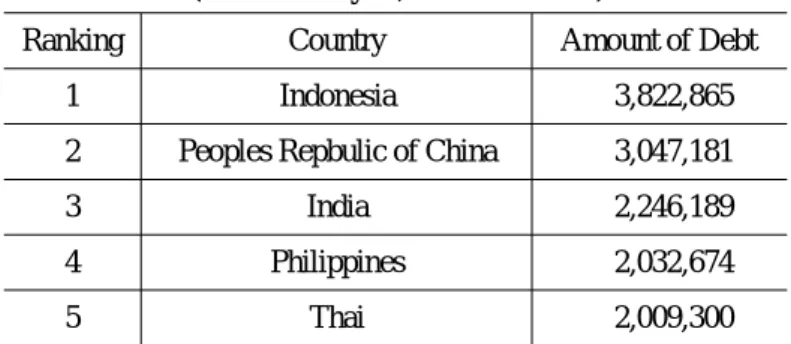
40[China is the top recipient] Table 1 lists the top five countries receiving government loans from Japan according to accumulated debt as of 2003. China’s second place standing can be deceiving, since it occupied the top yearly position each year since 1993, meaning that it held a privileged position within Japan’s ODA pecking order.
40 ODA 2005 White Paper appearing in the Ministry of Foreign Affairs website.
http://www.mofa.go.jp/mofaj/gaiko/oda/index.html
Table 1: Japan’s Top Five Debtor Countries: 2003 (in million yen, total to 2003)
Ranking 1 2 3 4 5
Country Indonesia Peoples Repbulic of China
India Philippines
Thai
Amount of Debt 3,822,865 3,047,181 2,246,189 2,032,674 2,009,300
Source: Japan Ministry of Foreign Affairs, 2005 ODA White Paper.
On the other hand, Japan continues as the largest contributor of aid to China among the DAC [Development Assistance Committee of OECD] members.
The yearly Japanese share of the total foreign government
loans incurred by China between 1979 and 1995 is shown in Table
2(total share 41.9%), indicating the important role played by Japan
in building a modernized China during the 1980s to middle of 90s.
Table 2: Japan’s Share of the Major Foreign Government Loans Made to China during 1979-1999
[Source: Lin Xiaoguang, Ribenzhenfu Kaifayuanzhu yu Zhongri Guanxi, Shijiezhishi Chubanshe, 2003, p. 381]
Rank 1 2 3 4 5
20
Country Japan Germany
France Spain
Italy
US Total
Amount
(US$100 million)
97.27 22.89 19.56 18.32 16.21
0.23 223.08
Item No.
72 42 80 107 47
1 1351
% of Total 41.91
9.86 8.42 7.89 6.98
0.10 100
[The evaluation of Japan’s ODA by China] China has evaluated the assistance it has received in proportion to its generosity. While it is not expressed out loud, Japan’s ODA is not thought of very differently from the war reparations China refused to claim.
However, China has never taken ODA for granted as relinquished war reparations and has not even mentioned or implied the two as existing in the same context. There have been some subtle inferences, like Deng’s comment to Komeito party chairman Yano Junya during his visit to China in June 1987;
From an historical perspective, Japan should be doing more to help China develop. Let’s face it, Japan probably owes more to China than any other country in the world. When we normalized diplomatic relations, we didn’t put reparations on the nego-tiating table.
41One should keep in mind, however, that Deng’s statement was made during a time of tension between the two countries over the incident involving Guanghualiao, the Nationalist-China-owned dor-
41 Asahi Shinbun, 1987.6.5.
mitory in Kyoto.
Otherwise, “China is grateful for all the economic cooperation that Japan has given us” (Chairman Jiang Zemin during Japan visit, November 1998) and “I would like to praise Japan’s ODA program, which has helped the Chinese economy develop as well as promote Sino-Japanese economic relations. We are especially grateful for the government loans we have received…” (Premier Zhu Rongji, on tour Fall 2000)
42, and so on.
Chinese academics as well have come forward with a general affirmative outlook about the benefits bestowed on their country through Japanese-sponsored ODA.
43Incidentally, Japan used ODA as a trump card in August 1995, when it decided to freeze all new gratuitous aid in protest over China’s implementation of its twice underground nuclear tests.
The “donor-recipient” relationship between the two countries symbolized by ODA continued for almost fifteen years, until nagg- ing economic stagnation in the patron’s backyard forced Japan to reevaluate the relationship in 2000. In December of the year, the 21st Century Sino-Japanese Economic Cooperation Confab (Miya- zaki Isao, chairman) stated that while Japanese assistance to China had been highly praised by all parties concerned, it was time to reevaluate the relationship given the state of the Japanese economy, the performance of the Chinese economy and changes in world public opinion regarding the nature of foreign aid, and proposed that;
1. aid priority be shifted to such areas as environmental, social, health and human resources development,
2. support be channeled towards the development of a market
42 Asahi Shinbun, 2000.10.14.
43 Zhang Guang, Riben Duiwai Yuanzhuzhengce Yanjiu (Policy Studies on Japanese Foreign Aid), Japan Center of Nankai University, Tianjing Renmin Chubanshe, 1996; Jin Xide, Riben Zhengfu Kaifayuanzhu (Japanese Government Aid for Development), Shehuikexue Wenxian Chubanshe, 2000; Lin Xiaoguang, Ribenzhengfu Kaifayuanzhu yu Zhongri Guanxi (Japanese Government Aid for Development and Sino-Japanese Relations), Shijie Zhishi Chubanshe, 2003.
economy, and
3. more care be taken about the ODA provision banning the military use of funds.
44In August 2003 the Japanese ODA guidelines written in 1992 were revised to include :
1. a balance between development and the environment,
2. avoidance of support for military uses or international conflicts,
3. attention to military outlays or weapons imports to developing countries, and
4. sensitivity to democratization, market economy and human rights records of developing countries.
Needless to say, China was no exception to such guidelines.
[Tiananmen Incident and grant aid] Towards the late 1980s, although the underlying problems of history, the Guanghua Dormi- tory incident and economic friction were starting to take their toll on the “honeymoon,” both parties avoided direct confrontation, due to the high expectations resting on the expansion of economic relations.
Towards the end of the decade, in the hopes of further deepening of economic ties, the death of former general secretary Hu Yaobang (15 April 1989) characterized the year’s “political season” with a Beijing demonstration to commemorate his passing turning ugly into a protest against the conservative faction that drove him out of office. Then the last days of May saw student protests in the Tiananmen Square opposing political corruption and inflation and calling for further democratization.
The Tiananmen Incident had veteran conservative politicians like Wang Zhen and Peng Zhen fearing another “Cultural Revolu- tion” and forcing Deng to resort to military action in quelling the disturbances, out of fear that compromise with the protestors would result in defeat like in the Soviet Union and Eastern Europe.
44 Li Genan,“Japan— From Gettimg-out Asia to Coming-back Asia,” Riben Xuekan (Japanese Studies), No. 3, 1994.