Fukushima Medical University
福島県立医科大学 学術機関リポジトリ
This document is downloaded at: 2021-11-07T23:22:47Z
Title Characteristics of awareness and behavior of medical staff for prevention of falling accidents among inpatients( 本文 )
Author(s) 木下, 美佐子
Citation
Issue Date 2019-09-30
URL http://ir.fmu.ac.jp/dspace/handle/123456789/1042
Rights © 2019 The Fukushima Society of Medical Science. This article is licensed under a Creative Commons [Attribution- NonCommercial-ShareAlike 4.0 International] license.
DOI
Text Version ETD
学 位 論 文
学位論文名
Characteristics of awareness and behavior of medical staff for prevention of falling accidents among inpatients
(入院患者の転倒転落事故防止に向けた 医療従事者の認識と行動の特徴)
福島県立医科大学大学院医学研究科 衛生学・予防医学分野
木下 美佐子
目 次
1 ・・・・・・・・・・・・・・・・・・・論文内容要旨(和文)
2 ・・・・・・・・・・・・・・・・・・・ Abstract 3 ・・・・・・・・・・・・・・・・・・・ Keywords Abbreviation
4 ・・・・・・・・・・・・・・・・・・・ Introduction 6 ・・・・・・・・・・・・・・・・・・・ Methods 7 ・・・・・・・・・・・・・・・・・・・ Results 10 ・・・・・・・・・・・・・・・・・・ Discussion
14 ・・・・・・・・・・・・・・・・・・ Conclusion Limitations 15 ・・・・・・・・・・・・・・・・・・ Acknowledgments
Conflict of Interest Disclosure References
19 ・・・・・・・・・・・・・・・・・・ Table1 20 ・・・・・・・・・・・・・・・・・・ Table2 21 ・・・・・・・・・・・・・・・・・・ Table3
22 ・・・・・・・・・・・・・・・・・・ Fig.1 Table4 23 ・・・・・・・・・・・・・・・・・・ Table5
24 ・・・・・・・・・・・・・・・・・・調査用紙(和文)
論 文 内 容 要 旨(和文)
学位論文題名
入院患者の転倒転落事故防止に向けた医療従事者の認識と行動の特徴
本研究の目的は、転倒転落事故防止に関連した医療従事者の職種別の認識と行 動の特徴を明らかにすることである。調査票は、 「事故防止のための意識と行動の 自己評価(SEABFAP) 」という看護師用に作成したアンケートを用いた。2016 年 10 月から 11 月までの間、アンケートは日本の病院で 1,670 人の医療スタッフ(看護 師、医師、検査技師、看護助手、放射線技師、薬剤師、理学療法士、栄養士、作 業療法士など)を対象として行った。回答は、1 から 5 までの尺度に加え、質問は 該当しない「該当なし」を選択してもらう方法で行った。有効回答は 923 人
(55.3%)であった。調査票を因子分析して得られた 7 つの要因すべてが、0.9 よ
り大きい Cronbach の α 係数を有していた。また、因子分析とは別に主成分分析
を行い、その結果に基づくクラスター分析では、4 つのカテゴリーに各職種の特徴 が分けられた。質問項目と職業に関する「該当なし」のカイ二乗検定の結果によ ると、看護師が「該当無し」に一番少なく答え、その後には医師、理学療法士、
作業療法士が続いた。看護助手の認識と行動はともに低く、転倒転落事故防止の ための教育の必要性を示唆していた。
SEABFAP を多職種に適応して評価することで、各医療従事者の転倒転落予防にお
ける認識と行動の特徴を明らかにすることができた。
(公表誌名: Fukushima Journal of Medical Science 2019;65:13-23 )
1
Abstract
The purpose of this study is to clarify the characteristics of awareness and behavior for falling accident prevention according to medical profession. We used a questionnaire called "Self-Evaluation of Awareness and Behavior for Falling Accident Prevention," which was originally designed for nurses. In October and November 2016, the questionnaire was administered to 1,670 medical staff (nurses, doctors, lab technicians, nursing assistants, radiological technicians, pharmacists, physical therapists, nutritionists, and occupational therapists, among others) at a hospital in Japan, using a 5-step scale and a not applicable (N/A) option. Valid responses were obtained from 923 (55.3%) participants, and all seven factors extracted by factor analysis had Cronbach’s α coefficients of greater than 0.9. Using cluster analysis based on principal component analysis, four categories were identified. According to the results of the N/A χ2 (chi-square) test question item and occupation, nurses answered N/A the least, followed by doctors, physical therapists, and occupational therapists. Nursing assistants’ awareness and behavior were both low, suggesting the necessity of education on preventing falling accidents. By applying the "Self-Evaluation of Awareness and Behavior for Falling Accident Prevention" to all medical staff, we succeeded in clarifying their characteristics of awareness and behavior for falling accident prevention.
2 1 1 1
Keywords
Preventing falling accidents, Non-technical skills, Self-evaluation survey, Medical staff,
Patient safety
Abbreviation
Self-Evaluation of Awareness and Behavior for Falling Accident Prevention (SEABFAP)
not applicable (N/A) non-technical skills (NTS)
3 1 1 1
Introduction
Falling accidents in hospitalized patients can lead to severe injury or even death. The Japan Council for Quality Health Care reported that, from 2010 to 2016, 2% of patients who had fallen during hospitalization died as a result, and 8% developed severe injuries
1). With the risk of fracture, which is especially high in the elderly
2,3), and the prediction of an increase in elderly hospitalization in Japan
4), falling accident prevention is becoming an increasingly important issue.
According to the Japan Council for Quality Health Care’s medical
accident information
5), in 2015, 275 medical institutions had a total of 3,374 reported medical accidents. The accidents most frequently occurred during
"care in medical treatment"(1,229, 36.4%) and "treatment/procedures"
(1,018, 30.2%). Among the 1,229 accidents, 744 were "falling accidents"
(60.5%), 398 occurred during "medical administration/conducts" (32%) and 23 were "mis-swallowing" (1.8%). In total, there were 3,485 multiple
responses received for the causes of the accidents occurred during "care in medical treatment": 1,679 "caused by the patients themselves", 525 "caused by medical staff ", 812 "environment/facility/equipment" and 469 "others".
The accidents caused by "caused by the patients themselves" occurred due to
"insufficient monitoring of patients" (n=495), "failure of observation"
(n=351),"failure of safety confirmation" (n=299), "insufficient explanation to the patient" (n=299), "failure of cooperation within a team" (n=180),
"accident reporting delay" (n=34), and "insufficient recording of medical records and others"(n=21). The "caused by medical staff " were "busy
4
working situation"(n=162), "lack of knowledge" (n=147), "unskilled caring techniques/maneuvers" (n=122), "under unusual psychological condition"
(n=17), "under unusual physical conditions" (n=10) and "others" (n=67).
The results suggest that falling accidents were associated with the awareness and behavior regarding fall prevention among medical staff. The main
causes of the accidents included technical factors such as "lack of
knowledge" and "unskilled caring technique/maneuver". Other causes found were related to "actions taken by the medical staff involved" such as "failure of observation", "failure of judgment", "poor cooperation”, and "delayed reporting".
For the prevention of falling accidents, numerous assessment score sheets to investigate the risk factors of the patients themselves have been created and revised.
6-9)However, it has been reported that many of the patients assessed as being at high risk are not concerned about falling.
10)The assessment score sheets focus on the risk factors of nurses and other medical staff who surround and observe the patients, rather than focusing on to the patients. Patient risk information needs to be shared among the team, and their observation system needs to be enhanced in order to establish effective countermeasures. We believe that we can identify patients who are at high risk of falling promptly and stop/prevent accidents by ensuring that medical staff are aware of preventative measures, which allow action monitoring of at-risk patients. Thus, by identifying the differences and characteristics of occupations regarding the awareness and behavior for falling accident prevention, materials to reflect communication among medical staff and
5
teamwork for fall prevention should be provided.
The purpose of this study is to clarify the characteristics of awareness and behavior for falling accident prevention by medical profession.
Methods
The subjects of this study comprised of 1,670 medical staff from an advanced treatment hospital (39 clinical departments, 778 beds and 472 reported falls in 2015) in Japan. Their occupations included doctors, nurses, pharmacists, nutritionists, physical therapists, occupational therapists, nursing assistants, laboratory technicians, and radiological technicians, among others, from all positions and ranks. The survey was conducted from October to November 2016, using the "Self-Evaluation of Awareness and Behavior for Falling Accident Prevention" (SEABFAP), which contains 58 items.
Submission of the SEABFAP questionnaire indicated the subject’s consent to participate in the study. The completed questionnaires were placed in collection bags at each workplace, and were then sealed and collected.
Kinoshita, an author of this thesis, created the SEABFAP in 2002.
11,12)It is an evaluation sheet of the awareness and behavior of nurses on fall prevention. It has been reported that the SEABFAP was used in many hospitals by nurses, in order to study the awareness and behavior of nurses regarding fall prevention.
13-15)However, there have been no reported cases where it was used by hospital medical staff other than nurses. As no assessment indicator that can assess/evaluate the characteristics of the awareness and behavior for falling accident prevention according to
6
occupation has yet been reported, we decided to evaluate these characteristics by applying the SEABFAP to a wider range of medical staff. Although the content and number of items in the SEABFAP remained unchanged, the word
"nurse" previously used in the items was changed to read "medical care provider" so that it applied to professions other than nursing.
Each question was answered from six choices, primarily using a scale of five possible answers, with an answer of 1 corresponding to fully understood/implemented, and an answer of 5 corresponding to not understood/implemented. The sixth option was "not applicable" (N/A), which basically means "not relevant to my job". Furthermore, in order to verify the reliability of the questions, the extracted factors were further analyzed by Cronbach’s α formula. Apart from these, with the intention of clarifying the characteristics classified by job category, cluster analysis was performed using the principal component analysis score. Additionally, in order to clarify the differences in the answers, we performed the χ2 (chi-square) test and analysis of the adjusted residuals of N/A by occupation.
Results
Attributes of Respondents
The questionnaire was distributed to 1,670 medical workers at Hospital A, 1,005 of whom responded. Eighty-two respondents who failed to answer all questions were excluded from the analysis. As a result, 923 responses were eligible, and the effective response rate was 55.3%.
The demographic details of the respondents were 594 nurses (response rate,
7
72.8%), 171 doctors (response rate, 30.5%), 37 laboratory technicians (response rate, 49%), 31 nursing assistants (response rate, 53%), 17 radiological technicians (response rate, 36%), 16 pharmacists (response rate, 41%), 12 physical therapists (response rate, 63.2%), seven nutritionists (response rate, 78%), five occupational therapists (response rate, 100%), and 33 others (response rate 78.6%). The median amount of years of experience of the 923 subjects was 8 years, with a range of 0 to 40 years. The occupation with the most experience was lab technicians, with a median of 12.5 years and a range of 0 to 40 years. The occupation with the least experience was nursing assistants, with a median of 3 years and a range of 0 to 15 years (Table 1).
Reliability of SEABFAP
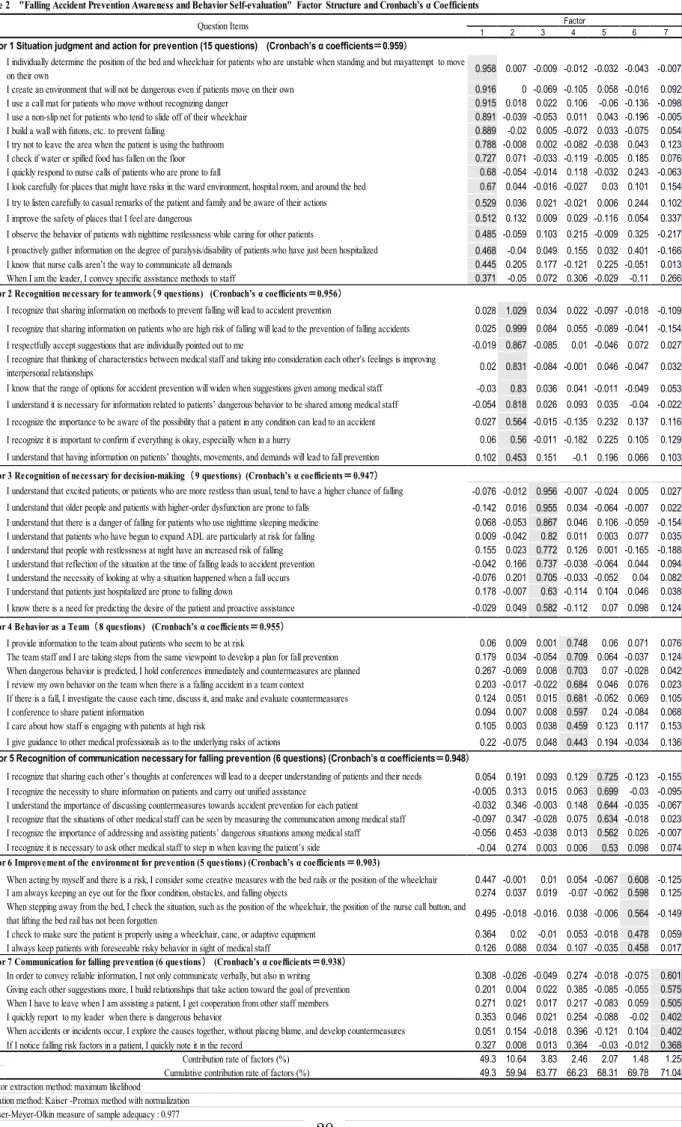
Seven factors were extracted as a result of a factor analysis (maximum likelihood with promax rotation) of SEABFAP. Cronbach’s α coefficients for each factor were determined as: Factor 1 – "Situational judgment and action for prevention"; Factor 2 – "Recognition of necessity for teamwork"; Factor 3 – "Recognition of necessity for decision-making"; Factor 4 – "Behavior as a team"; Factor 5 – "Recognition of communication necessary for falling prevention"; Factor 6 – "Improvement of the environment for falling prevention"; and Factor 7 – "Communication for falling prevention". The Cronbach’s α coefficient of all subscales was greater than 0.9. (Table 2)
Cluster analysis and distribution by occupation
The principal component analysis of the SEABFAP question items
8
extracted eight principal components. The first and second principal component factor loadings were 48.3% and 12.3%, respectively. The cumulative contribution rate was 60.6%. The internal structure of the data was sufficiently explained by these two components (Table 3). Therefore, these two components were employed as the X- and Y- axes in the present study. As shown in Fig. 1, the X-axis represents "Behavior for falling prevention", the first principal component, and the Y-axis represents "Awareness for falling prevention", the second principal component. From further principal component analysis, cluster analysis resulted in four clusters grouped by characteristics. The clusters were as follows: Group 1, respondents with "Low awareness and behavior"; Group 2, respondents with "Moderate awareness and behavior"; Group 3, respondents with "Moderate-high awareness and low behavior"; and Group 4, respondents with "Moderate awareness and high behavior" (Fig. 1).
Next, the most distributed cluster group for each occupation was as follows:
Group 1 – nutritionists (42.9%), nursing assistants (41.9%); Group 2 – doctors (46.2%), physical therapists (58.6%), occupational therapists (80%); Group 3 – pharmacists (75%), nutritionists (42.9%), laboratory technicians (56.8%), radiological technicians (76.5%), and others (54.5%); and Group 4 – nurses (52.7%) (Table 4).
N/A by each occupation
For each question item and occupation, the ratio of those who responded N/A was examined using a chi-square test, and adjusted residuals were
9
calculated. With an adjusted residual value greater than 1.96 and a P value of
<0.05, a significant number of respondents answered that the question did not apply to them. Each of the seven factors revealed by a factor analysis is organized in Table 5.
The number of N/A responses by doctors was significantly high regarding two items in both Factors 1 and 7. Nurses rarely responded with N/A. A significant number of pharmacists and nutritionists responded with N/A to most items concerning behavior in Factors 1, 4, 6, and 7. Physical therapists responded with N/A to six items in Factor 1, and occupational therapists answered N/A for four Factor 1 items, three Factor 4 items, and one Factor 7 item. Nursing assistants answered N/A for seven Factor 1 items, all items in Factors 2, 3, 4, and 5, one Factor 6 item, and four Factor 7 items. It is also worth noting that lab technicians answered N/A for items in almost all Factors.
Radiological technicians responded with N/A to all items in Factors 1, 4, and 7, one item in Factors 3 and 5, and two items in Factor 6. In the remaining occupations, an N/A response was significantly high in almost all of the factors (1, 3, 4, 6, and 7) (Table 5).
Discussion
In the SEABFAP used in the current study, seven factors were identified by factor analysis. In addition, the Cronbach’s α coefficient for measuring internal consistency was 0.9 or more, indicating high reliability. We confirmed that SEABFAP can be used as a questionnaire to investigate fall prevention awareness and behavior.
10
Our cluster analysis showed that nurses were strongly associated with the prevention of patient falls, as indicated by the significant number of nurses that were categorized into Group 4. However, nursing assistants, who are similar to nursing professionals in their engagement in operations with patients, were mostly categorized into Group 1, which was exactly the opposite to the result of nurses. In particular, the adjusted residual values of the nursing assistants’ N/A responses resulted in a significant increase in all the items in Factors 2, 3, 4, and 5, compared to other occupations. Because nursing assistants also work closely with hospitalized patients, they are expected to prevent accidents such as falls; however, the nursing assistants who took part in the survey showed both low awareness and low behavior. We suspect that the cause of this is related to the differences in situations between nurses and nursing assistants. One such difference is years of experience. The median experience of the nurses in this survey was 9 years, whereas that of the nursing assistants was 3 years. Another difference is work contents. While nurses are required to relay patients’ information to those working the following shift, nursing assistants are not. The nursing assistants may also be unaware of the importance of their involvement in patient falling prevention.
The SEABFAP results can be utilized to consider increasing the number of opportunities for nursing assistants to share relevant information.
The proportion of N/A responses from the laboratory technicians was high all of the factors. In particular, the proportions of their N/A responses in Factor 2, "Recognition of necessity for teamwork", and Factor 5, "Recognition of communication necessary for falling prevention", were significantly higher
11
than the other occupations. Laboratory technicians have limited contact with patients, and their work style might not be as a teamwork style. Therefore, the way of working and the frequency of communication might have caused a high number of N/A responses in these two factors. We believe that laboratory technicians may need to enhance their awareness more than any other occupations.
The doctors, physical therapists, and occupational therapists who were classified into Group 2 responded with N/A to Question 15, "I quickly respond to nurse calls of patients who are prone to fall", and Question 39, "I quickly report to my leader when behavior indicative of falls occurs". The above- mentioned doctors, physical therapists, and occupational therapists considered that questions other than Questions 15 and 39 were applicable to them. The pharmacists, nutritionists, laboratory technicians, radiological technicians, and other medical professionals in Group 3 had limited contact with patients.
Given the reports of accidents, such as falling from the examination bed or falling when moving to the examination bed
16-18), those in Group 3 require improved awareness and behavior related to teamwork, communication, and situational judgment. The Group 3 occupations had high awareness, but it is possible that they may not react to situations accordingly, or at all.
It will be necessary for us to consider and seek the best solution/practice for fall prevention by identifying the different characteristics among occupations. In a meta-analysis by Cameron et al., they stated that implementing multi-disciplinary teamwork, training and a team care plan for fall prevention showed good results.
19)The essential factors in multi-
12
disciplinary corporation are communication and teamwork, and we need to develop approaches to improve multi-disciplinary communication, and cognitive ability and actions of the team, which was found to be the weakness of some professions. Furthermore, education of all medical staff for fall prevention is considered to be necessary to raise their awareness of participating in fall prevention without isolating awareness and behavior for fall prevention as nurse-specific.
Lastly, the SEABFAP is seen to have a lot of common parts/items with non- technical skills (NTS), which Flin et al.
20)introduced in 2008. Flin defines the NTS in medical safety as ‘the cognitive, social and personal resource skills that complement technical skills, and contribute to safe and efficient task performance’.
20)Flin et al. introduced the conceptualization of NTS which influence safe and efficient operational performance. Some examples of NTS are "situation awareness", "decision making", "communication", "teamwork",
"leadership", "managing stress", and "coping with fatigue". Further, Flin et al.
said that we know that human error cannot be eliminated, but efforts could be made to minimise, catch and mitigate errors by ensuring that people had appropriate NTS to cope with the risks and demands of their work.
20)White et al. stated that NTS are an important element for decreasing human error, presenting an example of a grave accident that happened due to insufficient communication between the nurse and doctor.
21)Oxford NOTECHS II is an assessment tool of NTS, developed to evaluate teamwork such as that in the operating room.
22)Furthermore, at WHO, a checklist based on NTS for operation rooms was developed and offered to countries.
23)These suggest that
13
for medical safety, acquisition of NTS and prevention of falling accidents by medical workers are current issues. For medical safety, acquisition of NTS and prevention of falling accidents by medical workers have become an issue.
In order to acquire NTS appropriately, we consider that the use of SEABFAP is an option to identify NTS necessary for falling accident prevention among medical workers.
Conclusion
The results of the current study indicate that nurses showed high awareness and were able to perform the behavior necessary for preventing accidental falls in patients. Many nurses responded to all items as "relevant to my job".
Doctors, physical therapists, and occupational therapists showed an intermediate level of awareness and behavior necessary for prevention of accidental falls, except for duties that are related specifically to those of nurses.
The awareness of pharmacists, nutritionists, laboratory technicians, radiological technicians, and other medical professions was assessed to be better than their actions. Many answered "not relevant to my job" to questions other than those in Factors 2 and 5. Furthermore, many of the laboratory technicians answered "not relevant to my job" to items in Factors 2 and 5 as well. Nursing assistants were evaluated to have low awareness and behavior regarding fall prevention. Also, many nursing assistants answered as "not relevant to my job" to most questions. By applying the SEABFAP to all medical workers, we revealed their characteristics of awareness and behavior for falling accident prevention.
14
Limitations
One limitation of this study is that it was conducted in one hospital only.
In the future, further studies and analyses are needed in different types of hospitals, as the approach for fall prevention should vary depending on the characteristics of the in-patients.
Acknowledgments
We wish to thank Hospital A for allowing us to conduct our survey at their institution, and we are grateful to all the medical professionals who took part in the survey.
Conflict of Interest Disclosure
The authors declare no conflict of interest in this work.
References
1. Japan Council for Quality Health Care: Project to Collect Medical Near- Miss/Adverse Event Information [JQ web site]. http://www.med- safe.jp/contents/report/index.html/. 2010–2015. Accessed 15 July 2016.
2. Chelly J, Conroy L, Miller G, Elliott M, Horne J, Hudson M. Risk factors and injury associated with falls in elderly hospitalized patients in a community hospital. J Patient Saf, 4: 178-83, 2008.
3. Takashima M, Yamada R, Sato Y, Ito W, Kondou K, Okada K, et al. The actual circumstances surrounding bone fractures due to falls at a university hospital. (in Japanese) JJHM, 13: 59-64, 2012
.4. Ministry of Health, Labour and Welfare. 2014 Calculation Inpatient in
15
Japan. http://www.mhlw.go.jp/toukei/saikin/hw/kanja/14/. Accessed 15 September 2017.
5. Japan Council for Quality Health Care: Project to Collect Medical Near- Miss/Adverse Event Information [JQ web site] March 18 2016.
http://www.medsafe.jp/contents/report/index.html/. Accessed 5 May 2016.
6. Hayakawa T, Hashimoto S, Kanda H, Hirano N, Kurihara Y, Kawashima T, et al. Risk factors of falls in inpatients and their practical use in identifying high-risk persons at admission: Fukushima Medical University Hospital cohort study. BMJ Open, doi:10.1136/005385, 2014.
7. Tanaka B, Morimoto T, Adachi Y, Hinada T, Nagano Y, Tsuboyama T, et al. Revision of fall assessment scores and comparison of their predictive values in a university hospital. (in Japanese) JJQSH, 5: 22-31, 2010.
8. Akama N, Takeda K, Shimamura H, Atuya T, Suzuki N, Goto K, et al.
A case-control study for evaluating efficacy of risk-assessment tools for prediction of falls in hospital. (in Japanese) JJHM, 14: 171-178, 2014.
9. Toyabe S. Development of a risk assessment tool to predict fall-related severe injuries occurring in a hospital. Glob J Health Sci, 6: 70-80, 2014.
10. Twibell RS, Siela D, Sproat T, Coers G. Perceptions related to falls and fall prevention among hospitalized adults. Am J Crit Care, 24: 78-85, 2015.
11. Kinoshita M, Watanabe I. [ 転倒・転落事故防止対策―病棟全員参加のグル ープ編成を試みて― ] Nihon Kango Gakkai ronbunshu Kango kanri, 33:
266-268, 2002.
12. Kinoshita M. 特集;効果の出せる転倒転落事故防止対策;病棟全員参加
の グ ル ー プ 編 成 導 入 に よ る 防 止 対 策 . Japanese journal of nursing
16
KANGO, 56: 49-53, 2004.
13. Sakai T, Ozaki K, Kawabata M, Takakura S, Nakagawa U. Preventive measures against falling accidents: trial for improvement in team works of nurses. The Kyosai Medical Journal, 56: 225-229, 2007.
14. Fukumori H, Nishikawa N, Sasaki T. Katuma M. 転倒転落事故防止に
対する看護者の認識と行動調査 .Nihon Kango Gakkai ronbunshu Kango sougou, 39: 245-247, 2008.
15. Mitake K, Takeshima H, Ohtani M, Nakazima M, Oomori S, Ueno E.
転倒・転落に対する看護師の意識変化―定期的なカンファレンスで看護計 画の評価を行って― .Nihon Kango Gakkai ronbunshu Kango sougou, 43: 263-266, 2013.
16. Doi T, Kawamoto K, Yamaguchi K. Difference by level of awareness and the years of experience to patient treatment safety. (in Japanese) Jpn J Radiol Technol, 68: 608-616, 2012.
17. Hashida M, Shiraishi J. Incident reports related to tasks performed by radiological technologists: an analysis of ten years of incident reports.
(in Japanese) Jpn J Radiol Technol, 71: 99-107, 2015
18. Japan Council for Quality Health Care: Project to Collect Medical Near-Miss/Adverse Event Information [JQ web site]. No.141 2018.8 http://www.med-safe.jp/contents/info/index.html.
Accessed 15 November 2018.
19. Cameron ID, Murray GR, Gillespie LD, Robertson MC, Hill KD, Cumming RG, et al. Interventions for preventing falls in older people in care facilities and hospitals. Cochrane Database Syst Rev, doi:10.1002/14651858, 2012.
20. Flin RH, O’Connor PA, Crichton MA. Safety at the sharp end: a guide to non-technical skills. Ashgate, England, 2008.
17
21. White N. Understanding the role of non-technical skills in patient safety. Nurs Stand, 26: 43-48, 2012.
22. Robertson ER, Hadi M, Morgan LJ, Pickering SP, Collins G, New S, et al. Oxford NOTECHS
Ⅱ: a modified theatre team non-technical skills scoring system. PLoS One, doi: 10.1371/0090320, 2014.
23. WHO safe Surgery Saves Lives.
http://www.who.int/patientsafety/safesurgery/en/index.html. Accessed 15 November 2018.
18
Years of ExperienceMedian (Range) Gender*Male223(24.2%)127(74.3%)37(6.2%)7(43.8%)3(42.9%)7(58.3%)3(60.0%)‐‐9(24.3%)14(82.4%)16(48.5%) Female683(74.0%)37(21.6%)548(92.3%)9(56.3%)4(57.1%)5(41.7%)2(40.0%)31(100%)28(75.7%)2(11.8%)17(51.5%) Job PositionNote 2) Position 130(3.3%)11(6.4%)17(2.9%)1(6.3%)‐‐‐‐‐‐‐‐‐‐1(5.9%)‐‐ Position 239(4.2%)9(5.3%)29(4.9%)1(6.3%)‐‐‐‐‐‐‐‐‐‐‐‐‐‐ Position 3197(21.3%)16(9.4%)152(25.6%)3(18.8%)1(14.3%)1(8.3%)‐‐‐‐14(37.8%)5(29.4%)5(15.2%) Position 4175(19.0%)86(50.3%)77(13.0%)2(12.5%)2(28.6%)1(8.3%)2(40.0%)‐‐1(2.7%)3(17.6%)1(3.0%) Position 5482(52.2%)49(28.7%)319(53.7%)9(56.3%)4(57.1%)10(83.3%)3(60.0%)31(100%)22(59.5%)8(47.1%)27(81.8%) Hospital Ward485(52.5%)106(62.0%)327(55.1%)7(43.8%)5(71.4%)‐‐1(20.0%)26(83.9%)1(2.7%)‐‐12(36.4%) Outpatient222(24.1%)52(30.4%)159(26.8%)4(25.0%)‐‐‐‐‐‐4(12.9%)1(2.7%)‐‐2(6.1%) ICU.NICU51(5.5%)‐‐42(7.1%)‐‐‐‐‐‐‐‐1(3.2%)‐‐‐‐8(24.2%) Operating Room60(6.5%)10(5.8%)45(7.6%)‐‐‐‐‐‐‐‐‐‐‐‐1(5.9%)4(12.1%) Treatment Room31(3.4%)2(1.2%)6(1.0%)‐‐2(28.6%)12(100%)4(80.0%)‐‐‐‐3(17.6%)2(6.1%) Laboratory62(6.7%)1(0.6%)10(1.7%)‐‐‐‐‐‐‐‐‐‐35(94.6%)13(76.5%)3(9.1%) Other12(1.3%)‐‐5(0.8%)5(31.3%)‐‐‐‐‐‐‐‐‐‐‐‐2(6.1%) Note 2) Position 1 includes professor, general manager, assistant manager, and chief resident. Position 2 includes associate professor, assistant manager, and senior resident. Position 3 includes lecturer, director, and section chief. Position 4 includes assistant professor, assistant, and assistant director. Position 5 includes general technician staff, part-time, adjunct, intern, and graduate student.*N will be different because there are missing values
8 (0,40) Note 1) Others include the following occupations (actual number): clinical psychologist (8), clinical engineer (16), childcare worker (1), dental hygienist (1), speech therapist (1), and ward clerk (6)
3 (0,17)10 (0,36)9 (0,40)9 (0,40)6 (0,36)5 (0,28)8 (0,10)3 (0,15)12.5 (0,40)11 (0,35) Actual Number(%)
Main places of contact with patients
78.6%Recovery %30.5%72.8%41.0%78.0%63.2%100%53.0%49.0%36.0%55.3%
12531371733
Nursing AssistantLab- technicianRadiological TechnicianOther Note1) n171594167923
Ta bl e1 Ba si c At tr ib ut es o f Re sp on de nt s by O cc up at io n
AttributesNursePharmacistNutritionistPhysical TherapistOccupational TherapistAllDoctor19
19
1 2 3 4 5 6 7
50 I individually determine the position of the bed and wheelchair for patients who are unstable when standing and but mayattempt to move
on their own 0.958 0.007 -0.009 -0.012 -0.032 -0.043 -0.007
57 I create an environment that will not be dangerous even if patients move on their own 0.916 0 -0.069 -0.105 0.058 -0.016 0.092
55 I use a call mat for patients who move without recognizing danger 0.915 0.018 0.022 0.106 -0.06 -0.136 -0.098
56 I use a non-slip net for patients who tend to slide off of their wheelchair 0.891 -0.039 -0.053 0.011 0.043 -0.196 -0.005
49 I build a wall with futons, etc. to prevent falling 0.889 -0.02 0.005 -0.072 0.033 -0.075 0.054
58 I try not to leave the area when the patient is using the bathroom 0.788 -0.008 0.002 -0.082 -0.038 0.043 0.123
51 I check if water or spilled food has fallen on the floor 0.727 0.071 -0.033 -0.119 -0.005 0.185 0.076
15 I quickly respond to nurse calls of patients who are prone to fall 0.68 -0.054 -0.014 0.118 -0.032 0.243 -0.063
53 I look carefully for places that might have risks in the ward environment, hospital room, and around the bed 0.67 0.044 -0.016 -0.027 0.03 0.101 0.154 52 I try to listen carefully to casual remarks of the patient and family and be aware of their actions 0.529 0.036 0.021 -0.021 0.006 0.244 0.102
54 I improve the safety of places that I feel are dangerous 0.512 0.132 0.009 0.029 -0.116 0.054 0.337
11 I observe the behavior of patients with nighttime restlessness while caring for other patients 0.485 -0.059 0.103 0.215 -0.009 0.325 -0.217 14 I proactively gather information on the degree of paralysis/disability of patients who have just been hospitalized 0.468 -0.04 0.049 0.155 0.032 0.401 -0.166
48 I know that nurse calls aren’t the way to communicate all demands 0.445 0.205 0.177 -0.121 0.225 -0.051 0.013
38 When I am the leader, I convey specific assistance methods to staff 0.371 -0.05 0.072 0.306 -0.029 -0.11 0.266
35 I recognize that sharing information on methods to prevent falling will lead to accident prevention 0.028 1.029 0.034 0.022 -0.097 -0.018 -0.109 36 I recognize that sharing information on patients who are high risk of falling will lead to the prevention of falling accidents 0.025 0.999 0.084 0.055 -0.089 -0.041 -0.154
34 I respectfully accept suggestions that are individually pointed out to me -0.019 0.867 -0.085 0.01 -0.046 0.072 0.027
37 I recognize that thinking of characteristics between medical staff and taking into consideration each other's feelings is improving
interpersonal relationships 0.02 0.831 -0.084 -0.001 0.046 -0.047 0.032
33 I know that the range of options for accident prevention will widen when suggestions given among medical staff -0.03 0.83 0.036 0.041 -0.011 -0.049 0.053 32 I understand it is necessary for information related to patients’ dangerous behavior to be shared among medical staff -0.054 0.818 0.026 0.093 0.035 -0.04 -0.022 46 I recognize the importance to be aware of the possibility that a patient in any condition can lead to an accident 0.027 0.564 -0.015 -0.135 0.232 0.137 0.116
47 I recognize it is important to confirm if everything is okay, especially when in a hurry 0.06 0.56 -0.011 -0.182 0.225 0.105 0.129
45 I understand that having information on patients’ thoughts, movements, and demands will lead to fall prevention 0.102 0.453 0.151 -0.1 0.196 0.066 0.103
7 I understand that excited patients, or patients who are more restless than usual, tend to have a higher chance of falling -0.076 -0.012 0.956 -0.007 -0.024 0.005 0.027 9 I understand that older people and patients with higher-order dysfunction are prone to falls -0.142 0.016 0.955 0.034 -0.064 -0.007 0.022 8 I understand that there is a danger of falling for patients who use nighttime sleeping medicine 0.068 -0.053 0.867 0.046 0.106 -0.059 -0.154 6 I understand that patients who have begun to expand ADL are particularly at risk for falling 0.009 -0.042 0.82 0.011 0.003 0.077 0.035
1 I understand that people with restlessness at night have an increased risk of falling 0.155 0.023 0.772 0.126 0.001 -0.165 -0.188
5 I understand that reflection of the situation at the time of falling leads to accident prevention -0.042 0.166 0.737 -0.038 -0.064 0.044 0.094
3 I understand the necessity of looking at why a situation happened when a fall occurs -0.076 0.201 0.705 -0.033 -0.052 0.04 0.082
4 I understand that patients just hospitalized are prone to falling down 0.178 -0.007 0.63 -0.114 0.104 0.046 0.038
2 I know there is a need for predicting the desire of the patient and proactive assistance -0.029 0.049 0.582 -0.112 0.07 0.098 0.124
30 I provide information to the team about patients who seem to be at risk 0.06 0.009 0.001 0.748 0.06 0.071 0.076
31 The team staff and I are taking steps from the same viewpoint to develop a plan for fall prevention 0.179 0.034 -0.054 0.709 0.064 -0.037 0.124 29 When dangerous behavior is predicted, I hold conferences immediately and countermeasures are planned 0.267 -0.069 0.008 0.703 0.07 -0.028 0.042
28 I review my own behavior on the team when there is a falling accident in a team context 0.203 -0.017 -0.022 0.684 0.046 0.076 0.023
27 If there is a fall, I investigate the cause each time, discuss it, and make and evaluate countermeasures 0.124 0.051 0.015 0.681 -0.052 0.069 0.105
24 I conference to share patient information 0.094 0.007 0.008 0.597 0.24 -0.084 0.068
26 I care about how staff is engaging with patients at high risk 0.105 0.003 0.038 0.459 0.123 0.117 0.153
25 I give guidance to other medical professionals as to the underlying risks of actions 0.22 -0.075 0.048 0.443 0.194 -0.034 0.136
18 I recognize that sharing each other’s thoughts at conferences will lead to a deeper understanding of patients and their needs 0.054 0.191 0.093 0.129 0.725 -0.123 -0.155 19 I recognize the necessity to share information on patients and carry out unified assistance -0.005 0.313 0.015 0.063 0.699 -0.03 -0.095 22 I understand the importance of discussing countermeasures towards accident prevention for each patient -0.032 0.346 -0.003 0.148 0.644 -0.035 -0.067 23 I recognize that the situations of other medical staff can be seen by measuring the communication among medical staff -0.097 0.347 -0.028 0.075 0.634 -0.018 0.023 20 I recognize the importance of addressing and assisting patients’ dangerous situations among medical staff -0.056 0.453 -0.038 0.013 0.562 0.026 -0.007 21 I recognize it is necessary to ask other medical staff to step in when leaving the patient’s side -0.04 0.274 0.003 0.006 0.53 0.098 0.074
13 When acting by myself and there is a risk, I consider some creative measures with the bed rails or the position of the wheelchair 0.447 -0.001 0.01 0.054 -0.067 0.608 -0.125
16 I am always keeping an eye out for the floor condition, obstacles, and falling objects 0.274 0.037 0.019 -0.07 -0.062 0.598 0.125
12 When stepping away from the bed, I check the situation, such as the position of the wheelchair, the position of the nurse call button, and
that lifting the bed rail has not been forgotten 0.495 -0.018 -0.016 0.038 -0.006 0.564 -0.149
17 I check to make sure the patient is properly using a wheelchair, cane, or adaptive equipment 0.364 0.02 -0.01 0.053 -0.018 0.478 0.059
10 I always keep patients with foreseeable risky behavior in sight of medical staff 0.126 0.088 0.034 0.107 -0.035 0.458 0.017
43 In order to convey reliable information, I not only communicate verbally, but also in writing 0.308 -0.026 -0.049 0.274 -0.018 -0.075 0.601 42 Giving each other suggestions more, I build relationships that take action toward the goal of prevention 0.201 0.004 0.022 0.385 -0.085 -0.055 0.575 40 When I have to leave when I am assisting a patient, I get cooperation from other staff members 0.271 0.021 0.017 0.217 -0.083 0.059 0.505
39 I quickly report to my leader when there is dangerous behavior 0.353 0.046 0.021 0.254 -0.088 -0.02 0.402
44 When accidents or incidents occur, I explore the causes together, without placing blame, and develop countermeasures 0.051 0.154 -0.018 0.396 -0.121 0.104 0.402
41 If I notice falling risk factors in a patient, I quickly note it in the record 0.327 0.008 0.013 0.364 -0.03 -0.012 0.368
Contribution rate of factors (%) 49.3 10.64 3.83 2.46 2.07 1.48 1.25
Cumulative contribution rate of factors (%) 49.3 59.94 63.77 66.23 68.31 69.78 71.04
Table 2 "Falling Accident Prevention Awareness and Behavior Self-evaluation" Factor Structure and Cronbach’s α Coefficients
Kaiser-Meyer-Olkin measure of sample adequacy : 0.977 Rotation method: Kaiser -Promax method with normalization
Factor 3 Recognition of necessary for decision-making(9 questions) (Cronbach’s α coefficients=0.947)
Factor 4 Behavior as a Team(8 questions) (Cronbach’s α coefficients=0.955)
Factor 5 Recognition of communication necessary for falling prevention (6 questions) (Cronbach’s α coefficients=0.948)
Factor 6 Improvement of the environment for prevention (5 questions) (Cronbach’s α coefficients=0.903)
Factor 7 Communication for falling prevention (6 questions) (Cronbach’s α coefficients=0.938)
Factor extraction method: maximum likelihood
20 Factor 2 Recognition necessary for teamwork(9 questions) (Cronbach’s α coefficients=0.956)
Question Items Factor
Factor 1 Situation judgment and action for prevention (15 questions) (Cronbach’s α coefficients=0.959)
20
1 2 3 4 5 6 7 8 29When dangerous behavior is predicted, I hold conferences immediately and countermeasures are planned .838 -.131 -.206 -.277 .076 .033 -.105 -.035
28I review my own behavior on the team when there is a falling accident in a team context .828 -.098 -.207 -.247 -.002 .066 -.152 -.007
31The team staff and I are taking steps from the same viewpoint to develop a plan for fall prevention .822 -.067 -.291 -.201 .068 .065 -.108 -.036
41If I notice falling risk factors in a patient, I quickly note it in the record .822 -.085 -.257 .034 -.057 -.159 -.003 .097
50I individually determine the position of the bed and wheelchair for patients who are unstable when standing and but mayattempt to move on
their own .819 -.310 .185 .064 .160 -.015 .008 .020
30I provide information to the team about patients who seem to be at risk .818 -.010 -.268 -.259 -.006 .111 -.090 -.090
15I quickly respond to nurse calls of patients who are prone to fall .814 -.260 .168 -.041 -.063 .005 -.152 .176
13When acting by myself and there is a risk, I consider some creative measures with the bed rails or the position of the wheelchair .809 -.102 .202 -.055 -.292 .078 .035 .157 27If there is a fall, I investigate the cause each time, discuss it, and make and evaluate countermeasures .807 -.055 -.249 -.206 -.036 .068 -.111 -.065 53I look carefully for places that might have risks in the ward environment, hospital room, and around the bed .807 -.112 .066 .195 -.002 .083 -.044 -.223 12When stepping away from the bed, I check the situation, such as the position of the wheelchair, the position of the nurse call button, and
that lifting the bed rail has not been forgotten .800 -.117 .216 -.037 -.258 .115 -.066 .134
14I proactively gather information on the degree of paralysis/disability of patients who have just been hospitalized .797 -.096 .188 -.178 -.140 .119 -.012 .082
57I create an environment that will not be dangerous even if patients move on their own .793 -.272 .145 .198 .156 .050 .014 -.006
42Giving each other suggestions more, I build relationships that take action toward the goal of prevention .785 -.040 -.350 .111 -.104 -.147 .041 -.049
51I check if water or spilled food has fallen on the floor .783 -.142 .163 .241 -.018 .103 -.074 -.236
11I observe the behavior of patients with nighttime restlessness while caring for other patients .777 -.132 .222 -.277 -.120 .047 .104 .262 17I check to make sure the patient is properly using a wheelchair, cane, or adaptive equipment .775 -.045 .093 .066 -.259 .153 .061 -.061
26I care about how staff is engaging with patients at high risk .770 .070 -.198 -.138 -.014 .120 .127 -.196
54I improve the safety of places that I feel are dangerous .767 -.064 -.061 .279 -.066 .018 .060 -.253
39I quickly report to my leader when behavior of falls occurs .766 -.083 -.240 .172 -.111 -.254 -.198 .127
55I use a call mat for patients who move without recognizing danger .766 -.339 .189 -.040 .261 -.022 -.090 .015
43In order to convey reliable information, I not only communicate verbally, but also in writing .765 -.088 -.332 .196 -.062 -.115 .029 -.046 40When I have to leave when I am assisting a patient, I get cooperation from other staff members .764 -.050 -.272 .241 -.182 -.214 -.133 .096 52I try to listen carefully to casual remarks of the patient and family and be aware of their actions .761 -.058 .116 .155 -.104 .181 -.006 -.273
49I build a wall with futons, etc. to prevent falling .756 -.258 .172 .122 .192 -.032 .075 -.019
58I try not to leave the area when the patient is using the bathroom .750 -.254 .144 .225 .071 -.082 -.080 .063
25I give guidance to other medical professionals as to the underlying risks of actions .742 .002 -.187 -.205 .147 .106 .313 -.194
16I am always keeping an eye out for the floor condition, obstacles, and falling objects .724 .031 .108 .158 -.367 .141 .068 -.129
24I conference to share patient information .721 .067 -.271 -.269 .143 .141 -.013 -.080
44When accidents or incidents occur, I explore the causes together, without placing blame, and develop countermeasures .713 .051 -.318 .078 -.182 -.020 .058 .005
38When I am the leader, I convey specific assistance methods to staff .695 -.133 -.198 -.049 .089 -.374 .336 .098
48I know that nurse calls aren’t the way to communicate all demands .673 .251 .157 .138 .185 -.066 -.174 .016
56I use a non-slip net for patients who tend to slide off of their wheelchair .656 -.356 .154 .032 .385 -.013 .225 .013
6I understand that patients who have begun to expand ADL are particularly at risk for falling .646 .439 .242 -.145 -.116 -.209 -.038 -.157 45I understand that having information on patients’ thoughts, movements, and demands will lead to fall prevention .631 .492 .026 .209 .059 .032 -.025 .026
4I understand that patients just hospitalized are prone to falling down .630 .386 .265 -.050 -.028 -.194 -.008 -.143
10I always keep patients with foreseeable risky behavior in sight of medical staff .629 .076 .051 -.043 -.303 .178 .421 .141
22I understand the importance of discussing countermeasures towards accident prevention for each patient .626 .532 -.094 .010 .233 .185 -.030 .163 8I understand that there is a danger of falling for patients who use nighttime sleeping medicine .601 .456 .322 -.279 .016 -.222 -.096 -.128 5I understand that reflection of the situation at the time of falling leads to accident prevention .600 .503 .188 -.014 -.105 -.177 -.032 -.126
19I recognize the necessity to share information on patients and carry out unified assistance .592 .551 -.043 .029 .236 .187 -.105 .104
18I recognize that sharing each other’s thoughts at conferences will lead to a deeper understanding of patients and their needs .591 .495 -.006 -.095 .298 .151 -.122 .118 7I understand that excited patients, or patients who are more restless than usual, tend to have a higher chance of falling .588 .512 .254 -.143 -.103 -.220 -.025 -.124 21I recognize it is necessary to ask other medical staff to step in when leaving the patient’s side .581 .487 -.081 .126 .108 .132 .050 .192 46I recognize the importance to be aware of the possibility that a patient in any condition can lead to an accident .569 .524 -.032 .269 .050 .126 .018 .117
3I understand the necessity of looking at why a situation happened when a fall occurs .568 .526 .172 -.022 -.106 -.175 .020 -.073
20I recognize the importance of addressing and assisting patients’ dangerous situations among medical staff .568 .567 -.083 .136 .181 .174 -.008 .157
1I understand that people with restlessness at night have an increased risk of falling .568 .357 .310 -.334 .084 -.287 -.046 -.106
9I understand that older people and patients with higher-order dysfunction are prone to falls .545 .521 .234 -.171 -.108 -.242 .014 -.101
47I recognize it is important to confirm if everything is okay, especially when in a hurry .541 .515 -.020 .290 .072 .099 .040 .123
34I respectfully accept suggestions that are individually pointed out to me .517 .507 -.091 .256 .012 .104 .001 .138
2I know there is a need for predicting the desire of the patient and proactive assistance .515 .449 .178 -.007 -.101 -.150 .230 -.086
36I recognize that sharing information on patients who are high risk of falling will lead to the prevention of falling accidents .571 .593 -.002 .166 .086 .035 -.027 .112 35I recognize that sharing information on methods to prevent falling will lead to accident prevention .571 .592 -.023 .213 .076 .050 -.013 .116 32I understand it is necessary for information related to patients’ dangerous behavior to be shared among medical staff .536 .564 -.079 .157 .097 .102 .018 .089 33I know that the range of options for accident prevention will widen when suggestions given among medical staff .542 .560 -.086 .205 .090 .060 .094 .067 23I recognize that the situations of other medical staff can be seen by measuring the communication among medical staff .554 .558 -.115 .060 .213 .198 .096 .161 37I recognize that thinking of characteristics between medical staff and taking into consideration each other's feelings is improving
interpersonal relationships .493 .517 -.096 .237 .133 .097 .132 .085
Sum of squared load amount after extraction 28.044 7.146 2.097 1.816 1.425 1.209 .830 .944
Contribution rate of dispersion (%) 48.351 12.320 3.616 3.130 2.456 2.084 1.431 1.627 Cumulative contribution rate of dispersion (%) 48.351 60.671 64.287 67.417 69.874 71.958 73.389 75.017 Note: Ccoefficients extracted to the same component are shaded
Principal component Table 3 Principal component analysis
21 Question Items
No
21
Group 1 Group 2 Group 3 Group 4
Number 5 79 48 39 171
% 2.9% 46.2% 28.1% 22.8% 100%
Number 20 206 55 313 594
% 3.4% 34.7% 9.3% 52.7% 100%
Number 4 0 12 0 16
% 25.0% 0% 75.0% 0% 100%
Number 3 1 3 0 7
% 42.9% 14.3% 42.9% 0% 100%
Number 1 7 1 3 12
% 8.3% 58.3% 8.3% 25.0% 100%
Number 0 4 0 1 5
% 0% 80.0% 0% 20.0% 100%
Number 13 11 3 4 31
% 41.9% 35.5% 9.7% 12.9% 100%
Number 15 0 21 1 37
% 40.5% 0.0% 56.8% 2.7% 100%
Number 2 2 13 0 17
% 11.8% 11.8% 76.5% 0% 100%
Number 7 6 18 2 33
% 21.2% 18.2% 54.5% 6.1% 100%
Number 70 316 174 363 923
% 7.6% 34.2% 18.9% 39.3% 100%
Table4 Proportion of Cluster Numbers by Group and Occupation Cluster Groups
Total
Occupation
Doctor Nurse Pharmacist Nutritionist Physical Therapist Occupational Therapist Nursing Assistant Lab-technician Radiological Technician Other Total
22 Note : Shaded areas with the most occupation.
22