6
Moves toward the Utilization of Nuclear Technologies in the Kyoto Mechanism
— Points of Interest in the Future Framework of the Kyoto Protocol —
TATSUYA OHIRA Environment and Energy Research Unit
ISAO MOCHIDA Affiliated Fellow
1 Introduction
The Clean Development Mechanism (CDM), one of the Kyoto Mechanisms described in the Kyoto Protocol, is considered an excellent means for encouraging advanced countries to transfer their technologies for reducing greenhouse gas emissions to developing countries *1 However, the present Protocol, due to expire in 2012, does not include emissions reductions related to nuclear activities because of the EU’s objection.
Several Asian countries such as China and India, defined as developing countries in the Kyoto Protocol, are predicted to show rapid increases in economic growth and emissions of greenhouse gases. As a result, these countries may need to fulfill their new obligations to reduce greenhouse gas emissions by working together with the U.S.A. and others for the common purpose of protecting the global environment. The introduction of nuclear power generation systems into developing countries as soon as possible is considered an effective means for the prevention of global warming while these countries continue their sustainable development. It is therefore appropriate for Asian countries such as China, India, Indonesia, Korea and Vietnam to incorporate nuclear technologies into the CDM in the second term of the Kyoto Protocol, beginning in 2013 [1]. What is effective is the assistance of advanced countries in areas such as implementing safety and nuclear nonproliferation measures as well as
the development of the infrastructures necessary to introduce nuclear technologies.
This article briefly describes the Kyoto Protocol and the Kyoto Mechanism, the present nuclear constraints included in the Kyoto Protocol, and the trends in greenhouse gas emissions found in advanced and developing countries.
It also urges the adoption of a multifaceted approach to achieve the new targets during the post-Kyoto Protocol period. Furthermore, the article proposes a possible scenario for future development that would be effective in helping developing countries reduce greenhouse gas em issions th roug h the use of nuclear technologies. Thus, this article focuses on the importance of nuclear technologies with respect to the Kyoto Mechanism. It also describes a number of problems facing developing countries in Asia and other regions, including measures that they should take to promote the use of nuclear technology. Such measures are ensuring safety and nuclear nonproliferation as well as those for developing the necessary infrastructures.
2 Current status
of the Kyoto Protocol
This chapter describes the significance of the Kyoto Protocol and the Kyoto Mechanism and the constraints placed on the current utilization of nuclear technologies.
2-1 Outline of the Kyoto Protocol
The third session of the Conference of the
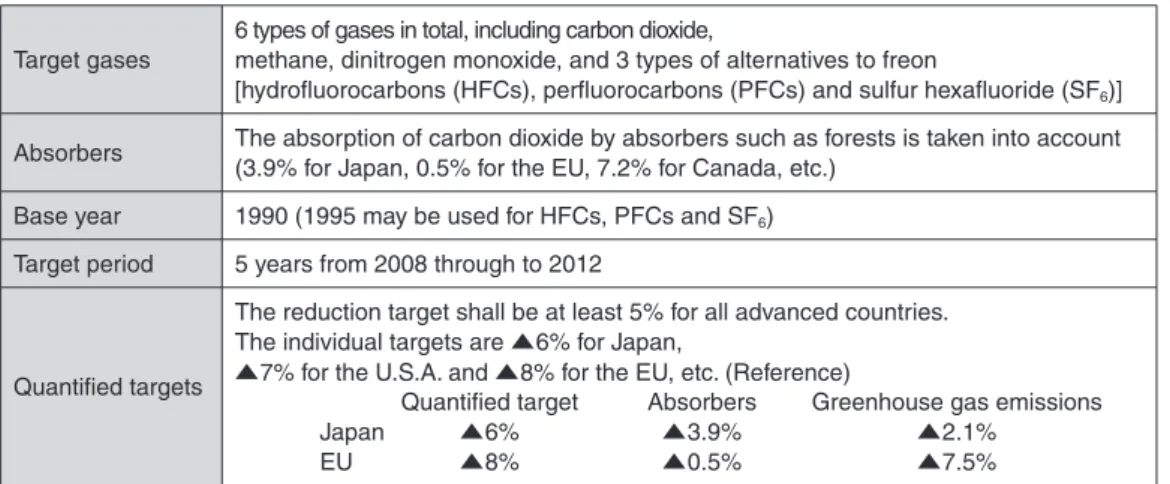
Pa r ties to the Un ited Nations Fr a mework Convention on Climate Change (COP3), held in Kyoto in December 1997, agreed on the Kyoto Protocol that defines the reduction targets of greenhouse gas emissions to be applied to the advanced countries. The Kyoto Protocol established quantified targets for the reductions in greenhouse gas emissions (from 1990 levels) required from 2008 to 2012, for example, 6%
for Japan, 7% for the U.S.A. and 8% for the EU.
Table 1 summarizes the agreements contained in the Kyoto Protocol. The U.S.A., with the highest levels of greenhouse gas emissions in the world, along with Australia, later seceded from the Kyoto Protocol. Despite this, the Kyoto Protocol formally took effect in February 2005 after ratification by Russia. Thus, all Parties to the Kyoto Protocol are now obliged to achieve their stated reduction targets for greenhouse gas emissions. The greatest impact of the Kyoto Protocol is that it has, for the first time in human history, caused world at large to place constraints on the use of coal.
2-2 Constraints on the utilization of
nuclear technologies in the Kyoto Mechanism
To achieve emissions reduction targets, the Kyoto protocol allows each country to make use of following measures: Countries may either take joint measures with other countries to combat global warming, and have this considered as part of its domestic reduction of emissions. Or, they can purchase the necessary reductions in emissions from other countries. This is called the
“Kyoto Mechanism (flexible action)”. The Kyoto
Mechanism is divided into Joint Implementation (JI), the Clean Development Mechanism (CDM) and Emissions Trading (ET), as shown in Figure 1F. JI and CDM are fundamentally similar, except that JI is implemented in advanced countries that are obliged to reduce their emissions, while CDM is implemented in developing countries that are not obliged to reduce their emissions.
The rules for the operation of these mechanisms were discussed at the COP6 session held at Bonn in July 2001, where there was controversy over whether the utilization of nuclear technologies should be incorporated in the Kyoto Mechanism.
European countries opposed the utilization of nuclear technologies to help developing countries combat global warming because they were concerned about the safety control measures available in these countries. On the other hand, Japan and other advanced countries (except those in Europe), as well as several developing countries such as China and India, supported the inclusion of nuclear technologies in the CDM because they felt that no specific technology should be excluded from the negotiations on the prevention of global warming [3]. In the end, the Chairman’s compromise was adopted that a decision be “withheld” on the use of nuclear activities to achieve emissions reduction targets, under either the JI or CDM mechanisms. Thus, the utilization of nuclear technologies was effectively excluded from the Kyoto Mechanism.
However, this compromise does not deny that the use of nuclear technologies is an effective means to reduce the emissions of greenhouse gases.
Table 1 : Key points of the targets to be achieved as part of the Kyoto Protocol Target gases
6 types of gases in total, including carbon dioxide,
methane, dinitrogen monoxide, and 3 types of alternatives to freon
[hydrofluorocarbons (HFCs), perfluorocarbons (PFCs) and sulfur hexafluoride (SF6)]
Absorbers The absorption of carbon dioxide by absorbers such as forests is taken into account (3.9% for Japan, 0.5% for the EU, 7.2% for Canada, etc.)
Base year 1990 (1995 may be used for HFCs, PFCs and SF6) Target period 5 years from 2008 through to 2012
Quantified targets
The reduction target shall be at least 5% for all advanced countries.
The individual targets are ▲6% for Japan,
▲7% for the U.S.A. and ▲8% for the EU, etc. (Reference)
Quantified target Absorbers Greenhouse gas emissions
Japan ▲6% ▲3.9% ▲2.1%
EU ▲8% ▲0.5% ▲7.5%
Source : Prepared by the STFC from Reference [2]
3 Trends in greenhouse gas emissions
To consider how countries should share the reduction in greenhouse gas emissions in the post-Kyoto Protocol, it is important to answer the following questions: What is the present status of greenhouse gas emissions around the world? What will the future trends in greenhouse gas emissions are in advanced and developing countries? What emission indicators are available?
This chapter provides some of the answers to these questions. Here, carbon dioxide (CO2)
is considered one of the greenhouse gases because it is a very effective source of energy and especially abundant, worldwide.
3-1 Current situation
Figure 2 shows the change over time in CO2
emissions by region and current CO2 emissions, broken down by cou ntr y. Worldwide, CO2
emissions have steadily increased. This increase has been especially rapid in Asia. In FY2001, the U.S.A. was the highest CO2 emitter, followed by China, Russia, Japan and India, respectively.
However, of the five countries producing most CO2 emissions, only Russia and Japan (3rd and Figure 1 : Outline of the Kyoto Mechanism
Source: Reference [4]
Figure 2 : Changing trends in CO2 emission by region and current CO2 emission levels, broken down by country
250
200
50 100 150
0 71 73 80 85 90 95 99 00 2001
143 21.6
64.5
46.9 1.7
1.4
2.5
4.8 158 24.6
70.2
51.0 1.9
1.8
2.8
5.6 184 33.4
79.5
8.3
52.3 2.3
3.6
4.2 191
39.5
79.7
8.3
50.7 2.5
5.1
5.6 209
38.1
80.2
9.4
53.4 2.9
6.0
6.2 218
64.6
8.1
7.0 7.7 7.9 8.0
67.8
10.7 12.4 12.5 12.5
56.4 60.9 63.1 62.7
3.1 229 3.6
69.2 71.5 72.1
9.2 10.2 10.2
65.5 66.1 67.1
235 3.7 2363.9
Source: Reference [5]
4th respectively) are currently obliged to reduce their CO2 emissions under the Kyoto Protocol.
Russia already has a CO2 emission level much lower than its target of ±0% below 1990 levels and consequently has a large margin of emission.
Therefore, Russia is not really obliged to reduce its CO2 emissions further. In other words, out of the five countries mentioned, only Japan (the 4th highest CO2 emitter) really expresses any interest in fulfilling its obligation to reduce its CO2
emissions in accordance with the Kyoto Protocol.
3-2 Future perspectives
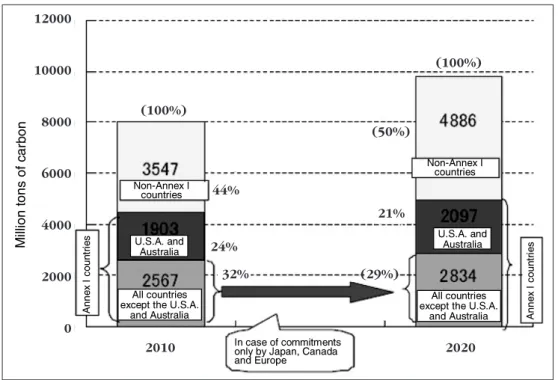
Figure 3 shows the predicted trends in CO2
emissions around the world. Except for the U.S.A.
and Australia (who have both withdrawn from the Kyoto Protocol), the obligations imposed on all countries for reducing CO2 emissions are as listed in Annex I. Overall, the Annex I countries accou nted for on ly 35 % of the world CO2
emissions in 1990, and the Intergovernmental Panel on Climate Change (IPCC) predicts that their share will continue to decrease naturally to about 32% in 2010 and 29% in 2020, as shown in Figure 3. On the other hand, CO2 emissions will significantly increase in the developing countries
not listed in Annex I (non-Annex I countries), as shown in Figure 3, and it is predicted that these developing countries will account for about 50% of global CO2 emissions in 2020. Thus, the current Kyoto Protocol does not apply to all the regions where CO2 emissions are expected to increase rapidly and which are likely to have a significant impact on global warming.
To prevent global warming in the future, one of the important challenges will be how to restrict the CO2 emissions of the U.S.A., Australia and developing countries. In addition, a new collaboration system is needed, based on various emission indicators, which those countries with higher emission levels can join.
3-3 Emission indicators
We looked at the levels of em issions i n adva nced a nd developi ng cou ntr ies usi ng different emission indicators. Figure 2 shows total CO2 emissions (2001) in the 12 top countries.
However, the 30 top countries in the database included 15 developing countries such as China (2nd) and India (5th). Japan was 4th. The emission indicator that the U.S.A. and other countries advocated was CO2 emissions per GDP
Figure 3 : Future CO2 emissions around the world 12000
10000
8000
6000
4000
2000
0
(100%)
44%
24%
32%
2010 2020
(100%)
(50%)
21%
(29%)
Annex I countries: Countries (advanced countries and new OECD countries) listed in Annex I to the UN Framework Convention on Climate Change. All the countries listed in Annex I are obliged to reduce greenhouse gas emissions under the Kyoto Protocol. Developing countries are not listed in Annex I (included instead as non-Annex I countries).
Source: The 3rd Assessment Report of IPCC and Reference [6]
(Gross Domestic Product) in 2000, as shown in Figure 4. The 30 top countries in terms of CO2 emissions per GDP included 21 developing countries. China, India, the U.S.A. and Japan were ranked at 10th, 15th, 43rd and 65th, respectively.
On the other hand, developing countries such as China and India recommended that CO2
emissions per capita (in 2000) be used as the emission indicator, as shown in Figure 5. This chart shows Qatar, Kuwait and the UAE (United Arab Emirates) ranked at 1st, 2nd and 3rd, respectively, and that the 30 top countries include only 10 developing countries. The U.S.A. and Japan were ranked at 4th and 21st while China and India were 59th and 65th, respectively [7].
Since COP8 (held at New Delhi in November 2002), developing countries have expressed strong opposition to starting discussions on any future framework convention because they argue that “the advanced countries should take
the initiative in committing to the protection of the global environment” under the principle of “common but differentiated responsibilities”
(C l au s e 1, A r t icle 3, t he Un it e d Nat ion s Framework Convention on Climate Change).
However, as Figures 4 and 5 shows, this argument is not justified in terms of all the available indicators of global warming.
The developing countries have argued that most importance should be attached to the indicator of CO2 emissions per capita. However, another point of view argues about countries to include China, India, Korea, Mexico, South Africa and Brazil. These countries which have highest total emissions of greenhouse gases of the developing countries should be responsible for tak i ng the i n itiative i n protecti ng the environment [4]. To build up a new system for sharing the reduction in emissions in accordance with a post-Kyoto Protocol, it is important to Figure 4 : CO2 emissions per GDP
Top 30 countries in terms of CO2 emissions per GDP are shown in the chart. The number to the left of each country’s name indicates the ranking. The countries that have the 10 highest CO2 emissions, worldwide, are shown in this chart even if they are ranked below 30th place in terms of CO2 emissions per GDP. The colored bars indicate developing countries.
Source: Prepared by the STFC from Reference [7]
have a multifaceted approach: for example, to set common global standards for emissions based on various indicators but without necessarily adhering to the conventional classification of advanced and developing countries, so that the U.S.A., Australia and other developing countries may also participate in the new Protocol.
The so - called equal emission allowance per capita [8], described below, should be adopted as the common emission standard for all countries.
The equal emission allowance per capita is calculated by dividing the allowable emissions by the predicted total population. By 2100, the allowable emission levels will probably stabilize the CO2 concentration in the atmosphere at around 550 ppm (about twice the level before the Industrial Revolution). This is expected to be the level that can be tolerated in order to prevent global warming. The emission allowance at a future point in time for each country is calculated
by multiplying the equal emission allowance standard per capita by the predicted population of that countr y. However, the emissions in advanced countries such as the U.S.A. were, are and will be more likely to be much higher than the emission allowance. In this case, countries that have emissions exceeding their emission allowance should make effective use of the flexible action under the post-Kyoto Protocol to observe the principle of polluters’ responsibility and efficiently achieve the global reduction target. It is predicted that emissions in China and other developing countries will probably exceed their emission allowance around 2020 so they will be obliged to reduce their emissions just as in the advanced countries. It is expected that these countries may easily join in a new framework under the post-Kyoto Protocol later, because their emissions do not yet exceed their emission allowance. The figure for CO2 emissions Figure 5 : CO2 emissions per capita
The top 30 countries in terms of CO2 emissions per capita are shown in the chart. The number to the left of each country’s name indicates the ranking. The countries that have the 10 highest CO2 emissions, worldwide, are shown in this chart even if they are ranked below 30th place in terms of CO2 emissions per capita. The colored bars indicate developing countries. Source: Prepared by the STFC from Reference [7]
per capita becomes lower as the CO2 emission per unit of energy consumption decreases, the consumption of energy per unit GDP drops, or the GDP per capita declines. Therefore, the reduction in CO2 emissions will be an effective way for developing countries to improve the efficiency of their economies by saving energy and improving productive efficiency.
4 Predicted utilization of nuclear technologies in Advanced and developing countries
It is predicted that developing countries will increase their emissions of greenhouse gases in the medium to long term, as described in the previous chapter. Therefore, it is expected that developing countries will also be obliged to take responsibility for reducing their emissions by various means. Nuclear technologies are very effective in reducing the emissions of greenhouse gases, and better than reusable, environmentally friendly energy technologies in terms of energy supply and power generation cost. Therefore, the utilization of nuclear technologies also has great significance for developing countries. This chapter presents some of the predictions made by Ujita et al.[9]. These authors maintain that any assistance given to developing countries to promote the use of nuclear technologies will effectively contribute to the worldwide reduction in CO2 emissions and the prevention of global warming in the 21st century.
4-1 Prediction technique
To make these predictions, Ujita et al. used a ver y long - term energy supply simulation technique that can predict CO2 emissions and the global energy supply structure. This technique uses the energy module structure of the GRAPE (Global Relationship Assessment to Protect the Environment)[11] integrated assessment model which was also used to produce the estimates adopted in the “Third Repor t of Intergovernmental Panel on Climate Change (IPCC)”[10]. Based on the predicted demand for energy under various circumstances, such as constraints placed on CO2 emissions, this technique optimizes energy system costs through
to the year 2100 in each of 10 regions, worldwide, and predicts the energy supply structure in each region. Based on the optimized energy system costs for the next 30 years, the energy supply structure is then reviewed every 10 years.
To estimate the future demand for energy, co n d i t i o n s we r e a d o p t e d t h a t t o o k i nt o consideration the promotion of energy saving initiatives[9] based upon Case B2 (environmental emphasis/regional coexistence) in the IPCC Special Report on Emission Scenarios[12]. For advanced countries, severe constraints on CO2
emissions, including the requirements of the Kyoto Protocol and the need for a continuous 5% reduction every 10 years from 2013 onwards, were adopted. For developing countries, more moderate requirements to maintain atmospheric CO2 concentrations below 550 ppm (stabilization scena r io t h roug h 210 0, W R E - 550*2) were adopted. It was assumed that oil, coal, natural gas, CO2-recoverable coal, solar power, wind power, biomass, hydropower, geothermal power, and light water reactors (LWRs) would be used as primary energy sources and that fast breeder reactors (FBRs) would be introduced in 2030.
Details of the other conditions used are given in Reference[9]. Some of the predictions made are presented below. Case 1 assumes that the nuclear power generation cost in any developing country is not given preferential treatment and that there is no system in place to promote the introduction of nuclear technologies. Case 2 assumes that the nuclear power generation cost in any developing country is given preferential treatment *3 and that there is a system in place to promote the introduction of nuclear technologies.
4-2 Results
Figures 6 and 7 show the predicted amounts of nuclear power generation plants of light water reactors (LWRs) and fast breeder reactors (FBRs) that advanced and developing countries will have in Case 1 (without a system for promoting t he i nt roduc t ion of nuclea r tech nolog ies in developing countries) and Case 2 (with a system for promoting the introduction of nuclear technologies in developing countries), respectively, in the 21st century.
In Case 1, nuclear power will be used mainly
in the advanced countries with strict regulatory constraints on CO2 emissions in the first half of the 21st century, while developing countries with high economic growth do not actively promote the utilization of nuclear power because they do not have any regulatory constraints on CO2
emissions, but instead promote the introduction of cheaper coal-fired power plants[9]. In Case 2, while advanced countries maintain their utilization of nuclear power, developing countries have a system for promoting the introduction of nuclear power and therefore actively promote the utilization of nuclear energy so that the amount of nuclear power plants (FBRs) in operation is about twice as large by 2100 than in Case 1.
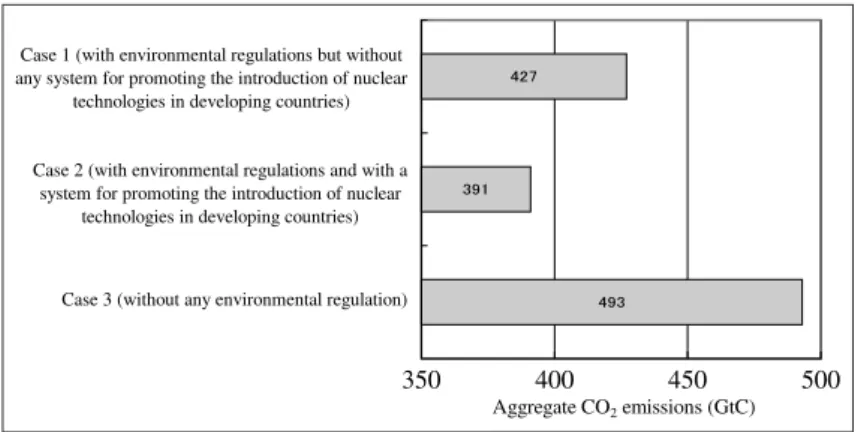
The aggregate CO2 emissions for the 50 years
from 2010 onwards are shown in Figure 8. This indicates the extent by which CO2 emissions will be reduced in Case 2, compared with that in Case 1. The aggregate CO2 emissions in both advanced and developing countries without any environmental regulation are shown in Case 3.
The reduction in CO2 emissions is higher in Case 1, with the existing environmental regulations in advanced countries, than in Case 3, with no environmental regulation. In Case 2, where a system for promoting the introduction of nuclear technologies is installed in developing countries, CO2 emissions are expected to be about 30 GtC (gigatons of carbon) lower than in Case 1.
Therefore, any assistance given to developing countries in promoting the utilization of nuclear Figure 6 : The predicted amounts of nuclear power
generation plants in advanced and developing countries [without any system for promoting the introduction of nuclear technologies (giving preferential treatment to generation cost) in a developing country (Case 1)]
LWR is the acronym for a light water reactor, and FBR is that for a fast breeder reactor. Source: Reference [9]
Figure 7 : The predicted amounts of nuclear power generation plants in advanced and developing countries [with a system for promoting the introduction of nuclear technologies (giving preferential treatment to generation cost) in a developing country (Case 2)]
LWR is the acronym for a light water reactor, and FBR is that for a fast breeder reactor. Source: Reference [9]
Figure 8 : Aggregate CO2 emissions for the 50 years from 2010 through to 2060
The environmental regulations in Cases 1 and 2 comprise the following constraints and conditions on CO2 emissions: The strict regulatory constraints on CO2 emissions assumed for advanced countries include the Kyoto Protocol and the requirement for a continuous 5% reduction every 10 years from 2013 onwards, while more moderate regulatory constraints requiring that the CO2
concentration in the atmosphere not exceed 550 ppm (stabilization scenario through 2100, WRE-550) were adopted for developing countries. Case 3 assumes that there is no environmental regulation.
Source: Prepared by the STFC from Reference [9]
technologies will be very effective, not only in overcoming regional disparities in the utilization of nuclear technologies, but also in reducing CO2
emissions and preventing global warming in the 21st century. If the post-Kyoto Protocol approves the utilization of nuclear technologies within the Kyoto Mechanism, the parties to the Protocol will then have more options available. If the utilization of nuclear technologies is formally approved, this will probably result in more environmental and economic assistance being given to developing countries and this, in turn, will be a sensible first step towards the establishment of a new international framework convention for reducing CO2 emissions, worldwide.
5 Problems regarding the introduction of
nuclear technologies into developing countries
As described in the previous chapter, it is considered that introducing nuclear power generation systems into developing countries as soon as possible will be an effective means to prevent the acceleration of global warming while still allowing these countries to continue their sustainable development. This is because these systems may be used as the main power sources while only producing relatively low levels of greenhouse gas emissions. To promote the utilization of nuclear technologies in Asian and other developing countries, it is very important to take safety and nuclear non - proliferation requirements into account, as well as building up the infrastructures necessary to introduce nuclear technologies. This chapter summarizes the process of introducing nuclear technologies into developing countries and describes the problems that can be encountered when promoting the utilization of these technologies.
5-1 Introduction of nuclear technologies
By the end of 20 04, 434 nuclea r power plants were operating around the world and had recorded the highest- ever total output of approximately 379.2 GW (379.20 million kW)[12]. Developing countries accounted for only about 10% or 38.36 GW of the total output. However, in
China and India, where the demand for electric power is expected to increase rapidly, policies and programs are in place to increase their nuclear power generation capacities to 36 GW and 20 GW, respectively, by 2020[12]. Similarly, the Korean Government plans to increase its capacity to about 27 GW. In China, international tendering closed for the upcoming construction of 4 nuclear power plants in February 2005.
French and Russian groups and a U.S. & Japanese consortium took part in the tender, and the contractors will be selected in 2005. In addition, Indonesia, Kazakhstan and Egypt (which do not currently operate any nuclear power plants) plan to construct about 4, 3 and 2 new nuclear power plants, respectively, each of 1 GW (1 million kW) capacity, by 2020. In Vietnam, a feasibility study has been completed on the construction of a new nuclear power plant of 1.2 to 4 GW in the southern part of the country by 2020[12].
As nuclear power generation capacit y is increasing worldwide, including the projects described above, it is expected that the world demand for uranium will increase by 10 - 29%
(to between 73495 - 86070 tU/year) in 2020, Table 2 : Introduction of nuclear power plants into
developing countries
Country
Nuclear power plants in operation Output (GW) Number of
plants
Korea 16.72 19
China 6.96 9
Taiwan 5.14 6
India 2.77 14
Brazil 2.01 2
South Africa 1.89 2
Mexico 1.36 2
Argentina 1.01 2
Pakistan 0.50 2
Total in developing countries 38.36 58
(Japan) (45.74) (52)
Total in the world 379.20 434 Developing countries / world 10.1% 13.4%
As of December 31, 2004, 1 GW is equivalent to 1 million kW.
Source: Prepared by the STFC from Reference [12]
from 66815 tU/year in 2002. On the other hand, the world production of uranium is expected to increase from about 47000 tU/year in 2003 to about 62000 tU/year by 2020. The resultant shortfall in supply is likely to be met by the sale of surplus military nuclear material by the U.S.
and Russian Governments, though there may be concerns about temporary disruptions to supply. It should be noted that China, India and Pakistan are taking measures to meet their own requirements for uranium [3].
The following sections describe the problems that developing countries may encounter in implementing the projects described above and with additional projects aiming to introduce nuclear power plants in order to reduce the emissions of greenhouse gases. They are intended for developing countries that plan to introduce nuclear power plants and for those countries that are actively promoting the introduction of nuclear power plants.
5-2 Technology transfer
Advanced countries are faced with many challenges in promoting the use of nuclear technologies in developing countries. Challenges include the transfer of nuclear power generation technologies and safety control technologies such as those related to reactor maintenance, needed to ensure and enhance the safety of the nuclear facilities. Another challenge is the nuclear material control of technologies to ensure nonproliferation[13] in accordance with the licenses of the technologies and international commitments. The critical reactor maintenance t e c h nolo g i e s i nc lu d e pipi ng i n s p e c t io n , p r e v e n t i v e m a i n t e n a n c e a n d t h e r e p a i r technologies needed to prevent long-term ageing and deterioration[14].
In the field of nuclear safety, Japan has started to establish multilateral and bilateral links with other Asian countries through the Forum for
Figure 9 : Japanese cooperation with other Asian countries through the exchange of nuclear researchers and the training service system (results in 2003)
The systems covered: (i) Nuclear research exchange system, (ii) International Nuclear Safety Seminar, (iii) International training services in nuclear safety technologies, (iv) International exchange and dispatch services for nuclear safety, (v) International training services in fields such as the safety control of nuclear power plants, (vi) Long-term training services promoting international cooperation to ensure the safety of nuclear power plants, and (vii) Introductory course in nuclear power generation. Systems (i) to (iv) are operated by the Ministry of Education, Culture, Sports, Science and Technology, (v) and (vi) are operated by the Ministry of Economy, Trade and Industry, and (vii) is operated by the Japan International Cooperation Agency (JICA). The fields covered include the utilization of radiation in the
agricultural, industrial, medical and other sectors. Source: Reference [15]
Nuclear Cooperation in Asia and the framework of the Regional Cooperative Agreement for Asia and the Pacific under the International Atomic Energy Agency (IAEA)[15]. In future, however, it will be necessary for Japan to contribute to the establishment and improvement of nuclear safety technology in other Asian countries not only through these forums and frameworks but also through the exchange of researchers and the training service system[15]. In order to cooperate with other Asian countries, it is also necessary to consider whether or not these countries are and will be politically stable and whether or not they are parties to and complying with the relevant conventions and frameworks.
5-3 Establishment of infrastructures
Another challenge in promoting the utilization of nuclear technologies in developing countries is how to build up the infrastructures necessary for the introduction of the appropriate nuclear technologies into these countries. In the case of developing countries that plan to introduce nuclear power generation plants for the first time, it is important that advanced countries help them build up the necessary infrastructures for a nuclear non-proliferation system, safety regulations and a nuclear liability system, and help foster good public relations regarding nuclear technologies. It is also important for advanced countries to help developing countries with the creation of the human resources necessary to maintain and strengthen these systems. Japan has worked together with other Asian countries to build up the infrastructures to help develop human resources in these countries, e sp ec i a l l y t h r oug h t he ab ove - me nt ioned frameworks such as the exchange of nuclear researchers, the training service system and the Forum for Nuclear Cooperation in Asia, as shown in Figure 9. In future, Japan should continue to provide assistance and cooperation to developing countries in Asia. When introducing nuclear power plants into developing countries, it will take a long time to help build up their infrastructures, establish their legislative systems and develop the human resources required.
Therefore, it is recommended that advanced and developing countries should enter into
bilateral nuclear agreements or cooperative agreements as soon as possible[15]. As for the developing countries that are actively promoting the i ntroduction of nuclear power plants, advanced countries should not only cooperate with them in order to ensure their safet y, develop human resources and comply with nuclear non-proliferation measures, but should also actively assist international nuclear power companies wanting to do business with them, regarding the peaceful use of nuclear technology.
To i nt roduce nuclea r tech nolog ies i nto developi ng cou ntr ies, it is also necessar y for advanced countries to provide financial assistance. At present, the World Bank operates a variety of Carbon Funds in accordance with the Kyoto Mechanism[7]. The post-Kyoto Protocol will discuss the operation of funds (appropriate to the Protocol) needed to help developing countries respond to the impact of climate change[16]. If the use of nuclear technologies is adopted as part of the Kyoto Mechanism, Japan will need to help these countries construct nuclear facilities instead of thermal power plants using Japanese funds and technologies to reduce emissions effectively with systems such as the CDM.
6 Recommendations
This article provides an overview of the Kyoto Protocol and Kyoto Mechanism, the existing constraints placed on the use of nuclear power, and trends related to greenhouse gas emissions in advanced and developing countries. It also emphasizes the importance of a multifaceted approach to achieving new targets within the framework of a post-Kyoto Protocol. To illustrate the importance of nuclear technologies in the Kyoto Mechanism, this paper examines the prediction that collaboration from advanced countries will help developing countries promote the use of nuclear technologies, and will be an effective way to reduce greenhouse gas emissions and prevent global warming in the 21st century.
However, to promote the use of nuclear power in developing countries in Asia and elsewhere, it is important to implement safety and nuclear n o n p r o l i f e r a t i o n m e a s u r e s a n d d e v e l o p infrastructures so that nuclear technologies
can be introduced. In this paper, a process to introduce nuclear technologies into developing countries is described. Some of the problems related to the transfer of these technologies, as well as the development of infrastructures to promote the use of these technologies are also presented. Next, we provide recommendations regarding the way the post- Kyoto Protocol should be formulated and suggest that advanced countries should help developing countries introduce nuclear technologies.
(1) A multifaceted approach to build a framework for sharing environmental burdens
It is necessary to create a system in which the United States and other more advanced nations, together with developing countries can share the burden of reducing greenhouse gas emissions to protect the environment. Japan has expressed an interest in fulfilling its obligations to reduce greenhouse gas emissions and; therefore, should actively participate in international discussions aimed at building the framework. Establishing common global standards for emission reduction should be based on a multifaceted approach that calculates emission reduction shares using a variety of indicators such as emissions per capita and GDP.
(2) Incorporating nuclear technologies into the Kyoto Mechanism (CDM/JI)
To maintain the Kyoto Mechanism within the framework of the post-Kyoto Protocol, the recommendation is that Japan, together with China, India, and other developing countries, persuade the European countries to incorporate nuclear technologies into CDM and JI. Most importantly, Japanese representatives need to explain the safety of nuclear technologies to those in Europe who are responsible for deciding environmental policies.
(3) Assistance for promoting the use of nuclear technologies in developing countries The introduction of nuclear power generation systems could be an effective way to both promote sustainable development in Asian and other developing countries and prevent the acceleration of global warming. However,
to ef fectively promote the use of nuclear technologies in developing countries, it is necessar y that advanced countries provide assistance in accordance with the current nuclear nonproliferation system:
(i) It is necessary to transfer technologies, i nclud i ng s a fet y cont rol s rel ated to nuclear power generation, and to provide assistance in the implementation of these technologies to developing countries. Japan will need to encourage other developing cou nt r ie s to pa r t icipate i n releva nt conventions and frameworks, and it will need to cooperate in the establishment of such a system.
(ii) To e f f e c t i v e l y i n t r o d u c e n u c l e a r t e c h n o l o g i e s a n d e s t a b l i s h t h e infrastructures in developing countries, greater importance should be given to the development of human resources and to providing financial assistance. Japan should actively help developing countries to establish the necessary infrastructures such as the development of human resources, a nuclear nonproliferation system, safety regulations, a nuclear liability system, and assistance with public relations.
Acknowledgments
We would like to express our heartfelt thanks to Mr. Sueo Machi, member of the Atomic Energy Commission, Mr. Hisaharu Dosho, guest professor, Department of Nuclear Engineering
& Management, School of Engineering, The University of Tokyo (and affiliated fellow, the National Institute of Science and Technology Policy), and Hiroshi Ujita, chief researcher, Project Testing and Research Department, the Institute of Applied Energy, for having made valuable contributions to the preparation of our article.
Glossary
*1 Developing countries
The Kyoto Protocol defines developing countries as those that are not obliged to reduce their emissions of greenhouse gases.
Here, not only China and India but also the OECD countries of Korea and Mexico are classified as developing countries.
*2 WRE-550
T o p r e v e n t g l o b a l w a r m i n g , t h e
“I ntergover n ment a l Pa nel on Cl i mate Change ( IPCC)” is now reviewing the s c e n a r i o i n w h i c h t h e p r e s e n t C O2
concentration of 370 ppm in the atmosphere will become saturated and stabilize at 450 to 1,000 ppm by 2100. Wigley, Richels &
Edmonds proposed a scenario in which the CO2 concentration will stabilize at 550 ppm.
*3 Power generation cost given preferential treatment
This energy prediction simulation assumes that the power generation cost will be 4 cents/kWh for a light water reactor, 4.6 cents/kWh in 2030 and 4 cents/kWh from 2060 onwards for a fast breeder reactor (to be introduced in 2030), if no preferential treatment is given to them. With preferential treatment, it is predicted that the power generation cost will drop by 2 cents/kWh for 50 years from 2010.
References
[1] PA Working Group, the projects entrusted by the Ministry of Education, Culture, Sports, Science and Technology “Meeting Discussing What Should be done in Public Relations” - public relations for sustainable development and atomic energy - Summary of the third proceedings, January 2003 (in Japanese):
http://www.pinenet.jp/e-kokusaikoho/e-3-3.
html
[2] Ta d a s h i Aoy a g i , “ W h a t i s t h e Kyo t o Protocol?”, March 2005, OHM, pp.18-23 (in Japanese)
[3] T he E nc yclop ed i a of Atom ic E ne r g y, ATOMICA, the 5th, 6th and 7th sessions of the Conference of Parties to the UN Framework Convention on Climate Change:
http://mext-atm.jst.go.jp/atomica/01080412 _1.html
The World Reserve of Uranium Resources and the Predicted Supply and Demand of Uranium: http://mext-atm.jst.go.jp/atomica/
04020107_1.html
[4] Reference 1, t he 25t h s e s sion of t he Global Environmental Subcommittee, the Environmental Committee, the Industrial Structure Council, the Ministry of Economy, Trade and Industry, 2004 (in Japanese):
http://www.meti.go.jp/committee/download files/g41104a91j.pdf
Material 5 distributed in the 16th session of the Global Environmental Subcommittee, 2003 (in Japanese):
http://www.meti.go.jp/committee/summary /0001635/0001.html
Advanced Earth Science & Technology O r g a n i z at ion, “Gu ideb ook on Glob a l Warming Problems, 2005 to 2006”, p.36 (in Japanese)
[5] Home page provided by the Institute of Applied Energy, Carbon Dioxide Emissions in the World (in Japanese): http://www.iae.o r.jp/energyinfo/energydata/data5010.html [6] Cl i mate Change and Energ y Prog ram,
homepage by FoE Japan (in Japanese)
http://www.foejapan.org/climate/doc/tokyo conf/08B_METI.PDF
[7] Material 5 distributed in the 16th session of the Global Environmental Subcommittee, the Environmental Committee, the Industrial Structure Council, the Ministry of Economy, Trade and Industry, 2003 (in Japanese):
http://www.meti.go.jp/committee/summary /0001635/0001.html
Reference, the 9th session of the Market Mechanism Expert Committee, the Global Environmental Subcommittee (in Japanese):
http://www.meti.go.jp/policy/global_enviro nment/sankoushin/9thshijomecha/9-10.pdf [8] Isei Shuh, “Protocol and Future Strategy”,
Economy Course, Nihon Keizai Shimbun, Inc., October 29, 2004, p.33 (in Japanese) [9] Hiroshi Ujita, Kazuaki Matsui and Hiroshi
Sekimoto, the Collection of Lectures and Papers, the 21st session of the Conference on Energy Systems, Economy and Environment, January 26-27, 2005, pp.41-44 (in Japanese) Kazumi Ikeda, Kazuo Aoki and Mamoru Hatano, ditto, pp.45-48 (in Japanese)
[10] Special Repor t on Em ission Scenar ios (SRES), International Panel on Climate Change (IPCC), Cambridge University Press,
2000
[11] Kurosawa A., et al., Analysis of Carbon E m i s s i o n S t a b i l i z a t i o n Ta r g e t s a n d Adaptation by Integrated Assessment Model, the energy journal, Kyoto Special Issue, pp.157-175, 1999
[12] Home page provided by the Japan Atomic Industrial Forum, Window of Atomic Energy, the Atomic Energy Commission of Japan, Summary (in Japanese):
http://www.jaif.or.jp/asia/window/39.html Nuclear Power Plants in the World:
http://www.jaif.or.jp/english/news/2005/06 20_doukou.html
[13] White Paper on Atomic Energy, Version 2004 (in Japanese):
http://aec.jst.go.jp/jicst/NC/about/hakusho/
hakusho2004/26.pdf
[14] Osamu Maekawa, “the Latest Technical Trend of Nuclear Plants”, July 2005, OHM, pp.2-3
[15] Council for New Planning (the 25th session), the Atomic Energy Commission of Japan, Material No.1 (in Japanese):
http://aec.jst.go.jp/jicst/NC/tyoki/sakutei200 4/sakutei25/sakutei_si25.htm
[16] Home page provided by the Ministry of Foreign Affairs, the 10th session of the Conference of Parties to the Framework Convention on Climate Change (COP10), Summary:
http://www.mofa.go.jp/policy/environment/
warm/cop/cop10_1.html
Tatsuya OHIRA, Ph.D.
Environment and Energy Research Unit, Science and Technology Foresight Center
He has a Doctorate of Engineering and is engaged in the research and development of energy equipment in the private sector, specializing in mechanical engineering, energy engineering and nuclear engineering. He is currently interested in science and technology policies in the fields of energy and environment, as well as policies and businesses contributing to the solution of energy, environmental and economic problems.
Isao MOCHIDA, Ph.D.
Affiliated Fellow, NISTEP
Special guest professor, Art, Science and Technology Center for Cooperative Research, Kyushu University
Director, Innovation Plaza of Japan Science and Technology Agency
He has a Doctorate of Engineering and retired from Kyushu University in 2004. As a special guest professor, he is involved in research and development efforts concerning the use of fossil fuels, carbon materials and the protection of the environment, where the results of his research can be used for the benefit of society.
(Original Japanese version: published in November 2005)