Introduction
In Japan, foresight exercises have been conducted every five years since 1971, to gain perspectives on future trends in science and technology in view of the coming thirty years. The National Institute of Science and Technology Policy (NISTEP) has been responsible for the task since the fi fth Foresight , and has extended the objectives to provide the future outlook of science and technology as well as the future society surrounding it, and in recent years added the grasping of social needs and the drawing up of future scenarios. The latest exercise in FY 2009, “The 9th Foresight : Contribution of Science and Technology to Future Society,” was conducted with a picture of the future direction to pursue borne in mind, whereby the focus of discussion was placed on methods to overcome the global and national issues that may arise in the future .
The exercise included: a questionnaire for experts, on the development of science and technology;
a scenario of people’s lives in the future, and a framework and paths that would lead to such a scenario; and workshops to enable discussion on each region’s sustainable development and its enabling technologies. The results were compiled into a three- volume report.[1]
The questionnaire for experts (Delphi survey) has been conducted from the first Foresight to the latest, with no exceptions, enabling us to evaluate the reliability of the predictions, i.e., the level of attainment viewed from the present perspective.
The predictions from the fi rst Delphi survey, which was published in 1971, to the fifth (published more than twenty years after the 1st, in 1992) have been assessed by groups of experts. As Japan is the only country in the world that has carried out uninterrupted
5
Have Past Foresight exercises been able to correctly indicate future directions?
Yoshiko YOKOO General Unit
1
2
surveys of this kind, it has the unique opportunity to examine the wisdom of the past, and the surveys may be considered as a valuable soft-asset from a global perspective.
An announcement of the survey evokes an interest in how many of the past predictions have been realized and to what degree. This report presents an overview of the realization assessment covering the predictions of the first to fifth surveys, and gives an account of some science and technology that has been realized and some that has not come to fruition.
The Method for Assessing the Realization Status
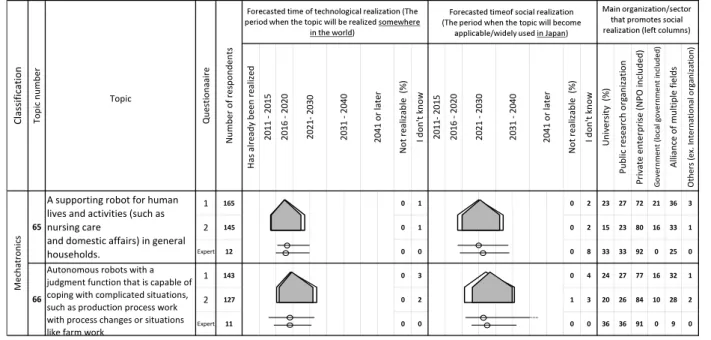
The questionnaire, for experts, on individual fi elds of science and technology is named after the method employed, and hence is called the Delphi survey. The Delphi method is to implement two or more rounds of the same questionnaire for a group of experts, until the answers converge towards some concrete opinion. In the second and subsequent rounds, summary results of the previous round are shown to the respondents, and they are encouraged to review their early answers in light of the trends of the overall opinions. As some respondents modify their views and adopt the mainstream ideas, the overall opinion tends to converge (Table 1). The Delphi method is considered to be one of the effective methods for long- term foresight, which has to depend more or less on intuition.
Delphi surveys thus far conducted in Japan have included two rounds of the questionnaire for the purpose of gathering experts’ opinions on future science and technology (“topics” in this report) in terms of the importance, feasibility, and the approach to be taken for realization. In the fi fth Delphi survey, an evaluation of the results of the fi rst Delphi survey
Table 1 : An Example of a Delphi Survey Summary Sheet
was implemented in order to assess the realization status. Thus, one previous survey has been added at the time of each Delphi survey since the fi fth one.
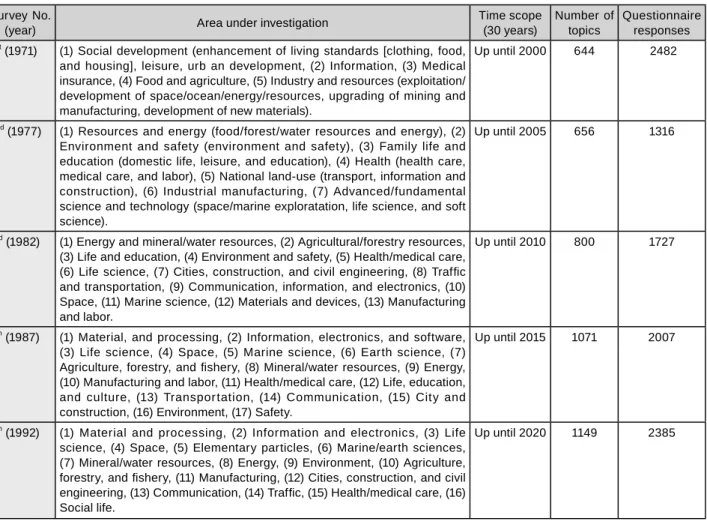
A summary of the five previous Delphi surveys , whose realization statuses were assessed in the ninth Delphi survey, is shown in Table 2. From the fi rst to the fi fth survey, the number of topics taken up became larger and larger, as did the number of respondents.
Also, topics concerning the fundamental aspects of science and technology have gradually become included in the surveys, in addition to the technologies of signifi cance in view of social applications.
The work for the realization status assessment carried out in the ninth Delphi survey was allotted to twelve panels, which were organized for the ninth survey. Preliminary counseling decided that the levels of realization of these topics should be classifi ed, based on the evaluation from the viewpoint at the time of assessment, into the following three levels: “fully realized,” “partially realized,” and “not realized.” Partial realization includes cases where some of the contents of the topic have been realized and cases where the results open to consideration show that realization has been reached from some viewpoints, but not from all. For the topics judged as “not realized,” the reasons for no realization were also discussed. Although the survey results include
information on the expected year of realization, there are cases where pinpointing the precise period of realization is difficult. Therefore, a comparison of the years of expected and actual realization was not performed.
Overview of Realization Status Assessment
The following is an overview of the realization status as of the time when the ninth Delphi survey was conducted. Further details can be found in the reference materials of the ninth Delphi Survey Report.[1]
3-1 Ratio of Realization
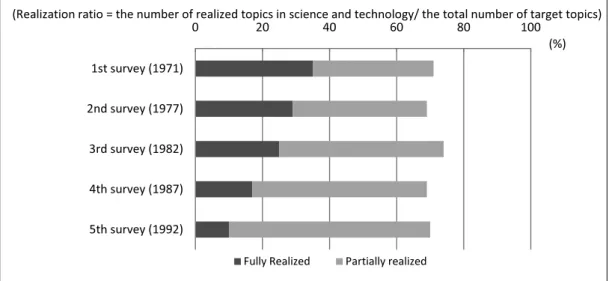
The assessment indicates that around 70 percent of the topics given in the first through fifth surveys have been realized (including partial realization) (the number of realized topics / the total number of target topics). The ratio of exact realization increases with time. However, the ratio for the other 30 percent of topics does not increase with time, indicating that it is impossible to realize these topics in the time span of tens of years, or that they have become obsolete or meaningless over time.
Field-by-field examination indicates that the fields directly related to human life (e.g., environment,
dŽƉŝĐ
ϭ ϭϲϱ Ϭ ϭ Ϭ Ϯ Ϯϯ Ϯϳ ϳϮ Ϯϭ ϯϲ ϯ
Ϯ ϭϰϱ Ϭ ϭ Ϭ Ϯ ϭϱ Ϯϯ ϴϬ ϭϲ ϯϯ ϭ
džƉĞƌƚ ϭϮ Ϭ Ϭ Ϭ ϴ ϯϯ ϯϯ ϵϮ Ϭ Ϯϱ Ϭ
ϭ ϭϰϯ Ϭ ϯ Ϭ ϰ Ϯϰ Ϯϳ ϳϳ ϭϲ ϯϮ ϭ
Ϯ ϭϮϳ Ϭ Ϯ ϭ ϯ ϮϬ Ϯϲ ϴϰ ϭϬ Ϯϴ Ϯ
džƉĞƌƚ ϭϭ Ϭ Ϭ Ϭ Ϭ ϯϲ ϯϲ ϵϭ Ϭ ϵ Ϭ
DĞĐŚĂƚƌŽŶŝĐƐ
ϲϱ
ƐƵƉƉŽƌƚŝŶŐƌŽďŽƚĨŽƌŚƵŵĂŶ ůŝǀĞƐĂŶĚĂĐƚŝǀŝƚŝĞƐ;ƐƵĐŚĂƐ ŶƵƌƐŝŶŐĐĂƌĞ
ĂŶĚĚŽŵĞƐƚŝĐĂĨĨĂŝƌƐͿŝŶŐĞŶĞƌĂů ŚŽƵƐĞŚŽůĚƐ͘
ϲϲ
ƵƚŽŶŽŵŽƵƐƌŽďŽƚƐǁŝƚŚĂ ũƵĚŐŵĞŶƚĨƵŶĐƚŝŽŶƚŚĂƚŝƐĐĂƉĂďůĞŽĨ ĐŽƉŝŶŐǁŝƚŚĐŽŵƉůŝĐĂƚĞĚƐŝƚƵĂƚŝŽŶƐ͕
ƐƵĐŚĂƐƉƌŽĚƵĐƚŝŽŶƉƌŽĐĞƐƐǁŽƌŬ ǁŝƚŚƉƌŽĐĞƐƐĐŚĂŶŐĞƐŽƌƐŝƚƵĂƚŝŽŶƐ ůŝŬĞĨĂƌŵǁŽƌŬ
WƵďůŝĐƌĞƐĞĂƌĐŚŽƌŐĂŶŝnjĂƚŝŽŶ
ϮϬϰϭŽƌůĂƚĞƌ /ĚŽŶΖƚŬŶŽǁ
ϮϬϭϲͲϮϬϮϬ ϮϬϮϭͲϮϬϯϬ ϮϬϯϭͲϮϬϰϬ KƚŚĞƌƐ;Ğdž͘/ŶƚĞƌŶĂƚŝŽŶĂůŽƌŐĂŶŝnjĂƚŝŽŶͿWƌŝǀĂƚĞĞŶƚĞƌƉƌŝƐĞ;EWKŝŶĐůƵĚĞĚͿ 'ŽǀĞƌŶŵĞŶƚ;ůŽĐĂůŐŽǀĞƌŶŵĞŶƚŝŶĐůƵĚĞĚͿ ůůŝĂŶĐĞŽĨŵƵůƚŝƉůĞĨŝĞůĚƐ
ϮϬϭϭͲϮϬϭϱ
ϮϬϮϭͲϮϬϯϬ ϮϬϯϭͲϮϬϰϬ ϮϬϰϭŽƌůĂƚĞƌ /ĚŽŶΖƚŬŶŽǁ hŶŝǀĞƌƐŝƚLJ;йͿ
YƵĞƐƚŝŽŶĂĂŝƌĞ
ůĂƐƐŝĨŝĐĂƚŝŽŶ dŽƉŝĐŶƵŵďĞƌ EƵŵďĞƌŽĨƌĞƐƉŽŶĚĞŶƚƐ EŽƚƌĞĂůŝnjĂďůĞ;йͿ EŽƚƌĞĂůŝnjĂďůĞ;йͿϮϬϭϲͲϮϬϮϬ
,ĂƐĂůƌĞĂĚLJďĞĞŶƌĞĂůŝnjĞĚ ϮϬϭϭͲϮϬϭϱ
&ŽƌĞĐĂƐƚĞĚƚŝŵĞŽĨƚĞĐŚŶŽůŽŐŝĐĂůƌĞĂůŝnjĂƚŝŽŶ;dŚĞ ƉĞƌŝŽĚǁŚĞŶƚŚĞƚŽƉŝĐǁŝůůďĞƌĞĂůŝnjĞĚƐŽŵĞǁŚĞƌĞ
ŝŶƚŚĞǁŽƌůĚͿ
&ŽƌĞĐĂƐƚĞĚ ƚŝŵĞŽĨƐŽĐŝĂůƌĞĂůŝnjĂƚŝŽŶ
;dŚĞƉĞƌŝŽĚǁŚĞŶƚŚĞƚŽƉŝĐǁŝůůďĞĐŽŵĞ ĂƉƉůŝĐĂďůĞͬǁŝĚĞůLJƵƐĞĚŝŶ:ĂƉĂŶͿ
DĂŝŶŽƌŐĂŶŝnjĂƚŝŽŶͬƐĞĐƚŽƌ ƚŚĂƚƉƌŽŵŽƚĞƐƐŽĐŝĂů ƌĞĂůŝnjĂƚŝŽŶ;ůĞĨƚĐŽůƵŵŶƐͿ
Source: Reference[1]
*The pentagons in the table represent the middle one-half of responses on the time of realization (the left edge, central apex, and right edge represent the 1/4, 1/2, and 3/4 accumulation points of the responses, respectively, arranged in order of forecasted year of realization [from early to later]). The hatched pentagon represents the results of the second round of the questionnaire, indicating a converging tendency of the opinions (i.e. narrower width than the non-hatched pentagon, which represents the fi rst round). The apex of the shape (i.e. the halfway point of the accumulated responses arranged in order of realization year — from earlier to later years — is used as the value representing the year of realization.
3
security, health care, medicine, and life science) have a relatively high score in terms of the realization and partial realization rate. The ICT field shows a high score for the exact realization ratio (excluding partial realization). On the other hand, the fields related to transport and energy show low ratios of realization.
As a general tendency, those topics that were expected for early realization scored high realization ratios, and those with a lower degree of importance generally show low realization ratios. Note, however, that there have been some cases where topics with low importance were realized, notably in the in ICT fi eld.
3-2 Reasons for No Realization of a Topic
Inspecting the reasons for no realization of a topic, technical problems are by and large the most frequent causes.
In the first and second surveys, where many of the topics involved social aspects, a relatively large portion of the reasons for no realization was occupied by social problems and insufficient needs. However, each time the survey was conducted, the proportion of technical problems cited as the obstacle to realization has become progressively larger.
As viewed on a field-by-field basis, technical problems have been cited as the reason for no realization in more than 75 percent of topics related to medical and health care through the first to fifth surveys. Cost is one of the major problems, in addition to technical problems, in infrastructure-related domains, such as resources and energy, transport, construction and civil engineering, and the frontier domains, such as space and marine. Cost is the most frequently cited obstacle in some cases. The advent of alternative technology is also pointed out as the obstacle more often in fi elds related to ICT or electronics (especially in communication fi eld) than in other fi elds. In the fourth and fi fth surveys, among the topics that failed to be realized, for around 30 percent of them, the advent of an alternative technology was stated as the reason for no realization.
As an example, the obstacles to realization of the topics in the fi fth survey, are shown for each fi eld in Figure 2. Among the 100 most important topics that were predicted to be realized by 2009, some of them still remain unrealized, and the reasons why are listed in Table 3.
Survey No.
(year) Area under investigation Time scope
(30 years)
Number of topics
Questionnaire responses 1st (1971) (1) Social development (enhancement of living standards [clothing, food,
and housing], leisure, urb an development, (2) Information, (3) Medical insurance, (4) Food and agriculture, (5) Industry and resources (exploitation/
development of space/ocean/energy/resources, upgrading of mining and manufacturing, development of new materials).
Up until 2000 644 2482
2nd (1977) (1) Resources and energy (food/forest/water resources and energy), (2) Environment and safety (environment and safety), (3) Family life and education (domestic life, leisure, and education), (4) Health (health care, medical care, and labor), (5) National land-use (transport, information and construction), (6) Industrial manufacturing, (7) Advanced/fundamental science and technology (space/marine exploratation, life science, and soft science).
Up until 2005 656 1316
3rd (1982) (1) Energy and mineral/water resources, (2) Agricultural/forestry resources, (3) Life and education, (4) Environment and safety, (5) Health/medical care, (6) Life science, (7) Cities, construction, and civil engineering, (8) Traffi c and transportation, (9) Communication, information, and electronics, (10) Space, (11) Marine science, (12) Materials and devices, (13) Manufacturing and labor.
Up until 2010 800 1727
4th (1987) (1) Material, and processing, (2) Information, electronics, and software, (3) Life science, (4) Space, (5) Marine science, (6) Earth science, (7) Agriculture, forestry, and fi shery, (8) Mineral/water resources, (9) Energy, (10) Manufacturing and labor, (11) Health/medical care, (12) Life, education, and culture, (13) Transpor tation, (14) Communication, (15) City and construction, (16) Environment, (17) Safety.
Up until 2015 1071 2007
5th (1992) (1) Material and processing, (2) Information and electronics, (3) Life science, (4) Space, (5) Elementary particles, (6) Marine/earth sciences, (7) Mineral/water resources, (8) Energy, (9) Environment, (10) Agriculture, forestry, and fi shery, (11) Manufacturing, (12) Cities, construction, and civil engineering, (13) Communication, (14) Traffi c, (15) Health/medical care, (16) Social life.
Up until 2020 1149 2385
Table 2 : Implementation Summary: First to Fifth Delphi Survey
Source: Reference[1]
(Realization ratio = the number of realized topics/ the total number of target topics)
Examples: Realized and Unrealized topics
This section introduces selected examples of realized and unrealized topics listed through the
fi rst to fi fth survey. The characteristics of the Delphi survey and subsequent developments of the topics are also described. Note that the “partially realized” cases are included in the description of the realized topics.
Ϭ ϮϬ ϰϬ ϲϬ ϴϬ ϭϬϬ
ϭƐƚƐƵƌǀĞLJ;ϭϵϳϭͿ ϮŶĚƐƵƌǀĞLJ;ϭϵϳϳͿ
;йͿ
;ZĞĂůŝnjĂƚŝŽŶƌĂƚŝŽсƚŚĞŶƵŵďĞƌŽĨƌĞĂůŝnjĞĚƚŽƉŝĐƐŝŶƐĐŝĞŶĐĞĂŶĚƚĞĐŚŶŽůŽŐLJͬƚŚĞƚŽƚĂůŶƵŵďĞƌŽĨƚĂƌŐĞƚƚŽƉŝĐƐͿ
Ϭ ϮϬ ϰϬ ϲϬ ϴϬ ϭϬϬ
ϭƐƚƐƵƌǀĞLJ;ϭϵϳϭͿ ϮŶĚƐƵƌǀĞLJ;ϭϵϳϳͿ ϯƌĚƐƵƌǀĞLJ;ϭϵϴϮͿ ϰƚŚƐƵƌǀĞLJ;ϭϵϴϳͿ ϱƚŚƐƵƌǀĞLJ;ϭϵϵϮͿ
;йͿ
;ZĞĂůŝnjĂƚŝŽŶƌĂƚŝŽсƚŚĞŶƵŵďĞƌŽĨƌĞĂůŝnjĞĚƚŽƉŝĐƐŝŶƐĐŝĞŶĐĞĂŶĚƚĞĐŚŶŽůŽŐLJͬƚŚĞƚŽƚĂůŶƵŵďĞƌŽĨƚĂƌŐĞƚƚŽƉŝĐƐͿ
Ϭ ϮϬ ϰϬ ϲϬ ϴϬ ϭϬϬ
ϭƐƚƐƵƌǀĞLJ;ϭϵϳϭͿ ϮŶĚƐƵƌǀĞLJ;ϭϵϳϳͿ ϯƌĚƐƵƌǀĞLJ;ϭϵϴϮͿ ϰƚŚƐƵƌǀĞLJ;ϭϵϴϳͿ ϱƚŚƐƵƌǀĞLJ;ϭϵϵϮͿ
;йͿ
&ƵůůLJZĞĂůŝnjĞĚ WĂƌƚŝĂůůLJƌĞĂůŝnjĞĚ
;ZĞĂůŝnjĂƚŝŽŶƌĂƚŝŽсƚŚĞŶƵŵďĞƌŽĨƌĞĂůŝnjĞĚƚŽƉŝĐƐŝŶƐĐŝĞŶĐĞĂŶĚƚĞĐŚŶŽůŽŐLJͬƚŚĞƚŽƚĂůŶƵŵďĞƌŽĨƚĂƌŐĞƚƚŽƉŝĐƐͿ
Figure 1 : Outcomes From First to Fifth Delphi Surveys: Realization Ratio
Prepared by the STFC
Figure 2 : Ratio of Reasons for No Realization of a Topic (5th survey)
Source: References[1]
4
Ϭ ϱϬ ϭϬϬ
DĂƚĞƌŝĂůƐĂŶĚƉƌŽĐĞƐƐŝŶŐ /ŶĨŽƌŵĂƚŝŽŶĂŶĚĞůĞĐƚƌŽŶŝĐƐ
>ŝĨĞƐĐŝĞŶĐĞ
^ƉĂĐĞ ůĞŵĞŶƚĂƌLJƉĂƌƚŝĐůĞ DĂƌŝŶĞĂŶĚĞĂƌƚŚ DŝŶĞƌĂůͬǁĂƚĞƌƌĞƐŽƵƌĐĞƐ ŶĞƌŐLJ ŶǀŝƌŽŶŵĞŶƚ ŐƌŝĐƵůƚƵƌĞ͕ĨŽƌĞƐƚƌLJ͕ĂŶĚĨŝƐŚĞƌLJ WƌŽĚƵĐƚŝŽŶ ŝƚLJ͕ĐŽŶƐƚƌƵĐƚŝŽŶ͕ĂŶĚĐŝǀŝů͙
ŽŵŵƵŶŝĐĂƚŝŽŶ dƌĂŶƐƉŽƌƚ ,ĞĂůƚŚͬŵĞĚŝĐĂůĐĂƌĞ
^ŽĐŝĂůůŝĨĞ
ZĂƚŝŽ;ďĂƐĞĚŽŶƚŚĞŶƵŵďĞƌŽĨƚŽƉŝĐƐͿ
&ŝĞůĚ
dĞĐŚŶŝĐĂůĚŝĨĨŝĐƵůƚLJ ^ŽĐŝĂůƉƌŽďůĞŵ
ŽƐƚ ĚǀĞŶƚŽĨĂůƚĞƌŶĂƚŝǀĞƚĞĐŚŶŽůŽŐLJ
>ŽǁŶĞĞĚƐ
䋦й
4-1 Examples of Realized Topics
(1) Provision of Services through a Network
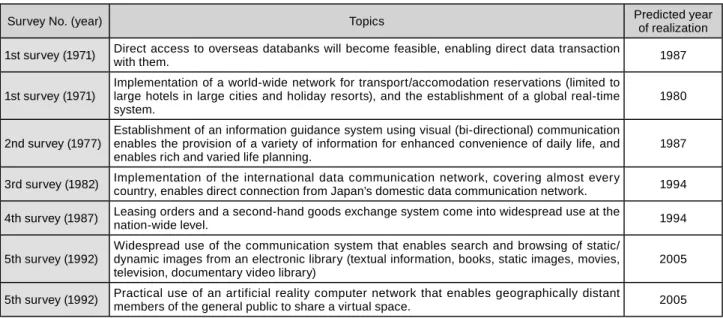
The provision of a variety of services through a network, such as information exchange, transport and accommodation reservations, and purchasing goods — as we see today provided by the Internet — were given in every survey. The term “Internet,” as a matter of course, was not mentioned, but many of the desirable concepts were already introduced.
(2) Emergency Medical System
The topics related to the emergency medical system provided important themes from the early surveys, and, by and large, many of these have already been realized in Japan. Nevertheless, a topic directly related to this issue is still given in the ninth survey (“.A f lexible regional healthcare system capable of corrective modification, coping with regional differences, especially in terms of emergency medical
care”), and it is predicted to be realized in 2021.
A reemergence of similar themes as new topics of importance may well be expected as the established system gradually becomes inadequate in view of changing social situations.
(3) Cloning Technology of Somatic Cells
The term “cloned animal” became widely used by 1982. Actually, the first success in cloning from somatic cells, a cloned sheep named Dolly, was announced in February 1997, which somewhat preceded the experts’ forecast. In the sixth survey (1997), the questionnaire was conducted just before the above announcement, and the experts predicted 2015 as the year when the “realization of cloning technology from a somatic cell of livestock” would occur.
The Delphi survey, because of its fundamental nature of consolidating a variety of opinions in a
Field Topic Predicted year
of realization
Reason for no realization
Communication
P r a c t i c a l u s e o f l o n g - d i s t a n c e , l a r g e - c a p a c i t y o p t i c a l communication methods, ulitizing optical fibers and coherent optical communication technology (e.g. the optical hetrodyne method).
1999 Technical diffi culty
Marine and Earth
Founding of an educational organization for ear th-science research in the broad sense of the term, aiming at development of internationally active scientists and engineers as human resources that can contribute to global environmental protection, resource exploitation and protection.
2001 Social problem
Health/medical care Development of an HIV vaccine 2003 Technical diffi culty
Elementary particles Practical use of a mass storage device that allows writing speeds
in excess of 1GB per second. 2004 Technical diffi culty
Health/medical care
Wide-spread use of a social system for secondary prevention of cancer (early detection) and enhanced knowledge among the general public make the average 5-year probability of survival of all types of cancers higher than 70% (current value: 50%).
2003
Te c h n i c a l d i f f i c u l t y, social problem, cost and other problems
Elementary particles
Practical use of pattern processing technology in the domain less than 10 nm, where synchrotron orbit radiation (SOR) is used as the light source of lithography.
2004 Cost and other problems
Communication
Establishment of an international ISDN network covering almost every country, enabling automatic connection to these countries from the ISDN network in Japan.
2004 A d ve nt o f a l t e r n a t i ve technology
Elementary particles Practical use of an analytical instrument capable of ultra-low
concentration analysis down to ppt [10-12] level. 2004 Low needs M a t e r i a l s a n d
processes
Practical use of large-area, high conversion efficiency (>20%)
amorphous solar cells. 2004 Technical diffi culty
Life science Practic al use of therapeutic methods that prevent c anc er
metastasis. 2007 Technical diffi culty
Production Extensive use of room-temperature superconductive materials in
industrial products. 2008 Technical diffi culty
Energy Practical use of disposal technology for solidified high-level
nuclear waste. 2009 Social problem
I n f o r m a t i o n a n d electronics
Advancement in verif ication technology leads to the rapid
development of large-scale software and the elimination of errors. 2009 Technical diffi culty Table 3 : Examples of Unrealized Topics in: (Those Predicted to Be Realized by 2009 in the 5th Delphi Survey)
Prepared by the SFTC
direction and giving survey results as a median estimate, has a weakness in that it may fail to refl ect the prescient opinions of the minority, making it difficult to predict when and how a breakthrough technology will be realized. This is a typical case where this weakness was made visible.
4-2 Examples of Unrealized Topics (1) Prevention of Carcinoma Metastasis
Owing to the advancement of diagnostic techniques, early detection and prompt therapy became feasible for certain types of cancer. However, although the mechanism that gives rise to malignant alteration of cancer is steadily becoming clear, a method to prevent
carcinoma metastasis has not been developed and remains a topic of great concern even now. The time scope of the forecast set by each survey is normally from 15 to 20 years from the time of the survey, and this topic is one where the expected period of realization has been postponed every time the survey is conducted. The development of a drug that prevents carcinoma metastasis is also given in the ninth survey, and the prediction is that the technique will be established by 2023 and enter into general clinical application by 2032.
Survey No. (year) Topics Predicted year
of realization 1st survey (1971) Direct access to overseas databanks will become feasible, enabling direct data transaction
with them. 1987
1st survey (1971)
Implementation of a world-wide network for transport/accomodation reservations (limited to large hotels in large cities and holiday resorts), and the establishment of a global real-time system.
1980
2nd survey (1977)
Establishment of an information guidance system using visual (bi-directional) communication enables the provision of a variety of information for enhanced convenience of daily life, and enables rich and varied life planning.
1987 3rd survey (1982) Implementation of the international data communication network, covering almost every
country, enables direct connection from Japan’s domestic data communication network. 1994 4th survey (1987) Leasing orders and a second-hand goods exchange system come into widespread use at the
nation-wide level. 1994
5th survey (1992)
Widespread use of the communication system that enables search and browsing of static/
dynamic images from an electronic library (textual information, books, static images, movies, television, documentary video library)
2005 5th survey (1992) Practical use of an artificial reality computer network that enables geographically distant
members of the general public to share a virtual space. 2005
Table 4 : Topics Associated with Network Service
Prepared by the SFTC
Survey No. (year) Topics Predicted year
of realization 1st survey (1971)
Nation-wide completion of the network for emergency medical service, and establishment of an emergency conveyance system enabling rapid delivery of patients to the appropriate medical facility.
1986
2nd survey (1977) Same as above. 1990
3rd survey (1982)
Establishment of a nation-wide emergency medical service system that provides appropriate medical service regardless of the geographical location of the patient: combination of well- placed local emergency centers under the control of the central medical center where all the data is diagnosed.
1997
5th survey (1992) Widespread implementation of close communication between ambulances and hospitals (e.g.
information from an image and knowledge database for emergency treatment). 2003 Table 5 : Examples of Topics Related to the Emergency Medical System
Prepared by the SFTC
Survey No. (year) Topics Predicted year
of realization 1st survey (1971) The development of an asexual reproduction technique for genetically homogeneous
experimental animals, based on the tissue culture of somatic cells. 2000 3rd survey (1982) Widespread use of reproduction techniques (including cloning) to produce experimental
animals. 1999
5th survey (1992) Development of techniques to grow an individual from an embryotic stem cell (a germinative
cell at its very early stage). 2011
Table 6 : Examples of Topics Related to Cloning Technology
Prepared by the SFTC
(2) Large-area, High-effi ciency Solar Cell
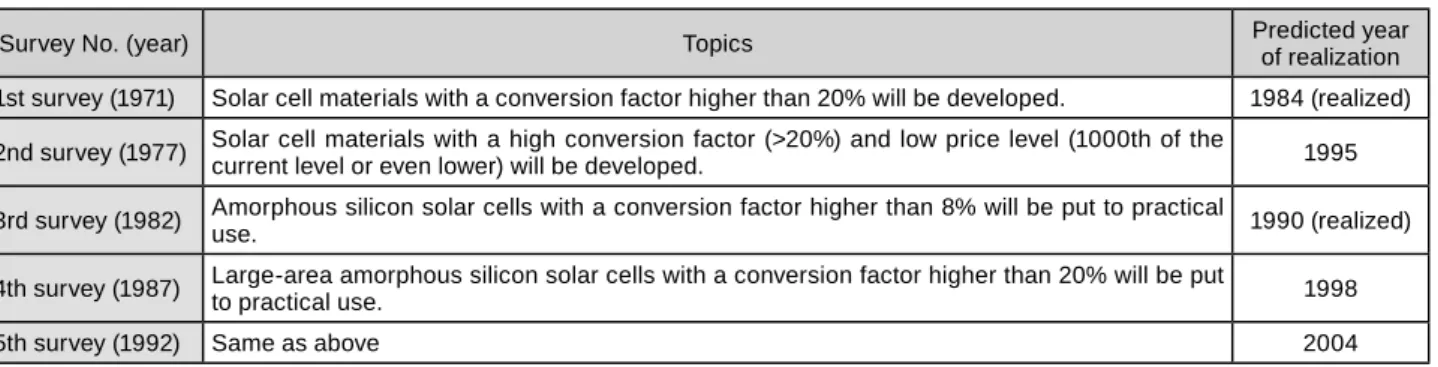
The solar cell, especially its conversion effi ciency, area enlargement, and materials, has been one of the focuses since the first survey, and was expected to yield practical applications by the early 2000s. Area enlargement and effi ciency improvement of the solar cell (“Large-area, High-efficiency Amorphous Solar Cells”) has been a topic in the material-related field, and has been given consecutively from the fourth (1987) to the eighth (2005) survey. This topic was assessed as “unrealized” at the time of the ninth survey. In the ninth survey, this topic is given under the title, “low-cost, large-area, thin-film solar cells with a conversion efficiency of 20% or higher” — note that the material is not specifi ed. The forecast is that this technology will be established by 2019, and will enter into general use in society by 2027.
(3) Traffi c Control System
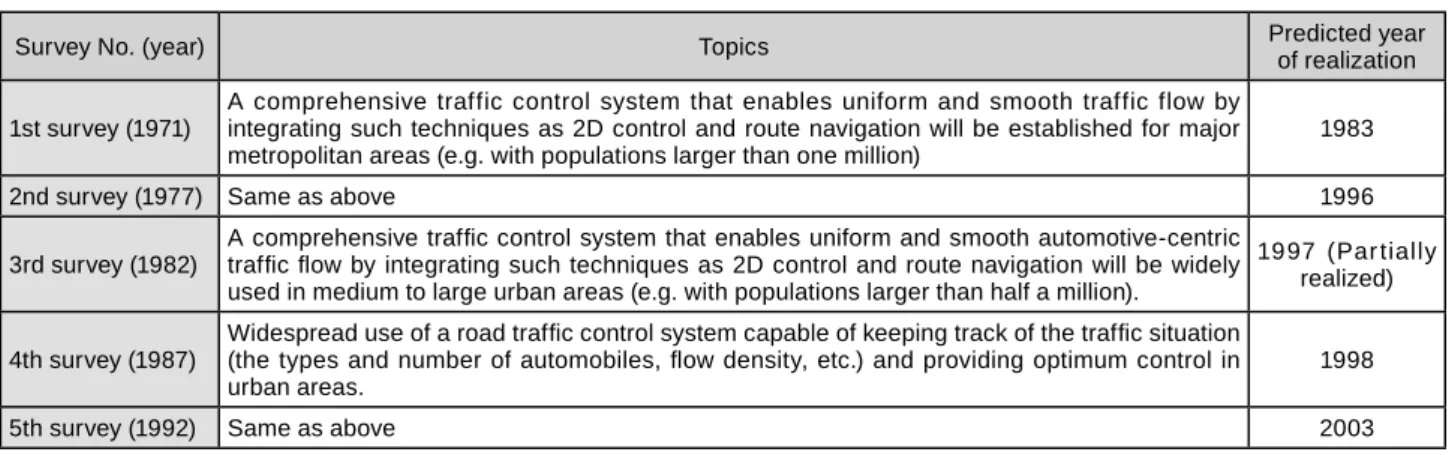
A road traffic control system has also been given as a topic target since the first survey, and yet it has not been realized to this day. This is another example of topics that have experienced postponement from one survey to the next. However, the perspective from which the topic is viewed is gradually shifting:
the main theme given in the seventh and preceding surveys (2001) was the determination of traffi c volume and a system to control traffi c fl ow, while in the eighth survey (2005) the focus shifted to the construction of
a traffi c demand management system that optimizes traffic flow in a comprehensive way, paying due attention to response from users. In the ninth survey, individual themes are given as the topics, such as the synchronization of traffic signals with engine control, working at home, and the enhanced utilization effi ciency of expressways through the introduction of automatic driving.
4-3 Examples of Topics That Failed to Be Realized due to Reasons Other than Technical Diffi culties For the topics that have failed to be realized, the obstacles are classified into several categories (i.e.
technical, social, cost and budgetary, the advent of alternative technology, and low needs) and shown in Figure 2. Table 10 shows the topics that failed to be realized due to reasons other than technical difficulties. Among these, those that failed to be realized because of “low needs” tended to have lower levels of importance than others at the time of the survey, indicating that they might have originally had limited importance.
Survey No. (year) Topics Predicted year
of realization 2nd survey (1977) Practical use of techniques that prevent cancer cell matastasis. 1993 3rd survey (1982) Development of effective measures against cancer metastasis. 1999/2003*
4th survey (1987) Same as above 2002/2005*
5th survey (1992) Practical use of effective measures against cancer matastasis. 2007/2011*
Table 7 : Examples of Topics Related to the Prevention of Cancer Metastasis
Prepared by the SFTC
* The survey gave two different years for realization because the same topics were was placed in two fields (medicine and life science).
Survey No. (year) Topics Predicted year
of realization 1st survey (1971) Solar cell materials with a conversion factor higher than 20% will be developed. 1984 (realized) 2nd survey (1977) Solar cell materials with a high conversion factor (>20%) and low price level (1000th of the
current level or even lower) will be developed. 1995
3rd survey (1982) Amorphous silicon solar cells with a conversion factor higher than 8% will be put to practical
use. 1990 (realized)
4th survey (1987) Large-area amorphous silicon solar cells with a conversion factor higher than 20% will be put
to practical use. 1998
5th survey (1992) Same as above 2004
Table 8 : Examples of Topics Related to Large-area, Thin-fi lm Solar Cells
Prepared by the SFTC
Survey No. (year) Topics Predicted year of realization 1st survey (1971)
A comprehensive traffic control system that enables uniform and smooth traffic flow by integrating such techniques as 2D control and route navigation will be established for major metropolitan areas (e.g. with populations larger than one million)
1983
2nd survey (1977) Same as above 1996
3rd survey (1982)
A comprehensive traffi c control system that enables uniform and smooth automotive-centric traffi c fl ow by integrating such techniques as 2D control and route navigation will be widely used in medium to large urban areas (e.g. with populations larger than half a million).
1997 (Par tially realized) 4th survey (1987)
Widespread use of a road traffi c control system capable of keeping track of the traffi c situation (the types and number of automobiles, fl ow density, etc.) and providing optimum control in urban areas.
1998
5th survey (1992) Same as above 2003
Table 9 : Examples of Topics Related to a Traffi c Control System
Prepared by the SFTC
Reason Topics Sur vey No.
(year)
Predicted year of realization S o c i a l
problem
Advancement of urban planning technology realizes a showc ase of a large metropolitan area (with a population of around one million) where workplaces are well dispersed, resulting in an environment with a high-level of home-workplace mixing.
2nd sur vey (1977)
1998
Around one percent of construction costs of public buildings in Japan will be used for additional cultural value: aesthetic appearance and harmony with the surrounding cityscape.
4t h sur vey (1987)
2000
Organ transplantation (kidney, heart, liver, etc.) will be per formed more often, approaching the current level in Europe and the United States.
5t h sur vey (1992)
2001 Evaluation/utilization standard regarding the use of useful living objects created by
biotechnology (genetic modification) in the open environment will be established.
Living objects with useful characteristics for environmental purifi cation will be put into practical use.
5t h sur vey (1992)
2006
Cost Advancement in oil substitution plant technology (development, improvement, and culture method) will lay the technical foundation for the widespread use of alternative energy (overseas products included)
4t h sur vey (1987)
2011
Advancement in deepsea mineral resource research (manganese, hydrothermal minerals, cobalt, and crust) will enable economic and selective practical mining of these resources.
5t h sur vey (1992)
2006
Power generation using the coal gasifi cation hybrid cycle will be practically applicable. 5t h sur vey (1992)
2005 A variable wavelength, free-electorn laser will become widely used in medical
applications.
5t h sur vey (1992)
2007 Advent of
alternative technology
Millimetric-wave wireless PCM (80-120GHz band) will become practically applicable. 2nd sur vey (1977)
1990 Optical card memory with a capacity larger than 10 giga-bits will become widely used
(i.e. for digital books).
4t h sur vey (1987)
1997 High-speed, wide-band switching equipment for multiplexing and time division
switching of high-speed, wide band information will become practically applicable.
4t h sur vey (1987)
1993 An automobile navigation instrument that uses an optical fiber gyrocompass will
become widely used.
5t h sur vey (1992)
2004 Low needs Major parts of software (including general-purpose systems) will be incorporated into
hardware (i.e. they become fi rmware).
2nd sur vey (1977)
1991 To make computers even easier to use, voice-input programming technology will
become practically usable.
2nd sur vey (1977)
1996 Improved rice growth technology will become widely used, enabling rice yields 1.5
times larger per unit area.
3 rd sur vey (1982)
1998 Electronic newspapers (through satelite/terrestial broadcasting) will become widely
used (subscription will be protected by scrambling).
4t h sur vey (1987)
2001 Table 10 : Examples of Unrealized Topics: Classifi ed by the Reasons for No Realization
Prepared by the SFTC
* Most of the topics that failed realization were taken up in more than one survey. The table shown above shows data from the latest surveys (1st to 5th).
A r e a s o f S c i e n c e a n d Technology That Seem to Be Realized Earlier than Expected
A look at the assessment of the topics given in the past surveys (from the 1st to 5th), conducted twenty years after the predictions, reveals that twenty to thirty percent of the topics that were forecast to be realized at a time later than the assessment have already been evaluated as “realized” (including partial realization).
These are examples of the topics that were realized earlier than expected.
Among the topics given in the fifth survey, an assessment made nearly twenty years later (toward the end of 2009) pointed out that thirteen topics were realized more than five years earlier than expected, and they are shown in Table 11. Nine of them are topics related to the life science or health care/
medicine fields, including such areas as the brain and neuroscience, regenerative medicine, and gene therapy.
The topics in the life science and health/medicine fields have been assigned a relatively long period for realization in every survey. Therefore, the same or similar topics have often been given in multiple surveys and the domains of topics often overlap.
Noteworthy here, however, is the fact that nearly half of the topics that were forecast to not be realized by the time of the assessment have actually been realized (or, partially realized).
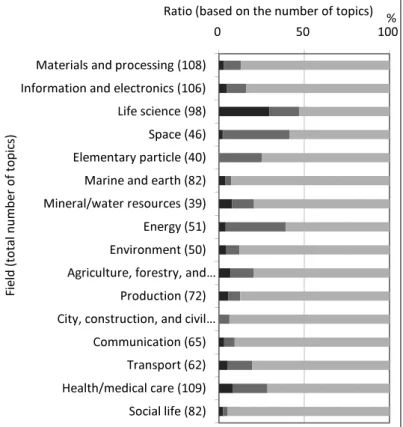
Figure 3 summarizes the realization status of the topics that were forecast in the fifth survey to take a long period of time. In the life science field, there were 46 topics that were forecast to be realized later than 2010, accounting for nearly half of all topics in the fi eld. Actually, 29 of these topics were assessed as realized (or partially realized) as of the end of 2009. In contrast, in the energy and space fi elds, where many of the topics are also expected to take a long period of time before realization, only one or two topics have come to fruition earlier than predicted .
Life science and related areas are considered to have a wide global scope for breakthroughs in the days ahead, and one of the weaknesses of the Delphi survey lies in its general unsuitability to predict discontinuous advancements. Life science and health/medicine are considered to be areas with clear, long-term objectives that are less prone to modification over time. These
indicate the risk of such simple, stereotyped thinking that, “it must require a long period of time before realization.”
Conclusion
In Delphi surveys, incompatible technologies are sometimes given as future options, and even a topic that seems to challenge others may be given to probe future direction. The fact that nearly seventy percent of the topics including those seemingly challenging cases, have been realized in one way or another reveals the significance of the uninterrupted implementation of Delphi surveys and the reliability of a certain amount of the results, as well as the surveys’
substantial value as an intellectual asset. It should be noted, however, that the major results from a Delphi survey may have ignored minority opinions, and there may remain important technologies that have escaped the attention of the survey.
A glimpse into the views and insights of the experts in the past also encourages us to ask ourselves if we have the same level of insight as they did. Perhaps we have to consider by ourselves if we have a power of prediction now that will be highly appreciated by experts in the future.
5
6
Field Topic Predicted year of realization
Realization status at the end of 2009 Life Science An interface directly connecting the brain and a computer will
be developed.
2020 Partially realized Life Science Technology for artificial cell synthesis, for replacing some of
the functions of natural cells, will be developed.
2019 Partially realized Life Science The link between the thought process and the neuron activities
inside the brain will be clarifi ed.
2018 Partially realized Life Science Artificial intelligence technology that mimicks the thought
process in the brain will be developed.
2017 Partially realized Life Science The neurobiological foundation underlying human emotion will
be clarifi ed.
2017 Partially realized Health/Medical
Care
Techniques for artifi cial preparation (excluding fetus cells) and transplantation of a cell that can grow and provide an organ function will be developed (e.g., as a therapeutic method for Alzheimer disease).
2020 Partially realized
Health/Medical Care
Electric circuitry directly connectable to neuro/brain cells will be developed and applied in an artifi cial eyesight system.
2019 Partially realized Health/Medical
Care
The mechanism of individual aging will be clarified, and the knowledge will be applied to anti-aging therapy.
2018 Partially realized Health/Medical
Care
Gene therapy will become practically applicable to many gene- defect diseases.
2016 Partially realized Space Space tourism around the earth on board a spaceship will
become available.
2016 Partially realized M a r i n e a n d
Earth
Combined efforts of humans — technological advancement of natural energy ulitization, the reduction of man-made heat generation, and the suppression of heat accumulation in the atomosphare — will facilitate a balance in the heat budget of the earth.
2016 Partially realized
Mineral/ Water Resources
Technology for artifical precipitation (in case of drought) will become practically applicable.
2015 Partially realized Environment The presence or absence of persistent effects of environmental
pollution on humans (i.e., inherited from one generation to the next) will be clarifi ed.
2015 Partially realized Table 11 : Examples of Topics That Were Assessed to Have Been Realized more than Five Years Earlier than Expected
Prepared by the SFTC (The forecasts given in the 5th survey [1992] were assessed at the time of the 9th survey [toward the end of 2009])
Ϭ ϱϬ ϭϬϬ DĂƚĞƌŝĂůƐĂŶĚƉƌŽĐĞƐƐŝŶŐ;ϭϬϴͿ
/ŶĨŽƌŵĂƚŝŽŶĂŶĚĞůĞĐƚƌŽŶŝĐƐ;ϭϬϲͿ
>ŝĨĞƐĐŝĞŶĐĞ;ϵϴͿ
^ƉĂĐĞ;ϰϲͿ ůĞŵĞŶƚĂƌLJƉĂƌƚŝĐůĞ;ϰϬͿ DĂƌŝŶĞĂŶĚĞĂƌƚŚ;ϴϮͿ DŝŶĞƌĂůͬǁĂƚĞƌƌĞƐŽƵƌĐĞƐ;ϯϵͿ ŶĞƌŐLJ;ϱϭͿ ŶǀŝƌŽŶŵĞŶƚ;ϱϬͿ ŐƌŝĐƵůƚƵƌĞ͕ĨŽƌĞƐƚƌLJ͕ĂŶĚ͙
WƌŽĚƵĐƚŝŽŶ;ϳϮͿ ŝƚLJ͕ĐŽŶƐƚƌƵĐƚŝŽŶ͕ĂŶĚĐŝǀŝů͙
ŽŵŵƵŶŝĐĂƚŝŽŶ;ϲϱͿ dƌĂŶƐƉŽƌƚ;ϲϮͿ ,ĞĂůƚŚͬŵĞĚŝĐĂůĐĂƌĞ;ϭϬϵͿ
^ŽĐŝĂůůŝĨĞ;ϴϮͿ
&ŽƌĞĐĂƐƚĞĚƚŽďĞƌĞĂůŝnjĞĚůĂƚĞƌƚŚĂŶϮϬϭϬ͕ďƵƚŚĂƐĂůƌĞĂĚLJďĞĞŶƌĞĂůŝnjĞĚ͘
&ŽƌĞĐĂƐƚĞĚƚŽďĞƌĞĂůŝnjĞĚůĂƚĞƌƚŚĂŶϮϬϭϬ͕ĂŶĚŚĂƐŶŽƚďĞĞŶƌĞĂůŝnjĞĚ͘
&ŽƌĞĐĂƐƚĞĚƚŽďĞƌĞĂůŝnjĞĚďLJϮϬϬϵ
ZĂƚŝŽ;ďĂƐĞĚŽŶƚŚĞŶƵŵďĞƌŽĨƚŽƉŝĐƐͿ й
&ŝĞůĚ;ƚŽƚĂůŶƵŵďĞƌŽĨƚŽƉŝĐƐͿ
Ϭ ϱϬ ϭϬϬ
DĂƚĞƌŝĂůƐĂŶĚƉƌŽĐĞƐƐŝŶŐ;ϭϬϴͿ /ŶĨŽƌŵĂƚŝŽŶĂŶĚĞůĞĐƚƌŽŶŝĐƐ;ϭϬϲͿ
>ŝĨĞƐĐŝĞŶĐĞ;ϵϴͿ
^ƉĂĐĞ;ϰϲͿ ůĞŵĞŶƚĂƌLJƉĂƌƚŝĐůĞ;ϰϬͿ DĂƌŝŶĞĂŶĚĞĂƌƚŚ;ϴϮͿ DŝŶĞƌĂůͬǁĂƚĞƌƌĞƐŽƵƌĐĞƐ;ϯϵͿ ŶĞƌŐLJ;ϱϭͿ ŶǀŝƌŽŶŵĞŶƚ;ϱϬͿ ŐƌŝĐƵůƚƵƌĞ͕ĨŽƌĞƐƚƌLJ͕ĂŶĚ͙
WƌŽĚƵĐƚŝŽŶ;ϳϮͿ ŝƚLJ͕ĐŽŶƐƚƌƵĐƚŝŽŶ͕ĂŶĚĐŝǀŝů͙
ŽŵŵƵŶŝĐĂƚŝŽŶ;ϲϱͿ dƌĂŶƐƉŽƌƚ;ϲϮͿ ,ĞĂůƚŚͬŵĞĚŝĐĂůĐĂƌĞ;ϭϬϵͿ
^ŽĐŝĂůůŝĨĞ;ϴϮͿ
&ŽƌĞĐĂƐƚĞĚƚŽďĞƌĞĂůŝnjĞĚůĂƚĞƌƚŚĂŶϮϬϭϬ͕ďƵƚŚĂƐĂůƌĞĂĚLJďĞĞŶƌĞĂůŝnjĞĚ͘
&ŽƌĞĐĂƐƚĞĚƚŽďĞƌĞĂůŝnjĞĚůĂƚĞƌƚŚĂŶϮϬϭϬ͕ĂŶĚŚĂƐŶŽƚďĞĞŶƌĞĂůŝnjĞĚ͘
&ŽƌĞĐĂƐƚĞĚƚŽďĞƌĞĂůŝnjĞĚďLJϮϬϬϵ
ZĂƚŝŽ;ďĂƐĞĚŽŶƚŚĞŶƵŵďĞƌŽĨƚŽƉŝĐƐͿ й
&ŝĞůĚ;ƚŽƚĂůŶƵŵďĞƌŽĨƚŽƉŝĐƐͿ
Figure 3 : Realization Status of Topics in Science and Technology That Were Forecasted to Take a Long Period of Time before Fruition
Prepared by the SFTC (The forecasts given in the 5th survey [1992] were assessed at the time of the 9th survey [toward the end of 2009])
References
[1] SFTC, “NISTEP REPORT No.140 – 142: The 9th Foresight: Contribution of Sciene and technology to Future Society,” The National Institute of Science and Technology Policy, March 2010.
The 9th Delphi Survey:
http://www.nistep.go.jp/achiev/ftx/jpn/rep140j/idx140j.html Future Scenarios Opened up by Science and Technology:
http://www.nistep.go.jp/achiev/ftx/jpn/rep141j/idx141j.html Capability of Local Regions for the Green Innovation:
http://www.nistep.go.jp/achiev/ftx/jpn/rep142j/idx142j.html
* For the realization status assessment of past Delphi surveys, see “The 9th Delphi Survey.”
[2] Past Delphi surveys:
The 8th survey: NISTEP REPORT No.97, Delphi Analysis, March 2005.
http://www.nistep.go.jp/achiev/ftx/jpn/rep097j/idx097j.html
The 7th survey: NISTEP REPORT No.71, The 7th Technology Foresight, July 2001.
http://www.nistep.go.jp/achiev/ftx/jpn/rep071j/idx071j.html
The 6th survey: NISTEP REPORT No.52, The 6th Technology Forecast Survey, June 1997.
http://www.nistep.go.jp/achiev/abs/jpn/rep052j/rep052aj.html
The 5th survey: NISTEP REPORT No.25, The 5th Technology Forecast Survey, November 1992.
http://www.nistep.go.jp/achiev/ftx/jpn/rep025j/idx025j.html
Yoshiko YOKOO General Unit
Science & Technology Foresight Center
Yoshiko Yokoo was engaged at the NISTEP in the survey on resources and human resources in science and technology. She is now in charge of the survey on science and technology foresight.
(Original Japanese version: published in July 2010) Profi le