Study on manufacturing and properties evaluation of Mg/Ni/Ti
hydrogen storage alloy
Ningning Zhou
Saitama Institute of Technology
Table of content
Chapter 1 Background and applications hydrogen energy 1
1.1 Development of hydrogen storage materials ...1
1.1.1 Necessity of hydrogen storage materials ...1
1.1.2 Application of hydrogen storage materials ...3
1.1.3 Research status of hydrogen storage materials...4
1.2 Development of metal hydrides ...6
1.2.1 Species of metal hydrides ...6
1.2.2 Research status of metal hydrides...6
1.3 Development of Mg-based metal hydride ...8
1.3.1 Species of Mg-based metal hydride...8
1.3.2 Research status of Mg-based metal hydride...9
1.3.3 Energy conversion and application of hydrogen energy ...12
1.4 Concluding Remarks ...13
References...14
Chapter 2 Design of applications in hydrogen absorption and desorption thermodynamics for Mg-based material microstructure 20
2.1 Introduction...20
2.1.1 Hydrogen absorption and desorption kinetics model ...20
2.1.2 Dissociation chemically absorption of hydrogen molecules on the surface...21
2.1.3 Surface penetration of H atoms ...23
2.1.4 Diffusion...23
2.1.5 Hydride generation on interface...24
2.2 Thermodynamic calculations of hydrogen absorption and desorption ...26
2.3 Grain structure...28
2.4 Crystal grain size...33
2.5 Concluding Remarks ...34
References...36
Chapter 3 Preparation and evaluation of Ni/MgO powder 38
3.1 Introduction...38
3.2 Experimental methods...38
3.2.1 Preparation of powder Ni by high temperature X-ray...38
3.3 Experimental results and discussion ...44
3.3.1 XRD pattern of generated phases ...44
3.3.2 SEM microstructure analysis ...45
3.3.3 TEM analyses of based experiment...46
3.3.4 EPMA analysis of elemental distribution ...47
3.3.5 XPS patterns analysis of the extent depth distribution ...49
3.4 Concluding Remark...51
References...53
Chapter 4 Electrochemical properties/Actual capacity evaluation of Mg/Ni(MgO) and Mg/Ni(MgO)/Ti composites 56
4.1 Introduction...56
4.2 Experimental methods by electronic balance ...58
4.2.1 Preparation of Mg/Ni (MgO) composite by electric furnace...58
4.2.2 Preparation of Mg/Ni(MgO)/Ti composite by electric furnace...59
4.3 Results and Discussions ...59
4.3.1 Characterization of Mg/Ni(MgO) composite ...59
4.3.2 Characterization of Mg/Ni(MgO)/Ti composite ...64
4.3.3 Voltage determination by electrochemistry ...71
4.3.4 Determination for the ability of absorption-desorption hydrogen by cyclic voltammeter...72
(a) Electrochemical evaluation of Mg/Ni(MgO) ...73
(b) Electrochemical evaluation of Mg/Ni(MgO)/Ti...75
4.3.5 Capacity evaluation of hydrogen absorption/desorption for Mg/Ni(MgO)/Ti ...80
(a) Qualitative synthesized analysis from 400 °C to 250°C...80
(b) Qualitative separately analysis under different H2 pressure and temperature...83
4.4 Defects and discussion...91
4.5 Concluding Remark...92
References...93
Chapter 5 Electrochemical properties/Actual capacity evaluation of Mg/Ni/Ti composite 96
5.1 Introduction...96
5.2 Experimental methods by electronic balance ...96
5.2.1 Preparation of Mg/Ni/Ti sintered body by electric furnace...98
5.3 Results and Discussions ...98
5.3.2 Determination for the ability of absorption-desorption
hydrogen by cyclic voltammeter...101
5.3.3 Capacity evaluation of hydrogen absorption/desorption (from 340°C to 220°C) ...103
(a) Quantitative analysis from 340°C to 220°C ...105
(b) Quantitative analysis under H2 pressure 4MPa and temperature 220°C ... 110
5.4 Concluding Remarks ... 115
References... 116
Chapter 6 Conclusions 119
Related publications of the author 122
Chapter 1 Background and applications hydrogen energy
1.1 Development of hydrogen storage materials
The hydrogen is the lightest element in the universe because composed of one proton and one electron. It is also the most abundant element in the universe and making up more than 90%. The using of the abundance of hydrogen energy on earth had been discussed in widely fields [1, 2]. Hydrogen energy can replace fossil fuels as the ideal fuel of the future. Hydrogen, as a clean energy carrier, has great potential to face energy challenges [3-6].
Hydrogen is not an energy source. It is an energy carrier like electricity and is found combined with other elements. For example, hydrogen is combined with oxygen in water [7, 8]. In fossil fuels and many organic compounds, it is combined with carbon as in petroleum, natural gas, coal or biomass. Which is the technological challenge facing researchers: to separate hydrogen from other compounds by using an efficient and economic process. Hydrogen is a new and different energy system. Hydrogen functions as a universal energy carrier converted to energy in fuel cells. Hydrogen is produced from water using renewable energy sources and the energy system holds the potential of zero emission [9- 13].
1.1.1 Necessity of hydrogen storage materials
Currently, hydrogen storage method is compressed gaseous hydrogen by high pressure cylinders or liquid hydrogen in a special bottle. But both methods have the shortcomings which high energy consumption, inconvenient heavy container and unsafe. Thus the wide application is limited [14-17].
into the hydrogen storage. Releasing the hydrogen needed energy is not high. Therefore, hydrogen storage alloy is the most promising hydrogen storage medium due to low working pressure, operating simple and safe [18].
Hydrogen storage principle is to form reversibly a metal hydride with hydrogen, or hydrogen and alloy formed a compound, hydrogen molecules are decomposed into hydrogen atoms into the inner of the metal [19-22]. The deformations of hydrogen damage, hydrogen corrosion and hydrogen embrittlement were easy to be caused. Moreover, in repeating absorb and release hydrogen process, constantly expanding and shrinking would occur, so that make the alloy be damaged. Therefore, the good hydrogen storage alloy must have the ability to resist the damaging effects [23-27].
Hydrogen storage alloy in research and development is generally constituted of endothermic type metal (e.g., iron, zirconium, copper, chromium, molybdenum, etc.) with an exothermic metal (e.g., titanium, zirconium, lanthanum, cerium, tantalum, etc.) [28,29]. The suitable intermetallic compounds were formed, so that achieved function of the hydrogen storage. Endothermic metal is defined under a certain hydrogen pressure, the solubility of hydrogen is increased with the temperature rises; On the contrary, the exothermic metal was confirmed. Better effect hydrogen storage materials were constituted of magnesium type, calcium type, titanium type and rare earth metals as based hydrogen storage alloys. But there are still some disadvantages to affect performance of hydrogen absorption/desorption [30-36].
Table 1.1 Department of Energy Technical Targets: On-board Hydrogen Storage Systems.
Storage Parameter Deadline:2010
Gravimetric capacity At least 6wt%
Fill time(5kg H2) Within 3 minutes
Volumetric capacity 45kg m-3
Equilibrium pressure -1 bar;353K
Cycle life >1000
Storage system cost $133
1.1.2 Application of hydrogen storage materials
Hydrogen storage material is a general consensus that the future energy system has to be based on renewable energy sources and not on non-renewable energy sources, which is the main situation today. Renewable energy can be defined as energy obtained from the natural environment. For examples are solar energy, hydro energy and geothermal energy. On the other hand, non-renewable energy can be defined as energy obtained from static stores of energy that remain bound, unless released by human interaction. Examples of these energy sources are nuclear fuels and fossil fuels of coal, oil and natural gas [39, 40].
1.1.3 Research status of hydrogen storage materials
What should be overcome in the utilization of hydrogen energy is effective storage and transportation of hydrogen. The development of zero emission vehicles, electric batteries and fuel cells is the two main power alternatives; in such applications, the demand for efficient energy storage, high volumetric and gravimetric energy densities is a crucial purpose [42-45]. The light and small molecules of hydrogen complicate the storage and transportation of this energy carrier. There are four different storing possibilities for hydrogen in compressed gas form, liquid form, chemical bonding and physical absorption [46].
Storage in the form of compressed hydrogen involves some technical challenges due to the small density of the gas. However, today hydrogen can be compressed in storage tanks with pressures up to 700bar and be used in small industrial projects and in transportation. Liquid hydrogen offers a higher volumetric storage density than compressed gas [47-49]. Hydrogen is liquefied at 20 K, the time and the energy were consumed in the process. However, it has the most gravimetric energy dense fuel in use, which is why it is employed in all space programs and need to be thermal insulated due to the storage tanks are usually large and bulky.
The most safe and volumetric effective way to store hydrogen is by chemical bounding, which can be done in metal hydrides, liquid hydrogen carriers and physical absorption. The hydrogen storage capacity has been subject to a lot of controversy the last 5 years, but the storage potential of such compounds at low temperatures (below 150 K) is well documented. The hydrogen storage potentials of both liquid and metal hydrides are utilized commercially as hydrogen storage alternatives.
chemical reaction and not a pure physical action. The chemical reaction during absorption of hydrogen in metal hydrides releases heat, and the heat must be put back in order to release the hydrogen from its bond. It means that the metal hydrides can absorb or desorb hydrogen depending on the temperature.
The metal hydrides are utilized in storage tanks for hydrogen storage and are also used in so-called metal hydride electrical batteries. The latter utilization of the metal hydrides is the topic for the present thesis [50-53].
1.2 Development of metal hydrides
1.2.1 Species of metal hydrides
In present, metal hydrides had been became a focus, hydrogen storage was achieved in form of metal hydrides and could effectively release out hydrogen under a certain conditions. The process of the cycle had been widely application in various fields. For example, aerospace; communications and electronics as focus had obtained attention from domestic and foreign. Specifically, the development and application of fuel cells cause a great attention. Through the hydrogen storage material had obtained significantly development, there are some malpractices. Expensive material price; not suitable industrial production and the dissociation temperature of metal hydrides was high seriously affected the performance of hydrogen absorption/desorption [54].
Table 1.2 Properties of hydrogen with various metallic hydrides.
1.2.2 Research status of metal hydrides
materials, strong hydrogen storage capacity is considered to be the best promising solid-state hydrogen storage medium. Theoretical hydrogen storage capacity of pure Mg was up to 7.6wt%, and is metal hydrogen storage materials that have the highest storage capacity except Al and Li.
Mg-based hydrogen storage materials not only have the advantages that high hydrogen absorption/desorption platform; abundant resources; low price and so on. But also which have some characteristics from others metal materials, or even superior. For example, Mg-based hydrogen storage materials have varied different form energy to achieve transformed function that heat and hydrogen chemical energy; heat and mechanical energy. For Mg-based, when hydrogen absorption process was achieved, the large number released heat for traditional storage heat material become strong challenge [55]. The prospect of hydrogen storage material was attractive by the characteristics which high-efficiency and no noise from hydrogen pressure work.
Mg alloy and Mg-based hydrogen storage material had been widely applied. In the earth, abundant Mg resources provides widely prospect for the development and produce of Mg alloy materials. In order to challenge the meet of Mg alloy material in current, the researchers put in more power to enhance development effort for Mg alloy and Mg-based hydrogen storage material, so that more perfect various properties of this kind material to develop a new Mg alloy. And based on above, the basis was laid for the formation of metal hydride.
the Cd-electrode in widely used Ni-Cd batteries, for which the obvious reason was to replace toxic Cd. Other advantages of a MH electrode instead of a Cd electrode include higher (dis)charge rates, a 50% higher capacity and the absence of a memory effect. The hydrogen storage alloy currently used in Ni/MH batteries is a metal-based LaNi5 compound. Much research effort is still aimed at improving properties of this electrode material, such as corrosion resistance, rate-capability and reversible hydrogen storage capacity. Yet, the gravimetric capacity is nowadays in the order of 1.2 wt. % H and it is not expected to rise significantly, simply because the intrinsic capacity is not much higher. In spite of their low gravimetric capacity, large Ni/MH packs are nowadays used in hybrid electric vehicles, like the well-known Toyota Prius and Honda Civic Hybid. Large scale implementation of Ni/MH will of course benefit from improving the gravimetric capacity of the anode. But also small electronic devices, such as mobile phones, personal digital assistants and navigation systems, that are nowadays mainly powered by Li-ion batteries might benefit from improving the capacity of the Ni/MH battery. Replacing Li-ion batteries is preferable as these batteries require expensive special safety equipment that prevents over discharging the battery, whereas Ni/MH batteries do not require any special safety equipment [56, 57].
1.3 Development of Mg-based metal hydride
1.3.1 Species of Mg-based metal hydride
the specimen. There are still easy to chalking; high hydrogen absorption/desorption temperature and difficult to active [58].
Table 1.3 Characteristics of Mg alloy hydride.
1.3.2 Research status of Mg-based metal hydride
Mg is lightweight metal and has many advantages that cheap and readily available. Mg and Mg-based alloys in the form of metallic hydrides such as MgH2 and Mg2NiH4 have been considered as potential materials for solid state
hydrogen storage. The theoretical hydrogen storage capacities of MgH2 and
Mg2NiH4 are 7.6 wt% and 3.6 wt% respectively. Unfortunately, the applications
undertaken to improve the activation and hydride properties. Zaluska et al. have demonstrated the excellent absorption/desorption kinetics of a milled mixture of Mg2NiH4 and MgH2 at 220-240°C and claimed a maximum
hydrogen concentration of more than 5 wt%. Hanada et al. have reported a hydrogen storage capacity of 6.5 wt% after doping of MgH2 with nanosized- Ni
in a temperature range of 150-250°C. Recham et al. have concluded that the hydrogen absorption characteristics of ball-milled MgH2 can be enhanced by
adding NbF5, and MgH2 + NbF5 composite has been found to desorb 3 wt% H2
at 150°C. Dobrovolsky et al. have synthesized a MgH2 (50 wt%) + TiB2 (50
wt%) composite by intensive mechanical milling and found that TiB2 additions
lower the dissociation temperature of the MgH2 hydride about 50°C. The
results reported by Cui et al. have testified the capability of amorphous and/or nanocrystalline Mg–Ni-based alloys to electrochemically absorb and also desorb a large amount of hydrogen at ambient temperatures. Kohno et al. had documented a large discharge capacity of 750 mA·h/g at a current density of 20 mA/g for modified Mg2Ni alloys. Ball-milling indubitably is a very effective
method for the fabrication of nanocrystalline and amorphous Mg and Mg-based alloys. This may facilitate the destabilization of MgH2 or Mg2NiH4.
process. Many researchers have prepared Mg2 (Ni, Y) hydrogen storage alloy
with possessing the composition of Mg63Ni30Y7 by rapid solidification process
to yield a maximum hydrogen absorption capacity about 3.0 wt%. Huang et al. have concluded that the amorphous and the nanocrystalline Mg based alloy (Mg60Ni25)90Nd10 prepared by melt-spinning technique displays the highest
discharge capacity of 580 mAh/g and the maximum hydrogen capacity of 4.2 wt% H. Our previous work has confirmed that the substitution of Co for Ni significantly improves the absorbing and desorbing kinetics of the Mg2Ni-type
alloys. Therefore, it is very desirable to investigate the influence of substituting the Ni with Cu on the hydrogen storage characteristics of Mg2Ni-type alloys
1.3.3 Energy conversion and application of hydrogen energy
The conversion of hydrogen energy had became a new power that improved social development. Common prepared materials divided into powders and alloys, generating alloy phase as main purpose to achieve absorb and release hydrogen under a certain conditions [61]. Metal hydride as carrier achieved the purpose of hydrogen storage.
1.4 Concluding Remarks
References
[1] F. Stampfer, C.E. Holley and J.F. Suttle, The magnesium-hydrogen system, J. Am. Chem. Soc. 1960, 82, 3504-3508.
[2] K.H.J. Buschow, P.C.P. Bouten and A.R. Miedema, Hydrides formed from intermetallic compounds of two transition metals: a special class of ternary alloys, Rep. Prog. Phys. 1982, 45, 937-1039.
[3] A. Krozer and B. Kasemo, Unusual kinetics due to interface hydride formation in the hydriding of Pd/Mg sandwich layers, J. Vac. Sci. Technol. A 1987, 5, 1003-1005.
[4] J. Rydén, B. Hjörvarsson, T. Ericsson, E. Karlsson, A. Krozer and B. Kasemo, Unusual kinetics of hydride formation in Mg-Pd sandwiches, studied by hydrogen profiling and quartz crystal microbalance measurements, J. Less-common Met. 1989, 152, 295-309.
[5] V.P. Zhdanov, A. Krozer and B. Kasemo, Kinetics of first-order phase transitions initiated by diffusion of particles from the surface into the bulk, Phys. Rev. B 1993, 47, 11044-11048.
[6] K.B. Gerasimov and A. Krozer and B. Kasemo, Unusual kinetics due to interface hydride formation in the hydriding of Pd/Mg sandwich layers, J. Vac. Sci. Technol. A 1987, 5, 1003-1005.
[7] K. B. Gerasimov, The mechanism and kinetics of formation and decomposition of magnesium hydride, Mater, Lett. 1985, 3, 497-499.
[8] C.M. Stander, Kinetics of the formation of magnesium hydride from magnesium and hydrogen, Z. Phys. Chem. Neue Folge 1977, 104, 229-238. [9] Z. Luz, J. Genossar and P.S. Rudman, Identification of the diffusing atom in MgH2, J. Less-common Met. 1980, 73, 113-118.
[11] P. Spatz, H.A. Aebischer, A. Krozer and L. Schlapbach, The diffusion of H in Mg and the nucleation and growth of MgH2 in thin films, Z. Phys. Chem.
1993, 181, 393-397.
[12] B. Vigeholm, K. Jensen, B. Larsen and A.S. Pedersen, Elements of hydride formation mechanisms in nearly spherical magnesium powder particles, J. Less-common Met. 1987, 131, 133-141.
[13] M. Stioui, A. Grayevski, A. Resnik, D. Shaltiel and N. Kaplan, Macroscopic kinetics of hydrogen in magnesium-rich compounds, J. Less-common Met. 1986, 123, 9-24.
[14] P. van der Sluis, M. Ouwerkerk and P.A. Duine, Optical switches based on magnesium lanthanide alloy hydrides, Appl. Phys. Lett. 1997, 70, 3356-3358. [15] R.A.H. Niessen and P.H.L. Notten, Electrochemical hydrogen storage characteristics of thin film MgX (X=Sc,Ti,V,Cr) compounds, Electrochem. Solid-State Lett. 2005, 8, A534-A538.
[16] H. Baker (Edt.), ASM Handbook – Alloy Phase Diagrams, vol. 3, ASM International, 1992.
[17] D. Kyoi, T. Sato, E. Rönnebro, N. Kitamura, A. Ueda, M. Ito, S. Katsuyama, S. Hara, D. Noreus and T. Sakai, A new ternary magnesium–titanium hydride Mg7TiHx with hydrogen desorption properties better than both binary magnesium and titanium hydrides, J. Alloys Compd. 2004, 372, 213-217.
[18] P. Villars (Edt), Pearson’s Handbook Desk Edition, ASM International, 1997, Vol. 2, 2336,
[19] A.R. West, Solid state Chemistry and its applications, 1st ed., 1984, 367. [20] T.J. Richardson, B. Farangis, J.L. Slack, P. Nachimuthu, R. Perera, N. Tamura and M. Rubin, X-Ray absorption spectroscopy of transition metal-magnesium hydride thin films, J. Alloys Compd. 2003, 356-357, 204-207.
165, 309-314.
[22] L. Vegard, The constitution of mixed crystals and the space occupied by atoms, Z. Physik 1921, 5, 17-26.
[23] E. Zen, Atomic volume and allotropy of the elements, J. Chem. Ed. 1984, 61, 137-142.
[24] O. Friedrichs, L. Kolodziejczyk, J.C. Sánchez-López, A. Fernández, L. Lyubenova, D. Zander, U. Köster, K.F. Aguey-Zinsou, T. Klassen and R. Bormann, Influence of particle size on electrochemical and gas-phase hydrogen storage in nanocrystalline Mg, J. Alloys Compd. 2008, 463, 539-545. [25] J. Paillier and L. Roue, Hydrogen electrosorption and structural properties of nanostructured Pd-Mg thin films elaborated by pulsed laser deposition, J. Alloys Compd. 2005, 404-406, 473-476.
[26] A. Léon, E.J. Knystautas, J. Huot and R. Schulz, Magnesium films for hydrogen storage, Mater. Sci. Forum 2001, 377, 85-94.
[27] A. Léon, E.J. Knystautas, J. Huot and R. Schulz, Influence of the evaporation rate and evaporation mode on the hydrogen sorption kinetics of air-exposed magnesium films, Thin Solid films 2006, 496, 683-687.
[28] A. Milchev and M.I. Montenegro, A galvanostatic study of electrochemical nucleation, J. Electroanal. Chem. 1992, 333, 93-102.
[29] P.H.L. Notten, M. Ouwerkerk, H. van Hal, D. Beelen, W. Keur, J. Zhou, and H. Feil, High energy density strategies: from hydride-forming materials research to battery integration, J. Power Sources 2004, 29, 45-54.
[30] H Kim, W Myung, K Sumyiama, K Suzuki, Formation and chemical leaching of non-equilibrium Al0.6(Co75Cu25)0.4 alloy powders by rod milling. J
Alloy Compd 2005; 398: 74–9.
[31] K Sumyiama, K Suzuki, Formation and chemical leaching effects of nonequilibrium Al0.6(Fe25Cu75) alloy powder produced by rod milling. J Alloy
Compd 2003; 360: 168–72.
Ni50Al50 alloy. J Catal 2004; 221: 612–8.
[33] G Golubkova, O Lomovski, Formation of nanocrystalline structures in a Co–Al system by mechanical alloying and leaching. J Alloy Compd 2003; 351: 101–5.
[34] H Lu, Y Li, F Wang, Synthesis of porous copper from nanocrystalline two-phase Cu–Zr film by dealloying. Scripta Mater 2007; 56: 165–8.
[35] D Ross, Hydrogen storage: the major technological barrier to the development of hydrogen fuel cell cars. Vacuum 2006; 80: 1084–9.
[36] G Duarte, L Bustamante, Hydriding properties of an Mg–Al–Ni–Ng hydrogen storage alloy. Scripta Mater 2007; 56: 789–92.
[37] L Ouyang, H Dong, C Peng, L Sun, M Zhu, A new type of Mg-based metalhydride with promising hydrogen storage properties. Int J Hydrogen Energy 2007; 32: 3929–35.
[38] J Puszkiel, P Larochette, F Gennari, Thermodynamic-kinetic characterization of the synthesized Mg2FeH6–MgH2 hydrides mixture. Int J
Hydrogen Energy 2008, doi:10.1016/j.ijhydene.2007.11.030.
[39] E Wirth, D Milcius, C Filiou, D Noreus, Exploring the hydrogen sorption capacity of Mg–Ni powders produced by the vapour deposition technique. Int J Hydrogen Energy 2008; 33: 3122–7.
[40] L Baum, M Meyer, L Mendoza-Zelis, Complex Mg-based hydrides obtained by mechanosynthesis: characterization and formation kinetics. Int J Hydrogen Energy 2007, doi:10.1016/j.ijhydene.2007.10.045.
[41] S Bouaricha, J Dodelet, D Guay, J Huot, S Boily, R Schulz, Hydriding behavior of Mg–Al and leached Mg–Al compounds prepared by high-energy ball-milling. J Alloy Compd 2000; 297: 282–93.
[42] K Yoshimura, Y Yamada, M Okada, Hydrogenation of Pd capped Mg thin films at room temperature. Surf Sci 2004;566: 751.
Lohstroh, et al, Study of the hydride forming process of in-situ grown MgH2 thin films by activated reactive evaporation. Thin Solid Films 2008; 516: 4351. [45] J Qu, Y Wang, L Xie, J Zheng, Y Liu, X Li, Hydrogen absorption-desorption, optical transmission properties and annealing effect of Mg thin films prepared by magnetron sputtering. Int J Hydrogen Energy 2009; 34: 1910.
[46] K Higuchi, K Yamamoto, H Kajioka, K Toiyama, M Honda, S Orimo, et al, Remarkable hydrogen storage properties in three-layered Pd/Mg/Pd thin films. J Alloys Compd 2002; 330: 526.
[47] J Ryden, Unusual kinetics of hydride formation in Mg-Pd sandwiches, studied by hydrogen profiling and quartz crystal microbalance measurements. J Less-Common Met 1989;152: 295.
[48] N Bazzanella, R Checchetto, A Miotello, Catalytic effect on hydrogen desorption in Nb-doped microcrystalline MgH2. Appl Phys Lett 2004;85:5212.
[49] F Tang, T Parker, The Pd catalyst effect on low temperature hydrogen desorption from hydrided ultrathin Mg nanoblades. Nanotechnology 2008; 19: 465706.
[50] J Huiberts, R Griessen, J Rector, R Wijngaarden, J Dekker, et al, Yttrium and lanthanum hydride films with switchable optical properties. Nature 1996; 380: 231.
[51] T Richardson, J Slack, R Armitage, R Kostecki, B Farangis, Switchable mirrors based on nickel-magnesium films. Appl Phys Lett 2001; 78: 3047. [52] M Pasturel, R Wijngaarden, W Lohstroh, H Schreuders, M Slaman, B Dam, et al. Influence of the chemical potential on the hydrogen sorption kinetics of Mg2Ni/TM/Pd (TM =transition metal) trilayers. Chem Mater 2007;19: 624.
[53] K Tajima, Y Yamada, S Bao, M Okada, K Yoshimura, Near colorless all-solid-state switchable mirror based on magnesium-itanium thin film. J Appl Phys 2008; 103: 013512.
[55] J Paillier, Hydrogen electrosorption and structural properties of nanostructured Pd-Mg thin films elaborated by pulsed laser deposition. J Alloys Compd 2005; 404: 473.
[56] K Tajima, Y Yamada, S Bao, M Okada, K Yoshimura, Flexible all-solid-state switchable mirror on plastic sheet. Appl Phys Lett 2008; 92: 041912.
[57] M Slaman, B Dam, M Pasturel, D Borsa, H Schreuders, et al. Fiber optic hydrogen detectors containing Mg-based metal hydrides. Sens Actuators B-Chem 2007; 123: 538.
[58] M Slaman, B Dam, H Schreuders, R Griessen, Optimization of Mg-based fiber optic hydrogen detectors by alloying the catalyst. Int J Hydrogen Energy 2008; 33: 1084.
[59] M Jurczyk, L Smardz, I Okonska, E Jankowska, M Nowak, K Smardz, Nanoscale Mg-based materials for hydrogen storage. Int J Hydrogen Energy 2008; 33: 374–80.
[60] H Imamura, I Kitazawa, Y Tanabe, Y Sakata, Hydrogen storage in carbon/Mg nanocomposites synthesized by ball milling. Int J Hydrogen Energy 2007; 32: 2408–11.
[61] K Aguey-Zinsou, J Fernandez, T Klassen, R Bormann, Effect of Nb2O5 on MgH2 properties during mechanical milling. Int J Hydrogen Energy 2007; 32: 2400–7.
[62] A Baldi, R Gremaud, D Borsa, C Balde, et al, Nanoscale composition modulations in MgyTi1_yHx thin film alloys for hydrogen storage. Int J Hydrogen
Chapter 2 Design of applications in hydrogen absorption
and desorption thermodynamics for Mg-based material
microstructure
2.1 Introduction
Many technical field that the rapid rate of hydrogen absorption/desorption for hydrogen storage material, good anti-crushing performance, absorbing and storage in neutron tube, electrode, hydrogen separation and hydrogen chemical synthesis catalyst and so on had been widely applied. The performance of hydrogen was affect by the characteristic from many materials, for example, diffused coefficients of H in metal; hydride nucleation; growth rate; material volume; surface area ratio and surface condition [1-5]. The experiments were conducted for powder and alloy materials by theoretical calculation. But there are some difficulties to achieve isothermal stable conditions and surface contamination for reaction mechanism and the explanation about differences data [6, 8].
For hydrogen absorption and desorption kinetics, many researches are limited under low-pressure hydrogen absorbed range (PH2 and Peq are hydrogen
absorbed pressure and equilibrium pressure), the chemical absorption only was considered as the rate control procedure. However, in order to promote the rate of hydrogen absorption, the surface penetration, the diffusion and the phase transformed process may be became the rate control procedure of hydride reaction when H pressure is high and after absorbing later period [9].
2.1.1 Hydrogen absorption and desorption kinetics model
from the surface to substrate. With H gradually dissolve in a specimen, solid solution α forms at first, H atoms from surface h0 to substrate form
concentration gradient; when H reach to supersaturate along the direction from gas-solid interface to the substrate, so that cause γ hydride continuously deposit in supersaturated solid solution [10]. According to γ phase nucleated the difficult degree and the rate in substrate, α phase can be divided three kinds cases: (1) γ phase which easy and rapid to nucleate along the surface to substrate continuous grow by layer and layer, in which the two-phase coexistence region is zero. (2) γ phase nucleating is difficult and slow, but γ phase can grow rapidly; (3) the nucleation and growth of γ phase are difficult and slow and distribute in the whole of the specimen. Therefore, two-phase α+γ forms and single γ phase diffuses from the surface to the substrate.
Fig. 2.1 Model of hydriding kinetics.
a- Continuously moving boundary; b- Certain thickness of the two-phase region; c- Two-phase region; CHγ(s)- Hydrogen concentration of hydride phase on inner side of surface; CHγ(i)- Hydrogen concentration of hydride phase on α/γ interface
2.1.2 Dissociation chemically absorption of hydrogen molecules on the surface
H M
ph k k ch M H b f 2 2 1 1 2 (1)M(ch) and M(ph) showed an empty chemical and physical adsorption state; k1f and k1b are reaction rate constants of positive and negative directions
respectively, T is the absolute temperature. The reaction rate was following:
2
1 1 0ks k f pH2 1 kb S dt dn (2) S0 is surface area; θ is chemisorbed coverage; ks is effective chemicaladsorption activity score; ks=k0ke, k0 is surface active area ratio; ke is H atoms
occupied activity area. When impurity gas is active absorption, ke is calculated
by follows equation: c c H H H H e p b p b p b k (3) bH and bc are absorbed coefficients of hydrogen and impurity gases; pH
and pc are partial pressure of hydrogen and impurity gases. When the reaction reach to equilibrium, 0
dt dn
, so that the equation(2) can be converted to: Peq is equilibrium pressure. n V RT p p k dt dn eq 0 (4)
kt V RT p p RT V n 0 eq exp (5) In the equation,
2 1 0 1 d eq f s p k k k S k , when chemical absorption is
non-rate-determining step, chemical absorbing H atoms and gas phase reached equilibrium, so H2 2M
ch 2H
ph ,equilibrium constant as follow:2.1.3 Surface penetration of H atoms
Surface layer of H atoms chemisorbed on surface transferred into hydride can be viewed as one-step diffusion. But the activation energy is different with diffused activation energy.
H
s M
ph k k s M H R b f r 2 2 2 (7)Mr(s) is a hole of surface in r phase lattice; Hr(s) is H atom of hydride phase
on sub-surface layer. The penetrated rate on surface is showed as bellow:
ksS0 k2f CM s k2b 1 dt dn r (8)CM is the concentration on sub-surface and is constant because reached to equilibrium with α/γ interface. When the reaction reach equilibrium, 0
dt dn
, combining equation can be obtained as following:
T K C
p p
pK
T
K S k dt dn eq s M F s 0 2 2 r /1 2 (9)For the experiment under constant pressure, dt dn is constant.
n K T V RT p p n V RT p k k S dt dn eq s 2 0 0 2 0 / 1
n K T V RT p p n V RT p k 0 eq / 1 0 2 (10) 2 0k k S k s ,
f M s r C k T Kk2 2 2 . There is numerical solution.
In next reacted process, hydrogen concentration must be equilibrium with gas phase.
p T K CMr s 3 1 (11) 2.1.4 Diffusiondiffused rate as shown in bellow:
eq eq f p p n k p p n h T K n D S dt dn 1 1 1 1 1 0 3 0 (12)
0 3 0 h T K nf D S k r , if p is constant,so n dt dn 1 .2.1.5 Hydride generation on interface
Finally, the reaction in two-phase region is the formation of new hydride in α/γ phase interface. Reacted equation is as shown in following:
MeH r
i k k H Me b f 4 4 (13) Me is metal. The reacted rate can be calculated.
k f k bCri
S dt dn 4 4 0 (14) When the reaction reach to equilibrium, ieq f
eq r f b k K T p C k k4 4 4 3 ,theequation can be became, as shown in below:
p p k p p p k S dt dn eq eq eq f 1 1 1 1 4 0
deterred the rate of hydrogen absorption. Although different hydrogenated reaction rate might be produce in each steps of absorbing hydrogen; but whether in two-phase region or γ phase region, the diffusion became finally determining step of hydrogenated reaction rate because H concentration gradient was very small when absorbing hydrogen process closed to equilibrium [12].
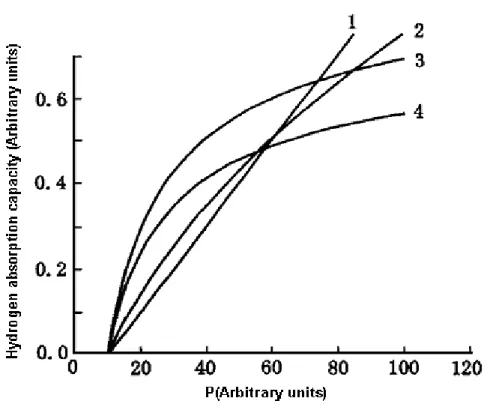
Figure 2.2 is the curve of hydrogen absorption pressure in two-phase region for varieties rate of hydrogen absorption kinetics. When the pressure is small, the absorbing rate on surface is small and is controlled by the reacted rate. With increasing pressure, other reacted steps became slowly, it will become control steps of hydrogen absorption kinetics. For affect of surface pollution on hydrogen absorption kinetics, with pollution degree aggravating, the absorbing and penetrating rate on surface will be significantly slowed down. Therefore, hydrogenation time by controlling process for surface will increase and the pressure of absorbing hydrogen will also increase [13].
2- Surface penetration; 3- Diffusion; 4- Hydride generation.
Fig. 2.3 Relation between rate and pressure; 1- Surface absorption; 2 – Surface penetration; 3 – Diffusion; 4 - Hydride generation.
2.2 Thermodynamic calculations of hydrogen absorption and desorption Through detecting PCT curve of hydrogen absorption and desorption under different conditions, the conclusion about the performance of hydrogen storage of the temperature was obtained, in which H2 pressure had significantly effects.
According to the micro- structure of the material and heating temperature X-ray calculating, two kinds of alloy phases generated in the composite material. The performance of hydrogen storage could be studied by thermodynamic calculations [14].
According to thermodynamic equation of chemical reactions:
Kp is a equilibrium constant; α is substance activity; M, MH is the standard state; αMH and αM are activity; PH2 is equilibrium H2 pressure.
According to the standard Gibbs free energy formulas:
P K RT
G ln
(6)
△G0 is standard Gibbs free energy amount of change; R is gas constant; T is thermodynamic temperature. Substituting formula (5) to (6): 2 1 2 ln H M MH P RT G (7) 2 lnPH RT G (8)
According to the basic equations of thermodynamics S
T H G
(9) △H and △S respectively represent the standard enthalpy and entropy changes. Substituting formula (8) to (9) R S RT H PH 2 ln (10) The formula (11) shows the equilibrium pressure PH2 of the system and
temperature T when the reactions reach equilibrium, standard enthalpy and entropy changes amount could be obtained.
For the experiment, the determination of hydrogen absorption and desorption was conducted under the different conditions:
(1) Constant temperature- Constant H2 pressure
(2) Constant temperature-Changing H2 pressure
(3) Constant H2 pressure-Changing temperature
(4) Changing temperature-Changing H2 pressure
According to four kinds of different conditions, the formulas were respectively used to calculate △H and △S.
convert formula to obtained △H,△S,△G. The period was an activated process, H molecules physically adsorbed on the surface of the composite. In order to discuss the effects the temperature and H2 pressure for producing
hydrogen absorption and desorption, the study respectively detected for constant temperature-changing H2 pressure and constant H2
pressure-changing temperature and according to the same formula to calculate enthalpy (△H) , entropy(△S)and Gibbs free energy(△G), the formulas as follows:
2 2 X H M MH f K X (11)
2 2 2 2 ln ln X H M MHx x H f P (12)
R S RT H P K H 673 2 ln ;
R S RT H P K H 523 2 ln (13)Through formulas (11), (12) and (13), enthalpy (△H) and entropy(△S) were obtained. Enthalpy (△H) and Entropy (△S) were 125KJmol-1 and 80JK-1mol-1. Enthalpy (△H) at 250°C is small and easy to lead the plateau pressure become higher, so that conducive to release hydrogen. It is showed that the effect on hydrogen desorption is more obviously. Based on the above measurement results, the rate and the capacity of hydrogen absorption and desorption under different conditions were discussed in detail.
2.3 Grain structure
planes separated by a distance d; it is represented by the Bragg equation [15-17].
Fig. 2.4 Diffraction of X-ray.
In a crystal the positions of the atoms are periodic in three dimensions and form the crystal lattice. It is possible to determine unit cell to describe structure of entire crystal by translation into three dimensions. The unit cell is characterized by the lattice parameter a, b and c that represents lengths of crystallographic unit cell, while α, β and γ are angles between them. Directions with repeating units in crystals are described by the Miller indices h, k and l, which defined a set of lattice planes (hkl). Miller indices specify points of intersection of lattice planes with unit cell axes.
Fig. 2.5 Lattice planes with Miller indices in a simple cubic lattice.
planes. For orthogonal lattices, the dhkl spacing is calculated by bellow equation: 2 2 2 l k h a dhkl (1) The material prepared in this experiment had uniform crystal structure and transitional layer that promoted hydrogen absorption and desorption. The different diffused layers were composed based on the same size pure Mg ingot as substance; the different transitional layers were connected between each diffused layers and had good continuity, so that improved the performance of hydrogen absorption and desorption. Distribution of elemental and continuous diffusion layers was observed by microstructure characterization; through analyzing metal hydride formation mechanism to discuss principle of hydrogen absorption/desorption. In the paper, confirming temperature range of hydrogen desorption as research focus was calculated by high temperature X-ray diffraction and laid a foundation for the determination of actual value about hydrogen absorption and desorption.
Through above crystal phase standardized, the occupying of the atoms was calculated. As shown in Fig. 2.6(a), Ti replaced atoms Ni in Mg2Ni alloy
phase. In the diffused process, Ni and Ti in form of simple substance reacted with Mg to form Mg2Ni alloy phase on the surface, with forming coherent
transited layers of Ni, Ti and Mg2Ni constantly diffused, Ti replaced occupying
of Ni in Mg2Ni, at the same time, NiTi formed on transited layers under a
certain temperature, so that formed the transited layers in each diffused layers. The bonding of the diffused layers became more density, but crystal structure had obviously pores and effective surface area in each diffused layers. As shown in Fig. 2.6(b), H atoms enter into octahedral and tetrahedral of lattices in the hydrogen absorption process; cell expansion was caused and lattice spacing reduced obviously. As shown in Fig. 2.6(c), under a certain temperature and H2 pressure, atoms H was released lead to the lattice spacing
2.4 Crystal grain size
The temperature range of the composite start release hydrogen was investigated by high temperature X-ray, equipped with a Cu source and an X’ Celerator detector. Besides the dimensions and symmetry of unit cells in the crystalline solid, another property that can be analyzed by XRD is the grain size. To quantify the grain size, the Scherrer equation can be used.
COS K D
(1)
In order to confirm hydrogen absorption/desorption range, the special method that calculated crystal grain size was proposed to distinguish conventional experimental conditions, in which the crystal grain size was calculated after absorbing hydrogen in order to accurately control an experimental temperature. The hydrogen desorption temperature range would be as the test standard. In the hydrogen absorption process, the sample was put into the homemade device under H2 state and the gas was held circulate
for 2 hours. The experiment through calculating the size of the crystal grains analyzed that the temperature range was easy to be enlarged because deviations of hydrogen absorption/desorption.
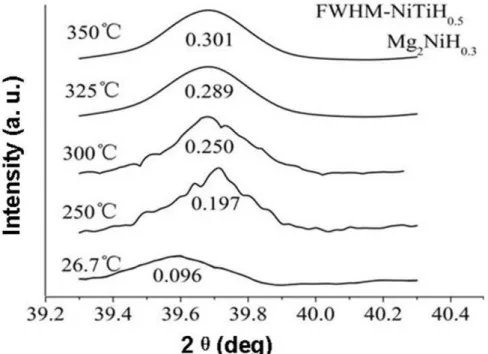
The growth process of metallic hydrides NiTiH0.5 and the Mg2NiH0.3 were
calculated by high temperature X-ray diffraction. As shown in Fig. 2.7, Full width half maximum NiTiH0.5 and Mg2NiH0.3 reached 0.096 under room
temperature of 250°C or so. The hydrogen absorption/desorption range laid the foundation for evaluating the actual capacity.
Fig. 2.7 High temperature XRD pattern of NiTiH0.5 and Mg2NiH0.3.
Table 2.1- Temperature range of hydrogen desorption after absorbing hydrogen Temperature (°C) β 2θ (deg) D (nm) 26.7 0.096 39.6 87.27 250 0.197 39.75 42.38 300 0.250 39.69 33.41 325 0.289 39.67 28.90 350 0.301 39.67 27.73 2.5 Concluding Remarks
shortcomings; according to grain calculation, the change degree of grain size under the absorption and desorption temperature was verified; the detected conditions were proved by the mechanism calculation of expansion and contraction for the crystal grain. It is showed that the most suitable temperature of generating Mg2Ni and NiTi alloy phases was 600-800°C and the most
References
[1] W.Kohn,L.J.Sham, Self-consistent Equations Including Exchange and Correlation Effects.Physical Review A,1965,140:1 133·l 138.
[2] J.P.Perdew,K.Burke, Comparison Shopping for a Gradient-corrected Density Functional.International Journal of Quantum Chemistry,1 996,57: 309-3 1 9.
[3] D.R.Hamann,M.Schluter,C.Chiang, Norm—conserving Pseudopotential. Physical ReviewLetters,1979,43:1494-1497.
[4] D . Vanderbilt, Soft Seit-consistent Pseudopotential in a Generalized Eigenvalue Formolism.Physical Review B,1 990,43:7892—7895.
[5] D.J.Siegel C.Wolverton,V.Ozolins,Reaction Energetics and Crystal Structure of Li4BN3Hlo from First Principles.Physical Review B,2007,75: 014101.
[6] E.Weidner, F.Doici,J.Hu,W.Wiebke,T.Hansen,D.J.Bull,M. Fichtner, Hydrogenation Reaction Pathway in Li2Mg(NH)2.Journal of Physical
Chemistry C,2009,l 1 3:1 5772-1 5777.
[7] R.L.Davis,C.H.L.Kennard, Structure of Sodium Tetradeuterobrate, NaBD4.Journal of Solid State Chemistry,1 985,59:393-396.
[8] M.D.Segall,R.Shah,C.J.Pickard,M.C.Payne, Popuimion Analysis of Plane·wave Electronic Structure Calculations of Bulk Materials.Physical Review B,1 996,54:163 17.16320.
[9] C.G.Van de Walle,J.Neugebauer, First-principles Calculations for Defects and Impurities:Applications to HI—nitrides.Journal ofApplied Physics,2004, 95:3851-3879.
[10] H.Y.Leng,T.1chiwawa,S.Hino,T.Nakagawa,H.Fujii, Mechanism of Hydrogenation Reaction in the Li-Mg-N-H System.Journal of Physical Chemistry B,2005,109:10744.10748.
Johnson, A.Walton,P.P.Edwards, A Mechanism for Non·stoichiometry in the Lithium Amide/Lithium Imide Hydrogen Storage Reaction.Journal of the American Chemistry Society,2007,129:1594-1601.
[12] H.Wu.Structure of Ternary Imide Li2Ca(NH)2 and Hydrogen Storage
Mechanisms in Amide, Hydride System.Journal of the American Chemistry Society,2008,130:6515-6522.
[13] T.Ichikawa, N.Hanada, S.Isobe,H.Y.Leng, H.Fujii, Mechanism of Novel Reaction from LiNH2 and LiH to Li2NH and H2 aS a Promising Hydrogen
Storage System.Journal of Physical Chemistry B,2004,l 08:7887-7892. [14] W.Luo,K.Stewart, Characterization of NHa Formation in Desorption of Li—Mg-N-H Storage System.Journal ofAlloys and Compounds,2007,440: 357-361.
[15] H.Y.Leng,T.Ichiwawa, H.Fujii, Hydrogen Storage Properties of Li-Mg-N-H System with Different Ratios of LiH/M90(H2)2.Journal of Physical
Chemislry B 2006,l 10:12964.12968.
[16] T.Nakagawa, T.Ichikawa, R.Iida, H.Y.Leng,N.Takeichi,T.Kiyobayashi, H.Takeshita, H.Fujii, Observation of Hydrogen Absorption/Desorption Reaction Processes in Li-Mg·N·H System by in-situ X-ray Diffractmetry. Journal of Alloys and Compounds,2007,430:21 7.221.
[17] S.Isobe,T.Ichikawa, H.Y.Leng,H.Fujii,Y.Kojima, Hydrogen Desorption Processes in Li—Mg-N·H Systems.Journal of Physics and Chemistry of Solids, 2008,69:2234—2236.
Chapter 3 Preparation and evaluation of Ni/MgO powder
3.1 Introduction
Ni/MgO powder had been applied in many fields, such as the efficient reaction of organic synthesis and reduction reactions. Especially for fields of battery materials and alloy binder metal, Ni/MgO is applied widely as a catalyst that improve thermal conductivity, the heat resistance and dynamic performance of hydrogen storage materials[1-3]. Specially, the structure of the Ni catalysts is also important in the liquid-phase reaction [4]. Much attention had been paid to the elemental substance of Ni [4]. In this paper, it had been achieved under certain conditions that Ni powder homemade process effectively reduced the presence of impurities and oxidation/reduction was used in order to further refine the powder [5-9]. Gas plays a vital role in protecting process, not only prevented re-oxidation at high temperatures, but also conducted reduction reaction with the oxide formed during sintering, so that the oxide is reduced sufficiently. Greater impact on the grain size to the crystal structure and elemental distribution was caused [10-15].
In this experiment, a trace amount of H3BO3 was added after the nickel is
prepared, the purpose is to make the grain more uniform and refinement by chemical reaction. We used uniform refinement method based on co-precipitation to obtain Ni/MgO [16-20], in which controlled the molar ratio of NiCl2・6H2O and MgCl2・4H2O solution. Then H3BO3 was added into the
Ni/MgO sintering powder and was sintered at 800°C,900°C and 1000°C. Through evaluated results of crystal structure and microstructure, we found that adjunction and grinding of H3BO3 promote grain refine at the second
sintered process and grain size is about 1μm.
3.2 Experimental methods
The mixed powder was prepared by co-precipitation. The ammonium oxalate [(NH4)2C2O4・H2O] of 25g, 1.4mol/L NiCl2・6H2O 32g were used as
starting materials to prepare Ni powder. It was confirmed that the solute of the aqueous solution was completely dissolved at 50°C; aqueous solution mixed was stirred at the rate of 300rpm for 2 hours. The next, aqueous solution stirred was filtered with the funnel and filter paper.
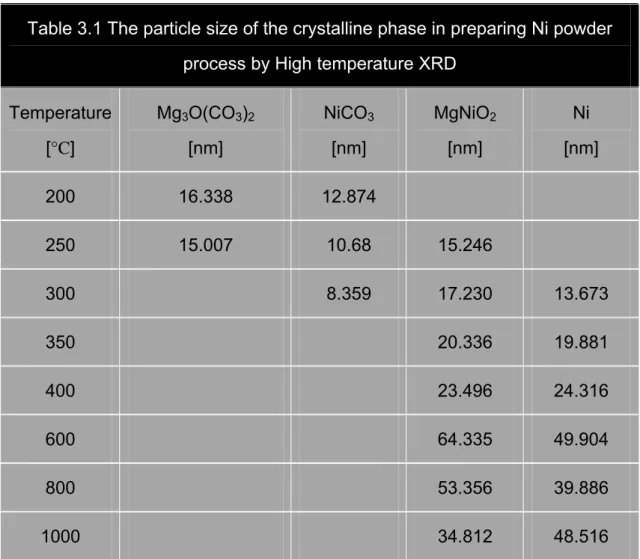
The mixed powder was sintered at 10°C /min to 1000°C by using the apparatus of high temperature X-ray. In the prepared process, As shown in Fig. 3.1 and Tab. 3.1, Mg3O(CO3)2, NiCO3 and MgNiO2 formed at 200°C. With the
temperature increasing, the grain of Mg3O(CO3)2 became smaller and
disappear at 300°C. In which Mg3O(CO3)2 was thermal decomposed , so that
the grain of MgNiO2 grew up and a small amount of Ni was restored out. It is
indicated that C2O42- was decomposed to CO and CO2 while generated NiO
(a)
Table 3.1 The particle size of the crystalline phase in preparing Ni powder process by High temperature XRD
Temperature [°C] Mg3O(CO3)2 [nm] NiCO3 [nm] MgNiO2 [nm] Ni [nm] 200 16.338 12.874 250 15.007 10.68 15.246 300 8.359 17.230 13.673 350 20.336 19.881 400 23.496 24.316 600 64.335 49.904 800 53.356 39.886 1000 34.812 48.516
3.2.2 Preparation and refinement of Ni powder by electric furnace
The Ammonium oxalate [(NH4)2C2O4・H2O] of 25g, 1.4mol/L NiCl2・6H2O
and MgCl2・4H2O of a amount of 77g were used as starting materials for
preparing Ni/MgO. In the present study, it was confirmed that the solute of the aqueous solution was completely dissolved at 50°C; aqueous solution mixed was stirred at rate of 300rpm for 2 hour. The next, aqueous solution stirred was filtered with the funnel and filter paper under the molar ratio of Mg: Ni (2:1) was prepared. Then the precursor was sintered at 10°C /min to 700°C by using electronic balance. (NH4)2C2O4・H2O was decomposed to CO and CO2 under
refined grain. According to a certain proportion promoted particles sufficient reaction. NiCl2・6H2O was reverted by C2O42-. In the powder prepared process,
a small amount of MgCl2・4H2O was added because the oxidizing from Mg is
much stronger than that of Ni. It made Ni be further reverted because Mg is active metal. The result consistent with high temperature X-ray diffraction result and the suitable temperature was 800°C. According to results from two kinds of equipments, it was confirmed that sufficient reaction was achieved by electric furnace. After that the black Ni/MgO sintered was formed. H3BO3 was
added into Ni/MgO powder and was sintered under 800°C,900°C and 1000°C, respectively. The sintering process was analyzed by TG-DTA determine. Reaction equation of Ni powder as follows:
MgCl2.6H2O+(NH4)2C2O4→MgC2O4.mH2O ↓+2NH4Cl+(6+1-m)H2O (1) MgC2O4.mH2O→MgO+CO↑+CO2↑+mH2O (2) NiCl2.6H2O + (NH4)2C2O4→NiC2O4.mH2O ↓+2NH4Cl+(6+1-m)H2O (3) NiC2O4.mH2O→NiO+CO↑+CO2↑+mH2O (4) NiO+CO→Ni+CO2 (5) 2MgO+B2O3→Mg2B2O5 (6)
Fig. 3.2 (a) shows the TG-DTA result for mixed powder. The curves show that the thermal development could be divided into three sections. The three sections of crystal water, CO and CO2 release at 220°C and 400 °C; the
endothermic peaks of MgO and NiO at 420°C are caused by thermal decomposition of C2O42-. The curve of weight remained stable was above
700°C.
Figure 3.2(b)shows crystal water lost at 100°C to generate B2O3. B2O3 and
figure. According to TG-DTA curves, the heat-treatment process was divided into three steps which included the volatilization of water and organic compounds.
3.3 Experimental results and discussion
3.3.1 XRD pattern of generated phases
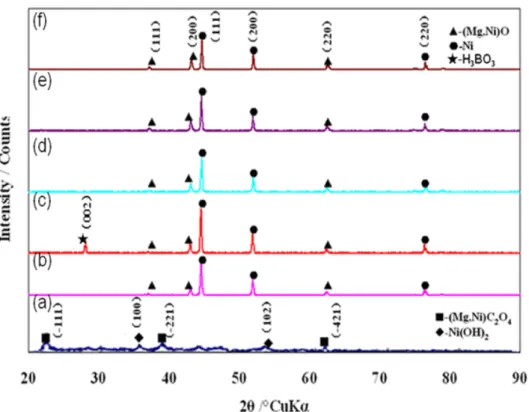
Fig. 3.3(a) shows MgC2O4 and NiC2O4 generated for the determination of
the mixed powder. The result showed that the strength of the peaks was weak because the size of crystal grain prepared by co-precipitation elemental composition is complicated, so that the noise become more obviously and lead the strength to decline. In the detected process, a small amount of the impurities is also the mainly reason that affected the strength of the peaks. As shown in Fig. 3.3(b), With the conduct of the thermal decomposition, the oxalate are decomposed into CO and CO2, and which make NiO be reverted
Ni in sintering process of the powder under 700°C. The crystalline structure had not been changed after adding H3BO3 because the amount of adding
H3BO3 wasless cause the peak of Mg2B2O5 was not detected out byX-ray
scanning from 20°C to 90°C. Elemental substance Ni is as the main characteristic peaks in the processes of the second sintering under 800°C, 900°C and 1000°C. It is result that the purity of Ni powder was relatively high and a small amount of impurities transformed into the gas from the electric furnace, such as Cl2 produced with the heating temperature. According to
Fig. 3.3 XRD patterns analysis (a)Compound sintered at 700°C; (b) Ni/MgO powder; (c) powder added H3BO3 before sintering; (d) Ni/MgO added H3BO3
sintered at 800°C; (e) Ni/MgO added H3BO3 sintered 900°C; (f) Ni/MgO added
H3BO3 sintered at 1000°C.
3.3.2 SEM microstructure analysis
The conclusions can be drawn according to SEM image. As shown in Fig. 3.4(a), the crystal grain is coarse and clear overlay phenomenon was observed. The larger sheet structure was exhibited. Figure 3.4(b) shows crystal grain is refined obviously in the process of the primary sintered because the reaction of oxide and CO. The size of the crystal grain became less than 2μm; it played a catalysis role for hydrogen absorption and desorption. As shown in Fig. 3.4(c), the crystal grain size of the mixed powder grinded after adding H3BO3 had not significant change. However, with the
powder of H3BO3 added secondary sintering 800°C, grain is more refinement
Fig. 3.4 SEM microstructure image (a)Mg-Ni precursor powder;(b) Mg-Ni powder sintered at 700°C;(c) Mg-Ni added B powder;(d) Mg-Ni added B sintered at 800°C.
3.3.3 TEM analyses of based experiment
The element and distribution in the selected region can be observed by EPMA analysis. In the process, elemental distribution status can be analyzed out clearly. The existing of element and the refinement degree were analyzed by the elemental uniformity in surface analysis and line analysis.
Fig. 3.5 TEM image of precursor power.
3.3.4 EPMA analysis of elemental distribution
As shown in Fig. 3.6(a), Mg, Ni, C and O elements are generated in the process which the precursor was prepared, it is indicated that the main resultant are MgC2O4 and NiC2O4. The line distributions of MgC2O4 and
NiC2O4 are uniform, at the same position, Mg, Ni, C and O peaks
powder. Complementary elements distributed of Mg and Ni elements are in the same position; the distribution of the part of element O and Mg were consistent. It is indicated that NiO was restored to simple substance Ni in the sintered process, so that MgO and Ni were observed. Figure 3.6(c) shows that Mg, B, and O elements are distributed for the grinding powder after adding H3BO3 and
powder was refined obviously by SEM observation. The results show that the main resultant is MgO and grains grow up to refine. In accordance to the distribution of Ni, the distribution of Ni is more uniform and the grain is more refinement, and which are analyzed to generate elemental substance Ni. As secondary sintering carrying out, Mg, B and O elements are distributed. MgO and Ni particle is further uniform and refinement in Figure 3.6(d) obviously.
Fig .3.6 EPMA analysis image (a) Ni(MgO) precursor powder;(b) Ni(MgO) powder sintered at 700°C (c) Ni(MgO) added H3BO3 powder; (d) The powder
sintered at 800°C.
3.3.5 XPS patterns analysis of the extent depth distribution
Full spectrum indicated the existence elements in the sample, what compounds were elemental compositions. The extend depth distribution analyzed as the change of sputtering to depth, observed elemental distribution from the surface of the sample to inside from inside and confirmed whether generated new compounds or alloys.
Figure 3.7(a) shows that B1s, MgKLL, O1s and Ni2p peaks were observed by
the analysis of full spectrum. Figure 3.7(b) shows that B2O3 is main
characteristic peak. The sputtering depth distribution as shown in Figure 3.7(c), MgKLL and Mg2p peaks were identified to MgO, and Mg2p peaks increased
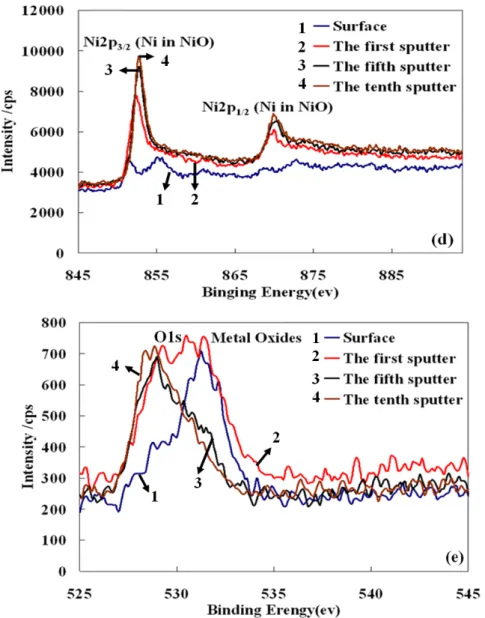
significantly as the increase of sputtering times. Figure 3.7(d) shows that Ni powder is produced at the time of generating NiO by the Ni2p3 / 2 and Ni2p1 / 2
peaks. According to sputtering depth distribution, Ni2p3 / 2 Ni2p1 / 2 peaks
Fig . 3.7 XPS analysis: (a) Full spectrum of 800°C; (b) B1s depth distribution of MgO/Ni added B sintered at 800°C; (c) Mg2p depth distribution of MgO/Ni added B sintered at 800°C; (d) Ni2p depth distribution of Mg-Ni added B sintered at 800°C; (e) O1s depth distribution of Mg-Ni added B sintered at 800°C.
3.4 Concluding Remark
The results show that oxalate was thermal decomposed completely to CO and CO2 in the sintering process at 700°C, and a part of NiO was reverted directly
to Ni because the reducibility of Ni is stronger than that of Mg. With the powder of H3BO3 added was the second sintered at 800°C, grain is more refinement
and uniform, and the size is about 1μm. The most suitable temperature of the second sintered is under 800°C. The adding of H3BO3 promoted crystal grain
refining. By the setting for temperature and the controlling for the sintered rate, simple substance Ni powder formed. According to above conclusions, Ni as catalytic phase can promote absorbing and desorbing hydrogen, but the adding H3BO3 did not produce a large effect on the crystal structure; there was
References
[1] J Kim, J Ahn, et al, In situ transmission electron microscopy study on microstructural changes in NbF5-doped MgH2 during dehydrogenation. Scr
Mater 2010; 62: 701.
[2] X Yu, Y Guo, Z Yang, Synthesis of catalyzed magnesium hydride with low absorption/desorption temperature. Scr Mater 2009; 61: 469.
[3] C Milanese, A Girella, G Bruni, et al, Mg/Ni/Cu mixtures for hydrogen storage: a kinetic study. Intermetallics 2010; 18: 203-11.
[4] R Gremaud R, C Broedersz, A Borgschulte, et al, Hydrogenography of MgyNi1-yHx gradient thin films: interplay between the thermodynamics and kinetics of hydrogenation. Acta Mater 2010; 58: 658.
[5] C Aymonier, A Denis, Y Roig, M Iturbe, E Sellier, S Marre S, et al, Supported metal NPs on magnesium using SCFs for hydrogen storage: interface and interphase characterization. J Supercrit Fluid 2010; 53: 102. [6] S Jin, J Shim, J Ahn, Y Cho, Improvement in hydrogen sorption kinetics of MgH2 with Nb hydride catalyst. Acta Mater 2007; 55: 5073.
[7] M Dornheim, S Doppiu, G Barkhordarian, U Boesenberg, T Klassen, O Gutfleisch, et al, Hydrogen storage in magnesium-based hydrides and hydride composites. Scr Mater 2007; 56: 841.
[8] M Song, S Kwon, D Mumm, S Hong, Development of Mg-oxide-Ni hydrogen-storage alloys by reactive mechanical grinding. Int J Hydrogen Energy 2007; 32: 3921.
[9] C Lin, C Wang, P Lee, H Lin, K Lin, The effect of Ti additions on the hydrogen absorption properties of mechanically alloyed Mg2Ni powders. Mater
Sci Eng A 2007; 449:1102.
[10] A Ebrahimi-Purkani, S Kashani-Bozorg, Nanocrystalline Mg2Ni-based
[11] M Jurczyk, L Smardz, I Okonska, E Jankowska, M Nowak, K Smardz, Nanoscale Mg-based materials for hydrogen storage. Int J Hydrogen Energy 2008; 33: 374.
[12] F Gennari, M Esquivel, Structural characterization and hydrogen sorption properties of nanocrystalline Mg2Ni. J Alloy Compd 2008; 459: 425.
[13] H Wang, S Chyou, S Wang, M Yang, C Hsu, H Tien, et al, Amorphous phase formation in intermetallic Mg2Ni alloy synthesized by ethanol wet milling.
J Alloy Compd 2009; 479: 330.
[14] S Ordonez, D Serafini, P Rojas, C Aguilar, M Santander, Thermal stability of amorphous Mg50Ni50 alloy produced by mechanical alloying. J Non-Cryst
Solids 2010; 356:120.
[15] V Skripnyuk, E Buchman, E Rabkin, Y Estrin, M Popov, S Jorgensen, The effect of ball milling and equal channel angular pressing on the hydrogen absorption/desorption properties of Mg4.95 wt% Zn0.71 wt% Zr (ZK60) alloy. Acta
Mater 2004; 52: 405.
[16] V Skripnyuk, E Rabkin, Y Estrin, R Lapovok, Improving hydrogen storage properties of magnesium based alloys by equal channel angular pressing. Int J Hydrogen Energy 2009; 34:6320.
[17] V Skripnyuk, E Buchman, E Rabkin, Y Estrin, M Popov, S Jorgensen, The effect of equal channel angular pressing on hydrogen storage properties of a eutectic MgNi alloy. J Alloy Compd 2007; 436: 99.
[18] Y Kusadome, K Ikeda, Y Nakamori, S Orimo, Z Horita, Hydrogen storage capability of MgNi2 processed by high pressure torsion. Scr Mater 2007; 57: 751e3.
[19] K Jeon, A Theodore, C Wu, Enhanced hydrogen absorption kinetics for hydrogen storage using Mg flakes as compared to conventional spherical powders. J Power Sources 2008; 183: 693.
films prepared by magnetron sputtering. Int J Hydrogen Energy 2009; 34: 1910.
[21] S Barcelo, M Rogers, C Grigoropoulos, S Mao, Hydrogen storage property of sandwiched magnesium hydride nanoparticle thin film. Int J Hydrogen Energy 2010; 35: 7232.
[22] M Tanniru, H Tien, F Ebrahimi, Study of the dehydrogenation behavior of magnesium hydride. Scr Mater 2010; 63: 58.
[23] A Neumaier, On the compa rison of H-matr ices with M -matrices [ J] . Linear Alg ebr a Appl, 1986, 83: 135 - 141.
Chapter 4 Electrochemical properties/Actual capacity
evaluation of Mg/Ni(MgO) and Mg/Ni(MgO)/Ti composites
4.1 Introduction
In the past few years, hydrogen storage, which had been widely used as negative electrode materials, has attracted much attention due to its several advantages, such as the high energy density, the durability against overcharge and over discharge [1, 2]. Recently, however, the rechargeable materials are encountering serious competition from Li-ion cells and other advanced cells with higher energy density. So it is urgent to develop some new-type electrode materials with higher activation capacity and lower cost in order to enhance the competition ability [3–5]. Fuel cell development is rapid. A metal hydride electrode was used primarily, for which the obvious reason was to replace expensive materials. Much of the research effort is still intended to improve the properties of this electrode material, such as corrosion resistance, rate-capability and ability hydrogen storage capacity[6, 7]. Yet, the gravimetric capacity is not expected to rise significantly because the intrinsic capacity is not much higher. It is known that Ti based alloys with high dynamic performance and excellent activation have been considered as new candidates for hydrogen storage applications. In the present work, it is the research purposes that electrochemical performance and absorption-desorption hydrogen performance were synthesized to prepare the electrode material of the absorption-desorption hydrogen [8].
The study basis on homemade Ni powder did the further research for the preparation of hydrogen storage materials. By a new type sintered method to study performance differences of hydrogen storage. The purpose is to generate absorbed hydrogen phase and catalytic phase can improve dynamics performance in the sintering process. The selection of element is crucial. It is showed that Ti alloy has good heat strength, low temperature toughness and fracture toughness; therefore, it had been widely applied in various fields, such as aircraft engine parts and rockets, missiles structure. Ti is also used as fuel, oxidizer tank and pressure vessel. Ti metal has excellent physical and chemical properties, good biocompatibility, low specific gravity and resistance corrosion [10–12]. The studies had shown that related the results had got corresponding development, but general method is ball milling method due to can effective increase surface area. There are some malpractices through application of the ball milling method [13]. The powder need to hold under a vacuum status and must use continuous milling to achieve hydrogen absorption and desorption cycles. In addition, the prepared powder by ball milling is not easy to save, no fixed shape to storage. Applications in various fields are limited [14].
The study broken traditional prepared method instead of cover method of a powder and an alloy to prepare hydrogen absorbing phase Mg2Ni and catalytic
phase NiTi that have excellent effect for hydrogen absorption and desorption, not only effectively increased the surface area of the sample, but also achieved the diffusion the powder to the alloy. Based on the formation of alloy, a part of simple substance was remained, so that the powder as medium make H atoms diffuse to the inner of alloy, dynamics performance of hydrogen absorption and desorption was improved.