Keiko Shintani : Association between the components of self-care and health locus of control among hemodialysis patients
28
Association between the components of self-care and health locus of control among hemodialysis patients
Keiko Shintani RN., Ph. D
Key words : Hemodialysis patient, self-care components, HLC (Health Locus of Control)
Department of Nursing, Faculty of Health Sciences, Niigata University of Health and Welfare, 1398, Shimami, Niigata 950-3198 Phone +81-25-257-4603, Fax+81-25-257-4603
E-mail [email protected]
Abstract
To obtain primary data about nursing intervention for hemodialysis patients, 120 patients undergoing treatment at a hospital were surveyed regarding the association between self- care components and HLC. A strong correlation was found between internal control and self-care involving shunt maintenance, with patients practicing this type of self-care rather easily. On the other hand, there was a strong correlation between external control and eating behavior, stress prevention, and confirmation of food safety.
Patients tended to be more compliant with respect to these types of self-care. In providing nursing support for self-care, it is important to understand the patient’s locus based on the contents of self- care.
Introduction
It is widely believed that decision-making in daily life is based on an individual’s cognition, and self-health maintenance behavior is practiced in a similar way. Health locus of control (HLC) is a sense of subjective control over one’s own health, and is one of the main factors determining health behavior. An individual’s outlook on healthcare and their way of thinking about the causes of illness are important factors of Rotter’s social learning theory of health-related behavior.
Self-care is vital to the maintenance of dialysis treatment, with nurses providing self-care support on a daily basis. In this regard, there are those
who are able to follow through on proper self- care behavior and those who are not. It has been found that there are also those who tend to try to solve problems on their own and those who tend to depend on others. This is thought to be a function of the differences in the various types of self-care behavior. Therefore, to provide long- term nursing support for self-care behavior, interventions based on sufficient understanding of the state of self-care are necessary. To ensure that nursing support is effective, it is necessary to clarify the locus of behavior for the various types of activities that constitute the self-care of hemodialysis patients.
Objectives
The objectives of this study were to investigate the relationship between the components of hemodialysis patients’ self-care and HLC and to obtain primary data for nursing intervention.
Methodology
A total of 120 patients undergoing regular hemodialysis treatment at a hospital participated in this study. Informed consent was obtained from all participants. A four-point Likert-style self-assessment questionnaire was distributed and collected one week later using the placement method. The questionnaires consisted of the Self- Care Measurement Scale1 (60 items), the Health Locus of Control Scale2 (11 items), and questions about basic attributes. The Self-Care Measurement Scale consists of 12 questions about dietary behavior
29 The Niigata Journal of Health and Welfare Vol. 7, No. 1
adjustment, 9 questions about stress prevention, 5 questions about confirmation of food safety, 5 questions concerning regulation of physical exercise, 4 questions about habit adjustment, 10 questions regarding shunt maintenance, 8 items regarding the implementation of therapeutic diet, and 7 questions about the strict observance of directions. Data analysis was performed using SPSS 10.0J statistics software.
Results
The average age of the 120 participants who submitted valid responses was 57.5 years (±11.2).
The average self-care score for internal and external control concerning each self-care component identified through factor analysis was compared using the t-test. Table 1 indicates that
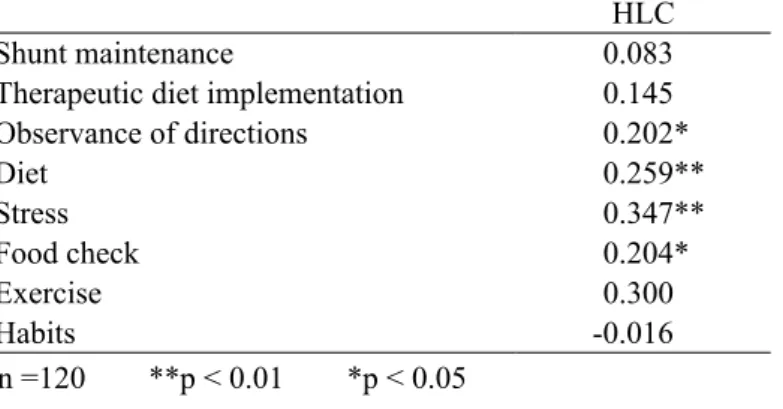
the self-care score for shunt maintenance was significantly higher for internal control than for external control. On the other hand, the self-care scores for dietary behavior, stress prevention, and confirmation of food safety were all significantly higher for external control than for internal control. There was no significant difference in relation to therapeutic diet, strict observance of directions, regulation of physical exercise, and habit adjustment. Table 2 shows the Cronbach’s α coefficient for each self-care component and HLC, and indicates that reliability was established for all of the items. In addition, Table 3 shows the relationship between self-care components and HLC using Pearson’s product-moment correlation.
Table 1. Average self-care scores by type of control Shunt
maintenance Therapeutic
diet Directions Diet Stress Food
check Exercise Habits External
control 31.9±6.7 22.5±5.6 22.5±3.4 36.4±5.7 31.5±3.7 16.0±4.0 11.8±4.2 11.8±3.9 Internal
control 34.3±4.5 21.5±6.5 22.1±3.9 34.2±5.1 27.3±5.3 13.9±3.9 12.0±3.9 11.4±3.5
t value 2.8 0.8 0.43 2.24 4.54 2.71 0.28 0.55
p 0.004 0.42 0.66 0.032 0.000 0.008 0.77 0.58
External control n = 44 Internal control n = 76
Table 2. Questionnaire Composition
Category No. of items α coefficient
Self-care practice Dietary adjustment 12 0.56
Stress prevention 9 0.77
Food safety check 5 0.77
Phy. Exercise regulation 5 0.68
Habit adjustment 4 0.69
Shunt maintenance 10 0.77
Implementation of
therapeutic diet 8 0.83
Observance of directions 7 0.54
HLC HLC(Wallston) 11 0.74
Keiko Shintani : Association between the components of self-care and health locus of control among hemodialysis patients
30
Discussion
The locus of behavior for self-care components was explored in light of the results obtained from the study questionnaires. With respect to the relationship between the components of hemodialysis patients’ self-care and their sense of health control, a correlation was found between shunt maintenance self-care and internal control.
Based on these findings, we can predict that internally controlled people are comparatively compliant, which might also mean that there will be a tendency to seek solutions from experts for problems related to shunt maintenance. In addition, there was a strong correlation between self-care related to dietary behavior, stress prevention, and confirmation of food safety, and external control. These types of self-care tend to be taken easily as compliant behavior for externally-controlled types of people. In other words, these types of self-care are considered as negative or passive types of health-maintenance behavior. A positive correlation was found between hemodialysis patients’ self-care components and HLC, with a few exceptions.
For those who are very internally controlled, self- care behavior tends to be taken actively. To provide effective nursing support for hemodialysis patients’ self-care behavior, it is important to understand the patients’ HLC tendencies.
Conclusion
The health locus of control (HLC) related to hemodialysis patients’ self care differs depending on the content of self-care.
This study is a revised version of a paper presented at the 22nd Conference of the Japan Academy of Nursing Science.
References
1) Shintani K., Takama S. Jinko toseki kanja no serufukea do sokutei shakudo no kokoromi (Testing the Artificial Dialysis Patients’ Self- Care Measurement Scale) Dai 20 kai Nihon kango kagakugakkai koenshu p. 20, Tokyo, December 2000. (in Japanese).
2) Munakata T. Kodo kagaku kara mita kenko to byoki (Health and Illness From the Perspective of Behavior Science) p. 110-112 K.A. Wallston,et al. Health Locus of Control Scale (translated by T. Munakata). (in Japanese).
Table 3. Relationship between self-care components and HLC
Shunt maintenance 0.083HLC
Therapeutic diet implementation 0.145
Observance of directions 0.202*
Diet 0.259**
Stress 0.347**
Food check 0.204*
Exercise 0.300
Habits -0.016
n =120 **p < 0.01 *p < 0.05