Mongolian Pastoralist Societies
著者(英) Takahiro Ozaki
journal or
publication title
Senri Ethnological Studies
volume 69
page range 99‑122
year 2005‑08‑23
URL http://doi.org/10.15021/00002642
99
Edited by K. Ikeya and E. Fratkin
North and South Mongolia:
A Comparison of Two Mongolian Pastoralist Societies
Takahiro Ozaki
Kagoshima University, Japan
INTRODUCTION
This article aims to compare actual conditions of pastoralism in North Mongolia (i.e. Mongol Uls or the Mongolian State; hereinafter referred to as MU) and South Mongolia (i.e. Neimengu Zizhiqu or Inner Mongolian Autonomous Region; hereinafter referred to as NZ), in order to clarify how socio-economic interactions with other people have influenced the livelihood of pastoralists. First, before starting the actual comparison of elements in pastoralism, the methodology and background of the issues should be mentioned.
Regarding methodology, this study begins with a discussion on discontinuity and continuity between MU and NZ. The aspects of discontinuity are obvious; first, these are two separate states. There was very little interaction between them until about 15 years ago because their shared boundary was the de facto forefront of conflict between China and the Soviet Union. Even now, except for those who come and go between the two areas for business or education, most have little knowledge of each other. On television in NZ, there are few if any scenes of MU, even though there are almost daily scenes of the US or Japan. On the other hand, in MU, cable television broadcasts NZ programming, but because the contents are mainly Chinese programs broadcast in Mongolian, they do not reveal much about the actual conditions of NZ. Therefore, the people of each area think of the other with ambiguous images attached to area names
1).
A discussion of the continuity between MU and NZ is far more difficult. To show differences that might form the basis for discontinuity, citing some cases will be sufficient because it is normal for every case to differ in some aspect. However, to show similarities that may be the basis for continuity, first the phenomena must have some criteria by which they can be categorized. Then similarity within the domain can be demonstrated.
In addition, the similarities should be plausible; that is, a persuasive comparison is needed.
What kind of phenomenon can have continuity beyond the border of MU and NZ?
To begin with, there is the natural environment. It is hard to believe that natural
phenomena such as precipitation or air temperature can be so drastically different on
both sides of a border, judging from meteorological data of the area. Although the
current landscapes differ greatly on each side of the border, that can be attributed to human activity; it may be impossible to claim that an area in NZ is ecologically more similar to a remote area in NZ than to an adjacent area in MU.
Next, there are the human activities. It is impossible to deny that the people of this area have lived, dependent on pastoralism, over a long time, regardless of today’s artificial boundaries. Of course, it is true that agriculture is rapidly becoming prevalent in NZ, especially in areas near the border with China. Even so, pastoralism in NZ survives. Moreover, because pastoralism is subject to the dictates of nature, pastoralism has limited feasibility in some areas and under certain natural conditions. Therefore, the continuity of pastoralism beyond the border of NZ and MU is not hard to imagine.
Moreover, the pastoralists on both sides are typically ethnic Mongolians.
Can we assume cultural continuity a priori because people on both sides of the border share the same Mongolian ethnicity? One must be cautious about this point. Of course, there are some cultural similarities, but the word “culture” is much too broad, so comparisons of “cultures” themselves frequently tend to merely list impressions without academic rigidity.
Because this is an academic discussion, then objectivity, empirical data and the proper setting of conditions under which persuasive comparison can be done are all necessary. For this reason, I have chosen to write this article comparing the pastoralism of two adjacent areas in NZ and MU. Through this comparison, we can clarify the differences in social environments, such as the pastoralists’ interaction with other people and the manner in which state policies influence the conditions of pastoralism.
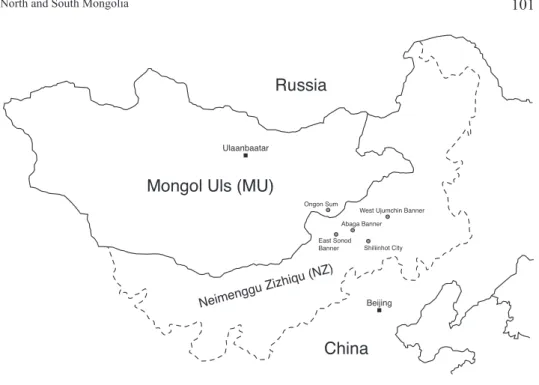
The discussion in this article covers some banners and the cities of Shiliingol Aimag in NZ and Ongon Sum of Sukhbaatar Aimag in MU (Figure 1). The main reason for the selection of this area is that the author has field data; all data used in this article were collected in the author’s own field research
2). With regard to the natural environment, it belongs to the plains area of Eastern Mongolia; the condition of the grassland is especially good in the northeastern region. For example, the Shiliingol pasture is recognized as one of the best pastures in NZ.
Although the main body of this article presents a comparison of elements in pastoralism, the differences in the land system should first be mentioned. The land system regulates the current conditions of pastoralism to a large degree. In NZ, the current land system originated in the nationwide changes of economic policy in early 1980s: the disbandment of the people’s communes and the adoption of the production responsibility system. It brought about the direct division of farmland to households in agricultural areas, but privatization of livestock to households came first, followed by the division of pastures to households in pastoral areas of NZ. These circumstances form the background for operations of pastoralists in NZ. The pastures have been nearly privatized over the last 10‒20 years, even though they cannot be disposed of freely (to be more accurate, the pastoralists have temporary exclusive rights and usufructuary rights).
In contrast, in MU a change in economic policy that was similar to that of NZ
occurred in the early 1990s. As a result, the negdel (agricultural and pastoral cooperatives)
were disbanded and the collective animals were privatized. The critical point of contrast to NZ is that privatization of the pasture has not been allowed even to today. On May 1, 2003, a new land law was effected
3)and privatization of sedentary housing lots and farming lands began, yet the pasture has not been an object of privatization to date. Of course, this fact does not mean that there is completely free access to the pasture. For example, there are pastures that are off-limits because they are particularly reserved for natural disasters such as snow damage. But under the present circumstances, it is true that pastoralists in MU enjoy more flexibility in choice of pasture than those in NZ. It is also noteworthy that pastoralists are a minority even in MU, and more so in NZ. In MU, the number of pastoral households was only 30.1% of the total households in 2002 (NSOM 2003: 44,151). In NZ, the population in the pastoral areas is 8.0% of the total population, and the Mongolian population occupies 16.7% of the total population (CIIC 2003). This is an important consideration when we discuss the socio-economic interactions between the pastoralists and other people.
Here, two kinds of “other people” are conceivable; sedentary people on one hand, and the government’s decision-makers on the other hand. In MU, both sedentary people and the government’s decision-makers are mostly Mongolian, whereas the vast majority of both are Han Chinese in NZ. Even so, it might be too simplistic to view differences of two pastoral societies as an ethnic issue.
It is probably true that sedentary people and the government’s decision makers in MU know pastoralism better, might have relatives who are pastoralists, and might be
Russia
Mongol Uls (MU)
China
Neimenggu Zi
zhiqu (NZ)
Ulaanbaatar
Beijing Shiliinhot City West Ujumchin Banner Abaga Banner East Sonod Banner Ongon Sum
Figure 1 The study area
more sympathetic to them. However, they still differ from pastoralists in terms of lifestyle, social roles, and conceptions of development. Therefore, they should not be identified with pastoralists. In this sense, it can be said that the objects of socio-economic interactions for pastoralists in both societies are similar, regardless of their respective ethnicities.
COMPARISON OF THE ELEMENTS IN PASTORALISM 1) Residence
One remarkable difference in the landscape of the pastoral areas of MU and NZ is the type of residence found in each. Generally speaking, the typical residence is a ger (yurt) in MU (Photo 1) and a sedentary home in NZ (Photo 2).
In Shiliingol, the most popular sedentary house of Mongolian pastoralists is a one-storied brick house about 15 meters wide by 10 meters deep. The builders of these houses are Han Chinese of Shiliinhot City or the banner centers, their basic structure is similar to the houses of Northern Han Chinese, which have a kang (a floor heater) in the bedroom. Figures 2 and 3 show plans of sedentary houses that the author saw in Abaga Banner in the summer of 2001.
All of these sedentary houses were constructed in the late 1980s and early 1990s;
for instance, 1993 (West Ujumchin), 1987 (Abaga), 1991 (Shiliinhot), 1991 (East Sonod). The informants themselves stated:
A) Around 1985‒86, there were almost no sedentary houses in West Ujumchin (West Ujumchin).
B) Before 1989, there were only one or two sedentary houses out of 40 households in the gachaa (i.e. subdivision of a sum, formerly a production team). Afterwards, about 10 sedentary houses were constructed every year. Now very few people live in ger (East Sonod).
These sedentary houses do not last long in general; it seems that they are rebuilt after 10 years. Reasons for reconstruction include the poor skill of the builders and the fact that the pastoralists are relatively well off.
But it is not true that the type of residence has completely shifted from the ger to a sedentary house. There are a few cases of people living only in a ger, but it is common that a ger is set up near a sedentary house for a guest room in summer. Alternatively, pastoral workers who were hired as shepherds live in the ger. Where seasonal pastures are scattered, as is the case in northern Abaga, it is usual that only in the spring pasture do they live in a sedentary house. In other pastures, they live in a ger. Moreover, the ger are used as temporary lodgings for such events as weddings, which last for several days.
An informant related that the reason ger became unpopular as the usual residence
was the fact that “the felt cover of ger needs to be changed once every 3‒4 years, so it
is troublesome unless it is moved seasonally” (West Ujumchin). Besides, the capacity
for bigger consumer durables such as TV sets and comfortable warmth in the winter
can be reasons for moving to a sedentary house.
Photo 1 Hot ail in MU
Photo 2 Brick house in NZ
In contrast, in MU, the basic residence for pastoralists is the ger. But the ger used in MU is not exactly the same as the ger of NZ. Usually, the ger in MU are bigger. It is not only that those ger have greater girth, but also that the hana (wall) of the MU ger are bigger. For example, a ger with 4 hana in MU is as big as a ger with 5 hana in NZ. In addition, a bagana (pillar) is indispensable to a ger in MU whereas a typical ger in NZ has no pillar. As a result, the former is taller and has a larger capacity than the latter.
It remains unclear how and when such differences appeared. But the old dariganga type ger which had been made in 1953 and was still being used by an informant in
Figure 3 Layout of a sedentary house (a larger house) Kitchen
Dining room Bedroom (for cohabiters=FB)
Bedroom (for children)
Bedroom (for
Ego and W) Reception room
Kitchen range
※ Each bedroom has a kang.
Figure 2 Layout of a sedentary house (a small house) Bedroom
(with kang) Kitchen
Stock room Kitchen range
Living room
Bed
Ongon Sum in 2001 had no bagana and a smaller uni (ceiling), which rendered the ger shorter and gloomier than the usual khalkha type ger used in MU. It is also true that the bigger ger are suitable for the lifestyle of modern pastoralists in MU who do not sleep on the floor but on beds. Therefore, one can imagine that ger have been improved such that they are more comfortable in MU than in NZ by now. This difference may reflect different situations for Mongolians who constitute the majority in MU and the Mongolians who are a minority in the PRC.
2) Livestock possession
In this section, the composition and numbers of livestock will be investigated.
Table 1 shows examples of livestock possession in Shiliingol. Cases 1‒7 and 11 are from 1999, and cases 8‒10 are of 2001.
There were 200 sheep from the Civil Administration Bureau that were consigned to No.1 and 200 sheep and goats from the Science Committee were consigned to No.5 with compensation. Because other households did not graze the livestock of others for compensation, 400 sheep and goats are recognized as the minimum for self-support.
On the other hand, even No.11, which can be classified as a typical wealthy household, owns 1,000 sheep and goat. In the case of Abaga, the flock was divided when the its size reached 1,000. Thus, it seems that 1,000 sheep and goats is seen as the maximum size for a flock.
However, No.4 said that the wealthiest household in their local community had 2,000 head of livestock and that the owner regarded himself as middle class. Number 3 possessed 1,000 sheep and goats after the lambs and kids were born, but he also described himself as middle class. Because the condition of the grassland is better in the east, people may possess more livestock there.
The characteristics of livestock possession will be discussed in detail after showing cases in MU, but it is clear that there are very few camels. Camels are used only for
Table 1 Livestock possessed in Shiliingol
No. Area Sheep Goats Horses Cattle Camels
1 Shiliinhot 200 20 10 20 0
2 West Ujumchin 400 10 7 30 0
3 West Ujumchin 400 200 25 25 0
4 Shiliinhot Total 700 Several 50 0
5 East Sonod 147 37 Total 30 0
6 East Sonod Total 700 40 140 3
7 East Sonod Total 800 20 30 3
8 Abaga Total 400 Several 30 0
9 Abaga 400 120 15 16 0
10 Abaga Total 700 20 60 3
11 Abaga Total 1,000 Several 100 0
riding in winter. In seasonal movements or for carrying water, cars or tractors are used.
Motorcycles are also a primary means for moving about, so camels have little utility value now.
Table 2 shows examples of livestock possession in Sukhbaatar. In this table, total livestock of hot ail (herding camps), which are groups of households that move and work together, are shown. Eleven of the examples were chosen randomly out of 16 cases examined through interviews in 2001.
Next, Table 3 shows the average numbers per household for comparing Shiliingol and Sukhbaatar. In this table, such data as “a few” or “a total of 30” are excluded from calculations because they are difficult to handle in quantitative analysis.
From Table 3, we can see a remarkable difference in sheep, goats, horses, and camels. Shiliingol pastoralists possess 1.8 times more sheep and goats per household, whereas Sukhbaatar pastoralists possess 2.2 times more horses and 2.8 times more camels.
To interpret these data in depth, elements such as usage patterns of pasture and livestock, which will be discussed later, must be considered. However, at least it can be said that Shiliingol pastoralists specialize in profitable livestock (i.e. sheep and goats, the reason will be mentioned later) and that Sukhbaatar pastoralists possess more livestock for purposes of mobility (i.e. horse and camel).
In addition, it is noteworthy that Sukhbaatar pastoralists recognize the owners who have 200‒300 head of livestock as middle class, over 500 livestock as upper middle
Table 2 Livestock possessed in Ongon Sum, Sukhbaatar
No. Household Sheep Goats Horses Cattle Camels
1 2 Total 700 65 115 4
2 2 Total 200 30 10 2
3 1 Total 100 11 7 1
4 4 Total 800 100 140 8
5 5 Total 1,800 250 310 8
6 2 100 60 40 40 3
7 1 400 300 50 60 5
8 2 1,000 300 60 180 10
9 2 200 90 40 80 Several
10 2 300 100 300 130 2
11 1 900 150 85 40 7
Table 3 Average number of livestock possessed per household
Sheep & Goats Horses Cattle Camels
Shiliingol 566.7 19.6 50.1 0.8
Sukhbaatar 312.5 43.0 46.3 2.3
class, and over 1,000 head of livestock as rich. Therefore in Sukhbaatar, the standard for middle class status is lower than in Shiliingol.
3) Pattern of pasture usage
Here patterns of pasture usage will be discussed through comparison. In Shiliingol, division of pasture to each household is the most influential factor regulating pasture usage. So, first specific cases of the division of pasture should be investigated. There are some ways of dividing the pasture at the level of sum, which is a subdivision of a banner in NZ.
A) Equal division for each household
In Yalalt Sum of eastern Shiliinhot, 1,200 mu (0.8 km
2) of pasture was allotted to each household. Pasture was one portion and its area was the smallest compared to other cases in Shiliingol.
B) Division according to the number of livestock
In Delger Sum in southern Abaga, pasture was divided according to the number of livestock of each household in 1983. But in 1990, pasture was redistributed according to the household size.
C) Division according to the household size.
Areas of pasture vary from sum to sum. For example, 1,800 mu (1.2 km
2) pasture was allotted to each person in Jaran Sum of western West Ujumuchin;
2,900 mu (1.9 km
2) in Arshaan Sum of northern Shiliinhot; 3,300 mu (2.2 km
2) in Chantshil Sum of eastern East Sonod, and so forth. In the case of Arshaan Sum, the pastoralists had winter and summer pastures separately, which were about 10 km apart, while in the other two cases, the pasture was of one portion.
In some sum in northern Abaga, there were cases where seasonal pastures were divided separately. For example, in Bogduul Sum, a total of 8,700 mu (5.8 km
2), and in Naranbulag Sum a total as large as 34,000 mu (22.8 km
2) of pasture, which was composed of winter, spring and summer pasture, was allocated to one informant’s household.
The method of dividing pasture is likely to depend more on the arbitrary decision of the sum government rather than on the natural environment. For instance, in Chantshil Sum adjacent to Bogduul Sum, there was a case in which a total of 14,000 mu (9.4 km
2) of pasture was divided by two roads, but actually only one parcel was allocated to a household.
Regarding the division of pasture, a Certificate for Pasture Usage and a Certificate for Pasture Ownership were issued to each household head. Now, the duration of the contract is 10‒30 years; in Bogduul Sum, research in 1996 showed that it was 10 years, but pastoralists said that the duration would be changed to 30 years. In Chantshil Sum, pasture was already divided under a 30 year contract in 1998.
Under these conditions of pasture division, we can categorize three patterns of
pasture usage according to the type of division; one portion, two portions, and more
than two portions of pasture.
When seasonal portions exist separately, each pasture is usually used in the same season as before the division. The sums of northern Abaga mentioned above were the case. In the case of two portions, each pasture is used in a specific season; winter and other seasons, for instance (Arshaan Sum, northern Shiliinhot). On the other hand, if pasture is one portion, basically the same pasture should be used all year round for grazing. But because pasture would be used unevenly if the animals start grazing from the same pen every day, some pastoralists have adopted otor, which means to have livestock sleep away from the pen, especially in the summer (Abaga).
The positive use of fodder in the winter can be pointed out as a characteristic of pasture usage in Shiliingol. There are three ways for obtaining fodder: cutting hay in their own pasture (Ex. West Ujumchin, Abaga), buying hay from other regions or straw transported from southern agricultural areas (Ex. East Sonod, Abaga), and cultivating their own pasture to plant bortuur, a kind of bean (Ex. East Sonod, Abaga) (Photo 3).
For instance, 1) a household with 800 small livestock (i.e. sheep and goats) and 50 large livestock (i.e. cattle, horse, and camel) bought 10 t of hay (East Sonod); and 2) a household with 600 small livestock and 60 large livestock cultivated 1 ha (150 m × 70 m) field for fodder (Abaga).
On the other hand, the most remarkable feature of pasture usage in MU is that they can choose pasture more freely because the pasture has not been divided for privatization. However, in reality, the pastoralists’ choice of pasture is far from free or random. Their usual movement area is limited to a bag, which is subdivision of sum in MU; if they move beyond the territory of a bag without permission, local government
Photo 3 Fodder field in NZ
officials, especially the bag leader, will investigate and possibly reprimand them.
Nevertheless, it is true that pastoralists in MU can make use of a far wider area of pasture than in NZ; for example, a pastoralists’ bag
4)has about 2,000 km
2area in Ongon Sum of Sukhbaatar Aimag.
Moreover, there is another official factor in regulation. The winter and spring camp sites should be licensed by the sum government because, in most cases, there is private property such as pens attached to them. So, winter and spring camps are expected to be fixed except in emergencies such as zud (snow disaster), and for the sake of convenience, the pastoralists themselves do not feel it necessary to set their camp in other places.
As for the sites of summer and autumn camps, on the contrary, the sum government requires only a report from the pastoralists. In theory, they can change their places more freely, but in most cases, they even choose from specific (i.e. 2‒3) options. They say they do not put their ger on exactly the same place as the year before; they stay at least 500 m away.
The practice of otor in autumn is also a characteristic that pasture usage in MU.
The aim of otor is to let the livestock eat a lot of fresh grass so that they will be strong enough to survive winter. The way otor works is through the repeated relocation of camp every 2‒3 weeks from late August to November or December when the pastoralists go to winter camp. As a result, otor enables them to enlarge the area of pasture which their flock can utilize.
Even if pastoralists have vast pasture, there is a limit of usable area when they go grazing and return to their camp in one day. If they can utilize the pasture within a 2 km radius from the camp, the total area will be about 12 km
2per camp. When they change their campsite four times a year, they can use 48 km
2pasture. In addition, if they move three times in otor, then the area jumps up to 84 km
2.
Of course, not every hot ail does otor, and the minimum number of seasonal movements is as small as two. Moreover, because pastoralists move as hot ail in Sukhbaatar, the area of pasture per household will be 1/2‒1/5 of that described above.
Nevertheless, the area of pasture that Sukhbaatar pastoralists can utilize is almost equal to the widest area of the pasture that is allocated to Shiliingol pastoralists of some sum
5).
4) Infrastructure of pastoralism
In this section, the infrastructure of pastoralism will be discussed, which includes enclosures of the pasture (limited phenomenon to NZ), wells, and pens.
One of the most remarkable differences in the landscape between the pastoral
areas of NZ and MU is the barbed wire fences that enclose the pasture and are seen
only in NZ, as well as the sedentary houses mentioned above. Barbed wire fences were
erected to protect the pasture after it was divided; specifically, to prevent livestock
from entering the pasture freely: at anytime for the animals of others, and at inappropriate
times for their own. In Shiliingol, this phenomenon seems to have appeared after the
second term contract of pasture division during the 1990s.
For example, an informant from East Sonod said, “Although the pasture was nominally divided in 1984‒85, it was really divided in 1998, so we enclosed 10,000 mu of the 16,500 mu of pasture which had been allocated to us.” In another case in Abaga, an informant said that they enclosed their whole pasture between 1996 and 2001.
An informant from West Ujumchin said that when he had enclosed his 10,000 mu of pasture, he spent 100,000 RMB. Because that same informant spent 30,000 RMB when he built his sedentary house in the early 1990s, it is apparent that enclosure is very costly. Therefore, it is often the case that the enclosure is built step-by-step as mentioned above, or that some family members enclose their pastures collectively.
Moreover, when seasonal pastures exist separately, they are all objects of enclosure.
Field research in Shiliingol often uncovered pastoralists who talked about wells, but regional differences exist. For example, in West Ujumchin or Shiliinhot where conditions of grassland are better and underground water levels are higher, pastoralists say that they desire a private well because a public well is bothersome, and its cost is only 3,000‒4,000 RMB for a manual shallow well. However, in East Sonod or northern Abaga where pastoralists grow their own fodder and the underground water level is lower, it is common for every household to have more than one motor well. Some informants have spent or will spend 70,000‒100,000 RMB for a 100 m deep electric pump well.
There is a pen for sheltering livestock at almost every household in Shiliingol.
Although the size varies according to the number of livestock, the average size is about 30 m wide by 15 m deep and 1.5 m high; it is made of brick, facing south, with the northern third covered by a roof, and with fodder storage in the middle. They appear to have been constructed at almost the same time as the sedentary houses; for example, in 1991 (Shiliinhot) and 1996 (West Ujumchin).
In MU however, motorized wells dug in the socialist era became unusable after the 1990s, thereby decreasing the amount of usable pasture. In the case of Ongon Sum, these motorized wells were already of no use by the time of this field research. The manual wells did not decrease from the time of the socialist era because privatization of wells has not been allowed, but there was only one new well dug after the 1990s, according to case studies of Ongon Sum. That well was dug near the informant’s spring camp (Photo 4).
Pens at the spring camps, which are used for birthing, were also constructed in the socialist era. Since privatization in the early 1990s, they have belonged to each hot ail. In Ongon Sum, they are usually made of stones. The pens are a little smaller than those of Shiliingol, and the northern third is covered by a wooden roof. During the author’s field research, fodder was little used; however one informant said that he bought 2‒3 bales of hay (1 m × 1 m × 20 cm) for which he paid 700‒800 Tg each.
Winter camps sometimes have roofless pens, but the summer and autumn camps have
no fixed pens; they are merely constitute a circle of wooden boards – about 15 m in
diameter and 1 m high.
5) Organizing labor in pastoralism
There are clear differences between NZ and MU in the way labor is organized in pastoralism. They arise from pasture usage and the number of livestock, as discussed above. In NZ, pastoralists also lived a mobile life in hot ail until the 1980s. Although every informant agrees that they adapted grazing by household afterwards, they attributed the disbandment of hot ail to two phenomena: increased livestock and the division of pastures.
Concretely, “There is no hot ail because the number of livestock is large,”
(Shiliinhot) and “Shortly after the pasture was divided in 1986‒87, we composed a hot ail of relatives, but now each household grazes by themselves because livestock increased” (Abaga). Those statements speak to the former, while “In former times we lived a mobile life composing a hot ail of 2‒3 households, but the households moved apart after we constructed sedentary houses in 1988” (East Sonod) speaks to the latter.
However, even in the last case, the informant agreed with the increase of livestock, saying “Our gachaa had 10,000 head of livestock or so in the 1980s, but now the livestock have increased to 70,000”.
How can they resolve the shortage of labor in their households when they are unable to compose hot ail as livestock increased and pasture was divided? If a household has little livestock and much labor, it is efficient for that to graze livestock. This is exactly the logic of hot ail, but it is difficult to take such measures because the increase of livestock was an orginal cause of disbandment of hot ail.
The general method of settlement is to hire a man or an entire household from other poorer areas to serve as pastoral workers. For instance, in Zagastai Gachaa of Jaran Sum, West Ujumchin Banner, about 10 pastoral workers’ households exist out
Photo 4 A well in MU
of a total of 40 households. This fact shows how common hiring pastoral workers is.
Of course, there are also pastoral workers who came there alone.
Most of the pastoral workers came from the southern part of NZ: Chahar (Ex.
Zhenglan Banner), Chifeng (Ex. Baalin Left Banner), Ulaanchab (Ex. Siziwang Banner), and so on. In exceptional cases, poor local people are also hired. When they are employed, there are no brokers, so they are introduced through acquaintances. Consequently, pastoral workers of a region tend to come from the same region. Their ethnicity is, in most cases, Mongolian. Their terms of employment are various: the longest is three years (Abaga) and the shortest case is two weeks (Abaga). They usually live in the employer’s ger or in a room of the employer’s sedentary house. They take little livestock from home. In extreme cases, they take only mattresses of their own (West Ujumchin).
Their wages vary according to the conditions of employment: 200 RMB and a lamb per month (West Ujumchin, household, 1999), 300 RMB per month (Shiliinhot, household, 1999), and 350 RMB per month with daily meals (Abaga, single, 2001).
In MU, the general way of organizing labor is to compose a hot ail. A hot ail comprises several households; a leader (always male) directs all the pastoral labor;
each member works at it by turn. There is no rule that households of a hot ail should be related directly or affinally but in reality, members of a hot ail are usually tied by kinship. In a case study of Ongon Sum in 1998, of 30 cases of relationships between the leader and other household heads in hot ails, 21 were relatives, and 9 were affines.
Pastoralists in Sukhbaatar and in Shiliingol apparently believe that the maximum size of a flock is 1,000 sheep and goats, and that it should be divided when livestock become more numerous. Therefore, when a hot ail has more than 1,000 sheep and goats, it seems that the division of the hot ail like Shiliingol is a rational choice, but in Sukhbaatar, it is not necessarily divided. Instead, often only the flock is divided and the leader continues to direct the labor of the whole hot ail.
For example, one hot ail, one of the biggest in both number of households and livestock, grazed 1,800 sheep and goats with five households (the leader, two sons, and two sons-in-law) in 2001. Except in winter, they completely divide their livestock into flocks of ewes/lambs and barren ewes/rams; in spring, only the former (about 1,000) moved to spring camp. The latter (about 800) stayed at winter camp, and two flocks moved to different places for summer camp and autumn otor. They got together in winter camp again. Although this is the most complicated case, a hot ail that has more than 1,000 livestock generally divides the flock in some seasons.
The following factors can constitute reasons why hot ail in Sukhbaatar continue to expand:
A) The leader owns most of the livestock
For the hot ail mentioned above, two sons-in-law possess only about 100
livestock each. It is often the case in Mongolia that sons cannot dispose of the
livestock at will even if it is theirs in official register. Consequently, the leader
has a right to dispose of most of the livestock in his hot ail, and does not want
to have “his” livestock out of his control.
B) The pens are also the leader’s property
To construct a new pen entails considerable cost, but the leader who can afford it already possesses even though its acquistion is difficult for other members.
C) The pastoral skills of the leader are superior
If a pastoralist owns a lot of livestock, Mongolians see it as evidence of his excellent skill because success in pastoralism depends on a pastoralist’s skill. It is profitable, especially for a pastoralist with less livestock, to belong to a hot ail of which the leader’s skill is superior.
D) There is no cost for using the pasture
The flock size is limited by the relationship between the quantity of grass growing on the pasture and the quantity of grass eaten by the livestock. In Sukhbaatar, the pastoralists can utilize as much pasture as they want for free because the pasture is not divided. Furthermore, the population density is rather low; for example, in Ongon Sum, the population density of the pastoral area is 0.3 per km
2. Therefore, the option of dividing the flock to utilize twice as much pasture is reasonable. There is little fear that it will cause a quarrel with other pastoralists.
Even Sukhbaatar has cases where pastoral laborers are employed. The only case witnessed in 2001 was that of a large hot ail which comprised five households with 1,900 sheep and goats. It included the household of a pastoral laborer. The laborer was a man in his twenties who had lived in Ongon Sum with his wife and grandmother. He was jobless, but famous for being hardworking, so the leader asked him to join his hot ail as a laborer in May 2001. He brought only a ger and a cow with him. The leader gave him 20 sheep and 20 goats, let him milk five cows freely, and let him ride the leader’s horses. Moreover, he received 500,000 Tg per month, wheat, rice, and tea when needed.
However, as this is only one case, it is problematic to generalize aspects of this case to the overall situation of pastoral laborers in Sukhbaatar.
6) Livestock consignment and pasture leasing
In Mongolian pastoral societies imbalance, imbalance between pastoral labor and the number of livestock is not only resolved through the organization of pastoral labor.
The last section described, the method of organizing pastoral labor according to livestock but livestock is essentially mobile. Taking into consideration the fact that it can move by itself, the rearrangement of livestock according to labor can also be a resolution;
through, livestock consignment.
In Shiliingol, there are three patterns of livestock consignment: 1) there are cases
where organizations such as civil administration bureaus or science committees consign
their livestock to pastoralists, as mentioned previously; 2) there was a case where a
pastoralist who was attacked by severe drought consigned his sheep to his brother in
another banner (Abaga), and one where a pastoralist consigned several horses that he
did not usually ride to his good friend (Shiliinhot); and 3) a case where a pastoralist
consigned his sheep and cattle flock to nearby pastoralists. They used their own pasture for grazing (East Sonod).
Cases 2) and 3) above illustrate a difference in economic position. In 2), the consignee has more livestock and the consigner’s animals join the consignee’s original flock, while in 3), the consigner has more and the consignee’s animals are joined to the consigner’s flock. Moreover, 3) differs from 1) in that the consigner compels the consignee to use the consignee’s pasture even though the consigner is also a pastoralist with his own pasture. Cases 1) and 3) reflect the difference of position between the consigner and the consignee, the consignee receives contractual rewards from the consigner.
Concrete instances of rewards are as follows: in the case of 1), the consignee who grazed 200 sheep of the civil administration bureau of Shiliinhot only in summer received 600‒800 RMB per month and a supply of coal in winter. In the case of 3), the pastoralist who consigned 140 cattle to his good friend paid 400 RMB per month, but he said the reward would be 700‒800 RMB per month according to a relationship between the consigner and the consignee (East Sonod).
As a variation of 3), a pastoralist will lease another pastoralist’s pasture to send his flock there for otor and have his pastoral laborer graze it. For instance, when there was a drought in Abaga in 2001, an informant planned to send his sheep flock to the pasture of a good friend (3,000 mu = 2 km
2) for otor and to have his pastoral laborer graze with a ger. In compensation, he said he would pay 600 RMB per month for the flock.
In MU, to the contrary, it is impossible to lease other pastoralists’ pastures for grazing or to have the livestock graze in their pasture because nobody can possess pasture as private property. Of course, in theory, it is possible for a pastoralist who possesses a lot of livestock to consign his flock to other pastoralists, which resembles pattern 3), but no case of this was found during the field research in Sukhbaatar.
As to pattern 1), some pastoralists talked about the case of a garrison of border guards that consigned its livestock to pastoralists who lived 70‒80 km from the garrison.
There are often cases where a person who lives in a sedentary settlement such as a sum center consigns his own livestock to a related pastoralist, corresponding to pattern 3); for instance, in the hot ail with 1,800 sheep and goats which was mentioned in the last section (No.5 of Table 2), several sedentary relatives consigned a total of 140‒150 livestock to the leader. These livestock included sheep, goats, cattle and horses; it was said that people chose a skillful pastoralist for their consignment partner
6).
7) Exploitation and sale of livestock
Mongolian pastoralists are, at least now, far from self-sufficient. That is, they do
not make everything they need from their livestock, but instead make their living by
exchanging their livestock for other goods. In this section, the ways they exploit their
livestock directly and indirectly will be investigated. To be more specific, the following
will be examined as direct exploitation: use for riding and transportation, use of meat,
milk, and animal hair. On the other hand, the sale of live animals and animal hair will be examined as indirect exploitation.
In Shiliingol, direct exploitation of animals is limited; horses and camels for riding are falling into disuse rapidly with the increasing popularity of motorcycles and cars.
Every household has at least one motorcycle. Although they ride a horse for grazing or for moving short distances when it snows, it is often the case that they use a motorcycle or a bicycle for grazing livestock. Camels for riding in winter remain only in East Sonod or Abaga, where is relatively dry.
Milk also is not in high demand. Now they only milk cattle; when the condition of grass is good, they produce 2‒3 kinds of dairy products like orom (cream), tsagaa (yogurt), and so on, and use milk for tea. But in drought years, not only do they not milk; they also leave the cows at spring camp after people have moved to the summer camp. Instead, they buy powdered milk for tea and a kind of hard cheese for visitors (Abaga). In that case, the direct use of cattle is only for meat.
Nevertheless, sheep and goats are still utilized commonly for meat. Now that the pastoralists do not live in ger, which use felt, the hair is of no direct use. As for cashmere, because its unit price is rather high, pastoralists often refer to it when they talk about their income, while they do not seem to regard wool as their principal source of income
7). For example, cashmere was sold 360 RMB per kilogram in West Ujumchin in spring 1999. But only 400 g cashmere can be taken from a goat, so real income from cashmere does not constitute a large fraction of income unless a pastoralist possesses around 100 goats.
In Shiliingol, the major objects for sale are live sheep, live goats, live cattle, and cashmere. Though the average sales price per head is said to be 300 RMB for 3-year- old sheep, 1,000 RMB for cattle, and so forth, a market price exists based on jin (500 g). For example, the market price of a lamb or kid was 2.6 RMB per jin in the pastoral area of East Sonod in autumn 1999. But in reality, they do not weigh an animal at the trading site. They merely look and guess its weight for pricing: for example, 100 RMB in the case of a large lamb or kid. In general, they sell male and older animals in addition to lambs and kids. There is no market price for horses based on weight; for instance, a horse in good condition was sold for about 1,300 RMB (Shiliinhot).
In Shiliingol, when autumn comes, trucks of buyers from cities often visit the houses of pastoralists; for instance, it is usual for sixteen head of cattle to be purchased for 20,000 RMB cash from a pastoralist (East Sonod). Buyers make up a party consisting of a truck, an investor who is very familiar with the market price, a driver, and a guide who has acquaintances in the pastoral area. They buy animals more cheaply in the pastoral areas and resell them in the cities at a profit
8). In the case of Shiliingol, places of resale vary from nearby cities such as Jining or Zhangjiakou to remote cities such as Beijing or Tianjin. Although the sale of livestock is most active in autumn, when animals get fat and pastoralists want to sell them before passing the winter, they can sell livestock in other seasons, too.
The following is an example of the concrete numbers involved in a sale: a pastoralist
in East Sonod who had 800 sheep and goats (No.7 of Table 1) said that he sold 200‒300
sheep and goats per year. From the perspective of annual income, in a case in 1999, a pastoralist from Shiliinhot who had 700 sheep and goats and 50 head of cattle (No.4 of Table 1) said he earned 30,000‒40,000 RMB per year.
On the other hand, in Sukhbaatar, direct exploitation of livestock is more extensive.
People usually ride horses or camels, even to places that are 20‒30 km away. Although they use cars or motorcycles when they go such long distances, not every household has a car or motorcycle. In some cases they must ride a horse some distance to where there is one.
For milk, each pastoralist household usually milks cows at least. It would be unimaginable to put powdered milk in tea because powdered milk is not sold there.
There is also more variation in dairy products, with fare such as shimiin arkhi (milk vodka), and shar tos (butter). Moreover, in the summer, some households milk sheep and goats to make dairy products
9), and milk mares for airag (kumis). They do not think of these products as goods to be sold: the dairy products are consumed by the pastoralists themselves or by relatives or friends in sedentary settlements.
The percentage of dairy products in the pastoralists’ diet is apparently larger in Sukhbaatar, although this is not based on specific data. Because pastoralists in Sukhbaatar do not purchase meat from outside sources, it can be said that self-sufficiency rate of diet is higher in Sukhbaatar. In Shiliingol, vegetables from outside sources make up a certain proportion of the diet, while pastoralists in Sukhbaatar consume almost no vegetables because they are difficult to purchase.
In Sukhbaatar, the pastoralists live in ger with a felt cover, but they do not make felt every year. They sell the wool they cut, except in the years when they use it themselves. In addition to wool, they sell cashmere and camel wool. In 1998, the market prices were as shown in Table 4.
In MU too, there is a difference in price according to area; for example in 1997, the unit price of cashmere was 9,000‒10,000 Tg per kilogram in Ongon Sum center, 12,000 Tg/kg in Sukhbaatar Aimag center, and 15,000 Tg/kg in the capital city of Ulaanbaatar. Because pastoralists in Ongon Sum generally do not own their own cars or have cash to hire a car, it is difficult for them to sell animal hair in Ulaanbaatar, which is 550 km away, or even in Sukhbaatar Aimag center, which is more than 100 km away. So their customers are, except for rich pastoralists who have means of transport, merchants who frequent the sum center with a truck. These merchants also purchase live animals. Table 5 shows the price list in Ongon Sum, 1998; different from Shiliingol, the market price there was set on a per head basis.
Table 4 Price list for animal hair (in Ongon Sum center, 1998)
Livestock Time of sale Price (Tg/kg)
Sheep June‒July 150
Camel June 500 (male), 800‒1,000 (female)
Goats (Cashmere) April 10,000
In 1998, 1 RMB was approximately equal to 100 Tg.
The basic sales calendar for live animals and livestock products is similar to that of Shiliingol. They mainly sell their livestock in autumn (Oct‒Nov) when the animals are fat, and sometimes sell camels and barren female animals in the spring because they are stronger. Cashmere is sold in the spring and wool in the summer.
However, it is characteristic of their sales that they do not see them as a means of obtaining cash income, but to meet their needs for goods; for example, one informant said “When I bought a solar generator and a TV set for 350,000 Tg from a merchant who came to the sum center in 2000, I sold him 12 sheep in order to pay for them”
(No.11 of Table 2).
Of course, the amount of consumption of necessities in everyday life such as flour and tea does not change much throughout the year if the household population is fixed;
for instance, a large household consisting of a married couple and seven children consumed 50 kg of wheat and one brick of tea each month (Table 2, No.7). But most household respondents, when asked how much they consumed of such foodstuffs, usually responded, “We do not know the amount because we just buy them when needed”.
They usually responded similarly when asked about the sales numbers of live animals. The only time an informant stated a concrete number was when the informant, who was a leader of a hot ail which comprised his and his son’s households, said that he generally sold about 200 animals a year, according to number of the births that year.
8) Access to information
Another big difference between the lives of the pastoralists in NZ and MU can be seen in access to information. Specifically, there is a difference in access to electricity, which enables pastoralists to use appliances such as TVs and telephones.
In the pastoral area of Shiliingol, where there are no electric wires, almost all households except those of pastoral laborers have generators. In the past, a combination of wind-powered generators and tin storage batteries was popular, but now solar panels are becoming more widely used because the wind generators and batteries generated insufficient electricity for appliances such as color TVs. The use of electricity is basically for two purposes: light and TV (including the use of video equipment such as VCDs).
There are few households that do not own a TV. They are usually unable to watch TV via land broadcasts in pastoral areas, so they watch satellite broadcasts. However,
Table 5 Price list of live animals (in Ongon Sum center, 1998)
Livestock Price (1,000 Tg/head) Remarks
Sheep 25‒30 (male), 15‒20 (female) Goats 15 (males), 13 (females)
Horses 50 10 million for a very fast horse
Cattle 150 (males), 100‒120 (barren females)
Camels 160‒200 Price depends on age
overseas broadcasts can be seen according to the direction that the parabolic antenna is set. Households report paying 300 RMB to have the direction inspected after setting up the antenna.
A wireless telephone system can be used in some pastoral areas of NZ; as for Shiliingol, there was only one known case in Abaga in the summer of 2001, yet that could change in the future because it is already common in other regions.
However, in Sukhbaatar, electric generators became popular only recently. Although there was an exceptionally rich pastoralist who owned a gasoline engine generator in 1997, its purpose was limited to electric lighting. After 2000, there were pastoralist households who watched TV through the use of solar generators. As of now, only wealthy hot ail leaders can do so, and the diffusion rate is low: only 3 of 16 hot ails that were researched in the summer of 2001 enjoyed watching TV. They watched satellite broadcasting using a parabolic antenna too, but they all said they only watched Mongolian broadcasting.
Regarding telephones, wired telephones exist only in places such as government buildings in the sum centers at present.
Finally, the different access to information affects pastoralism aside from daily amenities, as the following situation illustrates:
There were fierce snowstorms in the area that includes Sukhbaatar and Shiliingol from December 31, 2000 to January 1, 2001. The hot ail that was damaged most severely on the Sukhbaatar side lost 60‒70 cattle out of 370, which were blown by wind so that they had to cross the border or die. This hot ail’s winter camp was located near the border (about 30 km from it). To make matters worse. The ail members did not know about the snowstorm in advance. However, on the other side of the border, pastoralists in Abaga watched weather forecasts through satellite broadcasting. They knew the snowstorm was coming. They said that their damage was minor because they prepared for it by putting their livestock in a pen.
Of course, aside from mere access to TV, other problems can arise such as the accuracy of weather forecasts and whether there is a sufficient fodder to allow the livestock to eat in a pen. So, this case also can be interpreted in a wider sense to illustrate the difference between pastoralism in MU and pastoralism in NZ.
CONCLUSION
As detailed above, differences (and similarities) pertain in the pastoralism of MU and NZ, according to socio-economic environments of the respective areas. Here, I will briefly summarize the characteristics of each:
First, regardless of the pastoralists’ wishes, pastoralism in NZ is land-intensive.
The area of pasture distributed to each household in NZ is far ress than the area pastoralist households in MU utilize, though the former possesses more livestock per household than the latter. The direct cause is the fact that the pasture was divided, but in essence, it is a question of population density.
It was already mentioned that the population density of Ongon Sum in MU is 0.3
persons per km
2. On the other hand, the respective rural population densities of West Ujumchin and Abaga in the early 1990s were 2.10 and 0.92 persons per km
2(NZCZ 1993:127,264). It is also imaginable that these high population densities caused the enclosure of pasture in NZ. Moreover, the reason for this difference in population density is linked to migration to and from sedentary areas: in MU, the population decreased because of emigration to Ulaanbaatar; in NZ, there was a population increase caused largely by immigration from China proper.
However, it would be simplistic to infer that pastoralism in NZ is immobile merely because the pasture was divided; the pastoralists enclosed it and they live in sedentary houses built beside pens. Especially in cases where independent seasonal pastures were distributed to pastoralists, the movement of the livestock is similar to that found in MU. Even in MU, winter and spring pastures are licensed in specific places. Summer or autumn pastures are not selected randomly. As for otor in MU, pastoralists in NZ can do the same through livestock consignment and pasture leasing if they can afford it. On the other hand, seasonal movement is also difficult for poor pastoralists who do not have a means of transportation in MU. At least, in terms of pastoralism for fattening out a flock of sheep and goats, the ways chosen by pastoralists of both areas are more similar than they might first appear.
In addition, taking into consideration that disbandment of hot ail in NZ was not only because the pasture was divided but also because the number of livestock increased, pastoralism in NZ can be seen as a successful experience in a sense. On the other hand, in MU, pastoralists adopted a different management strategy by which they concentrate their livestock on hot ails that have a good leader and thereby increase the number of livestock; these should be taken as differences in ways of adaptation for different socio- economic environments such as land systems.
Regarding the composition of livestock, pastoralists in NZ apparently possess fewer livestock for movement such as horses or camels. This phenomenon can be understood as a consequence of changes in residential patterns. Yet, because most pastoralists possess a motorcycle or a car and are away from home frequently, it might be further argued that motorcycles and cars, which afford more mobility, have superseded horses and camels.
In consequence, pastoralism in NZ prioritizes profitable livestock such as sheep and goats. In the exploitation of cattle too, they give preference to sale over milking, by which they could produce foodstuffs that would make them self-sufficient. For this reason, it can be said that pastoralism in NZ is more market-economy oriented. However, it would be misleading to understand MU and NZ merely in terms of “traditional/
modern” because the current condition of pastoralism in MU was engendered in the collapse of the socialist system in the early 1990s.
Then, is pastoralism in NZ really more profitable than in MU? I will address this
question through a rough estimate. For NZ, calculating in proportion to the
aforementioned case that “a pastoralist who owned 800 sheep and goats sold 200‒300
a year”, in the case of a household which possesses a mean value of “566.7 sheep and
goats”, sales will be 142‒213 animals each year. Then, supposing that all sold livestock
as sheep and that the unit price was 200 RMB per head, which is based on an average price of a three-year-old sheep and a goat, it could earn 28,400‒42,600 RMB from sheep and goats.
For those in MU, on the other hand, calculating in proportion to the aforementioned case that “a hot ail that owned 800 small animals and 85 large animals sold 200 a year”, for a household that possesses a mean value of “312.5 sheep and goats”, sales will be 104 a year. Then, supposing all sold livestock as sheep and a unit price as 25,000 Tg per head, which is based on average prices of rams and ewes, it could earn 2,340,000 Tg, which is equivalent to 23,400 RMB at the exchange rate in 1998. It turns out that pastoralists in NZ earn 1.2‒1.8 times more per household than those in MU. It can be concluded that pastoralists in NZ have significantly more income, although detailed figures might reveal minor differences.
There are also more expenses involved in pastoralism in NZ: enclosure of the pasture, motorized wells, fodder for winter, wages for pastoral laborers, cars, motorcycles, TVs, and so on.
Here, we investigate the connotative sense of these additional expenses in NZ alongside of MU. In MU, because most industrial goods are imported, their prices are generally expensive. For instance, when Chinese products are imported into MU, the prices are usually almost double the original prices. If so, taking their expenses into consideration, the real difference of income will become double the above. The real economic gap between both sides will also become wider as a result. That is, pastoralists in NZ must spend more, but they can afford it. Needless to say, this difference arises from different relations with non-pastoral people; especially, it is critical whether or not pastoralists belong to the same state as Han Chinese society, with its huge population of potential trading partners of the pastoralists.
Notwithstanding, severe problems arise NZ; one of the most severe entrails environmental problems, especially degradation of the pasture attributable to water shortage. In an informants’ ger, photos of the 1970s which recorded the landscape of those days were often seen, where grass had been higher and dense. Some informants said that they would need to expand their production of fodder because they were concerned about degradation of the pasture. They viewed the sustainability of pastoralism in NZ as questionable. In reality, pasture degradation made it impossible to graze on grassland in Ejina Banner of westernmost NZ, even though the cause was excessive use of water in a neighboring agricultural area in the south
10).
However, if so, it is also hard for pastoralists in Shiliingol to find another style of pastoralism or livelihood at present. They have constructed their present lifestyle from limited options. It is hard to imagine abandoning their “maximized contentment” that they have attained, unless their strategy for survival breaks down.
Moreover, judging from recent trends of social change and comments of pastoralists
in MU, the comforts of a sedentary house, living with electricity and TVs, cars, and so
on, all of which the pastoralists in NZ have already attained, are also seen as desirable
by pastoralists in MU, who have never to emulated pastoralists in NZ and know little
about the actual conditions there.
It is no small wonder that these two Mongolian pastoralist societies, which share a common time, have similar tendencies, even if they do not have a direct relationship with each other. Of course, the actual situation in NZ includes matters such as the division of pasture, which pastoralists in MU do not dare to expect, and before all, there are essential differences: differences arising from disparate socio-economic interactions between pastoralists and other people. Yet, even so, if such a “synchronous”
phenomenon as mentioned above should arise, it might be possible to some degree to see the actual situation in NZ as a predictor of social change that can take place in MU in the near future.
NOTES
1) For ordinary people in MU, the term “Inner Mongolia” means the same thing as “China.” On the other hand, ordinary people in NZ can only imagine such abstract words as “traditional” or
“economic difficulties.” People in MU generally understand less about NZ than people in NZ understand about MU.
2) Data used in this article were collected during the following field research periods.
Year, Month Region Subregion
1997, Mar. Sukhbaatar Aimag Ongon Sum 1997, Jul. Sukhbaatar Aimag Ongon Sum 1998, Aug. Sukhbaatar Aimag Ongon Sum
1999, Mar. Shiliingol Aimag West Ujumchin Banner, Shiliinhot City and Abaga Banner
1999, Jul.‒Aug. Sukhbaatar Aimag Ongon Sum
1999, Sep.‒Oct. Shiliingol Aimag West Ujumchin Banner, Shiliinhot City and East Sonod Banner
2001, Aug. Sukhbaatar Aimag Ongon Sum 2001, Aug. Shiliingol Aimag Abaga Banner 3) For more on the new land law in MU, see (Murai 2003).
4) Every inhabitant in Onson Sum belongs to one of the five subdivisions called bag. Three bag are pastoralists’ bag, each of which possesses about 1/3 of the sum’s gross area as pasture land. The other two bag are those of sedentary people who have no areas outside of settlements.
5) Large animals are often grazed irrespective of ownership of the pasture, even in NZ, so it is difficult to calculate the area of pasture usage. Therefore, in this article, these calculations are omitted from the discussion.
6) In MU, it is not uncommon for sedentary people to possess livestock. For example, they utilize cattle for milking in summer, or sheep for meat as needed.
7) For example, in the case of Sunan Autonomous Prefecture (Gansu Province) in August 2002, the transaction price of wool was 12.6 RMB per kilogram.
8) For example, in autumn 1999, pastoralists said that the transaction prices of a lamb and kid were 2.6 RMB per jin (500 g) in the pastoral area, 2.8 RMB per jin in the banner center, and much higher in the cities (East Sonod).
9) In the case of Ongon Sum, only those who live in the northern area milk ewes.
10) Even in MU, there is a kind of “environmental issue”; after zud, the pastoralists who lost most
or all of their livestock started an exodus from the rural areas to Ulaanbaatar. It was especially severe in the western part of MU, where the natural environment is harsher and the distance from the markets (i.e. Ulaanbaatar or major border trade points) is longer.
REFERENCES
China Internet Information Center
2003 Inner Mongolian Autonomous Region (Population and Ethnicity).
http://www.china.org.cn/english/features/45688.htm (Browsed on 30 Oct., 2003).
Murai, M.
2003 Mongol Jihyo (Comments on Current News of Mongolia). http://www.aa.e-mansion.
com/~mmurai/page004.html (Browsed on 30 Oct., 2003).
National Statistic Office of Mongolia
2003 Mongolian Statistical Yearbook 2002. Ulaanbaatar.
Neimenggu Zizhiqu Cehuiju Zonghedui
1993 Xilinguolemeng Shizhen Diming Tuji (Toponomastic Atlas of Cities and Towns in Shiliingol Aimag). Neimenggu Zizhiqu Xilinguolemeng Diming Weiyuanhui (Committee of Toponymy in Shiliingol Aimag), Inner Mongolian Autonomous Region.