ESP global community
著者名(英) Kevin Knight journal or
publication title
神田外語大学紀要
volume 25
page range 23‑47
year 2013‑03
URL http://id.nii.ac.jp/1092/00000748/
for ESP Global Community
Kevin Knight Abstract
A new way for the members of the TESOL International Association to
communicate was created with the launching of the TESOL Community Network (i.e., online threaded discussions). The English for Specific Purposes (ESP) group in TESOL took advantage of this new community network to create the “TESOL ESPIS Community Discussions 2011-2012.” The purpose of this paper is to provide insights into why the community discussions were created, how they were created, and the result of their creation. In doing so, this paper brings together excerpts from a variety of publications (directly or indirectly related to the community discussions) in order to provide for a deeper understanding of the institutional forces and events that shaped the creation of this online professional development program connecting ESPers worldwide.
1 Introduction/Background
Sarangi and Candlin (2010, p. 17) note that “workplaces are in some sense held
together by the communicative practices to which they give rise, or even, more
boldly, that such communicative practices constitute the work of the workplace
themselves.” A new way for the members of the TESOL International Association
to communicate was created with the launching of the TESOL Community Network
(i.e., online threaded discussions). The English for Specific Purposes (ESP) group
in TESOL took advantage of this new community network to create the “TESOL ESPIS Community Discussions 2011-2012” for the professional development of its members and non-members on a global scale. The purpose of this paper is to provide insights into why the community discussions were created, how they were created, and the result of their creation. In doing so, this paper brings together excerpts from a variety of publications (directly or indirectly related to the community discussions) in order to provide for a deeper understanding of the institutional forces and events that shaped the creation of this online professional development program connecting ESPers worldwide.
The five TESOL ESPIS Community Discussions 2011-2012 not only educated
the global ESP community but they also created a global ESP community. The community discussions generated (and resulted from) collaborations between TESOL Interest Sections and also between the ESP groups of TESOL and IATEFL.
The fourth and fifth community discussions can still be viewed by members and non-members of TESOL worldwide, and therefore, these two discussions in particular continue to be a valuable source of information for ESP training and a valuable source of data for professional communication research. It is hoped that this paper provides some insight into what may be required for such online professional development programs to be successful.
1.1 TESOL International Association
In a brochure that can be downloaded from the website of the TESOL International
Association, the organization is described as follows:
For nearly 50 years, TESOL International Association has been bringing together educators, researchers, administrators, and students to advance the profession of teaching English to speakers of other languages. With more than 12,000 members representing 156 countries, and more than 100 worldwide affiliates, TESOL offers everyone involved in English language teaching and learning an opportunity to be part of a dynamic community, where professionals….connect with and inspire each other to achieve the highest standards of excellence….As the largest organization focused exclusively on English language teaching for speakers of other languages, TESOL annually hosts more than 6,500 people from across the United States and around the world at its international convention.
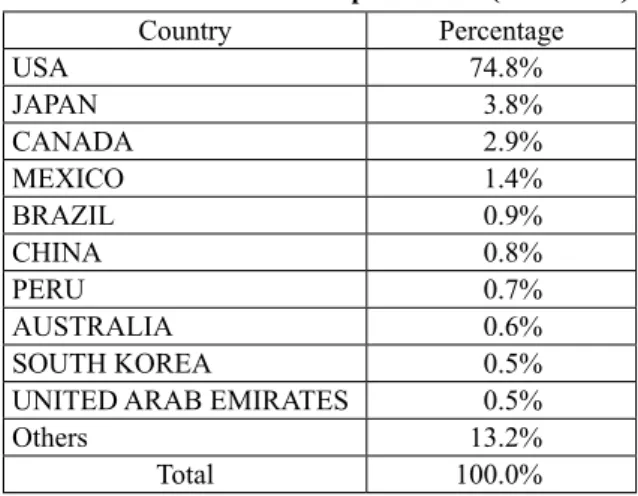
According to TESOL membership statistics dated June 2011 (p. 6), the United States had the largest percentage of members in TESOL (Table 1).
Table 1 TESOL Membership Statistics (June 2011)
Country Percentage
USA 74.8%
JAPAN 3.8%
CANADA 2.9%
MEXICO 1.4%
BRAZIL 0.9%
CHINA 0.8%
PERU 0.7%
AUSTRALIA 0.6%
SOUTH KOREA 0.5%
UNITED ARAB EMIRATES 0.5%
Others 13.2%
Total 100.0%
1.2 English for Specific Purposes Interest Section (TESOL ESP IS)
The TESOL International Association has 21 different interest sections (IS) of
which English for Specific Purposes (ESP) is one. According to the June 2011 statistics, there were 1,801 ESP IS members in TESOL.
The Steering Board is the policy-making body of the ESP IS and consists of the
Officers (Chair, Chair-Elect, Immediate Past Chair), elected representatives (e.g., EOP and EAP representatives), and appointed members (e.g., Secretary). During the TESOL international convention in New York City in 2008, the author of this paper was elected as ESP in Occupational Settings Representative (i.e., EOP position) and invited by the Chair to take the lead in creating a PowerPoint presentation that would define ESP for the benefit of the ESP IS community and would support ESP practitioners in their efforts to raise the awareness of various stakeholders. This invitation was accepted, and the result was a PowerPoint presentation (created by four authors over a period of a year) that was titled English for Specific Purposes:
An Overview for Practitioners and Clients (Academic and Corporate) (Knight, Lomperis, van Naerssen, & Westerfield, 2010). It is important to note that the “work”
of creating the PowerPoint presentation (i.e., over 40 drafts) was all done through e-mail exchange.
The ESP PowerPoint has had an impact on the global community. It has been
delivered (in various forms) at four TESOL international conventions and in
workplace-training and teacher-training programs. In April of 2010, the ESP
PowerPoint was officially placed in the TESOL Resource Center (TRC). The link
to the ESP PowerPoint presentation has been sent by e-mail to members of the
ESP IS for a variety of reasons; e.g., to improve convention proposals, to correct
misconceptions about traditional ESP, and to provide a free resource for ESP trainers worldwide. Moreover, the ESP PowerPoint presentation was shared as a free resource in the global, online discussions described in the subsequent sections of this paper.
1.3 IR/PS Global Online Forum Management Program – Model for TESOL ESPIS Community Discussions 2011-2012
Prior to being elected the EOP representative of the TESOL ESP IS, the author
of this paper had acquired specific experiences, as a member of the IR/PS (UC San Diego) alumni board, which had an impact on the creation of the TESOL ESPIS Community Discussions 2011-2012. The Dean of IR/PS, Peter Cowhey, who served for a year as Senior Counselor in the Office of the United States Trade Representative (USTR) under President Barack Obama, describes IR/PS on the school website as follows:
My service in the Obama Administration has reinforced my conviction that, clearly, the
"future" is here. The "Pacific Century" will be driven by the dynamics of the societies and governments stretching from the Americas to the South Asian sub-continent.
The University of California created the School of International Relations and Pacific Studies (IR/PS) at UC San Diego in order to provide a unique resource for training leaders, creating ideas, and building networks for the Pacific Century. The School is internationally renowned for its innovative programs, superb faculty, and outstanding students. It now stands among the world's top graduate schools of international relations, and is the established leader in its focus on Asia and the Americas. We are also part of a larger success story.
UC San Diego is now fifty years old, has many Nobel Prize laureates, and has among the highest ranked departments in the world in both the social and natural sciences. Both our political science and economics groups are among the top ten in the country. We have the sixth largest research and development budget among American universities.
Moreover, UCSD was again named as the number one school in the United States by the Washington Monthly in its 2012 ranking for the school’s positive impact on society (i.e., “contribution to the public good”).
In May of 2007, an invitation was extended by the author of this paper in his role
as an IR/PS alumni board member to participate in a historic event. An excerpt from that invitation appears below.
I am very pleased to announce that Professor Roger Bohn will be hosting and moderating an online, threaded discussion during the entire month of June 2007 about intellectual property rights (IPR) in the pilot project for the first global, online forum management program for the alumni and students of IR/PS entitled Issues for the Global Workforce.
In the IR/PS forum, the author of this paper was co-moderator as he had been a leader in initiating this project and had acquired experience working in the Japan Patent Office (JPO).
The IR/PS forum described above was later adapted to create a Pacific Rim Vision
Statement for the school (Knight, 2009).
Plans were made for 15 threaded discussions, each led by one or two professors with expertise in the discussion topic, which were to be conducted simultaneously over a
[two]-month period. Professors, alumni, and current students had access to each of the 15 discussions through free IR/PS e-mail accounts.
In one of the 15 threaded discussions, the author of this paper also had a leading role, and the lessons learned from this experience had an impact on future efforts to create a professional development program for the ESP global community.
2.0 TESOL ESPIS Community Discussions 2011-2012
At TESOL 2010, immediately after serving as EOP representative, the author of
this paper was elected to the position of Chair-Elect of the TESOL ESP IS (April 2010 – March 2011) and thereafter automatically became Chair of the TESOL ESP IS (April 2011 – March 2012). In the journal of the IATEFL ESP SIG, Knight (2012b, p. 31) describes the early stages in the creation of the community discussions.
There were several stages involved in the creation of the ESPIS Community Discussions.
In late January, 2011, the concept of ESPIS Community Discussions was proposed by me to the community along with a request for nominations for discussion leaders and for topics that focused on challenges, resources or high frequency communication tasks in a specific subfield. Additional insights regarding the content of the ESPIS Community Discussions were sought at the TESOL 2011 Annual Convention and Exhibit in New Orleans, LA in the USA from March 16–19, and especially at the ESPIS Academic Session, which was titled ‘English for Specific Purposes (ESP) – Imagine the Possibilities.’ In May of 2011, the ESPIS Community Discussions were introduced as ‘online threaded discussions for ESPIS members intended to meet the needs of and provide inspiration to ESP practitioners in our global community’ (Kevin Knight, 11 May, 2011, e-mail communication).
In the TESOL ESP IS, the Chair-Elect is responsible for the Academic Session. The
five TESOL ESPIS Community 2011-2012 discussions can be divided into three different versions that are described in the subsequent sections.
2.1 Version one – ESP IS members only
The first three community discussions were launched in the ESP IS section of
the new TESOL Community Network in 2011 during the months of May, June, and October respectively. The titles and leaders of the discussions are listed below.
1. “Onsite ESL Programs: From Best Practices to Reality on the Ground” (David Kertzner, Immediate Past Chair)
2. “Teaching Tips and Success Stories in ESP” (Ethel Swartley, Past Chair; Kevin Knight, Chair)
3. “Exploring for Excellence in EMP Practice” (Najma Janjua, Chair-Elect)
These discussions could only be viewed by members of the ESP IS Community
and not by other members of TESOL. In addition, a TESOL ESP IS member had to
login to the TESOL Community Network, which was not initially considered to be
a user-friendly process in the light of the history of the ESP IS as the exchange of
opinions on topics had been done traditionally through e-mail. Therefore, due to the
limited exposure and the newness of the TESOL Community Network, there was
relatively limited participation in these three discussions compared with the level of
participation in the fifth discussion. Since there was not public access to these first
three discussions, they are not considered in detail in this paper, but it should be
noted that they were a very positive contribution to the community and contained
valuable information for ESPers.
2.2 Version two – ESP IS and IC IS collaboration
In November of 2011, members of two TESOL Interest Sections (ESP and
Intercultural Communication) collaborated to lead the fourth community discussion.
Since the fourth community discussion necessitated the involvement of members of the IC IS, the discussion could not be conducted in the ESP IS section of the TESOL Community Network, as IC IS members did not have access. Therefore, TESOL proposed that the discussion be made accessible to the members of all 21 TESOL interest sections. In addition, the site of the discussion made it possible for anyone worldwide (members and non-members of TESOL) to view the discussion. An overview of this discussion appears in an excerpt from the opening statement below:
The fourth month-long ESP-IS Discussion 2011-2012 and the first joint discussion between two Interest Sections (specifically, “English for Specific Purposes” (ESP) and “Intercultural Communication” (IC)) titled "The Impact of Culture on Effective Communication in ESP Contexts" will be launched on November 2, 2011 on the ESP-IS community site.
This online discussion will explore the cultural dimensions of verbal and nonverbal communication in the workplace. Language and culture are intertwined. Decisions about what is appropriate, polite, and expected can vary tremendously from culture to culture. We welcome stories of culture bumps resulting from differences in national or ethnic value preferences, and practical suggestions for how to resolve those instances of miscommunication by applying intercultural communication skills.
The purpose of this fourth discussion is to collect stories about the impact of culture on effective communication in ESP contexts in preparation for the ESP & IC Intersection Session at TESOL 2012 on March 29 from 10:00 am to 11:45 am in Room Franklin 8 of the Marriott (so mark your calendars!). Discussion leaders will include the presenters in the ESP& IC Intersection Session including:
1. Kevin Knight (Organizer/presenter) – Kanda University of International Studies,
Japan
2. Annette Bradford (Organizer/presenter) – The George Washington University, US 3. Kay Westerfield (Presenter) – University of Oregon, US
4. Geoff Lawrence (Presenter) – Ryerson University, Canada 5. Ken Hyland (Presenter) – The University of Hong Kong, China
As an example of the types of stories that we will be looking for, consider the following:
1. In Japan as elsewhere, there has been an effort by many multinational companies to make English the primary language, e.g. Nissan and Rakuten. What types of cultural communication problems could arise from using English as a corporate lingua franca?
2. What types of business practices are particularly affected by culture? For example, exchanging business cards when first meeting someone is a common business practice in Japan. In the US, it may be more natural to exchange business cards after meeting someone and deciding that you would like to contact that person in the future. What problems could be created by this practice?
What are your stories of culture bumps in the workplace – call centers, hotels, high tech companies, banks, science labs, medical centers, or…?
The discussion did indeed generate valuable material for the TESOL international convention in Philadelphia in 2012 as displayed in the results section of this paper.
2.3 Version three – TESOL ESP IS and IATEFL ESP SIG collaboration
In February of 2012, members of the ESP groups of TESOL and IATEFL
collaborated to lead the fifth community discussion. In this case, TESOL provided an
unprecedented opportunity – IATEFL members were given free access to the TESOL
Community Network to participate in the discussion. As in the ESP-IC collaborative
discussion, the posts could be read by anyone worldwide. The opening statement of
this discussion also recognizes the involvement of the British Council in a speaker exchange between the two ESP groups.
I am writing to invite you to participate in the fifth month-long ESP-IS Discussion 2011- 2012 and the first joint discussion between the TESOL ESP IS and the IATEFL ESP SIG titled English for Specific Purposes (ESP) around the world in academic and occupational contexts, which will be launched on 1 February 2012 on the TESOL Community site. (The discussion can be accessed at this link.)
In this historic discussion, our purpose is to look at English for Specific Purposes (ESP) from a variety of perspectives – personal and professional. We will tell our own stories as well as the stories of others we know, exchange views, explore concepts, ask and answer questions, learn from our similarities and differences, and share resources. We envision the discussion as an engaging brainstorming session on current ESP topics, where, as a global community, we will discuss connections between topics/ideas/methodologies throughout the discussion. At the end of the discussion, we will hopefully have come to understand ESP and each other in new and valuable ways.
The leaders of this inspirational discussion will come from the TESOL ESP IS and the IATEFL ESP SIG and include:
IATEFL ESP SIG
◦ Mark Krzanowski (ESP SIG Coordinator) University of Westminster, London
◦ Prithvi Shrestha (Journal Co-Editor) Open University, Milton Keynes, UK
◦ Aysen Guven (Memberships Secretary) Bilkent University, Turkey
◦ Modupe Alimi (Journal Assistant Co-Editor) University of Botswana
◦ Andy Gillett (possibly future Committee member) Andy Gillett Consulting Ltd
◦ Sam Thompson (possibly future Committee member) The London School of English International
TESOL ESP IS
◦ Kevin Knight (Chair) Kanda University of International Studies, Japan
◦ Debra Lee (Community Leader, Past Chair) University of Tennessee, USA
◦ Susan Barone (English in Academic Settings (EAS) Representative) Vanderbilt University, USA
◦ David Kertzner (Immediate Past Chair) ProActive English, USA
◦ Margaret van Naerssen (Past Chair) Immaculata University, USA
◦ Shahid Abrar ul Hassan (Past Chair) Sultan Qaboos University, Oman
The co-hosting of this discussion is one of the ways that the TESOL ESP IS and the IATEFL ESP SIG are currently collaborating. The two ESP groups are also engaged in a speaker exchange, and thanks to the efforts of Mark Krzanowski and Michael Carrier (Head, English Language Innovation, British Council), Debra Lee will be sponsored to represent the TESOL ESP IS at the 46th Annual Conference and Exhibition of IATEFL in Glasgow, Scotland in March of 2012 just before TESOL 2012 in Philadelphia.
Please note that anyone can read the discussion without logging in. If you are a member of TESOL, you are able to log in to the TESOL Community and post to the discussion. If you are a member of IATEFL and would like your stories and opinions to be heard, please register at this link. (Registration is free of charge, and you will be able to post to the discussion during the month of February.) If you are a member of any TESOL IS or IATEFL SIG, you are very welcome to join the discussion, but please focus your comments on ESP- related topics. (In this regard, you may wish to refer to the summary of a very successful ICIS-ESPIS collaboration.)
I look forward to hearing your stories from around the world about ESP in academic and occupational contexts from 1 - 29 February 2012 as we create this memorable discussion about ESP together.
35
Since this discussion was held in February (during a leap year), it was the shortest of the month-long community discussions, which is a point that should be taken into account when considering the results.
3.0 Results
As the fourth and fifth discussions could be viewed by anyone in the world
without logging in (and therefore were in the public domain), the results of these two discussions are considered in this paper. The number of posts and views were significantly higher for the fifth discussion. Moreover, it is important to note the increase in the number of views of the discussions after the discussions had ended.
The number of views tripled in the case of the fourth discussion and doubled in the case of the fifth discussion (Figures 1 and 2).
Figure 1 Number of Posts to Discussions
Online Professional Development Program for ESP Global Community
logging in (and therefore were in the public domain), the results of these two discussions are considered in this paper. The number of posts and views were significantly higher for the fifth discussion. Moreover, it is important to note the increase in the number of views of the discussions after the discussions had ended.
The number of views tripled in the case of the fourth discussion and doubled in the case of the fifth discussion (Figures 1 and 2).
Figure 1 Number of Posts to Discussions
Figure 2 Number of Views of Discussions
神田外語大学紀要第25号
The Journal of Kanda University of International Studies Vol. 25(2013)
Figure 2 Number of Views of Discussions
In a TESOL Connections article, Knight (2012a) summarizes the content of the
fourth discussion as follows:
The month-long discussion hosted by the English for Specific Purposes Interest Section (ESPIS) and the Intercultural Communication Interest Section (ICIS) was a historical first such collaboration in TESOL with more than 70 posts and 3,000 views generated from 2–30 November 2011.
As the fourth in a series of professional development discussions launched by ESPIS in 2011 (and the first joint discussion), the TESOL community discussion on culture in academic and occupational contexts has had broad appeal due to the interesting posts from participants in various countries including the United States, Canada, Japan, China, Turkmenistan, Ethiopia, Rwanda, and Taiwan.
11
logging in (and therefore were in the public domain), the results of these two discussions are considered in this paper. The number of posts and views were significantly higher for the fifth discussion. Moreover, it is important to note the increase in the number of views of the discussions after the discussions had ended.
The number of views tripled in the case of the fourth discussion and doubled in the case of the fifth discussion (Figures 1 and 2).
Figure 1 Number of Posts to Discussions
Figure 2 Number of Views of Discussions
The leaders of the discussion, who were also listed as the future presenters in the ESPIS- ICIS intersection session at the TESOL 2012 convention in Philadelphia, USA, included Kevin Knight (Kanda University of International Studies, Japan), Annette Bradford (The George Washington University, USA), Kay Westerfield (University of Oregon, USA), Geoff Lawrence (Ryerson University, Canada), and Ken Hyland (The University of Hong Kong, China).
Although the purpose of the discussion was to collect stories of “culture bumps” to be addressed in the intersection session at TESOL 2012, the participants raised many important issues through their generous sharing of personal anecdotes, publications, and online resources on topics ranging from principled ESP and intercultural communicative competence to genre analysis and professional communication research.
The specific resources shared included:
◦ an ESP PowerPoint (Knight, Lomperis, Westerfield, van Naerssen)
◦ a prepublication chapter on language and intercultural communicative competence (Fantini)
◦ a plenary speech on genre analysis and academic writing in specific disciplines (Hyland)
◦ a list of new books and a journal on professional communication and discourse (Candlin, et al.)
◦ collections of various print and online resources related to cultural awareness and competence
◦ links to other ESPIS community discussions on English for Medical Purposes (EMP;
Janjua) and on best practices and the implementation of ESP programs (Kertzner).
As participants discussed the problems and issues presented by their colleagues around the world, it was interesting to see the various interactions. For example, a problem with a professional being trained in Canada was addressed by respondents in Turkmenistan
and Japan, whereas a culture bump in the workplace in Turkmenistan was the focus of comments from the United States.
The timeliness of the cases presented also became an interesting aspect of the discussion. A participant from the United States conducting training in Japan commented on a situation that had just happened to him that day. In another post, a participant in Japan shared a story about an event that had recently taken place in a university classroom.
Moreover, the depth of experience of the participants was revealed in their posts. The discussion provided valuable insights into conducting various classroom activities and professional communication research.
One of the most interesting aspects of the discussion was the challenges posed (directly or indirectly) to existing views. Is an ESP trainer required to be bilingual and bicultural?
Is genre analysis a “robust pedagogical approach” in the case of academic writing? Is professional communication research a required part of a needs assessment and material creation? Is the consideration of culture necessary at each stage of instructional design? The discussion raised many important questions that were left unanswered by the participants, but these unanswered questions were valuable in promoting self-reflection and awareness.
Finally, the personal stories unrelated to ESP were well-received. These focused on the raising of children, cultural values, and various cultural practices in different countries. It was fun to learn from colleagues around the world.
In summary, the posts, which were all thoughtful, both educated and entertained the readers, and connections were drawn between seemingly unrelated comments as the discussion proceeded. The vast number of ideas introduced and the desire to retain the valuable posts for future reference were also reflected in the comments of the participants. Not surprisingly, the number of views of the discussion continues to increase.
This article and other positive communications about the fourth community discussion may have been one reason that the number of views of the discussion increased after the discussion had ended.
In an interview that appeared in El Gazette (April 2012), the author of this paper
comments on primarily the fifth community discussion.
During my one year-term as Chair of the ESP IS (which ends in March at the Tesol conference in Philadelphia) I have focused on meeting the needs of the global ESP community by proposing, launching and actively promoting five one-month long online professional development discussions for ESPers around the world….It is a thrill for me to see what I had envisoned in 2009 to be happening during the month of February in the discussion that is being hosted by the ESP groups of Tesol and Iatefl on ‘ESP around the world in academic and occupational contexts’….In this discussion, we have not only been clarifying ‘principled ESP’, but more importantly we have been seeking a way to collect and share global resources for the benefit of ESPers in all countries. I like to refer to this global sharing as ‘ESP for humanity’, and we will be discussing this issue in the annual business meeting of the ESP IS at the March Tesol convention. I view these five professional development discussions as important resources for ESPers and researchers worldwide in the years to come as the discussions are being archived.
In the discussion section below, the benefits of the community discussions are considered in more detail.
4.0 Discussion
In this section, the benefits, success factors, and impacts of the TESOL ESPIS
Community Discussions 2011-2012 are considered. It is important to keep in mind
that the community discussions did much more than educate a community. These discussions created a community and were shaped by a community.
4.1 Benefits
In an article written about the first four of the community discussions before the
start of the fifth discussion, Knight (2012a) lists five benefits of the discussions.
The ESPIS Community Discussions have been extremely beneficial for several reasons.
First, the discussions have enabled ESP practitioners of various levels of experience around the world to share their knowledge and expertise. Second, participants with different English language abilities can easily post comments and interact as professionals. Third, the discussions have made it possible to provide a permanent record of important issues to ESPIS members as the discussions are to be archived. Therefore, the long, thoughtful, and valuable comments by participants are a new resource for research and practice. Fourth, the discussions have facilitated official collaboration between TESOL Interest Sections. Such collaboration has resulted in unique and important perspectives of ESP, as in the case of the fourth discussion. Finally, the location of the fourth discussion in the TESOL Community Network has made it possible to reach interested professionals outside of the ESPIS membership worldwide.
Moreover, when the fifth discussion is considered, another benefit is the facilitation of collaboration between TESOL and IATEFL.
4.2 Success Factors
Why was the fifth discussion relatively successful in terms of the number of posts
and the number of views? Several factors seem to have contributed to this success.
These may have included the following:
1.
Extensive promotion – The discussions were actively promoted inside and outside of the organizations of TESOL and IATEFL. Two leaders of the IATEFL ESP SIG (Krzanowski and Shrestha) and two administrators in TESOL (Sahr and Triplett) were invaluable in this regard. In addition, the writer of this paper, as Chair of the ESP IS, promoted the discussion to members of the ESP IS community and to all of the TESOL IS leaders.
2.
Easy accessibility – Triplett and Sahr deserve credit for acting rapidly to make it possible (and easy) for IATEFL and TESOL members to log in and post to the discussions.
3.
Participation – It was thought that having a large number of leaders would generate more posts and keep readers interested. In addition, there was the attraction of interacting and connecting with ESP professionals from around the world.
4.
Visibility – The discussion could be easily viewed with a click on the link.
Anyone in the world could (and still can at the time of this writing) view the fifth discussion without logging in.
5.
Educational value – The collaborative discussion of ESP by members of TESOL and IATEFL certainly had educational value, which was confirmed by various posts in the discussion. The discussion focused on defining “principled ESP” in particular (i.e., a term first used by Margaret van Naerssen).
6.
Entertainment value – The discussion was relatively fast moving with an
average of nine interesting posts per day. There was human drama, and it
was fun to participate. As the author of this paper explained in the El Gazette
interview:
The current Tesol-Iatefl discussion, which has been in my view a global potluck party to which everyone in the world is invited, has really made me think, more than ever before, of ESP on a global scale. I am in agreement with Iman from Iraq, who posted in the discussion that he had reached the ‘conclusion that we nearly all suffer from similar trouble’. For this reason, the global sharing of information and resources is incredibly important, and therefore I welcome collaborations in this area between Tesol and Iatefl.
7.
Project champion – The author of this paper was committed to making the discussion successful. Therefore, I was very active in contributing comments.
8.
Curiosity factor – This discussion was a new model of professional development, as well as a TESOL milestone, so the leaders of groups in TESOL and IATEFL and other stakeholders were possibly wondering how successful the discussion would turn out to be.
All of these factors may have worked together to contribute to the success of the discussion.
4.3 Impacts of the Discussions
In this paper, it has already been noted how certain activities and events led to the
creation of the ESP IS 2011-2012 Community Discussions. These can be listed as follows:
1. First global, online forum management program for the alumni and students of IR/PS titled Issues for the Global Workforce
2. Global online forum with 15 threaded discussions to create Pacific Rim Vision
Statement for IR/PS
3. Creation of the ESP IS PowerPoint titled English for Specific Purposes: An Overview for Practitioners and Clients (Academic and Corporate)
4. The ESP IS Academic Session titled English for Specific Purposes (ESP) – Imagine the Possibilities at the TESOL international convention in New Orleans (shortly after the earthquake and tsunami on March 11 in Japan)
5. The creation of the ESP & IC Intersection Session titled The Impact of Culture on Effective Communication in ESP Contexts
6. Three community discussions for ESP IS members only:
◦
Onsite ESL Programs: From Best Practices to Reality on the Ground
◦ Teaching Tips and Success Stories in ESP◦ Exploring for Excellence in EMP Practice
7. One collaborative community discussion between the IC IS and the ESP IS titled The Impact of Culture on Effective Communication in ESP Contexts (which could be viewed worldwide by anyone without logging in and to which only TESOL members could post comments)
8. The publication in TESOL Connections of an article titled The Impact of Culture on Effective Communication in ESP Contexts
9. The proposal of a speaker exchange between the ESP groups of IATEFL and TESOL
10. The invitation for TESOL ESP IS members to publish in the Journal of the IATEFL ESP SIG
11. One collaborative community discussion between the ESP groups of IATEFL
and TESOL titled English for Specific Purposes (ESP) around the World in
Academic and Occupational Contexts (which could be viewed worldwide by
anyone without logging in and to which TESOL and IATEFL members could
post comments)
The activities and events listed above resulted in the following:
1. Debra Lee did a fantastic job of representing the TESOL ESP IS at the 46th Annual Conference and Exhibition of IATEFL in Glasgow, Scotland, where she was given a warm welcome.
2. The ESP & IC Intersection Session titled The Impact of Culture on Effective Communication in ESP Contexts was a success at the TESOL international conference in Philadelphia.
3. Najma Janjua created a remarkable ESP IS Academic Session about English for Medical Purposes (EMP) that combined presentations and a poster session at the TESOL international conference in Philadelphia (Janjua, 2012).
4. Three articles were published by ESP IS members in the journal of the ESP SIG (Abrar-ul-Hassan, 2012; Knight, 2012b; Tsuda, 2012). The article of Abrar- ul-Hassan concerns the subject matter presented in the ESP PowerPoint (Knight, et al., 2010) and in the ESP IS 2011-2012 Community Discussions; namely,
“principled ESP.”
5. The author of this paper and Mark Krzanowski in their respective roles as heads of the ESP groups of TESOL and IATEFL were interviewed by El Gazette.
6. The author of this paper started to publish on the TESOL Blog under the subject heading of Global Resources and Leadership Development in ESP (Knight, 2012c).
7. Mark Krzanowski will represent the IATEFL ESP SIG at TESOL 2013 in Dallas, Texas.
8. TESOL approved for the first time in its history an intersection session between
the ESP groups of IATEFL and TESOL. The session, which is titled Crucial
Variables for Harmony in the ESP Classroom, will be co-chaired by Najma
Janjua, current ESP IS Chair, and Mark Krzanowski. The author of this paper will also be a speaker in this session at TESOL 2013.
9. The current Chair-Elect of the ESP IS, Yinghuei Chen, referred to a theme raised in the fifth community discussion (i.e., the global sharing of resources in the TESOL Resource Center) (Chen, 2012).
TESOL ESPIS extends its warm welcome to invite regional ESP associations and institutes around the world to help build a global resource center for ESP pedagogy and research. This brief overview of ESP development in Taiwan might serve to provide some direction for future cooperation.