Some Learning Outcomes and Contextual Factors of History as Content and Language Integrated Learning (CLIL) in a Japanese Context
著者名(英) Thomas Lockley
journal or
publication title
Studies in linguistics and language teaching
volume 25
page range 165‑188
year 2014‑11
URL http://id.nii.ac.jp/1092/00001192/
asKUIS 著作権ポリシーを参照のこと
Some Learning Outcomes and Contextual Factors of Histor y as Content and Language
Integrated Learning (CLIL) in a Japanese Context
Thomas Lockley
Abstract
This article investigated learners’ self-perceived foreign language learning outcomes and some contextual factors of a university level content and language integrated learning (CLIL) course in Japan; The International History of Japan. Interpretation of learner voice through a grounded theory study of reflective accounts (N=124) established that CLIL was welcomed by learners and that they generally self-perceived themselves to have improved L2 and associated skills such as presenting, summarizing, reflection and discussion.
Motivation of varying types seems also to have been in evidence. It found however that there may be complex and fluctuating issues of identity threat for some learners and feelings of ‘shame’ occasioned by a non-national educator teaching National history. Further research is needed into ways to critically engage with and mitigate this phenomenon.
Keywords
Content and Language Integrated Learning (CLIL); History in English as a Foreign Language (EFL); Critical Thinking; Intercultural Understanding;
Japanese EFL Learners; Educational Contexts.
Introduction and Literature Review
This article will investigate learning outcomes and contextual characteristics
of a university level language-embedded content and language integrated
learning (CLIL) course in Japan; The International History of Japan. As yet there
are seemingly no empirical studies on the foreign language learning (FLL) outcomes of CLIL history at the university level in Japan, nor many on CLIL in Japan in general; therefore this study attempts to explore new ground and pave the way for future research. In doing so it gives prominence to learner voice, how the learners themselves perceived CLIL history to have benefitted them and contributed to FLL and wider cognition.
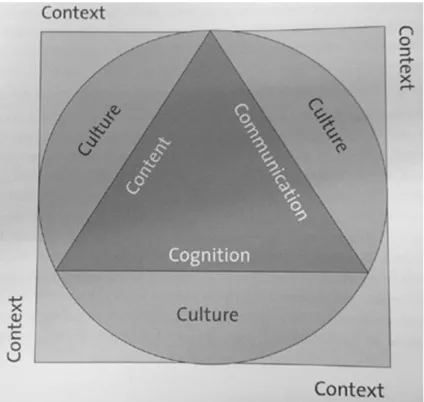
CLIL is an educational method combining cognition, content and communi- cation with FLL (Coyle et al., 2010) to create a form of pedagogy which is increas- ingly being treated as a distinct subject area in its own right (Breidbach &
Viebrock, 2012). Communication is fostered through group work, cooperative learning and dialogic interaction to facilitate a marriage of FLL and content, leading to improved cognition through critical thinking (Coyle et al., 2010; Moore, 2011). Curricula involve not only skills and knowledge but also cognitive engagement, L2 usage opportunities and conceptualization beyond the classroom (Coyle et al., 2010).
In Coyle et al.’s (2010, p. 41) 4Cs framework for CLIL (Figure 1), Content
(subject matter), Communication (language learning and usage), and Cognition
(learning and thinking processes) are, recognizing the complex but intangible link
between language and cultures, enveloped within a circle of Culture (global
citizenship and intercultural understanding). Symbiosis is necessarily sensitive to
context which surrounds the whole.
Coyle et al. (2010, p. 41) suggest that the 4Cs lead to effective CLIL through:
• Progression in knowledge, skills and understanding of the content;
• Engagement in associated cognitive processing;
• Interaction in the communicative context;
• Development of appropriate language knowledge skills;
• The acquisition of a deepening intercultural awareness, which is in turn brought about by the positioning of self and ‘otherness’
Figure 1. The Four C’s Framework
Studies seem to show CLIL producing significant FLL outcomes compared with traditional intensive language teaching (Várkuti, 2011); even leading to concurrent L1 improvements (Coyle et al., 2010; Kong & Hoare, 2011). Learners seem to apply lexical knowledge better and in broader contexts (Grum, 2012) and use a significantly higher level of cognitively demanding vocabulary more effectively (Várkuti, 2011); reading comprehension and elaborate strategy use benefit most (Breidbach & Viebrock, 2012). Várkuti (2011) suggested that CLIL might be particularly effective for FLL in largely monolingual societies with limited L2 usage opportunities.
CLIL students seem also to be better motivated and possess a more positive attitude to L2 (Fehling, 2008). Cyclical planning, requiring learners to process new ideas in increasingly more challenging ways (Kong & Hoare, 2011), using small groups to allow close cooperative co-construction of knowledge and language (Moore, 2011; Nikula, 2012) is effective in maintaining motivation and attitude. As long as group work is targeted and meaningful with adequately scaffolded L2, the temptation for learners to switch to L1 is reduced (Nikula, 2012).
Central to CLIL pedagogy are global citizenship and intercultural under-
standing, indeed as demonstrated in the 4Cs framework they might be considered
as the enveloping principle. Sudhoff (2010, p. 32) goes as far as saying that the very
fact of ‘experiencing and understanding a foreign language in a content-based way
opens the doors to intercultural learning processes’. CLIL history, as it lends itself
to dialogic methods, critical thinking and reflection on diverse cultures, seems
particularly suitable for critical understandings of intercultural issues. Analysis of
underlying assumptions, attitudes, feelings and interpretations can lead to critical
cognition of the world, intercultural understanding and connectivity (Mehisto et
al., 2008; Sudhoff, 2010). However, the data below will also show the need for careful planning to avoid infringing on feelings of national and cultural identity (Coyle et al., 2010).
There seem as yet to be no studies on CLIL history at the university level, but one article on history’s role in FLL does exist (Brooks-Lewis, 2010); the literature review commences ‘this literature review will be brief because there has been so little published about the role of history in foreign language education’ (p. 138), a problem which has necessitated a focus on CLIL theory in this review also. Brooks- Lewis (2010) found learners overwhelmingly positive towards history in FLL classes; cultural awareness, motivation and understanding of why English was worth studying improved. Perhaps the most striking learner comment was, ‘to date no other professor has bothered to explain to me where this language came from and why it is so important’ (p. 146), showing that learners need not only to learn languages, but learn about them as well. Brooks-Lewis (p. 148) concluded ‘history helps provide this panoramic vision, which creates a foundation for the constructing of learning, [language and history] is a learner need’ (p. 148).
To date, most CLIL research has taken place in Europe (Coyle et al., 2010).
The context of this study is Japan, and although there is increasing interest in
CLIL, few studies have been published. Pinner’s (2013) study emphasized the
crucial link between authenticity of materials and language experience in CLIL and
showed the motivation that arose from them. He showed that authentic materials
are suitable for all levels of learners when appropriately chosen and scaffolded by
educators. Godfrey (2013) wrote that both learners and educators had been
motivated through the implementation of a university level CLIL curriculum. In
line with other research, CLIL seemed to promote better communication,
critical-thinking and broaden the cultural scope of lessons.
CLIL’s sensitivity to context requires this lack of literature to be attended to if CLIL in Japan is to be effective. This study will therefore seek to answer the following questions:
1) What were learners’ self-perceived language learning outcomes in this Japanese context?
2) Did this CLIL curriculum provide learners with foreign language learning motivation? If so how?
3) What contextual characteristics do educators need to be aware of when consid- ering CLIL in Japan?
This study Context
This study investigates a one-semester elective English language-embedded CLIL course for third and fourth year (20-22 years old) international communi- cation students in a university near Tokyo; most were Japanese, a minority were Chinese and South Korean. TOEIC levels were between 600-800; CEFR
‘Independent User’. While CLIL was new to them, most students were used to L2 discussion and content. Many were not motivated to begin with however:
I took this course not because I was interested in Japanese history. Reason that
I took this class was the day and time of this class. I really didn’t want to come
to school early in the morning. After I took this class, I realized that this is a
history class which subject I hate the most. So, at the first day in this class, I
thought this class would be very boring to me yet it wasn’t and I started to like history. (#63)
A brief overview of content
1Throughout the course pains were taken to be as balanced and neutral as possible and to avoid promoting the idea of culture as a static and ‘national’ entity (Breidbach & Viebrock, 2012) but as a fluid and international hybrid. Content included ancient migrations of commoners, craftsmen and courtiers from the mainland and the embassies that travelled the other way in search of technology and culture from China, Korea and India. Middle age international cooperation to deal with piracy lead to widespread cultural and economic exchange, Japanese mined silver facilitating advanced economies in the region. Japan towns spread in Asia and Asian towns in Japan.
The arrival of Europeans and early modern travels to Europe facilitated technology and cultural transfers both ways but perceived and real political, religious and economic threats lead to sweeping overseas travel bans, reduced European links and expanded Asian ones. Most non-Japanese were restricted to Nagasaki and most Japanese abroad, mainly Christian refugees, merchants and mercenaries, were forbidden to return. Technological transfer via China was slowly superseded in the 18
thcentury by study of the new European sciences from books brought by Dutch traders. Culturally however, Japan still remained firmly Confucian.
Encroaching Europeans and Americans and the Opium Wars led to expanded language education, stricter border controls, nascent manufactoring industry and
1