Acta med. nagasak. 10 : 36-44
The Response of Blood Pressure of Men at Work to Humid Heat*
Ryu AIZAWA, Hajime MIURA. Akinori MINAMI, Gen KAWABATA and Toshitaka SHIBUYA**
Department of Public Health, Nagasaki University School of Medicine,
Nagasaki, Japan
Received for Publication, September 1, 1965
The present paper described the response of blood pressure of men at work to humid heat for the purpose of determining the permissible limit of environmental heat. From the practical viewpoint of industrial health, the upper permissible limit of humid heat seemed to be 30°-31°C wet bulb temperature and yet around 90°F effective temperature.
It is very important for industrial health to determine the permis- sible limit of environmental heat in which men can still work effectively.
In 1945 and 1946 EICHNA et alb' and AIZAWA1' respectively reported that men, exposed to such humid heat as 33°C wet bulb or more, might be subjected to heat stroke.
In the previous papers''", the authors reported the response of blood pressure with the subjects in the supine position or in the sitting position to humid heat for the purpose of determining the permissible limit of environmental heat. The present paper described the re- sponse of blood pressure of men at various levels of wet bulb tempera- ture.
METHODS
The subjects were 2 students in good physical condition, aged 23 and 24 years. The experiments were conducted in August 1964.
After 30 minutes' rest in ordinary temperature, the subjects worked for 75 or 120 minutes in the climatic room. The details of the environ-
mental heat for each exposure were shown in Figures 2-6 in which the experimental data were described.
~` Presented before the 35th General Meeting of the Japanese Society for Hygiene , Hirosaki, Japan, May 15, 1965.
36
1965 BLOOD PRESSURE AND HUMID HEAT (AT WORK) 37 Besides, the experiment in ordinary room temerature, shown in.
Fig. 1, was conducted as a control experiment.
The work consisted of the putting up and taking down of a bucket weighing 5 kg. on a table, being 80 cm. in height, in the rate of 10 times per minute in time with the rhythm of metronome. This work was middle grade for intensity, being 3.5 of relative metabolic rate.
The blood pressure, oral temperature, pulse rate, rate of sweating (represented by the loss of body weight) and general clinical appearance were adopted as the measuring items. The details were described in the previous paper".
The blood pressure, oral temperature and pulse rate were measured in the sitting position. The measurement of these items was finished within about 45 seconds. Therefore the above-mentioned work was almost continuously conducted throughout the exposure to humid heat.
RESULTS
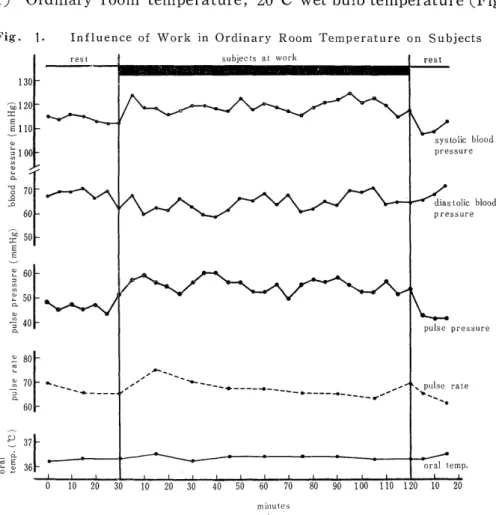
1) Ordinary room temperature, 20°C wet bulb temperature (Fig. 1) Fig. 1. Influence of Work in Ordinary Room Temperature on Subjects
minutes
Note : (1) ordinary room temperature (D . B . 24.9°C, W. B . 20.3°C, E . T . 72°F)
(2) Loss of Body Weight ... 380gm. (190gm. per hr.)
38 R. AIZAWA, H. MIURA, A. MINAMI,_G. KAWABATA and T. SHIBUYA Vol. 10.
Fig. 2. Influence of Humid Heat (W. B . 30°-31°C) on Subjects at work
Note : (1) before exposure (D . B . 29.0°C, W. B . 26.0°C, E . T . 81°F) Humid Heat (D. B. 33.5°C, W. B. 30.1°C, E . T. 88)F)
after exposure (D . B . 29.1°C, W. B . 26.0°C, E . T . 81°F)
(2) Loss of Body Weight ... 1135gm. (434gm. per hr.)
The physiological reactions maintained a steady state through 120 minutes' work in ordinary room temperature. The subjects continued the work easily and effectively. The loss of body weight was only 190 gm. per hr.
2) 300-310C wet bulb temperature (Fig. 2-3)
In the case of 34°C dry bulb (88°F effective temp.), the blood pressure remained almost unchanged. The oral temperature and pulse rate maintained a steady state, and the subjects continued the work easily and effectively through 150 minutes' exposure to heat. The loss of body weight was 434 gm. per hr.
The physiological reactions in this case were of the same results as those in ordinary room temperature.
In the case of 43°C dry bulb (93°F effective temp.), the systolic
blood pressure remained almost unchanged, excepting a tendency of
slight rise after 90 minutes' exposure. Soon after entering the
climatic room, the diastolic blood pressure began to fall, and then
slightly became instable. Therefore the pulse pressure increased
gradually, and then became instable slightly. This instability seemed
to be somewhat remarkable after 80 minutes' exposure. The pulse
1965 BLOOD PRESSURE AND HUMID HEAT (AT WORK) 39
Fig. 3. Influence of Humid Heat (W. B . 30°-31°C) on Subjects at Work
minutes
Note : (1) before exposure (D . B . 28.9°C, W. B . 26.3°C, E . T . 81°F) Humid Heat (D . B . 43.1°C, W. B . 31.1°C, E . T . 93°F)
after exposure (D . B . 29.3°C, W. B . 26.8°C, E . T . 82°F)
(2) Loss of Body Weight ... 1200gm. (600gm. per hr.)
rate steadily increased through 120 minutes' exposure, but the oral temperature showed only a slight rise. The subjects flushed with
heat and complained of being very hot. The loss of body weight amounted to 600 gm. per hr.
3) 33°-34°C wet bulb temperature (Fig. 4-5)
In the case of 34°C dry bulb (93°F effective temp.), the systolic blood pressure steadily rose for the initial 30 minutes' exposure, and then remained almost unchanged. The falling diastolic blood pressure rapidly turned to a rise after 65 minutes' exposure. Therefore the increasing pulse pressure rapidly turned to a marked decrease. The oral temper- ature and pulse rate steadily rose or increased. The loss of body weight amounted to 613 gm. per hr.
In the case of 43°C dry bulb (96° F effective temp.), the systolic
blood pressure remained at a slight rise after the initial 30 minutes'
exposure. After an initial fall, the diastolic blood pressure became
40 R. AIZAWA, H. MIURA, A. MINAMI, G. KAWABATA and T. SHIBUYA Vol. 10.
Fig. 4. Influence of Humid Heat (W. B . 33°-34°C) on Subjects at Work
Note : (1) before exposure (D . B . 29.4°C, W. B . 27.0°C, E . T . 82°F) Humid Heat (D . B . 33.5°C, W. B . 33.5°C, E . T . 93°F)
after exposure (D . B . 29.4°C, W. B . 26.2°C, E . T . 81°F)
(2) Loss of Body Weight ... 1225gm. (613gm. per hr.)
instable somewhat markedly. Therefore the pulse pressure, increa- sing soon after the exposure to heat, became instable somewhat marked- ly after 30 minutes' exposure. The pulse rate and oral temperature steadily increased or rose. The loss of body weight amounted to 857 gm. per hr.
With continued exposure, the subjects flushed with heat, and complained of weakness and of being extremely hot in the above-
mentioned two cases. It seemed to be very difficult for the subjects to continue the work effectively throughout 120 or 105 minutes' exposure.
4) 36° -37°C wet bulb temperature (Fig. 6)
In the case of 40°C dry bulb (99°F effective temp.), the systolic blood pressure remained at a slight rise throughout 75 minutes' exposure.
After an initial rapid fall, the diastolic blood pressure became instable
somewhat distinctly for a while, and then rapidly turned to a rise after
45' minutes exposure. Therefore the pulse pressure, increasing rapidly
soon after the exposure, began to decrease after 45 minutes' exposure,
1965 BLOOD PRESSURE AND HUMID HEAT (AT WORK) 41
Fig. 5. Influence of Humid Heat (W. B. 33°-34C°) on Subjects at Work
minutes
Note : (1) before exposure (D. B. 29.4°C, W. B. 26.6°C, E. T. 82°F) Humid Heat (D . B . 42.7°C, W. B . 32.8°C, E . T . 96°F)
after exposure (D . B . 29.2°C, W. B . 26.9°C, E . T . 82°F)
(2) Loss of Body Weight ... 1500gm. (857gm. per hr.)
The pulse rate and oral temperature steadily increased or rose.
After 60 minutes' exposure, the subjects flushed with heat and became
irritable and complained of weakness, faintness and of being extremely
hot. The sweating began to decrease. And then, the exposure to
humid heat was interrupted in 75 minutes. The loss of body weight
reached such large quantity as 1268 gm. per hr.
42 R. AIZAWA, H. MIURA, A. MINAMI, G. KAWABATA and T. SHIBUYA Z'ol. 10.
Fig. 6. Influence of Humid Heat (W. B . 36°-37°C) on Subjects at work
MUM It b