Acta Med. Nagasaki 35:175-180
A STUDY ON POSTOPERATIVE MORTALITY
AND MORBIDITY
AFTER PANCREATODUODENECTOMY
Tsukasa TSUNODA, Masazumi TERADA, Toshifumi ETO Teiji MATSUMOTO, Tohru SEGAWA, Koichi MOTOSHIMA Takashi YAMAGUCHI 1), Kunihide IZAWA 2), Takahisa UCHIDA 3),
Toshiya ITO 4) and Ryoichi TSUCHIYA 5)
1) Second Department of Surgery and 2) Emergency Department, Nagasaki University
School of Medicine, Nagasaki, Japan
3) Department of Surgery, Nagasaki Rosai Hospital, Sasebo, Japan 4) School of Medical Technology, Nagasaki University, Nagasaki, Japan 5) Shimane Medical University, Izumo, Japan
Received for publication, June 25, 1990
ABSTRACT : The early postoperative results of pancreatoduodenectomy performed in our institute during the last 20 years were reviewed, dividing the cases into two groups, from 1970 to 1979 and from 1980 to 1989.
Among a total of 136 pancreatoduodenctomies, 52 were performed in the earlier decade and 84 in the latter decade. Patients were significantly older in the latter than in the earlier decade. In the earlier decade, postoperative complications developed in 28.8% of the patients with a 19.2% overall mortality rate. In the latter decade, the complications occurred in 27.4% with a 6.0% mortality rate. There was a significant decrease in overall mortality rate between the two decades. The most common complication was the dehiscence of pancreatojejunostmy, but life-threatening major leakage was decreased. It was considered that recent improvements in surgical techniques and intraoperative and perioperative management contributed to the improvement of the results of this procedure. However, continuing efforts are needed to reduce the morbidity rate, which remains high.
INTRODUCTION
Pancreatoduodenectomy is accepted as a standard operation for malignant lesions in the area of the head of the pancreas. The main disadvantage of this procedure is said to be a high postoperative mortality and morbidity rate due to the fact that it is one of the most intricate and difficult procedures in surgery of the gastro- intestinal tracts 3>. It has been reported, however, that recent improvements in surgical
techiques and intraoperative and perioperative management have reduced the risk of failure of pancreatoduodenectomy4-6). To confirm this trend in our series, the early postoperative results of pancreatoduodenectomy performed in our institute during the last 20 years were reviewed.
PATIENTS AND METHODS
Between January 1970 and December 1989, 136
patients underwent pancreatoduodenectomy at
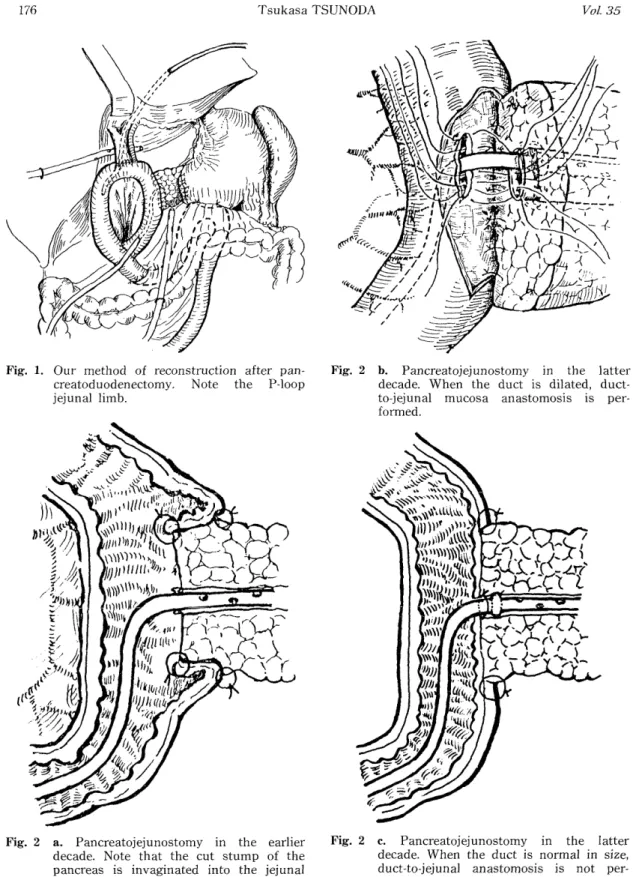
Fig. 1. Our method of reconstruction after pan- creatoduodenectomy. Note the P-loop
jejunal limb.
Fig. 2 b. Pancreatojejunostomy in the latter decade. When the duct is dilated, duct-
to-jejunal mucosa anastomosis is per-
formed.
Fig. 2 a. Pancreatojejunostomy in the earlier decade. Note that the cut stump of the
pancreas is invaginated into the jejunal
lumen, and that the decompression tube
does not have a knot.
Fig. 2 c. Pancreatojejunostomy in the latter decade. When the duct is normal in size,
duct-to-jejunal anastomosis is not per-
formed. Note the presence of a knot and
holes on the decompression tube.
the Second Department of Surgery, Nagasaki University School of Medicine. The mean age was 61.5 years, ranging from 30 to 84. There were 81 males and 55 females. The patients were divided into two groups on the basis of decades, that is, from 1970 to 1979 and from 1980 to 1989, to elucidate the trends in mortality and mor- bidity rate after operation. In each group, age, surgical indications, postoperative compli- cations, mortality rate in hospital, 30-day mortality rate, treatment of the complications and preoperative laboratory data were analyzed.
Our standard method of pancreato- duodenectomy was described elsewhere''8).
Briefly, the resection is done in the usual manner and the reconstruction is a modification of Child's method as shown in Figure 1. New methods of anastomosis between the remaining pancreas and the jejunm were done in the latter decade. One was a change in the anastomotic procedure itself and the other a change in the decompression tube.' In the earlier decade, the whole cut stump of the remaining pancreas was invaginated in the jejunal lumen (Fig. 2a), but in the latter decade, the duct-to-jejunal mucosa anastomosis was employed (Fig. 2b). A silastic plastic catheter without a knot was used for de- compression of the remaining pancreatic duct in the earlier decade (Fig. 2a), while in the latter decade a knot was made 5cm from the tip of the catheter to prevent the tube from sliding out of the pancreatic duct (Fig. 2b). When the duct-to-jejunal mucosa anastomosis was ruled out, the tube was simply ligated with the
'pancreatic duct using absorbable purse -string suture (Fig. 2c). There were no holes in the catheter on the jejunal side of the knot. In these cases, pancreatic juice was drained totally to the outside of the body. Eighty patients with obstructive jaundice, that is, those in whom total bilirubin was more than 10mg/dl, underwent preoperative biliary drainage. Chi-squared test and Student t-test were used for statistical analysis of the data.
RESULTS
The 52 patients undergoing surgery in the earlier decade had a mean age of 57.6 years, while the 84 patients in the latter decade had
a mean age of 64.1. The patients in the latter were significantly older than those in the earlier
decade (p<0.01).
The indications for pancreatoduodenectomy are summarized in Table 1 for each decade. The total number of patients in the latter decade was higher because the resection of bile duct car- cinoma and pancreatic carcinoma increased.
Postoperative complications developend in 38 of 136 patients (27.9%) during the 20 year period
(Fig. 3). Fifteen patients died in hospital after operation, and the overall mortality rate was 11.0%. Nine of these patients died within 30 days after surgery, showing a 30-day mortality rate of 6.6%. In the earlier decade, postoperative complications developed in 15 patients (28.8%).
The overall mortality rate was 19.2% (10 patients) and the 30-day mortality rate was 11.5%. In the Table 1. Indications for pancreatoduodenectomy in the 136 patients
Number of Patients
Diagnosis Total 1970-1979 1980-1989 Total
(n=136) (n=52) (n=84)
Carcinoma of the :
Bile duct 40 14 26
Ampulla 36 22 14
Pancreas 33 7 26
Stomach 5 2 3
Duodenum 4 2 2
Gallbladder 3 0 3
Colon 1 0 1 122
Chronic pancreatitis 9 4 5
Benign duodenal tumor 2 0 2
Others 3 1 2 14
latter decade, complications occurred in 23 patients (27.4%) and 5 of whom died, indicating an overall mortality rate and 30-day mortality rate of 6.0% 3.6%, respectively. There was a significant decrease in overall mortality rate from the earlier to the latter decade (P<0.02).
Table 2 shows the incidence and overall mortality rate by each complication. The most common complication in both decades was dehiscence of pancreatojejunostomy. The inci- dence did not change from the earlier to the latter decade. However, major leakage, which often causes a fatal outcome, decreased from 50% to 17%, although the decrease was not statistically significant. Other major life- threatening complications were bile leakage and liver failure.
The dehiscence of pancreatojejunostomy was also analyzed according to disease (Table 3).
Patients with carcinoma of the head of the pancreas showed a lower incidence of dehis- cence of pancreatojejunostomy than patients with carcinoma of other sites or benign disease.
Management and prognosis of patients with dehiscence of pancreatojejunostomy is shown in Figure 4. All 5 patients who developed major leakage of pancreatic juice died due to gastro- intestinal and/or intra-abdominal bleeding, followed by multiple organ failures. All except
one of 13 patients with minor leakage were cured by conservative treatment only. The conserva- tive treatment during the last 7 years included nutritional support by means of total parenteral nutrition and H2-blocker for gastrointestinal bleeding. In the earlier decade, total parenteral nutrition was not employed extensively and H2-blocker was not used at all.
Fig. 3. Morbidity, overall mortality and 30-day mortality rates in the total period and each
decade. ® Morbidity rate, C] overall
mortality rate and 0 30-day mortality
rate