Acta Med. Nagasaki 45 : 1-8
Review Article
Aberration in Signal Transduction Pathway in Human T-Cell Leukemia Virus Type I-Infected T Cells
Naoki MORI 1), Masahiro FUJII 2), Naoki YAMAMOTO 1)
1) Department of Preventive Medicine and AIDS Research, Institute of Tropical Medicine, Nagasaki University, Nagasaki 2) Department of Virology, Niigata University School of Medicine, Niigata, JAPAN
Adult T-cell leukemia (ATL) is a fatal T-lymphoproliferative disorder, and its development is associated with infection by human T-cell leukemia virus type I (HTLV-I). The molecular mechanism of leukemogenesis has not yet been elucidated.
However, several studies have suggested that aberrations in signal transduction in virus-infected T cells are involved in
the development of the disease. For instance, NF‑κB/Rel,
AP-1, and Jak/STAT signaling pathways are transiently acti- vated in normal T cells by growth-signals, whereas they are constitutively deployed in HTLV-I-infected T-cell lines. The HTLV-I viral transactivator Tax has oncogenic properties, and is a key molecule in ATL development. Tax activates
several transcription factors, including NF‑κB/Rel and AP‑1
in HTLV-I-transformed T-cell lines, and induces the expression of STAT proteins. Unlike HTLV-I-transformed T-cell lines, pri- mary ATL cells express low levels of Tax protein. Nevertheless,
the NF‑κB/Rel, AP‑1, and Jak/STAT signaling pathways in
primary ATL cells are also constitutively activated. Thus, the aberration in signal transduction pathway may be a common key factor to prolonged survival and proliferation of HTLV-I- infected T cells in vitro and in vivo, but the mechanisms seem to be different. Aberration in signal transduction could be targeted for the therapeutic control of HTLV-I-associated disease.
Key Words: ATL, HTLV-I, Tax, NF-KB/Rel, AP-1, Jak/STAT
Introduction
Human T-cell leukemia virus type I (HTLV-I) is the causative agent of two diseases; the adult T-cell leuke-
Address Correspondence: Naoki Mori, M.D.
Department of Preventive Medicine and AIDS Research, Institute of Tropical Medicine, Nagasaki University,
1-12-4 Sakamoto, Nagasaki 852-8523, Japan TEL: +81-95-849-7846 FAX: +81-95-849-7805
mia (ATL)"Z), a fatal CD4+ T lymphoproliferative dis- order, and HTLV-I-associated myelopa.thy/tropical spas- tic paraparesis3'4), a chronic progressive disease of the central nervous system. HTLV-1 is also associated with other disorders such as uveitis5), arthropathy6), and Sjoren's syndrome'.
Only a small proportion (3 to 5%) of individuals in- fected with HTLV-I develop ATL, about 40 to 50 years after the infection'). This long latency suggests that multiple genetic events which accumulate in HTLV-I- infected cells are involved in the development of ATL.
On the other hand, T-cell transformation mediated by HTLV-I appears to involve at least two distinct stages').
In the first stage, HTLV-I-infected T cells enter an ini- tial period of polyclonal proliferation, which is depend- ent on the growth factor interleukin (IL)-2. In turn, these clonally expanded cells become immortalized after a few weeks in culture as defined by their continuous growth in the presence of IL-2. The second stage of T cell transformation usually occurs over a period of months to years, during which time a subpopulation of immortalized T cells acquire chromosomal abnor- malities and the capacity for IL-2-independent growth.
Unlike most oncoviruses, HTLV-I does not contain a viral oncogene. The virus-encoded transactivator, Tax, has been the subject of intense investigation. In addi- tion to its ability to activate HTLV- gene expression, Tax can transform primary human T lymphocytes proba- bly by increasing the expression of a unique set of cel- lular genes that are involved in T cell proliferation.
Thus, activation of the specific signal transduction
pathway by Tax could be critical for the induction of
ATL by HTLV-I. An understanding of the mechanisms
involved in Tax activation of cellular gene expression
should increase our knowledge of how alterations in
cellular gene expression correlate with cellular trans-
formation. This review will discuss recent advances in
our understanding of Tax function. In addition, we
present a possible alternative mechanism involved in
Tax-independent activation of signal transduction path- way in ATL cells in vivo, which might be involved in the late stage of leukemogenesis.
NF-KB/Rel pathway
Regulation of NF-tcB/Rel activation
The prototypical nuclear factor (NF)-/cB complex cor- responds to a heterodimer of the p50 (NF-KB1) and Re1A (p65) members of the NF-,cB/Rel family of tran- scription factors'"'). In addition, this family includes RelB, c-Rel, and p52 (NF-/cB2). Prior to activation, NF-
KcB exists in the cytoplasm tightly associated with in- hibitory proteins, including U-13a and related proteins (I/cB/9, 1/,-BE:, P105 [NF-icB1], and p100 [NF-icB2])10-12) The activity of NF-/CB is stimulated widely by cytokines, oxidative stress, phorbol esters, and viral and bacterial infections. Activation of NF-KB is mediated by signal transduction cascades, which lead to activation of IKB kinases, IKKa and IKK(313-17). These two catalytic subunits phosphorylate the I/cBs, a modification of which trig-
gers their ubiquitination and proteolysis, allowing the released NF-fcB dimers to enter the nucleus and activate
target genes]). How IKK is activated by the diverse signals remains unknown. Several upstream kinases, such as two mitogen-activated protein kinase kinase kinases (MAP3K), MEK kinase 1 (MEKK 1) and NF-fc B inducing kinase (NIK), have been proposed to serve as IKK kinases (IKKKs)19-22). Recent studies have identi- fied IKK y/NEMO (NF-tcB Essential Modulator) in an IKK complex23'24) which is thought to act as a mediator that connects IKK proteins with upstream activators.
Mechanisms of Tax action on NF-KB/Rel
Through NF-/CB, Tax modulates the expression of sev- eral cytokines, chemokines, immune receptors, adhesion molecules, transcription factors, proto-oncogenes, and anti- apoptotic genes (Fig. 1). In HTLV-I-infected T-cell lines or cells expressing the Tax protein, NF-KB is constitutively localized in the nucleus"). Tax in part colocalizes with NF-/CB in subnuclear regions that contain specific RNA transcripts from a promoter containing NF- k B binding sites"-"). Tax has been reported to interact physically with many members of the NF-KcB/Rel family". These findings suggest that Tax functions as a transcriptional cofactor acting cooperatively with NF-KB in the nucleus.
However, Tax-mediated NF-,cB activation is thought to be primarily regulated at the level of NF-tcB nuclear translocation31-34). In fact, Tax in the cytoplasm can in- duce NF-KB nuclear translocation. For example, a Tax
Fig. 1. Tax target and potential transcription factors NF-KB/Rel and AP-1.
mutant defective in nuclear localization can still acti- vate NF-KB-dependent transcription"). A series of con- vincing studies have shown that Tax induces the phosphorylation and degradation of I is B a and I K B /9 , suggesting that Tax may induce nuclear translocation
of NF- k B by acting prior to or at the level of I k B phosphorylation3l-34, 36,37) . Resolution of this important missing link in the Tax / NF- K B signaling axis was achieved in conjunction with the identification of IKK.
Tax triggers activation of both IKKa38-40) and IKK(338-41), and this action requires NIK39.40) and MEKK141). Yamaoka et al.") established an IKKy/NEMO-deficient rat fibroblast line that fails to constitutively express active forms of NF-KB in the presence of Tax. This NF-/CB signaling defect could be rescued by overexpression of IKKy / NEMO, suggesting that IKKy / NEMO is required for
the proper assembly of the Tax-responsive IKK com-
plex. Several recent studies have indicated that Tax
physically interacts with IKKy / NEMO, which facili-
tates the recruitment of Tax to the catalytic subunits
IKKa and IKK/9 and promotes Tax-mediated activation
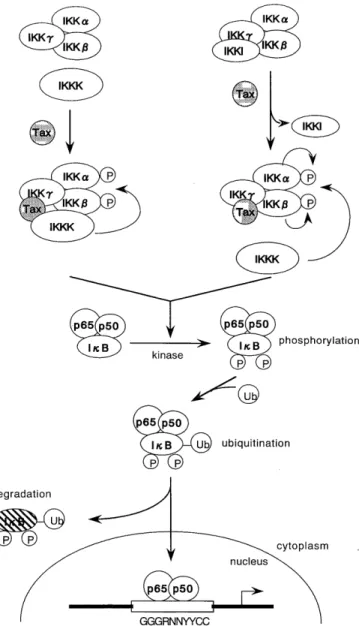
of IKK42-44). Recently, Sun and Ballard have proposed two models for Tax-directed activation of IKK (Fig. 2)45>
In the first model, Tax recruits an upstream IKKK to the IKK signalsome, which triggers phosphorylation and activation of the IKKa and IKK/9. Attractive candidates for this Tax-responsive IKKK are MEKK 1 and NIK. In the second model, Tax displaces a cellular IKK inhibi- tor (IKKI) from the holoenzyme, yielding a more favor-
able conformation for IKK autoactivation or for the ac- tion of a Tax-responsive IKK. Thus, Tax/IKKy interac- tion may serve as a molecular trigger for IKK activation.
Nuclear NF-KB DNA-binding activity, consisting of p50 and ReIA (p65), is rapidly induced in Tax-expressing cells via a post-translational mechanism"). In contrast, DNA-binding complexes composed of c-Rel and/or p52 are activated with relatively delayed kinetics, suggest- ing a requirement for de novo protein synthesis32' . Consistent with these studies, the c-Rel-containing com- plexes have also been shown to be the major NF-/cB binding complexes in HTLV-I-infected T-cell lines that constitutively express high levels of Tax 34,46-49) . Tax- mediated phosphorylation and degradation of hcB may contribute to the early-phase induction of the p50/ReIA (p65) heterodimer, while the sustained nuclear expres- sion of c-Rel heterodimers appears to be mediated by ad- ditional mechanisms. The genes encoding c-Rel and p52 are under the transcriptional control of ReIA (p65) 34,50) implying that activation of NF-/cB is a prerequisite for the late-phase induction of c-Rel/p52 heterodimers.
Fig. 2. Hypothetical schemes for Tax-directed activation of IKK.
Tax recruits an upstream IKKK to the IKK sugnalsome, which triggers phosphorylation and activation of the IKKa and/or IKK( catalytic subunit(s). Alternatively, removal of IKKI may render the IKKa and/or IKKj3 catalytic subunit(s) more susceptible to activation by the upstream Tax-responsive IKKK.
Attractive candidates for Tax-responsive IKKK are MEKKI and NIK. IKK activation triggers subsequent signal transduction cas- cades that result in hyperphosphorylation of I K Bs, ubiquitina- tion and degradation by the 26S proteasome. After I,cBs deg- radation, NF-/cB translocates to the nucleus and activates NF-
/cB-dependent cellular genes.
Constitutive NF-KB/Rel activation in ATL
Leukemic cells of ATL patients express very low levels of viral genes including Tax, suggesting that the expression of viral proteins is not necessary for leukemic proliferation at the late stage of the disease.
However, several genes that can be transactivated by Tax are also constitutively expressed in leukemic cells of ATL patients, probably by a Tax-independent mecha- nism. For instance, ATL cells in vivo display surface IL-2 receptor a chain (IL-2Ra) and express mRNA for cytokines and chemokines including IL-la, IL-6, IL-8, tumor necrosis factor /9, and monocyte chemoattractant protein-151'. Tax activates the transcription of these cel- lular genes through the NF- k B binding site (Fig. 1).
Recently, we found that leukemic cells from ATL pa-
tients in vivo, like HTLV-I-transformed T-cell lines in
vitro, display a constitutive NF- k B binding activity
and increased degradation of IKBa 49'. Thus, the NF-K
B/Rel pathway is activated in leukemic cells of ATL
patients in vivo, which may account for the persistent
expression of certain cellular genes. We also noticed
that the components of the activated NF- k B / Rel in
primary ATL cells are different from those in HTLV-I-
transformed cell lines expressing Tax in vitro. Gel-shift
analysis demonstrated that NF-,cB complexes are com-
posed of p50/p50 and p50/RelA (p65) dimers in both
primary ATL cells and ATL-derived T-cell lines, which
do not express Tax at all, whereas the complexes con-
sist mostly of p50 / c-Rel in Tax-expressing HTLV-I-
transformed T-cell lines. Our studies suggest that con-
stitutive expression of Tax does not appear to be neces- sary for maintenance of NF-KB/Rel activation in ATL cells in vivo and this activation occurs through a Tax- independent mechanism, possibly due to activation of a different NF-KB subunit.
Role of NF-fcB/Rel in Tax oncoprotein function
Several studies have suggested that activation of NF-KB/Rel by Tax is essential for the transformation of rodent cells and human primary T lymphocytes"-"'.
Inhibition of NF- k B activity by antisense NF-KB p65 oligonucleotides interferes with the growth of Tax- transformed cell lines both in vitro and in vivo56' Furthermore, recent experiments conducted with infec- tious molecular clones of HTLV-I DNA indicate that activation of the NF-/c B pathway is critical for the immortalization of T cells by HTLV-I57'. Recent results obtained with CTLL-2, a mouse IL-2-dependent T-cell line, have suggested that NF-/cB activation is the key to increasing the survival of HTLV-I-infected T cells.
CTLL-2 cell lines expressing wild-type Tax or a Tax mutant, which is still an activator of NF-KCB, are resis- tant to apoptosis induced in the absence of IL-258'. On the other hand, a Tax mutant, which is inactive for NF- k B, enhances apoptosis in the absence of IL-2.
The molecular mechanism of Tax-induced anti-apoptotic pathway could involve Bcl-x,, one of the molecules pro- tecting cells against apoptosis. We and others have re- cently demonstrated that Tax upregulates the Bcl-x, gene through NF-,cB pathway'"".
AP-1 pathway
Regulation of AP-1
The AP-1 complex is formed by three Jun-family members (c-Jun, JunB, and JunD) and four Fos-family members (c-Fos, FosB, Fra-1, and Fra-2), giving rise to a large variety of homo- and hetero-dimers binding to the same DNA consensus sequence, and are responsi- ble for the activation of various target genes involved in the control of cell proliferation, tumorigenesis, and metastasis","'. A causal role of AP-1 in neoplastic trans- formation has been demonstrated: a dominant negative c-Jun is able to suppress the ras-mediated transforma- tion'"". In addition, it has been reported that cell lines established from c-Jun knock out mice are resistant to ras-mediated transformation"). AP- 1 proteins are inactive in quiescent cells but are rapidly activated by a variety of extracellular stimuli, including growth factors, cytokines, and cellular stress signals","'. Activation of AP-1 is regu-
lated at the transcriptional and posttranscriptional level.
Activation of c-Jun N-terminal kinases (JNK, MAP kinase family member), also known as stress-activated protein kinases (SAPKs), phosphorylates c-Jun at Ser 63 and Ser 73 within the N-terminal activation domain, and stimulates its transcriptional activity70-72'. The stimulation of transcriptional activity of c-Jun after phosphorylation appears to be due to a higher affinity for the co-activator CBP. In addition, the phosphorylation of c-Jun by JNK reduces ubiquitination and degradation, thereby in- creasing its stability").
Increase in AP-1 activity is a general event at a late stage in T-cells transformed by HTL V-I
T-cell lines transformed by HTLV-I express high lev- els of mRNA encoding c-Fos, Fra-1, c-Jun, JunB, and JunD74,77', and have high levels of AP-1 activity"-"). Some of these genes are induced by Tax747880'. Indeed, Tax activates several cellular genes via an AP-1-like site (Fig.
1). Recently, we analyzed the AP-1 activity in periph- eral leukemic cells from ATL patients. All fresh periph- eral blood leukemic cells prepared from eleven patients exhibited increased AP-1 activity containing JunD, while the activity was not increased in normal peripheral blood mononuclear cells"). JunD homodimer generally forms unstable complexes with DNA","). However, our gel-shift analysis indicated that none of the characterized Fos family members (c-Fos, FosB, Fra-1, or Fra-2) was included in AP-1 binding complex of primary ATL cells. Thus, a factor, different from any currently char- acterized AP-1 transcription factor, is likely to be a component of the AP-1-binding complex in ATL cells.
In addition to primary ATL cells, all T-cell lines de- rived from ATL patients also displayed constitutive AP-1 activity, but expressed little Tax protein. These findings suggest that Tax is not the only mechanism for constitutive activation of AP-1 in HTLV-I-infected T cells in vitro as well as in vivo. On the other hand, the JNK kinase activity was constitutively activated in human lymphocytes transformed in vitro by HTLV-I84'.
Furthermore, such activation occurs only when HTLV- I-transformed lymphocytes become IL-2 independent.
However, Tax does not directly activate JNK because
JNK activation is not observed in cells transfected with
Tax expression vector. Constitutive JNK activation was
also detected in leukemic cells of ATL patients. Taken
together, these findings suggest that the acquisition of
constitutive JNK activation and subsequent AP-1 acti-
vation represent an important late event in HTLV-I
leukemogenesis.
Jak/STAT signaling pathway
Inappropriate Jak/S TAT activation in HTL V-I-transformed T-cell lines and primary A TL cells
The major growth-stimulatory cytokine for T cells is IL-2. The IL-2R is composed of at least three chains.
The a chain is involved in increasing ligand-binding affinity, and the /3 and common y (7,) chains are neces- sary and sufficient for transduction of the IL-2 signal"'.
IL-2R l9 and yc chains are members of the cytokine re- ceptor superfamily. None of IL-2R chains has a catalytic kinase domain, but like interferon receptors, IL-2R /9 and
yc chains use the Janus (Jak) family of cytoplasmic tyro- sine kinases and the signal transducer and activator of
transcription (STAT) proteins as one important mecha- nism to transduce their signals. Upon binding of IL-2 to its receptor, Jak3 is recruited to the yc chain, while Jakl is coupled to the IL-2R/9 chain'"'). These kinases are acti- vated upon IL-2 signaling") and phosphorylate STAT3, STAT5A, and STAT5B proteins","), allowing these pro- teins to form homo- and hetro-dimers, translocate to the nucleus, and bind DNA in a sequence-specific man- ner to initiate transcription of IL-2 responsive genes.
Constitutive activation of Jaks and/or STATs is associ- ated with cell transformation. For instance, in Drosophila, dominant activation of Jak leads to malignant neoplasia of hematopoietic cells"). Inappropriate activation of STAT has been described in many solid and hematologic malignancies. The role of Jak/STAT activation has been examined in T-cell lines transformed with HTLV-I. Jak1, Jak3, STAT3, and STAT5 proteins were constitutively activated in some IL-2-independent HTLV-I-transformed T-cell lines, whereas no constitutive Jak/STAT activa- tion was observed in HTLV-I-uninfected T-cell lines and IL-2-dependent HTLV-I-transformed ones. Thus, activa- tion of the Jak/STAT pathway in HTLV-I-transformed T-cell lines correlates with the transition from an IL-2- dependent to an IL-2-independent growth","'.
Jak/STAT activation has been examined in primary peripheral lymphocytes obtained from ATL patients").
Eight out of the twelve patients exhibited constitutive tyrosine phosphorylation of STAT proteins as well as constitutive STAT binding to the sis-inducible element from the c fos promoter and the prolactin responsive element from the (9-casein promoter. STAT3 activation was found in six patients (50%), and four exhibited activation of both STAT3 and STAT1. Activation of STAT5 was identified in four patients (33%), and two patients (17%) exhibited activation of both STAT3 and STAT5. Phosphorylation of Jak3 in leukemic cells was associated with activation of STAT3. In contrast, Zhang et al.") demonstrated no detectable basal phosphorylation
of Jak3, STAT3, and STAT5 in leukemic cells of all 8 ATL patients. The reasons for the discrepancy be- tween these two sets of data are unclear but may be related to the relatively small group of samples tested (12 and 8, respectively) and/or differences in method- ology. Recently, experiments by Tsukada et al.9", using a probe for the GAS (y interferon activation site)-like element termed LILRE (LPS/IL-1-responsive element), which is found in the human prolL-1/9 gene, revealed constitutive activation of LIL-STAT (LPS/IL-1-induced STAT) in all 7 ATL patients, although the precise sig- nificance of this activation in leukemogenesis remains unclear at present.
Mechanism of constitutive activation of Jak/STAT path- way in HTL V-I-transformed T cells
HTLV-I-transformed T-cell lines express higher amounts of STAT1, STAT3, and STAT5 mRNA and proteins than HTLV-I-negative cells"'. Tax induces the expres- sion of STAT 1 and STAT5 in a T-cell line, however, it does not induce DNA binding activity of these STAT proteins and Jak3 activation'"". Indeed, Tax-expressing HTLV-I-infected T-cell lines do not always express
constitutive DNA binding activity of STAT99'. Thus, the mechanisms by which HTLV-I transformation in- duces activation of the Jak/STAT pathway remains to be determined. Some HTLV-I-transformed T-cell lines such as HUT-102 can produce IL-15100', a T-cell growth factor that activates STAT3 and STAT590'. However, antibodies against IL-15 do not substantially decrease the activation level of Jak/STAT proteins","'. Interestingly, conditioned medium from HTLV-I-transformed T-cell lines could induce STAT5 activation in HTLV-I-uninfected T- cell lines (Yamaoka et al., unpublished results). Thus, activation of Jak/STAT pathway in HTLV-I-infected cells may be due to an autocrine or paracrine stimulation.
Concluding remarks
In our current model of Tax induced leukemogenesis
(Fig. 3), Tax causes proliferation of HTLV-I-infected T
cells by activation of transcription factors including
NF-/CB and AP-1. Because Tax does not appear to be
expressed in primary ATL cells, HTLV-I-infected T cells
with constitutive activation of both NF-/cB and AP-1
in a Tax-independent manner, are selected during late
stages of leukemogenesis probably by mutations or al-
terations of cellular genes. This may result in reduced
requirements of growth factors and may be a crucial
step in a leukemic proliferation in vivo. The finding that
ATL cells utilize a variety of mechanisms to activate
Fig. 3. Schematic diagram of hypothesized role of Tax in transformation.
several signal transduction pathways suggests that such property may be critical for leukemogenesis. We are beginning to understand how HTLV-I interacts with cellular factors to activate and modulate cellular signal transduction pathways leading to the leukemic proliferation of virus-infected cells. However, we do not know which upstream genetic changes in HTLV-I- infected cells result in the activation of these signaling cascades. Further characterization of these signaling cascades in HTLV-I-infected cells in vitro as well as in vivo should contribute to our understanding of ATL oncogenesis and identify a unique target for the treat- ment of this unusual leukemia.
Acknowledgments
This work is supported by a Grant-in-Aid for the Encouragement of Young Scientists from the Ministry of Education, Science, Sports and Culture of Japan, and Cooperative Research Grants No. 1998-1Q-A-14 and No. 1999-1O-A-14 from the Institute of Tropical Medicine, Nagasaki University. We thank Dr. Shoji Yamaoka for stimulating discussions.
References
1) Poiesz BJ, Ruscetti FW, Gazdar AF, Bunn PA, Minna JD, Gallo RC:
Detection and isolation of type C retrovirus particles from fresh
and cultured lymphocytes of a patient with cutaneous T-cell lym-
phoma. Proc Natl Acad Sci USA 77: 7415-7419, 1980
2) Yoshida M, Miyoshi I, Hinuma Y: Isolation and characterization of retrovirus from cell lines of human adult T-cell leukemia and its implication in the disease. Proc Natl Acad Sci USA 79: 2031-2035,
1982
3) Gassain A, Barin F, Vernant JC, et al: Antibodies to human T- lymphotropic virus type-I in patients with tropical spastic paraparesis.
Lancet ii: 407-410, 1985
4) Osame M, Usuku K, Izumo S, et al: HTLV-I associated myelopathy, a new clinical entity. Lancet is 1031-1032, 1986
5) Mochizuki M, Watanabe T, Yamaguchi K, et al: HTLV-I uveitis: a distinct clinical entity caused by HTLV-I. Jpn J Cancer Res 83: 236-
239, 1992
6) Nishioka K, Maruyama I, Sato K, Kitajima I, Nakajima Y, Osame M: Chronic inflammatory arthropathy associated with HTLV-I.
Lancet is 441, 1989
7) Terada K, Katamine S, Eguchi K, et al: Prevalence of serum and salivary antibodies to HTLV-1 in Sjoren's syndrome. Lancet 344:
1116-1119, 1994
8) Murphy EL, Hanchard B, Figueroa JP, et al: Modelling the risk of adult T-cell leukemia/lymphoma in persons infected with human
T-lymphotropic virus type I. Int J Cancer 43: 250-253, 1989 9) Ressler S, Connor LM, Marriott SJ: Cellular transformation by
human T-cell leukemia virus type I. FEMS Microbiol Lett 140: 99-
109, 1996
10) Verma IM, Stevenson JK, Schwarz EM, Van Antwerp D, Miyamoto S: Rel/NF-k B/Ik B family: intimate tales of association and dissocia-
tion. Genes Dev 9: 2723-2735, 1995
11) Baeuerle PA, Baltimore D: NF-KB: ten years after. Cell 87: 13-20, 1996
12) Baldwin AS Jr: The NF-KB and I/cB proteins: new discoveries and insights. Annu Rev Immunol 14: 649-683, 1996
13) DiDonato JA, Hayakawa M, Rothwarf DM, Zandi E, Karin M: A cytokine-responsive ItcB kinase that activates the transcription fac- tor NF-KB. Nature 388: 548-554, 1997
14) Zandi E, Rothwarf DM, Delhase M, Hayakawa M, Karin M: The I /C13 kinase complex (IKK) contains two kinase subunits, IKK a and
IKK(3, necessary for I K B phosphorylation and NF-/CB activation.
Cell 91: 243-252, 1997
15) Mercurio F, Zhu H, Murray BW, et al: IKK-1 and IKK-2: cytokine- activated IIcB kinases essential for NF-/cB activation. Science 278:
860-866, 1997
16) Regnier CH, Song HY, Gao X, Goeddel DV, Cao Z, Rothe M:
Identification and characterization of an IKB kinase. Cell 90: 373- 383, 1997
17) Woronicz JD, Gao X, Cao Z, Rothe M, Goeddel DV: I K B kinase-/3:
NF-KB activation and complex formation with I K B kinase- a and
NIK. Science 278: 866-869, 1997
18) Stancovski I, Baltimore D: NF-/c B activation: the I k B kinase re- vealed? Cell 91: 299-302, 1997
19) Lee FS, Peters RT, Dang LC, Maniatis T: MEKK1 activates both I KB kinase a and IKB kinase fl. Proc Natl Acad Sci USA 95: 9319-
9324,1998
20) Ling L, Cao Z, Goeddel DV: NF-KB-inducing kinase activates IKK-a by phosphorylation of Ser-176. Proc Natl Acad Sci USA 95: 3792-
3797,1998
21) Nakano H, Shindo M, Sakon S, et al: Differential regulation of IKB kinase a and (3 by two upstream kinases, NF-rcB-inducing kinase
and mitogen-activated protein kinase/ERK kinase kinase-1. Proc
Natl Acad Sci USA 95: 3537-3542, 1998
22) Nemoto S, DiDonato JA, Lin A: Coordinate regulation of IKB kinases by mitogen-activated protein kinase kinase kinase 1 and NF-KB-
inducing kinase. Mol Cell Biol 18: 7336-7343, 1998
23) Rothwarf DM, Zandi E, Natoli G, Karin M: IKK-y is an essential regulatory subunit of the IKB kinase complex. Nature 395: 297-300,
1998
24) Yamaoka S, Courtois G, Bessia C, et al: Complementation cloning of NEMO, a component of the I k B kinase complex essential for
NF-,cB activation. Cell 93: 1231-1240, 1998
25) Ressler S, Connor LM, Marriott SJ: Cellular transformation by human T-cell leukemia virus type I. FEMS Microbiol Lett 140: 99- 109, 1996
26) Semmes OJ, Jeang K-T: Localization of human T-cell leukemia virus type 1 Tax to subnuclear compartments that overlap with
interchromatin speckles. J Virol 70: 6347-6357, 1996
27) Bex F, McDowall A, Burny A, Gaynor R: The human T-cell leuke- mia virus type 1 transactivator protein Tax colocalizes in unique
nuclear structures with NF-tcB proteins. J Virol 71: 3483-3497, 1997 28) Bex F, Yin M-J, Burny A, Gaynor RB: Differential transcriptional
activation by human T-cell leukemia virus type 1 Tax mutants is mediated by distinct interactions with CREB binding protein and p300. Mol Cell Biol 18: 2392-2405, 1998
29) Hiscott J, Petropoulos L, Lacoste J: Molecular interactions between HTLV-1 Tax protein and the NF-KB/IrcB transcription complex.
Virology 214: 3-11, 1995
30) Yoshida M, Suzuki T, Fujisawa J, Hirai H: HTLV-1 oncoprotein Tax and cellular transcription factors. Curr Top Microbiol Immunol
193: 79-89, 1995
31) Good L, Sun S-C: Persistent activation of NF-KB/Rel by human T- cell leukemia virus type 1 Tax involves degradation of 1 K B/i. J
Virol 70: 2730-2735, 1996
32) Kanno T, Brown K, Franzoso G, Siebenlist U: Kinetic analysis of human T-cell leukemia virus type I Tax-mediated activation of NF- KcB. Mol Cell Biol 14: 6443-6451, 1994
33) Lacoste J, Petropoulos L, Pepin N, Hiscott J: Constitutive phosphoryla-
tion and turnover of I~cBa in human T-cell leukemia virus type I- infected and Tax-expressing T cells. J Virol 69: 564-569, 1995 34) Sun S-C, Elwood J, Beraud C, Greene WC: Human T-cell leukemia
virus type I Tax activation of NF-,cB/Rel involves phosphorylation
and degradation of I K B a and ReIA (p65)-mediated induction of the c-rel gene. Mol Cell Biol 14: 7377-7384, 1994
35) Nicot C, Tie F, Giam C-Z: Cytoplasmic forms of human T-cell leu- kemia virus type 1 Tax induce NF-KB activation. J Virol 72: 6777-
6784,1998
36) Brockman JA, Scherer DC, McKinsey TA, et al: Coupling of a sig- nal response domain in I/cBa to multiple pathways for NF-/CB acti-
vation. Mol Cell Biol 15: 2809-2818, 1995
37) McKinsey TA, Brockman JA, Scherer DC, Al-Murrani SW, Green PL, Ballard DW: Inactivation of I /c B /9 by the Tax protein of
human T-cell leukemia virus type 1: a potential mechanism for
constitutive induction of NF-KB. Mol Cell Biol 16: 2083-2090, 1996 38) Chu Z-L, DiDonato JA, Hawiger J, Ballard DW: The Tax oncoprotein
of human T-cell leukemia virus type 1 associates with and persis-
tently activates I K B kinases containing IKK a and IKK 9. J Biol
Chem 273: 15891-15894, 1998
39) Uhlik M, Good L, Xiao G, et al: NF-KB-inducing kinase and I k B kinase participate in human T-cell leukemia virus I Tax-mediated
NF-KB activation. J Biol Chem 273: 21132-21136, 1998
40) Geleziunas R, Ferrell S, Lin X, et al: Human T-cell leukemia virus type 1 Tax induction of NF-KB involves activation of the I k B
kinase a (IKKa) and IKK9 cellular kinases. Mol Cell Biol 18: 5157-
5165, 1998
41) Yin M-J, Christerson LB, Yamamoto Y, et al: HTLV-I Tax protein binds to MEKK1 to stimulate IKB kinase activity and NF-KB acti-
vation. Cell 93: 875-884, 1998
42) Chu Z-L, Shin Y-A, Yang J-M, DiDonato JA, Ballard DW: IKKy me- diates the interaction of cellular IKB kinases with the Tax trans-
forming protein of human T cell leukemia virus type 1. J Biol
Chem 274: 15297-15300, 1999
43) Jin D-Y, Giordano V, Kibler KV, Nakano H, Jeang K-T: Role of adapter function in oncoprotein-mediated activation of NF-KB. Human T-
cell leukemia virus type I Tax interacts directly with I K B kinase
y. J Biol Chem 274: 17402-17405, 1999
44) Harhaj EW, Sun S-C: IKKy serves as a docking subunit of the IK B kinase (IKK) and mediates interaction of IKK with the human T- cell leukemia virus Tax protein. J Biol Chem 274: 22911-22914,
1999
45) Sun S-C, Ballard DW: Persistent activation of NF-/CB by the Tax transforming protein of HTLV-1: hijacking cellular I K B kinases.
Oncogene 18: 6948-6958, 1999
46) Arima N, Molitor JA, Smith MR, Kim JH, Daitoku Y, Greene WC:
Human T-cell leukemia virus type I Tax induces expression of the Rel-related family of /LB enhancer-binding proteins: evidence for a
pretranslational component of regulation. J Virol 65: 6892-6899,
1991
47) Li C-C, Ruscetti FW, Rice NR, et al. Differential expression of Rel family members in human T-cell leukemia virus type I-infected
cells: transcriptional activation of c-rel by Tax protein. J Virol 67:
4205-4213, 1993
48) Lanoix J, Lacoste J, Pepin N, Rice N, Hiscott J: Overproduction of NFKB2 (lyt-10) and c-Rel: a mechanism for HTLV-I Tax-mediated
trans-activation via the NF-KCB signalling pathway. Oncogene 9: 841- 852, 1994
49) Mori N, Fujii M, Ikeda S, et al: Constitutive activation of NF-KB in primary adult T-cell leukemia cells. Blood 93: 2360-2368, 1999 50) Sun S-C, Ganchi PA, Beraud C, Ballard DW, Greene WC:
Autoregulation of the NF-/CB transactivator Re1A (p65) by multi-
ple cytoplasmic inhibitors containing ankyrin motifs. Proc Natl
Acad Sci USA 91: 1346-1350, 1994
51) Mori N, Yamamoto N, Fujii M: Activation of nuclear factor-K B/Rel proteins by human T-cell leukemia virus type I. Acta Med Biol 47:
85-96, 1999
52) Yamaoka S, Inoue H, Sakurai M, et al: Constitutive activation of NF-/c B is essential for transformation of rat fibroblasts by the
human T-cell leukemia virus type I Tax protein. EMBO J 15: 873-
887, 1996
53) Matsumoto K, Shibata H, Fujisawa J, et al: Human T-cell leukemia virus type 1 Tax protein transforms rat fibroblasts via two dis-
tinct pathways. J Virol 71: 4445-4451, 1997
54) Coscoy L, Gonzalez-Dunia D, Tangy F, Syan S, Brahic M, Ozden S:
Molecular mechanism of tumorigenesis in mice transgenic for the human T cell leukemia virus Tax gene. Virology 248: 332-341,
1998
55) Akagi T, Ono H, Nyunoya H, Shimotohno K: Characterization of peripheral blood T-lymphocytes transduced with HTLV-I Tax mu- tants with different trans-activating phenotypes. Oncogene 14: 2071-
2078,1997
56) Kitajima I, Shinohara T, Bilakovics J, Brown DA, Xu X, Nerenberg M: Ablation of transplanted HTLV-1 Tax-transformed tumors in
mice by antisense inhibition of NF-/CB. Science 258: 1792-1795,
1992
57) Robek MD, Ratner L: Immortalization of CD4+ and CD8+ T lym- phocytes by human T-cell leukemia virus type 1 Tax mutants ex-
pressed in a functional molecular clone. J Virol 73: 4856-4865, 1999 58) Iwanaga Y, Tsukahara T, Ohashi T, et al: Human T-cell leukemia
virus type 1 Tax protein abrogates interleukin-2 dependence in a
mouse T-cell line. J Virol 73: 1271-1277, 1999
59) Tsukahara T, Kannagi M, Ohashi T, et al: Induction of Bcl-x,L ex- pression by human T-cell leukemia virus type 1 Tax through NF-
,cB in apoptosis-resistant T-cell transfectants with Tax. J Virol 73:
7981-7987, 1999
60) Nicot C, Mahieux R, Takemoto S, Franchini G: Bcl-X,, is up- regulated by HTLV-I and HTLV-II in vitro and in ex vivo ATLL
samples. Blood 96: 275-281, 2000
61) Mori N, Fujii M, Cheng G, et al: Human T-cell leukemia virus type I Tax protein induces the expression of anti-apoptotic gene Bcl-xL
in human T-cells through nuclear factor-KB and c-AMP responsive
element binding protein pathways. Virus genes, in press
62) Angel P, Karin M: The role of Jun, Fos and the AP-1 complex in cell-proliferation and transformation. Biochim Biophys Acta 1072:
129-157, 1991
63) Karin M, Liu Z, Zandi E: AP-1 function and regulation. Curr Opin Cell Biol 9: 240-246, 1997
64) Lloyd A, Yancheva N, Wasylyk B: Transformation suppressor ac- tivity of a Jun transcription factor lacking its activation domain.
Nature 352: 635-638, 1991
65) Granger-Schnarr M, Benusiglio E, Schnarr M, Sassone-Corsi P:
Transformation and transactivation suppressor activity of the c- Jun leucine zipper fused to a bacterial repressor. Proc Natl Acad
Sci USA 89: 4236-4239, 1992
66) Brown PH, Alani R, Preis LH, Szabo E, Birrer MJ: Suppression of oncogene-induced transformation by a deletion mutant of c-jun.
Oncogene 8: 877-886, 1993
67) Johnson R, Spiegelman B, Hanahan D, Wisdom R: Cellular
transformation and malignancy induced by ras require c-jun. Mot Cell Biol 16: 4504-4511, 1996
68) Karin M: The regulation of AP-1 activity by mitogen-activated pro- tein kinases. J Biol Chem 270: 16483-16486, 1995
69) Whitmarsh AJ, Davis RJ: Transcription factor AP-1 regulation by mitogen-activated protein kinase signal transduction pathways. J
Mot Med 74: 589-607, 1996
70) Pulverer BJ, Kyriakis JM, Avruch J, Nikolakaki E, Woodgett JR:
Phosphorylation of c-jun mediated by MAP kinases. Nature 353:
670-674, 1991
71) Hibi M, Lin A, Smeal T, Minden A, Karin M: Identification of an oncoprotein- and UV-responsive protein kinase that binds and
potentiates the c-Jun activation domain. Genes Dev 7: 2135-2148,
1993
72) Kallunki T, Su B, Tsigelny I, et at: JNK2 contains a specificity- determining region responsible for efficient c-Jun binding and
phosphorylation. Genes Dev 8: 2996-3007, 1994
73) Toone WM, Jones N: AP-1 transcription factors in yeast. Curr Opin Genet Dev 9: 55-61, 1999
74) Fujii M, Niki T, Mori T, et at: HTLV-1 Tax induces expression of various immediate early serum responsive genes. Oncogene 6: 1023-
1029, 1991
75) Uchijima M, Sato H, Fujii M, Seiki M: Tax proteins of human T- cell leukemia virus type 1 and 2 induce expression of the gene en- coding erythroid-potentiating activity (tissue inhibitor of
metalloproteinases-1, TIMP-1). J Biol Chem 269: 14946-14950, 1994 76) Mori N, Mukaida N, Ballard DW, Matsushima K, Yamamoto N:
Human T-cell leukemia virus type I Tax transactivates human
interleukin 8 gene through acting concurrently on AP-1 and nu-
clear factor-,cB-like sites. Cancer Res 58: 3993-4000, 1998 77) Hooper WC, Rudolph DL, Lairmore MD, Lal RB: Constitutive ex-
pression of c jun and jun-B in cell lines infected with human T-
lymphotropic virus types I and II. Biochem Biophys Res Commun
181: 976-980, 1991
78) Fujii M, Sassone-Corsi P, Verma IM: c fos promoter trans-activation
by the taxi protein of human T-cell leukemia virus type I. Proc Natl Acad Sci USA 85: 8526-8530, 1988
79) Nagata K, Ohtani K, Nakamura M, Sugamura K: Activation of en- dogenous c fos proto-oncogene expression by human T-cell leuke-
mia virus type I-encoded p40tax protein in the human T-cell line,
Jurkat. J Virol 63: 3220-3226, 1989
80) Fu W, Shah SR, Jiang H, Hilt DC, Dave HPG, Joshi JB: Transactivation
of proenkephalin gene by HTLV-1 tax, protein in glial cells: involve- ment of Fos/Jun complex at an AP-1 element in the proenkephalin
gene promoter. J NeuroVirol 3: 16-27, 1997
81) Mori N, Fujii M, Iwai K, et at: Constitutive activation of transcrip- tion factor AP-1 in primary adult T-cell leukemia cells. Blood 95:
3915-3921, 2000
82) Nakabeppu Y, Nathans D: The basic region of Fos mediates spe- cific DNA binding. EMBO J 8: 3833-3841, 1989
83) Ryder K, Lanahan A, Perez-Albuerne E, Nathans D: jun-D: a third member of the jun gene family. Proc Natl Acad Sci USA 86: 1500-
1503, 1989
84) Xu X, Heidenreich 0, Kitajima I, et at: Constitutively activated JNK is associated with HTLV-1 mediated tumorigenesis. Oncogene 13:
135-142, 1996
85) Nakamura Y, Russell SM, Mess SA, et at: Heterodimerization of the IL-2 receptor f3- and y-chain cytoplasmic domains is required for
signalling. Nature 369: 330-333, 1994
86) Russell SM, Johnston JA, Noguchi M, et at: Interaction of IL-2R P and yc chains with Jaki and Jak3: implications for XSCID and
XCID. Science 266: 1042-1045, 1994
87) Boussiotis VA, Barber DL, Nakarai T, et at: Prevention of T cell anergy by signaling through the y c chain of the IL-2 receptor.
Science 266: 1039-1042, 1994
88) Miyazaki T, Kawahara A, Fujii H, et at: Functional activation of Jakl and Jak3 by selective association with IL-2 receptor subunits.
Science 266: 1045-1047, 1994
89) Witthuhn BA, Silvennoinen 0, Miura 0, et at: Involvement of the Jak-3 Janus kinase in signalling by interleukins 2 and 4 in lym-
phoid and myeloid cells. Nature 370: 153-157, 1994
90) Lin JX, Migone TS, Tsang M, et at: The role of shared receptor motifs and common Stat proteins in the generation of cytokine
pleiotropy and redundancy by IL-2, IL-4, IL-7, IL-13, and IL-15.
Immunity 2: 331-339, 1995
91) Nielsen M, Svejgaard A, Skov S, Odum N: Interleukin-2 induces ty- rosine phosphorylation and nuclear translocation of stat3 in
human T lymphocytes. Eur J Immunol 24: 3082-3086, 1994 92) Harrison DA, Binari R, Nahreini TS, Gilman M, Perrimon N:
Activation of a Drosophila Janus kinase (JAK) causes hematopoietic
neoplasia and developmental defects. EMBO J 14: 2857-2865, 1995 93) Migone T-S, Lin J-X, Cereseto A, et at: Constitutively activated Jak-
STAT pathway in T cells transformed with HTLV-I. Science 269:
79-81, 1995
94) Xu X, Kang S-H, Heidenreich 0, Okerholm M, O'Shea JJ, Nerenberg MI: Constitutive activation of different Jak tyrosine kinases in
human T cell leukemia virus type 1 (HTLV-1) Tax protein or virus-transformed cells. J Clin Invest 96: 1548-1555, 1995
95) Takemoto S, Mulloy JC, Cereseto A, et al: Proliferation of adult T cell leukemia/lymphoma cells is associated with the constitutive
activation of JAK/STAT proteins. Proc Natl Acad Sci USA 94:
13897-13902, 1997
96) Zhang Q, Lee B, Korecka M, et at: Differences in phosphorylation
of the IL-2R associated JAK/STAT proteins between HTLV-I (+), IL-2-independent and IL-2-dependent cell lines and uncultured
leukemic cells from patients with adult T-cell lymphoma/leukemia.
Leukemia Res 23: 373-384, 1999
97) Tsukada J, Toda Y, Misago M, Tanaka Y, Auron PE, Eto S:
Constitutive activation of LIL-Stat in adult T-cell leukemia cells.
Blood 95: 2715-2718, 2000
98) Nakamura N, Fujii M, Tsukahara T, et at: Human T-cell leukemia virus type 1 Tax protein induces the expression of STATI and
STAT5 genes in T-cells. Oncogene 18: 2667-2675, 1999
99) Mulloy JC, Migone T-S, Ross TM, et at: Human and simian T-cell leukemia viruses type 2 (HTLV-2 and STLV-2p,,,.,) transform T
cells independently of Jak/STAT activation. J Virol 72: 4408-4412,
1998
100) Burton JD, Bamford RN, Peters C, et at: A lymphokine, provision- ally designated interleukin T and produced by a human adult T-
cell leukemia line, stimulates T-cell proliferation and the induction
of lymphokine-activated killer cells. Proc Natl Acad Sci USA 91:
4935-4939, 1994