Relative Pronouns in An Alphabet of Tales, a Fifteenth Century Northern Text
著者 Saito Toshio
journal or
publication title
奈良教育大学紀要. 人文・社会科学
volume 19
number 1
page range 31‑52
year 1970‑11‑30
URL http://hdl.handle.net/10105/3057
Relative Pronouns in An Alphabet of Tales, a Fifteenth Century Northern Text
Toshio Saito
Department of English, Nara University of Education, Nara, Japan
An analysis of the relative constructions in An Alphabet of Tales with special reference to relative pronouns is attempted in this paper as part of the present writer's survey of the relative constructions in 15th Century English. The study is intended to present a general picture of how relatives are used in the Northern language of the late ME period. The work under investigation is a Northern English translation (c. 1450)1 of the
Alphabetum Narrationum of Etienne de Basancon. The prose of the book reflects the
colloquial language of the period though it is an English translation from the Latin.2 The text used in this survey is An Alphabet of Tales, pt. 1 edited by Mrs. Mary Mac- leod Banks (EETS, OS. 126, 1904).
1. 0. FORMS
In the present survey the passages of narrative exposition (abbr. NAR) and those of discourse (abbr. DIS) are separately investigated since it is naturally expected that there is some difference in linguistic levels between the two.
Relative pronouns are classified into two groups: (1) relatives with an antecedent, (2) relatives without an antecedent. The relatives of the latter group may be divided into simple forms and compounds.
The following tables show the relative forms and the total numbers of their examples found in the text examined.
TABLEI Relatives with Antecedent
N A R D I S T p a t 5 8 2 ( 6 6 . 6 ) 1 0 6 ( 5 8 .8 ) 6 8 8 ( 6 5 .4 ) a t , a t t 2 5 3 ( 2 9 . 0 ) 7 0 ( 3 8 .3 ) 3 2 3 ( 3 0 . 4 )
w h il k 2 3 ( 2 . 6 ) 3 C 1 . 7 ) 2 6 ( 2 . 4 ) p e w h i lk l l ( 1 .2 ) 1 ( 0 . 4 ) 1 2 C 1 . 1 ) w h o m , w h a m e . w h o m e 4 ( 0 . 5 ) K 0 .4 ) 5 ( 0 . 5 ) w h o s e , w h a s e K 0 . 1 ) 1 C 0 . 4 ) 2 ( 0 . 2 ) 8 7 4 ( 1 0 0 3 0 1 8 2 ( 1 0 0 % ) 1 0 5 6 ( 1 0 0 ^ )
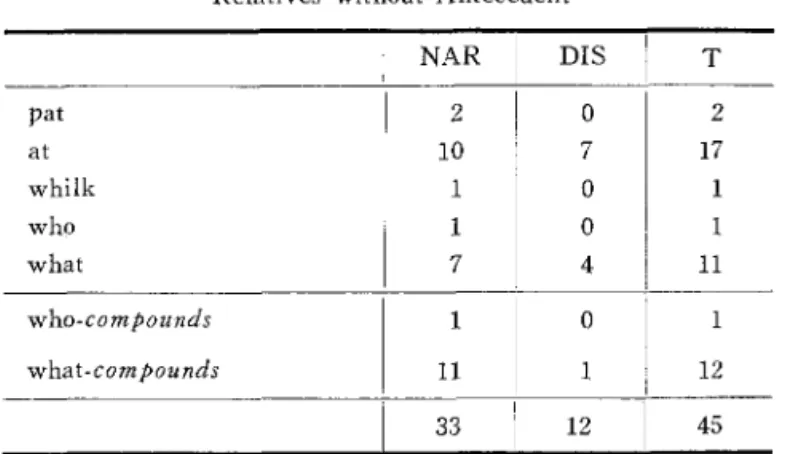
TABLE II Relatives without Antecedent
N A R D I S
p a t 0 2 a t
w h il k 'h o 'h a t
1 0 1 7 1 0 1
1 1 1
w h o ‑ c o m p o u n d s
蝣w h a t ‑ c o m p o u n d s 1 11 1 21
3 3 1 2 4 5
Notes:1. But3, pan, and as as relatives are excluded from Table I. They are not treated in the present study.
2. Examples where relative forms are used attributively or nonpronominally are included in the countings of Table I.
3. All the examples of Table I are those of anaphoric relatives, i. e. relatives in post-po-
sition, with only two exceptions: (NAR) Not-with-stondyng, at he wyste not, hurde-men
& plew-men rescowid his childer fro pis lyon 214-124/ and, at all men had wonder of,
he made hym kyng 254-26.
4. The tofto-compound found is who som-evur.
5. What-compounds include what-so (NAR: 2 exx.), what as (NAR: 1 ex.), what at-
evur (NAR: 4 exx.; DIS: 1 ex.), what as-evur (NAR: 1 ex.), what som-euer (NAR:
3exx.).
Historically relative pronouns are grouped into two categories: relatives of demonstrative origin and thase of interrogative origin.5 The figures of the above tables show two impor- tant facts about the relative pronouns of this Northern text.
(1) Relatives of demonstrative origin, i. e. pat and at are overwhelmingly predominant both in NAR and DIS, while those of interrogative origin, i. e. wA-forms are quite scarce,
especially as anaphoric relatives. It should be noted that no instance of anaphoric who is
recorded. All the examples of wh-iorms combined amount to only 6A% of the cases, the
rest being those of pat and at. It follows, therefore, that Wz-forms, especially anaphoric relatives in DIS are almost negligible, outnumbered by demonstrative-relatives.
(2) Northern at alongside of pat isvery frequent, especiallyin DIS. OED (at, 'at) says
this form is "a worn-out form of that, perhaps from ON. at,..., perh. independently de- veloped in the northern dialect, in which it was very common in 14-15th c."6
From these facts it may be concluded that "the main job in the present survey is to
probe into and clarify the actual usage of pat and at.
The scarcity of wh-iorms is a characteristic of this Northern text. For comparison some
other contemporary texts written in the colloquial style will be taken up here. Accord-
ing to my survey, the proportion between pat and wA-forms in MS Harley 7333 of Gesta
Romanorum (c. 1440, Midland; abbr. GR)7 and The Book of Margery Kempe (c. 1430s,
East Midland; abbr. MK)S is as follows:
NAR GR 224 (61.5^) : 140(38.55^)
MK 354 (47.7#) : 387(52.3^)
DIS 280 (74.996) å 94(25.
299 (72.9&) : 98(27.
As to another colloquial material, Paston Letters (1422-1509, East Midland;abbr. PL), when countings in Carstensen's work9 are manipulated, we shall get the rate of approxi- mately 5&%: A7%. The statistics of these three works discloses that already in the Fifteenth Century OT/z-forms, especially (pe) which, are rather highly developed even in colloquial prose, at least from the numerical point of view.10 Mustanojall states, "In later ME the dependent use of which becomes increasingly popular and develops into a mannerism at the hands of many 15th-century writers." In this respect An Alphabet of Tales is quite distinct from these three works. The present writer is not sure if this leads to the con- clusion that wh-iorms are scarce in the colloquial type of 15th Century Northern English.
Further investigations have to be conducted on ther Northern texts.
1. 1. The figures of the following table indicates the situation better.
TABLEIII
N A R D I S r n r p a t
a t
4 8 0
2 0 0 1 0 25 3 7 8 5 0
2 8 2 0 v h i lk 2 0 1 2 p e w h i lk
rh o n w h o s e
2 9 2 2 1 0 1 0 0
0 1 1 T 1 8 6 1 3 0 5 2
r : restrictive relatives nr : non-restrictive relatives
Restrictive wh- forms are negligible, being used in only 1.2^ of the cases, while with
the non-restrictive clauses they have already gained some ground, being used in 14.7%'
of the cases. This is the sphere where anaphoric wh-iorms first came into being in early
ME, and where they still linger in late ME.
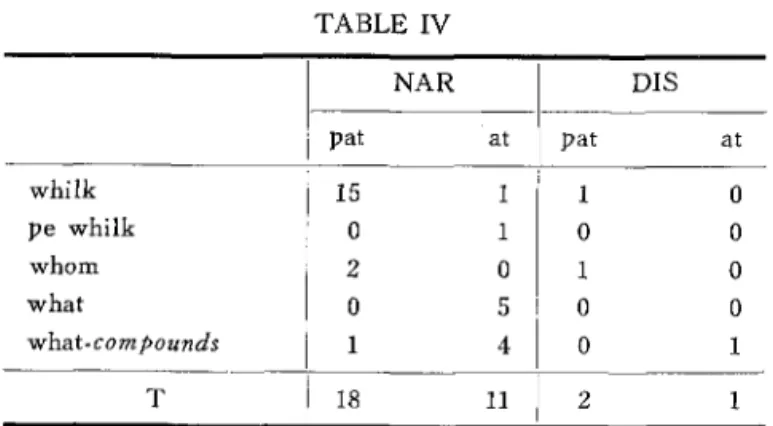
1. 2. There are 32 instances of relatives reinforced with pleonastic conjunction pat or at.12 Northern at appears also in this function.
TABLE IV
p a t N A R a t D IS
p a t a t
T 18 l l
Points of significance in these figures are:
(1) The combination pat pat or pat at is not found.
(2) Pleonastic pat is preferred in combination with whilk and possibly with whom. At goes with what and zt>/za?-compounds.
(3) This combination is used more frequently in NAR than in DIS. It may be worth noting that 17 of all the 27 examples of whilk is followed by pat or at. In GR and MK
the combination with pleonatic pat is not so popular, and it appears less frequently in NAR than in DIS.13
i. (NAR) whilk pat per was a preste pat servid in a kurk of Saynt Agnes, whilk pat on a tyme was hugelie vexid with temptacion of his flessh 32-31/per was a wurthi
knyght whilk pat did many enjuries vnto Lowisll3-26/ he made paim a law att pai
kepe yit, whilk pat is callid Machomett law 165-20. whame pat he commandid to gar feche vnto hym on pat hight Joseph, pat was a lew, whome pat he had sene be reuel- acion at sulde be a crysten man 74-20/ he suld be made rewler of paim, whame pat
God shewid for be pe Holie Gaste 165-12. whatt som euer pat Whatt howr som euer
pat a synner forthynkis his syn 58-4.
(DIS) whilk pat I hafe a pale face for I had mynd of pe paynys of hell, whilk pat I mond hafe bod if I did penance for my syn 56-33. whome pat Other mens wurdis sail neuer noy a man, how pat evur pai say, whom pat his consciens fylis noght 45-19.
ii. (NAR) whilk at and tolde hym my dissese, whilk at I durste not for shame tell att hame vnto Euagerus 92-7. pe whilk att ffor pat, he said, was most delicious, pe whilk att mans witt cuthe ymagyn off trewthe in a mans saule 103-25. what at & what at God wolde hafe dene 165-18. what att evur he suld do what att evur hym plesid to byd hymdo 148-16. (DIS) what at evur what at evur I hafe sail be pine 49-25.
1. 3. It may be added here that we have found only7 cases where the 0-form introduces what Jespersen calls 'contact-clause.' Subject-relation: 3 exx.; object-relation: 2 exx.;
adverbial: 2 exx. They are all found in NAR.
i. per was a lew /0/ wonnyd in pe town 143-23/ his Abbot...was war of a lytle blak boy /0/ led hym onte be pe shurte of his clothis 79-25/ 10-25.
ii. and wolde not lefe for noght/0/ sho cuth do 26-10/ pai wold bete hym for pe skorn
10/ he gaff permaister 141-6.
iii. I sail no meate eate vnto tyme /0/ I know if ourLord will hafe mercie of pe or noght 48-7.
This scarcity of examples with 0-forms is not due to the fact that this is a translation from the Latin, but probably it only reflects the late development of this construction in English.14 This is not popular in GR and MK either.15
2. 0. Whilk ; pe whilk
Whilk (<^ OE hwelc) is a Northern form which is seen in Northern texts such as the
writings of Richard Rolle of Hampole and the Towneley Plays. The combination pe
whilk is also considered to have come into use first in the North.16
In the present text there are found 27 instances (NAR 24; DIS 3) of whilk (one of which is an instance of generalizing whilk) and 12 (NAR ll; DIS 1) of pe whilk. Whilk is about two times as frequent as pe whilk. See the following data:
fNAR whilk 8: pe whilk 101
<DIS 8: 32
fNAR 245 : 65
MKfms
PL 986 : 234
Mustanoja says, "In 15th-century prose, as a ruie, the which is far more frequent than plain which."17 His statement applies to GR, but not to the other three works above. Ac- cording to Steinki,18 the which is favoured in the popular language. Does it mean that these works of popular prose are exceptions to the current tendency of the period?
2. 1. A further study will be conducted to attest the functional difference there may be between these two forms.
TABLE V GR
p e w h ilk n pp 0 1
p : personal np : non-personal
S: subjective O: objective R: regimen of a preposition A : attributive
i. Whilk (NAR) rpS per was a wurthi knyght whilk pat did many enjuries vnto Lowis
113-26/ per was a husband-man whilk pat vsid, & all his howse-meneya, gretelie to herbar pure folk 251-12. rnpS with pat pai wer streken with a lepre whilk held paim vnto per lyvis end, & made ane end of paim 83-17. nrpS per was a holie Saynt pat hight Maria de Oginiez, whilk pat oft sithes punysshid hur selfe with grete abstinence 17-ll/And pe iij frend is almighti God, whilk patt putt both His life & His sawle for His frendis 43-ll/ 2-ll/ 3-4/ 7-3/ 15-6/ 17-ll/30-19/ 32-31/ 38-5/ 71-6. nrpO per was a man pat had a son of xv yere age, whilk pat he luffyd passandlie wele, &
broght hym vp tenderlie 82-9. nrpR when he saw pies ij men, of whilk pe tone sulde be sent furth pis message, he consydured at 72-7. nrpA per was a passand Cfavr may- dyn) pat hight Thaysis, whilk maydyn hur modir in all hur yong age lete (6l6~} accor- dand to hur will 2-31/. per was a man boun in a howse pat had a fend in hym, whilk fend cawsid pis to vpbrayd ilkone at come in 123-16/ 2-ll/ nrnpS ye sail ynderstond pat pis ffurst frend is we[V]ldly possessions, whilk pat when we dye giffis vs bod a wyndyng clothe to lap vs in 43-8/ and come ad Montem Gaudii, whilk pat is bod halfe a lewke fro Saynt Iamys 256-28/ 165-20. nrnpO and tolde hym my dissese, whilk at
I durste not for shame tell att hame vnto Euagerus 92-7. nrnpA in pe bowndis of
Cleopilas, of whilk region Pytaphar pe preste was prince 61-23.
(DIS) rnpR whare pou gat so gude spicis purgh whilk all our chawmer is fyllid so . full of gude savir with 117-31. nrnpO I hafe a pale face forI had mynd of pe paynys
of hell whilk patI mond haf bod if I did penance for myn syn56-33/ I sail gif pe for my rawnson iij wisdoms, whilk & pou kepe, sail be grete profett vnto pe 132-12. N.B.
This whilk functions as the object of the adverbial clause. It is an instance of relative concatenation.
ii. pe Whilk (NAR) rnpR yit he said he forgatt a thyng, withoute pe whilk all oper pinges may nott profett 145-ll/ he had a certan vyneyard of pe whilk he had yereiie x ton of wyne 168-20. nrpR per he saw ij grete men, ofpe whilk pe tane was an Erie, and pe toder a grete prelatt 151-29/ and pai wer hyelie accusid be for our Lord. Agayns pe whilk, purf all hym semyd passand grevid,..., he putt ourhis sentans 151-30/ 214-31.
nrnpO ffor pat, he said, was most delicious, pe whilk att mans witt cuthe ymagyn off trewthe in a mans saule 103-25. nrnpR And aboute pis towre was per ane entre with a hy wall, with-in pe whilk per was fayre treis & frutefull of dyvers kyndis 62-18/ And pis 'bisshop with grete devocion reseyvid it, purgh vertue of pe whilk he come agayn vnto his right mynde 113-5/ 52-20/ 62/5. nrnpA Be pe whilk ping it is for to trow
what meknes (DIS) rnpR I conjure pe & chargis the purgh pat charite be pe whilk laste day I ete fless for my monke sake, at pou tarie here no langer ll-4.
A study of the figures of Table V and examples above reveals the following facts:
(1) Whilk and pe whilk are by far more non-restrictive than restrictive in the material examined.19 A further probing into the examples tells us that there are few instances where whilk introduces a continuative clause, while pe whilk is continuative in all the examples but one.
(2) Both of them can be used as personal as well as non-personal relatives. There seems to be a slight tendency that while whilk is more personal than non-personal, pe whilk has stronger non-personal character.20
(3) Whilk is mostly used in subject function. On the other hand pe whilk functions as a regimenof a preposition in all the cases exept one.
These facts taken into consideration, it may be concluded that there is a functional differentiation between these two forms at least in this Northern text: pe whilk is mainly used as a regimen of a preposition in a continuative relative clause, whereas whilk appears
in other functions than that. Furthermore, pe whilk is rarely followed by a pleonastic conjunction pat or at, though whilk seems to be normally reinforced by pat or at.21
A further scrutiny reveals an interesting fact. When a relative modifies an antecedent which already has a relative clause or clauses, pe whilk is never used in the text, with 10 examples where whilk appears. In this case the combination whilk pat is always used except when whilk is attributive. This gives evidence that whilk pat has more carrying force than plain whilk.
pat...whilk pat We rede of a monk pat hight Hubertus, whilk pat when he shulde dy, he askid straytJie pat pe abbott myght com vnto hym 15-6/ per was a knyght pat was in purgatorie, whilk pat was a gude man & luffid wele for to herber pure folk 71- 6/ 2-ll/ 3-4/ 17-ll/ 38-5/ 32-31.
pat...whilk per was a passand [7ayr mayden^] pat hight Thaysis, whilk maydyn hur modir in all hur yong age lete C^o^J according to hur will 2-31.
pat...whilk pat...whilk hym happend to mete with ane Abbott pat hight AppolJinus, whilk pat knew pe cauce of his gate oute of his ordur, whilk abbott comfurtid hym with fayr wurdis 2-ll.
At...whilk pat he made a law att pai kepe yit, whilk pat is callid Machomett law 165-20.
3. 0. Who; Whom; Whose
T A B L E V I
w ith a n te c e d e n t ! w ith o u t a n te c e d e n t N A R D I S N A R D I S T
蝣h o w h o m
w h o s e I I 5 2
w h o ‑c o ot p o u n d s
The following examples are all that are found in the present text.
a) Relatives with antecedent: Whame (NAR) rpO pat he shulde chese paim one of
ij, whame pai namyd 200-5. rpR he suld be made rewler of paim, whame pat God
shewid for be pe Holie Gaste 165-12. nrpO he commandid to gar feche vnto hym on pat hight Joseph, pat was a lew, whome pat he had sene be reuelacion at sulde be a crysten man 74-20. nrpR War vji maydyns pat servid pis Assenech, with whame spak
nowder childe nor man 62-12. (DIS) nrpO Other mens wurdis sail neuer noy a man,
how pat evur pai say, whom pat his consciens fylis noght. 45-19.
Whose (NAR) rp per was a mayden whase name was Alexandria 14-19. (DIS) nrp pis
my trew felow vuchesafe to hele of his lepre, for whose luffI was not ferd to shed my childre blude 40-20.
b) relatives without antecedent: Who (NAR) & he had as who say nothyng to sell 108-8. Who som-evur (NAR) who som-evur had it shulde bryng it agayn 232-9.
This scarcity of who-iorms indicates the more retarded development of them than that of which in the history of English. No examples of anaphoric who are found in the text.
It is also the case with MK and GR. According to Carstensen,22 sporadic occurrences of who in this function are perceived in PL. Ryden states, "Who did not come into common use as an anaphoric relative until the 16th century. In 15th century English it is rare except in certain stereotyped epistelary phrases."23 As to as who say in the above example, Visser says it was frequently used in Middle English.24
It is impossible to say anything about the functions of these forms in question on these scanty examples, but Mustanoja says, "There seems to be some tendency to use who
(whose, whom) in non-defining rather than defining relative clauses."25 His statement applies to the examples found in MK and GR.26
4.0. What
ll instances with what are found in the text. What as a relative which has the value of that which occurs 7 times in all (5 in NAR and2in DIS). The rest are the examples of relative adjectives. What takes at, not pat when it is reinforced with a pleonastic conjunction. See §1.2.
What (NAR) & bad hym do with hym what he wolde 37-16/ pis yong felow at
bere pis crippill hard what he said 231-14. (DIS) pou harde nott whatt I commawndid pe? 5-6/ ye sail nott witt what I say 140-17.
What at (NAR) he told paim all what at he saw 86-21/ & what at he mott safe over his meatt & his clothe, he wold go... & gi ff it vnto pure men 202-12/ 165-18.
The first example of what at is interpreted by Mustanoja27 as a case in which what is anaphoric.
As to the scanty occurrence of what, ,we are referred to Partridge's statement, "The neuter relative what without antecedent is found as early as the 13th C, but did not come into regular use until the 17th C."28
In treating what (=that which), other parallel expressions such as pat and at are also to be taken into consideration. Table VII confirms Partridge's remark. At and pat at are more frequent than what.
pat (NAR) a man pat is shamefull vnprofitable sulde titter fynde pat he desyrid,
pan pat ping att askid 37-29. Note the contrast between pat and pat ping att. /sho sulde do vnto hym pat sho did neuer vnto no noder. 251-5.
At (NAR) he myght grawnt hur at sho askid 75-27/ he began to forthynk at he
had said 139-3/ 65-24/ 103-18/ 158-27/ 159-18/ 184-2/ 191-12/ 246-12/ 252-18. (DIS)
Gyff me at I ask the 28-7/ Almi3tti God reward pe at pou hase done for me
58-32/ 36-18/ 41-8/ 153-8/ 194-18/ 244-1.
pat pat (NAR) how pat was taken fro hurpat God had giffen sho told hym 113-19.
pat at (NAR) sho was innocent of pat at sho was accusid of 12-19/ noman myght speke fayrer pat at he wold speke pan he bid 218-16/ 29-28/ 69-19/ 98-21/ 141-9/
218-10/ 218-16/ 224-20. (DIS) wo isme for pat at sail happyn 118-17/ 168-23/ 65-16/
80-9/ 89-ll/ 164-28.
It at (NAR) he said he was redie to profe it at he had told hym 154-12.
pat ping pat (NAR) make not sorow for pat ping pat is verely loste 132-17.
(DIS) pu desyris me for to do for pe pat ping pat is vnhoneste 41-10/ 132-29.
pat ping- pat (NAR) sho bad hym neuer to desyre to gett pat ping at he myght not gett 132-16/ 37-29/ 85-27. (DIS) when I se pat ping at I desire 17-29/ 132-30.
TABLE VII
N A R D I S 'h a t 5 2 p a t
a t
p a t p a t
p a t a t 1 012 0 7 0 6 it at
p at p in g p a t p a t p in g a t 0
2 2 T 3 1 1 9
5. 0. pat; At
In this section an attempt is made to find if there is any differentiation in function between these most common relatives in this Northern text. In Early ME pe and pat were current as relatives, and Angus Mclntosh successfully clarified the functional distinction between the two forms in the Midland dialects.29 A cursory glance of the examples of pat and at collected for this survey does not give the present writer any hope to find
such a clear-cut functional difference between them. The difference might be only that of statistical frequency. Nevertheless, it would be worth trying because there has been no work dealing with this Northern form at as far as I know.
5. 1. In the present text pat occurs 690 times in all (NAR 584: DIS 106), and at occurs 340 times (NAR 263: DIS77). Therefore, pat is about twice as frequent as at. But the above figures indicate that the ratio of pat to at is different in the two different categories of passages. The proportion between them is 68.8 : 31.2 in NAR anb 57.9 : 42.1 in DIS.
This fact that at is more frequent in DIS than in NAR may be interpreted to show its colloquial and informal character. OED may be quoted again as saying it is a worn-out form of pat. Is it too much to assume that there is some difference in speech level between pat and at just as there is between who/which and that in present-day English? To confirm or discard this assumption, an examinationhas to be made on more literary prose than this text.
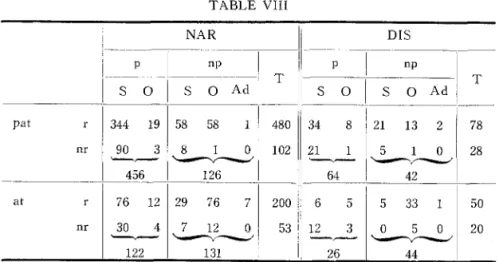
5. 2. When the examples of relatives with antecedent are classified according to personal/nonpersonal, restrictive/non-restrictive and subject/object/adverbial relations, we get the following table.
TABLE VIII
N A R D IS n p
s o s o A d T
s o s n po A d T
p a t 3 4 4 19 5 8 5 8 4 8 0 3 4 2 1
6 4
2 1 1 3 7 8 2 8 1 0 2
1 3 1
I 3 3 5
2 6 4 4 5 0 2 0
Ad : adverbial O includes objects of verbs and regimens of prepositions.
As a relative without antecedent pat occurs 2 times in NAR only, and at does 10 times
inNAR and 7 times inDIS as is shown in Table II. In this function at is the norm.
See§4.0.
5. 3. Restrictive & Non-restrictive Table VIII shows the following figures in terms
of restrictive/non-restrictive function.
NAR DIS
pat r 480: nr 102 r 78: nr 28
at r 200: nr 53 r 50: nr 20
These figures do not tell us that there is any distinction in this function between the two.
They both function non-restrictively as well as restrictively. Continuative relative clauses
are quite rare, that is to say negligible in both pat and at. With this respect compare
these forms with whilk and pe whilk.
5. 4. Personal & Non-personal From Table VIII we get the following statistics concern-
ing personal and non-personal uses of pat and at.
NAR DIS
pat p456:np126 p64:np~~42
at 122: 131 26: 44
578 257 90 86