The Japanese Psychonomic Society
NII-Electronic Library Service
The JapanesePsychonomic Society
ThelapaneseJo"rnalofPsrchonomicScience
2014,Vbl.32,No.2,232.234
Mtorial
Visual
illusion
in
ARTPOP
and
popart
Akiyoshi
KITAoKA
RitsumeikanUhiversity
'
Lady Gaga sfourthCD albumAR711'OP, designedbyAmerican popartist
Jeff
Koens,adopted one ofmy illu-sion works, namelF licrpinurchin, as themain insidedesign,
Thisoccurrence was significant forthestudy ofvisualillusioninthe
fo11owing
threesenses:first,
itdrew
people'sattention tovisual illusion;second, thechosen illusion was novel;and third,for
thefirsttime initshistorxvisual illusionwas recognized asubiquitous.Key words: visual illusien.motion, popart,Ouchi-Spillmannilluslon
Lady
Gaga's
founh
CD
album
ARTPOP
included
artworks of visualillusionAmerican
pop
artistJeff
Koonsdesignedthe cover andin-side of Lady Gaga'sfourthCD album ARTPOP, which was
re-leased
on November 6.2013.He adopted anovel type ofvisualillusionthatfeaturesa moving, shaking, or
jerking
opticalef-fect,
as well as chose one of myMusion
works,Hbrpin
urchin(Figures
1and 2),Thisoccurrence was significant forthestudy ofvisualMusienfor reasons other than theexpected
'
teresttovisual
Musion
from
peopleinfluencedby
LadyGaga
s superstar status worldwide, Inthispaper,Iwi11trytocastlight
on unnoticedbut significant influences.
The chosen illusionisnovel inthestudy of
visual Musion
Hbrpinurchin isan artwork ef a novel typeof motion
illu-sion, which Itentatiyely call"meving
stripes illusion."Thebasicimages are
given
a driftingexpressien(Figures
3a and3b),a retating
demonstration
(Figure
3c),and aradialIymov-ingexpression
(Figure
3d),The illusionof motion isachievedbymeeting the
"necessary
condition" of arranging stripes ofblack
(dark)
and white(light)
elements placedinfrent
ef agraybackground
(intermediate
luminance)(Kitaeka,
2012). Stripesofblack and white squares are suracient fbrrenderingtheillusion
(Figure
3b),whereas adding oblique componentstothestripes enhances theeffect
(Figures
3a,3c,and 3d).Nomodels havebeenproposedtoexplain thesecharacteristics.
Asfaras I
know;
thefirst
dernonstration
of thisillusionisCorrespondingaddress.Ritsumeikan UniversitT;56-1 Tkoji-inKitamachi,Kita-ku,KYoto603-8577,
Japan.
E-mail:[email protected]
copY
attributed toAmericanmathematical artist
Jeff
Berkeleyinhis artworks offractalsfractallllusion(Figure
4a)and FractalZap(Figure
4b)created in1993 and 1994,respectively Koons didnot cheese theseimages forthe CD design.Instead,he
,
ed TautvydasDavainissillusionartwork 5minutes cij}er the
PhiladeiphiaExperimentproducedin2010,which appears to
'
bea derivativeof Berkeleysartworks. Inmy case, I
-
"teredBerkeleys artworks before2008,extracted the moving stripes" illusionfromthem, and then created Harpin urchin in
2008.
The
Ouchi-Spillmann
illusion
wasalso
included
An irnageof theOuchi-Spillmannillusionwas adopted for
thebackcover of theCD
(Figure
5).This
imagewas also'
ducedand providedbyme. Koonssagent consulted with me
regarding this illusion,and Iinformedherof thestudy of this illusion,This illusionhad beencalled
"Ouchi
illusion"butI asked the agent tolabelit"Ouchi-Spillmann illusion"topayrespect tothe
discoverer
LotharSpillmann,who hadrecently".
publishedapaperentitled The Ouchi-Spillmann
illusion
re-yisited" inPerception
(Spillmann,
2013).Iwas unaware oftheintentionof Koonsforincludingthe
il-lusion,
However,Iirnagine thatheintuitivelythought of theOuchi-Spillmann
illusionasbeing
closely related to the"moving
stripes" illusion.Thisideamight beplausible
be-cause the latterisobtained byreducing theimageof the
for-mer
(Kitaoka,
2012),as shown inFigure
6,
Significance
ofvisualillusion
being
chosen
by
thepop
artistPop artisan art movement thatemerged inthe1950sin Britainand theUSA
(LivingstDne,
199e).Jasper
Johns,
Robert Rau$chenberg,Andy Warhol,and Rey Lichtensteingained
right2014.TheJapanesePsychonomic SocietyAllrightsreserved,The Japanese Psychonomic Society
NII-Electronic Library Service
TheJapanesePsychonomic Society
Kitaoka:TutorialVisualiIlusioninAR711'OP and popart 233
Figure 1. HLtpinurchin
(2008,
http;1/ www.psy.ritsumei.ac.jp/--akitaoka/opart5e.html). Theradial arms appear
toexpand orcontract abruptlp triggered
by the eye moyement of observers.
Thjswork was adopted forthecover
of
"Special
Issue;169 BestI]lusions
published
byScientijlcAmerican Mindin2010.
l'
+
Figure 2, Theinsideof LadyGagas
fourth
CD album ARTII'OPdesigned
by
Ieff
Koons,The backgroundof the original work was changed from bluetopink
(reproduced
with permissionfrornUNIVERSAL MUSIC LI.C).fame
aspepartistsinthe2ethcentury Popartchallenges tra-ditionsof fineart or highart, as well as includesimagery frompopularculture or industrialmass products,such as
advertis-ing,news, designs,comic books,commodities, or mundane cultural objects. Inother words, objects or motifs used inpop
artare populartothegeneralpublicor regarded as ubiquitous, VisualilLusionhadnever met thiscriterion
before
theinfor-mation and communications technology revolution
because
peop]eexperienced visual illusionsor illusionworks in psy-chology textbooks or in science museums. At present,people can seethem on theInternet.Thisnbiquitous nature of visual
illusion
has
been
accomplishedby
theparalleldevelopment
oftelecommunications technology and infrastructure,PCs,cell
phones,as well as avariety of communication networks.
Fur-thermore, rnany contributors in theworld continue tostudy
yisual itlusionor create illusionworks.
Jeff
Koons,one of themost prominentcontemporary pop artists,chose visual illusionfortheCD designofthe superstart
LadyGagasARTPOP. The ubiquity of yisual illusion was
con-firmedbythisevent, creating ahistoricalmark inthestudy of visual illusion.
Someremarks
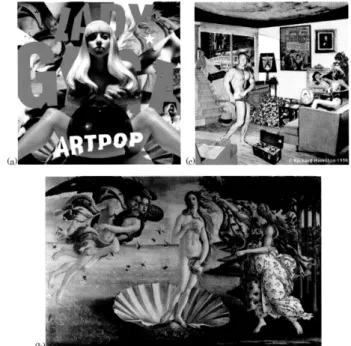
Thedesignofthe frentcever ofARTPOP
(Figure
7a) shows anude sculpture ofLady Gagawithablue
glazingball,
both
ofFigure3.
`'Moving
stripes" illusion.In(a)
and(b),the
insetappears todrift.
(c)
Each blockof rings appears torotatequickly
(d)
Radialarmsappeartoexpandorcontract.i
Figure4.
JeffBerke]ey
sartworks FractalIllusion(1993)
and FractatZap
(1994)
(reproduced
with permissionThe Japanese Psychonomic Society
NII-Electronic Library Service
TheJapanesePsychonomic Society
234
gmoJcli}g・?filfy
T
Figure5. The
back
cover ofthe CD showing an imageoftheOuchi-Spillmannillusion
(reproduced
withsion fromUNIVERSAL MUSIC LLC).
x・
ny
Figure6.
Continuation
betweentheOuchi-Spillrnann
illusion
(the
upper leftimage) andthe "moving stripes'' illusion(in
thethreeother images).Each insetappearstomove.
which were created byKoons,Thiscover designcallstomind
the
painting
The Birthof
Vlenusproduced
byItalianartistSan-droBotticelliin1483
(Figure
7b).Moreove4 Iwould
like
topointout an unnoticed meaning, Ieg
32tsng
2F,・ Cu).L
'/io,
/./.ttt
ccFigure 7.
(a)
The frentcever ofARTPOP(reproduced
with permissionfrem
UNIVERSAL MUSIC LLC);(b)
SandroBottjcel]isTheBirthqt'Vbnus(around
1483);t
t
(c)
RichardHamiltonsJust
what isitthatmakes todayshomesso dttibrent,so ampeating,?
(1956).
think thisimage also pays hornageto theearl>r pop artwork
Just
rvhat isitthatmakes today'shomes
sodtfilerent,
soappeal-ing?
(Figure
7c)producedin1956byBritishpainterRichardHamilton,which isone of themost famouspiecesinpop art
history
(Livingstone,
1990).References
Kitaoka, A.
(2012).
Are shorter sides of the checker pattern critical in the Ouchi illusion?Talk at the 45th Chikaku
(Perception)
Colloquium,Kiyosato,Japan,
on March 30
(in
Japanese).
http:ltwww.psy.ritsumeLac.jpl-akitaoka/chicollo2012.html
Livingstone,M.
C19Ye).
Pop art: a continuing historyNewYbrk:HarryN.Abrams.
Spillmann,L.