The Japanese Psychonomic Society
NII-Electronic Library Service
The JapanesePsychonomic Society
The
JaPanese
Jout7:at
of
l]SychonomicScience
2011,
VoL
30,No. 1,129-130Summary
ofAwarded
Presentation1-216
Effects
of
envelope
motion
and
carrier
motion
in
Gabor
patch
on
perceived
position
Rumi
HisAKATA,*
Masahiko
TERAo,*
and
Ikuya
MuRAKAMi*
The
Uitiversit),
of
7bleyo*
De
Valois
andDe
Valois
(1991)
showedthat
individuals
perceive
a shiftin
the
position
ofa
static
Gabor
patch
with
a
moving
carrier
in
the
direction
of
motion
inside
the
stimulus.In
ourprevious
study, we showedthat
illusory
position
shifts wereinduced
in
the
direction
of
carrier
motionon
the
retina.Here,
weinvestigate
the
effectsot
envelope
motion
on
the
display
and
examined
position
shifts whenthe
envelope and carrier movedindependently,
The
results revealedthat
the
envelope-relativemotion
rather
than
the
display-relative
motion
induced
illusory
position
shifts.Key
words:
illusion,
position
perceptton,
visual
motion
perception
The
precise
neural
mechanisms
that
allow
usto
detect
the
position
ef
an
object
are
still
relatively
unknown.In
psychological
studies,the
perceived
position
of a static objectis
affectedby
motioninside
that
object.
De
Valois
and
De
Valois
{1991)
showed
that
earrier motionin
a staticGabor
patch
induced
a shiftin
the
perceived
position
ofthe
entire stimulus.Indeed,
a
number
of
studies
have
used
various
types
of motionto
induce
an
illusory
position
shift:
carrier
motiondefined
by
binocular
correlation(Murakami
&
Kashiwabara,
2009),
and
carrier
motion
of
a
plaid
pattern
(e.g.
Hisakata
&
Murakami,
2009).
Previous
studies,
however,
have
not
investigated
the
effects
of
envelope
motion
on
perceived
position.
We
previously
showed
that
retinal
carrier
motion
induced
anillusory
position
shift whenthe
envelope
moved
in
the
same
direction
at
same
speed
as
the
eyes
(Hisakata,
Terao,
&
Murakami,
2010),
In
the
current
study, we examined whetherenvelope
mo-tion
affectsthe
perceived
position
of an object and whether envelope motion and carrier motioninter-act,
We
measuredMusory
position
shifts
while
the
enyelope and carrier moved
independently.
Methods
The
subjectsfor
this
studyincluded
one ofthe
authors and seven nai've adults with normalvision.
*Department of
Life
Sciences,
The
University
ofTokyo,
3-8-1
Komaba,
Meguro-ku,
Tokyo
153-8902,
Japan
Copyright2011
The
stimuli weretwo
vertically arraignedGabor
patches
(Fig,1)
presented
on a cathode raytube
monitor(1
min/pix; refreshrate,
100
Hz).
The
upper andlower
images
contained a statichorizontal
car-rierand
a vertical carrierthat
moved at various veLocities.After
the
lower
Gabor
stimulus
waspre-sented
for
750
ms,the
upperGaber
stimulus waspresented
for
250
ms.
The
experimental
conditions
werecharacterized
by
a
static
envelope
or
a
moving
envelope.Under
the
static envelope condition,the
envelopes
of
both
the
upper
and
lower
Gabor
patcbes
were static.
The
carrierin
the
lower
Gabor
patch
moved
at
2.5-5
degls.
Under
the
moving
envelope
condition,
both
envelopes
moved
at
2.5
degls
in
the
same
direction
(Fig.1).
In
this
case,
we assesseddisplay-relative
or
envelope-relative
carrier
velocity.The
display-relative
velocity
was
determined
based
onthe
carriergrating
moving onthe
displayi
-O.5
to
5.5
deg/s
(a
negativevelocity
indicated
that
the
car-rier and envelope movedin
oppositedirections).
The
enve]ope-relative velocity wasdetermined
based
onthe
movement
of
the
grating
relative
to
that
of
the
envelope, and was calculated
by
subtractingthe
en-velope velocityfrom
the
display-relative
velocity:
-3
to
3deg/s.
To
investigate
perception
ofthe
relative
positions
of moving objects, a controlcondi-tion
was usedin
which
both
upper
and
lower
Gabor
patches
were characterizedby
a statichorizental
carner.We
measuredillusory
position
shifts using.
The
Japanese
Psychonomic
Society,
All
rights reserved.The Japanese Psychonomic Society
NII-Electronic Library Service
The JapanesePsychonomic Society
130
The
Japanese
Journa1
of
Psychonomic
Science
VoL30,
No.
1
Figure
1.
Two
Gabor
patches
were
presented
in
lower
visual
fields.
The
fixation
point
was
prescnted
in
upperdisplay.
The
carriermoved at randorn speeds,
stant
methods.
Subjects
wereasked
to
judge
whether
the
upper stimulus wasto
the
right orleft
ofthe
lower
Gabor
patch.
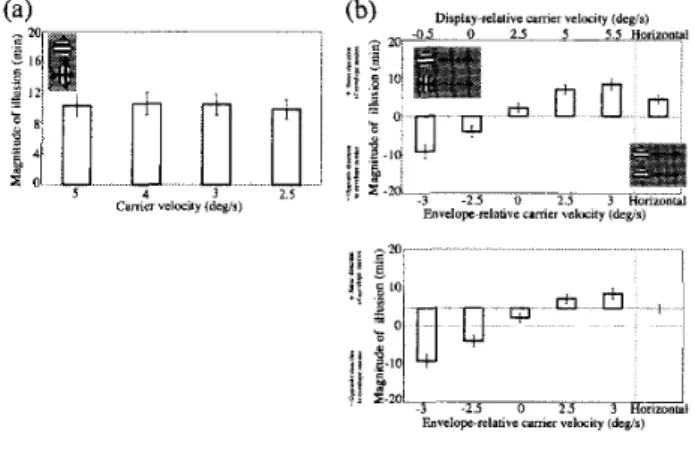
Results
Figure
2a
shows
averaged
positional
shifts
across
subjects underthe
conditionin
whichthe
envelope wasstatic.
We
confirmedrhe
illusory
shiftsin
this
experiment.The
illusion
saturated at2.5
deg/s.
Figure
2b
(upper
panel)
shows averagedpositional
shifts under conditionsin
whichthe
envelope moved.The
lower
axisindicates
the
envelope-relativevelocity,
whereasthe
upper
axis
indicates
the
display-relative
velocity.Under
the
controlcon-dition,
an
illusory
shift
occurred
eventhough
the
two
carriersdid
not move.This
likely
reflectedpositional
shifts causedby
temporal
differences
be-tween
the
uppcr andlower
Gabor
patches,
similar
to
flash-lag
effects.To
extractpositional
shifts onlyby
stimulus
motion,
we
subtracted
the
shift
from
the
other
data
{Fig.
2b,
lower
panel).
The
illusion
was relatedto
the
envelope-relative motion, notthe
dis-p]ay-relative
motion.
Furthermore,
we
found
that
the
magnitude ofthe
position
shifts
decreased
whenthe
carrierand
envelope
moved
in
the
same
direc-tion,
compared with conditionsin
whichthey
rnovedin
oppositedirections
(compartson
of
absolute
val-ues:F(4,
20)=3.66,
p<O.05).
Discussion
In
this
study,
we
showed
illusory
positlon
shiftsin
`
i
Fma
zm...llli,IIIzifI,i
r
lllill:ff
du2
1-
fi
i:
de ,..,,, mi .I/I,
Il
i:1
"'"'
''''
・
・
ge
lli・t[]
C]
i]:
[i]
.,lllj, ETve1rpretdin"rrkry"IL=;/r/.degs]Figure
2.
(a)
The
averagedposition
shiftsin
static envelope condition
inter
subjects,{b)
The
averaged
position
shifts
in
movedvelope
condition,
Positive
illusion
indicated
that
the
envelope was apparently shiftedin
the
samedirection
asthe
envelope andtive
valuesindicated
that
the
envelope
appeared
to
shift
jn
opposite
direction
to
the
envelope motion.
Lower
panel
showedthe
illusions
after
subtractingthe
magnitude ofillusion
in
herizontal
condition.Errer
bars
indicated
the
standard
errors.
the
direction
of carrier motion relativeto
the
enve-lope,
evenif
the
enve]ope ofthe
stimulus moved.We
alsofound
that
the
magnitude ofthe
illusory
shiftsdecreased
whenthe
envelope andcarrier
movedin
sarnedirections.
These
results suggestthat
the
posi-tion
of
a
stimulus
is
primarily
estimated
based
on
the
contour
position
andthis
estimationis
biased
by
motioninside
the
stimulus object.In
addition,the
estimated
position
of
the
object
is
disproportionately
oppositeto
the
direction
of contour motionbecause
the
future
stimulus
position
is
unknown.
References
De
Valois,
R.
L.,
&
De
Valois,
K,
K.
(1991).
Vernier
acuity
withstationary
moving
Gabors.
Vision
Re-search,31(9),
1619-1626.
MurakamL
I.
&
Kashiwabara,
Y.
(2009>.
Illusory
tion
shifts
induced
by
cyclopean
motion.Vision
Research,
49"5L
2037-2043.
Hisakata,
R.
&
Murakami,
I.
(2009>,
Illusory
position
shifts
induced
by
plaid
motion.
Vision
Research,
49