Japanese Physical Therapy Association
NII-Electronic Library Service
JapanesePhysical Therapy Association
M5:lffza7
on'35
tsig4
lj-
132-135
fi
C2eOS")
thffdirsI
Residency
and
Fellowship
Education:
Building
the
Professional;
Advancing
the
Profession
"
Carol
Jo
Tichenor
""
lntroduction
When
wegraduate
t'rom
physicalthcrapy
school welook
forward
to a career of providing rehabilitation serviceto
paLienls,
Wc
are young, energetic und motivatedto
providc
the
bcsL
physicat
therapy carethat
we can.Having
oppor-tunitics
to centinue to adx,ance our clinical skillsprovides
the
nioLivation tokeep
usintercsted
in
eurpatients
andin
our
profession.
The
purpose oflhis
artieteis
to
describe
res-idency
andfellowship
educationin
the
United
States,
specil-ically,
to
outliiie lhe curriculum components andhc)w
PhysicaL
Therapy
<PT)
Departincmts
and academicPT
pro-grams
cundevelop
partnerships
to
creazethese
prograT"s
in
the
cominunizy.}-'Iost
irr]porlant,
this
paper
",illalseaddress
ho",
residency Eindfellowship
educutien canbene[it
tbe
parient,
PT
climician, medical tareorgai]izationsl'hospi-tals.academic
1'T
programs
and the1'T
professien
in
Japan.
History
ofthe
Deve]opment
of
Residency
and
Fellowship
Education
in
the
United
States
,'X
brief
reviesv ofhow
residency andfettowship
programs
were
developed
iTi
the
United
ST.ates
willdemenstrate
along
term
proccss
of chaiigein
education andpractiee
that
mayHssist
Japanese
PT
prefessionalsin
undersLandingopportu-nities and
barriers
rhar may oucur.Kaiser
Permanente
is
thc
]argest
non-profithealth
inaimtenance organizationin
the
Unitad
States,
In
California
in
lhe
I970's,
pliysieaL therapis[spracticed
undcrthe
prescripTix,e
orders of physicians,oi[er-ing
`ultrasoulld,
hot
packs
and inassage' topatients.
1,Ve
rarely
questioned
er conx,ersed ",ithphysicians.
"ie
lendedto
LreaL as `technieians'and our raputation as a
hospila]
in
tt
'
'
'xft1![cctsttevvt';
v-tsles'7-u-y・v
7'ijffg]tv[nto.rcee.
fi#4EfliEJff[di"Otki[
k""i-f-!t-T*>・rsr' ",h)vt)s-
CgCi{1)
C/or]'espondcncc/
Carol
Jo
Ticlwnor,
PT.
N・T,X,
l'T Fcllowship inAdrHnced
C)i'thopedic
)'Ianu[d
Therapy/
Kaisor
P[/rmnnente
N,[edjcai
C'enter,
27400
Ilcsperian
BouLevm'd
Hnywnrd,
California
e4545.USAKey
words 1residency,fellowship,
post-graduntethe
community was reLatls,ely poor.Ill
the
late
1970"s,
severaL ptiysicaltheraplsts
frofn
arouridthe country "rent ovcrseas to siudy manuaL
therapy
in
Norway
and iXustrulia.Some
cameback
toCHLifon]ia
andbegan
teaching fT]unua[ zherapy courses anddcsigned
the
Kaiser
Permanente
Hayward
PT
Fellowship
in
Adx,anced
Orthopedic
ManLial
Therapy.
Kaiser
l'crmanente
elecledto
fund
thisprogram
aspart
ofits
non-prolit status a"d sociaEillission to serv{'
the
coir]inunity.I・{any
oflhe
graduates
ofthe program stayed
to
work is,ithin tha organizatioTt andbeeame
zhe mentorsfor
students and otherless
experiencedP'1'
slafEThey
alsotuught
continuing educationai coursesacross
Northerm
California.
Gradually
pliysicians
began
[o recognizethe
ability ofthese skitted
physicaL
thcrapists
lo solve cotnplexpaticnl
probleLns
and rotakc
rasporisibi]ityfor
inanagingniuseu-loskeletul
problems
Endependently,
Over
time. physicTansbecEtme
willing to collaborate anddelegute
moreresponsi-bility
to
these
skilted physicalthernpists
amd ultimately toall
physical
therapists
in
eurdepartmenLs.
They
begnn
to
trusl the clinTcal
judgrnent
aud recognizephysical
therapists
as speciaaists
in
niusculoskeletu] cai'e.Our
fellowship
in
man-ual
ther2py
Led
tothe
dei,etoptncnt
offive
other residenciesand
fe]lowships
in
Caiifornia.
impacting'
over44
clinics anclhospitals
and oK,er6,6
millionKaiser
Permanente
health
plan
nLeinbers.
Specialist
Certification
Process
in
the
United
States
[['his
section wilt addressthe
spccTalist cartification processin
Lhe
IJnited
States
andho-'
zhe specialisLproccss
con-tributes
to
the
development
of residencies andfellowships.
"/ithlm
the
American
PhysicaE
Thernpy
Association
(APTA)
thcre
is
aboard
identit'ied
asthe
iNmc/-ricanBoard
ofPT
SpecialLies
(ilBPTS)
which overseas specialisL cerLiricationi]i
seven areas/
Cardiovascuiar
undPutmonary,
C;linicaL
Japanese Physical Therapy Association
NII-Electronic Library Service
JapanesePhysical Therapy Association
Residency
andFel]owship
Education/
BuTldTng
Pediatric.
Sports
andWornen's
IIeatth
PT.
Each
ofthe
spe-cialty areas
has
conducted an extensivcpractice
analysis orDescription
ofSpeuialty
Practiee
to
determlne
foundational
knowledge
areas(e.g.
anaLomy,biomechanics,
exercisephys-iology),
ctinicaL medicaL sciencesCpharmacology,
radiology),and
behavToral
sciences underLyingthc
specialty area.The
practice
analysisalso
defines
the
professionalbehaviors
androsponsibilTtTes and the extensive patient management
com-petoncies
{e.g
tests, ineasures andintervcntTon
procedures)
Lhat an adx,anced clinician
in
that specialty zrea i・s,outdbe
expected todemonstrate.
The
competenciesdefined
in
thepracticc
analysis ot'eachspecialty area
form
thebasis
for
u written exaininationin
each specialty area
Once
theindividuaL
has
passed
the
exam-ination,
he
or she reeeives thedesigna[ion
ofOrthopaedic
Clinical
Speciaiist
(C)CS},
Gcriatrit
Clinical
Speciatist
<GCS).
Neurolegical
Clin[cai
Specialist
(NCS),
etc.In
thcUnited
States
in
LO07.
there
are npproxiniately155.000
physicalCher-apists of "'hich :ipproxirriatcl},
6,800
are niembers ef thaAPTA.
Since
1978,
approximately5,700
physical
therupisLshave
successfullypassed
the
specialTsiboard
examiiiationsin
the
areas ef erthopedic, neurologicat,pediatric,
geriaLric,sports amd ciinical clcetrophysiological
physical
therapy,How
Residency
and
Fellowship
Curricula
areDesigned
The
scope of a residency curriculuniis
defined
by
thepr:clice
anaLysis of each speciatly area.As
of2007,
thereare residencies
in
orthopedic, neuro]ogie,geriatric,
sporzs,pediatric
and women'shealth
physic/al
therapy.
The
scope of afellowship
curriculuinis
dcrined
atsoby
a pracliceanaly-sis
in
the subspecialty area withfel[owships
nowcrcden-tialed
in
orthopadic inanualphysical
therapy, muvemeT]tsci-ence,
hand
therapy
and advanced sportstraining.
Fer
thepurposes
ofthis
paper,
the
terms
`residenc/y'and `t'ellowship' wiil
be
usedinterchangeably.
ResideTicy
a"d i'ellowship cLLrricLilainciude
a varicty oflearning
opporrunities that niayinulude
didacLic
course work(foundational
sciences) and clinical course work(cxamination
and
intervention
in
the speciatty area), onHne chat rooms,problem
solx,ing tic.tssions, clinic'LLrounds, andjournat
clubs todiseuss
critiquc current evidcnce.4ti
curriculainclude
ongoing1/1
mentoring with advanced cliniciansi"
lhespe-cialty area.
Each
programhas
periodicpractjcal
examina-tions
with patients and written exaTni"ationsto
assesscom-petency
and requirementsfor
publicaLions
or additionatctin-ical
projects,
1:1
Mentoring:
the
Key
Element
ofResidency
Education
・"
key
part of ttie residency education orfellowship
edu-the
Prefessioiial/
.'Xdvancing
the
Profc/ssion
T3:1
caiion
is
the
opportLLnity [oprovide
patient
care under thegitidance
oi an advanced clinician.The
resident sccspatients
"ithin the speciulty area at
the
hospitd
or clinic i・s,hichis
sponsorillg the residency
progra]n.
During
rhe nientorillgsessien, the resideiit and
the
instructor
-,ork sidcby
sidein
solvlng patient pi'ol)lerristogether.
The
instructor
wiltassist
the
residei]tLo
confirm, expand or refine examinationfTndings,
witL recommend anddemonstrate
additionaiinter-vantaons
to
help
tbepatient
progress
more rapidly ancl scrve'Ls
a resourcein
deterinining
-,hether additionai quasTionsnc/cd
to
be
directed
to
thc
physician
if
medica]problems
may
be
intert'ering,
Threughout
the menteringprocess,
lhcrc/sident
is
taught
to
scliLcritiqltehis
orher
putientugamant on an ongoi"g
basis.
Mentoring
schedules varyaccording
to
the
progrnm
structure(e.g.
part-tima
versusfulHime),
duration
of Lheprogram,
availabiLity ofLhe
tor
and the number of residents wtio arebeing
trained.
The
mentoring may,
for
exanipLe,be
conductedi",o
to
five
hours
per
week on a reguLarbasis
or maybe
once evcry oL'herweek over severa] rnonlhs.
),{entoring
niay a]so occLtrin
blocks
oftime.
e.g.]-2
weekintervats.
Ill
parL-Lime
programs,
mentoring tends
te
b{/
conducted over aLongar
period
ofLiine ",ith
facuLzv
ceTnacL1-2
tiinesper
nionrh,Length
ofResidency
and
Fellowship
Programs
and
Admission
Requirements
Physical
therapists niay attend aresldencyprogram
diately
aftergraduation
froii]
physical
therapy schooL or afLergaining a
fcw
ycars of experienee.Rasidency
programs
ing
in
length
from
oneto
three
years.
Full-time
programs
tend
to
be
oneyear
iii
len.crth
andpart-lime
pregrams
lc/nd
Lo
be
threeyeurs
iii
leng:h.
Residency
programs
Tnclude
1,50()
curriculumhuitrs.
Fellowship
progi'ains
varyin
len.orth
betweeii
6-monT.hs
lo
3
years.
Iiil[-time
programs
areerally
6-inonths
to
oneyear/
parVtiiiie
prog'rarris
tend tobe
2-:S
},earsin
length.
In
order te attand afellowship,
prograins
ge'neraLly
require1-2
ycar
of experienceprior
to
entering
the
program.
Fello",shlps
include
1,OOO
curriculumhours.
Part-time
versusFull-time
Models
At
the
APTiX
website on residencics andfellowships,
therearc "'ebsites
liszed
for
alLprograins
whichdescribe
theirmodels
for
delivery.
hi
apart-time
proRram,
the residcTitmight work at
his,'her
primary
ernptoyment threedays
pcr
week and
travel
to
urieLher sitetwo
davs
a weekto
attcndcourse work, see
patlents
and receix,e menLoring,CoiLrse
"'ork inav
be
on ",eekends orin
the
evei]illg.In
afull-linie
niodel.
the
rcsident may moveto
theleeation
ofthe
gram
andb
¢eomc an employee ofthat
hospital
or cliuic[or
the
duration
olthe
program.
The
residL"ttreats
palic/nts,
Japanese Physical Therapy Association
NII-Electronic Library Service
JapanesePhysical Therapy Association
134
mp・?uti・li',
site(s) ef
the
sponsoringhospital(s)/clinic(s).
How
to
Build
a
Residency
orFellowship:
Community
and
Academic
Partnership$
Within
the
Uuited
Srates
there
are numerous modelsfor
how
residency andfetlowship
pi'ograms
canbe
deN,eloped.
Two
models wiltbe
described
beluw.
In
dex,eloping
uny,type
of resjdencyprogram,
one of thefirst
faciors
to consideris
thetype.
ofprogram
Lhat ",iliattract
the
mostinterest
amongphysicat
therapists
in
anarea or region of the country and
the
breadth
of caseloadthat
mighlbe
avui]able among'hospita]s
in
the
area.Figurc1
is
an example of u polential sLructurefor
a neurologicalI'T
residency
program.
A
mediumto
large
hospital
specializing
ln
neuro-surgcry wouldbe
anidenl
medical centerfor
arelogicai
physTcal
therapy residency asthe
PT
inpatient
andoutpatient
departments
could offer experiencein
acute andsub-acu[e
physicai
therapy.
The
program
mightbe
centeredat the neurosLLrgical
hospital
with clinical coursesin
to.ff.ical
physicul
therapy
and mc/ntoring occurringprimarily
at the neitro-surgieal
hospital.
The
neurosurgicalhospTtal
might aiso elecL Lo
partner
with arehabilitationhospitat
andskMcd nursing
facility
sothai
residents are exposed tetong
tc/rnirehabititation.
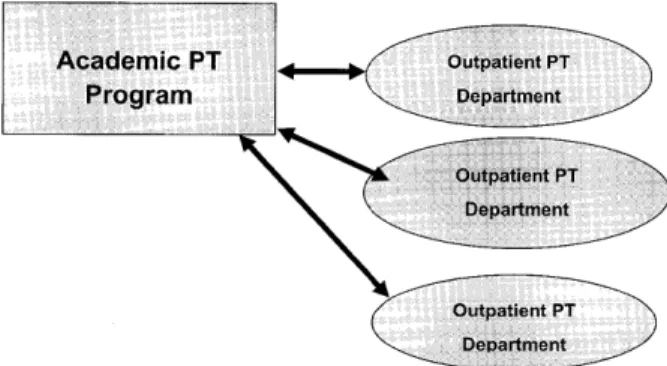
A
partnership
between
an academicprogram
andmunity
hospital
can crcate an excellenL residcney(Fig.
2).
iXcademic
PT
faculty
members coutdprovide
eourse -,ork
in
thefoundational
scie]ices and clinical course workin
the
specialty araa
{e.g.
geriatrics,
orthopedicPT).
The
acaclcmicFig.
1
Example
ofNeurologic
l'T
Residency
Partnership
Fig.
2
Example
ofAcademic
PT
I'rogram
Partnership
withPT
Departments
rg
35
ts
ca
4
PT
program
couldpartner
with seleetedPT
Departments
in
thc
communityto
provide
the
putient
care raquiredfor
the
program.
Academic
PT
faculty
inembers and,'or seuiorphysical
therapists
from
the
communityhospital
coLildvide
the
ongoing1/1
mentoring.Residency
andFellowship
Wage
and
Benefits
Residents
ge-erally
earn approximatety70-75%
ofthe
average salury
for
regularphysicul
therapist
andhavc
areduced
benefit
package such as aheatth
plan
benef"
only.Medical
care orgauizations may chargetuition
to
coverlhc
cost of
the
course worl[ proK,ided to the resident.Like
Kaiscr
Permanente,
some medicar care orgt'mizutions willprovide
constderable
financiat
sul]port teiheprogram
aspart
of [heirsocia[ mission
to
se]'ve the communit},.Benefits
to
Patient$,
PT
CIinicians,
Medical
Care
Organizations
andAcademic
PT
Programs
1'aLients
can expect amore consistentlex,el
of care aLpitals and clinics where a residency
program
has
been
eped
due
to
the
nationaL credentialing standardsthat
arerequjred to
becoma
a credentialedprogram.
As
graduates
finish
the
program
and continue work atthe
residenc},
gram
site orgo
oulto
workln
the
eommunity, thequality
o[ care of
the
community willincrease.
Physical
Therapy
Clinicians:
Gruduates
of residencies aiidfeilo"'ships
reportpositive
impact
ontheir
careerinterest
and
fulfillment
in
thefollowing
areas/1)
careerinterest
and
fulfillment,
2)
abilityto
treat
complexproblems,
3}
abilityto
diagnose
problems(e.g.
additionalproblems
that
may uothnve
been
identified
by
the
physician).
and4)
confidencein
coinnmllicatieni'3).
GraduaLes
consistently reportthat
Lhey
are more confident when they commumicate their
findings
to
patients,physiciiLus
and olherproviders.
Over
tirrie
this
leads
physicians tohave
greater
cenfidence and rcspeetin
the ]]hysical therapist,
i'Xcademic
PT
Pro.c.rrams:
iXs a resu]t ofhaving
acy
programs
in
the
community,PT
progrnms wiUhave
moreskilled
instructors
to
provide clinicaL practicumsfor
studellts.
Students
willbe
able to see role modets of skilled clinicianswho are efficient and effective
in
treatin.u,
patients
andx,ated
to
continue ioprovide
excelleiitphysieat
therapythroughouz
their
careers,,
The
studiesby
Donaldsoni),
Thornburg2),
andSmith
etal.3)taught
us someimportant
tessons
aboutphysical
therapy
professionals,
At
this tlme. graduates of residencies and
iowships
tend rohave
moderateinvotvement
in
variousels of
teaching,
e.g. staffinservicas,
mentorlng other staff,consulting, and academic teachlng, with
limited
invelveTTient
in
research,Tbere
areindividuals
within everyprofessiom
Japanese Physical Therapy Association
NII-Electronic Library Service
JapanesePhysical Therapy Association
Residency
andFellowship
Education/
Buitding
motivated
to
do
research.Every
profession
needs avenuesto
dcx,etop
cxcetlent rcsearchbut
cveryprofession
also needsavenues
that
allo", cliniciansto
develop
excellenL cllnicalskills.
Factors
that
Contribute
to
Building
Residency
and
Fellowship
Education
Rcsidencies
andfellowships
develop
successfullyif
there
is
a cuLture eflifelong
learning
withimthe
surroundingmunity and acress
the
profcssion.
Conl.inuing
educationcourses sponsored
by
physical
therapy
dapartmenrs
ior
iheirown
PT
staffincmbcrs and othcr comtnunityLherapists
con-trTbLtte
stronglyto
building
intercst
and motgs,ationfor
ther-apisrs
to
attend aresidency orfellowship.
Courses
conduct-ed once a week or once a monLh over several months
(ver-sus only on one weekend)help
physical
therapists
tointe-g,rate their skMs and
knowledge
evertime.
Development
ofcontinuin.[r edLtcatTon
directly
impacts
Lhe recruitmeni and retention ofphysical
therapists asChe
hospital's
repLttationfor
excetient educatien andparient
carebecomes
known.
University
programs
can contribute to residencyeduca-tioll
by
offering course workfor
thc clinicalinstructors
whoprovide
ciinical trainingfor
their students.This
is
an avenueto
buitd
the expertise of the clinical comrnunity andimprove
the
clinicaltralping
of students.Out
ofthese
continuingedu-cation courses will emerge skit:ed ctinicians who can
become
resideney aiid
fellowship
facully
members.qonclusion
Development
of rcsidencies andfellowships
in
Japan
requires
long
term
strategic planningdecisions
and theabit-ity
of theprofession
to askdifficutt
questions;
whatis
thelevcl
ofpraetice
thatyou
want to achieve over the next tenyears?
What
types
ofprofessional
relntionshipsdo
you
wishihe
Professional:
Advancing
the
Profession
135
to
achiex,e withphysicians?
Do
youhave
avenuesin
yourpost-graduate
programs
to enablcphysicat
therapists toattain advanced clinical skilLs?
IIew
can youbuild
strongercontinuing educalioll opportunilies ",ithin commLinity
hespi-tats?
As
the
Japanese
Physieal
Therapy
Association
movesferward
in
residency education, numcrous resources areavailable ro
be
sharedfrom
the
Anieriean
Ph],sical
Tharapy
Association
to
acceterateyour
pregress,
A
small numbcr oftherapists
canbegin
the
zransformatieTi ofyour
profcssion.
"/e
in
the
United
States
have
maT]y mere areas togrow
and adx,imce our
practice
but
residency edLtcationhns
helpcd
us
to
begin
that
transformation.
References
l)
Donaldson
)・{B/
,'Nn examk]atien c)fthe ac/crediLed orLhopuedicphysical therapy postgrnduate reside"uv. alld ortliepaedic
al
fcllowship
training'programsin
theUniled
States
andtioll of gruduat'es experience.
PhD
Disscrtation.
Nova
SotLLheastern
University.
College
ofALIied
ITcalth.
Physical
Therapy Depart[nenT, 200Z
21/Thornburg KL. Banaitis
D,
et al:Clinical
fellow6hip
trainiiigin
erthopacdiic manunl physicaL therapy.
A
CIraduate
Stucly.
CiinicaL
Doctorate
Thesis.
Pauific
Universi(y,
Forest
Grove
Oregon,
2004.
3)
Smith
KL,
Tichenor
C/J,
et al:Orthopedic
residency training/A
surve],ofthegradunLes' perspective.
JOSPT
29(11}/635-655,
19g9.
Other
resources:www.apta.org."professional
dcvelopmeiitlreside"cy
&
feLLowship
This website inchLdes tlLe[redelltialillg applicaLion -・hich outlincs
tlLesf/ope of resTdency and
fellowship
curriculum rcquircmcnts, initiuiis,irequently
askedqucstions.
and reseurcesfnr
bullding
grams.
The
prnctice
unalysis foreach speciaLLy section canbc
purchased at the uptu website/ www.apta.org!oniine store.Search
for
theABPTS Descriptioiiof ULinicaLHraclice and
Description
ofSpccialty
Practice.The practice anaLysis