The Pragmatics of Expressing Refusals in
German and American English
journal or
publication title
Kwansei Gakuin University humanities review
volume
18
page range
105-125
year
2014-02-18
The Pragmatics of Expressing Refusals
in German and American English
Amy JOHNSON*
Introduction
For non-native speakers, refusals are a significant cross-cultural “sticking point” (Beebe, Takahashi, and Uliss-Weltz, 1990). For language educators and those interested in cross-cultural pragmatics, refusals are of particular interest because they often involve complex face saving maneuvers and drawn out negotiations. Some degree of indirectness usually exists when refusing because of the risk of offending one’s interlocutor. The content and form of a refusal will vary according to at least 4 types of situations: 1) Suggestions, 2) Offers, 3) Invitations and 4) Requests (Beebe et al., 1990). Sociolinguistic variables such as the social status (Beebe et al., 1990) and social distance of the interlocutor (Beckers, 1999) also play a role in refusal strategies. Refusal strategies vary across cultures and languages (Beebe et al., 1990; Kwon, 2004; Liao and Bresnahan, 1996; Nelson, et al., 2002) and may thus lead to pragmatic transfer to a learner’s L2.
When refusal speech act strategies are inappropriately transferred from a learner’s L1 to an L2, pragmalinguistic failure ensues (Thomas, 1983). Pragmatic transfer has been explored in a number of studies (Beebe et al., 1990; Houck and Gass, 1995; Nelson, Al Batal, and Echols 1996) as a possible reason for pragmatic failure. To better understand why pragmatic failure occurs, however, it may be necessary to first address speech act strategies in a learner’s L1, perform cross-cultural research, and investigate whether pragmatic transfer is occurring and leading to pragmatic failure.
────────────────────────────────────────── * Instructor of English as a Foreign Language, School of Science and Technology, Kwansei Gakuin
University
Kwansei Gakuin University Humanities Review
Vol. 18, 2013 Nishinomiya, Japan
Previous Research on Refusals
One of the earliest studies on refusals was conducted by Beebe et al. (1990). The study compared refusals of native Japanese speakers with those of native English speakers. Pragmatic transfer was shown to occur with Japanese participants speaking English. It was revealed that the status of the interlocutor affected the directness of the refusals. Japanese used more direct strategies when addressing a lower status person and more indirect strategies when addressing a person of higher status than did Americans. Data was collected via a Discourse Completion Test (DCT), which was a written role play questionnaire comprised of 12 situations. A rejoinder followed the blank in which the refusal would fit, making it difficult for subjects to write anything other than a refusal.
Japanese and American refusals were further studied by Saeki and O’Keefe (1994), who collected data with a method similar to the DCT. The strategies employed by the participants were both more direct and literal than expected. Liao and Bresnahan (1996) and Kwon (2004) also used a written DCT to compare refusal strategies. Liao and Bresnahan examined refusal strategies of American English speakers and Mandarin Chinese speakers. They found that Americans and Chinese used different formulaic expressions in refusals and applied different strategies. Americans were less likely to refuse a friend while Chinese were less likely to refuse a family member. Both groups varied their refusal strategies according to social status. Kwon (2004) compared refusals of Korean speakers in Korea and American English speakers in the USA. The study found that Korean speakers hesitated more frequently and used direct refusal formulas less frequently than did the English speakers.
Nelson et al. (2002) investigated the similarities and differences of Egyptian Arabic and American English refusals using an oral DCT. They found that both groups used similar strategies with similar frequencies when making refusals. Refusal strategies were shown to be dependent on the status of the person making the request. Nelson et al. noted, however, the shortcomings of the DCT in that it forced upon participants a negative (refusal) response that, sociopragmatically, participants would not have been comfortable using. Whether this affected results is unclear.
Beckers (1999) compared German and American English refusals. This is the only study directly comparing German and American refusals to date. Beckers (1999) elicited data using a DCT, including 18 situations that might elicit a refusal: requests, invitations, offers, and suggestions. Each situation consisted of three variables: social status, social distance, and gender. She found that Americans varied their refusal strategies according to social status, while Germans varied their refusal strategies according to social distance. Americans used the word “no” more than
Amy JOHNSON
Germans, while Germans more often employed an avoidance strategy. German excuses were vaguer and less direct. Germans employed more gratitude as well as more politeness strategies and resorted to explanations other than their own personal inclinations when refusing.
The Present Study
The present study seeks to add to the current data on cross-cultural pragmatics by investigating German and American English refusal responses.
The research questions are:
1. Does the frequency of direct and indirect refusal strategy usage as reported by a Discourse Completion Task (DCT) differ between Germans and Americans?
2. Do Germans and Americans differ in their reported usage of indirect strategies when refusing?
3. Does the social status (high, equal, low) of the interlocutor affect the reported usage of refusal strategies by Germans and Americans?
Methodology
Overall Design
The following quantitative study was exploratory in nature. It examined the reported refusal responses of native German and American English speakers collected using a written Discourse Completion Task (DCT). Reported refusal responses were categorized according to the refusal taxonomy of Beebe, Takahashi, and Uliss-Weltz (1990). Any differences in the reported refusal strategies between the groups as measured by frequencies of semantic formula sequences were then analysed for statistical significance.
Participants
The subjects of this study were 15 native speakers of American English (AEA) from the USA and 15 native speakers of German from Germany (GSG). The AEA subjects consisted of 11 females and 4 males between the ages of 23 and 37. For the GSG group, 8 subjects were male and 7 subjects were female. German subjects were between the ages of 23 and 40.
The subjects should be considered a sample of convenience and thus results may not be representative of all ages, social classes, or ethnicities of native speakers of American English and German. Subjects were mainly comprised of young white, urban, educated, and upwardly mobile 23−40 year olds.
Instruments
The data was collected using a DCT. The DCT took the form of a written questionnaire comprised of 12 situations using as reference the DCT used by Beebe et al. (1990). Each of the 12 items began with a description of the situation and the establishment of a unique role play scenario. Following the role-play scenario, an empty slot was provided, indicating to the subject that a response was required. Question one, for example, created the following scenario:
You are a teaching assistant for a class at university. One of your favorite students is having trouble with a concept in class. She/he asks you if have time to help her/him with the concept after class today. You have prior engagements.
Student: I really don’t understand this idea from class. Do you have time to explain it to me a bit more right now?
You:
The situations provided in the DCT were broken down into four stimuli types according to Beebe et al. (1990). The four categories of stimuli were: requests, invitations, offers, and suggestions. For each of these stimuli types, the DCT situation specified a relationship to the interlocutor as being either of higher status, of equal status, or of lower status. Each stimulus type thus had three scenarios in the DCT, making up a total of 12 different scenarios. In the DCT, a professor, supervisor, or boss was used to represent an interlocutor of higher status, a friend or classmate was used to represent someone of equal status, and a barista, or a student was used to represent someone of lesser status.
Data Analysis
Data analysis in this study was guided by that of Beebe et al. (1990). After the DCTs were gathered from the AEA and GSG subjects, the contents of the reported refusal responses were analyzed for semantic formulas. The data was coded according to the supplemented refusal taxonomy of Beebe et al. (1990). For example, if a respondent reported that they would refuse a friend’s invitation to dinner by saying “I’m sorry, it’s my wife’s birthday tonight. Maybe we could come by for a drink afterwards,” this was coded as a series of indirect refusals: [expression of regret] [excuse] [statement of alternative]. Semantic formulas coded as direct refusals included, among others, “no”, “I can’t”, and “I don’t think so”. Refusals could be coded as both direct and indirect. For example, the refusal “No, I can’t. But maybe tomorrow.” would be coded as [direct refusal] [indirect refusal: statement of alternative]. Any preliminary remarks which could not function alone as refusals, but which combined with other semantic formulas to express a refusal
Amy JOHNSON
were termed “adjuncts”.
Once the data were classified into semantic formulas, the number of each semantic formula reported for each situation was counted. To answer the first research question, the total number of direct refusals and the total number of indirect refusals for each DCT item was counted. Direct refusals and indirect refusals may be combined when making a refusal. These data for each group were then statistically analysed using a repeated measures analysis of variance (ANOVA) to determine if the differences in directness between groups and within groups were statistically significant. Dependent variables within groups were directness and indirectness. Dependent variables between groups were country of origin, directness, and indirectness. Alpha was set at 0.05. The mean and percent of total semantic formulas for direct and indirect strategies were also calculated.
To answer the second research question, the average percent of each semantic formula reported per total number of semantic formulas reported on the full-length DCT was calculated. The frequency of each semantic formula was calculated by dividing the reported number of that semantic formula used by the total number of semantic formulas used for the DCT item (e.g., number of excuses reported for refusing half a sandwich/ total number of semantic formulas reported for refusing half a sandwich). These frequencies were converted into percentages for reporting. The percent frequency and type of indirect semantic formulas reported by AEA and GSG were compared. Reported usage of semantic formulas in the form of percent frequencies was compared between the two groups with respect to each individual semantic formula.
In order to answer the final research question, the frequencies of each semantic formula usage (expressed as percent of total semantic formulas) were compared between items of higher, equal, and lower refuser status for each of the four stimulus types. The percent frequency of reported usages for each semantic formula was then compared between the AEA and GSG groups for each of the four stimulus types.
Results
Frequency of Direct vs. Indirect Strategies
In order to answer the first research question, Does the frequency of direct and indirect refusal strategy usage as reported by a DCT differ between Germans and Americans? I first compared the number of direct refusal strategies to the number of indirect refusal strategies on the full length DCT.
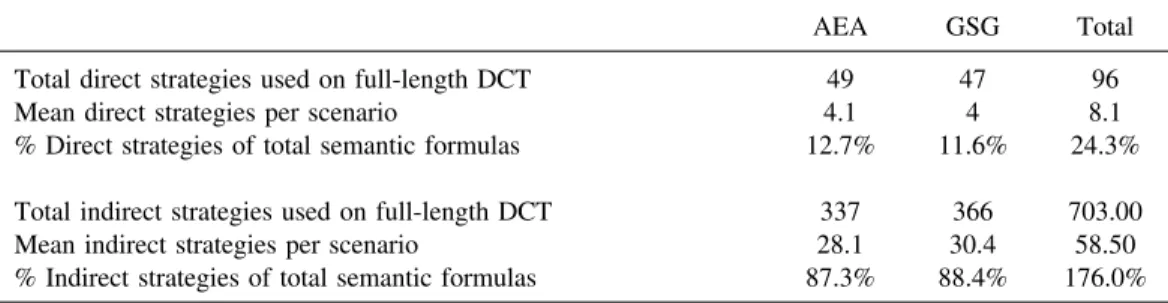
As seen in Table 1, the mean number of direct refusal strategies for AEA subjects was much lower than the mean number of indirect strategies; the mean The Pragmatics of Expressing Refusals in German and American English 109
number of direct strategies for AEAs was 4.1 strategies/item, while the mean number of indirect strategies was 28.1 strategies/item. Indirect strategies made up a total of 87.3 percent of all strategies used on the full length DCT. The average number of strategies per item was 2.4 for the total of 15 AEA subjects. GSG subjects showed a similar ratio of direct to indirect refusal strategies. The mean number of direct and indirect strategies per item was 4.0 and 30.4 respectively for GSG subjects. Indirect strategies made up a total of 88.4 percent of all strategies. The average number of strategies per item was 2.5 for the total of 15 GSG subjects.
Refusals often consisted of a mixture of indirect and direct strategies. Direct strategies never occurred without an accompanying indirect strategy or indirect adjunct strategy. A typical example of an American response with a combination of direct and indirect strategies may be seen in (1) where the subject refuses a friend’s sandwich.
(1) No (direct refusal) Thanks. (gratitude)
I’m quite content with my yogurt and leftovers. (reason)
A typical example of a German response to the same question using a combination of direct and indirect strategies may be seen in (2).
(2) Ne, (direct refusal) No
Danke! (gratitude)
Thanks!
Das Brot ist nicht mein Fall und hungrig bin ich auch nicht. (reason)
That’s not really my kind of sandwich and I’m also not that hungry
Direct strategies most often co-occurred with indirect strategies such as gratitude, statements of positive opinion, statement of an alternative, or reasons.
AEA subjects’ direct refusals made up 12.7 % of the total strategies, while GSG subjects utilized direct refusals slightly less at 11.6 %. To determine if the frequency of direct and indirect refusal strategy usage is significantly different
Table 1 Descriptive Statistics of Direct and Indirect Refusal Strategies for AEA and GSG Groups
AEA GSG Total
Total direct strategies used on full-length DCT Mean direct strategies per scenario
% Direct strategies of total semantic formulas Total indirect strategies used on full-length DCT Mean indirect strategies per scenario
% Indirect strategies of total semantic formulas
49 4.1 12.7% 337 28.1 87.3% 47 4 11.6% 366 30.4 88.4% 96 8.1 24.3% 703.00 58.50 176.0% Amy JOHNSON 110
between the AEA and GSG groups, a repeated measures analysis of variance (ANOVA) was run.
The ANOVA analysed the difference between direct vs. indirect strategy usage was significant and between groups (i.e. whether there was a significant difference between language groups). The dependent variable was directness (i.e., direct or indirect refusal strategies) and the independent variable was country (i.e. GSG or AEA group). The ANOVA found that the difference within groups for direct vs. indirect strategy usage was significant (F=119.64; p=0.000). Both groups used more indirect than direct strategies. The between groups analysis was not, however, significant (F=0.31; p=0.582). This indicates that the greater preference for direct refusals by the AEA group as opposed to the GSG group was not statistically significant.
Indirect Refusal Strategies
To answer the second research question, Do Germans and Americans differ in their reported usage of indirect strategies when refusing? I compared the indirect refusal responses of Americans and Germans. As seen in Figure 1, the four most popular indirect strategies used by Americans and Germans were reasons, gratitude, offering an alternative, and regret. The indirect refusal strategies less often used were stating a positive opinion, requesting more information, avoidance, setting
Figure 1 Indirect refusal strategies on a full-length DCT
specific conditions for acceptance, dissuasion, and “other”.
Strategy: Reason
The AEA group showed a slightly lower percentage use of the semantic formula reason per total semantic formulas for the entire length DCT (24.8 %) than the GSG group (27.9%). In the following examples, AEA and GSG groups both use reason as the sole refusal response to a Professor’s suggestion to change the title of a research paper.
(3) It doesn’t seem to fit with the ideas for the paper. (reason)
(4) Nun . . . das ist nicht gerade das, was ich urspruenglich vorhatte. (reason) Only . . . that isn’t really what I originally had in mind.
Eigentlich wollte ich . . . (reason continued)
Actually I wanted to . . .
Americans and Germans sometimes used reasons as the sole strategy for refusals (making up 3.9% and 3.3% of the total number of reason strategies employed, respectively) as seen in (3) and (4), but most often used reason strategies along with statements of regret and statements of alternatives as illustrated in (5) and (6) where subjects are refusing a request to stay on after class to explain a concept.
(5) Unfortunately, (regret)
I have to meet someone very soon. (reason)
Are you free later today, or maybe tomorrow? If not, I can explain it quickly right now, or we can do it over the phone. (alternative)
(6) Tut mir leid, (regret) I’m sorry,
Ich habe jetzt gerade keine Zeit, (reason)
I don’t have any time right now,
Aber wie waere es mit heute Nachmittag oder Morgen frueh da koennte ich Dir das Konzept ausfuehrlicher erklaeren. (alternative)
But what about this afternoon or tomorrow in the morning? Then I could explain the concept to you in more detail.
Strategy: Gratitude/appreciation
The second most popular indirect strategy among Germans and the third most popular strategy among Americans was the expression of gratitude. While gratitude was considered an adjunct, and thus incapable of functioning as a refusal on its own, it was nonetheless shown to be a vital component of refusal responses. The AEA and GSG groups were nearly identical in the frequency of their use of
Amy JOHNSON
gratitude. Gratitude made up a total of 13.3% of refusal strategies for the AEA group and a total of 13.7% of refusal strategies for the GSG group. Gratitude was found to co-occur with a variety of other strategies including direct refusals, reasons, and alternatives. A typical illustration of gratitude used in combination with direct refusals and reasons may be seen in (7) and (8) where the subject refuses a Barista’s suggestion to try a new beverage.
(7) No (direct refusal) Thanks, (gratitude)
I’ve been craving one of your cappuccinos all week. (reason) (8) Nein (direct refusal)
No
danke! (gratitude)
thanks!
Ich haette gerne meinen Lieblingcappuccino, auf den habe ich mich schon den ganzen Tag gefreut. (reason)
I’d like a cappuccino, my favorite, which I’ve been looking forward to the whole week.
Strategy: Statement of Alternative
Americans used more statements of alternative than German subjects. Statements of an alternative made up a total of 15.1 % of all strategy use by AEA subjects, but only 10.4% of strategy use by GSG subjects. Alternatives were the second most commonly used indirect strategy used by AEA subjects, but the third most commonly used indirect strategy used by GSG subjects. Alternatives were often seen in combination with statements of regret, reasons, and gratitude. A typical AEA refusal response to a boss’s offer to change workplaces with a raise is seen in example (9).
(9) I appreciate that you would consider me for this promotion, (gratitude) but I would prefer to stay in this area. . . .(reason)
If any position in the immediate area would open up though, please consider me for it. (alternative)
Thanks (gratitude continued)
The refusal response to the same offer by GSG subjects was more likely to contain a reason, gratitude, set conditions for future or past acceptance, and/or a statement of regret. A more typical German response containing a statement of alternative may be seen in (6) and in (10) in response to the request to borrow an MP 3 player.
(10) Ich brauch ihn eigentlich selbst. (reason)
I actually need it myself.
Aber ich kann dir eine Kopie meiner Aufzeichnung zusenden. (alternative)
But I can send you a copy of my notes.
Strategy: Statement of Regret
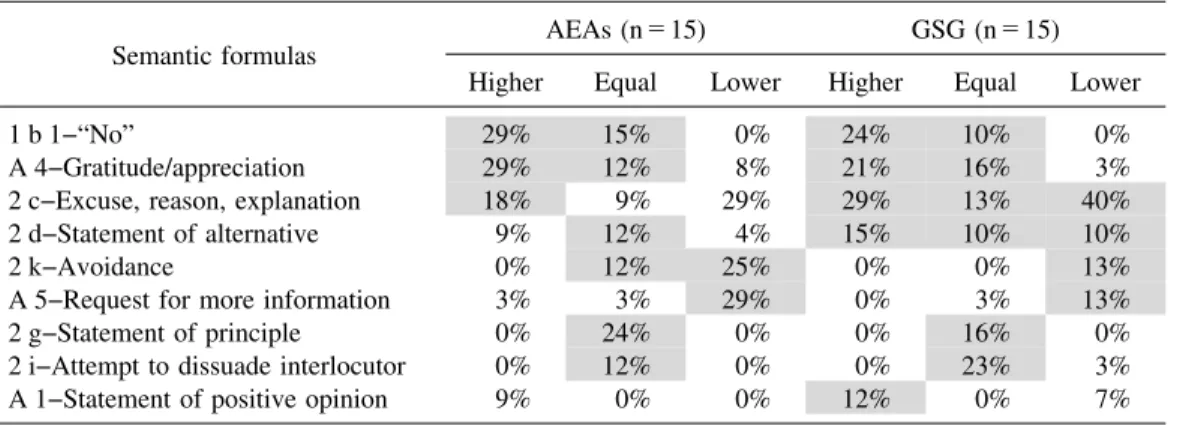
Statements of regret made up a larger percent of total strategy usage by Germans than by Americans. While GSG subjects’ regrets made up 8.8% of total strategies, AEA subjects’ statements of regret made up 6.5 % of total strategies. For item 1 of the DCT, as seen in Table 2, regret made up a total of 21% of total strategies used by Germans, whereas only 16% of total strategies used for Americans. Examples of typical refusal responses for item 1 may be seen in (5) and (6). As seen in Table 3 for item 1, Germans (2%) used less statements of positive opinion than Americans (8%) which may account for the fewer percent of regret strategies per semantic formula used by Americans.
The Effect of Interlocutor Status
In order to answer the third research question, Does the social status of the interlocutor affect the reported usage of refusal strategies by Germans and Americans?, I analysed the differences in strategy usage between DCT items placing the refuser in three different situations: that of higher status, equal status, and lower status relative to the interlocutor. In designing the DCT, the 12 items were divided into four stimulus types: refusals of suggestion, request, offer, and invitation. In the following sections I address semantic formulas with a reported usage of 10% of total semantic formulas or higher.
Refusals of Suggestions
For DCT items 8, 5, and 6, the subject was asked to respond to a suggestion. Item 8 assigned the subject a higher status relative to the interlocutor, item 5 an equal status, and item 6 a lower status.
As seen in Table 2, the semantic formulas most commonly reported by the AEA group in positions of higher status were “no”, gratitude/appreciation, and reason. In the position of equal status, the most reported semantic formulas by the AEA group were more varied and consisted of “no”, gratitude/appreciation, statement of alternative, avoidance, statement of principle, and attempt to dissuade the interlocutor. In the position of lower status, the AEA group reported mostly the semantic formulas reason, avoidance, and request for more information.
The semantic formulas most commonly reported by the GSG group in positions of higher status were “no”, gratitude/appreciation, reason, statement of alternative, and statement of positive opinion. In the position of equal status, the most reported
Amy JOHNSON
semantic formulas by the GSG group consisted of “no”, gratitude/appreciation, reason, statement of alternative, statement of principle, and attempt to dissuade the interlocutor. In the position of lower status, the GSG group reported mostly the semantic formulas reason, statement of alternative, avoidance, and request for more information.
Similarities existed between the American and German groups. Neither group used “no” in positions of lower status. The use of “no” by both groups increased with an increase in refuser status. Both AEA and GSG groups showed an increase in the use of gratitude strategies with an increase in status. Americans and Germans employed more reason strategies when they were in positions of lower status than when in positions of higher or equal status relative to the interlocutor. The semantic formulas statement of principle and attempt to dissuade interlocutor were only commonly used strategies in positions of equal status by both AEA and GSG groups. Request for more information was only a commonly used semantic formula in positions of lower status for both groups.
The main differences between groups lay in the use of the semantic formulas reason, statement of alternative, and avoidance. Americans used a smaller percentage of reasons in all three status categories. Americans only commonly used statements of alternative in positions of equal status, while Germans used them in all status categories. Finally, for Americans, avoidance decreased with an increase in refuser status. For Germans avoidance was only used as a common refusal strategy in positions of lower status. While Americans commonly used the refusal strategy avoidance in positions of equal status, Germans never did.
In summary, for refusals of suggestion, Americans and Germans refusal strategies changed according to interlocutor status. When the refuser was in a
Table 2 Frequency of Semantic Formulas in Refusals of Suggestions (DCT items 8,5,6)
Semantic formulas
AEAs (n=15) GSG (n=15) Higher Equal Lower Higher Equal Lower
1 b 1−“No” 29% 15% 0% 24% 10% 0%
A 4−Gratitude/appreciation 29% 12% 8% 21% 16% 3%
2 c−Excuse, reason, explanation 18% 9% 29% 29% 13% 40%
2 d−Statement of alternative 9% 12% 4% 15% 10% 10%
2 k−Avoidance 0% 12% 25% 0% 0% 13%
A 5−Request for more information 3% 3% 29% 0% 3% 13%
2 g−Statement of principle 0% 24% 0% 0% 16% 0%
2 i−Attempt to dissuade interlocutor 0% 12% 0% 0% 23% 3% A 1−Statement of positive opinion 9% 0% 0% 12% 0% 7% Note. Expressed as percentage of total semantic formulas per DCT item.
Highlighted areas indicate a percent of 10 or higher.
position of higher status, he/she used 3−4 basic strategies (“no”, gratitude, reason, or alternative). In positions of equal status, there was an increase in the variety of semantic formula types used; these were usually the basic 3−4 strategies used in positions of higher status plus 2−3 more. In positions of lower status the semantic formulas “no” and gratitude were used less than in the other two status positions and the semantic formulas reason, avoidance, and request for more information were used more.
Refusals of Requests
For DCT items 1, 2, and 12, the subject was asked to respond to a request. Item 1 assigned the subject a higher status relative to the interlocutor, item 2 an equal status, and item 12 a lower status.
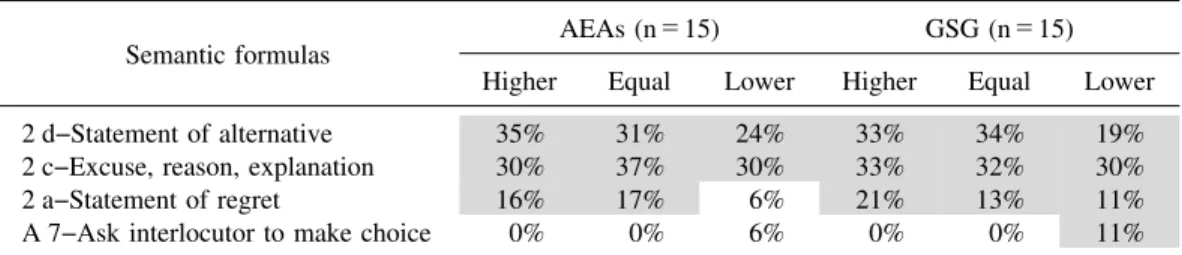
As seen in Table 3, the semantic formulas most commonly reported by the AEA and German groups in positions of higher and equal status were statement of alternative, reason, and statement of regret. In the position of lower status, the AEA group reported most commonly the semantic formulas statement of alternative and reason, while the GSG group most commonly reported the semantic formulas statement of alternative, reason, statement of regret, and ask interlocutor to make choice.
There were many similarities between the AEA and GSG groups. Both groups showed similar types and frequencies of semantic formula usage overall. The most commonly employed types of refusal strategies used by Americans and Germans (statements of alternative, reason, and statement of regret) were identical in positions of higher and equal status. These refusal strategies differed only in frequency of use. Americans and Germans showed the highest use of the semantic formula statement of alternative in positions of higher and equal status, but showed less use in positions of lower status. Americans and Germans both showed a similar percent use of reasons, which appeared to be independent of the status of the interlocutor. For statements of regret, AEA and GSG groups both showed higher use in positions
Table 3 Frequency of Semantic Formulas in Refusals of Requests (DCT items 1, 2, 12)
Semantic formulas
AEAs (n=15) GSG (n=15) Higher Equal Lower Higher Equal Lower 2 d−Statement of alternative 35% 31% 24% 33% 34% 19% 2 c−Excuse, reason, explanation 30% 37% 30% 33% 32% 30%
2 a−Statement of regret 16% 17% 6% 21% 13% 11%
A 7−Ask interlocutor to make choice 0% 0% 6% 0% 0% 11% Note. Expressed as percentage of total semantic formulas per DCT item.
Highlighted areas indicate a percent of 10 or higher.
Amy JOHNSON
of higher and equal status than in positions of lower status. In addition, both groups used the semantic formula acceptance in positions of lower and equal status, but never in positions of higher status. Finally, the use of the semantic formula “no” was never used in positions of lower status by either the AEA or GSG groups and both groups showed an increase in the semantic formula acceptance with a decrease in refuser status.
Americans and Germans differed in their use of semantic formulas in positions of lower status; Americans commonly used the semantic formulas statement of alternative and reason, whereas Germans commonly used the semantic formulas statement of alternative, reason, statement of regret, and ask interlocutor to make choice. Germans used more of a variety of semantic formulas when making refusals in positions of lower status than Americans. In positions of lower status, Americans used fewer types of semantic formulas when refusing than in positions of higher or equal status.
In summary, for refusals of requests, the type and frequencies of semantic formulas used in positions of higher and equal status were the same for Americans and Germans. Thus, the effect of interlocutor status was not observed between semantic formulas in positions of higher and equal status. In positions of lower status, there were a wider variety of semantic formulas used than in positions of higher or equal status. In addition to the semantic formulas used in positions of higher and equal status, the semantic formulas acceptance and ask interlocutor to make choice were commonly used.
Refusals of Offers
For DCT items 7, 9, and 11, the subject was asked to respond to an offer. Item 7 assigned the subject a higher status relative to the interlocutor, item 9 an equal status, and item 11 a lower status.
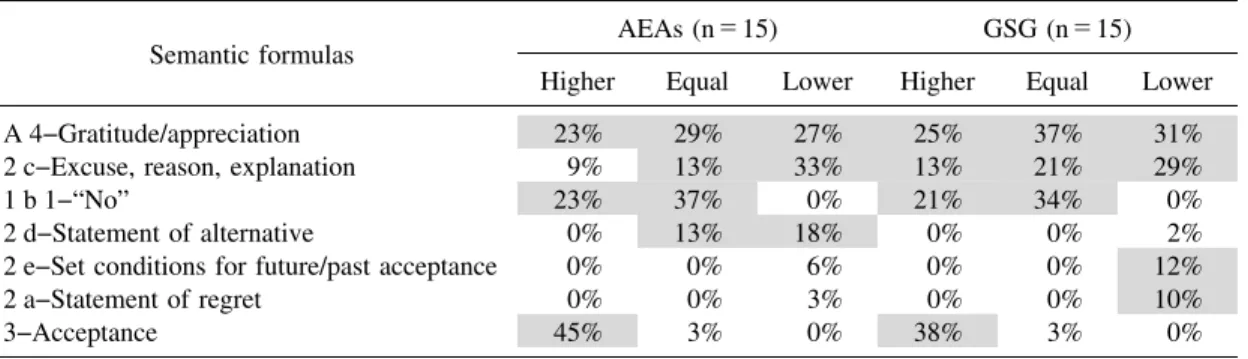
Table 4 Frequency of Semantic Formulas in Refusals of Offers (DCT items 7,9,11)
Semantic formulas AEAs (n=15) GSG (n=15)
Higher Equal Lower Higher Equal Lower
A 4−Gratitude/appreciation 23% 29% 27% 25% 37% 31%
2 c−Excuse, reason, explanation 9% 13% 33% 13% 21% 29%
1 b 1−“No” 23% 37% 0% 21% 34% 0%
2 d−Statement of alternative 0% 13% 18% 0% 0% 2%
2 e−Set conditions for future/past acceptance 0% 0% 6% 0% 0% 12%
2 a−Statement of regret 0% 0% 3% 0% 0% 10%
3−Acceptance 45% 3% 0% 38% 3% 0%
Note. Expressed as percentage of total semantic formulas per DCT item. Highlighted areas indicate a percent of 10 or higher.
As seen in Table 4, the semantic formulas most commonly reported by the AEA group in positions of higher status were gratitude/appreciation, “no”, gratitude/ appreciation, and acceptance. In the position of equal status, the most reported semantic formulas by the AEA group were gratitude/appreciation, reason, “no”, and statement of alternative. In the position of lower status, the AEA group reported mostly the semantic formulas gratitude/appreciation, “no”, and statement of alternative.
The semantic formulas most commonly reported by the GSG group in positions of higher status were gratitude/appreciation, reason, “no”, and acceptance. Due to the nature of DCT item 7, the acceptance response may have been exaggerated, and thus the frequencies of other semantic formulas in positions of higher status may be under represented. In the position of equal status, the most reported semantic formulas by the GSG group consisted of gratitude/appreciation, reason, and “no”. In the position of lower status, the GSG group reported mostly the semantic formulas gratitude/appreciation, reason, set conditions for future/past acceptance, and statement of regret.
Similarities existed between the AEA and GSG groups. The use of gratitude/ appreciation showed similar frequencies among all status groups for both Americans and Germans. The reported use of the semantic formula reason and statement decreased with an increase in interlocutor status. For both groups the semantic formula “no” was never used in positions of lower status; its greatest usage was in positions of equal status. Finally, acceptance only commonly occurred in positions of higher status.
The main differences between groups were observed in the frequency of the semantic formulas statement of alternative, set conditions for future/past acceptance, and statement of regret. The semantic formula statement of alternative decreased with an increase in interlocutor status for the AEA group, but was rarely used by the GSG group. The frequencies of the semantic formulas statement of regret and set conditions for future/past acceptance were less for the AEA group than the GSG group in positions of lower status.
In summary, for refusals of offers, the type and frequencies of semantic formulas used in positions of higher and equal status were similar for Americans and Germans. Thus, like for refusals of requests, the effect of interlocutor status was not greatly observed between semantic formulas in positions of higher and equal status. Due to the overrepresentation of the semantic formula acceptance in DCT item 7, percentages of other semantic formulas in positions of higher status were assumed to be similar to those in positions of equal status. In positions of higher and equal status, the AEA and GSG groups used 3−4 basic strategies (“no”, gratitude, reason, or alternative). In positions of lower status, there were a wider
Amy JOHNSON
variety of semantic formulas used than in positions of higher or equal status. The semantic formula “no” was used less than in the other two status positions and the semantic formulas reason, statement of regret, and set conditions for future/past acceptance were used more.
Refusals of Invitations
For DCT items 3, 10, and 4, the subject was asked to respond to a suggestion. Item 3 assigned the subject a higher status relative to the interlocutor, item 10 an equal status, and item 4 a lower status.
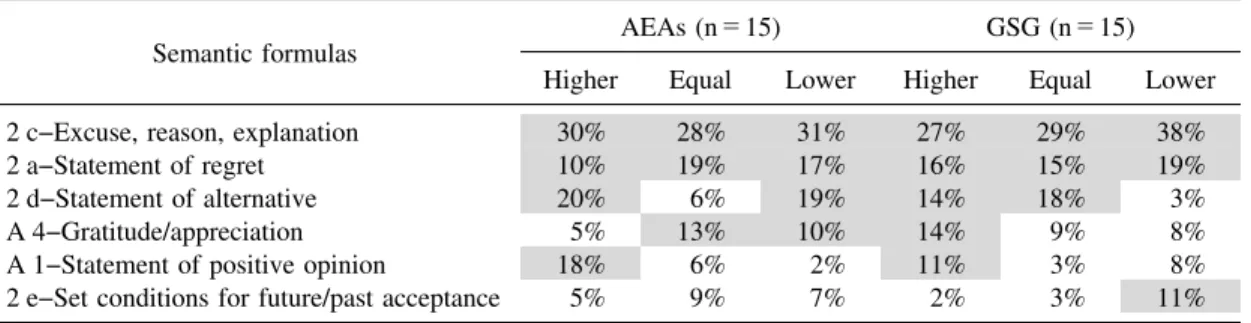
As seen in Table 5, the semantic formulas most commonly reported by the AEA group in positions of higher status were reason, statement of regret, statement of alternative, and statement of positive opinion. In the position of equal status, the most reported semantic formulas by the AEA group were reason, statement of regret, and gratitude/appreciation. In the position of lower status, the AEA group reported mostly the semantic formulas reason, statement of regret, statement of alternative, and gratitude/appreciation.
The semantic formulas most commonly reported by the GSG group in positions of higher status were reason, statement of regret, statement of alternative, gratitude/ appreciation, and statement of positive opinion. In the position of equal status, the most reported semantic formulas by the GSG group consisted of reason, statement of regret, and statement of alternative. In the position of lower status, the GSG group reported mostly the semantic formulas reason, statement of regret, and set conditions for future/past acceptance.
Americans and Germans utilized similar types of refusal strategies, but differed in the percent frequencies of some of these semantic formulas. The semantic formulas reason and statement of regret were used similarly by both Americans and Germans in all status groups.
Americans and Germans differed in the percent reported usage of the
Table 5 Frequency of Semantic Formulas in Refusals of Invitation (DCT items 3, 10, 4)
Semantic formulas
AEAs (n=15) GSG (n=15) Higher Equal Lower Higher Equal Lower 2 c−Excuse, reason, explanation 30% 28% 31% 27% 29% 38%
2 a−Statement of regret 10% 19% 17% 16% 15% 19%
2 d−Statement of alternative 20% 6% 19% 14% 18% 3%
A 4−Gratitude/appreciation 5% 13% 10% 14% 9% 8%
A 1−Statement of positive opinion 18% 6% 2% 11% 3% 8%
2 e−Set conditions for future/past acceptance 5% 9% 7% 2% 3% 11% Note. Expressed as percentage of total semantic formulas per DCT item.
Highlighted areas indicate a percent of 10 or higher.
commonly used semantic formulas statement of alternative, gratitude, and statement of positive opinion. Percent usage of these semantic formulas was affected by interlocutor status, and group (AEA or GSG). For example, the use of ‘statement of alternative’ was quite different between AEA and GSG groups. Americans showed similar usage of statements of alternative in positions of higher and lower status, although usage in positions of equal status was much lower. Germans showed a higher usage of statements of alternative in positions of higher and equal status than in positions of lower status. Gratitude and statements of gratitude positive opinion also showed different trends between the AEA and GSG groups as seen in Table 5.
In summary, for refusals of invitation, Americans and Germans refusal strategies changed according to interlocutor status. When the refuser was in a position of higher status, he/she used 4−5 basic strategies (reason, regret, alternative, gratitude, or statement of positive opinion). In positions of equal status, there was a decrease in the variety of semantic formula types used; these semantic formulas were reason and regret plus either statement of alternative or gratitude. In positions of lower status, the semantic formulas used for the AEA group were similar to those used in positions of higher or equal status, except for varying frequencies of the semantic formulas statements of positive opinion and statements of alternative. In positions of lower status the semantic formulas used for the GSG group were similar to those used in positions of equal status, except for a lower reported frequency of statements of alternative and higher reported frequency of set conditions for future/past acceptance.
Discussion
These results suggest that there are more similarities than differences in how the Germans and Americans in this study report refusal responses. These findings also do not support Beckers’ (1999) findings that Americans used the word “no” more than Germans or that Germans were less direct and employed the refusal strategy of avoidance more often. The present study found that the difference in reported use of indirect strategies was not statistically significant between the German and American groups. The German group in this study reported a smaller percentage of avoidance use per total number of semantic formula than the American group, although the difference between groups was relatively small at 0.6 % of total semantic formulas.
Beckers (1999) elicited data using a DCT, which included 18 situations and three variables (social status, social distance, and gender) that might elicit a refusal. Because the DCT of the present study involved different situations than those used by Beckers and examined fewer variables, the refusal responses reported for each
Amy JOHNSON
study may not be comparable. Thus I cannot be sure that the differences reported in the findings of the present study represent actual differences or differences due to methodology.
The frequency of direct and indirect refusal strategies as reported by the DCT did not significantly differ between the German and American groups. Thus the potential for incorrect pragmatic transfer of direct or indirect refusal strategies does not appear to warrant special concern for either group. These data provide no reason to portray Americans or Germans as more direct than the other, at least in making refusals.
American and German indirect strategies appear to be more similar than different. While Americans and Germans do differ in their reported usage of percent frequency of indirect strategies when refusing, these differences are less than 5 % for any single semantic formula. Thus the data do not justify any fear that pragmatic transfer of indirect strategies between groups would lead to pragmatic failure.
The social status of the interlocutor was found to affect the reported usage of some refusal strategies by Americans and Germans. Results suggest that for Americans and Germans making refusals of suggestion and invitation, the status of the interlocutor is an important variable in determining which refusal strategies will be employed and how often. In positions of higher status, a small set of semantic formulas are used, perhaps because such a situation does not warrant extensive face-saving maneuvers for the AEA and GSG groups. Depending on the type of refusal (suggestion or invitation), more or less variety of semantic formulas may be used for face-saving maneuvers in positions of equal status. This may suggest that refusals of suggestion require more intricate and variable maneuvers in order not to offend the interlocutor than do refusals of invitation. Finally, for refusals of suggestion and invitation, Germans and Americans used different types and frequencies of refusal strategies in positions of lower status, thus suggesting a potential point of pragmatic failure.
The most noticeable trend in the data was in the distribution of “no”. In all stimulus types direct refusals taking the form of “no” were only seen in circumstances in which the refuser was in the position of higher or equal status. This may suggest that it is pragmatically unacceptable in the AEA and GSG groups to use the refusal response “no” when responding to an interlocutor of higher status.
How semantic formulas patterned depended on the status of the interlocutor, the stimulus type (request, invitation, offer, or suggestion), and the language group. Unfortunately, this study examined refusal responses while accounting only for these three variables, while in reality there are a multitude of variables which may interact and affect refusal responses. While most American and German refusal strategies found in this study patterned in similar ways according to interlocutor status, some, The Pragmatics of Expressing Refusals in German and American English 121
like refusals of invitations and offers in positions of lower status, did not. Thus the potential for pragmatic failure between the two groups due to pragmatic transfer and varying with interlocutor status may very well exist.
Overall, for the American and German groups in this study, more similarities were found in how the groups reported refusal responses than substantial differences. While each group slightly preferred certain indirect refusal strategies on the whole, these observed pragmatic differences do not seem to warrant teaching in the language classroom. With regard to the overall types and frequencies of semantic formulas employed by both groups, the findings of the present study provide no reason that pragmatic transfer would lead to pragmatic failure between German and American English. However, in very specific situations, such as for refusals of invitation and offers in positions of lower status, the potential for pragmatic failure may not yet be dismissed.
Limitations
The most significant limitation of the present study lay in the instrument of data collection, the DCT. Each question on the DCT was unique and thus contained numerous variables. It could be argued that these variables decreased the validity of results and were even too numerous to run statistical tests. In order to increase the reliability and validity of the results, the number of variables influencing the subjects’ responses must be eliminated. Production questionnaires, such as the DCT, force subjects to imagine themselves in situations where there are multiple possibilities unaccounted for, all of which may influence their responses. Because of the very nature of the DCT, these variables may not all be accounted for. A DCT often asks subjects to imagine how a fictive person would act in fictitious circumstances. Thus whether the variables are accounted for or not, they are often not authentic or relevant to the lives of the subjects.
Data gathered using production questionnaires are not equivalent to authentic data and thus must not be treated as such. In a study by Hartford and Bardovi-Harlig (as cited in Kasper, 2000) it was found that production questionnaires produced a narrower range of semantic formulae and fewer status preserving strategies than authentic data. Beebe and Cummings (as cited in Kasper, 2000) compared production questionnaire to authentic data and found that questionnaires did not represent natural speech. Word choice, the range of refusal strategies employed, and response length differed between the two forms of data collection. However, the “canonical shape” of refusals was preserved in the DCT responses, leading researchers to believe that DCTs may be potentially valuable in illuminating the social and psychological factors affecting speech performance as well as in establish initial classification of refusal strategies (Beebe & Cummings as cited in
Amy JOHNSON
Kasper, 2000).
The data, which were collected, were considered preliminary because of the particularly limited scale and scope of this study. The gender and age of the requester and refuser, the social distance between them (stranger or intimate), the degree of inconvenience imposed upon the refuser, the personal priorities of the refuser, the refuser’s desire for solidarity, the current mood of the refuser, the politeness and appropriateness of the request/offer/suggestion/invitation, etc. may all play a part in how a particular refusal response will be formulated. Unfortunately these variables are not easy to isolate, nor do they lend themselves easily to disclosure via a DCT. This study would be well augmented using an ethnographic study of German and American English refusal responses in natural settings.
Comparing the frequencies of semantic formulas reported by AEA and GSG participants will not reveal which group of speakers is more or less direct when refusing. Reported behavior and actual behavior are different things. Results, however, may provide insight into how speakers with different sociolinguistic norms think that they would refuse. The refusals that participants report may reveal what a culturally acceptable refusal response would look like in theory, thus exposing their language ideology. The data obtained from such research, once further investigated, may be helpful in teaching pragmatically acceptable refusal responses in foreign language classrooms and may help determine where students are most likely to have pragmatic difficulties due to possible pragmatic transfer.
Clearly the scope of the present study is limited. Participants may be considered a sample of convenience and in no way constitute a random sample. Results may not be generalizable to all speakers of American English or German. Results reflect the reported refusal strategies of the members of the AEA group and GSG group in the sample.
Conclusion
The hope of the present study was to investigate German and American English refusal responses in order to add to the current data on German and American English cross-cultural pragmatics. It was found that Germans and Americans show many similarities in the frequency and type of their reported refusals.
The main limitation to this study was the instrument of data collection, the DCT. The situations in the DCT contained many variables, thus potentially decreasing the validity of the results. Although this study examined refusal responses while accounting for the variable of social status, there are in reality a multitude of variables which may affect refusal responses. This study would be well The Pragmatics of Expressing Refusals in German and American English 123
augmented using an ethnographic study of German and American English refusal responses in natural settings.
In spite of these limitations, the present study found that the frequency of direct and indirect reported refusal strategy usage does not differ significantly between German and Americans. However, within groups, both Americans and Germans reported significantly more indirect refusal strategies than direct.
Americans and Germans used very similar types and frequencies of indirect strategies when refusing. The greatest differences between groups were for the refusal strategies of statement of alternative and reason; Americans showed higher percent usage of the refusal strategy statement of alternative, expressed as percent of total semantic formulas on the full-length DCT, while Germans showed higher percent usage of the refusal strategy reason. Overall, however, differences between groups were less than 5%.
The social status of the interlocutor affected the reported usage of refusal strategies by Germans and Americans. For all stimulus types direct refusals taking the form of “no” were only seen in circumstances in which the refuser was in the position of higher or equal status, which may suggest that it is pragmatically unacceptable in the AEA and GSG groups to use “no” when responding to an interlocutor of higher status.
For Americans and Germans making refusals of requests and offers, the positions of higher and equal status were viewed as one status group semantically. For Americans and Germans making refusals of suggestion and invitation, all three positions of interlocutor status were important and separate variables in determining which refusal strategies would be employed and how often. In refusals of requests and offers, the greater variety in the semantic formulas employed in positions of lower status may reflect that for AEA and GSG groups, a wider range of indirect refusal strategies is necessary in order not to offend the higher status interlocutor. For refusals of suggestion and invitation, Germans and Americans used different types and frequencies of refusal strategies in positions of lower status, suggesting a potential point of pragmatic failure.
Overall, the findings of the present study identified more similarities in how the AEA and GSG groups reported refusal responses than substantial differences. With regard to the overall types and frequencies of semantic formulas employed by both groups, the findings of the present study provide no reason that pragmatic transfer would lead to pragmatic failure between German and American English. However, in very specific situations, such as for refusals of invitation and offers in positions of lower status, the potential for pragmatic failure may still pose a threat. Teaching pragmatic differences between refusal responses in German and American English in the classroom may thus not be necessary except in very specific refusal situations.
Amy JOHNSON
References
Beckers, A. M. (1999). How to say “no” without saying “no”: A study of the refusal strategies of Americans and Germans. PhD diss., University of Mississippi. New York: Plenum Press. Beebe, L. M., Takahashi, T., & Uliss-Weltz, R. (1990). Pragmatic transfer in ESL refusals. In R. Scarcella, E. Anderson, and S. Krashen (Eds.), Developing communicative competence in a
second language (pp.55−73). New York: Newbury House.
Celce-Murcia, M. and Larsen-Freeman, D. (1983). The grammar book. Rowley, Mass.: Newbury.
Cohen, A. (1996). Speech acts. In S. McKay and N. Hornberger (Eds.), Sociolinguistics and
language teaching (pp.383−420). New York: Cambridge University Press.
Davies, C. E. (2004). Developing awareness of crosscultural pragmatics: The case of American/ German sociable interaction. Multilingua, 23, 207−231.
Houck, N. and Gass, S. M. (1995). Non-native refusals: A methodological perspective. In S. Gass & J. Neu (Eds.), Speech acts across cultures: Challenges to communication in a
second language (pp.45−63). New York: Mounton de Gruyter.
House, J. (1988). Speech act performance in German: On the realization of the speech actions “Request” and “Apology”. Linguistische Berichte, 23/3, 207.
Kasper, G. and Blum-Kulka, S. (Eds.)(1993). Interlanguage pragmatics. New York: Oxford University Press.
Kasper, G. (2000). Data collection in pragmatics research. In H. Spencer-Oatey (Ed.), Culturally
speaking. New York: Continuum.
Kwon, J. (2004). Expressing refusals in Korean and in American English. Multilingua, 23, 339− 364.
Liao, C. and Bresnahan, M. I. (1996). A contrastive pragmatic study on American English and Mandarin refusal strategies. Language Sciences, 18, 703−727.
Lovik, T. A. (1987). Pragmatic pitfalls of learning/teaching German. Die Unterrichtspraxis/
Teaching German, 20/1, 36−44.
Nelson, G. L., Al Batal, M., & Echols, E. (1996). Arabic and English compliment responses: Potential for pragmatic failure. Applied Linguistics, 17, 411−432.
Nelson, G. L., Carson, J., Al Batal, M., & El Bakary, W. (2002). Cross-cultural pragmatics: Strategy use in Egyptian Arabic and American English refusals. Applied Linguistics, 23/2, 163−189.
Rings, L. (1994). Beyond grammar and vocabulary: German and American differences in routine formulae and small talk. Die Unterrichtspraxis/ Teaching German, 27/2, 23−28. Saeki, M. and O’Keefe, B. (1994). Refusals and rejections: Designing messages to serve
multiple goals. Human Communication Research, 21, 67−102.
Thomas, J. (1983). Cross-cultural pragmatic failure. Applied Linguistics, 4/2, 92−112.