Comparative Investigation on the Reliability of
Concept Map Assessment with Kit-Build Method
and Manual Methods
Warunya Wunnasri
1, Jaruwat Pailai
1, Yusuke Hayashi
1and Tsukasa Hirashima
1 1Graduate school of Engineering, Hiroshima University, Japan
Abstract: This paper describes an investigation into the reliability of an automatic assessment method of the learner-build concept map by comparing it with two well-known manual methods. We have previously proposed the Kit-Build (KB) concept map framework where a learner builds a concept map by using only a pro-vided set of components, known as the set “kit”. In this framework, instant and automatic assessment of a learner-build concept map has been realized. We call this assessment method the “Kit-Build method” (KB method). The framework and assessment method have already been practically used in classrooms in various schools. As an investigation of the reliability of this method, we have con-ducted an experiment to compare the assessment results of the method with the assessment results of two other manual assessment methods. In this experiment, 22 university students attended as subjects and four as raters. It was found that the scores of the KB method had a very strong correlation with the scores of the other manual methods. The results suggest that automatic assessment of the Kit-Build concept map can attain almost the same level of reliability as well-known manual assessment methods.
1.
Introduction
Concept maps were developed in 1972 in Novak and Musonda’s research program [1] which investigated changes in children’s knowledge of science. Novak and Musonda’s research was based on the learning psychology of Ausubel et al. [2] which discussed the assimilation of new knowledge into existing knowledge by learners. A concept map represents conceptual understanding via connections and links between concepts. To build the concept map, creators have to organize their knowledge following their target. The concepts should be ordered by placing the general concept in the top hierarchy and specific concepts at the bottom [3]. Moreover, concept maps can help learners to significantly reduce their learning cognitive load, because concept maps assist in the integration of knowledge and facilitate learners in their independent learning and thinking [4]. Due to these characteristics, concept map is used to organize and represent knowledge extensively.
Afterward, the concept maps are used in a classroom situation for checking learners’ understanding. Several educational researchers proposed the concept map assessment method for checking learners’ understanding. These assessment methods, which are processed manually, are reasonable for evaluating concept maps, but they entail high costs, such as time and human workload, for scoring
each concept map. Hence, an automatic concept map assessment is proposed for decreasing time cost and human workload.
The Kit-Build concept map (KB map) is a framework to realize automatic concept map assessment [5, 6]. In the KB map framework, a learner builds a concept map by using only a provided set of components, referred to as the set “kit”. Instant and automatic assessment of a learner-build concept map, realized in this framework, is referred to as the “Kit-Build method” (KB method). In this framework, the set of components are made by decomposing a concept map that is built by a responsible teacher. This map is called the “teacher-build map”. Then, a learner is requested to build a concept map to express his/her comprehension for the same topic or teaching. Because all components of the learner-build map are the same as the teacher-build map, automatic assessment of a build map is realized by comparing the learner-build map with the teacher-learner-build map. KB map and assessment methods have already been practically used in classrooms in various schools, for example, in science learning in elementary schools [7, 8], geography in junior high schools [9], and the learning of English as a second language [10].
These practices have shown that the KB map is suitable for use in teaching situation where the instructor gives
人工知能学会研究会資料 SIG-ALST-B508-02
directions followed by instructor’s interpretation. How-ever, we have not previously compared the KB method with other well-known manual methods that are accepted as reliable. Although the automatic assessment method has advantages over manual assessment, for example, real time assessment/feedback, load reduction of the rater/teacher, etc., the reliability of automatic assessment requires investigation. In this study, the results of manual methods were assumed to be reliable and we compare the assessment results of the KB method with the assessment results of two other manual assessment methods. As the two manual methods, (1) structural scoring proposed by Novak [11] and (2) relational scoring proposed by McClure [12] were adopted. We conducted an experiment where 22 university students were designated as subjects and four were designated as raters. The results of the experiment showed that the scores of the KB method had a statistically significant correlation with the scores of the other manual methods. The results suggest that automatic assessment using the KB method can attain almost the same level of reliability as well-known manual methods [13, 14, 15].
2. Overview of Concept Map
Assessment
2.1. Manual Concept Map Assessment
Methods
A manual concept map assessment method is used by a human who can understand the meaning of words in the concept map well. The human is often called a “rater”. In this study, we focus on the methods that pay attention to the structure of a concept map and the meaning of the proposition of a concept map.
Several concept map assessment methods evaluate the concept map by investigating the structure of the map, such as, the levels of the hierarchy, the characteristics of the branch, etc. In this study, we focus on the structural scoring of Novak and Gowin [11] as a typical structural method. This method gives high scores for each correct level of the hierarchy and each valid crosslink because ordering the concepts into the hierarchy, and connecting the crosslinks, can facilitate the constructor’s creative thinking. However, structural scoring, which tends to score the structure more than the meaning, may be the cause of substantial meaning-leakage in a concept map.
Many manual assessment methods which pay more attention to the meaning of a proposition for scoring the concept map, rather than the structure, have been proposed.
They focus on language and understanding of the representation. These meaningful methods always have a printed set of criteria as the rubric for assessing knowledge and giving feedback. From investigating various meaning methods, we focused on the relational scoring from McClure and Bell [12], which is referred to as relational scoring in this paper, and is a common concept map assessment method.In the study by McClure et al. [16], The authors claimed that this method has the highest reliability when using the criteria map, (teacher-build map), using the holistic method and the structural method as comparisons (Novak and Gowin structural scoring). The authors confirmed this result by using the g-coefficient value. Based on these considerations, we have designed an experiment for testing the reliability of a manual method, similar to the experiment of McClure et al. We have selected the structural scoring proposed by Novak and Gowin, and the relational scoring proposed by McClure and Bell, to compare with the KB map proposed in the current study.
2.2. Kit-Build Concept Map
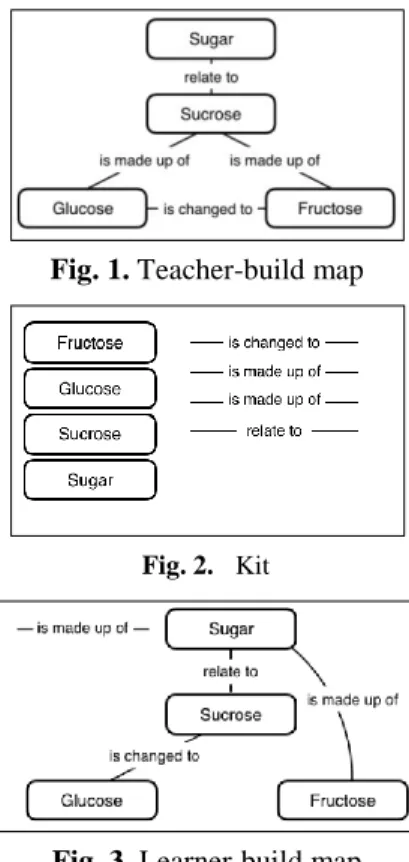
The Kit-Build concept map framework is one of the automatic concept map assessment methods that use a teacher-build map to compare with the learner-build map by using exact matching at the propositional level. It is utilized in the form of a learning task or exercise for checking learners’ comprehension of a topic that they have already learned. The task of the KB map is separated into two subtasks. The first is the segmentation task where a teacher is requested to prepare the teacher-build map, which is an expression of an eligible comprehension of the topic for the teacher. An example of the teacher-build map is illustrated in Figure 1. After submitting the teacher-build map to the server, the teacher-teacher-build map is extracted to be the kit that contains a list of concepts and relationships from the teacher-build map. The kit from the teacher-build map in Figure 1 is shown in Figure 2. Moreover, this kit is provided to help learners to reduce their cognitive load more than the traditional concept map, where they must create all components themselves. Using the kit, the learners are required only to recognize the components.
The second task is called the structuring task. Learners are given the learning task of reconstructing a concept map by using the kit, creating a map which is referred to as the learner-build map (Figure 3). After the learner-build maps are uploaded to the server, the KB map will evaluate learner-build maps by exactly matching each learner’s
proposition with the teacher-build map’s proposition. For example, the relation-ship between the concepts “Sugar” and “Sucrose” is checked. If the relationship is identified as “related to,” the score for this learner-build map will increase by one point. In the case of the concepts “Sucrose” and “Glucose,” if the learner connected them by using the relationship “is changed to,” this does not exist in the teacher-build map. Following the teacher-build map, the relationship of this proposition should be “is made up of”, so this proposition is not awarded any point from the system. This corresponds to the scoring by propositional level exact matching method. This method makes the KB map different from the manual methods which allow learners to create their own linking words, preventing the learner-build map from being straightforwardly compared with the criteria map. The manual methods require time for considering the meaning of each proposition carefully. After checking the connections of the learner-build maps by the propositional level exact matching, the system will generate a score in a percentage format.
Fig. 1. Teacher-build map
Fig. 2. Kit
Fig. 3. Learner-build map
2.3. Research Methodology
To confirm the reliability of the KB map, we designed an experimental procedure to compare the KB map and the manual methods in terms of their ability to assess the comprehension of learner on a topic. Usually, the KB map is used in teaching situations, however, it is desirable to
ensure that the KB map as can be used in a reading situation also. Hence, the experiment was designed to operate in two learning situations. Moreover, to compare the difference between the KB map and the manual method, the important attributes of the concept map assessment method are shown in Table. 1.
Table 1. Comparison between the attributes of each concept
map assessment method
Assessment Method
Assessment Provided Items
Rat er s L eve l of Anal ys is M at ch in g M et h od Conce p ts W or d s L in k in g W or d s Structural
Scoring Manual Structural Synonym Provided Not Provided Relational
Scoring Manual Propositional Synonym Provided Not Provided KB Map Automate Propositional Exact Provided Provided Two typical scoring methods, which are widely used for assessing concept maps, namely the structural scoring as structural level analysis, and the relational scoring as propositional level analysis, were chosen for comparison. The manual method is inferred from the research of McClure et al. [16], who provided a list of concepts to learners and requested that they construct concept maps by creating linking words themselves. The synonym matching method was used for evaluating the meaning of each proposition. However, the KB map provides both the concepts and the linking words, which are decomposed from the teacher-build map, to learners. Thus, the automatic exact matching method can be used for checking the correctness of each proposition.
2.4. Subjects
Subjects for this study were recruited from university students who possessed a good level of English. The 22 students, who were volunteers from various education fields, were given the role of learners. They were given introductory training in concept maps before participating in the experiment. Four students, who were familiar with the use of the concept map and understood the content of the experiment material well, were assigned as raters. These raters were given an explanation of the procedure of each assessment method, and they were required to study the procedures carefully before scoring the learner-build map. In addition, one graduate student was assigned the role of instructor. The instructor was required to prepare the article and teaching material for the experiment and the instructor was also required to construct the teacher-build map following specific instructions. In this study, the article “Sugar”, which uses
common explanatory words, was chosen for the learning process. This article contained three sections, each covering one third of a page, defined as the introduction to sugar, types of sugar and how sugar is produced [17].
2.5. Map Production
Initially, the instructor prepared the teaching materials and built the teacher-build map, which contained 15 concepts and 16 relationships. In the study, learners were requested to read the article in ten minutes, and they were then provided with the list of concepts. Next, they were required to create linking words by themselves for the construction of a concept map in 15 minutes using the CMapCloud application [18]. These learner-build maps were scored by the two manual methods. The learners were then asked to construct a concept map again in 15 minutes by integrating the kit of the KB map, which provided both a list of concepts and a list of linking words. After the learners had completely connected the propositions and uploaded their map, these learner-build maps were evaluated using the KB map assessment method based on exact matching at the propositional level. After the reading session concluded, the instructor taught learners based on the same reading article but following the instructor’s interpretation using 16 slides delivered over ten minutes. Afterward, learners were required to construct the learner-build maps following the same procedure as in the reading situation, namely, constructing learner-build maps by creating linking words by themselves and integrating the kit to create a learner-build map using the KB map. When learners completed all map, they were asked to answer a questionnaire.
2.6. Concept Map Scoring by Manual
Methods
The concept maps, which were constructed using CMapCloud, were scored by three manual methods that contained, (a) the Structural scoring, (b) the Relational scoring without the criteria map and (c) the Relational scoring with criteria map. The raters were required to read the instructions of each assessment method carefully without time restrictions. The score of the manual methods was normalized to a percentage score by using the perfect score for each method. After the scoring was completed, the raters were requested to complete the questionnaire. Procedures for each method were prepared based on the description in [16]. The reliability of the results of the manual methods is discussed in Section 4.
3. Experimental Results and
Discussion
3.1. Correspondence of KB Map and
Manual Method
The reliability of the manual method
To confirm the KB map’s reliability as a framework for assessing learners’ comprehension of a topic by comparing with reliable manual methods, we aim to first investigate the reliability of the manual methods. The scores from three manual methods were used to perform generalizability analysis through the GNOVA software [19] which returns the g-coefficient, as used in the reliability investigation by McClure et al. [16]. The g-coefficient is analogous to the reliability g-coefficient in classical test theory [20].
Table 2. the g-coefficient for each manual method and the
study of McClure et al. [16] Current Study McClure’s Reading Teaching Structural Scoring 0.7520 0.9029 0.23 Relational Scoring w/o Criteria 0.8659 0.8540 0.51 Relational Scoring w/ Criteria 0.8874 0.9133 0.76
In this study, we interpret the g-coefficient as an estimate of score reliability assuming a single rater which shows the consistency of each scoring method as shown in Table 2. Then, the relational scoring with the criteria map resulted in the highest score reliability in both reading and teaching situations, which is consistent with the investigation of McClure et al. [16] which indicated that the relational scoring method is reliable in assessing the concept map. Based on these results, we concluded that the manual assessment conducted in this research is reliable and it is possible to evaluate reliability of KB map by comparing with the results of the manual assessment. As for the reason why the g-coefficient obtained in the current study is higher than that obtained by McClure et al. we guess that the current study was conducted with a smaller number of subjects and raters, that is, 12 raters in McClure et al., and 4 raters in the current study.
The reliability of KB method
To confirm the reliability of the KB map, a comparison between the KB map’s result and the reliable manual method’s result is required. The Pearson’s correlation value is shown in Table 3. Following the strength of the correlation from Evans [21], the relational method with
criteria map, which achieved the highest reliability score, has a very strong correlation with the KB map in both reading and teaching situations. This is because raters use the criteria map as a frame for their scoring, in a similar way to the teacher-build map used in the KB map. For the remaining methods, the results from the relational scoring without criteria map have a very strong correlation in the reading situation and strong correlation in the teaching situation. This is because the procedure of relational scoring without the criteria map is too wide for meaningful evaluation of the learner-build maps, which are constructed for checking the understanding following a specific teaching situation. The structural scoring has a strong correlation with the KB map in both situations, even though structural scoring scores the concept map by giving precedence to the structure of the concept map, which is a different approach compared to the KB map.
Table 3. The correlations in scores between each manual
method and the KB method KB in Reading
KB in Teaching
Structural Scoring 0.7360 0.7360
Relational Scoring w/o Criteria 0.8532 0.7371
Relational Scoring w/ Criteria 0.8671 0.8165
Note: Calculated Pearson product correlations are statistically
significant as indicated by p-value < 0.01
The results above suggest that the KB map can assess learners’ comprehension of a topic as well as the manual concept map assessment methods. If the manual methods give a relatively high score to a learner, the KB map also has a high possibility of giving a relatively high score to the learner. In addition, learners who get a relatively low score from the manual methods, also have a high possibility of getting a relatively low score from the KB map. As indicated by the high correlation value, the KB
map is reliable, and is comparable to the manual methods, in identifying learners’ comprehension for a topic and evaluating the concept map.
Results of Questionnaire
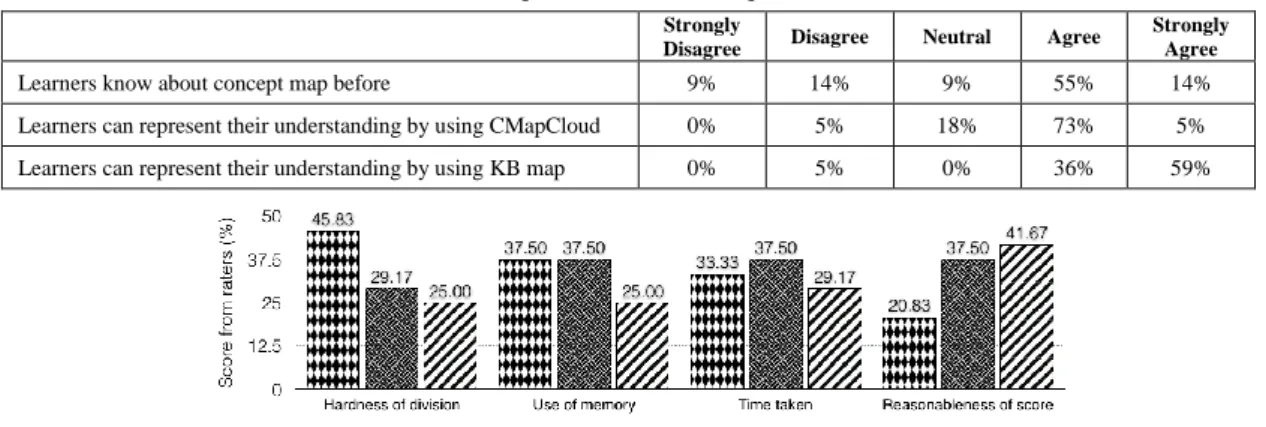
Two sets of questionnaires were used in this study. The first questionnaire was for learners after they completed all of their tasks, this is presented in Table 4. From the analysis, the summary suggests that the KB map is appropriate to use in supporting learners to express their understanding, and that it produces similar results to using concept map where the linking words are created freely.
For the raters’ questionnaire, all raters identified their familiarity with using the concept map and their understanding of the learning material as strong confident. In the raters’ ranking of the manual methods, which is illustrated in Figure 4, the structural scoring was the hardest assessment method, because the rater had to decide on the suitability of each hierarchy and crosslink. Conversely, it was easiest to use the relational scoring with criteria map since the criteria map could be used as a guide for scoring. For the cost of scoring, the raters noted that the structural scoring and the relational scoring without criteria map used their memory load and time more than the relational scoring with criteria map. This was because of the difficulty in thinking about the build map structure and recalling how previous learner-build maps were scored. In the final question, the raters ranked the most reasonable method in their opinion. The relational scoring with criteria map achieved the highest rating. This ranking corresponds with the comparison between six concept map assessments by McClure et al. [16].
Table 4. A part of the learners’ questionnaire Strongly
Disagree Disagree Neutral Agree
Strongly Agree
Learners know about concept map before 9% 14% 9% 55% 14% Learners can represent their understanding by using CMapCloud 0% 5% 18% 73% 5% Learners can represent their understanding by using KB map 0% 5% 0% 36% 59%
4. Conclusion
This study investigates the reliability of the KB map in terms of its ability to identify the efficiency of learning. An experiment was designed to compare the KB map with three manual concept map assessment methods in reading and teaching situations. Selected manual methods contained structural scoring, relational scoring without the criteria map, and relational scoring with the criteria map. They provide flexible and meaningful concept map assessment, and their reliability is widely accepted. However, they are inconvenient due to the limited class time that instructors have to complete a unit of instruction. In this study, the KB map was compared with the manual methods to test the assumption that the KB map is reliable in identifying the efficiency of learning. From this study, the results show a strong and significant correlation between the KB map and the manual methods in both the teaching and reading situations. The KB map has the highest correlation with the relational scoring with criteria map, achieving the most reliability score (g-coefficient) in both learning situations. Moreover, the learner-build map scores of the KB map were similar to the manual methods. Based on these results, it is concluded that the reliability of the KB map assessment is comparable to the manual methods.
Acknowledgement
This work was supported by JSPS KAKENHI Grant Number 17H0183901.
References
[1] Novak, J. D., & Musonda, D.: A twelve-year longitudinal study of science concept learning. American Educational Research Journal, 28(1), pp. 117-153, (1991).
[2] Ausubel, D. P., Novak, J. D., & Hanesian, H. (1978). Educational psychology: A cognitive view (2nd ed.). New York: Holt, Rinehart and Winston.
[3] Novak, J. D., & Cañas, A.J. (2008). Technical Report IHMC CmapTools. Florida: Institute for Human and Machine Cognition.
[4] Hu, M. L. M., & Wu, M. H. (2012). The effect of concept mapping on students’ cognitive load. World Transactions on Engineering and Technology Education, 10(2), 134-137. [5] Hirashima, T., Yamasaki, K., Fukuda, H., & Funaoi, H.
(2011). Kit-Build Concept Map for Automatic Diagnosis. Proceedings of Artificial Intelligence in Education 2011 (pp.466-468). Auckland, New Zealand: Springer-Verlag Berlin Heidelberg.
[6] Hirashima, T., Yamasaki, K., Fukuda, H., & Funaoi, H. (2015). Framework of Kit-Build concept map for automatic diagnosis and its preliminary use. Research and Practice in Technology Enhanced Learning, 10(1), 1-21. [7] Sugihara, K., Osada, T., Nakata, S., Funaoi, H. &
Hirashima, T. (2012). Experimental eval-uation of
Kit-Build concept map for science classes in an elementary school. Proceedings of Computers in Education 2012 (pp.17-24). Singapore: National Institute of Education. [8] Yoshida, K., Sugihara, K., Nino, Y., Shida, M., &
Hirashima, T. (2013). Practical Use of Kit-Build Concept Map System for Formative Assessment of Learners’ Comprehension in a Lecture. Proceedings of Computers in Education 2013 (pp.906-915). Bali, Indonesia: Asia-Pacific Society for Computers in Education.
[9] Nomura, T., Hayashi, Y., Suzuki, T. & Hirashima, T., (2014). Knowledge Propagation in Practical Use of Kit-Build Concept Map System in Classroom Group Work for
Knowledge Sharing. Proceeding of International
Conference on Computers in Education Workshop 2014 (pp.463-472). Nara, Japan: ICCE 2014 Organizing Committee.
[10] Alkhateeb, M., Hayashi, Y. & Hirashima, T. (2015). Comparison between Kit-Build and Scratch-Build Concept Mapping Methods in Supporting EFL Reading Comprehension. The Journal of Information and Systems in Education, 14(1), 13-27.
[11] Novak, J. D., & Gowin, D.B. (1984). Learning how to learn, New York: Cambridge Uni-versity Press.
[12] McClure, J.R., & Bell, P.E. (1990). Effects of an environmental education related STS approach instruction on cognitive structures of pre-service science teachers. Pennsylvania: State University.
[13] Wunnasri, W., Pailai, J., Hayashi, Y., & Hirashima, T. (2016). Comparison between Scratch-and Kit-Build concept map with several evaluation methods. SIG-ALST, 5(03), 54-59.
[14] Wunnasri, W., Pailai, J., Hayashi, Y., & Hirashima, T. (2016). Comparison of Concept Map Evaluation between Kit-Build Method and Handmade Method. Proceeding of International Conference on Work in Progress Posters of ICCE2016 (pp.4-6). Bombay, India: Asia-Pacific Society for Computers in Education.
[15] Wunnasri, W., Pailai, J., Hayashi, Y., & Hirashima, T. (2017). Reliability Investigation of Automatic Assessment of Learner-Build Concept Map with Kit-Build Method by Comparing with Manual Methods. Proceeding of International Conference on Artificial Intelligence in Education (pp. 418-429). Wuhan, China: Springer. [16] McClure, J.R., Sonak, B. & Suen, H.K. (1999). Concept
map assessment of classroom learning: Reliability, validity, and logistical practicality. Journal of Research in Science Teaching, 36(4), 475–492.
[17] Klaus, R. (2013). Sugar. Retrieved on August 01, 2017, from http://www.english-online.at/biology/sugar/sugar-carbohy-drate-that-gives-us-energy.htm
[18] The Institute for Human & Machine Cognition. (2014). Cmap Cloud & CmapTools in the Cloud. Retrieved on August 2017, from http://cmap.ihmc.us/cmap-cloud/ [19] Brennan, R. L. (1983). Elements of generalizability theory.
American College Testing Pro-gram.
[20] Webb, N. M., & Shavelson, R. J. (2005). Generalizability theory: overview. Wiley StatsRef: Statistics Reference Online.
[21] Evans, J. D. (1996). Straightforward statistics for the behavioral sciences. Brooks/Cole.
![Table 2. the g-coefficient for each manual method and the study of McClure et al. [16]](https://thumb-ap.123doks.com/thumbv2/123deta/8237813.1283188/4.892.463.810.512.630/table-coefficient-manual-method-study-mcclure-et-al.webp)