• 検索結果がありません。

Nearly Pure Blue Photoluminescent Poly(2,7-[9-)3,5-bis[3,5-bis(benzyloxy)-benzyloxy]benzyl)-9-(3,6-dioxaoctyl)]fluorene) in Film

N/A
N/A
Protected

Academic year: 2021

シェア "Nearly Pure Blue Photoluminescent Poly(2,7-[9-)3,5-bis[3,5-bis(benzyloxy)-benzyloxy]benzyl)-9-(3,6-dioxaoctyl)]fluorene) in Film"

Copied!
2
0
0

読み込み中.... (全文を見る)

全文

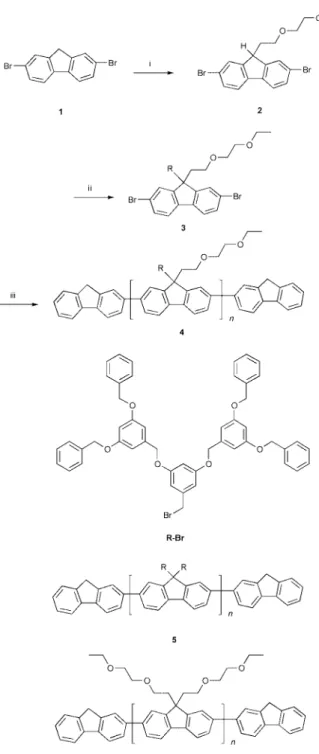
(1)View Online / Journal Homepage / Table of Contents for this issue. a b. CHEMCOMM. Hong-Zhi Tang,a Michiya Fujiki,*ab Zhong-Biao Zhang,ab Keiichi Torimitsub and Masao Motonagaa. Communication. www.rsc.org/chemcomm. Nearly pure blue photoluminescent poly{2,7-[9-{3,5-bis[3,5-bis(benzyloxy)benzyloxy]benzyl}-9 -(3,6-dioxaoctyl)]fluorene} in film†. CREST-JST, 3-1 Wakamiya, Morinosato, Atsugi, Kanagawa 243–0198, Japan NTT Basic Research Laboratories, NTT Corporation, 3-1 Wakamiya, Morinosato, Atsugi, Kanagawa 243-0198, Japan. E-mail: [email protected]. Downloaded by Nara Institute of Science & Technology on 04 October 2012 Published on 30 October 2001 on http://pubs.rsc.org | doi:10.1039/B108097K. Received (in Cambridge, UK) 6th September 2001, Accepted 11th October 2001 First published as an Advance Article on the web 30th October 2001 The first unsymmetrically substituted polyfluorene bearing a bulky poly(benzyl ether) dendron and less bulky 3,6-dioxaoctyl groups in the 9-position was designed and synthesized, which gives almost a pure bluish photoluminescence with negligible weak greenish excimer emission around 520 nm even in a thermally annealed thin solid film. Recently, p-conjugated polyfluorene (PF) has been attracting intensive interest due to its bluish photo/electro-luminescence properties with high quantum yield.1 However, greenish excimer emission and significant fluorescence quenching generally occur for this blue light emitter in a solid film.2 Among the methods to avoid the detrimental p-aggregation behavior,3 much effort has been made to introduce bulky dendrons like poly(benzyl ether) (Fréchet-type) or polyphenylene into the conjugated polymer backbone, i.e., endcapping of poly[2,7-(9,9-di-n-hexyl)fluorene]4 and symmetrically 9,9-bis-substituting PFs.5 The resulting PFs have been found to significantly suppress the excimer emission even in their thermally annealed solid films. In addition to these symmetrically 9,9-bis-substituted PFs, the unsymmetrically substituted PF having two different side groups in the 9-position has also attracted much attention.6 As an example, a PF bearing two different methyl and 4-cyanobutyl groups in the 9-position was designed and synthesized towards water-soluble conjugated polymer.6b Based on the assumption that a regio-random PF bearing two different substituents in the 9-position may significantly suppress the p-aggregation in a solid film to decrease the greenish excimer emission and the combination of bulky dendrons with less bulky groups will increase the luminophore density, thereby producing a strong luminescence, we have designed and synthesized a new unsymmetrically substituted PF 4 (Scheme 1) bearing semiflexible bulky poly(benzyl ether) dendrons and linear 3,6-dioxaoctyl groups in the 9-position. We now report that 4 emits almost a pure blue color photoluminescence even in a thermally annealed thin solid film, while the greenish excimer emission was drastically suppressed even compared to the corresponding 9,9-bisdendron-substituted 5. The synthetic procedures are outlined in Scheme 1. The resulting 2,7-dibromo-9-lithiofluorene from 2,7-dibromofluorene (1) (Aldrich) and 2-fold lithium diisopropylamide (LDA) (Aldrich) was reacted with an equivalent amount of 1-bromo3,6-dioxaoctane (Lancaster) at 260 to 25 °C in THF, yielding 2,7-dibromo-9-(3,6-dioxaoctyl)fluorene (2).7 Using the phase transfer catalyst, triethylbenzyl ammonium chloride (Kanto), the monomer 3 was synthesized from 2 and 3,5-bis[3,5bis(benzyloxy)benzyloxy]benzyl bromide (R-Br) (TCI). The conversion was almost quantitative, which was evidenced by the complete disappearance of the triplet signal of 9-H at 4.10 † Electronic supplementary information (ESI) available: characterization data for 2, 3, and 4, and measurement details of the quantum yield in THF solution. See http://www.rsc.org/suppdata/cc/b1/b108097k/. 2426. ppm in the 1H NMR spectrum. Polymerization was carried out using the zero-valent nickel reagent, bis(1,5-cyclooctadiene)nickel(0) (Ni(COD)2) (Kanto), and the end-termination was accomplished using 2-bromofluorene (Acros).8 For a comparison of the photophysical properties with 4, the two corresponding symmetrically 9,9-bis-substituted 5 and 6 were also synthesized using previouly reported method.8 The structures of all the synthesized monomers and PFs were confirmed by NMR and elemental analysis.† PF 4 as well as 5 is highly soluble in common organic solvents, e.g., THF, toluene and chloroform, but 6 has limited solubility in THF and toluene although it is readily soluble in chloroform. The molecular weights of 4, 5 and 6 (soluble part in THF) estimated by gel permeation chromatography (GPC) versus the polystyrene standards in THF at 30 °C are Mw = 26,300 (Mw/Mn, 2.0), Mw = 32,700 (Mw/Mn, 1.7), and Mw = 381,300 (Mw/Mn, 2.6), respectively. Differential scanning calorimetry (DSC) (heating at 10 °C min21 at the second run) revealed that 4 and 5 have softening points at around 58 °C and 62 °C, respectively, evidenced by the endothermic peaks, while 6 exhibits a melting point of 182 °C. As shown in Fig. 1, the UV-vis spectrum of 4 in THF solution exhibits two absorption bands at 386.0 nm (e = 3.1 3 104 (fluorene-repeating-unit)21 dm3 cm21) and 284.0 nm (e = 1.1 3 104 (fluorene-repeating-unit)21 dm3 cm 21), probably ascribed to the p–p* transition of the conjugated polymer backbone and the phenylene in the side dendrons, respectively. The lmax,abs of 4 exhibits only a slight red shift of 2 nm compared to that of 5 (lmax,abs, 384.0 nm), implying that the number of bulky dendron side chains does not affect the torsion angle in the conjugated polymer backbone, but shows a large blue shift of 8.5 nm compared to that of 6 (lmax,abs, 394.5 nm), probably due to the larger steric hindrance impacted by the bulky dendrons than the two less bulky 3,6-dioxaoctyl groups. The photoluminescence (PL) spectrum of 4 in THF solution exhibits the two characteristic sharp peaks at 415.0 and 437.0 nm and a low energy shoulder near 470.0 nm, almost identical to those of the corresponding 5 (lmax,emi, 414.0 nm, excited at 384.0 nm) and 6 (lmax,emi, 417.0 nm, excited at 394.5 nm). The quantum yield of 4 in THF is estimated to be 58%, comparable to 54% of 5 and 53% of 6.† Fig. 2 compares the UV-vis and PL spectra of 4–6 in the thermally annealed thin solid films. The UV-vis spectrum of 4 in the film exhibits no absorption band broadening except for the lmax,abs showing a minute red shift of 2.5 nm in comparison to that in THF solution. This is similar to 5 in the film and THF solution. On the other hand, 6 in the solid film gave a UV-vis spectrum with a significantly broadened absorption band and a new absorption peak around 399 nm compared to that in THF solution, indicating that a specific intensive aggregation formed. The PL spectrum of 4 in the film shows two characteristic lmax,emis at 423.0 and 447.5 nm and a tail in the range 500 to 700 nm. On the other hand, 5 gave a PL spectrum with a featureless long wavelength emission (excimer emission). Chem. Commun., 2001, 2426–2427 This journal is © The Royal Society of Chemistry 2001. DOI: 10.1039/b108097k.

(2) View Online. Downloaded by Nara Institute of Science & Technology on 04 October 2012 Published on 30 October 2001 on http://pubs.rsc.org | doi:10.1039/B108097K. Fig. 1 UV-vis absorption (3.0 3 1025 mol L21 of the fluorene-repeatingunit) and PL (1.4 3 1026 mol L21 of the fluorene-repeating-unit) spectra of 4 (excited at 386.0 nm) in THF solution at 25 °C.. Fig. 2 Normalized UV-vis absorption and PL spectra of 4 (excited at 388.5 nm), 5 (excited at 384.5 nm) and 6 (excited at 399.0 nm) in thin solid films prepared by the spin-coating method from chloroform solution ( ~ 1022 mol L21 of the fluorene-repeating-unit) on a quartz substrate upon annealing at 200 °C for 3 h in vacuo followed by slow cooling to 25 °C.. bluish photoluminescence with negligible weak greenish excimer emission around 520 nm even in the thermally annealed thin solid film, showing the great potential for the construction of large-area blue light emitters. We gratefully thank Dr Hideaki Takayanagi for his continuing support. CREST-JST is acknowledged for funding at NTT.. Notes and references. Scheme 1 Reagents and conditions: i, 2-equimolar LDA, THF, 1-bromo3,6-dioxaoctane, 260 to 25 °C, 3 h, 60%; ii, R-Br, 50% aq. NaOH, DMSO, triethylbenzyl ammonium chloride, 25 °C, overnight, ~ 100%; iii, Ni(COD)2–1,1A-bipyridyl (1+1, mol/mol), COD, DMF–toluene (1+4, v/v), 80 °C, 4 d; 2-bromofluorene in toluene, 4 h, 80%.. band around 520 nm, which is much weaker than that for 6, indicating that the steric impact of the dendritic substituents significantly suppresses the intermolecular p-stacking of the polymer backbone. The weak excimer emission for 5 could be due to the liquid crystalline property already reported for the poly(phenylenevinylene)s having poly(benzyl ether) dendron side chains.9 The almost negligible weak excimer emission for 4 in the film might result from an amorphous structure caused by the regio-random backbone structure, which is possibly related to the lower softening point than that of 5. Thus, the replacement of one dendron with a less bulky substituent in the 9-position enables almost pure blue photoluminescence. In conclusion, the first well-defined unsymmetrical-substituted 4 bearing bulky poly(benzyl ether) dendron and less bulky 3,6-dioxaoctyl substituents in the 9-position gave almost a pure. 1 (a) M. Fukuda, K. Sawada and K. Yoshino, Jpn. J. Appl. Phys., 1989, 28, L1433Q.-B. Pei and Y. Yang, J. Am. Chem. Soc., 1996, 118, 7416; (c) J. Teetsov and M. A. Fox, J. Mater. Chem., 1999, 9, 2117. 2 (a) J. Huber, K. Müllen, J. Salbeck, H. Schenk, U. Scherf, T. Stehlin and R. Stern, Acta Polym., 1994, 45, 244; (b) M. Grell, D. D. C. Bradley, G. Ungar, J. Hill and K. S. Whitehead, Macromolecules, 1999, 32, 5810. 3 G. Klärner, M. H. Davey, W.-D. Chen, J. C. Scott and R. D. Miller, Adv. Mater., 1998, 10, 993. 4 G. Klaerner, R. D. Miller and C. J. Hawker, Polym. Prepr. (Am. Chem. Soc., Polym. Sci. Div.), 1998, 39(2), 1006. 5 (a) D. Marsitzky, R. Vestberg, C. J. Hawker and K. R. Carter, Polym. Prepr. (Am. Chem. Soc., Polym. Sci. Div.), 2000, 41(2), 1344; (b) S. Setayesh, A. C. Grimsdale, T. Weil, V. Enkelmann, K. Müllen, F. Meghdadi, E. J. W. List and G. Leising, J. Am. Chem. Soc., 2001, 123, 946; (c) A. C. Grimsdale, A. Herrmann, S. Setayesh, T. Weil and K. Müllen, Polym. Mater. Sci. Eng., 2001, 84, 6. 6 (a) D. M. Johansson, M. Theander, T. Granlund, O. Inganäs and M. R. Andersson, Macromolecules, 2001, 34, 1981; (b) B. Liu, Z.-K. Chen, W.L. Yu, Y.-H. Lai and W. Huang, Thin Solid Films, 2000, 363, 332. 7 (a) M. Ranger and M. Leclerc, Chem. Commun., 1997, 1597; (b) M. Ranger, D. Rondeau and M. Leclerc, Macromolecules, 1997, 30, 7686; (c) M. Ranger and M. Leclerc, Macromolecules, 1999, 32, 3306. 8 H.-Z. Tang, M. Fujiki, M. Motonaga and K. Torimitsu, Polym. Prepr. (Am. Chem. Soc., Polym. Sci. Div.), 2001, 42(1), 440. 9 Z.-N. Bao, K. R. Amundson and A. J. Lovinger, Macromolecules, 1998, 31, 8647.. Chem. Commun., 2001, 2426–2427. 2427.

(3)

Fig. 2 Normalized UV-vis absorption and PL spectra of 4 (excited at 388.5 nm), 5 (excited at 384.5 nm) and 6 (excited at 399.0 nm) in thin solid films prepared by the spin-coating method from chloroform solution ( ~ 10 22 mol L 21 of the fluorene-repeating

参照

関連したドキュメント

Always add an appropriate adjuvant to the spray tank (see the Spray Additives section of this label). Apply to actively growing weeds. See Table 1 for a complete list of

Without TEPCO’s permission, it is prohibited to duplicate this document, to use its contents for other purposes than original or to disclose it to third parties.. Tokyo

最初の 2/2.5G ネットワークサービス停止は 2010 年 3 月で、次は 2012 年 3 月であり、3 番 目は 2012 年 7 月です。. 3G ネットワークは 2001 年と

1月 2月 3月 4月 5月 6月 7月 8月 9月 10月 11月 12月.

1月 2月 3月 4月 5月 6月 7月 8月 9月10月 11月 12月1月 2月 3月 4月 5月 6月 7月 8月 9月10月 11月 12月1月 2月 3月.

12月 1月 2月 3月 4月 5月 6月 7月 8月 9月 10月 11月 12月.

第1回目 2015年6月~9月 第2回目 2016年5月~9月 第3回目 2017年5月~9月.

4月 5月 6月 7月 8月 9月 10月 11月 12月 1月 2月