
近畿大学学術情報リポジトリ
26
0
0
全文
(2) M-11. '0 2 '4. Introduction. Problem. Statement:. A Case for Study Abroad. Programs. Teaching Japanese university students to use English communicatively. is a difficult. task for most teachers, but let us not forget the trials that so many Japanese students undergo. as well in learning. English.. For some, formally. meeting. a foreign person. and being expected to partake in a foreign language class is nothing short of terrifying, especially in the beginning.. In addition,. the basic structure. of English for Japanese. learners poses huge problems because of factors, such as extremely different grammars, pronunciation. systems, and orthographic. and clear problems. for Japanese. However, in addition, learning.. systems.. university. All of these create understandable. students.. there may be more dangerous. obstructions. to students'. In Japan, there has been a "push" in recent years to promote more exposure. to English.. There are TV shows which teach English. oral communication,. most. universities have full-time native English speaking teachers who are, to varying degrees, accessible to students,. and there are entire. sales of English language advantage. of these opportunities. Debatably, greatest adage,. textbooks.. threat. of book stores. devoted to the. So, why is it that more students. do not take. ?. it is not the linguistic. difficulties. to students'. but their own affective limitations.. learning,. "You can lead a horse to water,. highly appropriate facilities. sections. in this situation.. or opportunities. use if the students. of learning. but you cannot Without. that Japanese. students. that are provided. that pose the The old. make him drink,". motivation,. no matter. seems. how many. are offered, they will be of little. are not enticed to take advantage. To some, these facilities. English. of them.. and opportunities. that are offered. are rendered useless if they do not allow the students to experience English in a meaningful, authentic. and practical. way.. Public schools in Japan. require. youth to study three years of English. in junior high school.. on to high school will receive another. three years of instruction. sequently,. when students. enter a university. in Japan,. — 156 ( 324 )—. all Japanese. Those who continue in English.. Con-. they will have spent at least.
(3) Assessment of Self-Efficacy in an EFL Context (Burrows) 6 years studying English. English.. is based largely. ten study through. For many high school students, on passing university. memorizing. entrance. word lists or repeatedly. although the use of grammar-translation. the motivation. examinations. to learn. and they of-. taking practice tests.. And. to teach in secondary schools and universities. alike seems on the decline, as a whole, Japanese university students are still not learning English. as a tool of communication. futures,. but as a subject to be mastered. as passing. an entrance. that will assist them at some juncture. test or getting. allowed to use the language. in order to achieve an extrinsic hired by a specific firm.. that they have been learning. it was created, communication.. Few Japanese. in their goal such. They are rarely. for the sole purpose that. are shown how English. is an asset. that could be utilized to enhance their lives, instead of being an obstacle that they must overcome. One solution to this problem would be creating new study abroad (SA) programs and the promotion students. of extant. SA programs. to travel abroad to experience. By allowing. students. lationships,. express. would theoretically. university. English and its uses in authentic. to use language their. that would allow Japanese. practically. own feelings,. begin to understand. to gather. and impart. information,. knowledge. the value of English. contexts. build re-. to others,. they. as a tool and not as. a barrier.. General. Overview of Study Abroad. Study abroad other. country. (SA) is defined by Freed. or province. classroom-based. Programs. language. part of any foreign. where the target and/or. language. language. content area study.. (FL). the benefits from SA programs. (1995) as a period of residence. curriculum,. are abundant. and changes p.29). others,. with. literature. and diverse. to students. indicates. Early literature and regarding. that from "cross-. . . . the increase in knowledge and language skills of other countries. in attitudes. Participants. combined. Seen by many as an integral. research. the 1950's expounded the effects of SA in relation cultural interactions. is spoken,. in an-. and career. goals". (Kraft,. Ballantine. in SA were found to be more reflective,. more knowledgeable. with respect to international -. 157 ( 325 )—. & Garvey,. more prepared affairs,. 1994, to help. and more self-.
(4) 01.1 confident.. In addition, SA participants. that are essential 2001; Laubscher,. may develop cross-cultural. skills and knowledge. world of globalization. ( Chieffo & Zisper,. in the ever-changing 1994).. pendence, tolerance 1988; Laubscher,. 216-. SA has been shown to promote. for ambiguity,. self-esteem,. and empathy. of SA often go unnoticed. in mainstream. practice,. a group orientation. and a vacation. mentality. Furthermore,. Wilkinson. host country. with cultural. interaction. in the FL.. did not necessarily. contact with the host culture,. that. works. and linguistic. negative. to integrate. ramifications. inadequate. against. an academic. that students. assumptions. atmosphere.. may arrive. that may contribute. in the to less. research revealed that exposure to cultural differences. lead to cross-cultural. Low motivation. us that. that might isolate them from the host cul-. (1998, 2000) postulated. Further. Day (1987) reminded. understanding.. warned that feelings of anxiety could limit language it.. (Carlson & Widaman,. possible negative ramifications. literature.. a short length stay may entail superficial. ture,. inde-. 1994).. Amidst the echoes of these potential advantages,. language. world-mindedness,. into the target. in relation. to language. there is an abundance. of research,. Indeed, Krashen. learning. culture. (1985). instead of enhancing. could also lead to further. learning. ( Tremblay. & Gardner,. 1995). Clearly,. of possible negative ramifications. in which the participants. both supporting. SA and warning. All of the above studies, however, refer to situations. were studying. the L1 of the inhabitants. of the country. in which they were doing their SA.. In a recent phenomenon. in Asia, some EFL. students. English. speaking. have opportunities. (e.g., the Philippines,. Purpose. to study. countries. Thailand).. of the Study. This study will be conducted to illuminate will undergo willingness tivation. in non-English. in respect. to affective factors:. to communicate. through. the possible changes that participants EFL self-efficacy,. (WTC), integrative. the course of a short-term. motivation, SA program. language. anxiety,. and instrumental to Bangkok,. mo-. Thailand.. Research will be conducted in both the formal classroom settings as well as in informal —158 ( 326 )—.
(5) Assessment of Self-Efficacy in an EFL Context (Burrows) contacts. with the target. the target. language. instructors, tourists,. language. community. or fellow visitors. and reliability. research. to Thailand. methods. to eight months. native. (i.e., non-Japanese. with the participants will be utilized. to results of the study.. encountered by the participants. For the purposes. will be Thai nationals,. etc.) who may interact. well as quantitative. community.. English-speaking language. in English.. students,. Qualitative. to provide further. This longitudinal. as. validity. study will chart changes. from two months before departure. after the program. of this study,. for the SA program. has ended and the participants. have returned. to Japan.. Literature. Introduction:. Self-efficacy. Since the publication article entitled researchers business,. range. of the social cognitivist,. "Self-Efficacy:. Toward. affairs,. psychopathology,. 1996, 2004) have employed. of human functioning.. predict. such varied achievements. cessation,. a Unifying. Albert Bandura's Theory. from many fields (i.e., educational psychology, international. (Pajares,. Review. pain tolerance,. athletic. self-efficacy. of Behavioral. and social and political to predict. attention. theory,. in the area of academic motivation. can. social skills, smoking. career choices, assertiveness,. self-efficacy. a wide. that self-efficacy. as academic achievements,. within his social cognitive. change). and describe. ing with feared events, recovery from illnesses, and sales performance Embedded. Change,". health, medicine, athletics,. There is evidence to suggest. performances,. (1977) seminal. cop-. (Bandura, 1986).. has received increasing. and achievement. (Pintrich. & Schunk,. 2002; Schunk, 2004, Bandura, 1986). In his most recent book dealing with self-efficacy, Bandura. (1997) details the importance. behavior,. "People make causal contributions. through. mechanisms. of this construct. of personal agency.. and its influence on human. to their own psychosocial Among the mechanisms. is more central or pervasive than beliefs of personal efficacy. they can produce. desired effects by their actions,. Efficacy belief, therefore,. of agency, none. Unless people believe. they have little incentive. is a major basis of action. —159 ( 327 )—. functioning. to act.. People guide their lives by.
(6) %118 their beliefs of personal. Self-Efficacy. basis of Bandura's. actually. Toward a Unifying self-efficacy. (p.2).". Theory. The theoretical plications,. efficacy. M 2 '4. self-efficacy. derives from Bandura's Theory of Behavioral. as the strength. theory. (1977) seminal article,. Change.". of expectations. and all its current. "Self-Efficacy:. In this article, Bandura. individuals. maintain. to perform successfully a behavior that will lead to a particular. im-. defined. about their ability. outcome.. Individuals'. level of self-efficacy will influence "whether certain (coping) behaviors will be initiated, how much effort will be expended, and how long it will be sustained obstacles. and aversive experiences". of this theory, judgments. (Bandura,. of self-efficacy. 1977: 191).. may avoid it, while those who have a higher. be more apt to participate Bandura. readily. (1977) postulated. in the completion. task level difficulty.. For different. limited to the simpler tasks, most taxing. performances.. what difficulty. Firstly,. These efficacy. The strength. expectations. may differ.. situation.. by disconfirming. experiences,. of mastery. will persevere. (Bandura,. 1977: 194).". Within his self-efficacy. differ on magnitude,. to the. would help determine in.. expectation. Generality is anrefers to whether or extend. well. may also vary according. will determine. how resilient. one. "Weak expectations are easily extinguishable. whereas individuals. who possess strong expectations. in their coping efforts despite disconfirming. theory,. may be. ones, or extend. Generality. Expectancies. of one's expectations. can be in the face of aversive experiences.. of self-efficacy.. difficult. will create a specific mastery. beyond the specific treatment to strength.. differ on several dimensions. level one would be willing to initiate behavior. experience. would. of the task.. the efficacy expectations. reach to moderately. other area where efficacy expectations a particular. task within a particular. efficacy expectations. individuals,. Those who. sense of self-efficacy. that efficacy expectations. that would influence performance.. Within the framework. are task and domain specific.. hold a low sense of self-efficacy for accomplishing a particular domain. in the face of. Bandura. (1977) also hypothesized. experiences. the sources. According to him, there are basically four principle sources of informa-. 160 ( 328 )—.
(7) Assessment of Self-Efficacy in an EFL Context (Burrows) tion that help one create a sense of self-efficacy. pertaining. to a specific task and. a specific domain; performance accomplishments, vicarious experiences, verbal persuasion, and physiological states.. In other words, people base the level of confidence. they. have in relation to a particular behavior, on an aggregate reading of these four elements. Judged. to be the most influential. plishments. are especially. experiences. lower it.. performance. one's sense of self-efficacy. mastery. while failures. that occur early in the course of events can be particularly. to one's self-efficacy,. however, failures. that. occur later, after. success has been experienced may have less impact on self-efficacy. failures. accom-. because they are based on personal. Successes tend to increase. Failures. rimental. important. gauge of self-efficacy,. that are later overcome by sustained. one realizes that even difficult. sufficient. Even occasional. effort can strengthen. tasks can be mastered. det-. self-efficacy. with conviction. if. and continued. effort. Although performance. exerting. a weaker. accomplishments,. of self-efficacy information.. as well.. vicarious. on the formation. experiences. of self-efficacy. are also an important. than source. People do not rely solely on their own mastery experiences. to develop their self-efficacy. activities. influence. Certain. They are influenced by seeing others perform particular conditions. enhance the value of a vicarious. experience;. the more similar the observer feels he is to the model, the more influence the vicarious experience. will have on the observer's. self-efficacy.. clear outcomes conveys more efficacy information actions remained unclear. is re-enacted. Also influencing. particular. suggestion, task.. to be weaker persuasion. of models, is superior. to exposure. to the. by a single model. self-efficacy. is verbal persuasion,. in which people are guided,. into believing they are capable or incapable The impact that verbal persuasion. than that. arising. is not derived from an authentic. rely on their physiological. of performing. has on self-efficacy. from one's own accomplishments. The last element of self-efficacy sometimes. than if the effects of the modeled. diversified modeling, in which the performance. several times by a variety. same performance. through. Furthermore,. Model behavior that exhibits. a. is likely. because verbal. experience.. information reactions. — 161 ( 329 )—. is physiological to particular. states. situations. People to lead.
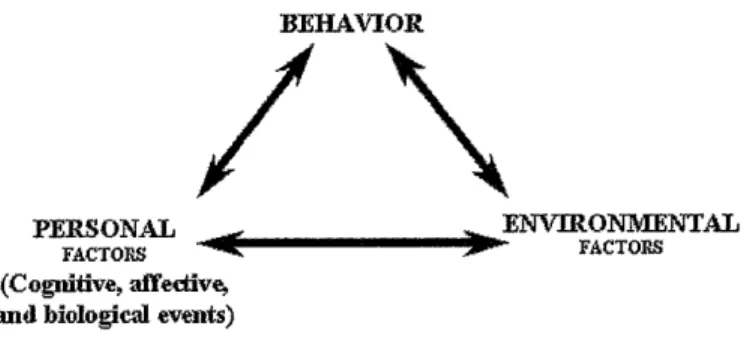
(8) i11. it" 214. them and their level of self-efficacy. an increased. heart. As one experiences. rate, induced sweating,. or hyperventilation,. expect failure more than success in that particular usually debilitates. performance,. individuals. they are not beset by aversive arousal. a fear reaction,. situation.. such as. one would likely. "Because high arousal. are more likely to expect success when. than if they are tense and viscerally. agitated. (p.198).". The Role of Self-Efficacy. in Social Cognitive Theory. This theory of self-efficacy underwent severe scrutiny by researchers in a multitude of fields and remained. quite robust even in the face of such scrutiny.. until 1986 that Bandura. introduced. a more comprehensive. his social cognitive theory, within which was embedded. look at human behavior,. the theory. In the social cognitive theory, people are seen as self-organizing, flecting and self-regulating. proactive,. self-re-. It is by this very definition. himself, rejects claims that he is a "behaviorist. called a social cognitivist.". of self-efficacy.. rather than as reactive beings molded and guided by environ-. mental forces or compelled by hidden inner impulses. that Bandura,. It was not. From this theoretical. perspective,. and demands. he be. human functioning. is considered the product of a dynamic triad of personal, behavioral, and environmental influences (Figure 1).. Of all the beliefs that influence human functioning, and standing. at the very core of the social cognitive judgments to attain. of their capabilities designated. Figure. 1.. theory,. to organize. are self-efficacy. and execute courses. types of performances. Model of the relations between in Bandura's (1986) conception. (Bandura,. beliefs,". of action required. 1986; 391).". the three classes of determinants of triadic reciprocality. BEHAVIOR. ENVIRONMENTAL FACTORS. PERSONAL FACTORS. (Cognitive, affective, and biological events) -162. ( 330 )-. people's.
(9) Assessment of Self-Efficacy in an EFL Context (Burrows) As the evolution of the self-efficacy theory and its role within the social cognitive theory. continued,. Bandura. explained. the refinement. book, Self-efficacy: The Exercise of Control. states,. "Perceived self-efficacy. execute the courses. In regards. of his theories. to the role of self-efficacy,. refers to beliefs in one's capabilities. of action. required. to produce. of one's beliefs in self-efficacy. to "the courses. they experience complishments. Bandura. extended. how long they will. Bandura. continued. affective. states,. objectively. true. (Bandura,. demands,. another. of his major contentions. beliefs in human functioning,. and actions (Bandura,. and the level of ac-. 1997: 3).". by explaining. the role of self-efficacy. whether. or self-aiding, how much stress and depression. in coping with taxing environmental they realize. and. Adding. in the face of obstacles and failures, their resilience to adversity,. their thought patterns are self-hindering. he. of action people choose. to pursue, how much effort they put forth in given endeavors, persevere. to organize. given attainments.". parts to this definition that were not found in his prior writings, the influence. in his 1997. as regards. "people's level of motivation,. are based more on what they believe than on what is 1997: 2).". Therefore,. it is not necessarily. the number. of skills one possesses, but what one believes one can do with those skills in a particular circumstance. that self-efficacy. theory. is really concerned. with.. Collins (1982). studied the level of problem solving by children in three levels of mathematical Mathematical children. ability played a part in the problem-solving. who maintained. a high sense of self-efficacy. those with a low sense of self-efficacy,. regardless. performance,. but those. were more successful. of the ability level.. ability.. than. Pervasive. self-doubt can over-rule skills, so that even highly skillful individuals may not perform to their true ability under circumstances (Bandura. & Jourden,. is highly influential. that undermine. their beliefs in themselves. 1991). As these studies demonstrate, to performance. accomplishments,. perceived self-efficacy. whatever. underlying. skills. one might possess.. Self-Efficacy This study after. a 4-week,. and. Its Relevance. will examine university-level. to the Current. the significant SA program. Study. affective. changes. in Bangkok,. — 163 ( 331 )—. for EFL participants. Thailand.. The factors.
(10) #111 that will be measured. will be EFL self-efficacy,. communicate,. integrative. unique nature. of this study. prior empirical tigation. 1.. Is a change. Is a change. 3.. 4.. Is a change. Is a change ticipating. 6.. to a non-English. exhibited. ingness. a difference. to communicate,. speaking. in the participants'. between. and integrative. study aims to use self-efficacy. country after. after. ? participating. motivation. after participating. ?. instrumental speaking. motivation,. motivation country. after. par-. ?. language. anxiety,. respectively,. will-. before. the. for the SA ?. EFL study motivation. measures,. as a consequence. In the long term, changes. of the students. participating. to communicate. levels of self-efficacy,. The current. many. inves-. ?. country. to a non-English. after. anxiety. country. integrative. departed. SA program.. The current. speaking. language. participants. heightened. country ),. ?. willingness. speaking. in the participants'. in a SA program. Was there. country. to a non-English. to a non-English. in a SA program 5.. speaking. in the participants'. exhibited. to. Due to the. speaking. EFL self-efficacy. in the participants'. exhibited. willingness. motivation.. EFL in a non-English. in the participants'. to a non-English. in a SA program. anxiety,. questions:. in a SA program. Is a change. and instrumental. (studying. the following. exhibited. participating. language. directly related to the topic is limited.. exhibited. in a SA program 2.. motivation,. research. will address. 2. participating. among others, to predict. of participation. in proficiency. in this study,. in a short-term. will also be analyzed. the SA experience. For. will allow. them for the first time in their history of English education to use English in authentic situations. had extensive. In reference to Bandura's performance. have had opportunities. self-efficacy. experiences. to use English. with English. in authentic. theory,. In other words, few of them contexts. their own abilities (i.e., experiencing successes and failures). inform. individuals. ficacy toward. of their abilities. English. language. most of them have not. and thereby. to test. These mastery experiences. and allow them to hone their sense of self-ef-. usage.. It could be hypothesized. —164 ( 332 )—. that,. due to the.
(11) Assessment of Self-Efficacy in an EFL Context (Burrows) artificial. nature. of many of these students'. many of them have inaccurate. readings. experiences. of their own abilities.. that there will be a change in each student's affect their motivation Another. self-efficacy. that. will be investigated. The concept of willingness. tendency of an individual. to initiate. It is hypothesized. and that that change will. to learn English even after returning. construct. communicate.. ( i.e. only in classrooms),. from the SA program.. in this study. to communicate. communication. is willingness. (WTC). to. refers to the. when free to do so (McCroskey. & Richmond, 1987, 1990). As one of the basic tenets of Bandura's. self-efficacy theory,. he believes that one's level of self-efficacy will help to predict what actions are initiated and what actions are avoided.. It is hypothesized. that there will be a strong. link. between WTC and self-efficacy. In addition. to WTC, language. As expected, Bandura ficacy in a particular demands. anxiety. purports. anxiety. will also be investigated. that as a result. of one's weakened. in this study. sense of self-ef-. subject, one becomes anxious about the corresponding. academic. Anxiety tends to manifest itself in both cognitive and somatic ways. can be recognized. hyperventilation, vironment. as physiological. sweating,. etc.. to another. theory. of the constructs. The longitudinal self-efficacy. theory.. of self-efficacy. (1977).. responses. information. (1977). to the en-. that. Bandura. in this study.. of this study will also be supported. Bandura. heart-rate,. Again, there seems to be a direct link. under investigation. nature. such as, increased. These types of physiological. are one of the four sources. details in his self-efficacy. responses. Somatic. 0 postulates. by the use of the. that one's level of self-efficacy. will predict what actions are initiated, how much effort will be expended on a particular task, task.. and the perseverance. one needs to overcome. As this study will be conducted. obstacles. in the course of the. over an extended period of time, participants'. level of perseverance will be revealed through an examination of achievement and motivation measures.. Self-efficacy. in Foreign. Although. researchers. medicine,. athletics,. Language. Research. from many fields. business,. international. ( i.e., educational affairs,. — 165 ( 333 )—. psychology,. psychopathology,. health,. and social.
(12) V611 and political. change). ( Pajares,. M 2 -1=-. 1996, 2004) have employed self-efficacy. and describe a wide range of human functioning, languages. remains limited.. research. in the field of foreign. In the early 1990's a collective criticism. field of SLA referring primarily to Gardner's. to predict. rose from the. (1985) Socio-Educational. Model (Crookes. & Schmidt, 1991; Oxford & Shearin, 1994; Dornyei, 1994). There was a general consensus among several researchers. in the field that research. restricted by a narrow perspective on motivation. begin to consider non-L2 approaches. Recommendations. to motivation. In response to these calls, Tremblay. in a francophone. measure various motivational. secondary. they completed an essay in French. as a measurement the hypothesis subsequently. of achievement. that self-efficacy. that researchers. (1995) investigated. factors.. In addition to these measures,. in the study.. The results of the study supported. has a direct effect on motivational to achievement. behavior. (Figure 2, Tremblay. 1995: 514).. 2.. Motivational. designed to. Final grades for the French class were accepted. has a direct relation. Figure. the im-. A sample of 75 French language. school completed questionnaires. and attitudinal. had been. were voiced.. and Gardner. plication of self-efficacy and its role in L2 motivation. students. in L2 learning. Model. (Tremblay. & Gardner,. 1995: 510). ABF Ability-Failure; ABS Ability-Success; AFC Attitudes toward French Canadians; AFO Attitudes toward the French Course; AFT Attitudes toward the French Teacher; ALF Attitudes toward Learning French; ATT Attention; COF Context-Failure; COS Context-Success; DLF Desire to Learn French; FCA French Class Anxiety; FLD French Language Dominance; FUA French Use Anxiety; GOF Goal Frequency; GOS Goal Specificity; IFL Interest in Foreign Languages; IGO Integrative Orientation; ISO Instrumental Orientation; LUF Luck-Failure; LUS Luck-Success; MIT Motivational Intensity; PER Persistence; PEX Performance Expectancy. -. 166 ( 334 )-. which. & Gardner,.
(13) Assessment of Self-Efficacy in an EFL Context (Burrows) Another study (Hseih & Schallert, and attribution German. 2008), considered the two constructs,. in the domain of foreign language learning.. and French. scores represented. courses. were first. 500 students in Spanish,. given class test scores and asked if the. a success or failure on the part of the student.. students were also asked to rate their self-efficacy and attribution The study supported. the hypothesis. was the most powerful but not as strong. predictor.. that in predicting. Ability attributions. as self-efficacy.. task difficulty,. self-efficacy. were considered. significant. to achievement. by Tremblay. this study showed a relation.. These attributions. Those who considered themselves. In another. Graham. of effort. between. one's ability. or a lack of it, respectively.. to manipulate. in French.. research. changing. that study and cultural. SA study,. Carlson. involving nearly. Undergraduates. thirty. maintains. that. and their link to academic they hold for successes. European. in more relevant. career,. personal. the impact satisfaction,. in four U.S. college and university. institutions -. languages,. et al. (1990), investigated. abroad has on such topics as education, values.. strategies. their self-efficacy.. these studies were in the field of foreign. to the current. learning. Graham. learners may start to change the attributions thereby. success. low ability and task difficulty. if learners could be educated on the use of language strategies. Although. who attributed. had higher levels of achievement.. On the contrary,. were blamed by most for lack of achievement. and failures,. credited both successes. (2004) showed that students. as a source of higher self-efficacy.. performances,. and interviews,. luck and ability.. to effort, high ability and effective learning strategies She detailed the relation. questionnaires. to be less efficacious tended to blame their failures. forces like task difficulty,. study,. through. with high self-efficacy. to either an ample expenditure. more on external. a di-. was not realized in the study conducted. study, conducted. noticed that most students. and failures. Although. to success and failure were also evident in a study by Graham. (2006). In this qualitative Graham. who attributed. than those who attributed and luck.. rect link from self-efficacy. the. based on the scores.. It was also found that students. to other factors such as ability,. and Gardner,. Thereafter,. achievement,. failure to lack of effort held a higher sense of self-efficacy failure. self-efficacy. were chosen for the study.. 167 ( 335 )—. programs The fo-.
(14) 11 cus of the research. AO2. is the role of study abroad. in students'. acquisition. of foreign. language proficiency, knowledge of and concern for foreign cultures and international issues, attitudes. toward. and accomplishments. achievement,. the authors. of the study. related. ociability.". abroad. Student. and satisfaction. The results. "S. their home country. and sociability.. patterns. that relate to the experience. abroad.. showed strong. to the self-efficacy. One of the reasons. construct,. loadings. result attributed. toward. Self " and that. study. levels of self-confidence. (1978) work on effectance written. for children,. had. Many of the items also talked about attitudes toward self and sociability. in nature.. For example,. They seem to be items that are almost. "Some students. are very happy being the way. or "Some people are sure that what they are doing is the right thing.". The items tend to be slightly the underlying. construct. ambiguous. and lacking. in any strong. relevance. et al explained, "Harter has developed a differentiated social, and physical competence. subdomains.. In the present. what we term personal. to. that was being studied.. In the rationale of the study given to explain the usage of the instrument,. Carlson. set of scales that assess cognitive,. Each of these domains can be divided into specific study,. self-efficacy.. we chose to focus on social competence,. or. The reason for this is that we consider this. dimension of one's perception of self to be particularly (Carlson. that. to this failure would be the scales. Taken from Susan Harter's. that might not change due to study abroad.. they are.". in motivation,. the hypothesis. in increased. objectives. on two factors. "Attitudes. the items of the scale, which were originally. to be revised.. trait-like. factor. did not support. would significantly. that were used in the study. motivation,. profiles indicate consistent. However, the findings. experience. and its values, and career. relevant for study abroad students. et al, 1990: 24)." There does not seem to be any clear connection. between. the items of the scale and the construct being studied, which in itself remains somewhat unclear.. There were no explicit definitions. by the researchers. Guidelines. of the self-efficacy. construct, as perceived. in this study.. for Assessing. Self-Efficacy. and Creating Self-Efficacy. Scales. As was encountered in the Carlson et al (1990) study, problems with the instrument — 168 ( 336 )—.
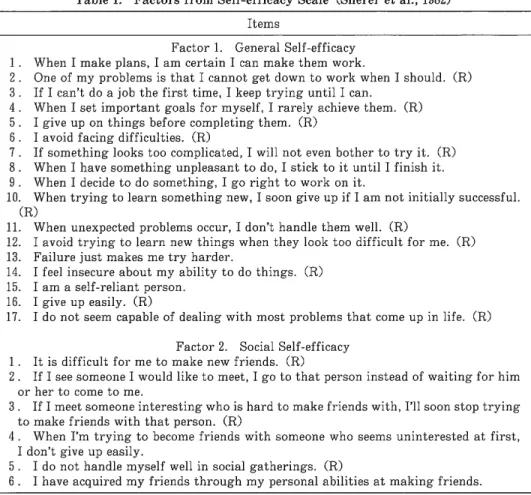
(15) Assessment of Self-Efficacy in an EFL Context (Burrows) of assessment. can lead to distorted. results.. To prevent. from occurring in the current study, a review of literature. these types of problems on self-efficacy assessment. is provided. In mainstream. psychological. and studied from two different. research,. self-efficacy. perspectives,. has been conceptualized. a trait like concept called general self-. efficacy (GSE) (e.g., Eden, 1988; Judge, Erez & Bono, 1998) and a state like concept called specific self-efficacy. ( SSE). 1989).. (1989) defined specific self-efficacy. Wood and Bandura. capabilities. (e.g., Gist & Mitchell,. to mobilize the motivation,. needed to meet given situation. demands.". 170) defined GSE as "individuals' variety. of different. cognitive. situations.". 1992; Wood & Bandura,. responses,. as "beliefs in one's and course of action. On the other hand, Judge, et al. (1998:. perception. of their ability to perform. across a. Chen, Gully, and Eden, noted, "GSE captures. dif-. ferences among individuals in their tendency to view themselves as capable of meeting task demands Research and domains a variety. in a broad array has shown that (Eden, 1988).. of performances. 1990; Sherer,. 1982).. of contexts. (2001: 63).". GSE has a positive. influence. This positive relationship. seems to "spill over". on SSE across. between GSE and SSE for. into specific situations. (Shelton,. Because of this, those with a high GSE are expected. more apt to succeed across a variety. tasks. to be. of domains.. To gain a reference of the types of questions asked on GSE research instruments, a review of Sherer et al. (1982) General Self-Confidence below.. The SGSES is comprised. (17 items). of two subscales:. and a Social Self-efficacy. subscale. As can be seen from the instrument, Although. it may be believed by some that. Scale (SGSES) is offered. a General Self-efficacy. (6 items).. the included. subscale. (See Table 1) items reflect. GSE factors.. these types of items will work well in. predicting human functioning in relation to foreign language motivation, the researcher in this study is not convinced that these questions best target in this SA study. in self-efficacy nature. the predictive elements. In addition, because one of the aims of this study is to see changes over an extended period of time, one would not expect the trait-like. of GSE to fluctuate. significantly,. therefore. SA study. — 169 ( 337 )—. rendering. it irrelevant. to the.
(16) 11 Table 1.. Factors. 2'4. from Self-efficacy. Scale. (Sherer. et al., 1982). Items. Factor 1. General Self-efficacy 1 . When I make plans, I am certain I can make them work. 2 . One of my problems is that I cannot get down to work when I should. (R) 3 . If I can't do a job the first time, I keep trying until I can. 4 . When I set important goals for myself, I rarely achieve them. (R) 5 . I give up on things before completing them. (R) 6 . I avoid facing difficulties. (R) 7 . If something looks too complicated, I will not even bother to try it. (R) 8 . When I have something unpleasant to do, I stick to it until I finish it. 9 . When I decide to do something, I go right to work on it. 10. When trying to learn something new, I soon give up if I am not initially successful. (R) 11. When unexpected problems occur, I don't handle them well. (R) 12. I avoid trying to learn new things when they look too difficult for me. (R) 13. Failure just makes me try harder. 14. I feel insecure about my ability to do things. (R) 15. I am a self-reliant person. 16. I give up easily. (R) 17. I do not seem capable of dealing with most problems that come up in life. (R) Factor 2. Social Self-efficacy It is difficult for me to make new friends. (R) If I see someone I would like to meet, I go to that person instead of waiting for him or her to come to me. 3 . If I meet someone interesting who is hard to make friends with, soon stop trying to make friends with that person. (R) 4 . When I'm trying to become friends with someone who seems uninterested at first, I don't give up easily. 5 . I do not handle myself well in social gatherings. (R) 6 . I have acquired my friends through my personal abilities at making friends. 1. 2.. Note.- (R) denotes items recoded in direction. The researcher. in this study agrees with Wood & Bandura. that SSE instruments. In agreement. resulting. with the basic tenets. in order. items will be created. in relation. Research question No.1 of this study deals with changes. from participation. items used in the instrument Therefore,. (1989) in claiming. will be better able to predict human functioning. to foreign language education. of self-efficacy. of high self-efficacy.. in a short-term. of Bandura's. study abroad program.. self-efficacy. theory. (1977), the. for this SA study will be task and domain. to get a better to measure. understanding. self-efficacy. of learner. in EFL reading,. specific.. EFL self-efficacy, writing,. speaking. and listening. Bandura. (2006) has offered a set of guidelines. scales for self-efficacy. measurement. —170. ( 338 )—. to be followed when creating.
(17) Assessment of Self-Efficacy in an EFL Context (Burrows) 1. Content validity: Firstly, In Bandura's. definition. items should reflect the construct. (1986) of self-efficacy, the term self-efficacy. with perceived capability.. Therefore,. pressions. than. as "can do" rather. other constructs. under investigation.. items should be termed using such ex-. "will do.". with self-efficacy.. worth, whereas self-efficacy. is concerned. He also warns against. Self-esteem,. is a judgment. confusing. for example, refers to one's. of capability.. refers to belief about outcome contingencies-whether. Also, locus of control. outcomes are determined. by one's actions or by forces outside of one's control. 2.. Items on the instrument the relevant writing,. should be based on a good conceptual. domain of functioning.. listening,. analysis. In this case, EFL is the domain.. and speaking. EFL tasks. will be specified. of. Reading,. in the items.. Items should be specific to both the EFL domain and the specific skill being targeted. 3.. The items should be ordered in a gradation. of challenge.. and the challenge of the items may be in regulating processes,. performance. conditions.. level, emotional. states,. Personal. influence. one's own motivation, thought or altering. environmental. It should be clear in the items which one of these domains is being. targeted. 4.. The items of the instrument It is recommended ability. should reflect varying. that participants. to execute the mentioned. do at all) Although. to 50 (moderately. this scale is recommended. 0-60 will offer a much better. The scale runs from 0 (Cannot. can do). to 100 (Highly. to increase the sensitivity. accurate. results. With these recommendations the following instrument.. can do ).. of the instrument, a 0-100 scale A scale of. the same survey. study.. Scale in mind, the researcher in this SA study has designed. It was adapted. by Carlson et al. (1990: 153-55).. certain. from this study.. graded scale for administering. times over the course of this longitudinal. EFL Self-Efficacy. of their belief in their. in this SA study that maintaining. will not be effective for offering. Completed. activities.. certain. it is believed by the researcher. multiple. rate the strength. levels of task demands.. from a similar questionnaire. There are four basic components -. 171 ( 339 )—. provided. to this EFL Self-.
(18) Z11. % 2 -1=. efficacy scale: reading, speaking, listening, and writing sections. element. in the beginning. of survey questions. of the survey. being asked.. to acclimate. (See survey sections. —172 ( 340 )—. There is a practice. the participants below). to the style.
(19) Assessment of Self-Efficacy in an EFL Context (Burrows). EFL. I . Practice. Self-efficacy. Scale. Rating. To familiarize. yourself. with the rating. form, please complete. this practice. item. first.. If you were asked to lift objects of different are you that you can lift each of the weights. weights. right now, how certain. described below ?. Rate your degree of confidence by recording a number from 0 to 60 using the scale given below:. 0. 10. 20. Cannot do. 30. 40. 50. moderately. at all. highly certain. can do. Physical. strength. can do. Confidence (0-60). Lift a 20 kg object Lift a 40 kg object Lift a 60 kg object Lift a 80 kg object Lift a 100 kg object Lift a 120 kg object. Bandura. (2005: Appendix. 1). — 173 ( 341 )—. 60.
(20) 11A II.. Reading. self-efficacy. A number rate. of situations. are described. in each of the blanks. the written. English. 0. in the column. below. about. how certain. reading. you are that. in English.. 30. 20. do. 40. moderately. at all. you can understand. 60. 50. highly. situation. Confidence (0-60). Read and understand. cell phone text message from a. native English speaker vocabulary 2.. Read and understand shop",. 4.. Read and understand. newspaper. to another. 5. Read popular. the type of store. "bakery",. "computer. headlines an email from one native English. about weekend plans. novels (for example,. Harry. Potter). using a dictionary. 6. Read and understand. magazine. to those found in a publication 7.. used simple. "restaurant"). Understand. without. on store fronts (for example,. 3.. speaker. who deliberately. and grammar. or services provided. Read and understand. technical. articles. at a level similar. such as Time or Newsweek material. academic field with very infrequent. certain. can do. can do. Reading. 1.. Please. in each situation.. 10. cannot. -14. in a particular. use of the dictionary. — 174 ( 342 )—.
(21) Assessment III. Speaking. in each. and make. of situations. are described. of the blanks. in the column. yourself. 0. understood. 10. cannot. in an EFL Context. (Burrows). self-efficacy. A number rate. of Self-Efficacy. below about. speaking. in English.. how. you are. that. certain. you. 30. do. 40. moderately. at all. 60. 50. highly. can do. Speaking. Confidence. situation. 1. Say the day of the week 2.. Order a simple meal in a restaurant. 3.. Introduce. 4.. Describe your present using appropriate. 5.. job or situation. vocabulary. vocabulary. State and support controversial toward. 7.. expressions as a student,. and grammar. Tell what you plan to be doing five years from now, using appropriate. 6.. at a party using appropriate. and leave-taking. North. and grammar. an opinion you might have on a. issue (environmental. pollution,. stance. Korea). Describe your country's. political. certain. can do. (0-60). greetings. can speak. in each situation.. 20. yourself. Please. system in detail. —175 ( 343 )—.
(22) 1Vg IV. Listening. self-efficacy. A number rate. in each. of situations. are described. of the blanks. in the column. to and understand. 0. spoken. 10. cannot. M2. English. below about. listening. in English.. how. you are. that. certain. 30. 40. 60. 50. moderately. at all. highly. can do. Listening. Understand. Confidence. situation. very simple statements. in English (for example, "Wh ere do you live ?'") 2.. In a face-to-face who is speaking plans. 3.. slowly. or questions. "What is your name ?",. conversation,. understand. and carefully. someone. about. his weekend. in English. On a telephone, slowly. understand. and carefully. about. someone. who is speaking. a homework. assignment. in. English. 4.. In a face-to-face whether future. 5.. conversation. the speaker. to past,. understand present,. or. events. In a face-to-face English about. conversation,. speaker weekend. 6.. Understand. 7.. From song. in English,. is referring. understand. who is speaking. a native. at a natural. speed. plans. movies. the radio,. in English. understand. you have not heard. without. the words. certain. can do. (0-60) 1.. can listen. in each situation.. 20. do. you. Please. subtitles. of a popular. before. — 176 ( 344 )—.
(23) Assessment V.. Writing. in each. and make. of situations. are. of the blanks. your. 0. written. described. in the column. work. 10. cannot. in an EFL Context. (Burrows). self-efficacy. A number rate. of Self-Efficacy. about. you. in English.. are that. 40. can. Writing. 60 highly. situation. name, address, 2.. Write. application. Confidence. in English. age, place of birth,. (type). (for example,. occupation,. etc.). a text message to a friend in English. him to meet you for lunch, using appropriate and correct 3.. Write. a letter. yourself,. using. and. 4.. Write. a letter. and spelling. your. new. appropriate. home-stay. family. vocabulary. to a hotel. a problem. vocabulary. and. or airline. you had with. and correct. to introduce correct. (the economic situation. appropriate Write. vocabulary. a business. letter. company. grammar. of a product. the reason,. using. appropriate. appropriate. your opinion about a controversial in Japan,. you. whaling,. grammar. to a company. date. using. and spelling. and correct. a shipment. to complain. the company,. grammar. Write an essay describing issue. 6.. to. to ask. vocabulary. spelling. about. 5.. grammar. etc.), using. and spelling. asking. for a change. have ordered. vocabulary. and correct. 7. Write a paper to be published in a journal grammar. using appropriate. grammar. for a particular. vocabulary. and spelling — 177 ( 345 )—. of. and explaining. and spelling. field of academics,. certain. can do. do. (0-60). 1. Fill in a passport. can write. 50. moderately. at all. you. Please. in each situation.. 30. do. writing. how certain. understood. 20. below. and correct.
(24) M-11. M 2 -14. Conclusion Since the publication. of the social cognitivist,. Albert Bandura's. (1977) seminal. article entitled "Self-Efficacy: Toward a Unifying Theory of Behavioral Change," where Bandura introduced his theory of self-efficacy, extensive research has been conducted and strongly. supported. man functioning. Bandura's. (i.e., educational. international. affairs,. 1996, 2004).. Although. foreign. language. theory. psychology,. psychopathology, research. relevance to my ensuing dissertation literature,. (SLA).. overview of the self-efficacy research.. I have also offered guidelines. for EFL self-efficacy.. Acquisition. Through. in constructing. in hu-. business,. change). has been relatively. shows a new interest. to Second Language. nature. health, medicine, athletics,. in self-efficacy. have aimed to offer a comprehensive. predictive. and social and political. field, recent literature. its possible connections. of self-efficacy's. (Pajares,. limited in the. in the theory. and. In this paper, I construct. examination an assessment. and its. of relevant instrument. Finally, I have offered an example of a completed instrument,. including a practice section and four main subject sections, reading, listening, speaking and listening.. REFERENCES. (1) (2) (3) 4. (5). (6) 7. (8). Bandura, A. (1977). Self-efficacy: Toward a unified theory of behavioral change. Psychological Review, 84(2), 191-215. Bandura, A. (1986). Social foundations of thought and action: A social cognitive theory. Englewood Cliffs, NJ: Prentice Hall. Bandura, A. (1997). Self-efficacy: The exercise of control. New York: W. H. Freeman. Bandura, A., & Jourden, F. J. (1991). Self-regulatory mechanisms governing the impact of social comparison on complex decision making. Journal of Personality and Social Psychology, 60, 941-51. Bandura, A. (2006). Guide for constructing self-efficacy scales. In F. Pajares & T. Urdan (Eds. ). Self-efficacy beliefs of adolescents, ( Vol.5., pp.307-337). Greenwich, CT: Information Age Publishing. Carlson, Jerry S., B. B. Burn, J. Useem, and D. Yachimowicz. 1990. StudyAbroad: The Experience of American Undergraduates. Westport CN: Greenwood Press. Carlson, J., & Widaman, K. (1988). The effects of study abroad during college on attitudes toward other cultures. International Journal of Intercultural Relations, 12(1), 1-17. Chen, G., Gully, S. M., & Eden, D. (2001). Validation of a New General Self-Efficacy Scale. Organizational Research Methods, 4(1), 62-68. — 178 ( 346 )—.
(25) Assessment. of Self-Efficacy. in an EFL Context. ( 9). (Burrows). Chieffo, L. P., & Zisper, R. A. (2001). Integrating study abroad into the foreign language curriculum. ADFL Bulletin, 32(3), 79-85. (10) Collins, J. L. (1982). Self-efficacy and ability in achievement behavior. Paper presented at the annual meeting of he American Educational Research Association, NY. (11) Crookes, G., & Schmidt, R. W. (1991). Motivation: Reopening the research agenda. Language Learning, 41, 469-512. (12) Day, J. T. (1987). Student motivation, academic validity, and the summer language program abroad: An editorial. Modern Language Journal, 71(3), 261266. (13) Dornyei, Z. (1994). Motivation and motivating in the foreign language classroom. The Modern Language Journal, 78, 273-284. (14) Eden, D. (1988). Pygmalion, goal setting, and expectancy: Compatible ways to boost productivity. Academy of Management Review, 13, 639-652. (15) Freed, B. (1995). What makes us think that students who study abroad become fluent ? In B. Freed (Ed.), Second language acquisition in a study abroad context (pp.123-148). Philadelphia: John Benjamins Publishing Company. (16) Gist, M. E. and T. R. Mitchell. (1992). Self-Efficacy: A Theoretical Analysis of Its Determinants and Malleability. Academy of Management Review, 17, 183211. (17) Graham, S. (2004). Giving up on modern foreign languages ? Students' perceptions of learning French. Modem Language journal, 88(2), 171-191. (18) Graham, S. (2006b) A study of students' metacognitive beliefs about foreign language study and their impact on learning, Foreign Language Annals, 39(2), 296-309. (19) Harter, S. (1978). Effectance motivation considered: Toward a developmental model. Annual Human Resources Development Report, 21, 36-64. (20) Hsieh, P. H., & Schallert, D. L. (2008). Implications from self-efficacy and attribution theories for an understanding of undergraduates' motivation in a foreign language course. Contemporary Educational Psychology, 33, 513-532. (21) Judge, T. A., Erez, A., & Bono, J. E. (1998). The Power of Being Positive: The Relationship Between Positive Self-Concept and Job Performance. Human Performance, 11, 167-187. (22) Kraft, R. J., Ballantine, J., & Garvey, D. (1994). Study abroad or international travel: The case of semester at sea. International Review, 4, 23-61. (23) Krashen, S. (1985). The input hypothesis: Issues and implications. Torrence, CA: Laredo Publishing Company, Inc. (24) Laubscher, M. R. (1994). Encounters with difference: Student perceptions of the role of out-of-class experiences in education abroad. Westport, CT: Greenwood Press. [25) Oxford, R. L., & Shearin, J. (1994). Language learning motivation: Expanding the theoretical framework. Modern Language Journal, 78, 12-28. [26) Pajares, F. (1996). Self-efficacy beliefs in academic settings. Review of Educational Research, 66, 543-578. (27) Pajares, F. (1996). Self-efficacy beliefs in academic settings. Review of Educational Research, 66, 543-578. (28) Pintrich, P. R., & Schunk, D. H. (2002). Motivation in education: Theory, research, and applications (2nd ed.). Upper Saddle River, NJ: Merrill/Prentice Hall. -179. ( 347 )-.
(26) 2. (29). Sherer, M., Maddux, J. E., Mercandante, B., Prentice-Dunn, S., Jacobs, B., & Rogers, R. W. (1982). The Self-Efficacy Scale: Construction and validation. Psychological Reports, 51, 663-671. (30) Shelton, S. H. (1990). Developing the construct of general self-efficacy. Psychological Reports, 66, 987-994. (31) Tremblay, P. F., & Gardner, R. C. (1995). Expanding the motivation construct in language learning. Moder Language Journal, 79(4), 505-520. (32) Warden, C. A. & Hsiu, J. L. (2000). Existence of integrative motivation in an Asian EFL setting. Foreign Language Annals, 33, 535-547. (33) Wilkinson, S. (2000). Emerging questions about studying abroad. ADFL Bulletin, 32(1), 36-41. (34) Wood, R. E., Bandura, A. (1989). Impact of conceptions of ability on selfregulatory mechanisms and complex decision making. Journal of Personality and Social Psychology, 56, 407-415.. —180 ( 348 )—.
(27)
図

関連したドキュメント
The general context for a symmetry- based analysis of pattern formation in equivariant dynamical systems is sym- metric (or equivariant) bifurcation theory.. This is surveyed
In this section we study the Legendre equation (1.1) on the whole real line R and note that, in addition to its singular points at −∞ and +∞, it also has singularities at the
Abstract The representation theory (idempotents, quivers, Cartan invariants, and Loewy series) of the higher-order unital peak algebras is investigated.. On the way, we obtain
Then it follows immediately from a suitable version of “Hensel’s Lemma” [cf., e.g., the argument of [4], Lemma 2.1] that S may be obtained, as the notation suggests, as the m A
Definition An embeddable tiled surface is a tiled surface which is actually achieved as the graph of singular leaves of some embedded orientable surface with closed braid
Applications of msets in Logic Programming languages is found to over- come “computational inefficiency” inherent in otherwise situation, especially in solving a sweep of
Shi, “The essential norm of a composition operator on the Bloch space in polydiscs,” Chinese Journal of Contemporary Mathematics, vol. Chen, “Weighted composition operators from Fp,
[2])) and will not be repeated here. As had been mentioned there, the only feasible way in which the problem of a system of charged particles and, in particular, of ionic solutions
