Experimental
Study on Phase Equilibria in the System
CaSiO3-MnSiO3-(Ca,Mn)Cl2-H2O
by Means of Ion Exchange*
Yasushi
KAKUDA**, Etsuo
UCHIDA** and Naoya
IMAI**
Abstract: Stability relations of minerals in the system CaSiO3-MnSiO3-H2O have been determined experimentally by means of ion exchange in the temperature range from 400 to 800•Ž under lkbar. Aqueous chloride solution was used as a transport and exchange medium for cations Ca2+ and Mn2+. Stable minerals under the experimental condi-tions are wollastonite, bustamite, rhodonite, pyroxmangite, xonotlite and johannsenite.
Rhodonite is a high temperature polymorph of pyroxmangite and the transition temperature depends on the chemical composition. Pure pyroxmangite inverts to rhodonite at 725•Ž. Three phases, rhodonite, pyroxmangite and bustamite can coexist with each other at 525•Ž. Bustamite shows a wide stability field concerning temperature and composition. Johannsenite becomes stable below 450•Ž. The transition temperature between wollastonite and xonotlite was obtained to be 475•Ž for the end member composition.
The experimental results revealed that manganese ion is preferentially partitioned into the minerals, whereas calcium ion into the aqueous chloride solution. This tendency is enhanced with decreasing temperature.
1. Introduction
The stability relations of minerals in the
system CaSi03-MnSiO3-H2O provides
impor-tant information on the formation condition
of pyroxenes and pyroxenoids occurring
main-ly in skarn-type deposits and metamorphosed
manganese deposits. Experimental studies on
the stability relations in this system have been
performed by MOMOI
(1968), ABRECHT
(1980)
and ABRECHT
and PETERS (1975 and 1980)
without aqueous chloride solution.
Ion exchange experiments using aqueous
chloride solution have been carried out for
many rock-forming
minerals; e.g., olivine
(SCHULIEN
et al., 1970), pyroxene (UCHIDA,
1982), alkali feldspar (WYART and SABATIER,
1956; ORVILLE, 1963; IIYAMA, 1966) biotite
(SCHULIEN, 1980), and wolframite-scheelite
(UCHIDA et al., 1989). The ion exchange
method using aqueous chloride solution is
suitable for transporting cations, shortening
the experimental duration and promoting the
growth of large and well-crystallized minerals.
Moreover, it gives us information
on the
chemical composition of aqueous species
coex-isting with minerals and on thermodynamic
properties of aqueous chloride solution and
mineral solid solution. This study was carried
out to determine experimentally the stability
relations of minerals in the system
CaSiO3-MnSiO3-H2O using the cation
exchange
method and also to clarify thermodynamic
properties of bustamite solid solution.
2. Experimental Procedures
A stoichiometric mixture of reagent-grade
CaO and SiO2 oxides was used as a starting
material for CaSiO3, and a stoichiometric
mix-ture of reagent-grade Mn metal powder and
reagent-grade SiO2 oxide for MnSiO3. The
star-ting material in different proportions
of
Received on July 15, 1991, accepted on October, 1,
1991
* A part of this study was presented at the Joint Meeting
of the Society of Mining Geologists of Japan, the
Mineralogical Society of Japan, and the Japanese
Association
of
Mineralogists,
Petrologists
and
Economic Geologists held in Yamaguchi (October 3,
1990).
** Department
of
Mineral
Resources
Engineering
,
School of Science and Engineering, Waseda
Universi-ty, Ohkubo 3-4-1, Shinjuku, Tokyo 169, Japan.
Keywords: Phase equilibria,
CaSiO3-MnSiO3 system,
Aqueous chloride solution, Wollastonite, Bustamite,
Rhodonite, Pyroxmangite, Xonotlite, Johannsenite.
Y. KAKUDA, E. UCHIDA and N. IMAI MINING GEOLOGY:
CaSiO3 and MnSiO3 was encapsulated in a
gold capsule (2.7 mm inner diameter, 3.0 mm outer diameter, and 35 mm long) with 1 mo•¬ aqueous CaCl2 and/or MnCl2 solution . All
ex-periments were performed using standard cold-seal type hydrothermal apparatus. The
pressure vessel containing gold capsule was kept at a constant temperature from 400 to 800•Ž in electric furnaces. The experimental
pressure was fixed at 1 kbar. The temperature was monitored by chromel-alumel thermocou-ple, and the pressure was measured by a Heise gauge.
At the end of the run, the pressure vessel was quenched with water. Then each capsule was carefully checked for any possible leakage. The solid products, separated from the aqueous chloride solution with a mem-brane filter, were identified with an optical microscope, X-ray diffractometer and scann-ing electron microscope. Their chemical
com-positions were determined on the crystal sur-face by energy dispersive type microanalyzer
(Link QX200JI). The mole ratio of the ca-tions, Ca2+and Mn2+, in the aqueous chloride solution was determined by atomic absorption spectrophotometer (Shimadzu AA-610S).
3. Experimental Results and Considerations
3.1 Synthesized minerals
In the present experiments, the following minerals were synthesized; wollastonite
, xonotlite, bustamite, johannsenite
, pyrox-mangite and rhodonite. The SEM images of these minerals are shown in Fig. 1.
Wollastonite and bustamite show a fibrous or long prismatic form, and reach up to 100
ƒÊm in length (Figs. 1-A and 1-B) . Wollaston-ite is white in color, and bustamite is pinkish .
Johannsenite shows radiate aggregates of long
prismatic crystals reaching up to 100,ƒÊm in length (Fig. 1-C). Xonotlite occurs as
ag-gregates of short fibrous crystals, and is white in color (Fig. 1-D). Pyroxmangite is pinkish in color, and shows a prismatic form . Pyrox-mangite frequently shows parallel intergrowth
(Fig. l-E). Rhodonite is pinkish in color and shows a short prismatic form (Fig. 1-F) with less than 20,urn in grain size.
3.2 Stability relation
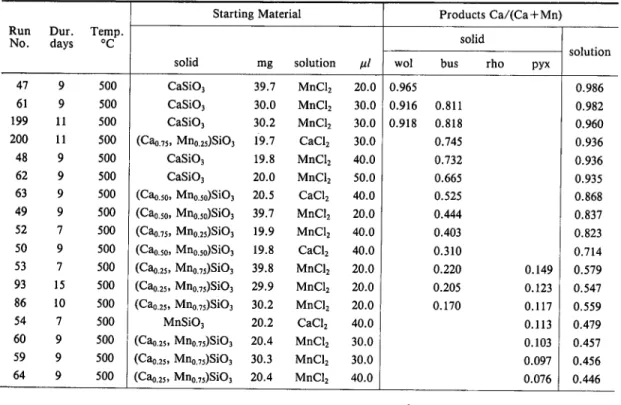
The experimental data are listed in Tables 1 to 5 and are plotted in the
temperature-com-position diagram (Fig. 2).
Wollastonite becomes stable above 475•Ž in-stead of xonotlite. Dissolution of a MnSiO3 component in wollastonite increases with the increase of temperature and amounts to 12 mol.% at 800•Ž. Bustamite is stable in the wide compositional and temperature range. The maximum amount of a CaSiO3 compo-nent dissolved in bustamite gradually in-creases with the decrease of temperature, and
amounts to 85 mol.% at 500•Ž. The miscibili-ty gap between wollastonite and bustamite shifts towards the CaSiO3 side with decreasing temperature. Three phases, wollastonite, xonotlite and bustamite can coexist with each other at 450•Ž. The lower limit of the CaSiO3 content in bustamite is nearly constant (20 mol.%). The miscibility gaps between bustamite and rhodonite/pyroxmangite is in-sensitive to temperature.
Rhodonite is a high temperature polymorph of pyroxmangite. The transition temperature decreases with the increase of the CaSiO3 con-tent. Pure pyroxmangite inverts to rhodonite at 725•Ž. Rhodonite, pyroxmangite and bustamite can coexist with each other at 525•Ž. The upper limit of the CaSiO3 content in rhodonite and pyroxmangite is almost in-dependent of temperature (15 mol.%). Johannsenite becomes stable below 450•Ž in-stead of bustamite. The CaSiO3 content in
johannsenite ranges from 45 to 50 mol.% at 400•Ž. Johannsenite can coexist with both bustamite and xonotlite at 410•Ž.
3.3 Ion exchange equilibria
The chemical compositions of the coexisting aqueous chloride solution and solid phases are
plotted in the Roozeboom diagram (Fig. 3). The Ca/(Ca+Mn) mole ratio in the aqueous chloride solution is plotted against that in the solid phase.
The experimental results revealed that manganese ion is preferentially partitioned in-to the minerals, whereas calcium ion into the aqueous chloride solution. The ion exchange isotherm gradually shifts towards the top
left-Experimental study on phase equilibria in the system 341
Fig. 1 SEM images of synthesized minerals. A: fibrous or long prismatic wollastonite (run no. 47 at 500•Ž), B: fibrous bustamite (run no. 130 at 700•Ž), C: radiate aggregate of long prismatic johannsenite coexisting with fibrous xonotlite (run no. 10 at 400•Ž), D: fibrous xonotlite (run no. 7 at 400•Ž), E: pyroxmangite showing parallel intergrowth (run no. 72 at 700•Ž), and F: short prismatic rhodonite (run no. 75 at 700•Ž).
342 Y. KAKUDA, E. UCHIDA and N. IMAI MINING GEOLOGY:
Table 1 Experimental data for the ion exchange equilibria in the system CaSiO3-MnSiO3-(Ca, Mn)Cl2-H2O in the temperature range from 700 to 800•Ž under 1 kbar.
41(6), 1991 Experimental study on phase equilibria in the system
Table 2 Experimental data for the ion exchange equilibria in the system CaSiO3-MnSiO3-(Ca, Mn)Cl2-H2O in the temperature range from 525 to 650•Ž under 1 kbar.
Y. KAKUDA, E. UCHIDA and N. IMAI MINING GEOLOGY: Table 3 Experimental data for the ion exchange equilibria in the system CaSiO3-MnSiO3-(Ca, Mn)Cl2-H2O at
500•Ž under 1 kbar.
Table 4 Experimental data for the ion exchange equilibria in the system CaSiO3-MnSiO3-(Ca , Mn)Cl2-H2O in the temperature range from 450 to 475•Ž under 1 kbar.
hand corner as the temperature decreases from 800 to 400•Ž. Xonotlite and wollastonite are stable in the aqueous chloride solution with ex-tremely high Ca/(Ca+Mn) mole ratios .
The
ion
exchange
isotherms
between
bustamite
and aqueous
chloride
solution
are
thermodynamically
analyzed
using
a
follow-ing
asymmetric
regular
solution
model
for
Table 5 Experimantal data for the ion exchange equilibria in the system CaSiO3-MnSiO3-(Ca, Mn)Cl2-H20 at 400•Ž under 1 kbar.
Fig. 2 Temperature-composition
diagram in the
system CaSi03-MnSiO3-(Ca, Mn)Cl2-H20
at 1
kbar. Two phase regions are, hatched.
Abbrevia-tions:
rho,
rhodonite;
bus, bustamite;
wol,
wollastonite;
pyx, pyroxmangite;
joh,
johann-senite; xo, xonotlite.
bustamite solid solution (bus s.s.);
Gex(bus S.S.)=XCa¥(1-XCa)-{WCaMn¥XCa
+ WMnCa¥(1-XCa) }
where Gex is excess Gibbs energy of mixing,
Wca and WMn are interaction parameters, and
Xi is a mole fraction of cation i in octahedral
site of bustamite solid solution. Aqueous
chloride solution is assumed to be an ideal
solution.
The
ion
exchange
reaction
between
bustamite solid solution and aqueous chloride
solution can be written as follows;
CaSi03(bus s.s.)+MnCl2aq
=MnSi03(bus s .s)+CaCl2aq.
Under the experimental conditions, MnCl2aq
and CaCl2aq are dominant aqueous species
(BOCTOR,
1985; Pope and FRANTZ,
1979).
Based on the experimental results, the
in-teraction parameters for bustamite solid
solu-tion and standard Gibbs energy of the reacsolu-tion
were calculated using least-squares fits. The
results of calculation are listed in Table 6. The
ion exchange isotherms between bustamite
346 Y. KAKUDA, E. UCHIDA and N. IMAI MINING GEOLOGY:
Fig. 3 Ion exchange isotherms in the system CaSiO3-MnSiO3-(Ca, Mn)Cl2-H20 under 1 kbar. Abbreviations are
the same as those in Fig. 2.
41(6), 1991 Experimental study on phase equilibria in the system
Table 6 Standard Gibbs energy of the ion exchange
reaction between bustamite solid solution and (Ca,
Mn)Cl2 aqueous solution under 1 kbar and
interac-tion parameters for bustamite solid soluinterac-tion
* Gex(bus)=X
Ca¥XMn(XCa¥WCaMn+XMn¥WMnCa) ** ‡™G•¬r=(ƒÊ•¬CaCl2aq-ƒÊ•¬MnCl2aq)-(ƒÊ•¬busCaSiO3-ƒÊ•¬busMnSiO3)
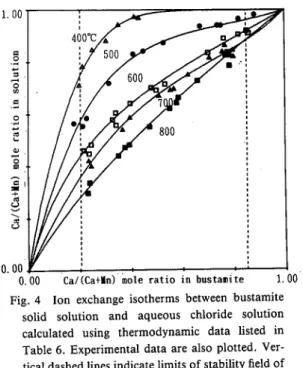
solid solution and aqueous chloride solution calculated using the above thermodynamic data are shown and compared to each other in Fig. 4. The interaction parameters for bustamite solid solution have positive values above 600•Ž. However, they have a negative values at 400•Ž. This may indicate that order-ing of the cations in the octahedral site in-creases with decreasing temperature, and that a mineral with an intermediate composition in-stead of bustamite becomes stable at lower temperature. In fact, johannsenite with the ideal chemical formula CaMnSi2O6 instead of bustamite becomes stable below 450•Ž.
4. Discussion
A systematic experimental study on phase equilibria in the system CaSiO3-MnSiO3 has been performed by ABRECHT and PETERS (1975). However, our present result and natural occurrence of the minerals indicate that their experiments seem not to have attain-ed equilibrium, especially in the CaSiO3-rich side. ABRECHT (1980) has constructed the
phase diagram in the system CaMnSi2O6-CaSiO3. The topology of their phase diagram is similar to the present one, but the position of the miscibility gap between bustamite and wollastonite is different. As compared to his experimental result, the present phase diagram shows a narrower miscibility gap and a slight temperature dependence.
ABRECHT and PETERS (1980) have con-structed the phase diagram in the system
Fig. 4 Ion exchange isotherms between bustamite solid solution and aqueous chloride solution calculated using thermodynamic data listed in Table 6. Experimental data are also plotted. tical dashed lines indicate limits of stability field of
bustamite solid solution.
MnSiO3-CaMnSi2O6 based on their experi-mental data and on natural mineral assem-blages. The topology of their phase diagram is the same as that of the present one in the CaMnSi2O6 side, but very different in the MnSiO3 side. The miscibility gap between rho-donite and bustamite varies with temperature in their phase diagram, but it is almost
in-sensitive to temperature in the present one. The transformation temperature of pyrox-mangite to rhodonite has been obtained to be about 700•Ž by PETERS (1971) and MOMOI
(1974), whereas about 400•Ž by MARESCH and MOTTANA (1976). The present experimental result agrees well with the former result. Some reversed runs were performed. Pyroxmangite was easily inverted to rhodonite at 750•Ž, but rhodonite not to pyroxmangite at 650•Ž. Therefore, it may be possible that the
transfor-mation temperature is lower than 725•Ž at 1 kbar.
In the experiment of MOMOI (1968), pyrox-mangite breaks down to tephroite + quartz below 550•Ž. However, in this experiment,
pyroxmangite was stable in the temperature range from 400 to 700•Ž instead of tephro-ite + quartz.
Y. KAKUDA, E. UCHIDA and N. IMAI MINING GEOLOGY:
The transformation temperature of xono-tlite to wollastonite has been determined expe-rimentally to be about 420•Ž by BUCKNER et al. (1960), and to be about 230•Ž by GUSTAFSON (1974). The present experimental result in-dicates 475•Ž as the transformation temper-ature. Thus, our data prefer the former experi-mental result.
The upper temperature limit of the stability field of johannsenite is obtained to be 450•Ž by ABRECHT (1980). This is concordant with the present experimental result.
As mentioned above, the present experimen-tal result is necessarily concordant with the
previous experimental results. However, it is not easy to judge which experimental result is
preferable. One method to select preferable ex-perimental results is to compare the experimen-tal results with natural occurrence of minerals . However, natural minerals corresponding to the present system generally contain a FeSiO3 component which has a large effect on the stability of the minerals, and information on the formation temperature of the minerals is also deficient. Therefore, experiments in-cluding a FeSiO3 component and the ac-cumulation of detail information on natural occurrence of minerals are expected.
Acknowledgments: We wish to acknowledge the financial support by a Grant-in-Aid for Scientific Research from the Ministry of Education, Science and Culture of Japan
(Pro-ject No. 01740477, E. UCHIDA).
Reference
ABRECHT, J. (1980): Stability relations in the system CaSiO3-CaMnSi2O6-CaFeSi2O6 . Contrib. Mineral. Petrol., 74, 253•`260.
ABRECHT, J. and PETERS, Tj. (1975): Hydrothermal syn-thesis of pyroxenoids in the system MnSiO3-CaSiO3 at P•¬=2 kb. Contrib. Mineral. Petrol., 50, 241•`246 . ABRECHT, J. and PETERS, Tj . (1980): The miscibility gap
between rhodonite and bustamite along the join MnSiO3-Ca0 .60Mn0.40SiO3, Contrib. Mineral. Petrol., 74, 261•`269.
BUCKNER, D. A., ROY, D. M. and ROY, R . (1960): Studies in the system CaO-Al2O3-SiO2-H2O, II: the system
CaSiO3-H2O. Am. Jour. Sci., 258, 132•`147. BOCTOR, N. Z. (1985): Rhodonite solubility and
thermo-dynamic properties of aqueous MgCl2 in the system MnO-SiO2-HCl-H2O. Geochim. Cosmochim. Acta, 49, 565•`575.
GUSTAFSON, W. I.(1974): The stability of andradite, h edenbergite, and related minerals in the system Ca-Fe-Si-O-H. Jour. Petrol., 15, 455•`496.
IIYAMA, J. T. (1966): Influence des anions sur les equilibres d'change d'ions Na-K dans les feldspaths alcalins a 600•Ž sous une pression de 1000 bars. Bull. Soc. Fran.
Crist., 89, 442•`454.
M ARESCH, W. V. and MOTTANA, A. (1976): The pyrox-mangite-rhodonite transformation for the MnSiO3 composition. Contrib. Mineral. Petrol., 55, 69•`79. MOMOI, H. (1968): Some manganese pyroxenoids. Jour.
Miner. Soc. Japan, 8, Spec. Issue, 2, 1•`6 (in Japanese).
MOMOI, H. (1974): Hydrothermal crystallization of MnSiO3 polymorphs. Miner. Jour., 7, 359•`373. PETERS, Tj. (1971): Pyroxmangite: stability in H2O-CO2
mixtures at a total pressure of 2000 bars. Contrib. Mineral. Petrol., 32, 267-273.
POPP, R. K. and FRANTZ, J. D. (1979): Mineral-solution equilibria. III. An experimental study of complexing and thermodynamic properties of aqueous CaCl2 in the system CaO-SiO2-H2O-HCI. Geochim. Cosmo-chim. Acta, 43, 1777•`1790.
ORVILLE, P. M. (1963): Alkali ion exchange between vapor and feldspar phases. Am. Jour. Sci., 261, 201•`237. SCHULIEN, S. (1980): Mg-Fe partitioning between biotite
and a supercritical chloride solution. Contrib. Mineral. Petrol., 74, 85•`93.
SCHULIEN, S., FRIEDRISCHEN, H. and HELLNER, E. (1979): Das Mischkristallverhalten des Olivins zwischen 450•‹ and 650•Ž bei 1 kb Druck. Neues Jahrb. Miner. Monatsh., 4, 141•`147.
UCHIDA, E. (1982): Skarnization in the Kamaishi mine and experimental studies on ion exchange equilibria . Un-published Ph.D. thesis, University of Tokyo. UCHIDA, E., GIMA, M. and IMAI, N. (1989): Experimental
studies on ion exchange equilibria between minerals and aqueous chloride solution in the system CaWO4 -FeWO4-MnWO4 under supercritical condition
. Geochem. Jour., 23, 339•`347.
WYART, T. and SABATIER, G. (1956): Transformations muturelles des feldspaths alkalins. Reproduction du microcline et de l'albite. Bull. Soc. Fran. Miner. Crist., 79, 444•`448.